Naïlé Titah
Matt Gray sells one product above all others: a calm, systemized founder life that runs without him. His headline calls Founder OS "Proven systems to grow a profitable audience with organic content," and his posts are the proof of concept. At MagicPost, we analyzed 758 of his LinkedIn posts: what he writes, when, for whom, what it sells, and the one structural habit that defines his entire feed.
This is who Matt Gray is, according to the best possible source: his own posts, measured.

His story, in his own posts
Gray does not hide his backstory. He builds his entire brand on it, and the same chapters resurface again and again.
Rock bottom. "I used to be depressed, broke, and anxious," he writes in his single biggest post. Elsewhere he is more specific: "When I was 25, I wanted to kill myself. Burnout and depression had me in a death grip as I built my first company," and "At 22, I was burned out, depressed, and $15K in debt."
The government raid. The most dramatic chapter is one he tells like a thriller: "The government wanted to throw me in jail. Fine me a million dollars. I was 21 years old running a coding bootcamp," ending with "the only government exemption for a business like mine in Canadian history."
Ikigai and Founder OS. The turnaround pivots on one Japanese concept. "I started journaling about my Ikigai, your 'reason for being', and immediately began sharing what I was learning," he writes. "The intersection of these factors became Founder OS." He frames his calling as "Helping 100 million founders accomplish their dreams."
The freedom test. His current life is the offer made literal: "Right now, the two companies I own make me $13.8 million a year, all while I travel the world," and the systems exist so he can "disappear for 4 weeks without your business falling apart."
One thing our data surfaces that a normal bio never would: his life story is not a post, it is a re-shippable template. He publishes near-identical "lessons for younger Matt" posts on a near-annual cadence, and the wording barely moves. At 35 he wrote "11 lessons for 21-year-old Matt," opening "I battled to get sober, had my company raided by the government, traveled the world." At 36 he wrote "11 lessons for 18-year-old Matt," opening with almost the same sentence. Inside both, the exact same lessons recur word for word: "Be Boring," "Find Your Peak Energy State," "Learn Storytelling Early," and "get 1% better every day and be 37x better by the end of the year." The origin story is an asset he re-runs, not a one-off he retires.
What he actually talks about

Entrepreneurship leads his feed (about 301 of the posts we measured), with Leadership, Coaching and Content Marketing filling most of the rest. But the ranking hides the more interesting story:
Coaching is his best-performing theme (about 1,212 median likes versus his 879 overall), and Personal Development and Leadership also out-pull his average. His pure business-tactics posts (Content Marketing, Marketing) sit below his median. Gray's audience rewards him most when he plays mentor, not marketer.
Sorted by register rather than topic, the single largest bucket by far is selling through value: roughly half the posts we categorized are a useful framework or list that ends in an invitation to a workshop, a newsletter, or a DM keyword. The value is real, and the value is the funnel.
Who he writes for
His reader is explicit and consistent: the burned-out founder who built a successful business and lost themselves inside it. He writes to the person whose "business owns you", who works "15-hour days. Constant anxiety. Zero joy. A mind that wouldn't stop racing at 2 AM. Sound familiar?" (his words). The promise is always the same shape: more output, less work, systems that run without you. The offers match: Founder OS, a free live workshop, a 137,000-plus subscriber newsletter.
His best posts of 2026
His biggest posts of 2026 so far, reproduced from our data (click through to the originals):

4,029 likes. "33 habits that (quietly) changed my life forever." A numbered mega-list where every item is a two-word imperative plus one line of payoff. Maximum saveable value, minimum reading friction, then a workshop link at the bottom.

3,574 likes. "Life hacks I know at 36, I wish I knew at 19." The age-regret hook again, this time closing on a DM keyword ("DM me '15'"). It is the same engine as his story posts, pointed at a lead magnet.

2,831 likes. "I've hired 90+ high performers in the last 3 years. Here are 8 rare traits I see in every high performer." Authority hook plus a numbered list, ending in a free workshop invite. Three posts, one repeatable structure.
Is he still growing?

Here the data is honest in a way the follower count is not. His median post went from about 1,163 likes in 2024 to 803 in 2025 to 688 so far in 2026. That is a real compression in per-post engagement, even as his audience sits near 912,000 followers. It is the most common shape on LinkedIn right now: more followers, fewer likes per post, as feeds get more crowded and reach tightens platform-wide. One honest note: we measure engagement, not follower growth over time, so this is the trajectory of how hard each post lands, not of his audience size, which has clearly kept climbing.
Where do these charts come from? Everything on this page runs on MagicPost's LinkedIn analytics, and it works on your profile too: your best posts, your audience, your benchmark, even a side-by-side with creators like Matt Gray.
How he writes (the long-form list machine)
Here is Gray measured against the average creator, and the headline is the opposite of what you would guess:

Metric (per post) | Matt Gray | Average creator* |
Words | 402 | 185 |
Words in the hook | 11 | 11 |
Words per paragraph | 9 | 13 |
Words per sentence | 8 | 10 |
Emojis | 1 | 2 |
Hashtags | 0 | 0 |
Exclamation marks | 0 | 1 |
Hooks built on numbers | 40% | 22% |
*Median across the 3,344 creators we analyzed with 20+ posts each.
The surprise is the first row. Gray is not a short writer, he is the longest of his peer group, at 402 words against a 185-word average, more than double. But read the next two rows and the trick appears: his paragraphs run 9 words, his sentences run 8. He writes very long posts out of very short lines. That is the numbered-list format made structural: a long scrollable column of one-line items, each easy to skim and easy to save. Two in five of his posts open on a number ("33 habits", "11 lessons", "8 rare traits"), nearly double the average, because the number is the promise. The list is not a stylistic choice, it is his entire delivery system.
The "AI tells" in his style (read this the right way)
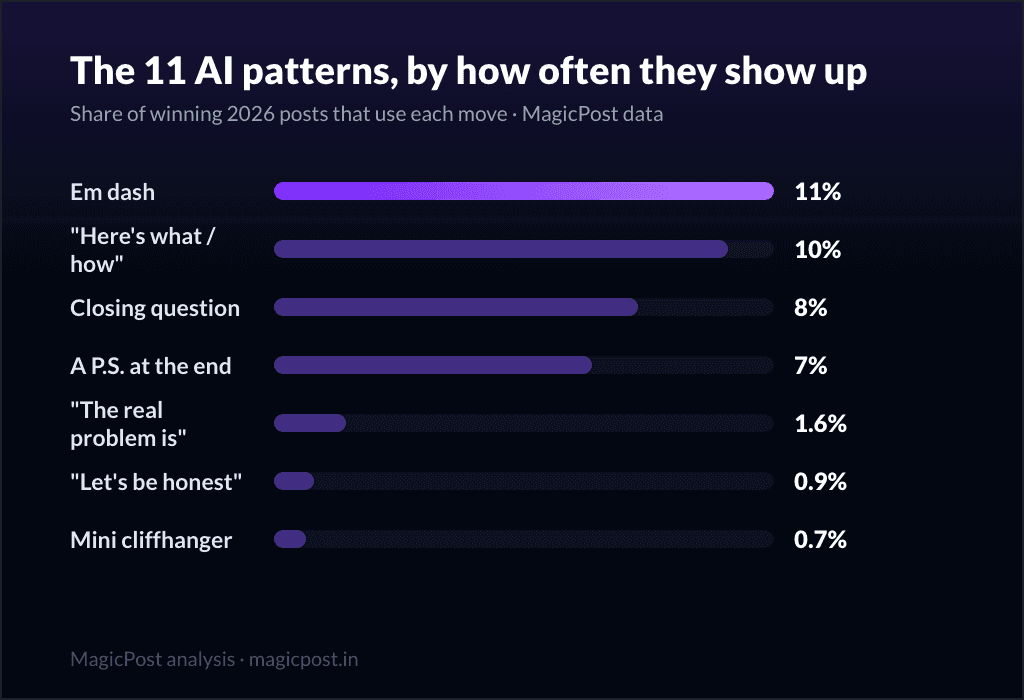
Run Gray's writing through the patterns people now call "AI tells," and the result is revealing:

A third of his posts use the "It's not X, it's Y" contrast formula, and once you see it you cannot unsee it. "Hard work is common. Grit is rare." "Flow beats force every single time." "Connection beats information every single time." "The secret isn't doing more. The secret is doing less, but better." He reaches for that exact two-beat contrast across post after post; it is his single most repeated rhetorical move. Two in five of his posts also lean on a "Here's how" opener, and a quarter on a generic advice frame.
Do not read it backwards. Gray does not write like an AI; AI writes like Gray. These patterns read as robotic today because the models trained on the best creators of this platform and then deployed all of their moves at once, in every paragraph. Gray uses the contrast formula where it gives a list item its snap, and it works for him. And the other half of his fingerprint is exactly what AI cannot resist adding and he resists: he almost never hedges ("it's worth noting"), never opens with a "Moreover" transition (zero in our sample), and rarely bolts on a sincerity flourish. The discipline is the signature. (Full story: how to spot AI writing on LinkedIn.)
When he posts
Gray publishes about 7 times a week, favorite slot Tuesday 8 AM US Eastern, with 71% of his posts in the morning and a meaningful 29% on weekends. That lines up neatly with what our US timing data shows about the early-morning window, and his cadence sits comfortably inside what our posting-frequency study measured for top creators. His posts also pull an unusually high comment count (about 325 median comments), so if part of your own playbook is showing up in his replies, that is exactly what an engagement feed is for: his posts, every morning, without hunting the timeline.
What to steal from Matt Gray
Open on a number. 40% of his posts start with a count ("33 habits", "8 traits"). The number sets the scope and the promise in line one.
Long post, short lines. 402 words delivered in 8-word sentences. Length earns saves only if every line is skimmable on its own.
Build a re-shippable origin story. His "lessons for younger Matt" template runs nearly every year, almost verbatim. A story that works is an asset, not a one-off.
Sell through the lesson. Half his posts end in an offer, and the audience stays, because the framework is genuinely useful before it asks for anything.
One contrast per point, not six tells stacked. "Hard work is common. Grit is rare." That snap is the difference between a signature move and an AI tell.
Study him, then study yourself. With MagicPost you can dig into Matt Gray's numbers the way we just did, analyze your own LinkedIn analytics with the same depth, and write in the spirit of his style, in your own voice. The data on this page is the product.
Where this data comes from
Everything in this article is MagicPost's own research. MagicPost analyzed 758 of Matt Gray's public LinkedIn posts: timing, engagement, topics, writing metrics, and the AI-pattern profile from a 30-post style sample. Every biographical claim is quoted from one of his own public LinkedIn posts and linked to it. Gray is not affiliated with MagicPost; his style is one of those MagicPost tracks most closely.
FAQ
Who is Matt Gray?
The founder and CEO of Founder OS, a Brooklyn-based entrepreneur with about 912,000 LinkedIn followers who teaches founders to grow a profitable audience with organic content. By his own public account he recovered from burnout and addiction in his twenties, survived a government shutdown order on his first company at 21, and now runs two companies he reports at $13.8M a year.
How does Matt Gray make money?
By his own posts: Founder OS (systems, community, and education for founders), a newsletter he reports at 137,000-plus subscribers, and recurring paid workshops. He says he closed "60 sales at $4,800 each = $288,000 in 3 days" from one early workshop, and that his two companies make $13.8M a year.
How often does Matt Gray post on LinkedIn?
About 7 posts a week in our data, most often at 8 AM US Eastern, with Tuesday his most frequent day and 29% of posts on weekends.
Does Matt Gray write with AI?
His most viral posts predate the AI era and read intensely human, built on his own life story. The twist is that AI tools learned from creators like him, which is why a third of his posts contain the "It's not X, it's Y" contrast people now mislabel as an AI tell. He uses it where it lands and skips the filler AI adds.
Is Matt Gray still growing on LinkedIn?
His follower count keeps climbing (near 912,000), but his median engagement per post has compressed, from about 1,163 likes in 2024 to 688 so far in 2026, the platform-wide pattern of more followers and fewer likes per post.
Can I write like Matt Gray?
You can learn the mechanics: MagicPost learns a creator's writing style (length, rhythm, hooks, signature moves) and helps you write in that spirit, in your own voice.
The Top LinkedIn Creators to Study in 2026 (By the Data)
The top LinkedIn creators to study in 2026, by the data: 62 creators, six languages, 27 countries, 32,000 posts analyzed by MagicPost. Grouped by what they teach.
Who Is Justin Welsh? The $10M Solopreneur, Explained by Data (2026)
Who is Justin Welsh? MagicPost analyzed 1,303 of their LinkedIn posts: topics, timing, signature moves and the writing fingerprint behind their growth, with rea
Who Is Matt Barker? The Hook Writer on LinkedIn, by Data (2026)
Who is Matt Barker? MagicPost analyzed 1,047 of their LinkedIn posts: topics, timing, signature moves and the writing fingerprint behind their growth, with real
Who Is Lara Acosta? The Forbes 30 Under 30 Comment Machine, Explained by Data (2026)
Who is Lara Acosta? MagicPost analyzed 461 of their LinkedIn posts: topics, timing, signature moves and the writing fingerprint behind their growth, with real n
Who Is Jasmin Alić? The Bosnian Coach LinkedIn Mistook for a Bot (2026)
Who is Jasmin Alić? MagicPost analyzed 364 of their LinkedIn posts: topics, timing, signature moves and the writing fingerprint behind their growth, with real n
Who Is Caroline Mignaux? France's LinkedIn Top Voice Who Turned Shame Into a Following (2026)
Who is Caroline Mignaux? MagicPost analyzed 684 of their LinkedIn posts: topics, timing, signature moves and the writing fingerprint behind their growth, with r
Who Is Orane Janvier? The Freelance Coach LinkedIn Quietly Copies (2026)
Who is Orane Janvier? MagicPost analyzed 505 of their LinkedIn posts: topics, timing, signature moves and the writing fingerprint behind their growth, with real
Who Is Benoît Dubos? The Growth Operator Who Turned a Falling Reach Into a Lead Machine (2026)
Who is Benoît Dubos? MagicPost analyzed 424 of their LinkedIn posts: topics, timing, signature moves and the writing fingerprint behind their growth, with real
Who Is Ruben Hassid? The "Master AI Before It Masters You" Creator, Explained by Data (2026)
Who is Ruben Hassid? MagicPost analyzed 1,189 of their LinkedIn posts: topics, timing, signature moves and the writing fingerprint behind their growth, with rea
Who Is Juliette Cadot? The Agency Founder Whose Audience Talks Back (2026)
Who is Juliette Cadot? MagicPost analyzed 398 of their LinkedIn posts: topics, timing, signature moves and the writing fingerprint behind their growth, with rea