How to Spot an AI-Written LinkedIn Post: 11 Patterns (We Analyzed 46,000 Posts)

How to Spot an AI-Written LinkedIn Post: 11 Patterns (We Analyzed 46,000 Posts)

How to Spot an AI-Written LinkedIn Post: 11 Patterns (We Analyzed 46,000 Posts)

Naïlé Titah

Naïlé Titah

|

The signs of AI writing you learned in 2023 are gone. No more "delve," no more "in today's fast-paced world," no more "unleash your potential." The posts that win on LinkedIn in 2026 have already cleaned all of that out.

So we went looking for what replaced it. We checked 46,000 popular LinkedIn posts from 2026 (all of them with more than 20 likes) with our own tool that flags AI writing. What we found is not what the usual "10 signs of AI" lists tell you.

97% of the posts that do well read as human. Only 3 in 100 look clearly AI. The giveaway is no longer the words. It is the shape: how a post starts, how it turns, and how it ends.

Two moves define AI writing in 2026: the "Here's how / Here's what" opener, and the "It's not X, it's Y" line. If you only learn to catch two patterns, catch these.

And here is the part nobody else can show you. Neither one was invented by AI. All 100 of the top creators we studied use both at least sometimes, from Gary Vaynerchuk to Justin Welsh. The biggest names on LinkedIn built these moves. AI did not come up with a style. It copied the best creators, then used every one of their tricks at once, in every post.

That is the real tell of 2026. Not the move itself. Using too many of them, every time.


How we checked this

We used two sets of data, both our own:

  • The posts. 45,965 LinkedIn posts from 2026, each with more than 20 likes, in every language (English first, then French). Our tool gives each one an AI score from 0 to 100. (When we look at how a habit changed over time, we go wider and reach back through earlier years of posts too. We will flag it when we do.)

  • The top creators. 100 of the biggest LinkedIn creators (most of them around 79,000 followers, and 96 of the 100 above 10,000). We looked at their posts one by one and noted which moves they use all the time, which they use now and then, and which they never use.

Two different things, so we keep them apart. When a number is about "the posts," it is the wide pool of LinkedIn posts. When it is about "the top creators," it is the 100. We say which one every time.

The posts tell us how often a move shows up in what works. The creators tell us whether the move came from real people or from AI. Put together, they tell the whole story. Both run on MagicPost's own engine, the same one behind our writing tools.

One honest note. Our AI score partly looks at two of the moves below (the em dash and the "It's not X, it's Y" move). So for those two, we do not use the score to make our point. We use things the score does not touch: how often they appear, how that has changed over the years, and how many likes they get.

LinkedIn'de büyümek için ihtiyacınız olan her şey LinkedIn. Tek bir yerde.

Kendi sesinizle yazın, fikir bulun, planlayın, analiz edin, etkileşim kurun…
MagicPost yalnızca LinkedIn için geliştirilmiştir.

Naïlé Titah

MagicPost'ta CEO

LinkedIn algoritmasını bir kez daha değiştirdi. Ve bu sefer, bu dikkat çekici.


Bunu bilmek için iyi bir konumdayım:

LinkedIn'de büyümek için ihtiyacınız olan her şey LinkedIn. Tek bir yerde.

Kendi sesinizle yazın, fikir bulun, planlayın, analiz edin, etkileşim kurun…
MagicPost yalnızca LinkedIn için geliştirilmiştir.

Naïlé Titah

MagicPost'ta CEO

LinkedIn algoritmasını bir kez daha değiştirdi. Ve bu sefer, bu dikkat çekici.


Bunu bilmek için iyi bir konumdayım:

İlk LinkedIn gönderinizi 5 dakikadan kısa bir sürede oluşturun

MagicPost ile haftada 4 saate kadar tasarruf edersiniz, ilk gönderinizle başlayarak. Daha az zaman yazmaya harcayın ve işinizi büyütmeye daha fazla zaman ayırın.

Kredikartı yok. Taahhüt yok. Sadece gerçek zamanlı tasarruf.

%100 ücretsiz deneme.

The 11 patterns, with real examples from top creators

Order note: we lead with the moves that define AI writing today, not strictly with the most frequent. Every example below is a real, word-for-word line from one of the 100 creators.

"Top creators" below means the 100 we studied. "Uses it" means at least sometimes. "All the time" means it is a habit.

#

Pattern

How often it shows up

Effect on likes

Top creators who use it

1

Em dash

11% (up from under 2% before AI)

+9% likes

Rare for most (typical 3% of posts)

2

"Here's what / Here's how"

10%

about average

98% use it, 14% all the time

3

"It's not X, it's Y"

0.4%

about average likes, slightly more comments

100% use it, 28% all the time

4

A question at the end

8%

-17%

98% use it, 34% all the time

5

A P.S. at the end

7%

+8%

72% use it, 23% all the time

6

"The real problem is..."

1.6%

small

100% use it, 0% all the time

7

"Let's be honest..."

0.9%

small

86% use it, 1% all the time

8

"The result?" mini cliffhanger

0.7%

small

99% use it, 5% all the time

9

"The key is... / Stop doing X"

0.3%

about average

100% use it, 12% all the time

10

"Moreover / Furthermore"

under 0.2%

small

3% use it, 0% all the time

11

"It's worth noting that..."

under 0.1%

small

22% use it, 0% all the time

Now each one, in plain terms.

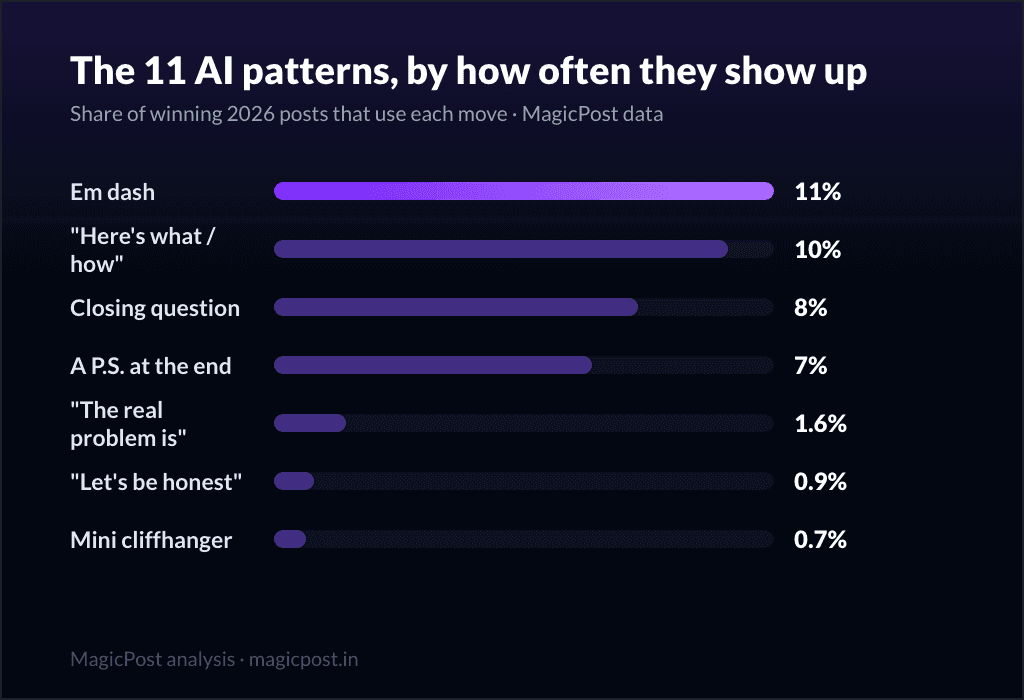
Bar chart: how often each of the 11 AI patterns appears in winning 2026 LinkedIn postsChart: share of 100 top LinkedIn creators who use each AI move, and who use it in nearly every post

1. The em dash (11% of posts)

The em dash is the long dash some people drop in the middle of a sentence. It is the most visible pattern on the list: about one winning post in nine has one.

Here is what makes it interesting, and this is about the posts (the wide pool, going back year by year). The em dash barely existed on LinkedIn before AI. Then it tracked the AI boom almost exactly:

Year

Posts with an em dash

2019

0.7%

2020

0.8%

2021

1.2%

2022

1.9%

2023

3.0%

2024

9.5%

2025

15.6%

2026 (so far)

10.4%

Under 2% for years, then a jump to 15.6% right as AI writing tools went mainstream. Real people rarely typed it. AI tools produce it constantly. So yes, it is a genuine AI fingerprint.

The catch, and now we are talking about the 100 top creators: it spread so far that even they carry it in their AI-assisted posts. But most of them still use it rarely. The typical top creator has an em dash in about 3% of their posts, and 55 of the 100 either never use it or use it in under 1 post in 20. So treat a single em dash as a strong hint, not as proof on its own. (We are not printing an example here on purpose: our own style avoids the em dash, which is the whole point of this series. We go deeper in our dedicated article, Is the em dash really a sign of AI?)

Line chart: share of LinkedIn posts with an em dash by year, climbing with AI adoption

2. "Here's what / Here's how" (10% of posts)

The promise opener. "Here's what nobody tells you." "Here's how I did it." AI loves it because it is a great hook: it promises a payoff.

But 98% of top creators use it too, 14% of them all the time. The biggest accounts open this way and win big:

  • Chris Donnelly (1.2M followers): "Here's the breakdown:" on a post that got 23,000+ likes.

  • Shulin Lee (267k, a top creator in Singapore): "Here's how you stop your top talent from leaving:", reused on several posts, each with 8,000 to 10,000 likes.

  • Ruben Hassid (831k): "Here's how to best use DeepSeek instead:", 8,000+ likes.

So the opener is fine. What gives AI away is using it in every post, always in the same spot, the same way. A real person mixes it up. AI, left alone, never does. (Full breakdown of this handoff: the "Here's how" line.)

LinkedIn'de büyümek için ihtiyacınız olan her şey LinkedIn. Tek bir yerde.

Kendi sesinizle yazın, fikir bulun, planlayın, analiz edin, etkileşim kurun…
MagicPost yalnızca LinkedIn için geliştirilmiştir.

Naïlé Titah

MagicPost'ta CEO

LinkedIn algoritmasını bir kez daha değiştirdi. Ve bu sefer, bu dikkat çekici.


Bunu bilmek için iyi bir konumdayım:

LinkedIn'de büyümek için ihtiyacınız olan her şey LinkedIn. Tek bir yerde.

Kendi sesinizle yazın, fikir bulun, planlayın, analiz edin, etkileşim kurun…
MagicPost yalnızca LinkedIn için geliştirilmiştir.

Naïlé Titah

MagicPost'ta CEO

LinkedIn algoritmasını bir kez daha değiştirdi. Ve bu sefer, bu dikkat çekici.


Bunu bilmek için iyi bir konumdayım:

İlk LinkedIn gönderinizi 5 dakikadan kısa bir sürede oluşturun

MagicPost ile haftada 4 saate kadar tasarruf edersiniz, ilk gönderinizle başlayarak. Daha az zaman yazmaya harcayın ve işinizi büyütmeye daha fazla zaman ayırın.

Kredikartı yok. Taahhüt yok. Sadece gerçek zamanlı tasarruf.

%100 ücretsiz deneme.

3. "It's not X, it's Y" (0.2% of posts, but every top creator)

This is the textbook case, and one of the two moves that define AI writing in 2026. In the raw posts it is rare. But among our 100 top creators, most of them with around 79,000 followers, it is almost everywhere: all 100 use it at least sometimes, and 28% use it all the time. And these are not small accounts:

  • Gary Vaynerchuk (5.9M followers): "It's not always how much money you make, it's how much you spend against how much you make."

  • Steven Bartlett (3.1M): "...it isn't connections, it's not anything material, it's knowledge and information." (2,500+ likes)

  • Justin Welsh (853k): "It's not just about hearing words, it's about understanding the meaning behind them." (2,900+ likes)

  • Matt Gray (911k) goes further. He reuses one line, "Your business should work without you, or it's not a business, it's a job," on at least four different posts, each with 1,000 to 2,400 likes.

To be clear, this is not a callout. These are great creators and these are good lines. That is the whole point. The best creators reach for this move again and again (interestingly, in our data it does not actually win more likes than average, though it does spark slightly more comments). AI learned it from them, then started using it in every paragraph. What was a signature became a tell. (Full breakdown: It's not X, it's Y: the formula LinkedIn is quietly penalizing.)

4. A question at the end (8% of posts)

"What about you?" "How do you handle it?" The question that fishes for comments. The biggest names lean on it hard:

  • Gary Vaynerchuk (5.9M followers): "Which are you great at and which are you working on?" (15,500+ likes)

  • Simon Sinek (8.9M): "What's the one thing on your desk you can't live without?" (5,200+ likes)

Surprise: this is not a reliable AI sign. Posts that end on a question actually get fewer likes than usual (about 17% fewer), even for creators this big. 98% of top creators use it. It is less an AI sign than a tired old tactic. Use it only when the question is genuine, not as a reflex.

5. A P.S. at the end (7% of posts)

The "P.S. if this helped, repost it" line at the bottom. Common, and it comes with slightly more likes (about 8% above usual).

  • Gary Vaynerchuk (5.9M followers): "PS: Share a photo in comments of you in your 30s!"

  • Gary Vaynerchuk again: "PS. Don't forget to drop your question in the comments!"

72% of creators use it. The P.S. is not the problem. The same automatic P.S. on every post is.

6. "The real problem is..." (1.6% of posts)

"The real problem is..." "What most people miss..." "Change your mindset." The move that promises a big reveal under every line:

  • Steven Bartlett (3.1M followers): "...the real reasons and reality behind it all." (21,000+ likes)

  • James Caan (3.3M): "...most people get this wrong."

Here is the catch: all 100 creators use it now and then, but not one leans on it. It is rare, and when it stacks up (three "real problems" in one post), it is a red flag.

7. "Let's be honest..." (0.9% of posts)

"Let's be honest." "Real talk." "I'll be blunt." The honesty label that sounds fake exactly because it announces itself:

  • Eric Partaker (1.2M followers): "Let's be honest." (10,000+ likes), and he reuses "Real talk on leadership." across many posts.

  • Steven Bartlett (3.1M): "Honestly, you should be so proud of you." (9,000+ likes)

86% of creators use it now and then, but only 1% all the time. Real honesty does not introduce itself. It just shows up.

8. The mini cliffhanger (0.7% of posts)

A short line plus a question mark, held for drama:

  • Simon Sinek (8.9M followers): "The lesson?" (7,000+ likes)

  • Steven Bartlett (3.1M): "Plot twist:" (9,000+ likes)

  • Chris Donnelly (1.2M): "The best part?"

Rare per post, and while 99% of creators use it now and then, only 5% make it a habit. When it shows up, it usually travels with other AI signs. One is fine. Three in a post reads like a script.

LinkedIn'de büyümek için ihtiyacınız olan her şey LinkedIn. Tek bir yerde.

Kendi sesinizle yazın, fikir bulun, planlayın, analiz edin, etkileşim kurun…
MagicPost yalnızca LinkedIn için geliştirilmiştir.

Naïlé Titah

MagicPost'ta CEO

LinkedIn algoritmasını bir kez daha değiştirdi. Ve bu sefer, bu dikkat çekici.


Bunu bilmek için iyi bir konumdayım:

LinkedIn'de büyümek için ihtiyacınız olan her şey LinkedIn. Tek bir yerde.

Kendi sesinizle yazın, fikir bulun, planlayın, analiz edin, etkileşim kurun…
MagicPost yalnızca LinkedIn için geliştirilmiştir.

Naïlé Titah

MagicPost'ta CEO

LinkedIn algoritmasını bir kez daha değiştirdi. Ve bu sefer, bu dikkat çekici.


Bunu bilmek için iyi bir konumdayım:

İlk LinkedIn gönderinizi 5 dakikadan kısa bir sürede oluşturun

MagicPost ile haftada 4 saate kadar tasarruf edersiniz, ilk gönderinizle başlayarak. Daha az zaman yazmaya harcayın ve işinizi büyütmeye daha fazla zaman ayırın.

Kredikartı yok. Taahhüt yok. Sadece gerçek zamanlı tasarruf.

%100 ücretsiz deneme.

9. "The key is... / Stop doing X" (0.3% of posts)

"The key is..." "Stop doing X, start doing Y." "If you want to succeed..." Rare in top posts, and despite how confident it sounds, it lands about average on likes.

  • Gary Vaynerchuk (5.9M followers): "Stop doing things you hate." (6,400+ likes)

  • Gary Vaynerchuk again: "If you want to build something big..."

And all 100 top creators use it, 12% all the time. Again: a real, effective move that only looks suspect when it is overused.

10. "Moreover / Furthermore" (almost 0% of posts, no creator uses it)

"Moreover." "Furthermore." "Additionally." The essay-style linking words, at the start of a line.

This is one of only two moves on the list that is a dead giveaway, and here the example is the absence of one. We searched all 100 creators, from Simon Sinek down. Only 3 ever used a single "Moreover," and not one as a habit. In 29,000 popular posts you can count them on one hand. Nobody opens a line with "Furthermore" on LinkedIn. When you see it, it is not a person with an unusual style. It is AI that nobody cleaned up.

11. "It's worth noting that..." (almost 0% of posts, no creator uses it)

The second dead giveaway, and again the example is that there is none. "It's worth noting that." "Keep in mind that." "It's important to remember." The warm-up words before the actual point. Almost never in top posts. A few creators let one slip now and then, but not one of the 100 builds a post around it. A person with something to say just says it. Cautious AI clears its throat first.

The trap: these were never the edge, but they are now a liability

Here is the quiet finding in our data. Most of these moves barely move likes at all. "It's not X, it's Y" lands about average. So does "the key is" and the "Here's" opener. The closing question actually does worse than a normal post. Only the em dash and the P.S. nudge likes up, and only by single digits.

In other words, these patterns were never the thing winning you reach. They just feel like good writing, because the best creators use them. That is the trap. They are proven-feeling moves with no real edge, and AI hands you all of them, at once, in every post. The pile-up is what screams robot, not any single move. (For how these moves became everyone's defaults, see where the AI patterns came from.)

The two moves no creator uses ("Moreover" and "It's worth noting that") are the only ones that give it away on their own.

The takeaway is simple: you do not beat AI detection by dropping the good moves. You beat it by not piling them all on, and by cutting the two dead giveaways.

This is what MagicPost was built for. Our Humanizer checks every draft against the 11 patterns above, keeps the moves that fit your voice, and quietly removes the pile-up and the dead giveaways before you post. Try MagicPost free

Chart: effect on likes of each AI pattern versus a normal LinkedIn post

Why LinkedIn itself cares

It is not just readers. In May 2026, LinkedIn made it official. In a post titled "Keeping conversations real on LinkedIn", Laura Lorenzetti (VP and Executive Editor, LinkedIn Global Editorial) announced a crackdown on what she called "AI slop": "low-effort, AI-generated content that may sound polished on the surface but lacks any real unique perspective or substance."

The rule of thumb LinkedIn gives is simple: "It's ok to use AI to help you write, but your posts and comments need to represent your voice and your perspectives. The ultimate value comes from the human behind the tool."

And it has teeth. LinkedIn says its systems now tell apart content that "adds perspective, context, or expertise" from content that "feels generic or repetitive, even if it appears polished on the surface." When a post reads as generic AI, "it is less likely to be widely distributed beyond a person's immediate network." LinkedIn's own early number: "we're correctly identifying generic content 94% of the time."

Here is the gap we fill. LinkedIn told everyone it is demoting generic, repetitive AI content. It did not publish the list of what "generic and repetitive" actually looks like. That list is this article. The 11 patterns above are the concrete shapes of the exact thing LinkedIn says it is now trained to catch. (For what "demoting" actually means for your reach, see Does LinkedIn penalize AI content?)

Checklist: is your post getting flagged?

Reread your draft and count:

  • How many moves from this list are in this one post? One or two: normal. Four or more: AI is showing.

  • Do you open with "Here's what / Here's how"? If your last three posts start the same way, change it up.

  • Any "Moreover" or "Furthermore" at the start of a line? Cut it. Nobody writes that way on LinkedIn.

  • Any "it's worth noting that"? Cut it. Get to the point.

  • Are you stacking "the real problem is..." reveals? Keep one, at most.

  • Is your "It's not X, it's Y" earned, or a reflex? Once, it is a signature. Three times, it is a tic.

Three checks or more, and your post does not read fake because it is bad. It reads fake because there is too much of it.

How to fix it yourself

Good news: you do not have to give up the moves that work. You just need your own rhythm back.

  1. One strong move per post, not six. Pick your best hook and drop the rest.

  2. Change your openers. Look at your last five posts. If they all start the same way, that is a template, not a voice.

  3. Cut the two dead giveaways, always. "Moreover" and "it's worth noting that": zero tolerance.

  4. Keep your best moves, just space them out. "It's not X, it's Y" is a great line. Use it when it lands, not by default.

  5. Read it out loud. If a sentence does not come out of your mouth naturally, it came out of AI.

Or let MagicPost do it for you

You can run that checklist by hand on every post. Or you can let MagicPost's Humanizer do it in one click.

MagicPost learns your voice from your own posts and from the creators you admire, the same kind of top creators we studied here. When you write or paste a draft, the Humanizer keeps the moves that make your style, removes the pile-up that reads as AI, and cuts the two dead giveaways every time. It does not flatten your writing. It just removes the robotic coating on top.

The result reads like you on your best day, not like AI on its most generic one.

Try MagicPost's Humanizer free


SSS

Is using AI to write LinkedIn posts against the rules?

No. The problem is not using AI. It is posting AI that still reads like AI. The fix is editing it, not avoiding it.

Does an em dash mean a post was written by AI?

It is a real hint. The em dash barely existed on LinkedIn before AI (under 2% of posts through 2022) and then jumped to over 15% in 2025, right alongside AI tools. But it is now so common that a single one is not proof on its own. Look at the whole post, not one dash. We break this down in a dedicated article.

What is the single biggest sign of AI writing?

Two of them: "Moreover / Furthermore" at the start of a line, and warm-up phrases like "it's worth noting that." Not one of the 100 top creators we studied uses either as a habit. When you see them, it is almost always AI.

Can I still use "It's not X, it's Y"?

Yes. All 100 top creators we studied use it at least sometimes, from Gary Vaynerchuk to Justin Welsh. Just do not use it in every post. The tell is the repetition, not the line.

How does MagicPost help with this?

MagicPost's Humanizer checks your draft against the 11 patterns in this article, keeps the ones that fit your voice, and removes the pile-up and the two dead giveaways automatically. You write; it quietly cleans up. Try it free

LinkedIn'de büyümek için ihtiyacınız olan her şey LinkedIn. Tek bir yerde.

Kendi sesinizle yazın, fikir bulun, planlayın, analiz edin, etkileşim kurun…
MagicPost yalnızca LinkedIn için geliştirilmiştir.

Naïlé Titah

MagicPost'ta CEO

LinkedIn algoritmasını bir kez daha değiştirdi. Ve bu sefer, bu dikkat çekici.


Bunu bilmek için iyi bir konumdayım:

LinkedIn'de büyümek için ihtiyacınız olan her şey LinkedIn. Tek bir yerde.

Kendi sesinizle yazın, fikir bulun, planlayın, analiz edin, etkileşim kurun…
MagicPost yalnızca LinkedIn için geliştirilmiştir.

Naïlé Titah

MagicPost'ta CEO

LinkedIn algoritmasını bir kez daha değiştirdi. Ve bu sefer, bu dikkat çekici.


Bunu bilmek için iyi bir konumdayım:

İlk LinkedIn gönderinizi 5 dakikadan kısa bir sürede oluşturun

MagicPost ile haftada 4 saate kadar tasarruf edersiniz, ilk gönderinizle başlayarak. Daha az zaman yazmaya harcayın ve işinizi büyütmeye daha fazla zaman ayırın.

Kredikartı yok. Taahhüt yok. Sadece gerçek zamanlı tasarruf.

%100 ücretsiz deneme.

İlgili makaleler

İlgili makaleler

EN 🇹🇷

EN 🇹🇷

"It's Not X, It's Y": The LinkedIn Formula Everyone Now Reads as AI

"It's not X, it's Y" is the most-flagged AI formula on LinkedIn. The data: every top creator uses it, it barely lifts engagement, and why it became a tell.

...daha fazla oku

EN 🇹🇷

EN 🇹🇷

Is the Em Dash a Sign of AI on LinkedIn? Yes, and Here Is the Fix

Is the em dash a sign of AI on LinkedIn? Yes. Em-dash use jumped from under 2% of posts to over 15% with ChatGPT. The data, and what to use instead.

...daha fazla oku

EN 🇹🇷

EN 🇹🇷

"Here's How" and "Here's What": LinkedIn's Most Common AI Handoff

"Here's how" is LinkedIn's most common AI handoff. It went from under 3% of posts to over 16% with ChatGPT. Why it reads as AI, and how to vary it.

...daha fazla oku

EN 🇹🇷

EN 🇹🇷

The AI Words Everyone Tells You to Avoid Are Already Dead on LinkedIn

The famous AI words to avoid (delve, tapestry) are already dead on LinkedIn. We checked 129,000 posts. The real tells moved from vocabulary to structure.

...daha fazla oku

EN 🇹🇷

EN 🇹🇷

Does LinkedIn Penalize AI Content? What the Data and LinkedIn's Own Crackdown Say (2026)

Does LinkedIn penalize AI content? Not exactly. It demotes generic posts, not AI. We scored 46,000 top posts and 97% read as human. Here is what happens.

...daha fazla oku

EN 🇹🇷

EN 🇹🇷

AI Writing on LinkedIn in 2026: The Patterns, and Where They Actually Came From

AI gave LinkedIn a house style. Here are the patterns that now read as AI in 2026, and the uncomfortable truth about where they actually came from.

...daha fazla oku