Naïlé Titah
Kevin Dufraisse's LinkedIn headline reads "From Invisible to Omnipresent in the next 24 Hours," and the man behind it is one of the most introspective creators in French-speaking LinkedIn. At MagicPost, we analyzed 571 of his posts in our engagement window (and his full history back to 2023): what he writes, when, for whom, what works, and the one thing the numbers reveal that no bio would.
That one thing: Dufraisse does not win with likes, he wins with comments. His biggest post of all time pulled 2,625 likes and 2,927 comments, more comments than likes. He built a lead-magnet machine where the comment box is the product. This is who Kevin Dufraisse is, according to his own posts, measured.

His story, in his own posts
You do not need a biographer for Dufraisse. He re-introduces himself on a schedule, and the data shows which chapters he keeps coming back to.
The corporate exit. "J'ai quitté The Family en tant que salarié il y a 3 ans après avoir frôlé la dépression à cause du COVID. Je gagnais 2200 euros par mois." ("I left The Family as an employee three years ago after nearly hitting depression because of COVID. I earned 2,200 euros a month.") That is the opening of a "let me introduce myself" post addressed to his then 38,000 followers.
The theft. The pivot of his whole narrative is a betrayal he names by date: "j'apprends le 23 décembre 2023 que je me suis fait voler 150 000€ par mon partenaire." ("On December 23rd, 2023, I learn that I was robbed of 150,000 euros by my partner.") In the same post: "2 mois plus tard je réalise un CA de 129 000€ en changeant toute ma stratégie business." ("Two months later I do 129,000 euros in revenue by changing my whole business strategy.")
The numbers he is proud of. Marking the business turning three, he framed it plainly: "mon solo-business à plus d'un demi-million par an a fêté ses 3 ans" ("my solo business at over half a million a year just turned three"), and in another tally, "J'ai vendu 1,5 M€ de formations en ligne" ("I sold 1.5M euros of online courses"). He sells online education to French-speaking solopreneurs, by his own repeated account.
The first failure. He keeps the origin honest. At 23, "je voulais être milliardaire avec une startup de réservation de voyages qui s'appelait bedwel" ("I wanted to be a billionaire with a travel-booking startup called bedwel"), and twelve months in: "j'ai gagné 1000€ en 12 mois." ("I made 1,000 euros in 12 months.")
One detail a regular bio never would surface: his most-engaged post is not a post, it is a reusable asset. His freelance-jobs file ran in December 2024 for 2,625 likes and 2,927 comments, then again near-verbatim in January 2025 for another 1,033 likes and 1,256 comments. When a comment magnet works, he re-runs it.
What he actually talks about

No surprise at the top: entrepreneurship dominates his feed (about 339 of his analyzed posts), with social media, sales and marketing filling most of the rest. Two details beat the ranking:
His smaller themes punch hardest. Posts about AI carry his highest median (about 150 likes) and social media about 145, both above his overall 116 median. Market research is his weakest theme (about 20 likes): the operational stuff does not travel.
Sorted by register rather than topic, his biggest bucket is "Vente via valeur" (selling through value, about 111 posts), then punchy standalone advice and, crucially, "Lead magnet par commentaire" (lead magnet by comment, about 61 posts). Roughly one post in nine is engineered to make you comment. That is the engine.
Who he writes for
His reader is explicit in his own words: the salaried person who suspects the 9-to-5 is a trap. He writes for "ceux qui, comme moi, cherchent à sortir de ce système" ("those who, like me, are trying to get out of this system"), and he writes to his younger self: "si j'écris tous les jours en ligne, c'est en partie pour parler au Kevin de 23 ans." ("if I write online every day, it is partly to talk to the 23-year-old Kevin.") The offers match the audience: courses for francophone solopreneurs who want freedom over a salary.
His best posts of 2026
His biggest posts of 2026 so far, reproduced from our data (click through to the originals):

750 likes. A news hijack built on a contrarian thesis ("il y a un truc que personne ne t'apprend sur la viralité négative," nobody teaches you this about negative virality), pivoting to his own offer. Topical, opinionated, monetized.

454 likes, 195 comments. His most-commented 2026 post is a deliberately provocative take ("En France, on préfère quand ça brûle que quand ça réussit," in France we prefer it when things burn than when they succeed). The provocation is the comment engine.

362 likes. A marketing parable ("Ce n'est pas l'offre qui crée la demande. C'est la visibilité qui crée la demande," it is not the offer that creates demand, it is visibility) ending on a link. His clearest one-line thesis, wrapped around a story.
Is he still growing?

Here the honesty matters. His median post held flat for three years (about 120 likes in 2023, 117 in 2024, 131 in 2025), and then 2026 cut it roughly in half, to about 62, while his follower count kept climbing past 60,000. This is the reach-compression arc showing up across LinkedIn right now, and Dufraisse narrates the doubt instead of hiding it: "Aujourd'hui, je suis dans le mood où j'ai envie d'arrêter." ("Today I am in the mood where I want to quit.") He ends that post with "qu'est-ce que je fous là?" ("what the hell am I doing here?"). One note: we track engagement per post, not followers over time, so the dip is how hard his posts land, not how many people follow him.
Where do these charts come from? Everything on this page runs on MagicPost's LinkedIn analytics, and it works on your profile too: your best posts, your audience, your benchmark, even a side-by-side with creators like Kevin Dufraisse.
How he writes
Here is Dufraisse measured against the average creator, and the headline is not "short":

Metric (per post) | Kevin Dufraisse | Average creator* |
Words | ~140 | 185 |
Words in the hook | 16 | 11 |
Words per paragraph | 12 | 13 |
Words per sentence | 11 | 10 |
Emojis | 0 | 2 |
Exclamation marks | 0 | 1 |
Hashtags | 0 | 0 |
Hooks built on numbers | 38% | 22% |
*Median across the 3,344 creators we analyzed with 20+ posts each.
His paragraphs and sentences sit almost exactly on the average; this is not the white-space style. Two things separate him. First, the hook is long and loaded: 16 words against the typical 11, because he front-loads a full scene before the turn. Second, 38% of his posts open on a number, nearly double the benchmark: an age, a euro figure, a follower count, a month. The list of facts is the format. And the four zeros (no emojis, no hashtags, no bold, no exclamation marks) keep all the energy in the writing, not the decoration. When our system names his style in one word, it says: punchy.
The "AI tells" in his style (read this the right way)
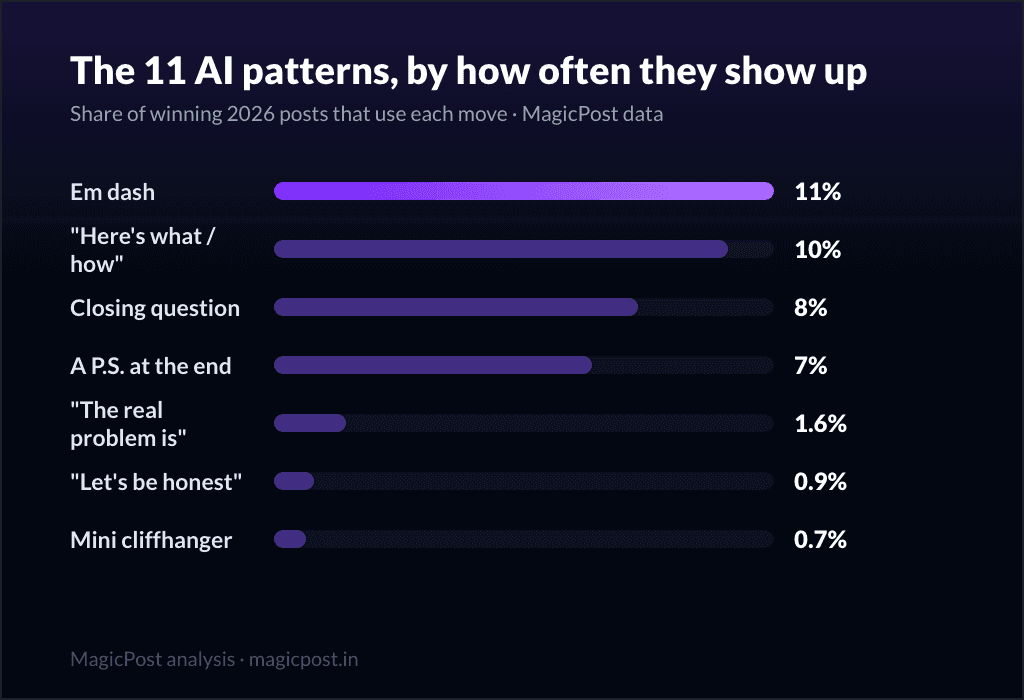
Run Dufraisse's writing through the patterns people now call "AI tells," and the picture is instructive:

One in three of his posts uses the "It's not X, it's Y" contrast formula, the single most flagged "AI" pattern on LinkedIn ("Ce n'est pas l'offre qui crée la demande. C'est la visibilité"). About a quarter lean on a reveal-bridge ("Sauf qu'il y a un truc que personne ne t'apprend," except there is something nobody teaches you), and a fifth on a depth-signaling beat.
Do not read it backwards. Dufraisse does not write like an AI; AI writes like Dufraisse. These moves read as robotic today because the models trained on the best creators of this platform and then used every device at once, in every post. Dufraisse uses the contrast where it lands, and the other half of his fingerprint is what AI cannot resist adding and he refuses: he never hedges, never opens a line with a transition opener like "Moreover", and never bolts on an automatic P.S. sign-off. The restraint is the signature. (Full story: how to spot AI writing on LinkedIn.)
When he posts
Dufraisse publishes about 5 to 6 times a week, favorite slot Wednesday around 4 PM Paris time, with only 3% of his posts in the morning and a meaningful 23% on weekends. That afternoon habit is unusual against what our France timing data says about the best windows, and his volume sits inside what our posting-frequency study found sustainable. His median post draws about 116 likes and 42 comments, the unusually high comment share that is the point of his lead-magnet posts. And if showing up in his comment section is part of your playbook, that is what an engagement feed is for: his posts, every day, without hunting the timeline.
What to steal from Kevin Dufraisse
Engineer the comment, not just the like. His lead-magnet posts pull more comments than likes by asking for the comment in exchange for a file. The comment box is the funnel.
Re-run what converts. His freelance-jobs file earned thousands of comments twice. A proven asset is worth shipping again.
Open on a number, then tell a scene. 38% of his hooks are numeric, and the rest open mid-story. Specificity in line one is his whole edge.
Use one strong move per post. The contrast formula in a third of posts, never six AI devices stacked. That is the line between a signature and an AI tell.
Narrate the doubt. His "I want to quit" post is one of his most human. Honest vulnerability is content.
Study him, then study yourself. With MagicPost you can dig into Kevin Dufraisse's numbers the way we just did, analyze your own LinkedIn analytics with the same depth, and write in the spirit of his style, in your own voice. The data on this page is the product.
Where this data comes from
Everything in this article is MagicPost's own research. MagicPost analyzed 571 Kevin Dufraisse posts across our engagement window (and his full history back to 2023): timing, engagement, topics, writing metrics, and the AI-pattern profile from a 30-post sample. Every biographical claim is quoted from one of his own public LinkedIn posts and linked to it. Dufraisse is not affiliated with MagicPost; his style is one of those we track most closely.
SSS
Who is Kevin Dufraisse?
A French solopreneur and online-course creator, founder of Empire Internet, with about 60,000 LinkedIn followers. By his own account he left the startup studio The Family, survived having 150,000 euros stolen by a partner, and built a one-person online-education business he reports at over half a million euros a year. His headline: "From Invisible to Omnipresent in the next 24 Hours."
How does Kevin Dufraisse make his money?
By his own posts: selling online courses to French-speaking solopreneurs. He has stated "J'ai vendu 1,5 M€ de formations en ligne" ("I sold 1.5M euros of online courses") and described a solo business at over half a million euros a year.
How often does Kevin Dufraisse post on LinkedIn?
About 5 to 6 posts a week in our data, most often on Wednesday around 4 PM Paris time, with 23% of posts on weekends.
Does Kevin Dufraisse write with AI?
His fingerprint reads intensely human: four hard zeros (no emojis, hashtags, bold or exclamation marks) and none of the filler AI adds (no hedging, no transition openers, no automatic P.S.). The twist is that AI tools learned from creators like him, which is why a third of his posts contain the "It's not X, it's Y" pattern people now mislabel as an AI tell.
Is Kevin Dufraisse still growing on LinkedIn?
His followers kept climbing past 60,000, but his median engagement per post, flat near 120 likes for three years, fell to about 62 in 2026. That reach-compression dip is common across LinkedIn now and he posts openly about the doubt it brings.
Can I write like Kevin Dufraisse?
You can learn the mechanics: MagicPost learns a creator's writing style (length, rhythm, hooks, signature moves) and helps you write in that spirit, in your own voice.
The Top LinkedIn Creators to Study in 2026 (By the Data)
The top LinkedIn creators to study in 2026, by the data: 62 creators, six languages, 27 countries, 32,000 posts analyzed by MagicPost. Grouped by what they teach.
Who Is Justin Welsh? The $10M Solopreneur, Explained by Data (2026)
Who is Justin Welsh? MagicPost analyzed 1,303 of their LinkedIn posts: topics, timing, signature moves and the writing fingerprint behind their growth, with rea
Who Is Matt Barker? The Hook Writer on LinkedIn, by Data (2026)
Who is Matt Barker? MagicPost analyzed 1,047 of their LinkedIn posts: topics, timing, signature moves and the writing fingerprint behind their growth, with real
Who Is Lara Acosta? The Forbes 30 Under 30 Comment Machine, Explained by Data (2026)
Who is Lara Acosta? MagicPost analyzed 461 of their LinkedIn posts: topics, timing, signature moves and the writing fingerprint behind their growth, with real n
Who Is Jasmin Alić? The Bosnian Coach LinkedIn Mistook for a Bot (2026)
Who is Jasmin Alić? MagicPost analyzed 364 of their LinkedIn posts: topics, timing, signature moves and the writing fingerprint behind their growth, with real n
Who Is Caroline Mignaux? France's LinkedIn Top Voice Who Turned Shame Into a Following (2026)
Who is Caroline Mignaux? MagicPost analyzed 684 of their LinkedIn posts: topics, timing, signature moves and the writing fingerprint behind their growth, with r
Who Is Orane Janvier? The Freelance Coach LinkedIn Quietly Copies (2026)
Who is Orane Janvier? MagicPost analyzed 505 of their LinkedIn posts: topics, timing, signature moves and the writing fingerprint behind their growth, with real
Who Is Benoît Dubos? The Growth Operator Who Turned a Falling Reach Into a Lead Machine (2026)
Who is Benoît Dubos? MagicPost analyzed 424 of their LinkedIn posts: topics, timing, signature moves and the writing fingerprint behind their growth, with real
Who Is Ruben Hassid? The "Master AI Before It Masters You" Creator, Explained by Data (2026)
Who is Ruben Hassid? MagicPost analyzed 1,189 of their LinkedIn posts: topics, timing, signature moves and the writing fingerprint behind their growth, with rea
Who Is Juliette Cadot? The Agency Founder Whose Audience Talks Back (2026)
Who is Juliette Cadot? MagicPost analyzed 398 of their LinkedIn posts: topics, timing, signature moves and the writing fingerprint behind their growth, with rea