Naïlé Titah
Ulysse Lubin is the French explorer who spent five years telling one story, "Je relève 100 challenges à travers le monde" (I take on 100 challenges around the world), and then, in February 2026, announced to his 114,000 followers that he was retiring the sentence that built his entire audience. At MagicPost, we analyzed 137 of his LinkedIn posts back to 2022: what he writes, when, for whom, and what makes his style worth studying.
This is who Ulysse Lubin is, according to the best source: his own posts, measured.

His story, in his own posts
You do not need a biographer for Lubin. He narrates his own life in chapters, and the data shows which ones he returns to.
The quitting. The founding act, repeated in post after post: in 2020 he walked away. "En 2020, j'ai tout quitté : mon job, mes affaires, ma vie parisienne... Je suis parti sans plan B." (In 2020, I quit everything: my job, my belongings, my Parisian life... I left with no plan B.) The trigger, he says elsewhere, was a small black ball that floated above his shoulder for years: "Personne ne la voyait. Moi, je ne voyais plus qu'elle." (Nobody saw it. I no longer saw anything but it.)
The challenges. What followed was a deliberate hunt for discomfort. "Jungle, glace, désert : j'ai poursuivi l'inconfort," he writes, listing a muay thai fight in Thailand, a freezing bath with Wim Hof, free-diving to minus 35 meters, and Antarctica. He fought five full rounds in a ring after one month of training and lost on the judges' decision: "J'ai perdu, et je n'ai jamais été aussi fier." (I lost, and I have never been so proud.)
The anchoring. Around 2023 the nomad chapter closes. "C'est la fin de ma vie de nomade," he announces: "Il y a 3 ans, j'étais perdu. Aujourd'hui, je pense m'être trouvé." (Three years ago I was lost. Today I think I have found myself.) He builds a tiny house in the woods, meets love, and chooses France over a tax-friendlier Dubai: "plus je voyage, plus je ressens un attachement à mes racines" (the more I travel, the more attached to my roots I feel).
The pivot. Then comes the post that defines this whole page. In February 2026 he writes "J'arrête mes 100 défis à travers le monde" (I am stopping my 100 challenges around the world) and says it plainly: "Cette phrase n'est plus vraie. Ce n'est plus moi." (That sentence is no longer true. It is no longer me.) He is now a father in Marseille launching a company, Supranormal.
One detail our data surfaces that a normal bio never would: the "j'ai tout quitté pour relever 100 challenges" line is not a sentence, it is a franchise. It appears, near word for word, across his biggest posts of four straight years: the YouTube-trophy post, the Albin Michel book deal, the "ma vie est un film" post, the company anniversary. By his own count he repeated it "des centaines de fois." When a story works, you do not abandon it; you build on it until you choose the moment to close it.
What he actually talks about

His feed reads like adventure, but our topic engine files it as business. Entrepreneurship is his single biggest theme (about half his posts), ahead of coaching, with travel a smaller slice than you would guess from the icebergs. Two details are more telling than the ranking:
Wellness over-performs for him (about 970 median likes versus 730 on entrepreneurship): the posts on sobriety, preventive blood panels, and the body's survival reflexes hit harder than the startup talk. His audience comes for the explorer, not the founder.
Sorted by register rather than topic, his dominant modes are overcome-a-challenge stories and personal reflection, well ahead of straight advice. Lubin rarely tells you what to do. He tells you what he did, and lets you draw the lesson. It is, literally, his stated method: "Voilà ce que j'ai fait. Voilà ce que j'ai appris. Essayez et tirez-en vos propres leçons." (Here is what I did. Here is what I learned. Try it and draw your own lessons.)
Who he writes for
His reader is the person with a flame quietly going out. He names the enemy in the launch post: "une flamme brûle en chacun de nous. Mais qui, trop souvent, étouffe... sous le poids du Normal." (a flame burns in each of us, but one that, too often, suffocates, under the weight of the Normal.) He writes to the salaried Parisian he used to be, who suspects, as he once put it, that "la vie est trop courte pour la passer à bosser pour le rêve des autres" (life is too short to spend working for other people's dreams). The offers match: an introspection workshop "pour trouver sa voie," and a method for getting started without permission.
His best posts of 2026
His biggest posts of 2026 so far (click through to the originals):

647 likes. A birthday post structured as five numbered "réalités de la trentaine" (realities of your thirties): health, relationships, kids, money, work. The list-of-life format that lets every reader find their own line, closed on a question.

454 likes. The franchise-killer itself: six years compressed into one minute, ending on the launch of Supranormal. He uses the accumulated weight of the old story to give the new one a running start.

199 likes. A lead magnet done his way: 100 book summaries given away free, with a pointed twist on the comment-bait norm, "Pas besoin de commenter « Claude »" (no need to comment "Claude"), just a like to help others find it.
Is he still growing?

The honest answer is the interesting one. His median likes per post climbed every year we measured: about 547 in 2022, 795 in 2023, 824 in 2024, even as his posting volume fell sharply (100 posts in 2022 to 38 in 2024). He was posting less and landing harder. One note: we measure engagement, not followers over time, so this is how hard his posts hit, not the size of his audience. The collapse in volume matters too: he treats LinkedIn as a place to mark milestones, not a daily feed.
Where do these charts come from? Everything on this page runs on MagicPost's LinkedIn analytics, and it works on your profile too: your best posts, your audience, your benchmark, even a side-by-side with creators like Lubin.
How he writes (the storyteller's numbers)
Here is Lubin measured against the average creator, and the headline is not "he writes long":

Metric (per post) | Ulysse Lubin | Average creator* |
Words | ~179 | 185 |
Words in the hook | 7 | 11 |
Words per paragraph | 10 | 13 |
Words per sentence | 9 | 10 |
Emojis | 1 | 2 |
Exclamation marks | 1 | 1 |
Hashtags | 0 | 0 |
Hooks built on numbers | 48% | 22% |
*Median across the 3,344 creators we analyzed with 20+ posts each.
His post length is dead average, but the shape is not. The number that jumps off the table is the hook: 48% of his posts open on a number, more than double the 22% benchmark. "Aujourd'hui, j'ai 32 ans." "J'ai plongé à -35 m en apnée." The opening line is almost always a concrete count or measurement you can picture, and it is seven words against the typical eleven. That is the engine of his style: a precise, scene-setting first line, then a story in short paragraphs with little decoration (one emoji, no hashtags, no bold). When our system describes his style in one word, it says: narrative.
The "AI tells" in his style (read this the right way)
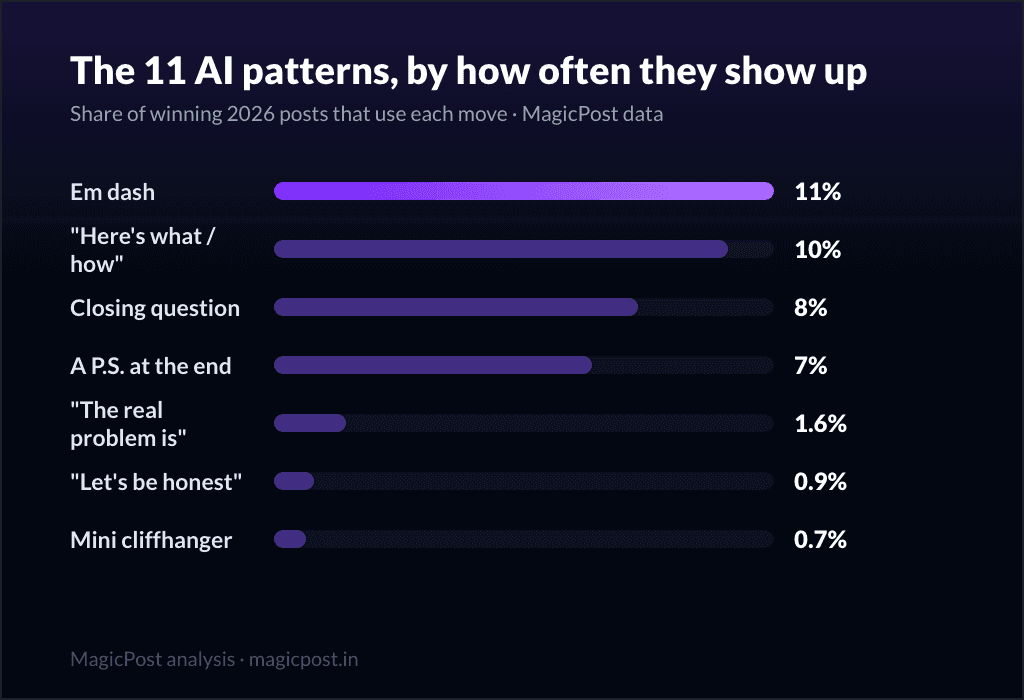
Run Lubin's writing through the patterns people now call "AI tells," and the result is revealing:

His one characteristic device is the closing question: 40% of his posts end by turning to the reader ("Les trentenaires, ça vous parle ?", "Alors, qui relève le défi ?"). A smaller share open with a "here is what I learned" reveal, and about one in six leans on the "it's not X, it's Y" contrast ("Ici, l'échec est risible. Là-bas, l'échec est valorisé.").
Do not read it backwards. Lubin does not write like an AI; AI writes like Lubin. These moves read as robotic today because the models trained on the best storytellers of this platform, then stacked every move into every post. Lubin uses the closing question where it earns its place, as a genuine invitation after a personal story, and he is clean on the filler AI cannot help adding: he never hedges, never opens a line with a mechanical "Moreover." The discipline is the signature. (Full story: how to spot AI writing on LinkedIn.)
When he posts
Lubin publishes rarely, about once every two weeks, and that scarcity is the point: each post is an event. His favorite slot is Tuesday around 10 AM Paris time, almost everything on weekdays (only 4% on weekends). That mid-morning, mid-week window lines up with our France timing data, and his low cadence sits at the opposite end of our posting-frequency study from the daily grinders. His comments run unusually hot for his like count (a median of 123 comments against 785 likes), the sign of an audience that writes back. And if showing up in his comments is part of your playbook, that is what an engagement feed is for: his posts, the day they land, without hunting the timeline.
What to steal from Ulysse Lubin
Open on a number. Nearly half his hooks are a count or measurement ("-35 m," "5 banques"). A concrete first line beats a vague one every time.
Show, do not advise. "Voilà ce que j'ai fait. Voilà ce que j'ai appris." He earns the lesson by living it first, then lets you decide.
Build a signature story, then know when to close it. He rode "100 challenges" for years and chose the exact post to retire it. The story is an asset, including its ending.
One real question at the end. His closing questions land because they follow a real story, not a formula.
Post less, land harder. His median engagement rose while his volume fell. Making each post count beats frequency.
Study him, then study yourself. With MagicPost you can dig into Lubin's numbers the way we just did, analyze your own LinkedIn the same way, and write in the spirit of his style, in your own voice. The data on this page is the product.
Where this data comes from
Everything in this article is MagicPost's own research. MagicPost analyzed 137 of Ulysse Lubin's public LinkedIn posts back to 2022: timing, engagement, topics, writing metrics, and the AI-pattern profile from a 30-post style sample. Every biographical claim is quoted from one of his own posts and linked to it. Lubin is not affiliated with MagicPost; his style is one of those we track closely.
SSS
Who is Ulysse Lubin?
A French explorer and entrepreneur with about 114,000 LinkedIn followers. In 2020 he quit his Paris job to take on "100 challenges around the world," documented across the jungle, Antarctica and a muay thai ring, wrote a book with Albin Michel (1000 jours en quête de sens), and in 2026 founded a company, Supranormal.
How does Ulysse Lubin make money?
By his own public account: products built around his journey, including an introspection workshop "pour trouver sa voie" and a method for getting started, plus his book, alongside the Supranormal venture he announced in 2026.
How often does Ulysse Lubin post on LinkedIn?
Rarely and deliberately, about once every two weeks in our data, most often around 10 AM Paris time on a Tuesday, and almost never on weekends.
Does Ulysse Lubin write with AI?
His style reads intensely human: a narrative built on concrete number-hooks, almost no hedging, and a real closing question after a real story. The twist is that AI tools learned from storytellers like him, which is why patterns such as the closing question now get mislabeled as "AI tells."
Is Ulysse Lubin still growing on LinkedIn?
His median engagement per post rose every year we measured (about 547 in 2022 to 824 in 2024) even as he posted less often.
Can I write like Ulysse Lubin?
You can learn the mechanics: MagicPost learns a creator's writing style (length, rhythm, hooks, signature moves) and helps you write in that spirit, in your own voice.
The Top LinkedIn Creators to Study in 2026 (By the Data)
The top LinkedIn creators to study in 2026, by the data: 62 creators, six languages, 27 countries, 32,000 posts analyzed by MagicPost. Grouped by what they teach.
Who Is Justin Welsh? The $10M Solopreneur, Explained by Data (2026)
Who is Justin Welsh? MagicPost analyzed 1,303 of their LinkedIn posts: topics, timing, signature moves and the writing fingerprint behind their growth, with rea
Who Is Matt Barker? The Hook Writer on LinkedIn, by Data (2026)
Who is Matt Barker? MagicPost analyzed 1,047 of their LinkedIn posts: topics, timing, signature moves and the writing fingerprint behind their growth, with real
Who Is Lara Acosta? The Forbes 30 Under 30 Comment Machine, Explained by Data (2026)
Who is Lara Acosta? MagicPost analyzed 461 of their LinkedIn posts: topics, timing, signature moves and the writing fingerprint behind their growth, with real n
Who Is Jasmin Alić? The Bosnian Coach LinkedIn Mistook for a Bot (2026)
Who is Jasmin Alić? MagicPost analyzed 364 of their LinkedIn posts: topics, timing, signature moves and the writing fingerprint behind their growth, with real n
Who Is Caroline Mignaux? France's LinkedIn Top Voice Who Turned Shame Into a Following (2026)
Who is Caroline Mignaux? MagicPost analyzed 684 of their LinkedIn posts: topics, timing, signature moves and the writing fingerprint behind their growth, with r
Who Is Orane Janvier? The Freelance Coach LinkedIn Quietly Copies (2026)
Who is Orane Janvier? MagicPost analyzed 505 of their LinkedIn posts: topics, timing, signature moves and the writing fingerprint behind their growth, with real
Who Is Benoît Dubos? The Growth Operator Who Turned a Falling Reach Into a Lead Machine (2026)
Who is Benoît Dubos? MagicPost analyzed 424 of their LinkedIn posts: topics, timing, signature moves and the writing fingerprint behind their growth, with real
Who Is Ruben Hassid? The "Master AI Before It Masters You" Creator, Explained by Data (2026)
Who is Ruben Hassid? MagicPost analyzed 1,189 of their LinkedIn posts: topics, timing, signature moves and the writing fingerprint behind their growth, with rea
Who Is Juliette Cadot? The Agency Founder Whose Audience Talks Back (2026)
Who is Juliette Cadot? MagicPost analyzed 398 of their LinkedIn posts: topics, timing, signature moves and the writing fingerprint behind their growth, with rea