" height="26.80529977783203px" id="tymKb8bqC" width="128.00300311279295px"/><path d="M 0 2.417 L 0 0 L 12.909 0 L 12.909 2.417 Z" fill="rgb(126, 78, 253)" height="2.417099999999998px" id="aYr4em6zK" transform="translate(128.341 22.325)" width="12.908999999999992px"/></svg>)

"/><stop offset="1" stop-color="rgb(118, 37, 250)"/></linearGradient></defs><g d="M 19.242 21.22 L 19.362 6.204 L 19.272 6.204 L 13.757 21.22 L 10.161 21.22 L 4.796 6.204 L 4.706 6.204 L 4.825 21.22 L 0 21.22 L 0 0 L 7.283 0 L 12.109 13.607 L 12.229 13.607 L 16.844 0 L 24.247 0 L 24.247 21.22 Z M 26.421 26.113 L 26.421 23.445 L 41.407 23.445 L 41.407 26.113 Z" fill="transparent" height="26.112508199679183px" id="DvfaAIHYn" width="41.40731898311435px"><path d="M 19.242 21.22 L 19.362 6.204 L 19.272 6.204 L 13.757 21.22 L 10.161 21.22 L 4.796 6.204 L 4.706 6.204 L 4.825 21.22 L 0 21.22 L 0 0 L 7.283 0 L 12.109 13.607 L 12.229 13.607 L 16.844 0 L 24.247 0 L 24.247 21.22 Z" fill="rgb(46, 46, 46)" height="21.220180016149442px" id="pLsxRCobd" width="24.247352589074694px"/><path d="M 0 2.668 L 0 0 L 14.986 0 L 14.986 2.668 Z" fill="url(%23yD9d4I5GR-3279285344-linear-gradient)" height="2.6675085048549647px" id="yD9d4I5GR" transform="translate(26.421 23.445)" width="14.986002836263765px"/></g></svg>)

Bénédicte Rivory
Educators who treat LinkedIn like a living portfolio win faster opportunities than those who treat it like an online CV. The platform turns expertise into visible proof, and proof into connections that matter: partnerships, speaking invitations, consulting, curriculum work, research collaborations, and hiring conversations.
The rule is simple: the advantage goes to educators who package their knowledge into clear positioning and repeatable content. A good profile attracts the right people, consistent posts create trust at scale, and targeted networking unlocks doors without chasing them.
Why Educators Should Use LinkedIn?
LinkedIn provides educators with a public layer of credibility that a resume cannot. Teaching impact, curriculum design, research interests, and classroom successes become visible proof, not private claims. This proof attracts the right conversations faster than job boards or cold outreach.
LinkedIn also broadens opportunities beyond “teaching jobs.” Educators utilize it to secure partnerships with schools and edtech teams, join pilot programs, receive invitations to speak, publish thought leadership, contribute to policy discussions, and obtain consulting or training work. The platform rewards clear expertise, not loud self-promotion.
Networking becomes more effective as well. Instead of sending messages into the void, educators can engage in public discussions, build familiarity through consistent contributions, and convert warm interactions into introductions. This creates a professional network that compounds over time.
Benefits that matter for educators:
✔️ Stronger professional visibility with proof of expertise and pedagogy
✔️ More opportunities: roles, partnerships, speaking, consulting, publishing
✔️ Faster access to decision-makers in education and edtech
✔️ Higher trust through consistent public contributions
✔️ A portable reputation that travels across schools, countries, and projects



How to Make the Most of Your LinkedIn Profile as an Educator?
Define a Clear Educator Positioning
A strong educator positioning makes the profile instantly understandable. One sentence should communicate who is helped, what is improved, and where the expertise resides. This is not personal branding fluff; it is a filter that attracts relevant connections and repels random noise.
A positioning can be built from one primary axis and one specialty. Primary axis examples include grade level, subject, student population, or role type. Specialty examples include literacy, social-emotional learning, neurodiversity, STEM, project-based learning, assessment design, teacher training, curriculum development, school leadership, instructional design, learning analytics, or educational technology implementation.
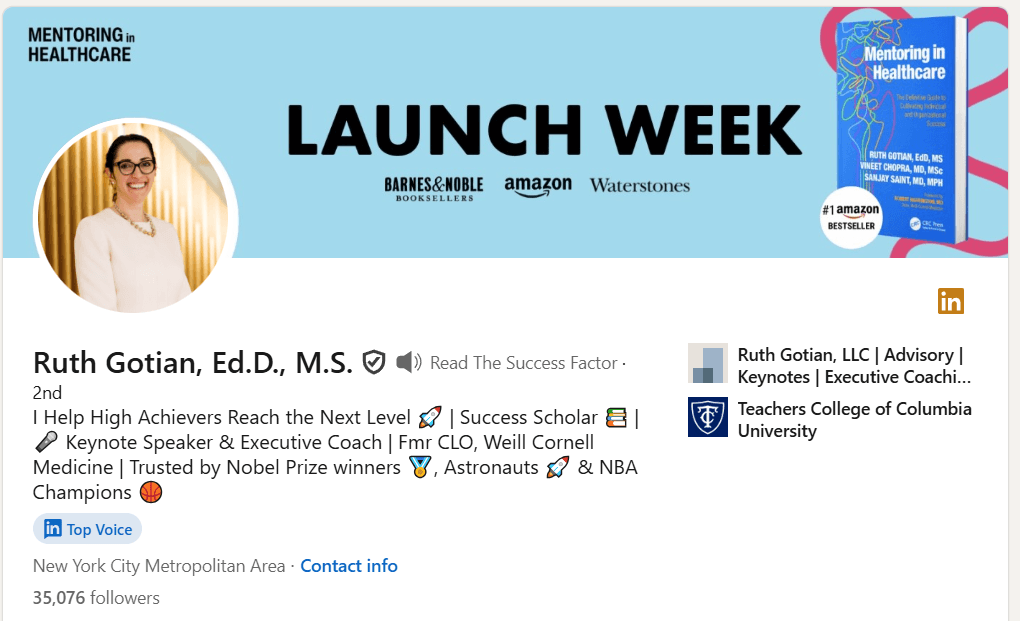
Examples of impact headlines for educators:
High School Science Educator | Project-Based Learning | Higher engagement and exam readiness
Literacy Specialist | Early Reading Intervention | Stronger fluency and comprehension outcomes
Instructional Designer | Higher Education and Corporate Learning | Courses that drive completion and application
Teacher Trainer | Classroom Management and Social-Emotional Learning | Confident teachers and calmer classrooms
Keep it specific, avoid exaggerated claims, and align wording with the real positioning. This makes search, profile scanning, and inbound opportunities more likely to match the actual work.
Turn the About Section Into a Proof Narrative
The About section should read like a credibility snapshot, not a biography. The goal is to make a recruiter, school leader, or partner understand teaching context, approach, and results in under 20 seconds.
Structure that works
Line 1: educator identity + niche (grade/subject/population)
Line 2: problems solved (what improves, what gets fixed)
Line 3: approach (methods, pedagogy, systems, tools)
Line 4: proof (outcomes, examples, concrete wins)
Line 5: collaboration signal (open to roles, partnerships, speaking, curriculum work)
Line 6: simple CTA (connect for X, message for Y)
Proof beats adjectives. Replace “passionate” with real artifacts: curriculum built, program launched, classroom outcomes, training delivered, research published, resources created, community led. Numbers help when available, but specifics work even without metrics.
Use Featured Content as a Living Portfolio
The Featured section should function like a portfolio shelf. It shows proof immediately, without forcing people to scroll through a full career history. Three to five strong items are enough.
Pick assets that match the positioning and the opportunities being targeted. Good options include a curriculum sample, a lesson resource, a slide deck, a research summary, a conference talk, a newsletter issue, a thread that explains a teaching framework, or a case showing how a learning problem was solved.
A simple selection rule keeps it sharp: one artifact that proves expertise, one that proves outcomes, one that proves communication. When possible, add a short description that frames what the viewer should notice and why it matters.
MagicPost supports this by turning these artifacts into a consistent content loop. One Featured item can generate multiple posts: a mini case, a framework breakdown, a practical template, and a recap that invites educators to connect. Try Magicpost for free today and launch your LinkedIn strategy as an educator!✨
Rewrite Experience as Outcomes (Not Duties)
Experience sections often fail because they read like task lists. A strong educator profile translates work into outcomes, decisions, and improvements. The point is to show what changed because of the work, not what was done every day.
A clean structure per role:
👉 Context: school type, level, constraints, audience
👉 Scope: subjects, cohorts, programs, responsibilities that matter
👉 Actions: what was built, redesigned, launched, or improved
👉 Outcomes: what improved and how it was measured or observed
👉 Collaboration: cross-functional work with leadership, families, partners, edtech
Examples of outcome-style bullets:
Redesigned assessment system to improve feedback speed and student ownership of learning
Built a project-based unit sequence that increased engagement and quality of final work
Led teacher training on classroom routines, improving consistency across a grade team
Implemented learning supports for diverse learners with clearer differentiation pathways
Specificity does the heavy lifting. Add names of programs, methods, and deliverables when possible. Replace “taught” with “built,” “designed,” “led,” “implemented,” “improved,” and “measured.”
6 Educators That You Must Follow on LinkedIn in 2026!
The smartest educator feeds are a mix of classroom practicality, learning science, instructional design, and leadership. The names below consistently publish ideas that can be applied quickly, not vague inspiration.
These creators also model what “educator authority” looks like on LinkedIn in 2026: clear positioning, repeatable content formats, and strong community engagement. Following them makes it easier to spot trends, improve teaching practice, and enhance how educational work is presented publicly.
Dr Philippa Hardman: instructional design and learning science, with a strong focus on practical systems and AI in learning design
Ruth Gotian: high performance in academia, mentorship, and career growth in educational leadership
Ross Morrison McGill: K-12 teacher perspectives and classroom practice, widely followed for practical teaching insights
Elizabeth Leiba: higher education and online learning, instructional design, and discussions on education equity
George Couros: a voice in school leadership focused on innovation, digital learning culture, and practical change management for educators
Dr. Catlin Tucker: a blended learning specialist sharing classroom-ready frameworks for engagement, differentiation, and sustainable teaching workflows
Conclusion
LinkedIn works for educators when the profile reads like proof, not a CV. Clear positioning makes expertise instantly legible. An impactful headline increases the quality of inbound connections. A proof-driven About section builds credibility quickly. Featured assets act as a living portfolio. Outcome-based experience descriptions make teaching impact obvious to recruiters, partners, and edtech teams.
Consistency turns all of this into a flow of opportunities. Publishing and engaging regularly keeps expertise visible, warms up networking, and opens doors to roles, collaborations, speaking engagements, and consulting without the need to chase them.