" height="26.80529977783203px" id="tymKb8bqC" width="128.00300311279295px"/><path d="M 0 2.417 L 0 0 L 12.909 0 L 12.909 2.417 Z" fill="rgb(126, 78, 253)" height="2.417099999999998px" id="aYr4em6zK" transform="translate(128.341 22.325)" width="12.908999999999992px"/></svg>)

"/><stop offset="1" stop-color="rgb(118, 37, 250)"/></linearGradient></defs><g d="M 19.242 21.22 L 19.362 6.204 L 19.272 6.204 L 13.757 21.22 L 10.161 21.22 L 4.796 6.204 L 4.706 6.204 L 4.825 21.22 L 0 21.22 L 0 0 L 7.283 0 L 12.109 13.607 L 12.229 13.607 L 16.844 0 L 24.247 0 L 24.247 21.22 Z M 26.421 26.113 L 26.421 23.445 L 41.407 23.445 L 41.407 26.113 Z" fill="transparent" height="26.112508199679183px" id="DvfaAIHYn" width="41.40731898311435px"><path d="M 19.242 21.22 L 19.362 6.204 L 19.272 6.204 L 13.757 21.22 L 10.161 21.22 L 4.796 6.204 L 4.706 6.204 L 4.825 21.22 L 0 21.22 L 0 0 L 7.283 0 L 12.109 13.607 L 12.229 13.607 L 16.844 0 L 24.247 0 L 24.247 21.22 Z" fill="rgb(46, 46, 46)" height="21.220180016149442px" id="pLsxRCobd" width="24.247352589074694px"/><path d="M 0 2.668 L 0 0 L 14.986 0 L 14.986 2.668 Z" fill="url(%23yD9d4I5GR-3279285344-linear-gradient)" height="2.6675085048549647px" id="yD9d4I5GR" transform="translate(26.421 23.445)" width="14.986002836263765px"/></g></svg>)
Tworzenie treści

Saad Mouaouine
A growing number of founders and B2B teams are shopping for LinkedIn content agencies in 2026. LinkedIn is 227% more effective for lead generation compared to other social media platforms, and consistent posting takes time most executives don’t have.
The problem is that the agency market is opaque, expensive, and full of promises that don’t always survive contact with reality.
This guide covers what a LinkedIn content agency actually does day-to-day, what the real costs look like, and when an agency makes sense versus when it’s more than you need.
What Is a LinkedIn Content Agency?
A LinkedIn content agency manages some or all of a company’s executive LinkedIn presence on their behalf. Services typically include content strategy, post writing, scheduling, community management, and performance reporting.

Retainers range from $1,500 to $10,000+ per month depending on scope. For founders and small B2B teams focused on organic thought leadership, dedicated LinkedIn platforms offer the same output at a fraction of the cost.
What Does a LinkedIn Content Agency Actually Do?
Most people buying content agency services aren’t sure what they’re paying for.

In practice, a LinkedIn content agency handles some combination of the following:
Strategy: Deciding which topics to own, which formats to use, how often to post, and how to align content with business goals like pipeline or hiring.
Content creation: Writing posts, sometimes carousels or articles, on behalf of the client or their executives.
Scheduling and publishing: Managing the content calendar and getting posts live at the right times.
Community management: Responding to comments, engaging with target accounts, and managing the inbox to grow your network or generate leads.
Reporting: Creating monthly summaries of impressions, engagement, follower growth, and occasionally pipeline attribution.
What the pitch deck rarely shows you is the operational reality: briefing calls to fill in the agency on your world, waiting several days for drafts, rounds of revisions over email, and content that often still needs heavy editing before it sounds like you.
✅ Pro Tip: Ask any agency you evaluate to walk you through their exact content production workflow, from brief to publish. The answer will tell you a lot about turnaround time, how many hands touch your content, and whether you’ll spend your time reviewing or actually approving.
How Much Does a LinkedIn Content Agency Cost?
Agency pricing is deliberately hard to find. Most hide fees behind discovery calls. Based on current industry benchmarks, here’s what the market actually looks like:
Service Level | Monthly Cost | What's Typically Included |
|---|---|---|
Freelance ghostwriter | $500–$1,500 | 4–12 posts/month, basic voice matching, with minimal strategy |
Boutique content agency | $1,500–$4,000 | Strategy call, 12–16 posts, scheduling, and monthly reports |
Full-service LinkedIn agency | $4,000–$10,000+ | Multi-format content, paid ads, CRM integration, and a dedicated account manager |
Enterprise positioning agency | $10,000+ | Executive narrative, investor comms, PR alignment, and crisis management |
📊 Source: Clicks Geek, Windmill Growth, 2026 industry benchmarks.
The published retainer is rarely the full number. Factor in setup fees (often one to two months of the retainer), revision rounds that creep beyond scope, and six- to twelve-month lock-in contracts before the ROI conversation even starts.
⚠️ Watch Out: Most agency contracts include a minimum term of six to twelve months. If the content quality isn’t there after month two, you’re still paying. Ask for a monthly rolling option or a short pilot period before committing to a long-term contract.
Why LinkedIn Agency Content Often Sounds Generic
This is the most common complaint from founders who have been through the agency experience. The content is grammatically fine; it’s posted on schedule, but it doesn’t sound like them.
The reason is primarily structural:
Most agencies assign clients to junior writers or content managers who are skilled at producing volume but don’t have deep industry expertise.
They work from a brief, produce something plausible, and move on.
The result is content that could have been written for any founder in any sector.
LinkedIn’s algorithm also penalizes generic AI-sounding content with 30% less reach and 55% less engagement. Content that lacks specificity, personal opinion, or original insight underperforms regardless of who wrote it.
Voice matching is the hardest thing in content outsourcing:
A good agency solves it through deep onboarding, structured interviews, and a writer who sticks with one client long-term.
A mediocre agency treats it as a box-ticking exercise during onboarding and hopes you don’t notice the drift.
✅ Pro Tip: Before signing with any agency, ask them to write three sample posts using only a 30-minute call as input, without seeing your existing content. The quality of those samples is the ceiling of what you’ll get in month three when the account manager moves on to their next client.
When Does Hiring a LinkedIn Content Agency Make Sense?
Agencies earn their price in specific situations. If any of the following apply to you, a full-service agency is probably the right call:
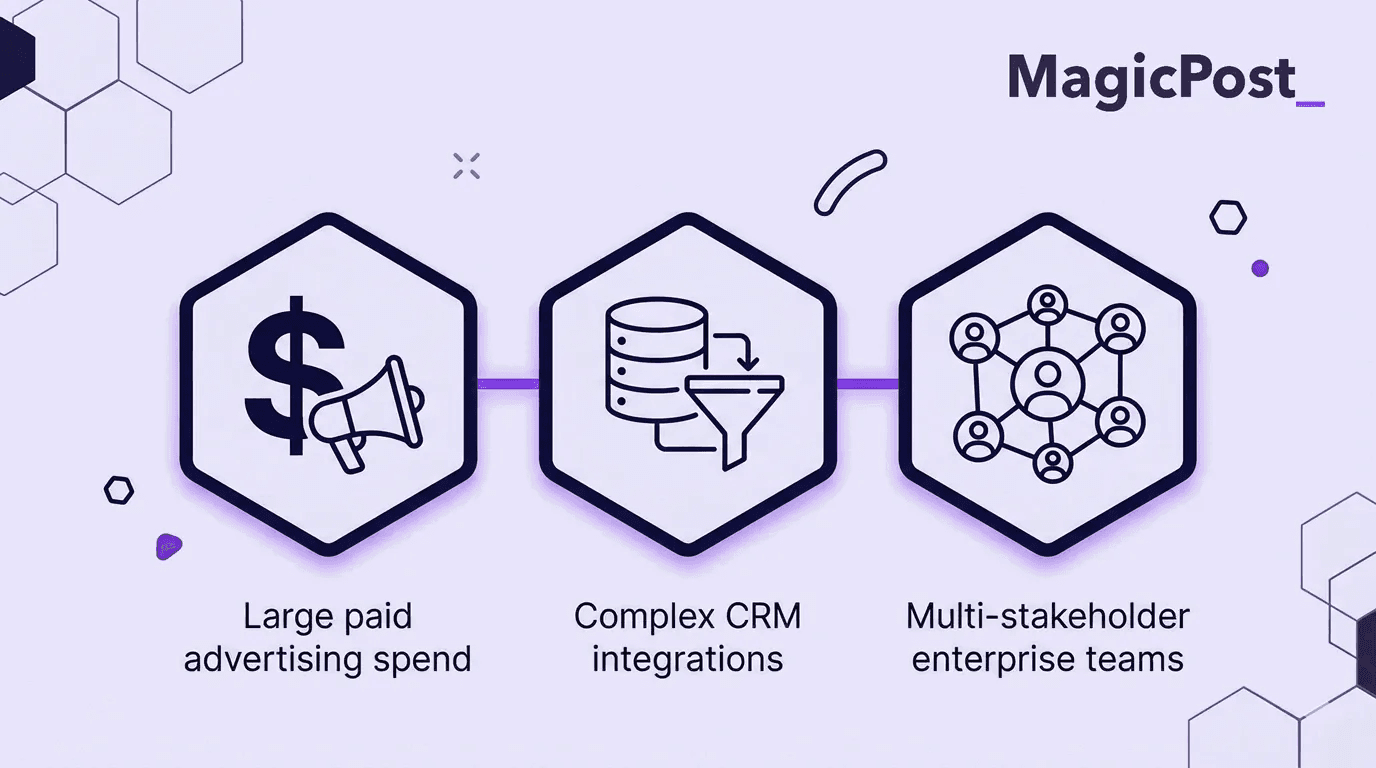
You’re running paid LinkedIn campaigns alongside organic content: Agencies with media-buying expertise justify their retainer through ad performance, not just post volume.
Your LinkedIn strategy requires CRM integration and lead attribution: Connecting content to pipeline data across HubSpot, Salesforce, or similar systems is genuinely complex work.
You need multi-stakeholder content at enterprise scale: Coordinating content across a C-suite, investor relations, and PR requires human judgment that software cannot replace.
You’re in a regulated industry: Financial services, healthcare, and legal sectors need compliance review baked into the content workflow, which agencies can structure.
Your monthly LinkedIn ad spend exceeds $20,000: At that level, the optimization expertise an agency brings can return more than their fee in ad efficiency alone.
Outside of these situations, most founders are buying more agency than they need.
When Do You Not Need a LinkedIn Content Agency?
If your primary goal is consistent organic thought leadership and inbound pipeline from LinkedIn, an agency is often overkill. Ask yourself the following questions:
Question | If yes... |
|---|---|
Is your main goal consistent posting and growing your personal brand? | A platform handles this better and faster than an agency |
Are you a founder or solopreneur at a 1–20 person company? | Agency overhead is not designed for your stage |
Do you want your own voice in the content, not a writer's interpretation of it? | Voice-matched AI outperforms junior agency writers on this |
Is your budget under $2,000/month for LinkedIn content? | No quality agency operates at this level; software does |
Do you want to post more than three times a week? | Agency volume at that frequency is extremely expensive |
The audience most oversold on agency services is B2B founders and solopreneurs who need consistent LinkedIn posting and inbound visibility. That’s a content consistency problem, not a strategy complexity problem. It doesn’t require a six-person agency team.
What Most Founders Use Instead of LinkedIn Content Agencies
The alternative to a full agency isn’t doing it yourself manually. It’s a dedicated LinkedIn platform that handles the parts of the workflow that consume time (drafting, scheduling, and analytics) while keeping you in control of the voice and the strategy.
There’s a huge operational difference between the two approaches.
MagicPost connects to your LinkedIn profile, imports your writing style from past posts, and generates drafts that match your specific tone. You pick the post type and subject, review the draft, and schedule in one step. There are no briefing calls, no waiting for a writer's turnaround, and no revision chains.
Operational Variable | Traditional Agency | MagicPost |
|---|---|---|
Idea generation | ❌ Scheduled brainstorming calls; relies on account manager research | ✅ AI surfaces relevant ideas from your niche instantly |
Content drafting | ❌ Multi-day turnaround; junior writer interprets your brief | ✅ Draft generated in seconds, matched to your voice and past posts |
Revisions | ❌Back-and-forth over email; risk of voice drift with each round | ✅ Edit directly in-platform; no third party in the loop |
Scheduling | ❌Manual or via disconnected third-party tools | ✅ One-click scheduling via LinkedIn's official API |
Analytics | ❌Monthly PDF report; no real-time visibility | ✅ Live dashboard: impressions, engagement, follower growth |
Monthly cost | ❌ $3,000–$10,000+ | ✅ From $49/mo. |
Account safety | ❌ Varies; many agencies share credentials or use risky tools | ✅ LinkedIn-verified partner; official API only |
For agencies managing multiple client accounts, MagicPost's Agency plan adds multi-account management, a built-in client approval workflow, and white-label reporting. Each client gets a dedicated space with their own voice settings with no password sharing or login juggling.
Want agency-quality LinkedIn content without the agency price tag? Try MagicPost for free. No credit card or commitment is required.
FAQ
What does a LinkedIn content agency charge per month?
Most boutique LinkedIn content agencies charge between $1,500 and $4,000 per month for organic content management. Full-service agencies with paid media included typically start at $4,000 and go well above $10,000 for enterprise accounts.
Freelance ghostwriters operate between $500 and $1,500 for basic packages. See our LinkedIn ghostwriting guide for a detailed pricing breakdown by tier.
Is hiring a LinkedIn content agency worth it?
For enterprise companies with complex content needs, paid campaigns, and multi-stakeholder communication, yes. For most founders and small B2B teams focused on organic thought leadership, the cost-to-value ratio rarely works out.
A dedicated LinkedIn platform gives you faster output, better voice matching, and real-time analytics at a fraction of the price.
What is the difference between a LinkedIn content agency and a LinkedIn management tool?
An agency is a service: people manage your presence for you. A LinkedIn management tool is software that gives you the infrastructure to manage it yourself, faster and more consistently. The best tools include AI drafting, scheduling, analytics, and in some cases team features for agencies.
For a full comparison, see our best LinkedIn management tools guide.
How do I know if a LinkedIn agency is safe to use?
The key question is how they publish content. Agencies that log into client accounts directly or use browser extension tools violate LinkedIn's Terms of Service and risk account restrictions. Agencies or tools that publish through LinkedIn's official OAuth API are fully compliant.
Ask any agency how they handle publishing before you share account access. See our guide to LinkedIn account restrictions for what to watch for.
Can I get the same results as a LinkedIn agency using AI tools?
For organic thought leadership (consistent posting, growing your personal brand, and generating inbound inquiries), yes. AI tools trained on your past posts and LinkedIn posting strategy produce content in your voice faster than a human ghostwriter and at a fraction of the cost.
Where agencies maintain an advantage is in complex paid campaigns, CRM integration, and enterprise multi-stakeholder content programs.
LinkedIn Ghostwriting: How to Build and Scale in 2026
LinkedIn ghostwriting is one of the fastest-growing services in B2B for 2026. Here’s how to capture client voices, manage approvals, and scale your operation.
Social Selling on LinkedIn: Win B2B Sales with Content (2026)
Social selling on LinkedIn isn’t about sending more InMails. You need to build the presence that makes prospects reply before you ever reach out. Here’s how.
Best LinkedIn Management Tools in 2026 (Tested and Compared)
Looking for the best LinkedIn management tool in 2026? We compared MagicPost, Taplio, Supergrow, RedactAI, and others on quality, safety, and price.
Jak zdobyć więcej obserwujących na LinkedIn w 2026 roku
Zmagasz się z rozwojem na LinkedIn? Dowiedz się, jakie konkretne strategie, ramy oraz nawyki publikacji naprawdę pomogą Ci zdobyć więcej obserwujących na LinkedIn w 2026 roku.
Czym jest zaangażowanie na LinkedIn (i jak je opanować w 2026 roku)
Zmagasz się z zaangażowaniem na LinkedIn? Dowiedz się, jak algorytm LinkedIn to ocenia, jakie są wskaźniki na rok 2026 oraz 4 filary, które zwiększą twoje interakcje.
Jak mierzyć wydajność treści na LinkedIn (2026)
Nie jesteś pewien, jak mierzyć wyniki treści na LinkedIn? Poznaj 3 metryki, które naprawdę mają znaczenie, oraz wskaźniki i prosty system śledzenia.