" height="26.80529977783203px" id="tymKb8bqC" width="128.00300311279295px"/><path d="M 0 2.417 L 0 0 L 12.909 0 L 12.909 2.417 Z" fill="rgb(126, 78, 253)" height="2.417099999999998px" id="aYr4em6zK" transform="translate(128.341 22.325)" width="12.908999999999992px"/></svg>)

"/><stop offset="1" stop-color="rgb(118, 37, 250)"/></linearGradient></defs><g d="M 19.242 21.22 L 19.362 6.204 L 19.272 6.204 L 13.757 21.22 L 10.161 21.22 L 4.796 6.204 L 4.706 6.204 L 4.825 21.22 L 0 21.22 L 0 0 L 7.283 0 L 12.109 13.607 L 12.229 13.607 L 16.844 0 L 24.247 0 L 24.247 21.22 Z M 26.421 26.113 L 26.421 23.445 L 41.407 23.445 L 41.407 26.113 Z" fill="transparent" height="26.112508199679183px" id="DvfaAIHYn" width="41.40731898311435px"><path d="M 19.242 21.22 L 19.362 6.204 L 19.272 6.204 L 13.757 21.22 L 10.161 21.22 L 4.796 6.204 L 4.706 6.204 L 4.825 21.22 L 0 21.22 L 0 0 L 7.283 0 L 12.109 13.607 L 12.229 13.607 L 16.844 0 L 24.247 0 L 24.247 21.22 Z" fill="rgb(46, 46, 46)" height="21.220180016149442px" id="pLsxRCobd" width="24.247352589074694px"/><path d="M 0 2.668 L 0 0 L 14.986 0 L 14.986 2.668 Z" fill="url(%23yD9d4I5GR-3279285344-linear-gradient)" height="2.6675085048549647px" id="yD9d4I5GR" transform="translate(26.421 23.445)" width="14.986002836263765px"/></g></svg>)

Naïlé Titah
Short answer: not exactly. LinkedIn does not ban AI, and it does not punish you for opening ChatGPT. What it demotes is generic content, the kind that sounds polished but says nothing. AI just happens to produce a lot of it.
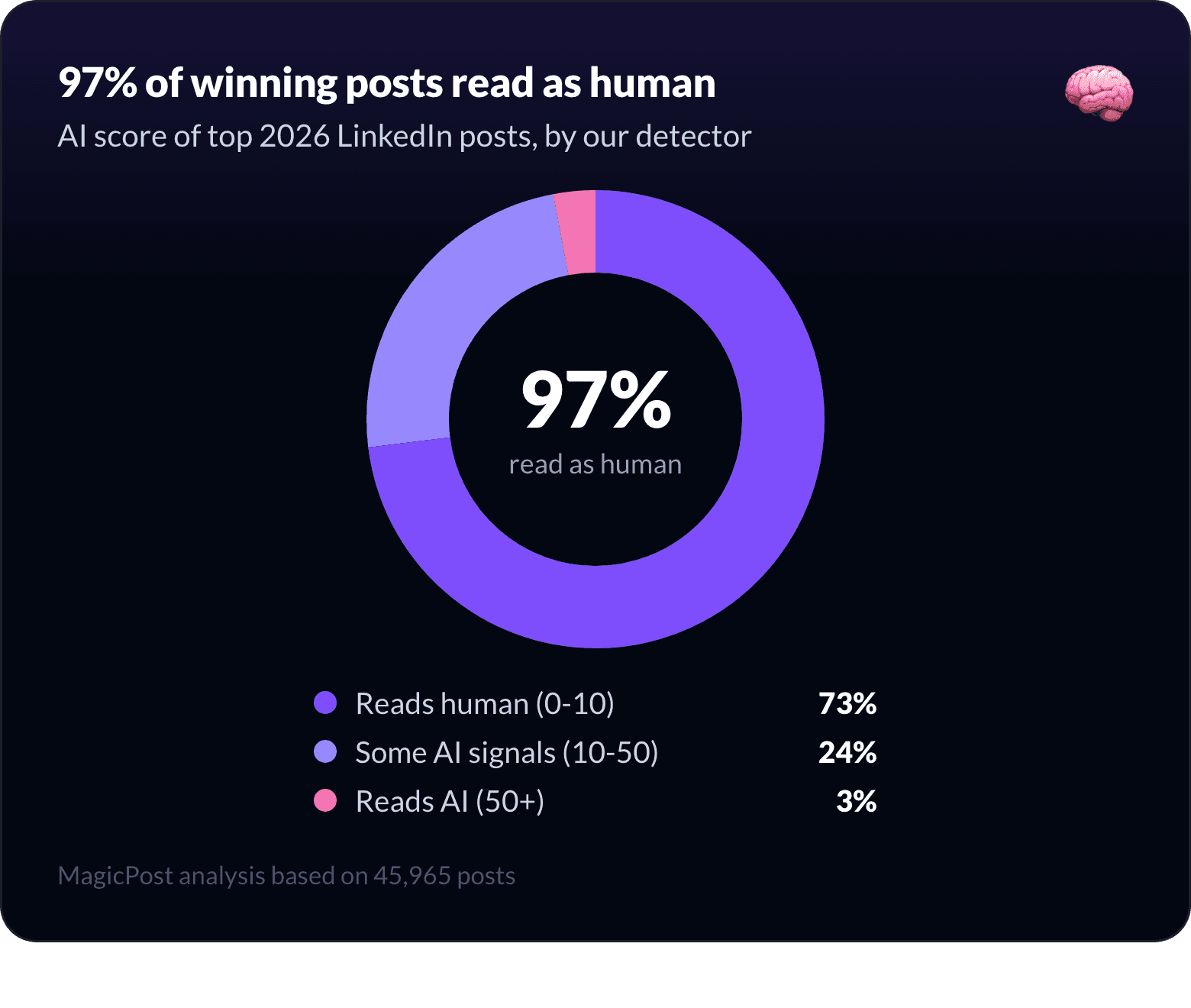
And the data backs this up from the other side. We scored 45,965 of the best-performing LinkedIn posts of 2026 (all with more than 20 likes) with our own AI detector. 97% of them read as human. The posts that win are overwhelmingly the ones that sound like a person. So the question is not really "will I get penalized for AI." It is "does my post still sound like me."
Here is what is actually happening, and what to do about it.
What LinkedIn actually announced
In May 2026, LinkedIn made its position official. In a post titled "Keeping conversations real on LinkedIn", Laura Lorenzetti (VP and Executive Editor, LinkedIn Global Editorial) announced a crackdown on what she called "AI slop": "low-effort, AI-generated content that may sound polished on the surface but lacks any real unique perspective or substance."
The key line, in LinkedIn's own words:
"It's ok to use AI to help you write, but your posts and comments need to represent your voice and your perspectives. The ultimate value comes from the human behind the tool."
So the target is not AI. It is emptiness. LinkedIn says its systems now tell apart content that "adds perspective, context, or expertise" from content that "feels generic or repetitive, even if it appears polished on the surface."



What "penalize" actually means here
This matters, because "penalty" sounds like a ban. It is not. Here is the real mechanism, straight from the announcement:
What people fear | What LinkedIn actually does |
Your post gets removed | It stays up. Nothing is deleted. |
Your account gets punished | No account-level penalty mentioned. |
AI writing is banned | AI-assisted writing is explicitly fine. |
The real effect | Generic-looking posts are less likely to be distributed beyond your immediate network. |
In LinkedIn's words, when content reads as generic AI, "it is less likely to be widely distributed beyond a person's immediate network." Your connections may still see it. The wider feed will not. And the detection is not a toy: LinkedIn reports it is "correctly identifying generic content 94% of the time" in early testing.
So the downside is not a strike. It is silence. Your post simply stops traveling.
What the data shows: the winners sound human
We looked at this from the content side. Across 45,965 top posts from 2026:
AI score (our detector, 0-100) | Share of top posts |
Reads clearly human (0-10) | 73% |
Some AI signals (10-50) | 24% |
Reads clearly AI (50+) | 3.1% |
Only about 1 in 30 high-performing posts reads as clearly AI. Whatever you think of LinkedIn's filter, the market has already voted: the content that earns reach is the content that sounds like a human with a point of view.
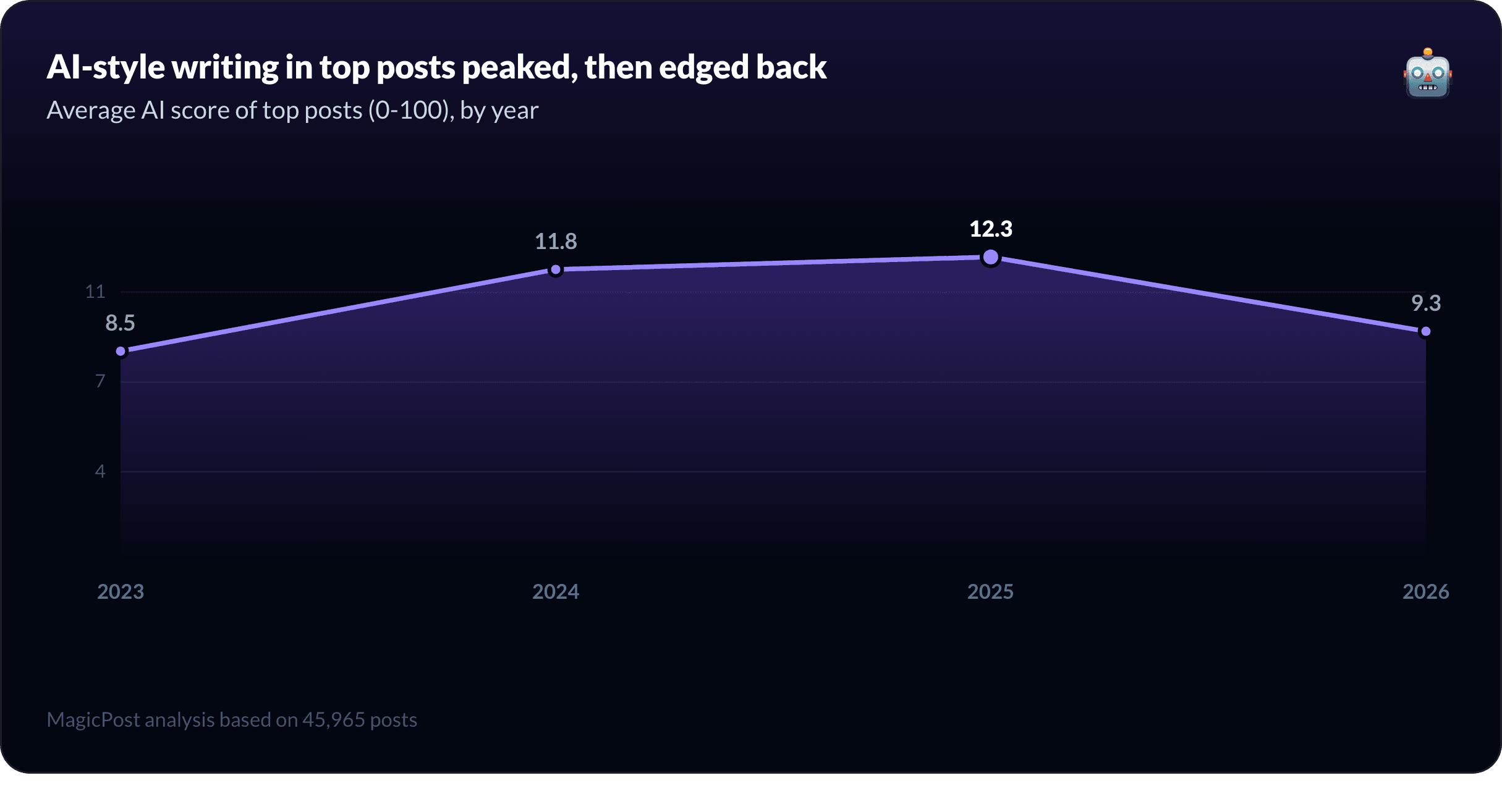
There is even a time signal. AI-style writing in top posts climbed every year through 2025, then edged back down in early 2026:
Year | Average AI score of top posts |
2023 | 8.5 |
2024 | 11.8 |
2025 | 12.3 |
2026 (so far) | 9.3 |
We will not over-read a half-year, but the direction lines up with the crackdown and with creators cleaning up their writing. The generic stuff is starting to cost more than it returns.
The nuance everyone misses: top creators use the "AI" moves constantly
Here is where most takes on this get it wrong. The moves that read as AI are not AI inventions. They are the signature moves of the best human creators on the platform.
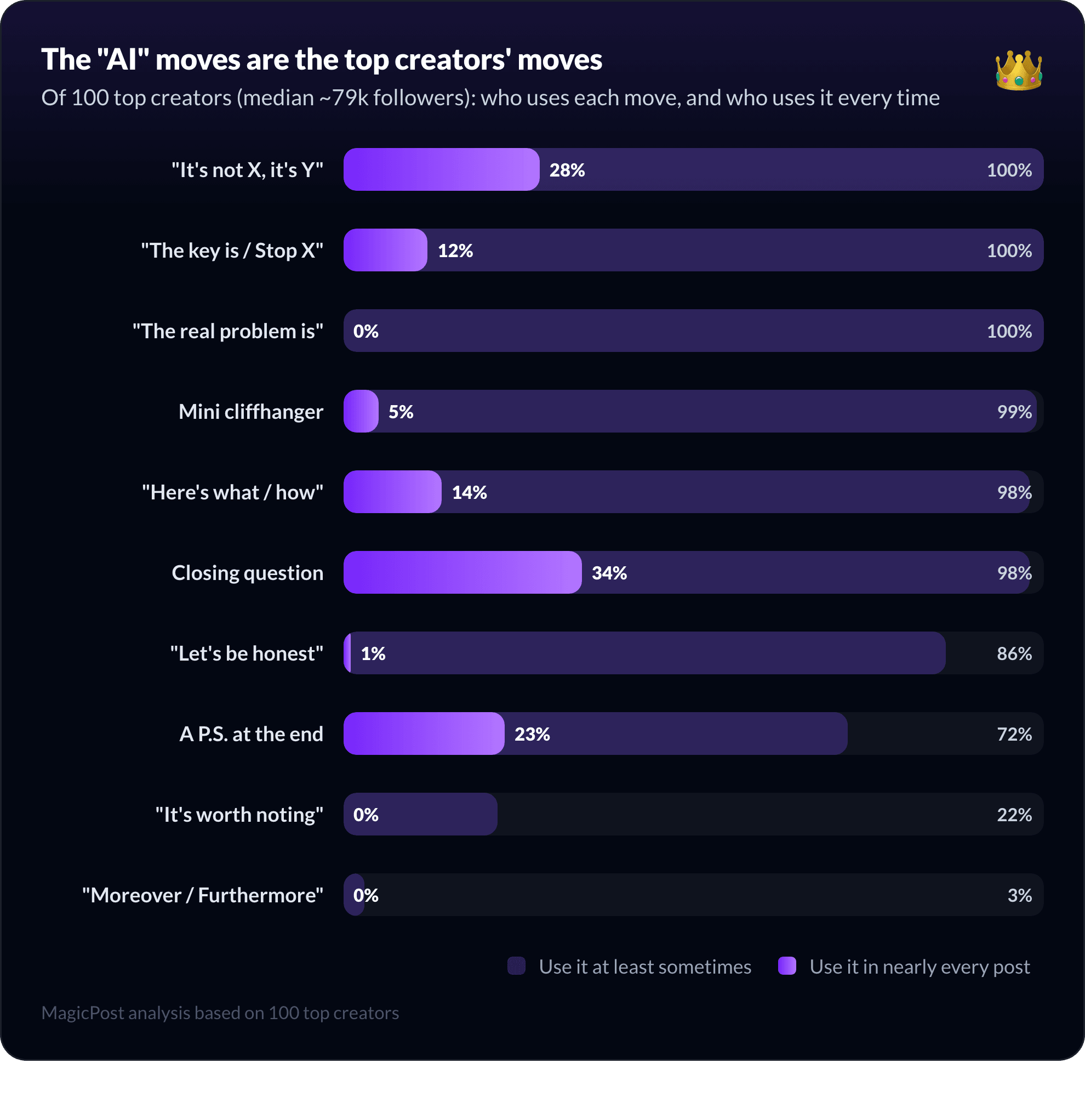
We profiled 100 of the biggest LinkedIn creators (a median of roughly 79,000 followers each). Among them:
"AI" move | Top creators who use it |
"It's not X, it's Y" | 100% (28% in nearly every post) |
"Here's how / Here's what" | 98% |
"The key is / Stop doing X" | 100% |
A question at the end | 98% |
And their posts win, thousands of likes at a time. Gary Vaynerchuk (5.9M followers) writes "It's not always how much money you make, it's how much you spend." Justin Welsh (853k) opens with "Here's." These are not getting buried.
So if LinkedIn simply banned these patterns, it would bury its biggest creators. It does not. The filter is not keyed on the phrase. It is keyed on whether there is a real perspective behind it. A top creator drops "it's not X, it's Y" once, to land a hard-won lesson. A generic AI post stacks six stock moves around an idea anyone could have written. Same phrases, opposite outcomes.
That is the real answer to "does LinkedIn penalize AI content." You are not penalized for the moves. You are penalized for using them to dress up nothing.
So what actually gets demoted?
It helps to keep two things separate: what LinkedIn says it targets, and what that looks like in a real post.
What LinkedIn says. Its announcement is careful and short on specifics. It targets content that "feels generic or repetitive, even if it appears polished on the surface" and that "lacks any real unique perspective or substance." On comments, it also names automation, "comments members create and post at scale using automation tools, with little or no human involvement," and "responses that simply restate the original post without sharing anything new." That is the whole official list. LinkedIn does not name a single banned word or phrase.
What "generic" looks like in practice. This part is our analysis, not LinkedIn's. "Generic and repetitive" is not one thing; it is a set of recognizable moves run on autopilot. We mapped them in the pillar, How to spot an AI-written LinkedIn post. The signal is rarely a single move. It is the pile-up: several stacked in one post with no first-hand angle holding them together.
So the line is simple. LinkedIn demotes content with no point of view. Our data just shows what "no point of view" tends to look like on the page.
How to stay on the right side
You do not have to choose between using AI and getting reach. The fix is not to strip out the good moves (the top creators prove they work). It is to put a real perspective back underneath them. Five concrete habits:
Anchor every post in one thing only you could say. A real number, a named client situation, a mistake that cost you something. The fastest way to beat a "generic" flag is one specific detail a model could not invent.
Let AI draft, never decide. Use it to get words on the page faster. The opinion, the example, the conclusion: those are yours, or the post has no author.
One signature move per post, not six. Keep your best hook and drop the rest. A single "it's not X, it's Y" lands. Four stacked stock moves is the pile-up the filter is built to catch.
Cut the two dead giveaways, every time. No "Moreover" or "Furthermore" to open a line, no "it's worth noting that." No top creator we studied uses either, and they are the cleanest tells there are.
Do the read-aloud test. If a sentence does not come out of your mouth the way you would actually say it, rewrite it. If it does not sound like you, it will not sound human to the algorithm either.
Do these and you are not gaming the filter. You are giving it exactly what it now rewards: a human point of view, in your voice, that happens to have used AI as a tool.
This is exactly what MagicPost's Humanizer does. It keeps the moves that fit your voice, strips the generic pile-up that reads as AI, and removes the dead giveaways before you post, so AI-assisted writing still passes as yours.
Preguntas frecuentes
Does LinkedIn ban or remove AI-generated posts?
No. Posts are not removed and there is no account penalty. Generic-looking AI content is simply distributed less, mostly staying within your immediate network instead of reaching the wider feed.
Is it against the rules to use AI to write LinkedIn posts?
No. LinkedIn's own line is "it's ok to use AI to help you write, but your posts and comments need to represent your voice and your perspectives." The tool is fine. Empty content is not.
How does LinkedIn detect AI content?
It uses systems trained with its editorial team to tell apart content that adds perspective from content that feels generic or repetitive. LinkedIn reported about 94% accuracy at flagging generic content in early testing.
Will using ChatGPT hurt my reach?
Only if you publish what it gives you unedited. In our analysis of 45,965 top 2026 posts, 97% read as human. AI-assisted posts with a real point of view do fine. Generic ones get buried.
How do I make AI-assisted posts sound human?
Lead with first-hand specifics, cut the stock phrases, and keep your own voice. Or run the draft through MagicPost's Humanizer, which does it automatically.
How to Spot an AI-Written LinkedIn Post: 11 Patterns (We Analyzed 46,000 Posts)
We analyzed 46,000 LinkedIn posts to find the 11 patterns that make a post read as AI in 2026, with real examples from top creators and how to fix each.
"It's Not X, It's Y": The LinkedIn Formula Everyone Now Reads as AI
"It's not X, it's Y" is the most-flagged AI formula on LinkedIn. The data: every top creator uses it, it barely lifts engagement, and why it became a tell.
Is the Em Dash a Sign of AI on LinkedIn? Yes, and Here Is the Fix
Is the em dash a sign of AI on LinkedIn? Yes. Em-dash use jumped from under 2% of posts to over 15% with ChatGPT. The data, and what to use instead.
"Here's How" and "Here's What": LinkedIn's Most Common AI Handoff
"Here's how" is LinkedIn's most common AI handoff. It went from under 3% of posts to over 16% with ChatGPT. Why it reads as AI, and how to vary it.
The AI Words Everyone Tells You to Avoid Are Already Dead on LinkedIn
The famous AI words to avoid (delve, tapestry) are already dead on LinkedIn. We checked 129,000 posts. The real tells moved from vocabulary to structure.
AI Writing on LinkedIn in 2026: The Patterns, and Where They Actually Came From
AI gave LinkedIn a house style. Here are the patterns that now read as AI in 2026, and the uncomfortable truth about where they actually came from.