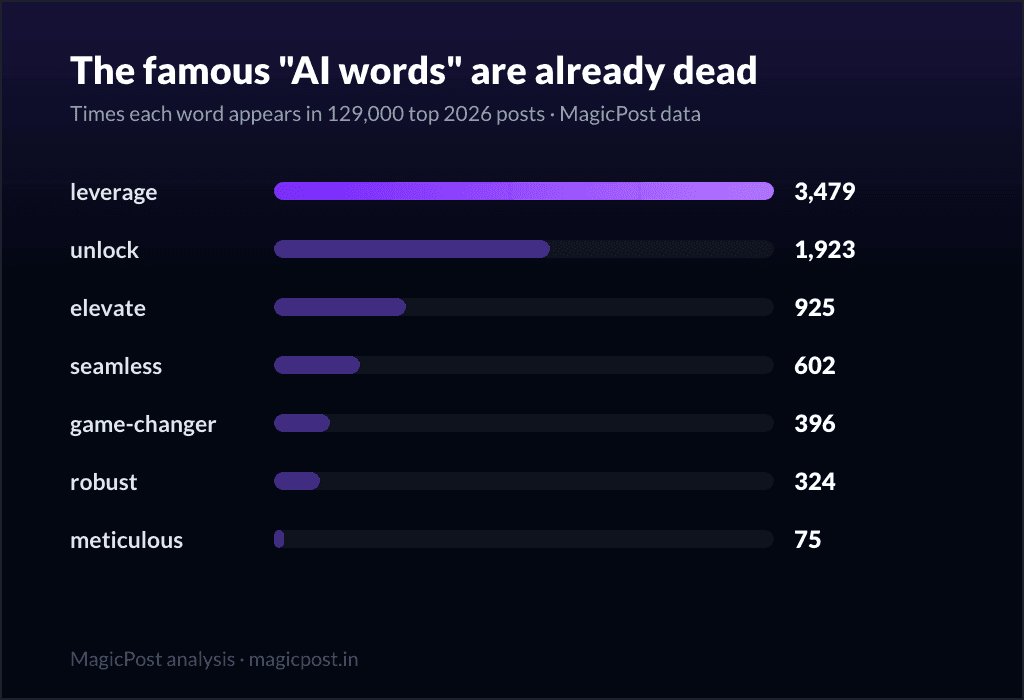
In 2026, AI writing on LinkedIn rarely gives itself away through “AI words” anymore. The sentence shape does. A handful of templated turns come back again and again in AI drafts, even when the post sounds clean and professional.
Our analysis of thousands of high-performing posts points to four recurring structures that tend to underperform: “Here’s how” openers, “It’s not X, it’s Y” contrasts, “Stop X, start Y” frameworks, and “The result?” style cliffhangers. Their cost is small, a few percent of reach, and it was already there in 2025.
These aren’t inherently bad writing techniques. In fact, many top creators use them occasionally. The issue is overuse and stacking: when posts rely on multiple templated structures at once, performance drops.
The bigger change came in the week of July 27, 2026, and it concerns what a post says. Posts with no concrete detail and nothing that happened to the author fell further below their author’s usual reach, while the turns cost no more than before. This guide shows how to recognize the 11 patterns, and why the substance of your post deserves your attention first.
What Data Did We Use to Spot AI Posts?
This analysis is based on two datasets we built ourselves:
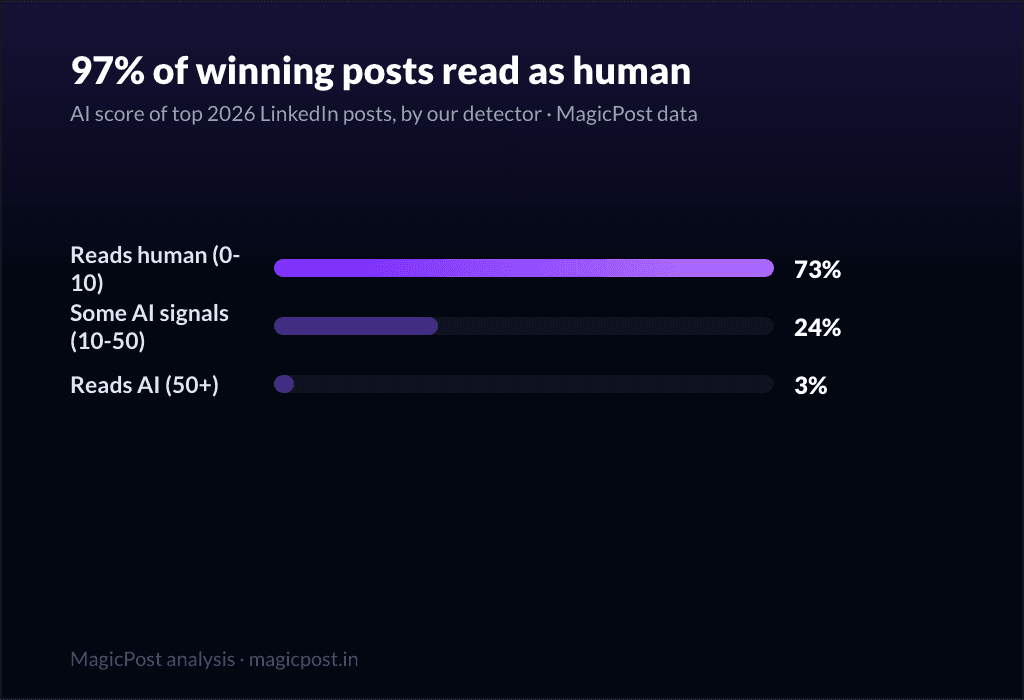
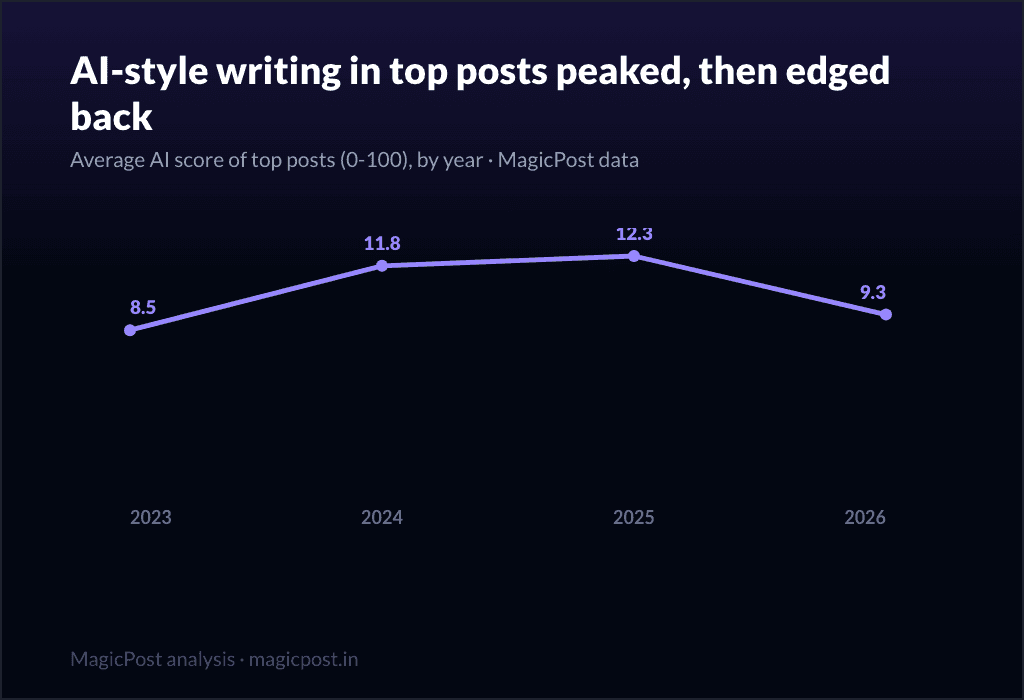
45,965 English LinkedIn posts (2026, 20+ likes each), each scored from 0 to 100 using our AI-detection model. We also use historical post data to track how writing patterns change over time where relevant.
100 top LinkedIn creators, selected based on audience size and activity. We manually reviewed their posts to identify which writing patterns they consistently use, occasionally use, or avoid entirely.
To separate reach from popularity bias, we also ran a reach study on 287,000 posts, measuring performance within each author’s own feed. This controls for follower count and lets us compare posts against a creator’s baseline rather than raw likes.
Together, these datasets show two things:
What writing patterns are actually common in high-performing posts
Which patterns correlate with reduced distribution on LinkedIn, and since when
Note: reach effects are observational, not strictly causal. They reflect relative performance within each author’s audience.
11 Patterns to Spot AI Posts on LinkedIn
We lead with the moves that define AI writing today, not strictly with the most frequent. The four phrasings that cost reach are marked costs reach; that is the column to read first. Reach costs are measured from December 2024 to May 2026, and the same four turns already cost reach on 2025 posts alone. Every example below is a real line, paraphrased from our data (we never reproduce a creator's post word for word).
"Top creators" below means the 100 we studied. "Uses it" means at least sometimes. "All the time" means it is a habit.
# | Pattern | How often it shows up | Reach cost (English, within-author) | Top creators who use it |
|---|---|---|---|---|
1 | Em dash (—) | 11% (up from under 2% before AI) | not directly measured (likes +9%) | Rare for most (typical 3% of posts) |
2 | "Here's what / Here's how" | 10% | costs reach: -4.3% | 98% use it, 14% all the time |
3 | "It's not X, it's Y" | 0.4% | costs reach: -4.9% | 100% use it, 28% all the time |
4 | A question at the end | 8% | does not hurt (do not strip) | 98% use it, 34% all the time |
5 | A P.S. at the end | 7% | does not hurt (helped in 2025, neutral since late July 2026; do not strip) | 72% use it, 23% all the time |
6 | "The real problem is..." | 1.6% | small | 100% use it, 0% all the time |
7 | "Let's be honest..." | 0.9% | helps reach (real candor, +4.6%) | 86% use it, 1% all the time |
8 | "The result?" mini cliffhanger | 0.7% | costs reach: -4.8% | 99% use it, 5% all the time |
9 | "The key is... / Stop doing X" | 0.3% | costs reach: -6.7% (the firmest number on the list) | 100% use it, 12% all the time |
10 | "Moreover / Furthermore" | under 0.2% | dead giveaway | 3% use it, 0% all the time |
11 | "It's worth noting that..." | under 0.1% | dead giveaway | 22% use it, 0% all the time |
A note on patterns 4, 5 and 7: real candor or vulnerability actually helps reach in our English data (about +4.6% within an author), a real closing question does not hurt, and a P.S./CTA sign-off helped in 2025 (about +5.9%) and has been neutral since late July 2026.
They look LinkedIn-y, but they are good practice, and none of them costs reach. Never strip them to "sound less AI." The measurable cost sits in the four templated turns.
Now each one, in plain terms.
1. The em dash (11% of posts)
The em dash is the long dash (—) some people drop in the middle of a sentence. It is the most visible pattern on the list: about one winning post in nine has one.
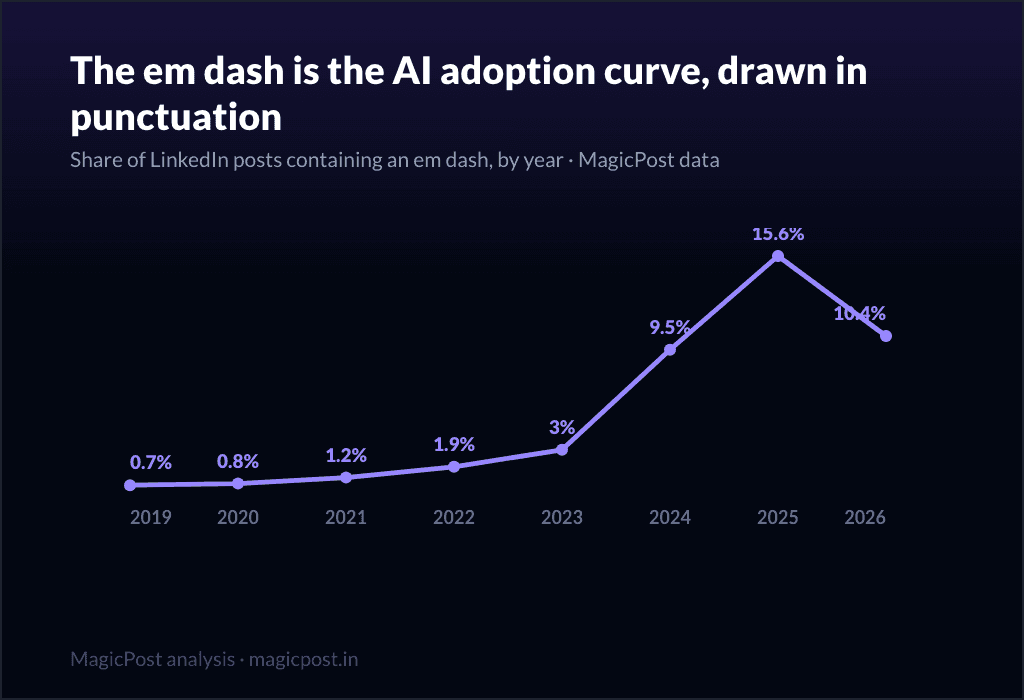
What makes it interesting is its history, and this is about the posts (the wide pool, going back year by year). The em dash barely existed on LinkedIn before AI. Then it tracked the AI boom almost exactly:
Year | Posts with an em dash |
|---|---|
2019 | 0.7% |
2020 | 0.8% |
2021 | 1.2% |
2022 | 1.9% |
2023 | 3.0% |
2024 | 9.5% |
2025 | 15.6% |
2026 (so far) | 10.4% |
Under 2% for years, then a jump to 15.6% right as AI writing tools went mainstream. Real people rarely typed it. AI tools produce it constantly. Yes, it is a genuine AI fingerprint.
The catch, and now we are talking about the 100 top creators: it spread so far that even they carry it in their AI-assisted posts. But most of them still use it rarely.
The typical top creator has an em dash in about 3% of their posts, and 55 of the 100 either never use it or use it in under 1 post in 20.
So treat a single em dash as a strong hint, not as proof on its own. (We are not printing an example here on purpose: our own style avoids the em dash, which is the whole point of this series. We go deeper in our dedicated article, Is the em dash really a sign of AI?)
2. "Here's What/Here's How" (10% of posts)
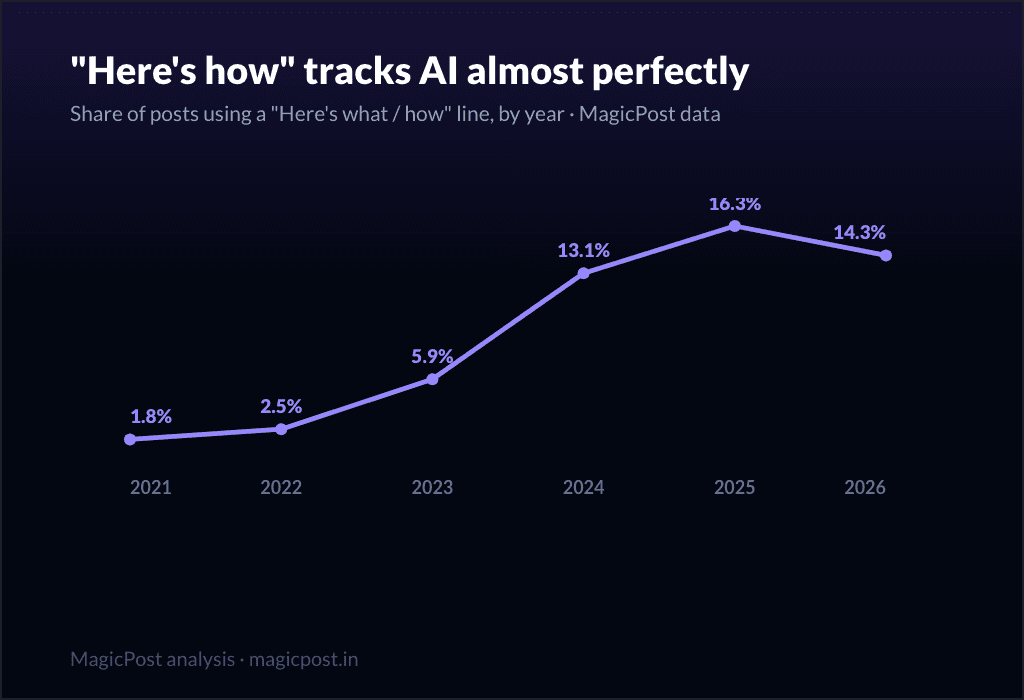
The promise opener. "Here's what nobody tells you." "Here's how I did it." AI loves it because it is a great hook: it promises a payoff before the post delivers one.
This is one of the four that cost reach. Held against each author’s own normal, the "Here's how / Here's what" opener pulls a post about -4.3% in our English data, and about -4.1% on 2025 posts alone, so the cost is far from new. The trap is that it feels like a strong hook, so writers reach for it constantly, and a few percent per post adds up.
What it looks like, paraphrased from real 2026 posts (not anyone's exact wording):
"Here's what nobody tells you when you run your own agency..."
"Here's what changed everything for the teams I work with."
"His calendar stayed empty for months. Here's what I told him."
And 98% of top creators use it too, 14% of them all the time, so it is not banned, it is just costly when it becomes the reflex.
The fix is to open straight on the substance and delete the announcement: not "Here's what changed everything," just the thing that changed everything. A real person varies the opener. AI, left alone, never does. (Full breakdown of this handoff: the "Here's how" line.)
3. "It's not X, it's Y" (0.4% of posts, but every top creator)
The textbook case. The structure is a negate-then-reframe pivot: deny one thing, then declare its "real" replacement.
On reach, comparing each author to their own posts across our English data, this contrast pivot costs about -4.9% within an author. That cost was already there in 2025 (about -5.1% on 2025 posts alone), and January 1, 2026 shows no break.
What it looks like, paraphrased from real 2026 posts:
"That's not a branding question. That's a system question."
"It's not decoration. It's the foundation of the whole guest experience."
"That's not a discipline problem. It's not a motivation problem. It's a structure problem."
The same-author evidence bites hard. Take one creator we studied, a B2B founder: across their 2026 posts, the ones built on this contrast pivot landed about -1% versus their own average, while their clean posts ran +40% above it.
Same person, same audience, a 41-point gap. Those posts also differ in topic and in how much they say, so one creator illustrates the pattern without measuring it. The line writes well; it just gets expensive once it becomes the default.
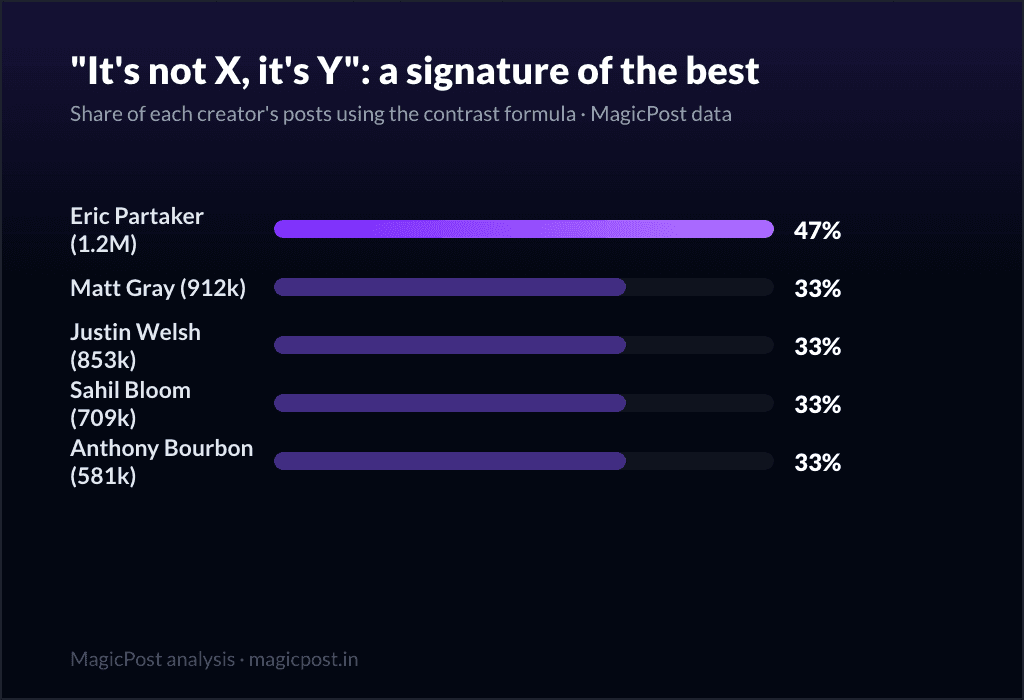
To be clear, this is not a callout. All 100 top creators use it at least sometimes, and 28% use it all the time (most of them with around 79,000 followers), from Gary Vaynerchuk to Justin Welsh. These are great creators and good lines.
AI learned the move from them, then started using it in every paragraph. What was a signature became a tell. The fix is to state the point directly ("This is a system question") and drop the negate-then-reframe scaffolding. (Full breakdown: what the "It's not X, it's Y" formula costs on LinkedIn.)
4. A Question at the End (8% of posts): Helps Reach, Do Not Strip
"What about you?" "How do you handle it?" The genuine question that invites a reply. It reads LinkedIn-y, so it is easy to assume the feed dislikes it. The opposite is true.
A closing question is the move people most often mistake for a costly AI tic, and it is not one.
In our English data it does not cost reach (it runs slightly positive within an author), and it pulls comments rather than likes. So this is the inverse of an AI flag. Never cut a real question to "sound less templated".
What it looks like, paraphrased:
"She finally asked the question she'd been avoiding: am I on track?"
"Which of these are you great at, and which are you still working on?"
98% of top creators use it. The only failure mode is the empty reflex question bolted onto a post that asks nothing real. Keep the genuine ones; they pay.
5. A P.S. at the End (7% of posts): Harmless, Do Not Strip
The "P.S. if this helped, repost it" sign-off at the bottom. Like the closing question, it reads like a LinkedIn cliché, and like the closing question, it does not cost reach. In 2025 it even helped (about +5.9% within an author in English). Since late July 2026 that gain has faded to nothing we can measure, but the P.S. still does not hurt. It is a CTA, not an AI tell.
What it looks like, paraphrased:
"P.S. Drop your own version in the comments, I read every one."
"LinkedIn's algorithm changes have hit everyone's reach. You don't need to panic, here's why."
72% of creators use it. The P.S. is not the problem and should not be stripped. The only thing to watch is the identical automatic P.S. copy-pasted onto every post.
6. "The Real Problem Is..." (1.6% of posts)
"The real problem is..." "What most people miss..." "Change your mindset." The move that promises a big reveal under every line. Paraphrased examples: "...the real reasons behind all of it" or "...most people get this completely wrong."
This one did not clear our reach threshold on its own, so the issue is repetition, not a per-post tax. All 100 creators use it now and then, but not one leans on it. It is rare in winning posts, and when it stacks up (three "real problems" in one post), it reads as a script.
7. "Let's Be Honest..." (0.9% of posts): Real Candor Helps Reach
"Let's be honest." "Real talk." "I'll be blunt." A label here is a double-edged thing, and the distinction is the whole point. Genuine candor and vulnerability are one of the phrasings that help reach (worth about +4.6% within an author in our English data).
The empty label that announces honesty and then delivers a generic line is the tell. Paraphrased: a hollow "Let's be honest" with nothing honest after it reads as fake; "This month I hit my best revenue ever, and this morning I realised I have no friends to celebrate with" is the real thing, and it travels.
86% of creators use the label now and then, but only 1% all the time. The rule of thumb: do not strip sincerity to dodge a flag, it is reach-positive. Just make sure the candor is real, because real honesty does not need to introduce itself.
8. The "The result?" cliffhanger (0.7% of posts): costs reach
A setup line, then a short drop held for drama: "The result?" / "The kicker?" / "Plot twist:", followed by the payoff on the next line. It is the dramatic bridge AI reaches for to fake suspense.
This is the third of the four that cost reach: about -4.8% within an author in our English data, and about -3.0% on 2025 posts alone. The same-author example is one of the clearest we have.
One recruiter we studied wrote 15 posts in 2026; the ones that leaned on this bridge landed about -18% versus their own average, while their clean posts ran +18% above it, a 36-point swing with the audience held constant. One creator only illustrates the average, since those posts differ in more than one line, but the direction matches.
What it looks like, paraphrased:
"Teams stitch their workflow together from five different apps. The result? The frontline is lost."
"Companies bring it in-house too early and under-invest. The result? It quietly under-performs."
99% of creators use it now and then, only 5% make it a habit, and that habit is what hurts. The fix is to chain the consequence directly and skip the drumroll: not "...too early. The result? It under-performs," just "...too early, so it under-performs."
9. "The Key Is... / Stop Doing X" (0.3% of posts): Consistent Reach Killer
"The key is..." "Stop doing X, start doing Y." "If you want to succeed..." The generic advice frame. It is rare in top posts and lands about average on likes, which is exactly why it slipped past everyone, because on reach it is the most reliable offender we found: a steady -6.7% within an author (about -6.6% on 2025 posts alone), the firmest number on the whole list.
What it looks like, paraphrased:
"Stop describing the tool. Start owning the result."
"If you want LinkedIn to grow your business, stop chasing likes and start solving problems."
And all 100 top creators use it, 12% all the time, so it is not a forbidden move, it is a costly default. The fix is to swap the empty frame for the concrete, specific action: not "the key is consistency," but the actual thing you did.
A creator we studied who used this frame averaged about -2% versus their own posts, while their clean posts ran +20% above, the same pattern as the others.
10. "Moreover / Furthermore" (Almost 0% of Posts, No Creator Uses It)
"Moreover." "Furthermore." "Additionally." The essay-style linking words, at the start of a line.
This is one of only two moves on the list that is a dead giveaway, and here the example is the absence of one. We searched all 100 creators, from Simon Sinek down. Only 3 ever used a single "Moreover," and not one as a habit.
In 29,000 popular posts you can count them on one hand. Nobody opens a line with "Furthermore" on LinkedIn. When you see it, it is not a person with an unusual style. It is AI that nobody cleaned up.
11. "It's Worth Noting That..." (Almost 0% of Posts, No Creator Uses It)
The second dead giveaway, and again the example is that there is none. "It's worth noting that." "Keep in mind that." "It's important to remember." The warm-up words before the actual point.
Almost never in top posts. A few creators let one slip now and then, but not one of the 100 builds a post around it. A person with something to say just says it. Cautious AI clears its throat first.
How Much LinkedIn Reach Do These AI Patterns Cost?
Our analysis of 287,000 LinkedIn posts finds a small but consistent drop in distribution for highly templated writing, measured within each author’s own feed, so follower count is controlled.
The effect is concentrated in four overused structures, and it is old: on 2025 posts alone, the same four already landed about 3% to 7% below their author’s normal, with no break on January 1, 2026.
“Stop X, start Y” (~ -6.7%)
“It’s not X, it’s Y” (~ -4.9%)
“The result?” (~ -4.8%)
“Here’s how” (~ -4.3%)
These aren’t inherently bad phrases. The issue is repetition and stacking. AI-generated drafts tend to combine multiple of these patterns in a single post, creating a predictable structure that performs slightly worse in distribution.
Importantly, this is a small, second-order effect. We measure how far some posts travel against the same creator’s baseline; we do not see how LinkedIn ranks posts, so none of this proves a ranking penalty.
What did move is substance. In our study of AI slop on LinkedIn (40,937 posts from 660 creators), posts with no concrete detail and no lived experience sat 13% below their author’s average post from April 1 to July 26, 2026, and 23% below since the week of July 27. At equal substance, the AI turns flagged by MagicPost’s detector cost about 4% before that week and show no extra cost we can detect since.
So over-templated structure still trims reach a little, especially when several patterns appear together. A post with nothing checkable and nothing that happened to you loses far more. Fix the substance first, then clean the turns.
This is what MagicPost was built for. Our Humanizer checks every draft against the 11 patterns above, keeps the moves that fit your voice, and quietly removes the pile-up and the dead giveaways before you post. Try MagicPost free
Do AI-Sounding Posts Lose Reach on LinkedIn?
A little, and less than posts with nothing concrete in them. In our data, a post rated 30 points more AI-like (out of 100) got about 9% fewer impressions than a comparable post by the same creator before July 27, 2026, at equal substance, and shows no extra cost we can detect since. A post rated 30 points more generic costs about 20%, as it did before.
LinkedIn has said where it stands. In May 2026, in a post titled "Keeping conversations real on LinkedIn", Laura Lorenzetti (VP and Executive Editor, LinkedIn Global Editorial) described how LinkedIn handles what she called "AI slop": "low-effort, AI-generated content that may sound polished on the surface but lacks any real unique perspective or substance."
The rule of thumb LinkedIn gives is simple: "It's ok to use AI to help you write, but your posts and comments need to represent your voice and your perspectives. The ultimate value comes from the human behind the tool."
LinkedIn says its systems now tell apart content that "adds perspective, context, or expertise" from content that "feels generic or repetitive, even if it appears polished on the surface." When a post reads as generic AI, "it is less likely to be widely distributed beyond a person's immediate network." LinkedIn's own early number: "we're correctly identifying generic content 94% of the time."
On July 30, 2026, LinkedIn announced classifiers that identify AI slop and low-quality content, to show less of it in suggested posts and in posts from outside your network, and added a "Seems like AI slop" report button. That is the same week our data moves: in our LinkedIn AI slop study, the extra reach a concrete detail brings jumped 21% at July 27, the largest jump of the 24 dates we tested. We see the timing and the size, not the mechanism.
LinkedIn did not publish what "generic or repetitive" looks like in a post. The 11 patterns above cover the phrasing side. Our numbers point to the larger side: against a comparable post by the same creator, a concrete detail went from +2% before July 27 to +14% since, and a lived experience from +7% to +25%.
Spot the patterns, then check that your post says something only you could say. For what all this means for your reach, see Does LinkedIn penalize AI content?
Checklist: Is Your Post Getting Flagged?
Reread your draft and count, reach-first. The first two checks are about substance, the largest gap since late July 2026. The next four are the turns that cost distribution:
Is there one detail a reader could check? A real number, a name, a date, a precise example. Without one, and without a lived experience, a post sits 23% below its author's average since late July 2026.
Did you tell something that happened to you? A specific moment with your team, a client or yourself. A general "I believe" does not count.
Do you open with "Here's what / Here's how"? Costs reach (about -4.3%). Open on the substance instead.
Any "Stop X, start Y" or "the key is"? The most reliable reach-killer on the list (-6.7%). Swap it for the concrete action.
Any "The result?" / "The kicker?" cliffhanger? Costs reach (about -4.8%). Chain the consequence directly.
Is your "It's not X, it's Y" earned, or a reflex? It costs about -4.9% once it becomes a default. Once, it is a signature; three times, it is a tic.
Any "Moreover" or "Furthermore" at the start of a line? Cut it. Nobody writes that way on LinkedIn.
Any "it's worth noting that"? Cut it. Get to the point.
How many moves total are in this one post? One or two: normal. Four or more: AI is showing.
And do not cut a genuine closing question, a P.S./CTA sign-off, or real candor and vulnerability: none of them costs reach, and real candor helps it.
If the first two checks fail, fix them before anything else. Three or more of the other checks on top, and the post also reads as a template, which costs a few percent more.
How to Make AI Posts Look Human on LinkedIn
Good news: you do not have to give up the moves that work. You just need your own rhythm back.
Start with what only you can say. Add one checkable detail and one thing that happened to you. Since late July 2026, that matters more for reach than any phrasing fix.
One strong move per post, not six. Pick your best hook and drop the rest.
Change your openers. Look at your last five posts. If they all start the same way, that is a template, not a voice.
Cut the two dead giveaways, always. "Moreover" and "it's worth noting that": zero tolerance.
Space out the reach-costing turns. "It's not X, it's Y," "Here's how," "Stop X / start Y," and "The result?" each pull a post a few percent below your own normal, as they already did in 2025. Use one when it genuinely lands, never as a default.
Read it out loud. If a sentence does not come out of your mouth naturally, it came out of AI.
Let MagicPost Handle Your LinkedIn Content
You can run that checklist by hand on every post. Or you can let MagicPost's Humanizer do it in one click.
MagicPost learns your voice from your own posts and from the creators you admire, the same kind of top creators we studied here.
When you write or paste a draft, the Humanizer targets the four reach-costing turns first, keeps the moves that make your style (including the ones that help your reach), and cuts the two dead giveaways every time.
It does not flatten your writing. It removes the robotic coating on top so your post reads like you on your best day, not like AI on its most generic one.
FAQ
Is using AI to write LinkedIn posts against the rules?
No, using AI to write LinkedIn posts is allowed. LinkedIn says it is fine to use AI to help you write, as long as the post represents your voice and your perspective. In our within-author data, the templated turns AI tends to produce cost an English post about 3% to 7% of reach against the same author's normal, as they already did in 2025.
The larger cost since late July 2026 is substance: LinkedIn posts with no concrete detail and no lived experience sit 23% below their author's average post. So keep AI if it helps, add a detail only you could give, then edit out the four reach-costing turns.
Does an em dash mean a post was written by AI?
It is a real hint. The em dash barely existed on LinkedIn before AI (under 2% of posts through 2022) and then jumped to over 15% in 2025, right alongside AI tools.
But it is now so common that a single one is not proof on its own. Look at the whole post, not one dash. We break this down in a dedicated article.
What is the single biggest sign of AI writing?
Two of them: "Moreover / Furthermore" at the start of a line, and warm-up phrases like "it's worth noting that." Not one of the 100 top creators we studied uses either as a habit. When you see them, it is almost always AI.
Can I still use "It's not X, it's Y"?
Occasionally, yes, but know the cost. Across our English data it runs about -4.9% of reach within an author once it becomes a reflex. All 100 top creators use it at least sometimes, from Gary Vaynerchuk to Justin Welsh, so once, as a real signature, it is fine. As a per-post reflex it quietly drags your distribution down.
How does MagicPost help with this?
MagicPost's Humanizer checks your draft against the 11 patterns in this article, keeps the ones that fit your voice, and removes the pile-up and the two dead giveaways automatically. You write; it quietly cleans up. Try it free