15 Beste LinkedIn-Nachrichtenvorlagen (Mit Folgeanleitung)

15 Beste LinkedIn-Nachrichtenvorlagen (Mit Folgeanleitung)

15 Beste LinkedIn-Nachrichtenvorlagen (Mit Folgeanleitung)

Inhaltserstellung

Das MagicPost-Team

|

Zuletzt aktualisiert: 16.01.2026

Forget the awkward handshakes and stiff business cards; networking has moved almost entirely to LinkedIn. With over 1 billion users, it’s a goldmine for leads.

Whether you’re looking for clients or a partner, LinkedIn is where the decision-makers actually hang out, but there’s a catch: everyone else knows it too.

If you’ve ever been hit with a "buy my services" message five seconds after connecting, you know exactly what not to do. You know that sending messages that actually get replies is a real challenge.

Let’s break down how to reach out the right way and use LinkedIn outreach message templates that actually start real business conversations.

TL;DR

This guide explains what outreach is, its main advantages, what InMails are, and how much they cost, and the psychological principles behind effective outreach messages.

It also shows how to write high-performing messages, includes 15 ready-to-use message templates, and shares follow-up examples to keep conversations going.

What’s LinkedIn Outreach?

LinkedIn outreach is the strategic process of contacting other professionals on LinkedIn to build relationships, find leads, get jobs, or create partnerships.

It involves sending personalized messages, connection requests, and engaging with content to meet your goals.

It’s a targeted way to network online. The goal is to start real conversations and build connections by sending tailored invites and messages to the right people.

This process might require you to get out of your comfort zone, but there are many advantages to putting yourself out there:

1. You get higher response rates than emails
LinkedIn direct messages often get an average reply rate of 10%+, which is significantly higher than most cold email campaigns. This means your outreach efforts are more likely to spark real conversations.

2. You can target better profiles using filters
LinkedIn lets you filter prospects by industry, job title, location, company size, and more... This helps you send the right message to the right people from the beginning.

3. You get a direct access to decision-makers
LinkedIn lets you contact professionals at every level, from managers to top executives, without having to go through gatekeepers.

Sending an InMail or connection request gives you a direct line to potential leads, collaborators, or partners.

4. You can build authority
Even if someone doesn’t reply right away, just seeing your profile or interacting with your content can help your reputation. Over time, this builds your visibility, credibility, and attracts more interest.

👉 For more information on how to implement the perfect outreach strategy for your business, read the complete LinkedIn Outreach guide.

How to Send Outreach Messages With InMails

To avoid confusion, let’s differentiate between reaching out to current connections and contacting people you haven’t connected with yet.

Direct Messaging Your Existing Contacts

When someone accepts your connection request, they become a “1st-degree connection,” and you can message them for free.

Focus on building the relationship; share useful industry tips, comment on their posts, or ask about their current projects.

This helps you build rapport and stay memorable.

Sending InMails for Cold Outreach

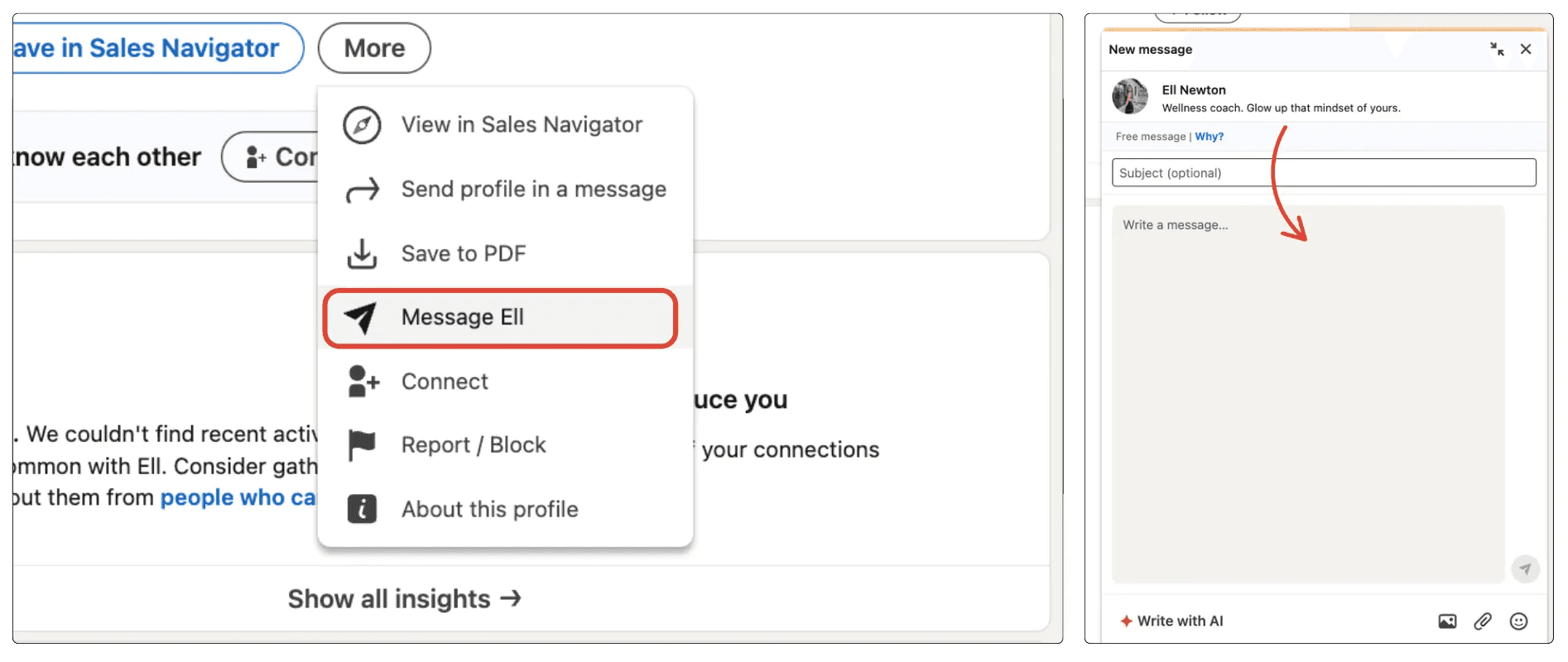
On the other hand, InMail is a paid feature that lets you message anyone on LinkedIn, even if you’re not connected.

InMails stand out in the inbox with a “Premium” tag and usually get more replies since your message lands directly in a prospect’s primary inbox.

Choosing the Right InMail Type

There are 3 types of InMails you can use; free, payed and sponsored. Choosing the wrong format can lead to wasted budget or missed opportunities. Here is a quick breakdown:

Type

Best For

Pros

Cons

Free InMails

Budget-conscious networking

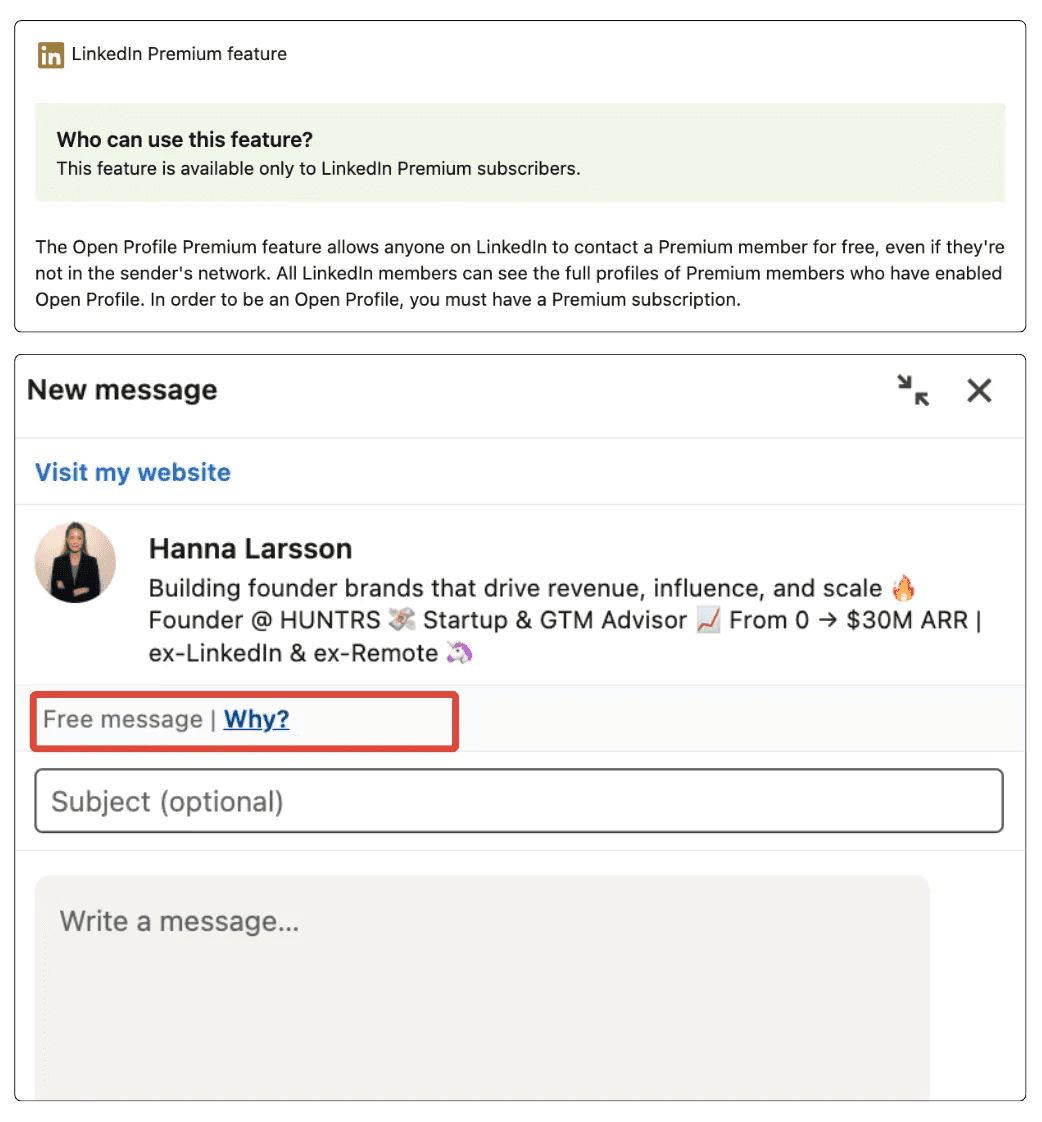
Costs $0; works with “Open Profiles”

Only works if the recipient enables it

Paid InMails

Targeted sales & recruiting

Guaranteed reach; credit refunds

Limited monthly credits; can be pricey

Sponsored

Large-scale marketing

Massively scalable; automated

Labeled as “Sponsored”; less personal

1. Free InMails

Available when a Premium member has an Open Profile. You can message these users without spending a single credit. It’s the perfect “hidden” trick for cost-free outreach to high-profile professionals.

2. Paid InMails

The standard for Premium, Sales Navigator, and Recruiter users. These allow you to reach 2nd and 3rd-degree connections. Because credits are limited, this encourages high-quality, personalized messaging that yields better results.

3. Sponsored InMails (Message Ads)

These are part of the LinkedIn Ads ecosystem. Instead of manual outreach, you set a target audience and budget, and LinkedIn delivers your message to thousands of inboxes at once. While highly scalable, they carry a “Sponsored” tag, so they require a very strong hook to maintain high engagement.

For more details on message limits and practical advice, read our full guide on LinkedIn InMail features and tips.

How to Write the Perfect Outreach Message

To stand out from generic messages like “I’d love to add you to my network,” use psychological triggers that encourage people to respond.

Use The Law of Reciprocity

Give something before you ask for anything. Share a helpful resource, an interesting article, or a real compliment about their recent achievement. When you offer value first, people feel more inclined to reply.

Establish Social Proof

Mention a mutual connection or a shared professional group. Human beings are “tribal” by nature; we trust people who are connected to people we already know. Instantly referencing a shared contact lowers the recipient’s guard.

Keep it Short

Short messages work better. Messages under 400 characters (about 3-4 sentences) get a 22% higher response rate. Make your message easy to read and identify a pain point, offer a quick solution, and be direct.

Don't Forget The Easy Call-To-Action

End with a “soft” Call to Action (CTA) that is easy to answer. Instead of asking for a 30-minute meeting (which feels like a chore), ask a low-friction question like, “Are you currently focused on [Topic] this quarter?” or “Would you be open to seeing a quick case study on this?” This creates an “open loop” in the prospect’s mind that they want to close by providing a quick “yes” or “no.”

15 LinkedIn Outreach Message Templates

Every LinkedIn outreach message should be tailored to the situation and your reason for reaching out. This approach gets the best results.

Here are 9 LinkedIn outreach message templates you can adapt depending on who you’re contacting.

1. Offer to help their business/brand

Why send this message:

If you want to start a conversation by offering value first, position yourself as a helpful expert rather than selling immediately.

Message:

Hi {{First Name}},
I came across your work at {{company}} and really liked how you’re approaching {{specific project/initiative}}.

I work with {{type of business/brand}} on {{specific outcome}}, and while looking at what you’re building, a few ideas came to mind that could help you {{improve result or solve problem}}.

If you’re open to it, I’d be happy to share them in a quick chat and see if it’s useful for you.

2. Product pitch with a CTA

Why send this message:

If you’ve identified a clear pain point your product solves and want to introduce it without sounding pushy, while guiding the prospect toward a next step.

Message:

Hi {{First Name}},
I noticed that {{company}} is currently dealing with {{specific challenge or goal}}, which is something we see a lot in {{their industry}}.

We built {{product name}} to help teams like yours {{clear benefit/result}} without {{common friction or downside}}.

Would you be open to a quick 15-minute call this week so I can show you how it works and see if it’s relevant for you?

3. Introduce Your Channel/ Page

Why send this message:

If you want to connect by sharing valuable content first, position yourself as a useful resource, and start a conversation without selling.

Message:

Hi {{First Name}},
I came across your profile while reading about {{topic/industry}} and thought you might find this useful.

I run a content page where I share practical insights on {{main topics}}, based on real-world experience and case studies.

If you’re interested, I’d be happy to share it with you and exchange thoughts.

4. Introduce your product

Why send this message:

If you want to introduce your product clearly and professionally, without pushing for an immediate sale, and open the door for a follow-up conversation.

Message:

Hi {{First Name}},
I came across {{company}} while looking into {{industry/topic}} and thought your work around {{specific detail}} was interesting.

I wanted to quickly introduce {{product name}} — a solution designed to help {{type of company}} {{main benefit or result}} more efficiently.

If this is something you’re currently exploring, I’d be happy to share more details or walk you through how it works.

5. Connection Request to a Potential Partner

Why send this message:

If you want to connect with someone for a potential partnership and set the right tone from the first interaction.

Message:

Hi {{First Name}},
I came across your work at {{company}} and felt there could be strong synergy between what you do and what we’re building around {{shared focus}}.

I’d love to connect and explore potential ways we could collaborate if it makes sense.

6. Make an offer based on a lead’s interest

Why send this message:

If the lead has already shown interest (liked a post, commented, visited your site, or mentioned a need) and you want to turn that signal into a relevant offer.

Message:

Hi {{First Name}},
I noticed your interest in {{specific topic/action they took}}, which usually means teams are looking to improve {{related goal or pain point}}.

Based on that, I think {{product/service}} could help you {{specific outcome}} without {{common obstacle}}.

Would you like me to share a quick example or walk you through how it could work for your situation?

7. Offer a Free Audit or Review

Why send this message:

If the lead has a business or profile that could clearly benefit from improvement and you want to offer value upfront.

Message:

Hi {{First Name}},
I noticed your current setup around {{topic}} and thought you might be open to a quick audit.

I can review {{website/profile/strategy}} and share 3–5 practical improvements that could help you {{result}}.

Would you be interested in a short review?

8. Invite to a Webinar or Live Event

Why send this message:

If you’re hosting an event relevant to their interests and want to invite them in a non-salesy way.

Message:

Hi {{First Name}},
I saw you’re interested in {{topic}}, and I’m hosting a live session on {{topic}} next week.

It’s a short webinar where we’ll cover {{key points}} and share real examples.

Would you like me to send you the link?

9. Share a Case Study

Why send this message:

If your lead is in the same industry as a successful client and you want to build credibility.

Message:

Hi {{First Name}},
I noticed you’re working in {{industry}}, and we recently helped a similar company achieve {{result}}.

I can share the case study if you’re interested.

Would you like me to send it over?

10. Congratulate on a Recent Achievement

Why send this message:

If the lead recently shared a win, new role, or milestone and you want to start a relationship based on authenticity.

Message:

Hi {{First Name}},
Congrats on {{achievement/new role}} — that’s a big win!

I’m really impressed by what you’re building in {{industry}}.

Would love to connect and learn more about your journey.

11. Ask for Feedback or Opinion

Why send this message:

If you want to start a conversation by asking for their professional opinion, which makes them feel valued.

Message:

Hi {{First Name}},
I saw your expertise in {{topic}}, and I’d love to get your opinion on something.

Would you mind sharing your thoughts on {{question}}?

I’d really appreciate your insight.

12. Offer a Content Collaboration

Why send this message:

If you want to collaborate on a blog, podcast, or interview with someone in your niche.

Message:

Hi {{First Name}},
I love your content on {{topic}} and think our audiences would benefit from a collaboration.

Would you be open to doing a short interview or co-creating a post together?

If yes, I can share a few ideas.

13. Offer a Discount or Special Offer

Why send this message:

If you want to make a time-limited offer to encourage action without being pushy.

Message:

Hi {{First Name}},
I noticed you’re exploring {{topic}}, and we’re currently offering a special discount for {{product/service}}.

If you’d like, I can share the details and see if it fits your needs.

Would you like to learn more?

14. Invite to Join a Private Group or Community

Why send this message:

If you have a community that provides value and you want to invite them to join.

Message:

Hi {{First Name}},
I’m building a small community of professionals focused on {{topic}}.

We share resources, case studies, and networking opportunities.

Would you like an invite?

15. Offer a Quick Demo or Trial

Why send this message:

If you want to let them experience your product before committing.

Message:

Hi {{First Name}},
I’d love to show you how {{product}} works and how it can help you {{benefit}}

Would you be open to a quick demo or a free trial?

I can set it up in under 10 minutes.

15 LinkedIn Outreach Message Templates

Every LinkedIn outreach message should be tailored to the situation and your reason for reaching out. This approach gets the best results.

Here are 9 LinkedIn outreach message templates you can adapt depending on who you’re contacting.

1. Offer to help their business/brand

Why send this message:

If you want to start a conversation by offering value first, position yourself as a helpful expert rather than selling immediately.

Message:

Hi {{First Name}},
I came across your work at {{company}} and really liked how you’re approaching {{specific project/initiative}}.

I work with {{type of business/brand}} on {{specific outcome}}, and while looking at what you’re building, a few ideas came to mind that could help you {{improve result or solve problem}}.

If you’re open to it, I’d be happy to share them in a quick chat and see if it’s useful for you.

2. Product pitch with a CTA

Why send this message:

If you’ve identified a clear pain point your product solves and want to introduce it without sounding pushy, while guiding the prospect toward a next step.

Message:

Hi {{First Name}},
I noticed that {{company}} is currently dealing with {{specific challenge or goal}}, which is something we see a lot in {{their industry}}.

We built {{product name}} to help teams like yours {{clear benefit/result}} without {{common friction or downside}}.

Would you be open to a quick 15-minute call this week so I can show you how it works and see if it’s relevant for you?

3. Introduce Your Channel/ Page

Why send this message:

If you want to connect by sharing valuable content first, position yourself as a useful resource, and start a conversation without selling.

Message:

Hi {{First Name}},
I came across your profile while reading about {{topic/industry}} and thought you might find this useful.

I run a content page where I share practical insights on {{main topics}}, based on real-world experience and case studies.

If you’re interested, I’d be happy to share it with you and exchange thoughts.

4. Introduce your product

Why send this message:

If you want to introduce your product clearly and professionally, without pushing for an immediate sale, and open the door for a follow-up conversation.

Message:

Hi {{First Name}},
I came across {{company}} while looking into {{industry/topic}} and thought your work around {{specific detail}} was interesting.

I wanted to quickly introduce {{product name}} — a solution designed to help {{type of company}} {{main benefit or result}} more efficiently.

If this is something you’re currently exploring, I’d be happy to share more details or walk you through how it works.

5. Connection Request to a Potential Partner

Why send this message:

If you want to connect with someone for a potential partnership and set the right tone from the first interaction.

Message:

Hi {{First Name}},
I came across your work at {{company}} and felt there could be strong synergy between what you do and what we’re building around {{shared focus}}.

I’d love to connect and explore potential ways we could collaborate if it makes sense.

6. Make an offer based on a lead’s interest

Why send this message:

If the lead has already shown interest (liked a post, commented, visited your site, or mentioned a need) and you want to turn that signal into a relevant offer.

Message:

Hi {{First Name}},
I noticed your interest in {{specific topic/action they took}}, which usually means teams are looking to improve {{related goal or pain point}}.

Based on that, I think {{product/service}} could help you {{specific outcome}} without {{common obstacle}}.

Would you like me to share a quick example or walk you through how it could work for your situation?

7. Offer a Free Audit or Review

Why send this message:

If the lead has a business or profile that could clearly benefit from improvement and you want to offer value upfront.

Message:

Hi {{First Name}},
I noticed your current setup around {{topic}} and thought you might be open to a quick audit.

I can review {{website/profile/strategy}} and share 3–5 practical improvements that could help you {{result}}.

Would you be interested in a short review?

8. Invite to a Webinar or Live Event

Why send this message:

If you’re hosting an event relevant to their interests and want to invite them in a non-salesy way.

Message:

Hi {{First Name}},
I saw you’re interested in {{topic}}, and I’m hosting a live session on {{topic}} next week.

It’s a short webinar where we’ll cover {{key points}} and share real examples.

Would you like me to send you the link?

9. Share a Case Study

Why send this message:

If your lead is in the same industry as a successful client and you want to build credibility.

Message:

Hi {{First Name}},
I noticed you’re working in {{industry}}, and we recently helped a similar company achieve {{result}}.

I can share the case study if you’re interested.

Would you like me to send it over?

10. Congratulate on a Recent Achievement

Why send this message:

If the lead recently shared a win, new role, or milestone and you want to start a relationship based on authenticity.

Message:

Hi {{First Name}},
Congrats on {{achievement/new role}} — that’s a big win!

I’m really impressed by what you’re building in {{industry}}.

Would love to connect and learn more about your journey.

11. Ask for Feedback or Opinion

Why send this message:

If you want to start a conversation by asking for their professional opinion, which makes them feel valued.

Message:

Hi {{First Name}},
I saw your expertise in {{topic}}, and I’d love to get your opinion on something.

Would you mind sharing your thoughts on {{question}}?

I’d really appreciate your insight.

12. Offer a Content Collaboration

Why send this message:

If you want to collaborate on a blog, podcast, or interview with someone in your niche.

Message:

Hi {{First Name}},
I love your content on {{topic}} and think our audiences would benefit from a collaboration.

Would you be open to doing a short interview or co-creating a post together?

If yes, I can share a few ideas.

13. Offer a Discount or Special Offer

Why send this message:

If you want to make a time-limited offer to encourage action without being pushy.

Message:

Hi {{First Name}},
I noticed you’re exploring {{topic}}, and we’re currently offering a special discount for {{product/service}}.

If you’d like, I can share the details and see if it fits your needs.

Would you like to learn more?

14. Invite to Join a Private Group or Community

Why send this message:

If you have a community that provides value and you want to invite them to join.

Message:

Hi {{First Name}},
I’m building a small community of professionals focused on {{topic}}.

We share resources, case studies, and networking opportunities.

Would you like an invite?

15. Offer a Quick Demo or Trial

Why send this message:

If you want to let them experience your product before committing.

Message:

Hi {{First Name}},
I’d love to show you how {{product}} works and how it can help you {{benefit}}

Would you be open to a quick demo or a free trial?

I can set it up in under 10 minutes.

15 LinkedIn Outreach Message Templates

Every LinkedIn outreach message should be tailored to the situation and your reason for reaching out. This approach gets the best results.

Here are 9 LinkedIn outreach message templates you can adapt depending on who you’re contacting.

1. Offer to help their business/brand

Why send this message:

If you want to start a conversation by offering value first, position yourself as a helpful expert rather than selling immediately.

Message:

Hi {{First Name}},
I came across your work at {{company}} and really liked how you’re approaching {{specific project/initiative}}.

I work with {{type of business/brand}} on {{specific outcome}}, and while looking at what you’re building, a few ideas came to mind that could help you {{improve result or solve problem}}.

If you’re open to it, I’d be happy to share them in a quick chat and see if it’s useful for you.

2. Product pitch with a CTA

Why send this message:

If you’ve identified a clear pain point your product solves and want to introduce it without sounding pushy, while guiding the prospect toward a next step.

Message:

Hi {{First Name}},
I noticed that {{company}} is currently dealing with {{specific challenge or goal}}, which is something we see a lot in {{their industry}}.

We built {{product name}} to help teams like yours {{clear benefit/result}} without {{common friction or downside}}.

Would you be open to a quick 15-minute call this week so I can show you how it works and see if it’s relevant for you?

3. Introduce Your Channel/ Page

Why send this message:

If you want to connect by sharing valuable content first, position yourself as a useful resource, and start a conversation without selling.

Message:

Hi {{First Name}},
I came across your profile while reading about {{topic/industry}} and thought you might find this useful.

I run a content page where I share practical insights on {{main topics}}, based on real-world experience and case studies.

If you’re interested, I’d be happy to share it with you and exchange thoughts.

4. Introduce your product

Why send this message:

If you want to introduce your product clearly and professionally, without pushing for an immediate sale, and open the door for a follow-up conversation.

Message:

Hi {{First Name}},
I came across {{company}} while looking into {{industry/topic}} and thought your work around {{specific detail}} was interesting.

I wanted to quickly introduce {{product name}} — a solution designed to help {{type of company}} {{main benefit or result}} more efficiently.

If this is something you’re currently exploring, I’d be happy to share more details or walk you through how it works.

5. Connection Request to a Potential Partner

Why send this message:

If you want to connect with someone for a potential partnership and set the right tone from the first interaction.

Message:

Hi {{First Name}},
I came across your work at {{company}} and felt there could be strong synergy between what you do and what we’re building around {{shared focus}}.

I’d love to connect and explore potential ways we could collaborate if it makes sense.

6. Make an offer based on a lead’s interest

Why send this message:

If the lead has already shown interest (liked a post, commented, visited your site, or mentioned a need) and you want to turn that signal into a relevant offer.

Message:

Hi {{First Name}},
I noticed your interest in {{specific topic/action they took}}, which usually means teams are looking to improve {{related goal or pain point}}.

Based on that, I think {{product/service}} could help you {{specific outcome}} without {{common obstacle}}.

Would you like me to share a quick example or walk you through how it could work for your situation?

7. Offer a Free Audit or Review

Why send this message:

If the lead has a business or profile that could clearly benefit from improvement and you want to offer value upfront.

Message:

Hi {{First Name}},
I noticed your current setup around {{topic}} and thought you might be open to a quick audit.

I can review {{website/profile/strategy}} and share 3–5 practical improvements that could help you {{result}}.

Would you be interested in a short review?

8. Invite to a Webinar or Live Event

Why send this message:

If you’re hosting an event relevant to their interests and want to invite them in a non-salesy way.

Message:

Hi {{First Name}},
I saw you’re interested in {{topic}}, and I’m hosting a live session on {{topic}} next week.

It’s a short webinar where we’ll cover {{key points}} and share real examples.

Would you like me to send you the link?

9. Share a Case Study

Why send this message:

If your lead is in the same industry as a successful client and you want to build credibility.

Message:

Hi {{First Name}},
I noticed you’re working in {{industry}}, and we recently helped a similar company achieve {{result}}.

I can share the case study if you’re interested.

Would you like me to send it over?

10. Congratulate on a Recent Achievement

Why send this message:

If the lead recently shared a win, new role, or milestone and you want to start a relationship based on authenticity.

Message:

Hi {{First Name}},
Congrats on {{achievement/new role}} — that’s a big win!

I’m really impressed by what you’re building in {{industry}}.

Would love to connect and learn more about your journey.

11. Ask for Feedback or Opinion

Why send this message:

If you want to start a conversation by asking for their professional opinion, which makes them feel valued.

Message:

Hi {{First Name}},
I saw your expertise in {{topic}}, and I’d love to get your opinion on something.

Would you mind sharing your thoughts on {{question}}?

I’d really appreciate your insight.

12. Offer a Content Collaboration

Why send this message:

If you want to collaborate on a blog, podcast, or interview with someone in your niche.

Message:

Hi {{First Name}},
I love your content on {{topic}} and think our audiences would benefit from a collaboration.

Would you be open to doing a short interview or co-creating a post together?

If yes, I can share a few ideas.

13. Offer a Discount or Special Offer

Why send this message:

If you want to make a time-limited offer to encourage action without being pushy.

Message:

Hi {{First Name}},
I noticed you’re exploring {{topic}}, and we’re currently offering a special discount for {{product/service}}.

If you’d like, I can share the details and see if it fits your needs.

Would you like to learn more?

14. Invite to Join a Private Group or Community

Why send this message:

If you have a community that provides value and you want to invite them to join.

Message:

Hi {{First Name}},
I’m building a small community of professionals focused on {{topic}}.

We share resources, case studies, and networking opportunities.

Would you like an invite?

15. Offer a Quick Demo or Trial

Why send this message:

If you want to let them experience your product before committing.

Message:

Hi {{First Name}},
I’d love to show you how {{product}} works and how it can help you {{benefit}}

Would you be open to a quick demo or a free trial?

I can set it up in under 10 minutes.

15 LinkedIn Outreach Message Templates

Every LinkedIn outreach message should be tailored to the situation and your reason for reaching out. This approach gets the best results.

Here are 9 LinkedIn outreach message templates you can adapt depending on who you’re contacting.

1. Offer to help their business/brand

Why send this message:

If you want to start a conversation by offering value first, position yourself as a helpful expert rather than selling immediately.

Message:

Hi {{First Name}},
I came across your work at {{company}} and really liked how you’re approaching {{specific project/initiative}}.

I work with {{type of business/brand}} on {{specific outcome}}, and while looking at what you’re building, a few ideas came to mind that could help you {{improve result or solve problem}}.

If you’re open to it, I’d be happy to share them in a quick chat and see if it’s useful for you.

2. Product pitch with a CTA

Why send this message:

If you’ve identified a clear pain point your product solves and want to introduce it without sounding pushy, while guiding the prospect toward a next step.

Message:

Hi {{First Name}},
I noticed that {{company}} is currently dealing with {{specific challenge or goal}}, which is something we see a lot in {{their industry}}.

We built {{product name}} to help teams like yours {{clear benefit/result}} without {{common friction or downside}}.

Would you be open to a quick 15-minute call this week so I can show you how it works and see if it’s relevant for you?

3. Introduce Your Channel/ Page

Why send this message:

If you want to connect by sharing valuable content first, position yourself as a useful resource, and start a conversation without selling.

Message:

Hi {{First Name}},
I came across your profile while reading about {{topic/industry}} and thought you might find this useful.

I run a content page where I share practical insights on {{main topics}}, based on real-world experience and case studies.

If you’re interested, I’d be happy to share it with you and exchange thoughts.

4. Introduce your product

Why send this message:

If you want to introduce your product clearly and professionally, without pushing for an immediate sale, and open the door for a follow-up conversation.

Message:

Hi {{First Name}},
I came across {{company}} while looking into {{industry/topic}} and thought your work around {{specific detail}} was interesting.

I wanted to quickly introduce {{product name}} — a solution designed to help {{type of company}} {{main benefit or result}} more efficiently.

If this is something you’re currently exploring, I’d be happy to share more details or walk you through how it works.

5. Connection Request to a Potential Partner

Why send this message:

If you want to connect with someone for a potential partnership and set the right tone from the first interaction.

Message:

Hi {{First Name}},
I came across your work at {{company}} and felt there could be strong synergy between what you do and what we’re building around {{shared focus}}.

I’d love to connect and explore potential ways we could collaborate if it makes sense.

6. Make an offer based on a lead’s interest

Why send this message:

If the lead has already shown interest (liked a post, commented, visited your site, or mentioned a need) and you want to turn that signal into a relevant offer.

Message:

Hi {{First Name}},
I noticed your interest in {{specific topic/action they took}}, which usually means teams are looking to improve {{related goal or pain point}}.

Based on that, I think {{product/service}} could help you {{specific outcome}} without {{common obstacle}}.

Would you like me to share a quick example or walk you through how it could work for your situation?

7. Offer a Free Audit or Review

Why send this message:

If the lead has a business or profile that could clearly benefit from improvement and you want to offer value upfront.

Message:

Hi {{First Name}},
I noticed your current setup around {{topic}} and thought you might be open to a quick audit.

I can review {{website/profile/strategy}} and share 3–5 practical improvements that could help you {{result}}.

Would you be interested in a short review?

8. Invite to a Webinar or Live Event

Why send this message:

If you’re hosting an event relevant to their interests and want to invite them in a non-salesy way.

Message:

Hi {{First Name}},
I saw you’re interested in {{topic}}, and I’m hosting a live session on {{topic}} next week.

It’s a short webinar where we’ll cover {{key points}} and share real examples.

Would you like me to send you the link?

9. Share a Case Study

Why send this message:

If your lead is in the same industry as a successful client and you want to build credibility.

Message:

Hi {{First Name}},
I noticed you’re working in {{industry}}, and we recently helped a similar company achieve {{result}}.

I can share the case study if you’re interested.

Would you like me to send it over?

10. Congratulate on a Recent Achievement

Why send this message:

If the lead recently shared a win, new role, or milestone and you want to start a relationship based on authenticity.

Message:

Hi {{First Name}},
Congrats on {{achievement/new role}} — that’s a big win!

I’m really impressed by what you’re building in {{industry}}.

Would love to connect and learn more about your journey.

11. Ask for Feedback or Opinion

Why send this message:

If you want to start a conversation by asking for their professional opinion, which makes them feel valued.

Message:

Hi {{First Name}},
I saw your expertise in {{topic}}, and I’d love to get your opinion on something.

Would you mind sharing your thoughts on {{question}}?

I’d really appreciate your insight.

12. Offer a Content Collaboration

Why send this message:

If you want to collaborate on a blog, podcast, or interview with someone in your niche.

Message:

Hi {{First Name}},
I love your content on {{topic}} and think our audiences would benefit from a collaboration.

Would you be open to doing a short interview or co-creating a post together?

If yes, I can share a few ideas.

13. Offer a Discount or Special Offer

Why send this message:

If you want to make a time-limited offer to encourage action without being pushy.

Message:

Hi {{First Name}},
I noticed you’re exploring {{topic}}, and we’re currently offering a special discount for {{product/service}}.

If you’d like, I can share the details and see if it fits your needs.

Would you like to learn more?

14. Invite to Join a Private Group or Community

Why send this message:

If you have a community that provides value and you want to invite them to join.

Message:

Hi {{First Name}},
I’m building a small community of professionals focused on {{topic}}.

We share resources, case studies, and networking opportunities.

Would you like an invite?

15. Offer a Quick Demo or Trial

Why send this message:

If you want to let them experience your product before committing.

Message:

Hi {{First Name}},
I’d love to show you how {{product}} works and how it can help you {{benefit}}

Would you be open to a quick demo or a free trial?

I can set it up in under 10 minutes.

How to Follow Up and Keep the Conversation Going

It’s tough to start a conversation on LinkedIn, but keeping it going is even harder. Many people send just one message and then wait, hoping for a reply.

But real results come from consistently and thoughtfully following up, keeping your lead interested without making them feel pressured.

Besides not spamming, here are a few more tips to keep your lead interested and the conversation moving:

1. Don’t Wait Too Long: Timing matters. If you wait too long, your message becomes irrelevant or forgotten.

2. Mention Their Activity: If they posted something recently, commented, or updated their profile, use it. This shows you’re paying attention and not just sending generic messages.

3. Keep It Short and Natural: No one wants to read long, wordy messages. LinkedIn isn’t the place for sales emails. Make your messages brief, friendly, and easy to read.

4. Be Respectful and Know When to Leave: If you’ve followed up three times with no reply, it’s fine to stop. You can still keep things positive by saying, “If now isn’t the right time, I’ll reach out later.” This keeps the relationship professional.

5. Use “Proof” to Build Trust: Don’t leave your lead guessing. Share your credentials or proof early on, like quick results, a client win, or a testimonial. Proof makes your message more credible and easier to answer.

6. Always End with a Clear Next Step: Every message should end with a clear CTA, but not pushy. This makes it easy for the lead to respond. For example:

  • “Want to see a quick demo?”

  • “Can I send you a short example?”

  • “Would you be open to a 10-minute call?”

7. Ask Open-Ended Questions: Instead of yes/no questions, ask something that invites a conversation. Open-ended questions make it easy for the lead to reply. For example:

  • “What’s your biggest challenge with X right now?”

  • “How are you currently handling Y?”

  • “What would be your ideal outcome for Z?”

8. Use the “Micro-Commitment” Technique: Instead of asking for a meeting right away, ask for a small action first. Micro-commitments are easier to agree to and help build trust. For example:

  • “Would you like a quick example?”

  • “Can I send you a case study?”

  • “Is it okay if I share a short demo?”

Wrapping it Up

A successful outreach campaign is about treating people like people, not just as data points on a spreadsheet.

By using the right mix of InMails and personal messages, you will reach decision-makers directly. Keep your messages short, offer value upfront, and use LinkedIn outreach templates that feel like a real conversation, not a sales pitch.

When you focus on building real relationships, you’ll see your response rates and your business grow.

Müde von stundenlangem Schreiben Ihres nächsten LinkedIn-Beitrags?

Keine Kreditkarte erforderlich

Genießen Sie Ihre kostenlose Testversion.

Müde von stundenlangem Schreiben Ihres nächsten LinkedIn-Beitrags?

MagicPost ist nicht nur Ihr Lieblings-AI-LinkedIn-Post-Generator. Es ist die alles-in-einem Plattform für die mühelose Erstellung von ansprechendem Inhalt auf LinkedIn.

Keine Kreditkarte erforderlich

Genießen Sie Ihre kostenlose Testversion.

Müde von stundenlangem Schreiben Ihres nächsten LinkedIn-Beitrags?

MagicPost ist nicht nur Ihr Lieblings-AI-LinkedIn-Post-Generator. Es ist die alles-in-einem Plattform für die mühelose Erstellung von ansprechendem Inhalt auf LinkedIn.

Keine Kreditkarte erforderlich

Genießen Sie Ihre kostenlose Testversion.

Deutsch

Unternehmen

Ressourcen

Alternativen

Kostenlose Werkzeuge