" height="26.80529977783203px" id="tymKb8bqC" width="128.00300311279295px"/><path d="M 0 2.417 L 0 0 L 12.909 0 L 12.909 2.417 Z" fill="rgb(126, 78, 253)" height="2.417099999999998px" id="aYr4em6zK" transform="translate(128.341 22.325)" width="12.908999999999992px"/></svg>)

"/><stop offset="1" stop-color="rgb(118, 37, 250)"/></linearGradient></defs><g d="M 19.242 21.22 L 19.362 6.204 L 19.272 6.204 L 13.757 21.22 L 10.161 21.22 L 4.796 6.204 L 4.706 6.204 L 4.825 21.22 L 0 21.22 L 0 0 L 7.283 0 L 12.109 13.607 L 12.229 13.607 L 16.844 0 L 24.247 0 L 24.247 21.22 Z M 26.421 26.113 L 26.421 23.445 L 41.407 23.445 L 41.407 26.113 Z" fill="transparent" height="26.112508199679183px" id="DvfaAIHYn" width="41.40731898311435px"><path d="M 19.242 21.22 L 19.362 6.204 L 19.272 6.204 L 13.757 21.22 L 10.161 21.22 L 4.796 6.204 L 4.706 6.204 L 4.825 21.22 L 0 21.22 L 0 0 L 7.283 0 L 12.109 13.607 L 12.229 13.607 L 16.844 0 L 24.247 0 L 24.247 21.22 Z" fill="rgb(46, 46, 46)" height="21.220180016149442px" id="pLsxRCobd" width="24.247352589074694px"/><path d="M 0 2.668 L 0 0 L 14.986 0 L 14.986 2.668 Z" fill="url(%23yD9d4I5GR-3279285344-linear-gradient)" height="2.6675085048549647px" id="yD9d4I5GR" transform="translate(26.421 23.445)" width="14.986002836263765px"/></g></svg>)

Naïlé Titah
Every fact on this page was checked on the vendors' own sites and help docs on June 7, 2026.
Quick picks: Best overall for LinkedIn: MagicPost (LinkedIn-only premium, working @mentions, agency mode and team mode, official API, free trial). Best budget all-rounder: SocialSonic. Best free LinkedIn specialist: TypeGrow. Generalist swaps, honestly compared: #9-11. Details and receipts below.
Buffer is the generalist it is hardest to be hard on: a real free plan, per-channel pricing instead of seats, a support presence that actually replies to its reviews. The case for an alternative is not that Buffer is bad; its own most even-handed reviewer makes the case better: "it lacks the ability to use all the same features that I would normally have on the individual app settings" (3-star Trustpilot review, May 2026, which Buffer answered graciously). On LinkedIn, that gap has receipts, starting with the conditions on its brand-new person mentions. This page does one job: what to use for LinkedIn instead.
TL;DR: Buffer is the friendliest generalist, and even its person mentions ship with a condition list. 11 LinkedIn-specialist alternatives compared with receipts, plus where Buffer genuinely fits.
The alternatives at a glance
Tool | Best for | Price (as of June 2026) | LinkedIn depth | Free trial |
The LinkedIn-only premium standard, solo to enterprise | From $21/mo (AI from $39/mo), billed yearly | LinkedIn-only, official API, working @mentions | Yes, no card | |
Supergrow | Voice-first AI writing + teams | From $19/mo (Teams $139/mo) | LinkedIn-only | 7 days |
SocialSonic | Broadest budget feature set | From $20/mo (Agency $200/mo, 10 users) | LinkedIn-only | 7 days, no card |
Taplio | All-in-one with outreach | From $39/mo (AI from $69/mo) | LinkedIn-only (extension-based) | 7 days |
Postdrips | Budget multi-account scheduling | From $18/mo (5 accounts at $29/mo) | LinkedIn-only | 7 days |
TypeGrow | Free, extension-less | Free (paid plans in development) | LinkedIn-only, claims official API | Free plan |
AuthoredUp | Formatting, previews and analytics, no AI | From $19.95/mo | LinkedIn-only | Yes, no card |
Kleo V3 | Writing app + coaching bundle (schedules) | $99/mo | LinkedIn-only | No trial |
Agorapulse | The full-suite generalist | $79-149/user/mo (annual) | Multi-network (11) | 30 days, no card |
Metricool | The analytics-first generalist | Free (LinkedIn excluded); from ~€16/mo | Multi-network | Free plan |
Swello | The French generalist | From €19/mo | Multi-network | 7 days, no card |



The mention test: Buffer almost passes it, and that is the story
Credit first, because it is rare in this category: Buffer is the only big generalist that shipped @mentions of LinkedIn people at all (it announced the feature on its own LinkedIn page). Now read the conditions, verbatim from its help center, checked live in June 2026: "LinkedIn profiles can only tag profiles belonging to their connections." The tagged person must have "Off-LinkedIn Visibility" on, "Allow mentions" on, and their "profile language set to English." You cannot tag your own profile, and you cannot @mention a person when posting to multiple LinkedIn channels at once. From a company page, "ensure the profile is following the LinkedIn Company Page attempting to tag it."
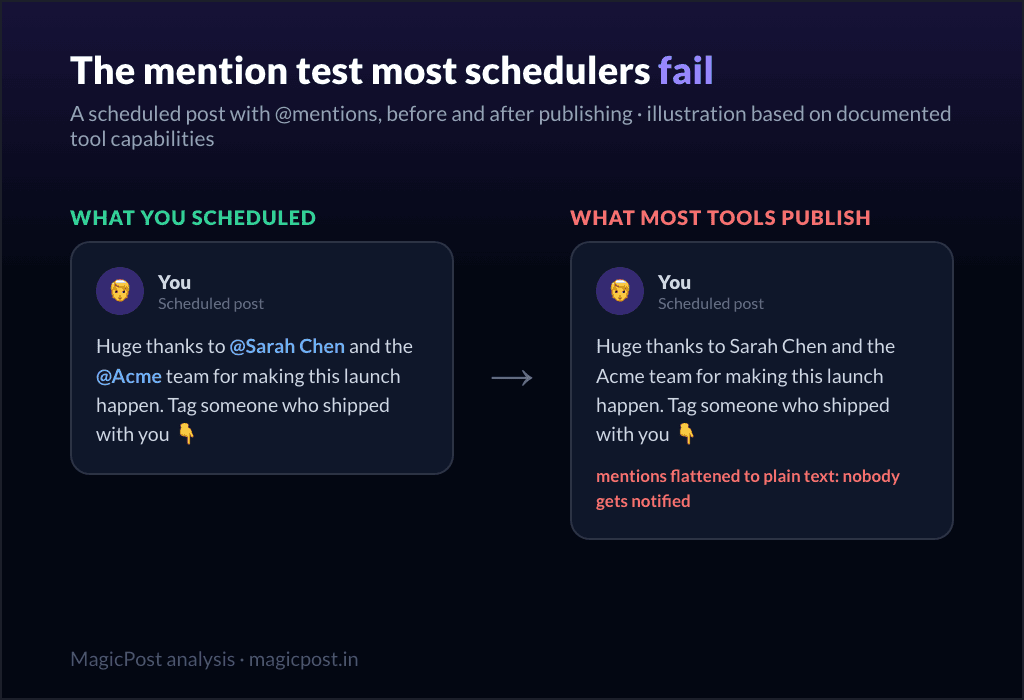
Count the dice rolls in one routine post thanking a client: are they your connection, is their profile in English, did they flip two settings most people have never seen? Each "no" turns the tag into plain text that notifies nobody. MagicPost publishes working @mentions of people and companies in scheduled posts, the receipt: how mentions work. Buffer got further than its peers here; a specialist starts where the conditions end.
1. MagicPost: the depth Buffer's reviewer asked for
MagicPost is the LinkedIn-only premium solution: AI-native, safe and complete. Jen's critique, the native features Buffer cannot carry, is the product description: working @mentions without the condition list, fold-accurate previews, carousels and formats, and analytics that speak LinkedIn natively: market benchmarks ("See how you stack up against LinkedIn market benchmarks") and audience analysis by countries, job fields and verticals. The AI learns your voice from your account, where Buffer's AI Assistant helps with captions, and every draft runs through a humanizer built on our published research (AI-sounding posts earn 57% less engagement). For teams it scales the way Buffer's per-channel model never tried to: companies get member spaces, complete team dashboards and adoption monitoring; agencies get client workspaces, validation workflows ("no post goes live until your client approves it") and white-label reports. Everything publishes through LinkedIn's official API as a LinkedIn-verified application; Buffer plays by the rules, and so do we, with a specialist's API depth.
Three differences that matter most coming from Buffer:
Mentions without the obstacle course. People and companies, in scheduled posts, working. No connections-only restriction, no English-profile requirement to check before every tag.
A loop, not a queue. Buffer schedules; MagicPost schedules and then keeps working: engagement workflows (curated feeds, daily objectives, AI comment suggestions you approve, scheduled comments) and lead detection with AI scoring plus CRM integrations.
Analytics that benchmark. Buffer's analytics report your numbers; MagicPost places them: the median creator earns a 0.39% engagement rate per post, and knowing your side of that line is what turns posting into strategy. The trial is verbatim "100% free trial. No credit card, No commitment.", and Buffer's free plan deserves the same credit; run both side by side.
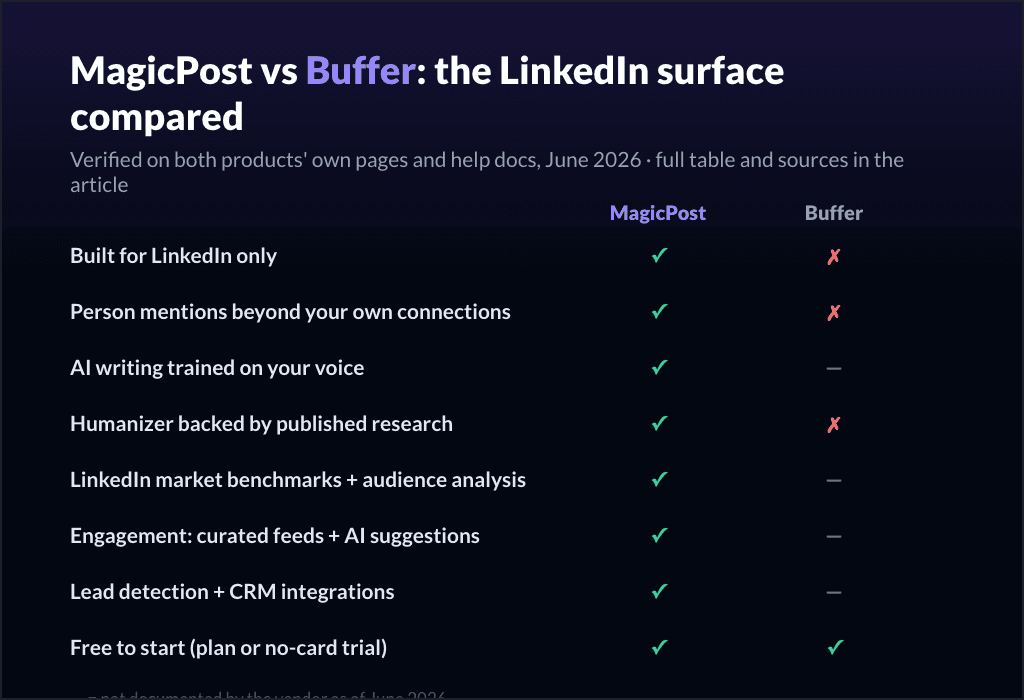
The LinkedIn surface, feature by feature (verified on both products' own pages and help docs, June 2026):
MagicPost | Buffer | |
Built for | LinkedIn only | Multi-network |
@mentions of LinkedIn people | ✅ Working, people and companies | ⚠️ Shipped, with conditions: connections only, English-language profiles, opt-in settings |
AI writing in your voice | ✅ Style import from your account | ⚠️ AI Assistant (captions; voice training not documented) |
Posts that don't sound AI | ✅ Humanizer, backed by published research | ❌ No published research |
LinkedIn market benchmarks | ✅ "See how you stack up against LinkedIn market benchmarks" | ❌ Not documented |
Audience analysis | ✅ "Countries, job fields, verticals, cities" | ⚠️ Cross-network analytics |
Engagement | ✅ Curated feeds, daily objectives, AI comment suggestions | ⚠️ First-comment scheduling (Essentials+) |
Lead detection | ✅ AI scoring + CRM integrations | ❌ Not documented |
Pricing model | ✅ Plans, no per-channel meter | ⚠️ Per channel: free (3), $5/mo, $10/mo per channel |
Trustpilot (June 2026) | ✅ 4.7/5 on 91 reviews | ⚠️ 3.2/5 on 105 reviews (invited; replies to 30% of negatives) |
Free to start | ✅ "100% free trial. No credit card" | ✅ Free plan, 3 channels |
Read it honestly: for one LinkedIn channel, Buffer costs $5-10 a month or nothing, replies to its critics by name, and now mentions people, with conditions. If your LinkedIn ambition is "queue posts, cheaply, politely," Buffer is a fine answer. The reasons to move are depth-shaped: a February 2026 reviewer's "post failures occur far too often for this to be a reliable tool" (Buffer engages with such reports publicly, to its credit), the free plan's 10-posts-in-queue ceiling that surprised another, and everything in the table above marked "not documented."
Switching your LinkedIn off Buffer? Try MagicPost free: import your voice, schedule two weeks of posts with working mentions, and see your numbers against LinkedIn benchmarks, no card, before you pay anything.
2. Supergrow: the writing upgrade
Supergrow swaps Buffer's caption assistant for an actual writing system: "Content DNA" voice training, "Postcast" AI interviews, voice-to-post, repurposing of YouTube videos, blogs and PDFs, calendar, queue and Kanban scheduling with auto first-comment, and a carousel maker on Pro, at $19/$39/mo with a Teams plan at $139/mo for 4 accounts (per its pricing, as of June 2026, 7-day trial).
Coming from Buffer, what changes. Your posts stop sounding like prompts and start sounding like you; the price of that is a real subscription where Buffer offered free. Two diligence notes: its public reviewers' most repeated critique is the analytics, and its pages never document the publishing mechanism, a detail Buffer documents cheerfully. (Full breakdown: Supergrow alternatives.)
Strong: voice-first AI with real scheduling, team plan. Watch for: analytics its own users flag, undocumented publishing method, no free tier.
3. SocialSonic: Buffer-simple, LinkedIn-deep
SocialSonic, from the team behind Writesonic, keeps the budget instinct and adds the LinkedIn depth: AI writing trained on viral LinkedIn posts, smart scheduling, analytics with lead attribution, a carousel maker with AI branding images, polls and gamification, at Pro $20/mo (a locked early-adopter rate; listed future price $39), Team $75/mo for 3 users, Agency $200/mo for 10 (as of June 2026; no-card trial plus a money-back week).
Coming from Buffer, what changes. Four dollars a month more than two Buffer channels buys an entire LinkedIn feature wall. The fine print: publishing mechanism not documented, engagement runs through a Chrome extension spanning four networks, several features "Coming Soon" at check time.
Strong: widest feature set under $25, team and agency tiers, no-card trial. Watch for: undocumented publishing mechanism, extension-based engagement, "Coming Soon" features.
4. Taplio: the maximalist, with asterisks
Taplio is the all-in-one at LinkedIn scale: AI writing on a large viral library, Kanban scheduling, analytics, engagement tools, outreach automation and advocacy sharing, with a 7-day full-Pro trial.
Coming from Buffer, what changes. Everything Buffer keeps minimal, Taplio piles on, including the risk: its own support acknowledges its extension is treated by LinkedIn as an automation tool against the ToS, the opposite of Buffer's rule-following brand. Pricing: $39/mo advertises the suite, the AI starts at $69/mo (per its pricing, as of June 2026), and its Trustpilot (2.4/5 on 13 reviews) is led by billing complaints, answered nowhere near as diligently as Mike answers Buffer's. (The full picture: Taplio alternatives.)
Strong: real LinkedIn breadth, full-Pro trial. Watch for: extension flagged by its own support, AI locked out of the entry plan, billing complaints.
5. Postdrips: the budget twin, LinkedIn-only
Postdrips is what Buffer's price point looks like as a LinkedIn specialist: tone-of-voice from a pasted profile URL, weekly ideas, an AI writer for grammar and tone passes, previews, native auto-queue scheduling (video, GIFs, multi-image), at Starter $18/mo and Pro $29/mo for up to 5 LinkedIn accounts with approval workflows (as of June 2026).
Coming from Buffer, what changes. Roughly the same money, one network, more voice. The gaps: no carousels, no person tagging (Buffer's conditional mentions actually beat this one), analytics "coming soon," publishing mechanism undocumented, and the 7-day trial auto-enrolls into Pro unless you cancel, a habit Buffer's free plan never taught. (Postdrips vs MagicPost)
Strong: 5 accounts at $29/mo, approval workflows, real scheduling. Watch for: analytics "coming soon", no tagging, trial auto-enrolls into Pro.
6. TypeGrow: free, like Buffer, but specialist
TypeGrow matches Buffer's best argument, free, and spends it all on LinkedIn: "completely free to use" per its own pricing page (no card, paid plan in development but unannounced, as of June 2026), with an AI writing assistant, scheduler, hook generator, carousel maker, post previews, a 1+ million viral-post library, "100% in the cloud," and a stated use of "the official LinkedIn API to connect to your LinkedIn account and post content from your or your company pages."
Coming from Buffer, what changes. Free stays free, the channel count drops to the one you came for, and the library plus hook generator out-LinkedIn anything in Buffer's composer. The trade is youth: analytics undocumented, no team features yet, future pricing unknown. (TypeGrow vs MagicPost)
Strong: genuinely free, claims official API, no extension. Watch for: no documented analytics, no team features yet, paid tier unannounced.
7. AuthoredUp: the craft answer
AuthoredUp covers what no generalist composer attempts: LinkedIn-native formatting, fold-accurate previews, 150+ hook and 100+ CTA references, readability grading, snippets, a calendar and a deep counting dashboard (saves, sends, profile views, CSV export), with no AI by design and the category's plainest operating statement: "100% secure. No automation. No cookies." Solo $19.95/mo, teams $14.95/profile/mo with a 3-profile minimum (no-card trial, as of June 2026).
Coming from Buffer, what changes. The composer becomes a writing room: previews that match the feed, stats that go deeper than impressions. No generation, no queue-across-networks. Its customer list (2,500+ companies self-reported, Microsoft and EY among them) says who it suits: people who already know what to write. (More options: AuthoredUp alternatives.)
Strong: best-in-class previews and formatting, deep analytics, transparent stance. Watch for: no AI, extension-based, per-profile team pricing.
8. Kleo V3: writing with a coach attached
Kleo V3 pairs a conversational writing app (voice training, 160+ post templates, 200+ hooks, 20 generated graphics a month) with weekly live group coaching and a private creator community, at $99/mo or $999/yr, no trial (FAQ verbatim: "Kleo does not offer a free trial at the moment," as of June 2026).
Coming from Buffer, what changes. This is the anti-Buffer purchase: maximal personal investment instead of minimal tooling. No analytics documented, no team features, a young product (early users report bugs and slow support), and the only humans-included option on this page. (The full comparison: Kleo alternatives.)
Strong: live human coaching and community, voice-first writing. Watch for: $99 with no trial, no analytics, young product.
9. Agorapulse: the full-suite generalist
If the move is up-market rather than specialist, Agorapulse is the suite Buffer is not trying to be: unified inbox, social listening, moderation rules and reporting across 11 networks, at $79-149/user/mo billed annually (10 profiles per tier) with the category's most generous trial, 30 days without a card (as of June 2026), and the best big-suite record on Trustpilot (4.0 across 57 reviews).
Coming from Buffer, what changes. Per-channel pricing becomes per-seat, the inbox becomes a real workflow, and the LinkedIn module stays a module: its own help centre states "Personal profiles cannot mention another Personal profile," a condition list stricter than Buffer's. (The LinkedIn-lens breakdown: Agorapulse alternatives.)
Strong: best-reviewed big suite, unified inbox, 30-day no-card trial. Watch for: per-seat pricing, person-mentions documented as unavailable, generalist LinkedIn module.
10. Metricool: the analytics-first generalist
Metricool is the data-minded swap: scheduling plus the strongest analytics culture of the budget generalists, competitor tracking included, on brand-based pricing: a permanent Free plan (1 brand, 20 posts/month), Starter from ~€16/mo for 10 brands, Advanced from ~€43/mo with team and client management (as of June 2026; annual saves up to 24%), and a 3.9 Trustpilot across 603 reviews.
Coming from Buffer, what changes. Free-plan readers, note one line on its pricing page: the Free plan covers "all your brands' social networks (except LinkedIn and Twitter)". Buffer's free plan includes LinkedIn; Metricool's does not, LinkedIn is paid-tier here. The analytics are its real draw, and they are cross-network ones. (Dedicated LinkedIn-lens page coming in this series.)
Strong: brand-based pricing, strong analytics culture, big review base. Watch for: LinkedIn excluded from Free, generalist module, the mention test.
11. Swello: the French generalist
Swello, made in France (Toulon), covers LinkedIn, Instagram, TikTok, Threads, Bluesky, Facebook and X with scheduling, AI caption and hashtag helpers, analytics, an inbox, an image editor and team-and-client workflows, at Medium €19/mo (1 user, 5 profiles), Large €59/mo (5 users, 15 profiles) and Business €99/mo (as of June 2026, annual = 2 months free, 7-day unlimited trial without a card).
Coming from Buffer, what changes. For European teams the appeal is locality: EUR pricing, French support culture, a tidy team model at flat tiers instead of per-channel math. The LinkedIn module is generalist-grade like Buffer's: caption-level AI, cross-network analytics, and no documented person-mention support. (Dedicated LinkedIn-lens page coming in this series.)
Strong: EU/French option, flat team tiers, no-card trial. Watch for: generalist LinkedIn module, lighter ecosystem than the big suites.
How to choose, in four questions
Run the mention test with the conditions in hand. Buffer's person mentions need a connection, an English-language profile and two opt-in settings; Agorapulse documents person-to-person as unavailable. Tag one person in one scheduled post on your shortlist and check what publishes; the specialist answer should come without homework.
Is the AI a voice or a caption helper? Buffer's AI Assistant is honest about being the latter. If LinkedIn is where your reputation lives, voice-trained generation with a humanizer behind it is a different product category, not a nicer caption box.
What do the analytics compare you against? Queue stats tell you what happened; LinkedIn benchmarks and audience analysis tell you what it means. Ask each tool which it has.
What does free actually include? Buffer's free plan includes LinkedIn with a 10-post queue ceiling; Metricool's free plan excludes LinkedIn entirely; TypeGrow's free plan is LinkedIn-only. Free is three different products here; read the one line of fine print.
Building your own brand on LinkedIn? MagicPost was built for exactly that workflow: see how solopreneurs use it, from first idea to published post with working mentions, all on the official API.
Running LinkedIn for clients or a team?
Buffer's per-channel model is friendly until the roster grows; then the math and the workflow both want structure. Agencies get one workspace per client, client validation ("no post goes live until your client approves it"), white-label exportable reports and all client metrics in one place; companies get member spaces, complete team dashboards (total impressions, followers gained, top performers) and adoption monitoring, with every member publishing through the official API. See how agencies use MagicPost or what it does for teams.
Switching your LinkedIn off Buffer in an afternoon
Export the LinkedIn slice. Your scheduled LinkedIn queue and drafts; the other channels can stay on Buffer's free plan, which is a perfectly honest way to run the combo.
Re-create the voice the caption box never learned. Minutes anywhere: account import (MagicPost), interview (Supergrow), profile URL (Postdrips).
Re-run your last month's tags. List the people you mentioned or meant to mention; check how many were non-connections or non-English profiles. That list is your personal answer to whether Buffer's conditions matter.
Trial against the free plan you already have. Buffer free stays as the control group; run the same week through a no-card specialist trial (MagicPost, TypeGrow, SocialSonic, AuthoredUp) and compare mentions, analytics and time spent.
Where these facts come from
Every claim on this page was verified on the vendor's own site, pricing page or help documentation in June 2026, and volatile facts (prices, trials, feature availability) are dated. Buffer's pricing and free-plan limits are from its own pricing page; its LinkedIn mention feature and conditions are quoted verbatim from its own help center, fetched live at the check date, and we credit the feature explicitly because it is the only one of its kind among the big generalists; its Trustpilot figures and review quotes are from its public, review-inviting profile, where Buffer's replies to critics are part of the record and noted as such. Where a vendor does not document something, we say "not documented" rather than guessing. Our own performance claims come from our published research program on 1.2M LinkedIn posts. If you spot something outdated, it will be corrected at the next quarterly refresh.
Buffer vs MagicPost: what is the real difference?
A queue versus a loop. Buffer schedules posts to many networks simply and cheaply, with conditional LinkedIn mentions and caption-level AI. MagicPost does one network completely: voice-trained AI with a research-backed humanizer, working @mentions of people and companies, LinkedIn benchmarks and audience analysis, engagement workflows, comment scheduling and lead detection with CRM integrations, on the official API, with a no-card trial (as of June 2026).
Is there a free Buffer alternative for LinkedIn?
TypeGrow: completely free, no card, no extension, claiming official-API publishing, LinkedIn-only (as of June 2026). MagicPost's free trial covers the complete workflow without a card; a trial rather than a free plan, but it is the zero-cost way to test working mentions, benchmarks and a real scheduled week against the free plan you already have.
Preguntas frecuentes
What is the best Buffer alternative for LinkedIn?
MagicPost: LinkedIn-only and premium, AI trained on your voice with a research-backed humanizer, working @mentions of people and companies without Buffer's condition list, LinkedIn market benchmarks and audience analysis, engagement workflows and lead detection, on the official LinkedIn API as a verified application, with a no-card free trial (as of June 2026). Budget all-rounder: SocialSonic. Free specialist: TypeGrow.
Why leave Buffer for a LinkedIn-specific tool?
Buffer's own 3-star reviewer said it precisely: "it lacks the ability to use all the same features that I would normally have on the individual app settings." On LinkedIn that means conditional person-mentions, caption-grade AI, cross-network analytics without LinkedIn benchmarks, and no engagement or lead layer. Buffer is honest, cheap and polite; the gap is depth, not character.
Can Buffer tag people in scheduled LinkedIn posts?
Yes, and it is the only big generalist that can, with documented conditions: "LinkedIn profiles can only tag profiles belonging to their connections," the tagged person needs "Off-LinkedIn Visibility" and "Allow mentions" enabled plus an English-language profile, you cannot tag yourself, and person-mentions do not work when posting to multiple LinkedIn channels at once (per Buffer's help center, June 2026). Every condition that fails turns the tag into plain text.
Is Buffer good for LinkedIn?
For queueing posts to LinkedIn at minimal cost, genuinely yes: free for up to 3 channels, $5/mo per channel for unlimited scheduling, first-comment scheduling on paid tiers, and a company that answers its critics. What it does not offer LinkedIn: unconditional mentions, voice-trained AI, LinkedIn benchmarks, engagement workflows or lead detection. A reliable queue, not a strategy.
How much does Buffer cost?
Per channel, as of June 2026: Free (3 channels, 10 scheduled posts per channel, 1 user), Essentials $5/month per channel (unlimited scheduling, advanced analytics, first-comment scheduling), Team $10/month per channel (unlimited team members, approval workflows, branded reports). Paid tiers carry a 14-day trial and auto-downgrade to Free after.
What is the cheapest Buffer alternative for LinkedIn?
TypeGrow, free outright as a LinkedIn specialist (no card, paid plans in development as of June 2026). Buffer's own free plan remains the cheapest multi-network option with LinkedIn included; Metricool's free plan, note, excludes LinkedIn entirely.
Buffer vs Hootsuite for LinkedIn?
Buffer, on the public record: 3.2/5 across 105 Trustpilot reviews with replies to 30% of negatives, against Hootsuite's 1.3/5 across 554 on an invited profile, and per-channel pricing against $99-249/user/mo. Neither gives LinkedIn unconditional person-mentions, voice-trained AI or LinkedIn benchmarks; both are queues for the network where you need a strategy. Our LinkedIn-lens take: Hootsuite alternatives.
Can I use MagicPost and Buffer together?
Yes, and Buffer's free plan makes it the cheapest combo in the category: Buffer keeps your secondary networks queued at zero cost, MagicPost runs LinkedIn, where mentions, voice, benchmarks, engagement and leads need the specialist. Both starts are free; the experiment costs nothing.
10 Mejores Herramientas de Programación de LinkedIn (2026)
Las 10 mejores herramientas de programación de LinkedIn en 2026. Compara funciones, precios y rendimiento para ahorrar tiempo, automatizar publicaciones y aumentar el compromiso.
Las 10 mejores alternativas a Hootsuite para una mejor gestión de redes sociales en 2026
¿Es Hootsuite demasiado caro o complicado? Descubre 5 alternativas altamente valoradas con funciones más inteligentes y mejor relación calidad-precio para gestionar tu diverso contenido en redes sociales.
11 Best Agorapulse Alternatives for LinkedIn (Verified June 2026)
Agorapulse is a fine generalist, but its own docs say personal profiles cannot mention each other on LinkedIn. 11 specialist alternatives compared with receipts: mentions, voice AI, benchmarks, June 2026.
11 Best Metricool Alternatives for LinkedIn (Verified June 2026)
Metricool's free plan covers every network except LinkedIn, its own pricing page says so. 11 LinkedIn alternatives compared with receipts: mentions, voice AI, real LinkedIn benchmarks, June 2026.
11 Best Swello Alternatives for LinkedIn (Verified June 2026)
Swello is the best-loved generalist we have reviewed, and still a generalist on LinkedIn: caption AI, cross-network analytics, no documented mentions. 11 alternatives compared with receipts, June 2026.
Las 10 mejores alternativas a SocialPilot en 2026
¿Buscas las mejores alternativas a SocialPilot en 2026? Descubre 10 herramientas para la gestión de redes sociales, que ofrecen mejor programación y análisis a mejores precios.