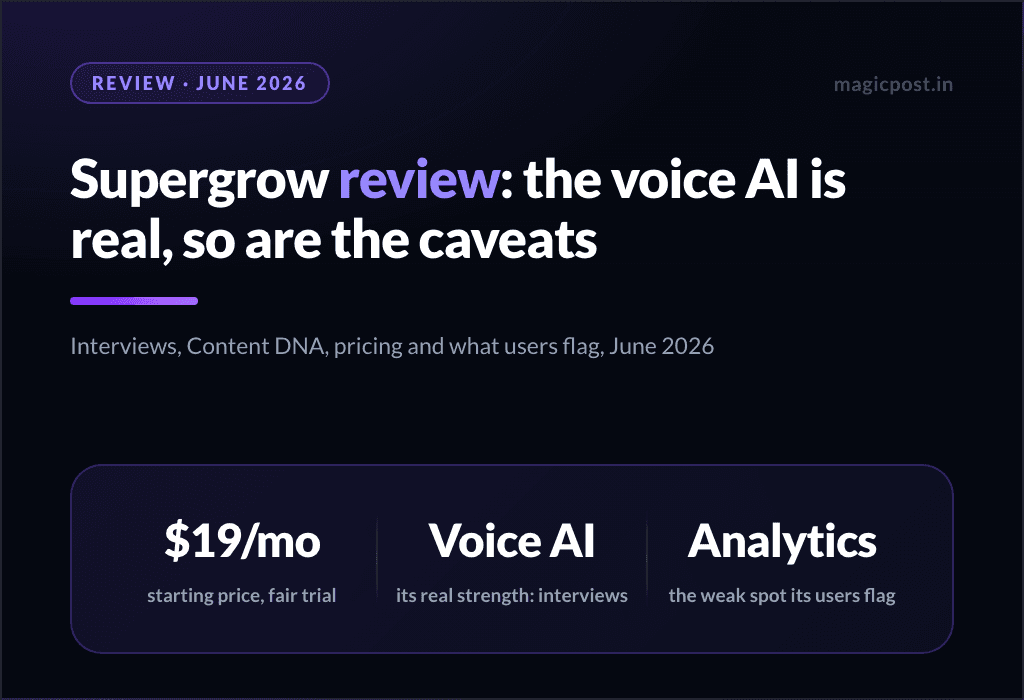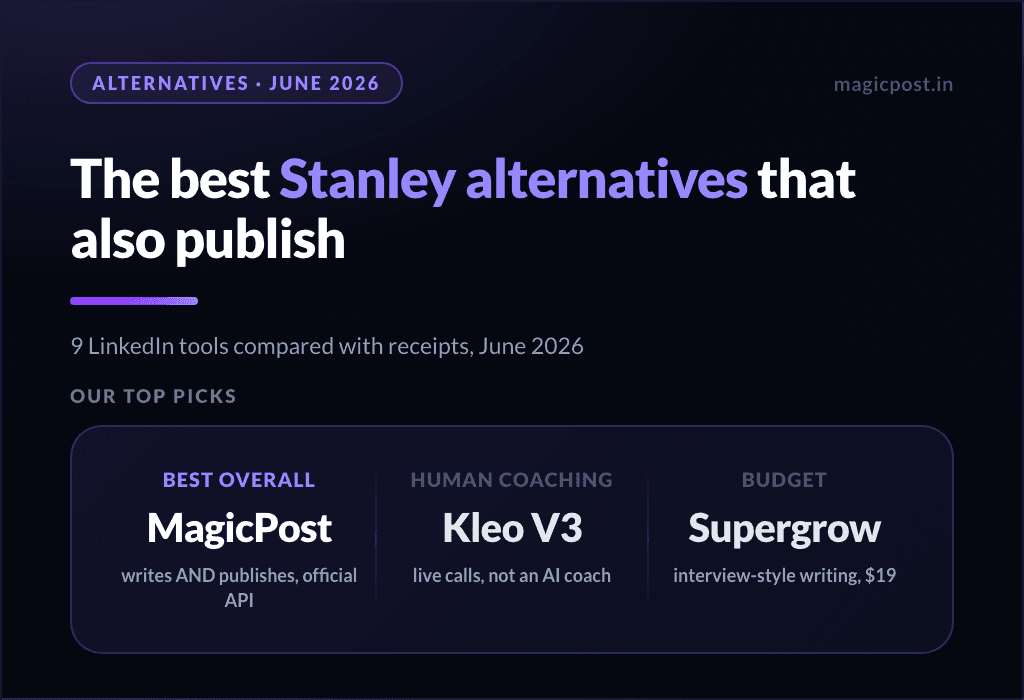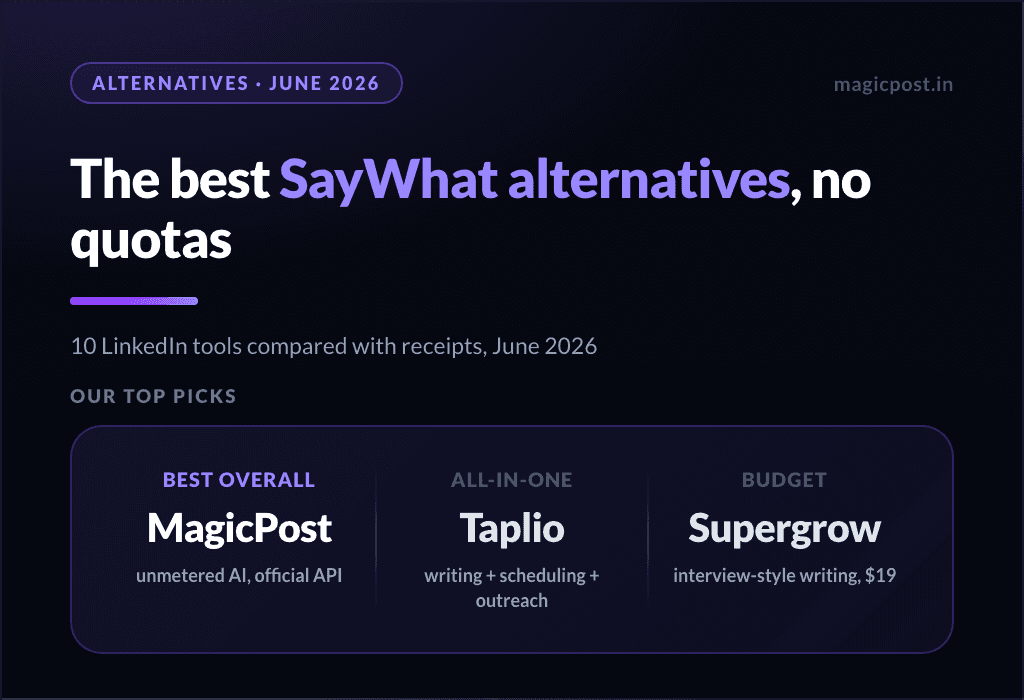
Supergrow writes well; that is rarely why people leave it. The reasons that show up in its own users' words are different: analytics its reviewers keep flagging, an engagement side that stays manual, a safety story that rests on a single FAQ sentence, and no free tier to fall back on once the 7-day trial ends and the account pauses.
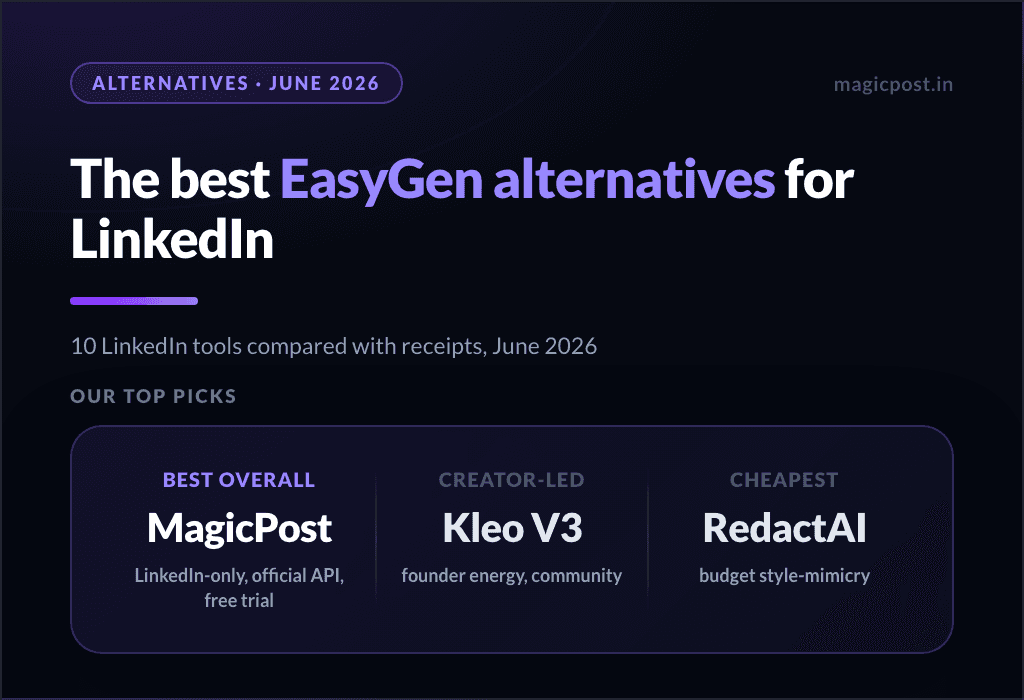
Here's what to use instead. Ten Supergrow alternatives, compared at equal depth, with what each is best for, key features, pros and cons, and monthly pricing. Our full verdict on the product is in our Supergrow review.
Supergrow Alternatives at a Glance
Tool | Best for | Price/mo | Publishing | Start |
The complete LinkedIn workflow | $49 (AI $69) | Official LinkedIn API | No-card trial | |
Kleo V3 | Coaching alongside writing | $99 | Schedules (undocumented) | No trial |
Stanley | Interview-style AI writing | $97 | None (you publish) | No trial, 30-day refund |
SayWhat | Turning engagement into leads | $59.99 to $299.99 | Browser-based | Trial |
Taplio | All-in-one breadth | $39 to $199 (AI from $69) | Cookie/extension | 7-day full Pro |
RedactAI | The cheapest voice-matched writing | $11.90 to $66 | Copy-paste | Free start |
EasyGen | Creator-grade generation | Not public* | Manual by design | 7-day trial |
SocialSonic | The widest budget feature set | $20 to $200 | Account (undocumented) | 7-day no-card |
AuthoredUp | Analytics without AI | $14.95 to $19.95 | Extension, your own session | No-card trial |
TypeGrow | Generous free trial | $29 | Claims official API | No-card trial |
*EasyGen advertises a 7-day trial but does not publish pricing; third-party reviews report ~$59.99/mo.
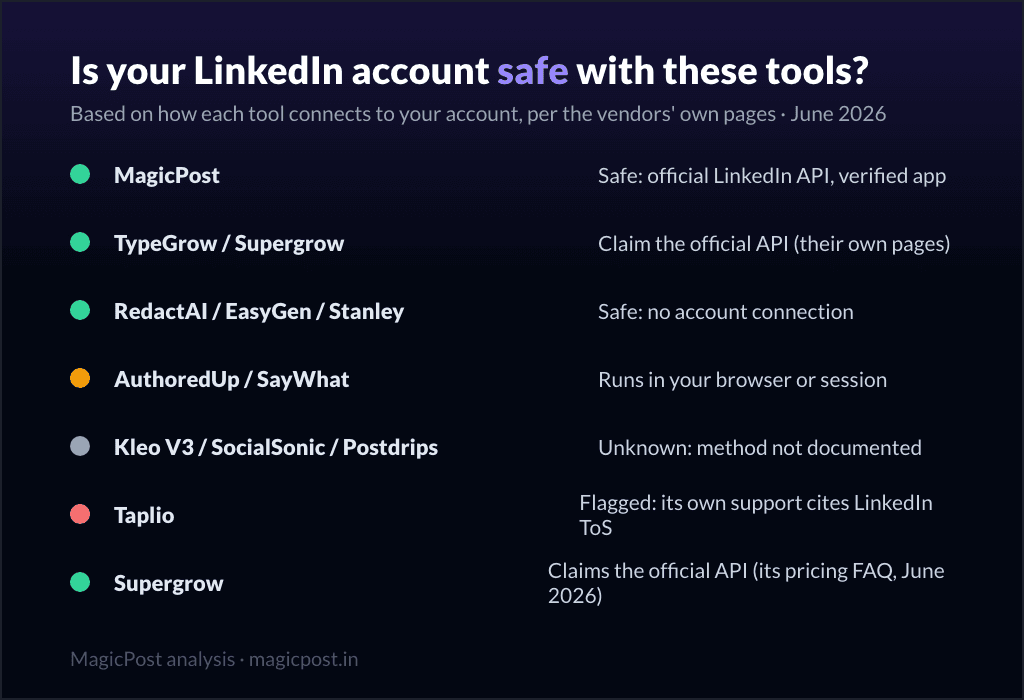
Start with the publishing column. Supergrow's pricing FAQ now states it connects through LinkedIn's official API and follows the platform's terms, which is the right sentence to publish, and we credit it.
It is also a vendor's claim rather than a LinkedIn-verified-application receipt, the standard exactly one tool here documents. LinkedIn's policy warns prohibited tools may become non-operational without notice, and 2026 delivered two object lessons: Kleo's original extension, forced to shut down, and Shield Analytics, gone entirely.
One reading note before the list. If you research Supergrow on LinkedIn itself, you will mostly find praise, AI-stack roundups from large creators, several of them the same text republished across accounts.
That is a well-run affiliate program doing its job, not a measure of the product. The useful signal lives in the critical themes of its public reviews and on the vendors' own pages, which is what this list is built from.
1. MagicPost: Best for the complete LinkedIn workflow
MagicPost covers Supergrow's home turf first, idea generation and AI that learns your voice from your actual account, then keeps going where Supergrow stops.
The addition Supergrow has no answer to is a humanizer backed by published research. AI phrasing itself is not penalized; what loses reach is generic, interchangeable content, roughly 10-14% fewer people, and the humanizer is built to keep your posts out of that bucket.
Everything then runs on LinkedIn's official API as a verified application: publishing, comment scheduling, metrics, engagement and lead detection, with no extension and no undocumented mechanism.
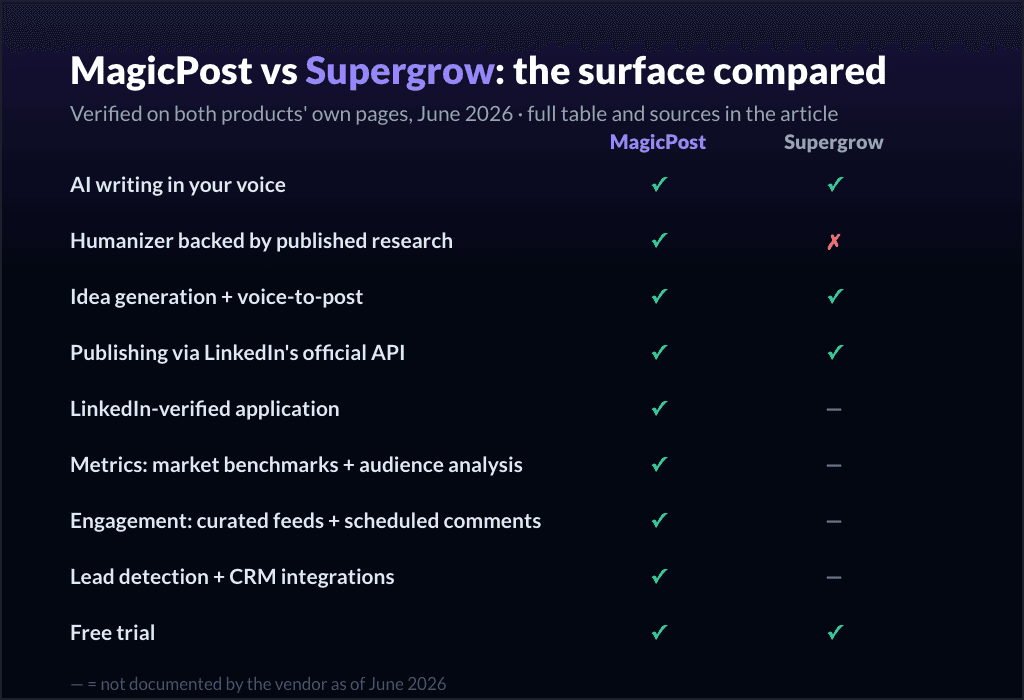
Three things separate it coming from Supergrow. The analytics answer the question Supergrow's own reviewers keep asking, market benchmarks and audience analysis by country, job field and vertical, where their most repeated critique is the analytics.
Engagement is a workflow, not a to-do, curated feeds, saved comments you reuse and scheduled comments, where Supergrow's stays manual.
And the publishing path is documented, not a single FAQ sentence, with a no-card trial so no paused account holds your queue hostage.
Key features
AI writing from your account's style, with a research-backed humanizer.
Publishing via LinkedIn's official API (verified app), with working @mentions.
Analytics against market benchmarks, plus audience analysis.
Engagement as a safe workflow, plus lead detection with CRM.
A 2M+ searchable inspiration library; agency and team modes.
MagicPost | Supergrow | |
AI writing in your voice | ✅ Style import | ✅ Content DNA, interviews |
Posts that don't read as AI | ✅ Humanizer, research-backed | ❌ |
Publishing via official API | ✅ Verified app | ⚠️ FAQ claim, not documented as verified |
Analytics + market benchmarks | ✅ | ⚠️ Its reviewers flag the analytics |
Engagement | ✅ Safe workflow | ⚠️ Manual |
Lead detection + CRM | ✅ | ❌ |
Trustpilot | ✅ 4.7/5 (91) | ❌ No reviews found |
Free trial | ✅ No card | ⚠️ 7 days, account pauses after |
In fairness: Supergrow's writing experience is genuinely modern, the Kanban scheduling is a real workflow idea, and the Teams plan exists where most of this list has nothing. The gaps are the rest of the loop, analytics, engagement and leads, which is exactly where its own users say it thins out.
Pros | Cons |
✅ The whole loop in one tool: write, publish, measure, convert | ❌ LinkedIn-only (not a multi-network suite) |
✅ The analytics layer Supergrow's reviewers wish they had | ❌ Premium positioning, not the cheapest |
✅ Official-API publishing with working @mentions | |
✅ Safe engagement and lead detection; no-card trial |
Plan | Price/mo | Includes |
Growth | $49 | Scheduling, analytics, market benchmarks |
Creator (AI) | $69 | AI writing in your voice, humanizer, engagement |
2. Kleo V3: Best for coaching alongside writing
Kleo V3 shares Supergrow's conviction that the tool should learn your voice, then bets the rest of the product on people instead of features.
Around conversational writing and deep template libraries sits the bundle nothing else here offers: weekly live group coaching and a private creator community. What you pay for is the humans, $99/mo with no free tier and, unlike Supergrow, not even a trial week to test the fit.
The product around the coaching is younger than Supergrow's: analytics undocumented, engagement nonexistent, and early users report bugs and slow support. Two features do beat Supergrow outright, the one-click graphics (where Supergrow's visual tooling is its reviewers' sore spot) and the community itself. The question that decides it: will you attend the calls?
Key features
Conversational writing app with a memory layer.
Deep template libraries and included graphics.
Weekly live group coaching and a private community.
Schedules to LinkedIn (mechanism not documented).
Pros | Cons |
✅ The only human coaching-and-community bundle | ❌ $99/mo, no free tier, no trial |
✅ Included graphics, Supergrow's sore spot | ❌ Younger than Supergrow: no analytics, bugs |
✅ Founder credibility with creators | ❌ No engagement tooling |
Plan | Price/mo | Includes |
Kleo | $99 | Writing app, templates, graphics, community |
The full comparison: Kleo alternatives.
3. Stanley: Best for interview-style AI writing
If Supergrow's Postcast interviews were your favourite feature, Stanley is that feature as an entire product.
A conversational AI from the Stan Store team interviews you, drafts in your voice, critiques your recent posts on request, and backs it with a native analytics dashboard (follower growth, top performers, content pillars, a projected growth curve).
The trade versus Supergrow is deeper conversation, narrower workflow: Stanley schedules nothing and publishes nothing, which means zero account risk and a second tool in your stack for the actual posting.
The price is the filter, $97/mo on the Stanley plan, a cheaper single-user Stanley Lite tier below it, a 30-day refund instead of a trial, about two and a half times Supergrow's Pro for the thinking half of the job only. It fits one profile: the creator who wants Kleo-style guidance from an AI instead of a weekly call, and already has a publishing tool.
Key features
Conversational modes: interview, write, analyze posts.
Voice-matched generation from your past posts.
Native analytics: follower growth, top performers, pillars.
No scheduling or publishing (zero account connection).
Pros | Cons |
✅ The best conversational writing flow in the field | ❌ No publishing or scheduling |
✅ Real analytics included | ❌ $97/mo, no free trial (30-day refund) |
✅ Zero account risk by design | ❌ About 2.5× Supergrow Pro |
Plan | Price/mo | Includes |
Stanley | $97 | Writing + analytics; cheaper single-user Lite tier below |
Head-to-head: Stanley vs MagicPost · full take: Stanley review.
4. SayWhat: Best for turning engagement into leads
SayWhat aims Supergrow's core promise, AI that sounds like you, at a sales audience.
Its Collab AI studies your profile and past posts, generates from a database of pre-validated formats, and surrounds the writing with engagement analytics, comment management and lead tracking that turns engagers into pipeline, the piece Supergrow does not have.
The pricing logic flips from flat to metered, by how many posts the AI generates per cycle, and annual plans add community calls and 1:1 sessions.
Entry costs about 1.5× a Supergrow Pro, so the math only works if the lead tracking earns its keep; for a consultant whose posts exist to start conversations, it can be the whole game. On safety, SayWhat runs browser-side rather than on the official API, so keep the chart above in mind.
Key features
Lead tracking and an opportunity pipeline.
Voice-matched writing from a trending-formats database.
Engagement analytics and comment management.
Community calls and 1:1 sessions on annual plans.
Pros | Cons |
✅ Lead tracking Supergrow lacks | ❌ Metered post quotas |
✅ Voice matching plus a sales layer | ❌ Browser-based, not official API |
✅ Coaching extras on annual plans | ❌ Entry is 1.5× a Supergrow Pro |
Plan | Price/mo | Includes |
Standard | $59.99 | from 6 posts/cycle |
Premium | $99.99 | more credits |
Executive+ | $299.99 | up to 40 posts/cycle |
Head-to-head: SayWhat vs MagicPost · full take: SayWhat review.
5. Taplio: Best for all-in-one breadth
Taplio is the inverse trade from most of this list: feature breadth Supergrow does not attempt, in exchange for the two biggest asterisks in the category.
A large viral-post library, engagement tools and outreach automation are the breadth. The asterisks: the advertised $39 Starter ships zero AI credits (Supergrow's $39 buys working AI; Taplio's does not), and Taplio's own support acknowledges its extension is treated by LinkedIn as an automation tool against the ToS.
Its Trustpilot sits at 2.4/5 across 13 reviews, dominated by billing complaints, including one user flagged off LinkedIn through its engagement tools. Where Supergrow's publishing method is undocumented, Taplio's is documented in the wrong direction.
Key features
A large viral-post library and AI writing.
Kanban scheduling and analytics.
Engagement tools and outreach automation.
Auto-DMs on the top tier.
Pros | Cons |
✅ The widest feature surface here | ❌ AI locked out of the $39 entry plan |
✅ Full-Pro 7-day trial | ❌ Extension flagged by its own support |
✅ Built-in lead database | ❌ 2.4/5 Trustpilot; card-gated trial |
Plan | Price/mo | Includes |
Starter | $39 | Suite without AI credits |
Growth | $69 | 250 AI credits |
Pro | $199 | Auto-DMs and auto-connections |
The full picture: Taplio alternatives, and the head-to-head in Supergrow vs Taplio.
6. RedactAI: Best for the cheapest voice-matched writing
RedactAI strips the job down to the part Supergrow users actually came for: posts that sound like you, for a tenth of the price.
It learns from a pasted profile URL, no account connection, and adds niche idea generation, light scheduling with top-post recycling, basic stats, and free front-door tools. The bill drops leaving Supergrow, and so does the scope.
Mind the cap: Essential's 15 posts a month suits an every-other-day rhythm, not a daily one. The losses are everything around the writing, copy-paste publishing, no engagement layer, no team plan, and an indie-scale roadmap. The flip side: no account connection means nothing to trust and nothing to verify.
Key features
Style-matched generation from a pasted profile URL.
Niche idea generation from viral posts.
Light scheduling that recycles top posts.
Free tools (profile review, formatter).
Pros | Cons |
✅ The gentlest paid entry here | ❌ Essential capped at 15 posts/mo |
✅ Zero account exposure | ❌ Copy-paste publishing, no engagement |
✅ Free start, no card | ❌ Indie-scale, single-purpose |
Plan | Price/mo | Includes |
Essential | $11.90 | 15 posts/mo (billed yearly) |
Creator | $24 | Unlimited posts (billed yearly) |
Copywriter | $66 | Write for multiple profiles |
The full breakdown: RedactAI alternatives.
7. EasyGen: Best for creator-grade generation
EasyGen comes from LinkedIn creator Ruben Hassid (100M+ views) and sells exactly that pedigree.
Around the generator sit a content calendar, creator search, trending-topic intelligence from Reddit, X, Google and Perplexity, voice notes, and a Chrome extension for drafting inside LinkedIn (4.7/5 on the Chrome Web Store).
On publishing, the two tools are mirror images: where Supergrow stays quiet about its method, EasyGen is loud about refusing one, arguing that auto-posting hurts reach, so you post by hand as a feature.
That claim ships without published data, and our measurements on API-published posts show no such penalty, so weigh both sides yourself. The other quiet part is the price, not published (third-party reviews report ~$59.99/mo), Supergrow-Pro money for generation without analytics or engagement.
Key features
Creator-grade generation with a famous-founder pedigree.
Trending-topic intelligence from four sources.
Voice notes and an in-feed Chrome extension.
Content calendar (manual publishing by design).
Pros | Cons |
✅ Creator-grade draft quality | ❌ Manual publishing by design |
✅ Trending-topic intelligence | ❌ Pricing not public |
✅ 4.7/5 Chrome extension | ❌ No analytics, no engagement |
Plan | Price/mo | Includes |
Not published | ~$59.99* | 7-day trial advertised |
*Per third-party reviews. The full field: EasyGen alternatives.
8. SocialSonic: Best for the widest budget feature set
SocialSonic, from the team behind Writesonic, is what Supergrow's feature page would look like if it kept going.
AI writing trained on viral posts, smart scheduling, analytics with lead attribution, a carousel maker with AI branding, and gamification, at a Pro rate of $20/mo (an early-adopter price; listed future price $39), with real team and agency tiers above. On carousels it lands ahead of where Supergrow's own reviewers place theirs.
Same blind spot, though: the publishing mechanism is undocumented, and it ships a Chrome extension for AI-suggested comments across LinkedIn, X, Reddit and Meta, the risk category the chart above flags. Several engagement features were also marked "coming soon" at check time.
Key features
AI writing trained on viral posts.
Smart scheduling with optimal-time recommendations.
Carousel maker, AI branding images, polls.
Analytics with lead attribution; team and agency tiers.
Pros | Cons |
✅ The widest feature set under $25 | ❌ Publishing mechanism not documented |
✅ Real team and agency tiers | ❌ Four-network engagement extension |
✅ No-card trial | ❌ Several features marked coming soon |
Plan | Price/mo | Includes |
Pro | $20 | Solo writing + scheduling |
Team Accelerator | $75 | 3 users |
Agency | $200 | 10 users, branding |
The full picture: SocialSonic alternatives.
9. AuthoredUp: Best for analytics without AI
AuthoredUp is the deliberate opposite of everything Supergrow optimizes for: no generation, no voice model, no interviews.
You write; it polishes, formatting, fold-accurate previews, 150+ hooks and 100+ CTA references, readability grading, a calendar, and analytics with the depth Supergrow's reviewers wish they had (saves, sends, profile views, CSV export). It runs as a Chrome extension in your own session, privacy-first, with no automation and no cookies.
The trade is explicit: you swap the generator for the analytics, and you take back the writing. It reports 2,500+ companies as customers, including Microsoft and EY. The bet only works if the blank page does not scare you, there is no AI to fill it.
Key features
LinkedIn-native formatting and fold-accurate previews.
150+ hooks, 100+ CTA references, readability grading.
Deep analytics: saves, sends, profile views, CSV export.
Scheduling and content calendar (no AI generation).
Pros | Cons |
✅ The analytics depth Supergrow's reviewers want | ❌ No AI writing at all |
✅ Best-in-class formatting and previews | ❌ Lives in a Chrome extension |
✅ Privacy-first; trusted by 2,500+ companies | ❌ Per-profile team pricing adds up |
Plan | Price/mo | Includes |
Individual | $19.95 | One profile, craft + stats |
Business | $14.95/profile | Min 3 profiles |
More options: AuthoredUp alternatives.
10. TypeGrow: Best free trial
Typegrow gives you an AI writing assistant, a scheduler, a hook generator, a carousel maker, post previews, and a 1M+ viral-post library. Two claims Supergrow never makes, stated plainly: it runs entirely in the cloud with no extension, and it uses the official LinkedIn API to publish from your or your company pages.
However, its analytics are undocumented, and the platform is less established than its alternatives.
Key features
AI writing assistant, hook generator, carousel maker.
One-click scheduler and post previews.
A 1M+ viral-post library.
Claims official-API publishing, no extension.
Pros | Cons |
✅ Genuinely useful free trial | ❌ No documented analytics yet |
✅ Claims official API, no extension | ❌ Official-API claim not independently verified |
✅ Real scheduling and carousels | ❌ Young product |
Plan | Price/mo | Includes |
Starter | $29/seat | Writing, scheduling, carousels |
If you only used Supergrow for one thing
Most people hire an all-in-one for one or two jobs. Name yours before shopping, because the right alternative changes completely with it:
The AI interviews (Postcast). Stanley is that idea as a whole product, at coaching prices. MagicPost reaches the same destination from your account history.
The Kanban view. Genuinely Supergrow's; nobody else here documents one. Decide if the view or the workflow was the point.
Repurposing YouTube, blogs and PDFs. Supergrow's most underrated feature, and the field's gap: none of the ten documents an equivalent pipeline. Weigh that loss before leaving.
The Teams plan and advocacy. Its own reviewers flag the friction (one approver per post, a separate account for every profile). MagicPost's LinkedIn employee advocacy platform is built for that scale (employee advocacy software compared); Postdrips is the budget patch.
The analytics. If you are leaving over them, you are in the majority of Supergrow's public critics. AuthoredUp and Stanley both out-analyze it; MagicPost adds the layer none of them have.
How to Choose the Best Supergrow Alternative
Can you verify how it touches your account? Supergrow only put its answer in writing recently, one FAQ sentence claiming the official API. Credit claims, prefer receipts: only one tool here is a verified application on the official API, the same check our best LinkedIn scheduling tools ranking applies.
What happens after you publish? Writing is the half every tool now does. Analytics, engagement and leads are where the lists thin out; count which of the four jobs each tool actually ships.
What happens at the billing boundary? Check whether the trial needs a card, what pauses when it ends (Supergrow pauses the account), and what auto-enrolls (Postdrips into Pro; Taplio's trial is card-gated with a 2.4 Trustpilot).
What do its users say in public? Read critical themes, not scores; scores are easy to farm, recurring complaints are not. Supergrow's recurring one is the analytics.
Building a solo brand on LinkedIn? MagicPost was built for exactly that workflow: see how solopreneurs use it, from first idea to published post and the analytics that tell you what worked, all on the official API.
Leaving Over the Gaps? There's a Fit
Supergrow's writing is genuinely good, and if writing volume in your voice is your entire problem, it solves it. This page exists for the people whose problem turned out to be bigger than that, the ones leaving over the analytics, the manual engagement, or the account that pauses after a week.
MagicPost is the same writing idea executed on more data, plus the rest of the loop its own users say it thins out: benchmarked analytics and audience analysis, engagement as a safe official-API workflow, and lead detection, with agencies running one workspace per client on validation workflows. It is all testable first on a no-card trial.
FAQ
What is the best Supergrow alternative?
MagicPost: the complete loop (AI writing in your voice, scheduling, advanced analytics, engagement, leads) on the official LinkedIn API, and the only verified application here, with a no-card trial. Narrower needs have narrower answers: Stanley for interview-style writing, AuthoredUp for zero AI with strong analytics, TypeGrow at $29/mo after a free trial.
Why do people look for Supergrow alternatives?
The themes in its own public reviews: analytics that underdeliver (the most repeated critique), engagement that stays manual, an immature carousel maker, and approval workflows that allow one approver and require a separate account per LinkedIn profile. Add two structural points: its pages document publishing only as a recent FAQ claim, and there is no free tier, accounts pause when the trial ends.
Is Supergrow safe for your LinkedIn account?
Probably, but you verify it from one FAQ sentence claiming the official API, with no enforcement incident on record. Our standard is stricter: a documented, verified official API beats an undocumented or claim-only assurance.
How much does Supergrow cost?
Pro $39/mo, Teams $199/mo for 5 accounts with approval workflows, custom Enterprise above that. Annual billing brings them to $31/mo and $189/mo. All plans carry a 7-day trial; there is no permanent free tier.
What is the cheapest Supergrow alternative?
RedactAI starts at $11.90/mo billed annually (15 posts), Postdrips at $18/mo, TypeGrow at $29/mo after a free trial. All three are narrower than Supergrow; check the jobs you actually need covered.
What is the best Supergrow alternative for teams and employee advocacy?
MagicPost's team mode: member spaces, adoption dashboards, company-wide publishing, plus client-style validation if an agency runs the program, without one-account-per-profile juggling. SocialSonic's Team Accelerator ($75/mo, 3 users) is the budget option.
Supergrow vs MagicPost: what is the real difference?
Both write in your voice and schedule to LinkedIn. MagicPost is a verified application on the official API, ships market benchmarks and audience analysis, runs engagement and lead detection through the same workflow, and backs its writing advice with published research on 1.2M posts. Supergrow documents none of those. The head-to-head: Supergrow vs MagicPost.