" height="26.80529977783203px" id="tymKb8bqC" width="128.00300311279295px"/><path d="M 0 2.417 L 0 0 L 12.909 0 L 12.909 2.417 Z" fill="rgb(126, 78, 253)" height="2.417099999999998px" id="aYr4em6zK" transform="translate(128.341 22.325)" width="12.908999999999992px"/></svg>)

"/><stop offset="1" stop-color="rgb(118, 37, 250)"/></linearGradient></defs><g d="M 19.242 21.22 L 19.362 6.204 L 19.272 6.204 L 13.757 21.22 L 10.161 21.22 L 4.796 6.204 L 4.706 6.204 L 4.825 21.22 L 0 21.22 L 0 0 L 7.283 0 L 12.109 13.607 L 12.229 13.607 L 16.844 0 L 24.247 0 L 24.247 21.22 Z M 26.421 26.113 L 26.421 23.445 L 41.407 23.445 L 41.407 26.113 Z" fill="transparent" height="26.112508199679183px" id="DvfaAIHYn" width="41.40731898311435px"><path d="M 19.242 21.22 L 19.362 6.204 L 19.272 6.204 L 13.757 21.22 L 10.161 21.22 L 4.796 6.204 L 4.706 6.204 L 4.825 21.22 L 0 21.22 L 0 0 L 7.283 0 L 12.109 13.607 L 12.229 13.607 L 16.844 0 L 24.247 0 L 24.247 21.22 Z" fill="rgb(46, 46, 46)" height="21.220180016149442px" id="pLsxRCobd" width="24.247352589074694px"/><path d="M 0 2.668 L 0 0 L 14.986 0 L 14.986 2.668 Z" fill="url(%23yD9d4I5GR-3279285344-linear-gradient)" height="2.6675085048549647px" id="yD9d4I5GR" transform="translate(26.421 23.445)" width="14.986002836263765px"/></g></svg>)

Naïlé Titah
The single biggest reason employee advocacy programs stall is not strategy or tooling. It is the blank page. Employees want to post, then freeze, because they do not know what to say.
So here are eight post types that consistently work, each with a real example from the companies we measured winning at advocacy, plus what our benchmark of millions of posts says about making them land. None of them require being a "creator"; they just require an angle only that person could write.
Here they are at a glance:
# | Post type | What it is | Real example |
1 | The contrarian take | Argue against a common belief | Clay's Head of Growth |
2 | The teardown | Break down how something works | ColdIQ's founder |
3 | The practical how-to | Teach something specific | Clay's product support |
4 | The milestone | Mark a company or personal milestone | lemlist's copywriter |
5 | The behind-the-scenes | A real moment inside the company | Gong's sales leader |
6 | The data drop | Share a real playbook or numbers | HubSpot's CS director |
7 | The one-liner | A funny, human one-liner | Clay's brand lead |
8 | The vulnerable story | Something real you struggled with | ColdIQ's senior hire |
TL;DR: Stuck on what your team should post? 8 employee advocacy content ideas for LinkedIn, each with a real example from the companies winning at advocacy (Clay, ColdIQ, Gong, HubSpot, lemlist), plus the data on what actually performs.
1. The contrarian take
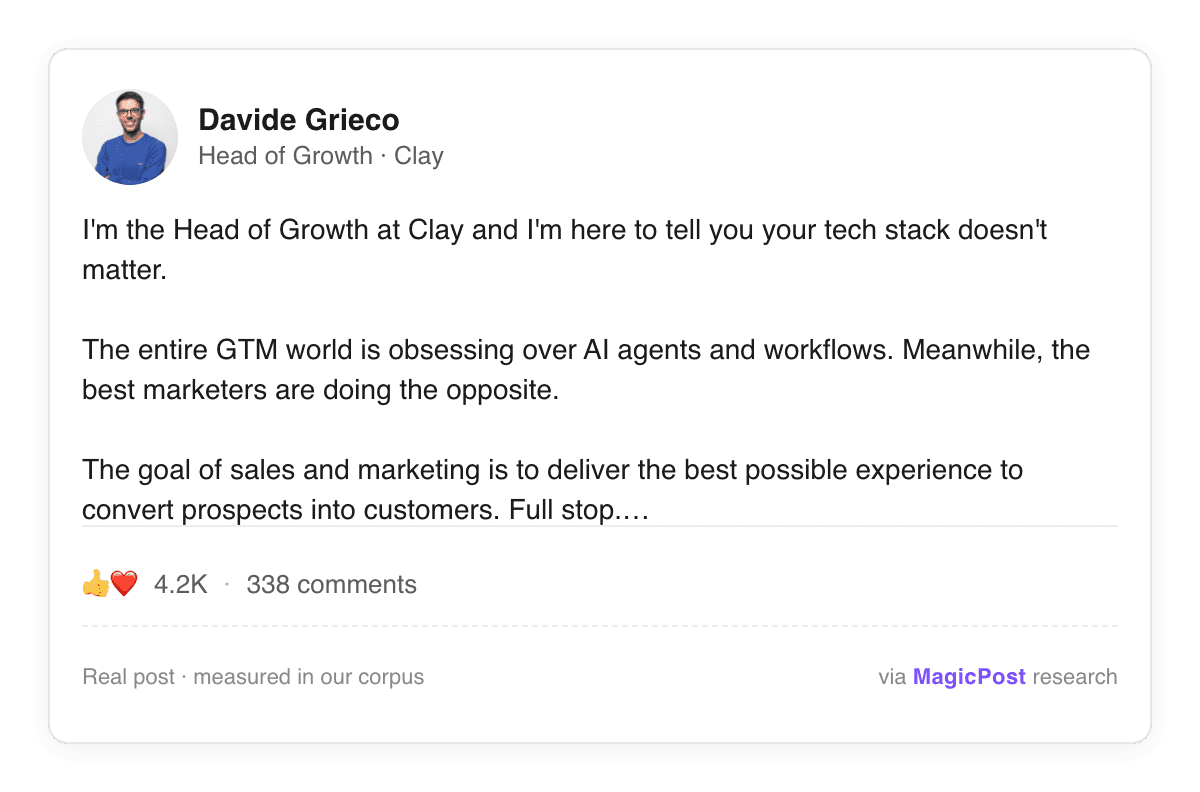
Pick a belief everyone in your field repeats, and argue the opposite (when you genuinely mean it). It earns reach because it stops the scroll and invites debate. Clay's Head of Growth does this constantly, here, telling the entire GTM world that their obsessed-over tech stack does not matter.



2. The teardown
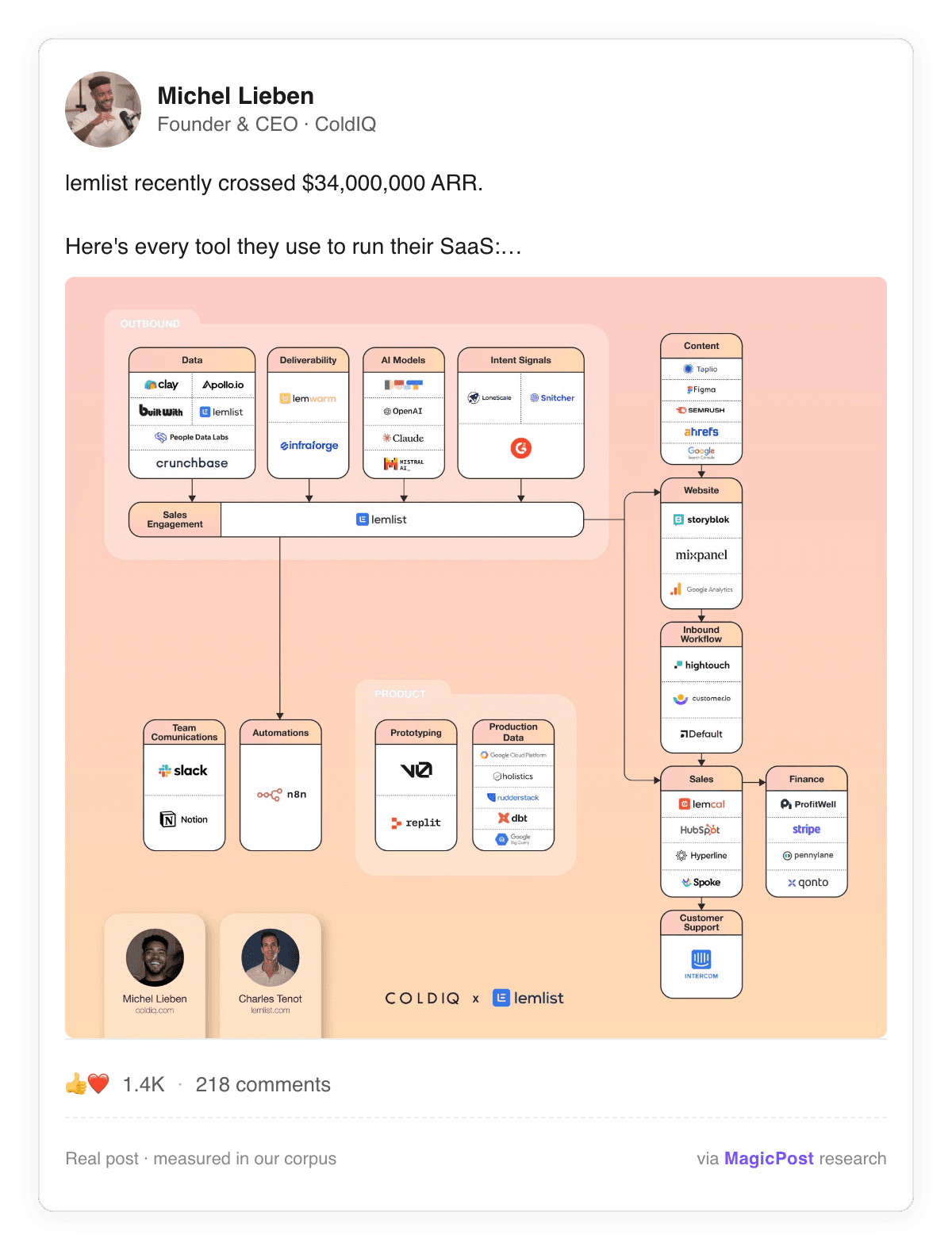
Break down how another company, product or campaign actually works. It is generous, specific and endlessly shareable. ColdIQ's founder built much of his reach dissecting other companies' growth, like this teardown of a competitor's entire tech stack.
3. The practical how-to
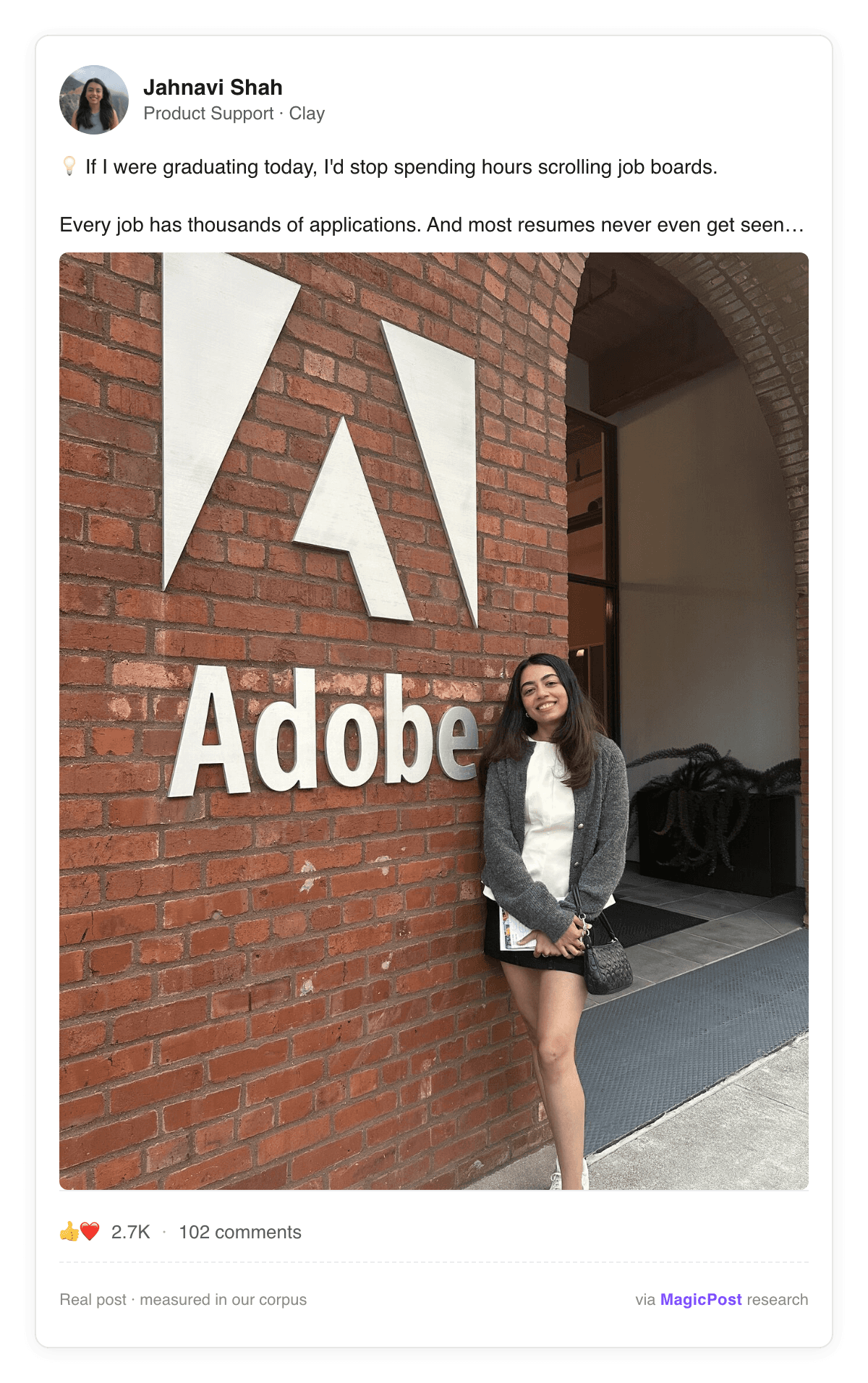
Teach your audience to do something specific, in your area of expertise. It reaches far beyond your company's buyer and builds durable authority. Clay's product-support creator posts career advice that lands with a 97,000-follower audience, here, how to land a job without using job boards.
4. The milestone
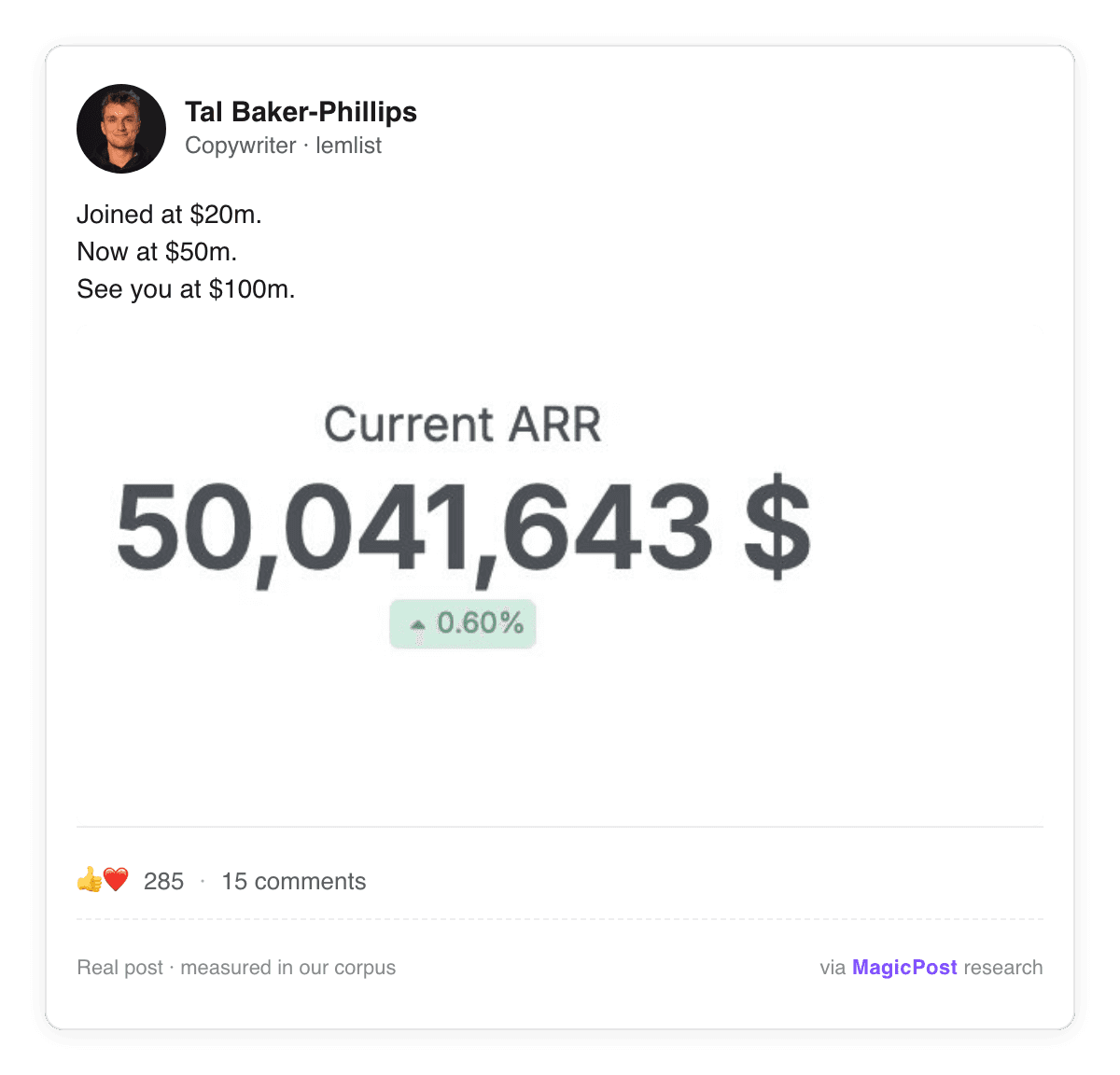
Mark a company or personal milestone, tied to your own story. It is authentic, proud and effortless to write, and the whole team can carry the same narrative. lemlist's copywriter distilled it to one line.
5. The behind-the-scenes / new chapter
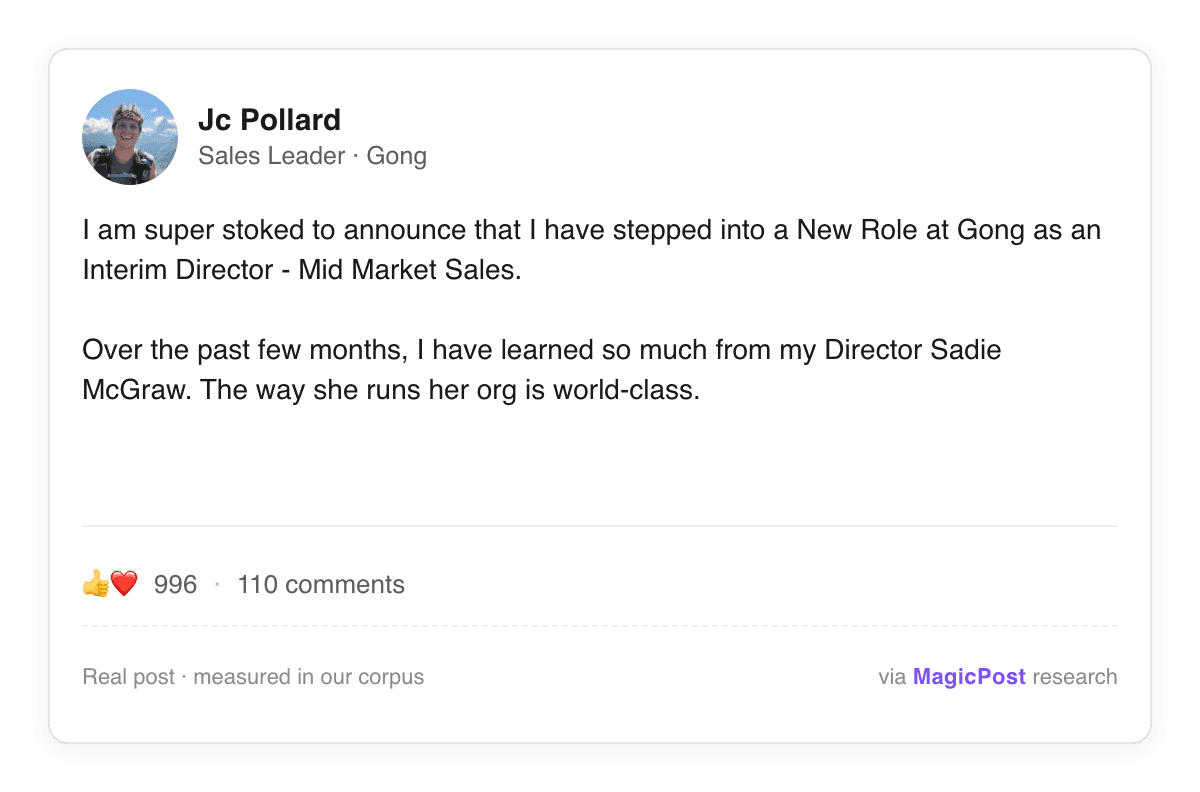
Share a real moment from inside the company, a new role, a team win, a decision. It puts a human face on the brand and quietly doubles as recruiting. Gong's sales leader turned a promotion into a generous post crediting his manager.
6. The data drop
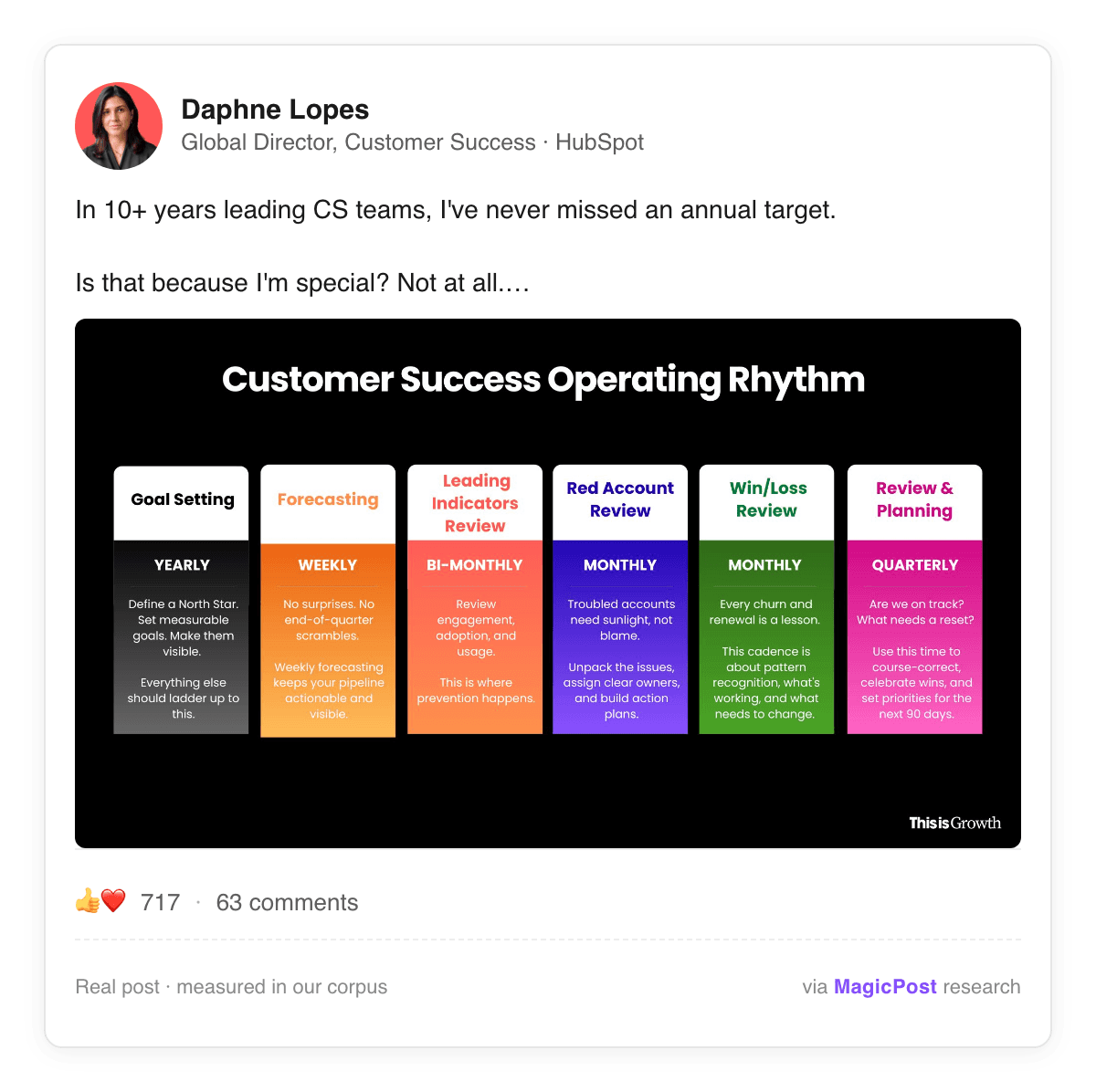
Share a real playbook, framework or set of numbers from your actual work. It is the most credible content there is, because only a practitioner could write it. HubSpot's customer-success director posts operating cadences for CS teams, a function that almost never shows up in advocacy.
7. The one-liner with personality
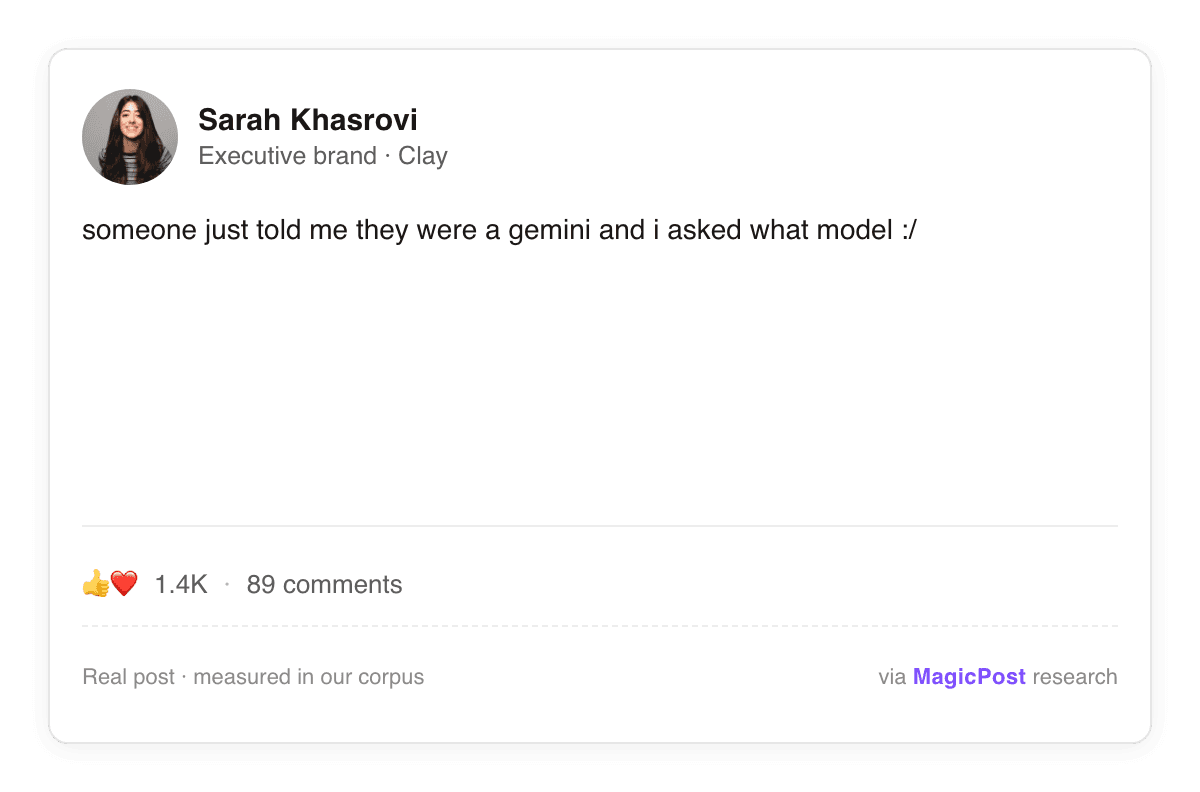
Not every post needs to teach. A sharp, funny, human one-liner builds the relationship that makes your other posts land. Clay's executive-brand lead got 1,400+ reactions on a throwaway joke.
8. The vulnerable story
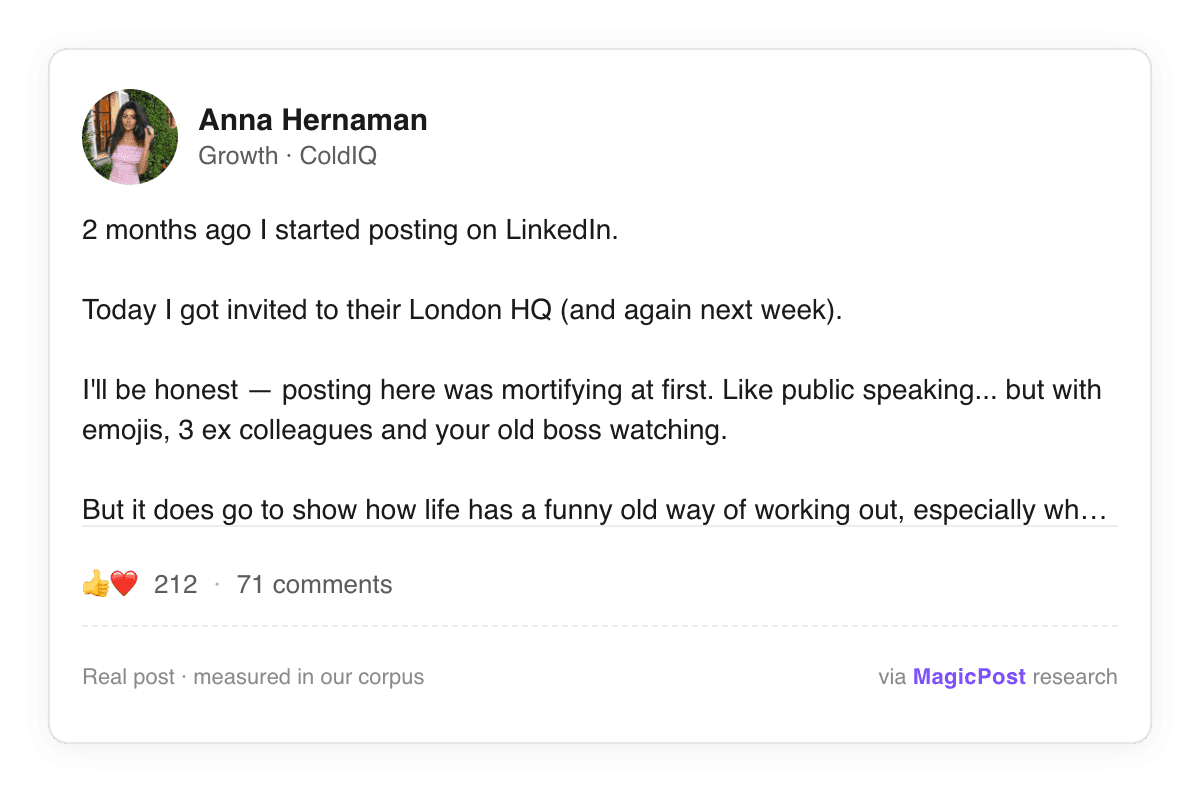
Share something real you struggled with or were unsure about. Vulnerability outperforms polish, because it is unmistakably yours. A senior ColdIQ hire wrote about how mortifying it felt to start posting, and it became proof the program works.
What the data says about making these perform
Picking the right idea is half of it; the format and delivery are the other half. From our benchmark of millions of LinkedIn posts:
Carousels get about 51% more reach than text-only posts, so turn teardowns, how-tos and data drops into slides where it fits (images, though, earn the highest engagement rate).
Post early in the week: Tuesday is the best day, with Monday close behind.
Some types just win: celebrating a win is the highest-engagement post type we measured, see every post type ranked.
Keep it tight: the median high-performing post is about 183 words.
Leave links out of the body, a link cuts reach by around 13% (put it in the comments).
Be specific, not generic: content that "could have been written by anyone" reaches 10-14% fewer people. The angle that is unmistakably yours is the entire advantage. (The full numbers are in our employee advocacy statistics.)
How your team never runs out of ideas
Eight idea types is a start, but the real challenge is sustaining a steady flow for a whole team, week after week, without it eating everyone's time.
That is exactly what our LinkedIn post ideas feature is built for, and why advocates love it: it turns a topic or a rough thought into ready-to-publish posts in each person's own voice.
The bigger picture, getting an entire team posting consistently and authentically rather than one founder, is what MagicPost for enterprises is designed to do. For what good looks like, see our measured examples, or book a short walkthrough to talk it through.
If you would rather just start, MagicPost is where a team manages all of its LinkedIn content in one place.
Veelgestelde vragen
What should employees post for employee advocacy?
The post types that consistently work are the contrarian take, the teardown, the practical how-to, the milestone, the behind-the-scenes moment, the data drop, the personality one-liner, and the vulnerable story.
The common thread is that each is specific to the person, content only they could have written, rather than reshared corporate material.
How do I give my team content ideas without making posts sound corporate?
Give people angles, not scripts. Map each person to a lane that fits their real expertise, then prompt with idea types (a teardown of X, a lesson from Y) rather than finished copy.
In our benchmark, generic content reaches 10-14% fewer people, so the goal is to spark something only that person could write, which a tool like our post ideas feature can do at team scale.
What type of LinkedIn post gets the most reach?
By our benchmark, carousels reach about 51% more people than text-only posts, and posts kept short (~183 words), published early in the week, without a link in the body, do best. But format only amplifies a good angle: a specific, personal point of view is what actually drives reach.
How often should advocates post?
Consistency beats volume. A steady cadence (one or two thoughtful posts a week, sustained) outperforms occasional bursts. The hard part is keeping a whole team at it, which is why programs that last pair idea prompts and tooling with light recognition, rather than relying on motivation.
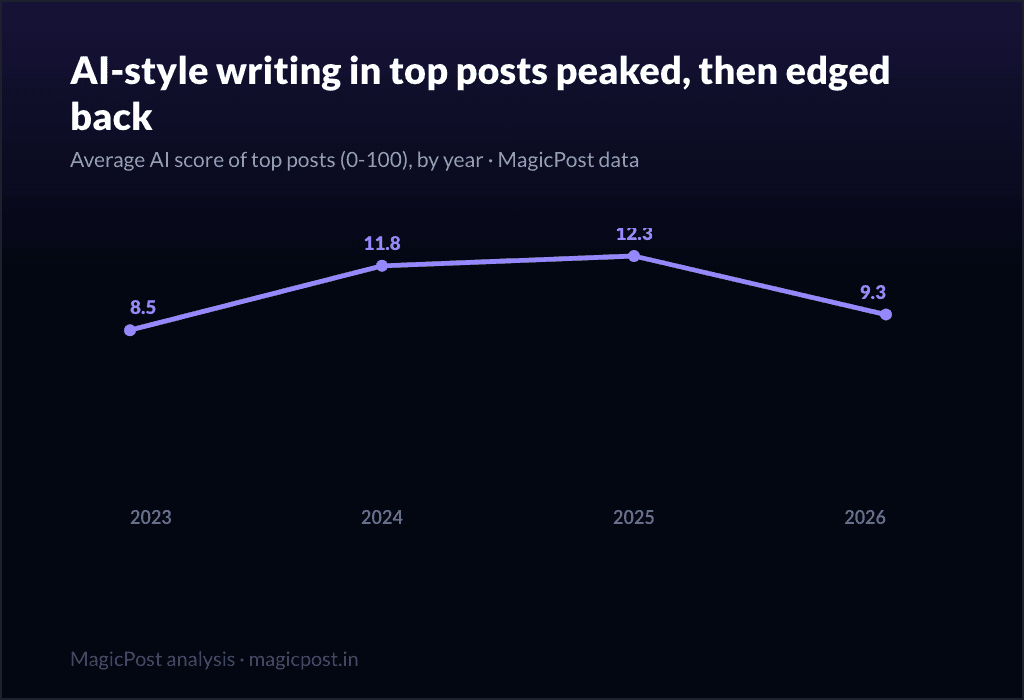
AI Writing on LinkedIn in 2026: The Patterns, and Where They Actually Came From
AI gave LinkedIn a house style. Here are the patterns that now read as AI in 2026, and the uncomfortable truth about where they actually came from.
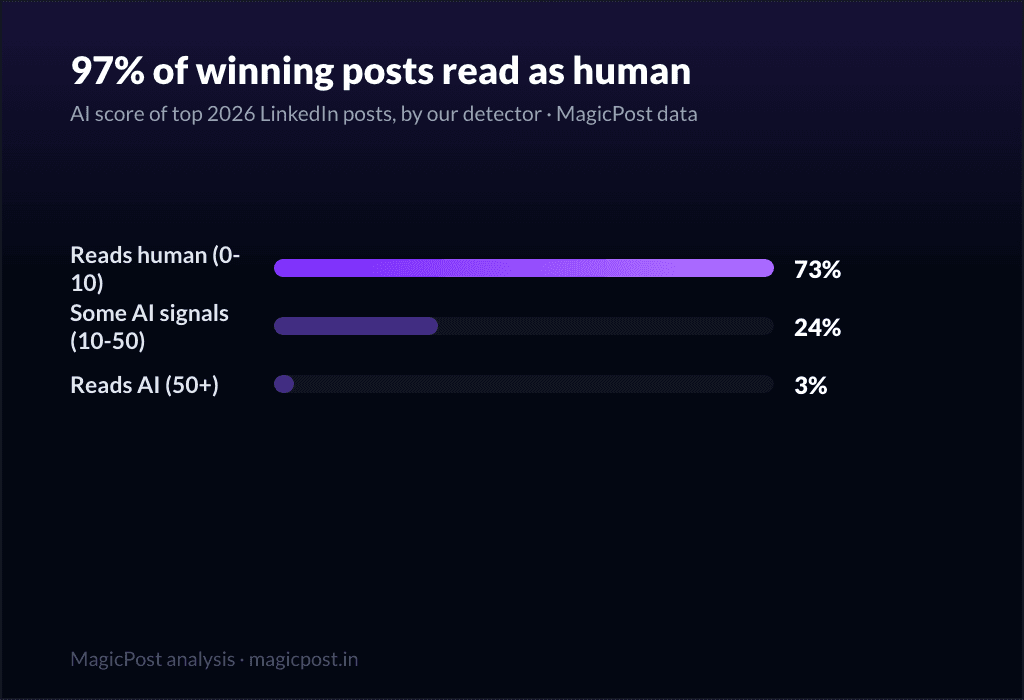
Does LinkedIn Penalize AI Content? What the Data and LinkedIn's Own Crackdown Say (2026)
Does LinkedIn penalize AI content? Not exactly. It demotes generic posts, not AI. We scored 46,000 top posts and 97% read as human. Here is what happens.
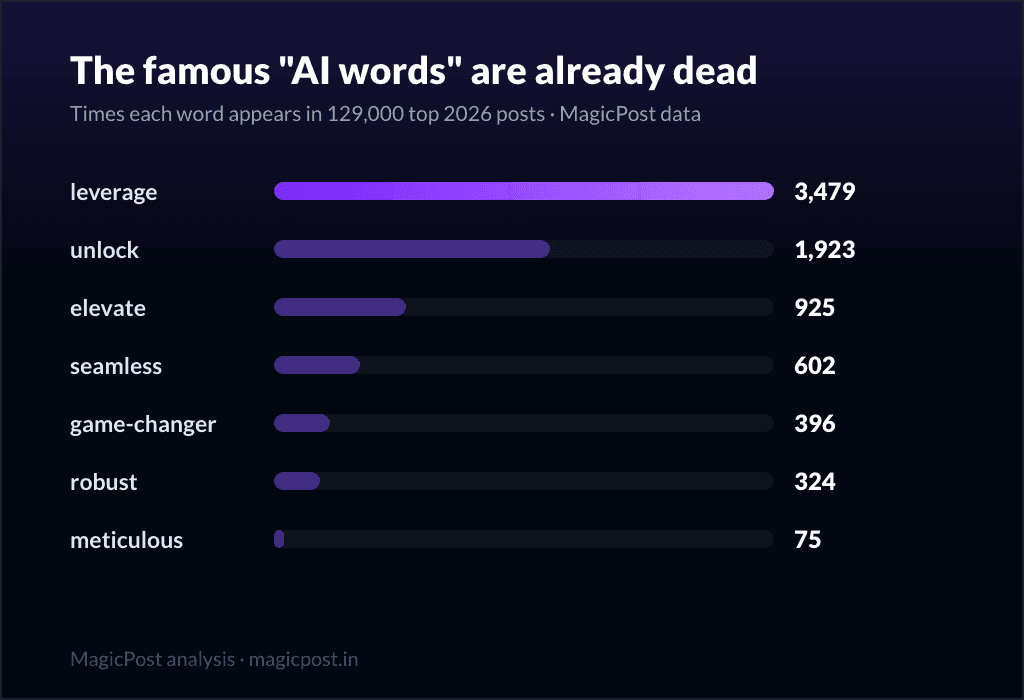
The AI Words Everyone Tells You to Avoid Are Already Dead on LinkedIn
The famous AI words to avoid (delve, tapestry) are already dead on LinkedIn. We checked 129,000 posts. The real tells moved from vocabulary to structure.

"Here's How" and "Here's What": The AI Opener That Costs You Reach in 2026
"Here's how" is LinkedIn's most common AI handoff. It went from under 3% of posts to over 16% with ChatGPT. Why it reads as AI, and how to vary it.
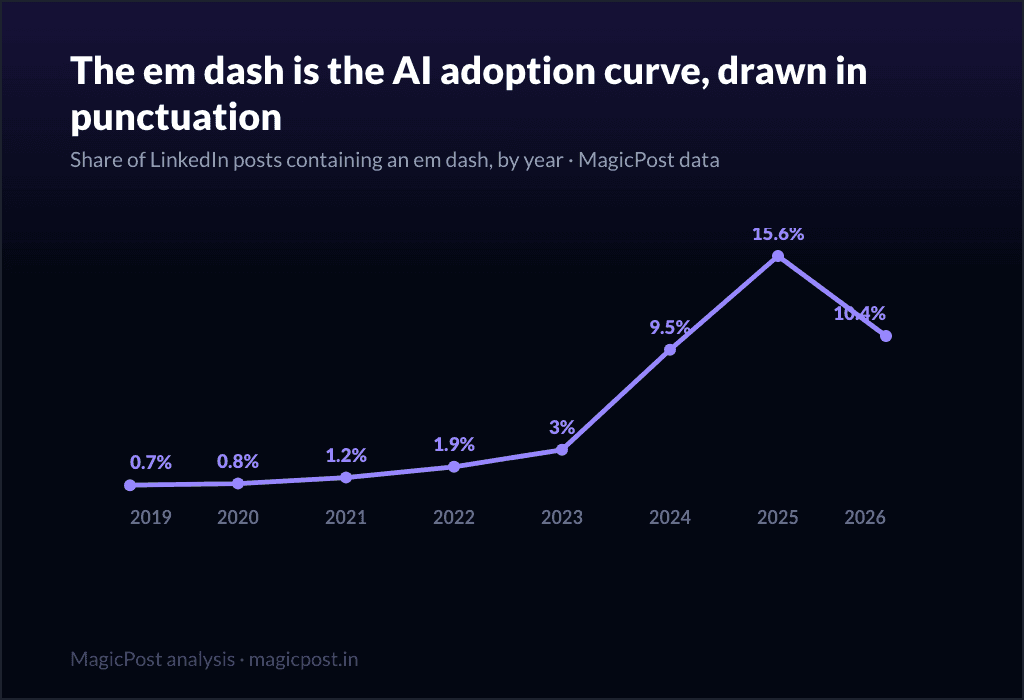
Is the Em Dash a Sign of AI on LinkedIn? Yes, and It Has a Bigger Cousin
Is the em dash a sign of AI on LinkedIn? Yes. Em-dash use jumped from under 2% of posts to over 15% with ChatGPT. The data, and what to use instead.
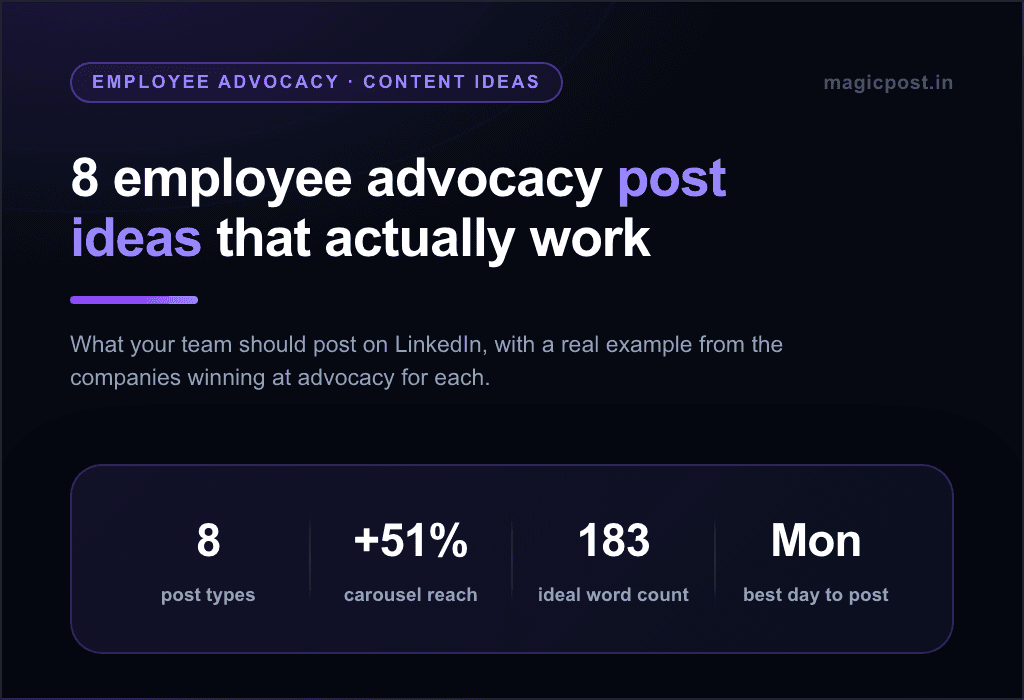
Employee Advocacy Content Ideas: 8 LinkedIn Post Types That Actually Work (2026)
Stuck on what your team should post? 8 employee advocacy content ideas for LinkedIn, each with a real example from the companies winning at advocacy, plus the data on what actually performs.
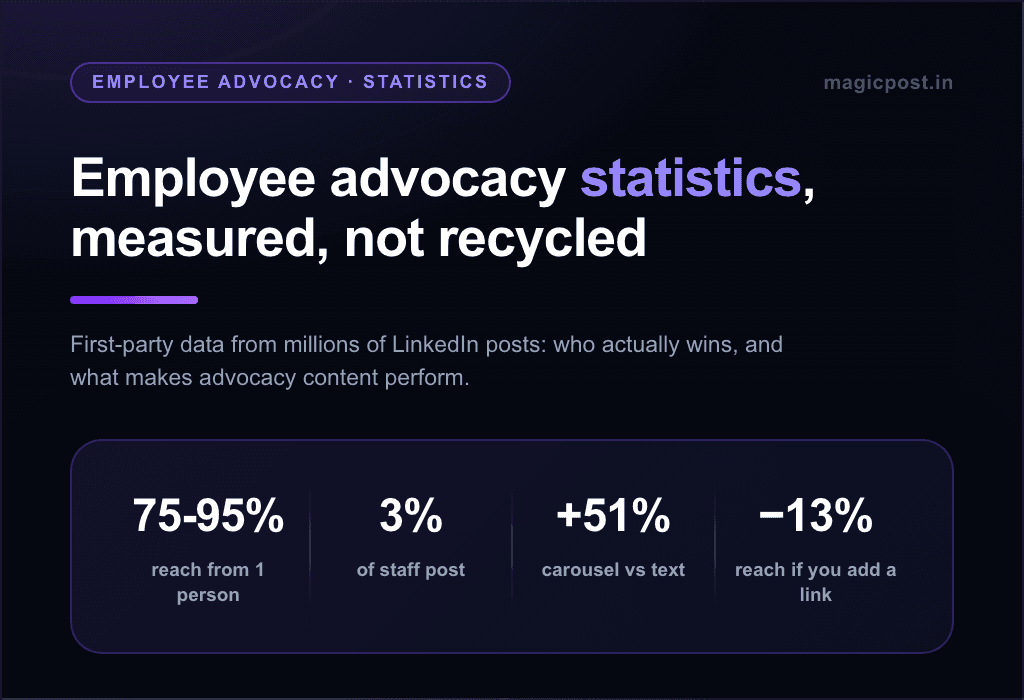
Employee Advocacy Statistics 2026 (From Millions of LinkedIn Posts)
Employee advocacy statistics for 2026, separated into our own first-party data (measured on millions of LinkedIn posts) and commonly cited figures. Adoption, reach, trust, and what actually makes advocacy content perform.