Employee advocacy is the highest-ROI distribution channel most companies already have but rarely structure. Employees collectively have more reach, more credibility and more influence than any brand account, because audiences trust people, not logos.
The problem with most "employee advocacy examples" lists is that they assert who does it well without ever measuring it.
We did the opposite: eight of the ten examples below are measured from our research corpus of 1.3M LinkedIn posts, with real numbers, and five have full breakdowns you can read. The other two are well-documented classics we are honest about not having measured.
What is employee advocacy?
Employee advocacy is a structured approach where employees share content, opinions and experiences related to their company on their own social channels. The goal is simple: extend reach, increase credibility and start conversations through real people instead of brand pages.
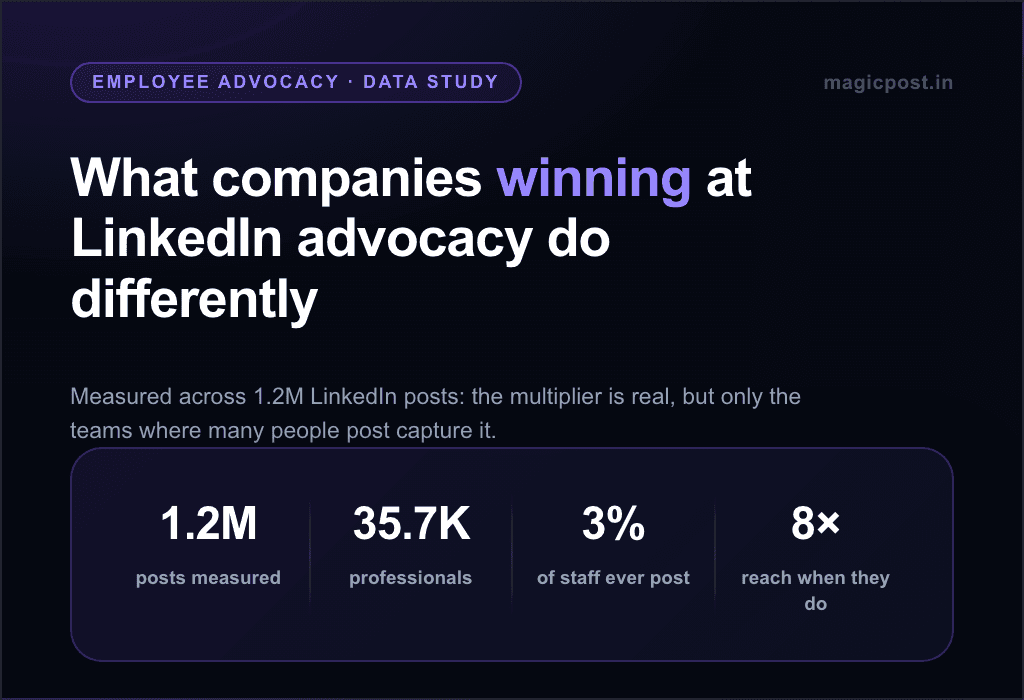
It works because personal profiles outperform corporate accounts, people engage more with individuals, trust their opinions more, and are more likely to act after seeing a post from a perceived peer. The catch, which our data makes vivid, is that it only works when many employees participate, not one.
(The full pattern is in our study of advocacy across 1.3M posts.)
Why implement employee advocacy
Employee advocacy creates immediate distribution without paid channels, and it compounds: each employee builds an audience, each post reinforces positioning, each interaction creates new opportunities. The companies that operationalize it get faster reach without more ad spend, higher engagement from authentic content, and more inbound pipeline.
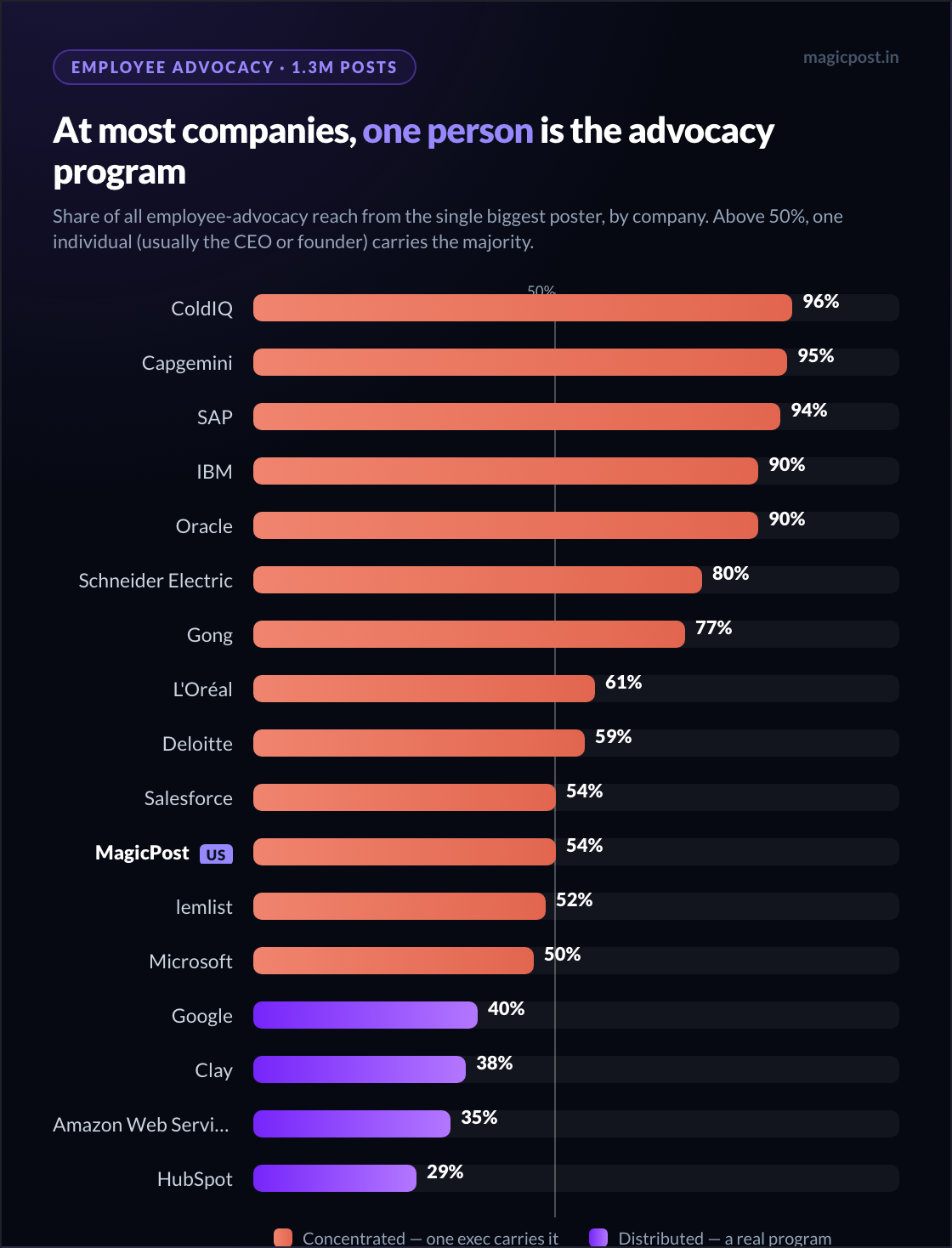
The examples below show what that looks like in practice, and the data below shows the one variable that separates the winners from the rest: how spread out the posting is.
The 10 best employee advocacy examples
The best employee advocacy examples in 2026, measured on 1.3M LinkedIn posts, are the companies where reach is spread across many employees rather than one executive: HubSpot, Clay, AWS and Google at the top, Microsoft for sheer breadth, within the companies in our research corpus.
At a glance, the ten and what stands out about each:
Company | Type | What stands out |
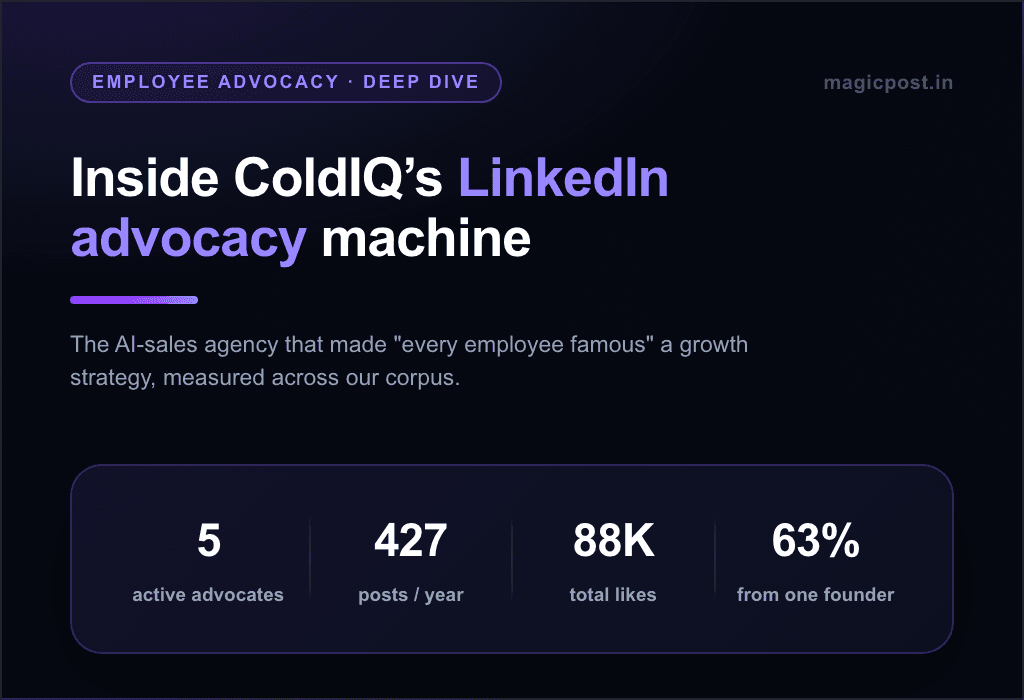
ColdIQ | Measured | 5 advocates and 88k likes in June; 2 of the 5 gone by September |
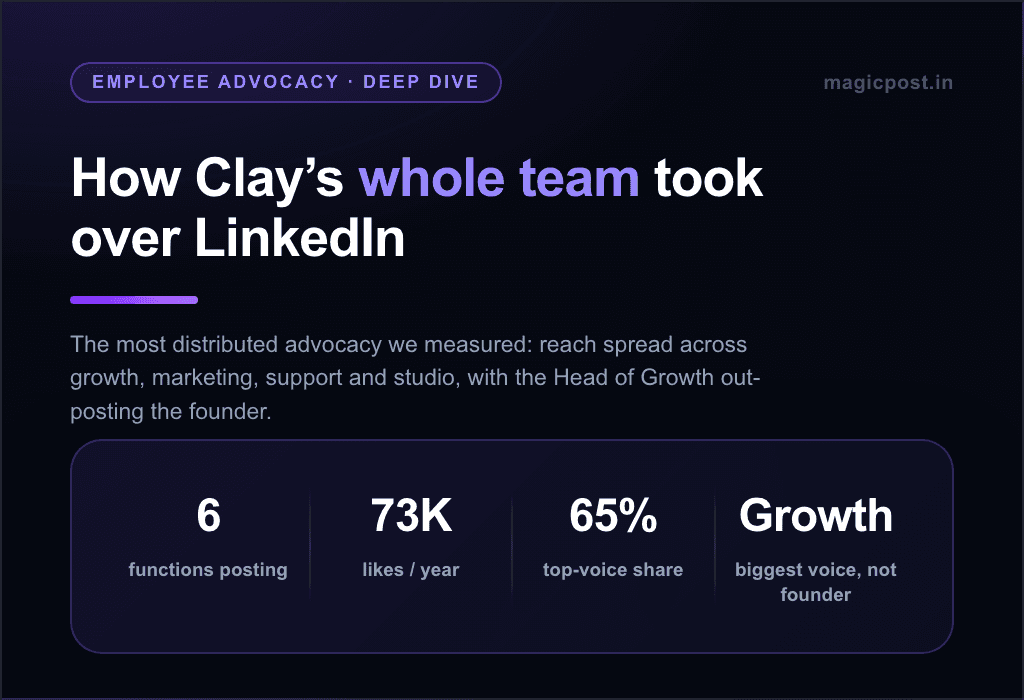
Clay | Measured | Top voice 38%, and it is not a founder |
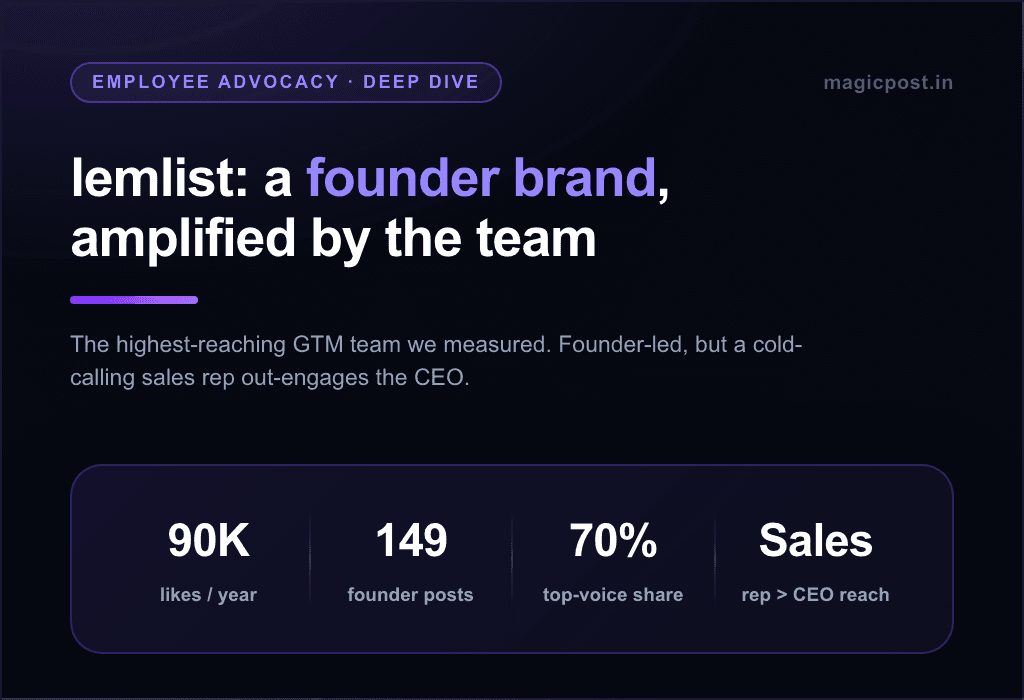
lemlist | Measured | 10 advocates; the founder's share down to 52% |
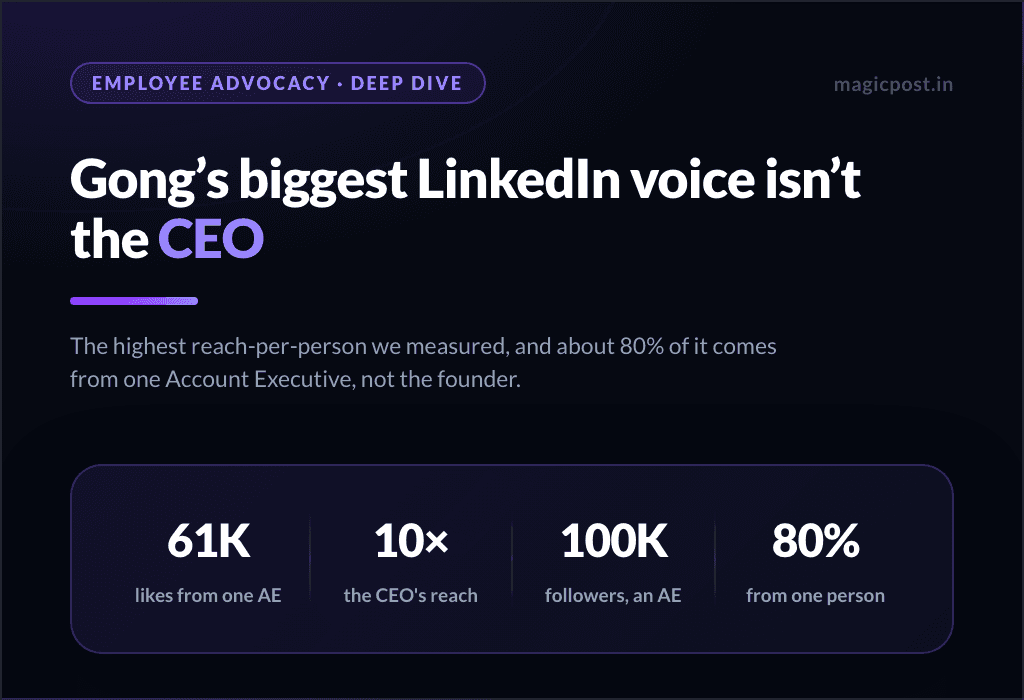
Gong | Measured | An Account Executive reaches ~8x the CEO |
HubSpot | Measured | Most distributed enterprise (top voice 29%) |
Microsoft | Measured | 63 advocates; the "Microsoft Life" heritage |
Salesforce | Measured | From 29% to 54% in a year: what one departure does |
L'Oréal | Measured | A global French icon, leadership-led |
Adobe | Documented | "Adobe Life", employer brand |
Shopify | Documented | Founder-and-operator audience |
For the six programs compared side by side, with method and numbers, see our employee advocacy case studies.
Measured on 1.3M posts
1. ColdIQ, the agency that made "every employee famous" ColdIQ turned employee advocacy into an explicit growth strategy: co-founder Michel Lieben has said he wants every employee to be famous.
In our June 2026 measurement, five ColdIQ people published 427 posts and 88,417 likes in a year, at a median of 176 likes per post. By September, two of them had left for another company: the program is two people, 49,500 likes and 96% one founder. The lesson cuts both ways: a distributed team is an asset, and it can walk out the door.
The full breakdown is in our ColdIQ employee advocacy deep-dive.
2. Clay, the most distributed team we measured Clay is everywhere on LinkedIn because its reach is genuinely spread out: across growth, marketing, GTM engineering, brand and studio, with its biggest voice a content creator rather than a founder.
Its top voice accounts for just 38% of reach across ten advocates, the lowest of any specialist we measured, and the people post their own expertise (career advice, GTM essays, memes), not product content. See the Clay employee advocacy deep-dive.
3. lemlist, a founder brand amplified by the team lemlist's reach starts with founder Guillaume Moubeche's "0 to $150m" brand, but the team carries it, generating roughly 116,000 likes a year across ten advocates, with the founder's share down to 52%.
The standout is that an outbound expert, the CEO and a cold-calling rep each carry about 15% of reach, proof that a founder brand should be a flywheel, not a ceiling.
See the lemlist employee advocacy deep-dive.
4. Gong, where a salesperson out-reaches the CEO Gong has the highest reach-per-person we measured, and its single biggest voice is not the founder, it is an Account Executive (Brian LaManna) who generated ~74,000 likes in a year, about eight times the CEO.
The lesson: your biggest LinkedIn asset may be a frontline employee you have not activated. See the Gong employee advocacy deep-dive.
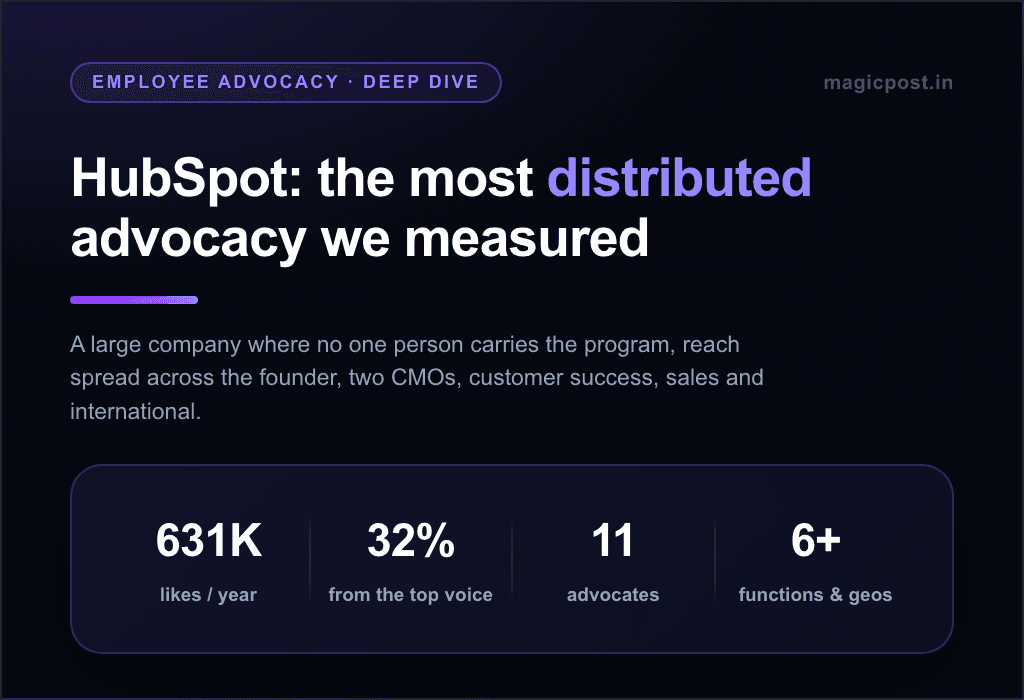
5. HubSpot, distribution at enterprise scale HubSpot runs the most distributed program we measured: ~494,000 likes a year spread across founder Dharmesh Shah, CMO Kipp Bodnar, former CMO Kieran Flanagan, a partnerships director and international voices, with no one above 29%.
Two of its biggest voices came in through the Mindstream acquisition; without them, the founder's share would be 57%, so the acquisition bought part of the spread. See the HubSpot employee advocacy deep-dive.
6. Microsoft, breadth at massive scale Microsoft brings the most breadth we measured: 63 employees cleared our posting bar in a year, generating over 1.2M likes, the living version of its long-running "Microsoft Life" employer-brand program.
Engagement per post is modest (a median of 81 likes), the trade-off of scale, but the sheer number of participating employees is the example here: advocacy as a genuinely company-wide habit rather than a marketing campaign. See the Microsoft employee advocacy deep-dive.
7. Salesforce, the distributed program that lost its widest voice Salesforce was the most evenly spread enterprise in our June 2026 measurement: across 18 advocates, its biggest voice accounted for just 29% of reach. That person has since left the company, and across 19 advocates the top share is now 54%.
It still runs a structured program where employees personalize centrally-created content, and the breadth is still there: 19 people clear the bar. The example is now about durability: reach that depends on one person's audience leaves with them. See the Salesforce employee advocacy deep-dive.
8. L'Oréal, the French enterprise icon L'Oréal is the rare global French company with a visible LinkedIn program: in our data, twelve advocates including CEO Nicolas Hieronimus, several brand presidents and the employer-branding team generated roughly 133,000 likes a year.
It is leadership-led (about 61% of reach comes from the CEO, a reminder that even icons can over-rely on the top), but the employer-branding angle, people showcasing the brand, its houses and its culture, is a strong model for large consumer companies.
Documented from the public record
9. Adobe combines advocacy with employer branding: employees share projects, creative work and culture (the long-running "Adobe Life" theme), making the brand more human and attractive to talent. The lesson is to highlight people, not just products, and to encourage visual content.
10. Shopify encourages employees to share insights on entrepreneurship, product building and remote work, aligned with the brand's founder-and-operator audience. It works because employees speak to the same people the company sells to, with personal, mission-aligned content.
Want to see what these posts actually look like before you copy them? You can search 2M+ real LinkedIn posts on MagicPost and pull up the exact posts from teams like these, by company, by person or by format.
How to scale employee advocacy with MagicPost
Every example above shares one trait: many people posting in their own voice, consistently. That is also where most programs fail, employees start, then stop, because ideas run out and time gets short.
MagicPost turns content creation into a repeatable system instead of relying on motivation. Each team member generates posts in their own voice with AI trained on their profile, defended by a humanizer (because content that could have been written by anyone reaches 10 to 14% fewer people in our benchmark).
Posts publish safely through LinkedIn's official API, and admins track adoption: who's posting, who's stalled, what's working.
It is how you get a whole team to the breadth of a HubSpot or a Clay without an M&A budget. Before you start, estimate how much reach your team is leaving on the table today.
See how it works for teams on MagicPost's employee advocacy platform, compare the platforms in our employee advocacy tools comparison or our wider roundup of the best employee advocacy tools for LinkedIn, or book a short walkthrough. It is also where you manage all your LinkedIn content in one place.
FAQ
What are the best employee advocacy examples in 2026?
The strongest measured examples in our data are ColdIQ, Clay, lemlist, Gong and HubSpot, GTM and SaaS companies where many employees post in their own voice, generating tens of thousands of likes a year.
Among large enterprises, Microsoft brings the most breadth, HubSpot the most even distribution, and L'Oréal the most recognizable French program, while Adobe and Shopify are well-documented classics. The common thread is distribution: reach spread across many people, not one executive.
What makes a good employee advocacy example?
Three things: many employees participate (not just the founder), each posts their own expertise in their own voice rather than reshared corporate content, and they do it consistently.
In our measurement of 1.3M posts, the companies that win at advocacy are the ones where no single person accounts for most of the reach.
Which company has the best employee advocacy on LinkedIn?
By genuinely distributed reach, HubSpot and AWS stand out among enterprises (no one voice above 35%), and Clay among specialists. Gong has the highest reach-per-person, but it is concentrated in one Account Executive. We profile each in individual deep-dives, all measured rather than asserted.
How do I start an employee advocacy program like these?
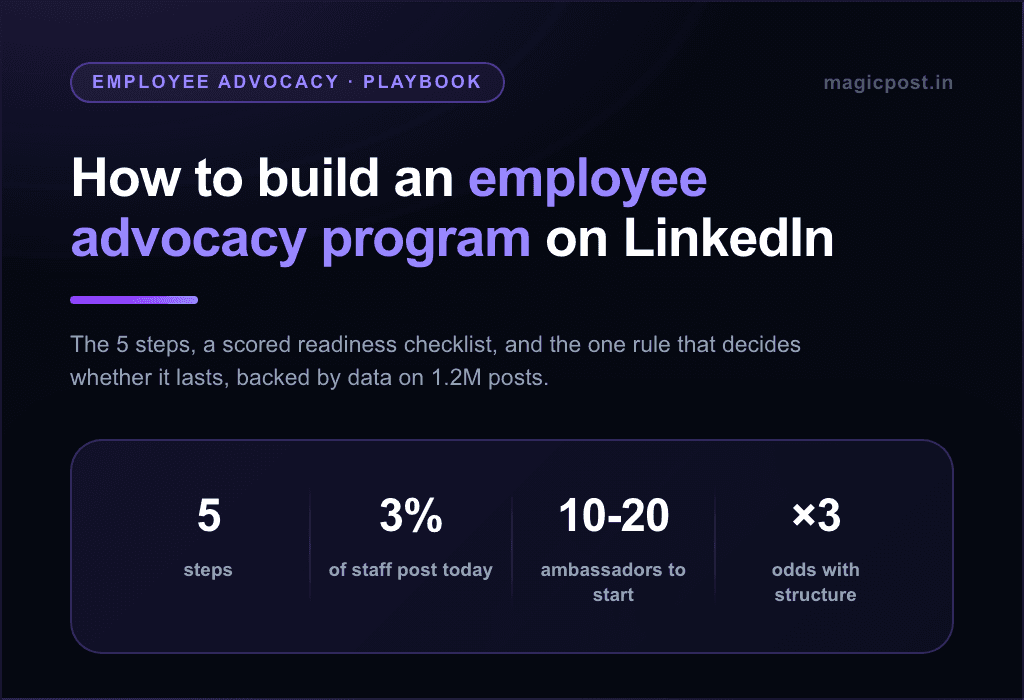
Start with volunteers, give each person a lane that fits their real expertise, have leadership post first, and remove the per-person friction that kills most programs (the blank page, the lack of time).
Our guide to building an employee advocacy program covers the operating cadence, and tools like MagicPost make consistent, voice-authentic posting fast enough to sustain.