Content Creation

Saad Mouaouine
Última atualização: 27 de fev. de 2026
Jonathan Perelman, former VP at Buzzfeed, put it plainly: “Content is king, but distribution is queen, and she wears the pants.”
Most LinkedIn creators have the ratio backwards. They spend 90% of their time writing a post and 10% on what happens after it goes live. They wonder why nothing builds.
Publishing isn’t distributing. The moment you hit post, you’ve done the smallest part of the job. What happens in the next 90 minutes, the next 48 hours, and the next month determines how far that content actually travels.
This guide breaks down the content distribution strategies that extend your reach on LinkedIn without making you feel like a full-time social media manager.
Short Answer: Publishing a post is the starting gun, not the finish line. Owned distribution means scheduling consistently at the right times. Earned distribution means winning the first 90 minutes with genuine engagement, leveraging your team's networks, and commenting on others' content.
Repurpose your best posts across formats, as one idea can fuel four posts. Only boost with paid once something has already proven itself organically. And post from your personal profile, not your company page, as organic reach for company pages dropped up to 66% between 2024 and 2026.
What Is Content Distribution?
Content distribution is everything you do to get your content in front of an audience after it’s created. On LinkedIn, that includes when and how you publish, how you engage with early responses, how you repurpose posts across formats, and whether your network amplifies your content beyond your immediate followers.

The distinction between creation and distribution matters because they require completely different skills and habits:
Creating is about quality.
Distributing is about reach, timing, and leverage.
Most people are reasonably good at the first and nearly absent from the second.
What Are the Three Types of Content Distribution?
Every distribution channel falls into one of three categories. Understanding which is which helps you allocate your time and energy deliberately instead of guessing.
Type | What it means | LinkedIn examples | Your control |
|---|---|---|---|
Owned | Channels you fully control | Your profile, your posts, and your scheduling system | Total |
Earned | Reach you generate through engagement and relationships | Comments, reshares, algorithm amplification, and employee advocacy | Indirect |
Paid | Reach you pay to access | LinkedIn Ads, sponsored content, and boosted posts | High, but budget-dependent |
For most solo founders, consultants, and lean marketing teams, owned and earned distribution is where the real leverage is. Paid is valuable once you know what content performs organically, and not a moment before. Boosting a weak post with a budget doesn’t fix the post.
How to Maximize Your Owned Distribution on LinkedIn?
Owned distribution comes down to two things: the quality of your content and the reliability of your publishing system. The first is a creative challenge. The second is an operational one, and it’s where most people quietly fail.
Publish Consistently at the Right Times
LinkedIn’s algorithm gives an initial visibility window to every post. That window is determined partly by when you publish.
→ The first 60 to 90 minutes after publishing determine the vast majority of a post’s total lifetime reach. Post at a time when your audience is already scrolling, and that window is worth more.
For most B2B audiences, Tuesday through Thursday mornings (7 to 9 a.m. in the reader’s time zone) and late mornings (10 a.m. to noon) consistently outperform other windows.
→ However, the most reliable data isn’t generic; it’s your own analytics showing when your specific audience engages.
Pro Tip: Rather than guessing at optimal times, use your own LinkedIn analytics to find the posts that generated the most engagement, then note when they were published. 3 to 5 months of consistent posting gives you enough data to identify your personal peak windows with confidence.
Schedule Everything in Advance
Ad hoc posting is the enemy of owned distribution. When you post reactively, you publish at suboptimal times, skip days when life gets in the way, and lose the consistency that builds algorithmic momentum.
Scheduling in advance solves all three problems. Write a week’s worth of posts in one session, assign each one a time slot, and let a tool handle publication.
With MagicPost, once a post is drafted or AI-generated and ready, you select a date and time and the platform publishes automatically on your behalf. You don’t need to set reminders, manually copy and paste, or scramble around at 8 a.m.
For more information on creating a schedule you won’t struggle committing to, check out How to Build a LinkedIn Editorial Calendar.
How to Generate Earned Distribution on LinkedIn?
Earned distribution is the most powerful and the least controllable. It happens when real people, the algorithm, or both amplify your content beyond your immediate network.
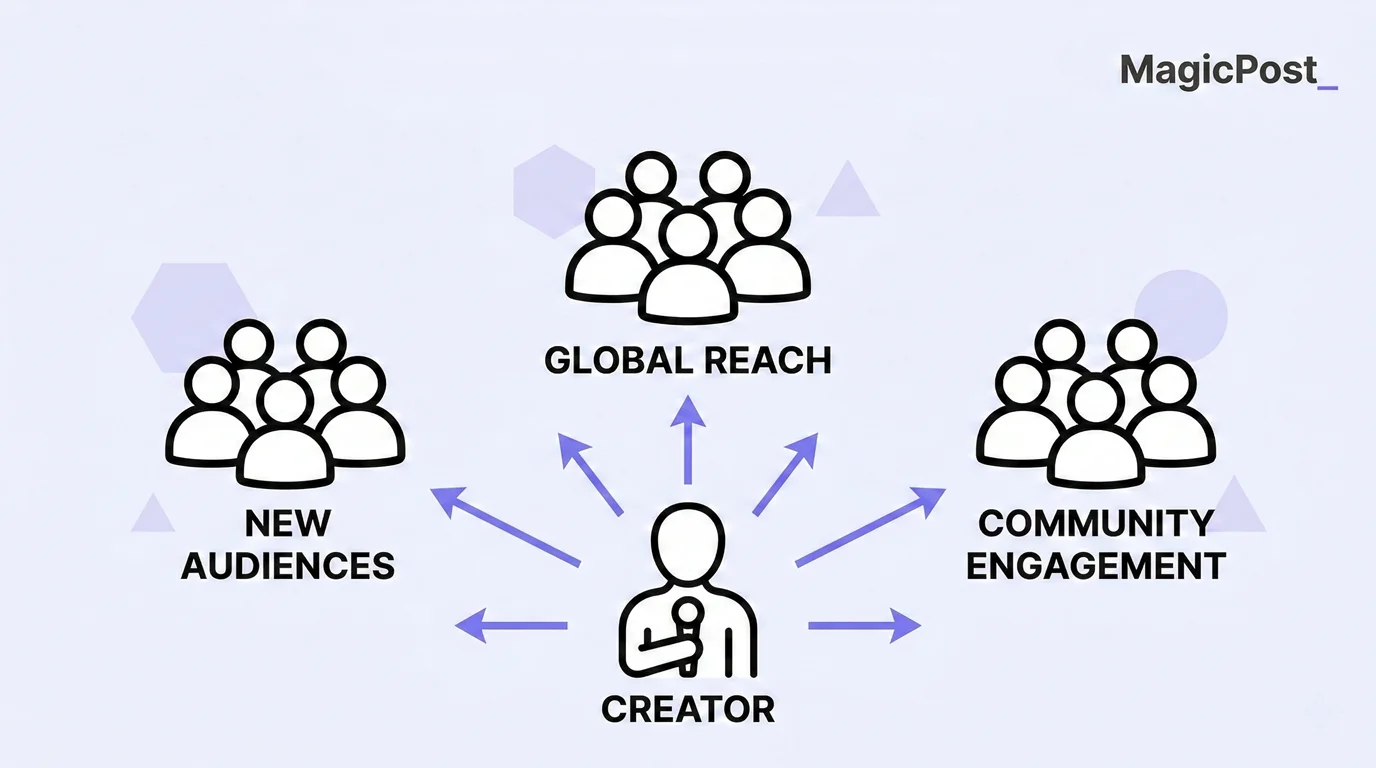
Here’s how to earn it systematically rather than hoping for it accidentally.
Win the First 90 Minutes
LinkedIn’s algorithm tests every post against a small slice of your network first. If that initial audience engages quickly and meaningfully, the platform widens distribution to second and third-degree connections. If it doesn’t, the post stalls.
This makes the first 90 minutes your most critical distribution window. There are three ways to make the most out of it:
Reply to every comment within the first hour. Author responses signal to the algorithm that genuine conversation is happening, which increases the likelihood of further distribution.
Ask a question in the post itself. Not engagement bait (’Comment YES if you agree’) but a genuine question that your target would actually want to answer.
Engage with other posts before and after publishing your own. Being active in the feed when your post goes live primes the algorithm and pulls engaged users into your orbit at exactly the right moment.
Pro Tip: Comment threading is an underused distribution topic. When someone leaves a substantive comment, reply with a follow-up question. This extends the comment thread, signals ongoing conversation to the algorithm, and keeps the post appearing in the feeds of everyone who has already engaged with it.
Leverage Employee Advocacy
According to data compiled by the MSL Group, content shared by employees receives 561% more reach than the same content shared through a brand’s official channels. Employees’ personal networks are also, on average, ten times larger than a company’s follower base.
This is an underutilized channel sitting right inside your organization. However, the barrier isn’t willingness.
Most employees don’t share company content because it feels like unpaid marketing work.
Or they don’t because the friction of finding and resharing posts is just high enough to skip.
The fix is simple: send a direct link, make it easy to reshare with a personal comment, and make participation feel authentic rather than mandated.
Pro Tip: The most effective employee advocates are people who are already posting about their work. Ask your most LinkedIn users to reshare first, and frame it as sharing their perspective, not amplifying a corporate message. A genuine comment added to a reshare outperforms a silent reshare every time.
Engage Beyond Your Own Content
Distribution on LinkedIn isn’t only about what happens on your posts. Every thoughtful comment you leave on someone else’s post is a distribution event.
→ Your comment appears in the feeds of everyone connected to that post’s author, exposing your name and your thinking to an audience you haven’t earned yet.
The creators who grow fastest on LinkedIn are rarely only posting. They’re spending as much time engaging with others as they’re publishing, using comments as a soft form of content distribution.
→ A ten-word comment that adds genuine insight on a post with 200 engagements is worth more than a post that gets five likes.
How Do You Repurpose Content for Greater Distribution?
Content repurposing is the highest-leverage distribution tactic available to solo creators and lean teams. According to ReferralRock, 94% of marketers repurpose content in some form. The gap between those who do it well and those who don’t is a system.
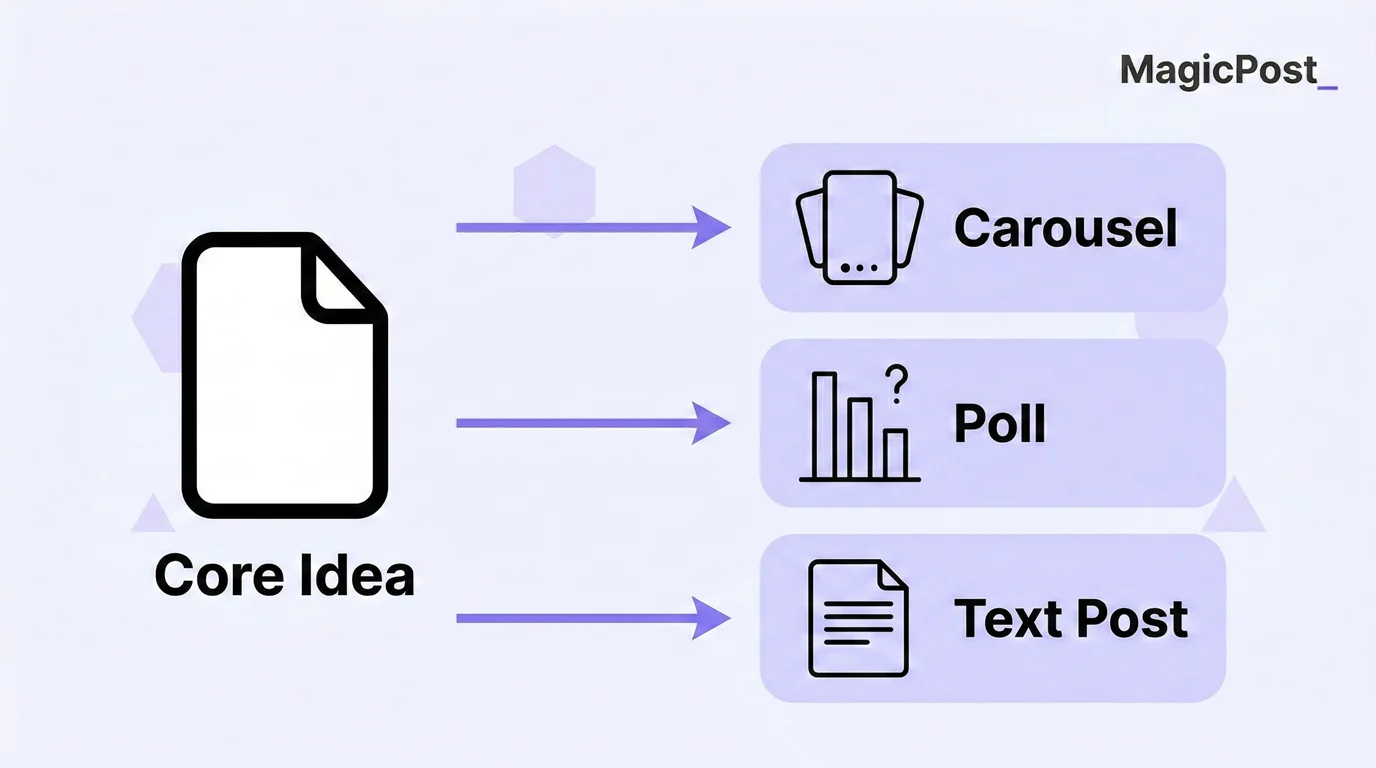
The principle is simple: one idea, multiple formats, and multiple distribution moments. A single insight doesn’t have to live and die as one LinkedIn post. It can become:
A text post sharing the main idea or lesson
A carousel breaking it into a step-by-step framework
A poll testing whether your audience shares the same experience
A follow-up post sharing what the poll revealed
That’s four posts from one idea, each appearing in feeds at different times, reaching people who missed the original, and reinforcing the same underlying message to people who saw it the first time.
→ Repetition on LinkedIn doesn’t hurt you. Most of your followers won’t see most of your posts. Saying the same thing in a different format is good distribution strategy, not laziness.
MagicPost’s AI Post Writing can help reformat existing post ideas into different structures quickly. Write the main insight once, then generate a carousel version or restructure it as a list-format post without starting from scratch.
Pro Tip: Your top-performing posts from three to six months ago are prime candidates for repurposing. Most of your current followers weren’t around when you first published them. Update the hook, adjust the angle slightly, and redistribute. Evergreen posts that continue to generate engagement in feeds can resurface weeks after the original publication date.
When Does Paid Distribution Make Sense on LinkedIn?
Paid distribution earns its place in a content strategy, but not before you understand what’s working organically.
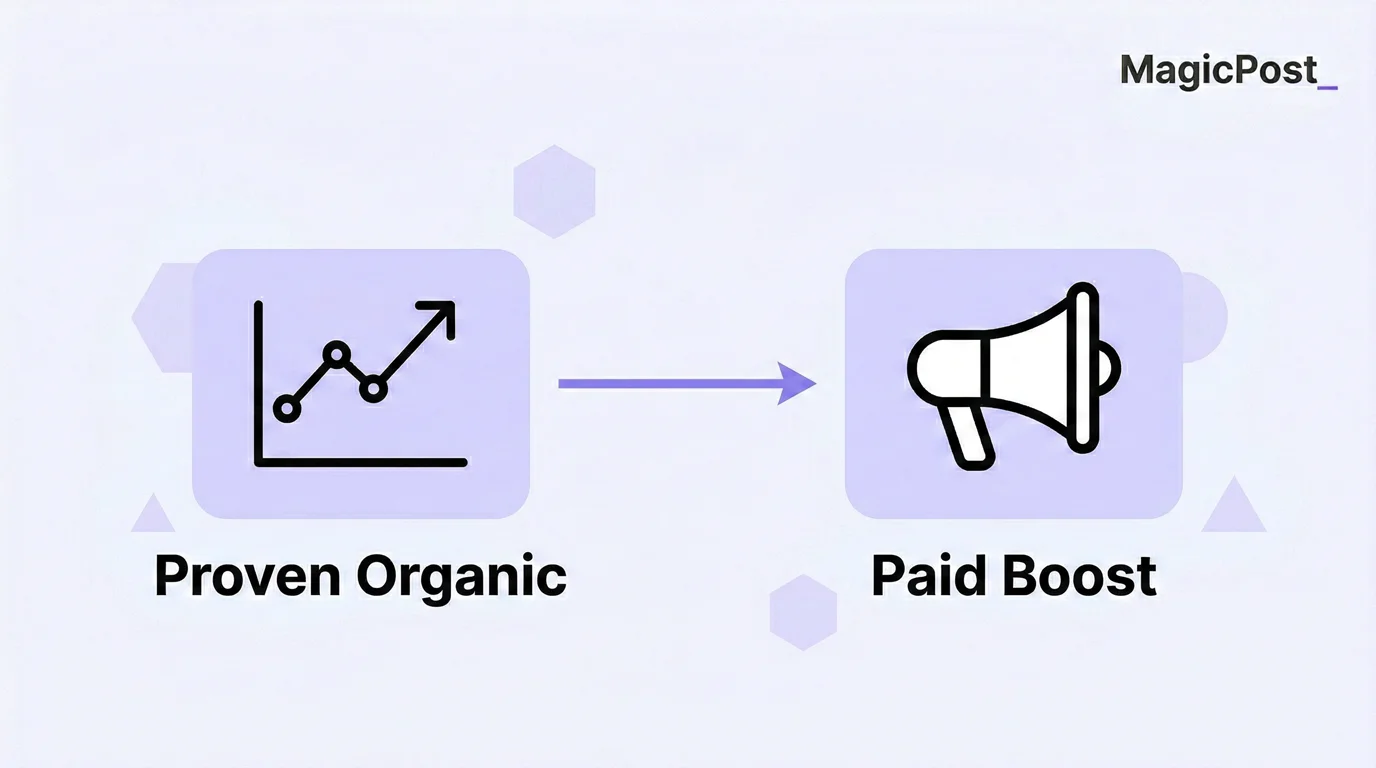
Here’s what to keep in mind:
LinkedIn’s advertising tools are powerful: Sponsored Content, Thought Leadership Ads, and boosted posts all let you reach precisely defined audiences based on job title, industry, seniority, and company size. But a budget doesn’t fix content problems.
The right approach is to use paid distribution to amplify what has already been proven. If a post generates strong organic engagement, an unusually high save rate, or inbound DMs, it’s telling you something resonates.
Put your budget behind such posts. Boosting them extends their reach to audiences that would never have seen them organically, without the risk of spending on content that hasn’t been validated.
Here’s a quick cheat sheet:
Paid option | Best used for | When to use it |
|---|---|---|
Boosted organic posts | Amplifying already-proven content to larger audiences | After strong organic performance |
Sponsored Content | Reaching new audience segments with lead-gen content | When you have a defined offer and validated message |
Thought Leadership Ads | Distributing personal profile posts as paid content | When a specific post drives inbound and you want to scale it |
Pro Tip: Thought Leadership Ads let you run personal profile posts as paid LinkedIn ads, which means the content appears to come from an individual, not a company page. In a feed skeptical of corporate brand content, ads that look like personal posts consistently outperform Sponsored Content on engagement metrics. This format is best for founders and consultants whose personal brand is the primary trust signal.
Company Page vs. Personal Profile: Where Should You Distribute?
According to recent platform analysis, the organic reach of LinkedIn company pages dropped 60% to 66% between 2024 and early 2026. The algorithm now shows company page posts to as few as 2% to 5% of followers in the initial test window.
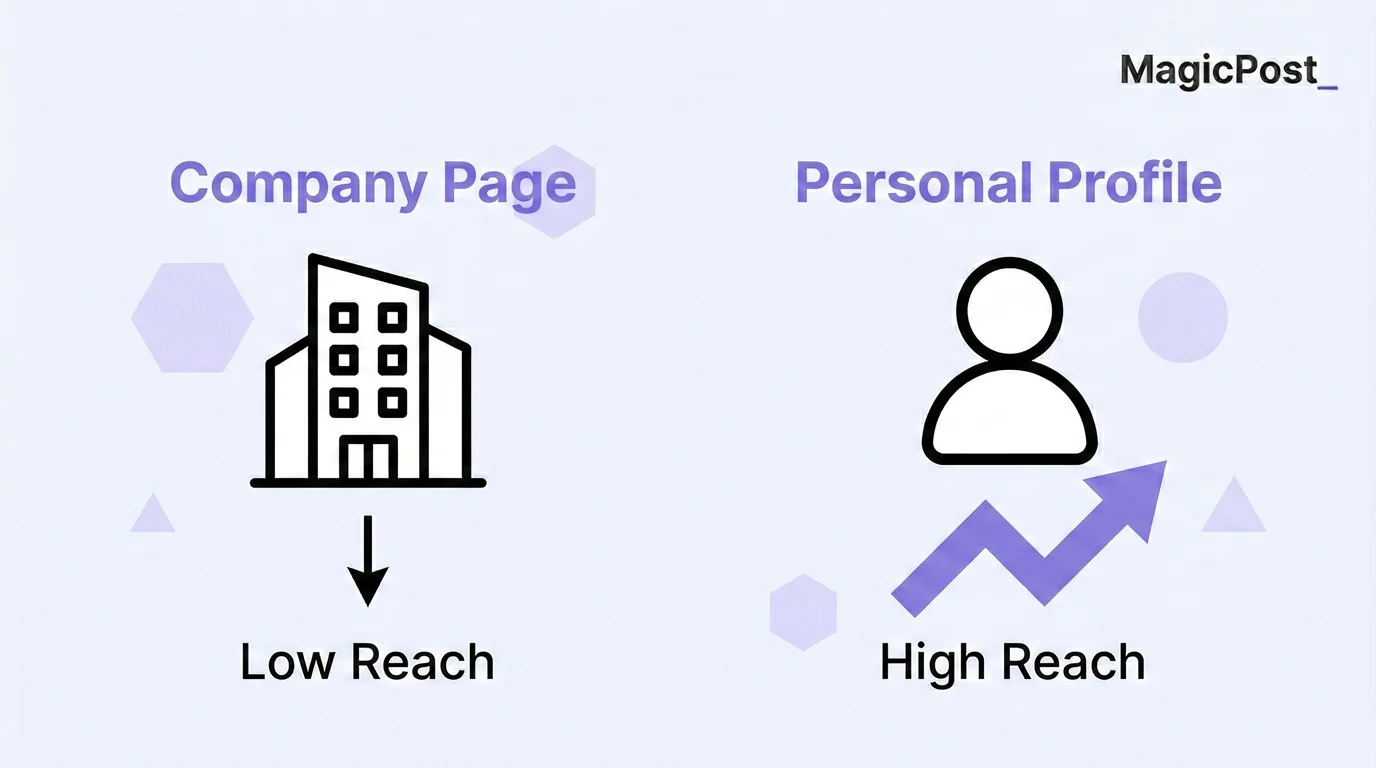
→ Put simply, for most businesses, the primary content distribution channel on LinkedIn should be personal profiles, not company pages. The company page serves as supporting infrastructure, a place to centralize content and build brand credibility, but the reach flows through people.
Channel | Organic reach (2025/2026) | Best used for |
|---|---|---|
Personal Profile | Strong, algorithm-favored | Primary distribution: thought leadership, stories, insights, and offers |
Company page | Limited (2% to 5% initial reach) | Brand credibility, content archive, paid ad base, and employee resharing hub |
Pro Tip: If you run a company page, use it as the official record of your content and encourage employees to reshare individual posts with their own comments. That employee’s reshare on a personal profile gets dramatically more reach than the original company post ever would.
How to Know If Your Distribution Strategy Is Working
Most creators default to measuring distribution by vanity metrics: total impressions, follower count growth, and total likes. These numbers feel good but tell you very little about whether your content is actually reaching the right people.
A sharper distribution measurement framework tracks three signals:
Reach beyond your network: Check LinkedIn’s native analytics for how many impressions came from second- and third-degree connections. A rising share of out-of-network reach is the clearest signal that your distribution strategy is working.
Save rate: According to AuthoredUp’s 2025 research, posts that get saved consistently produce 3x faster audience growth than those that only get likes. Saves signal that content is worth returning to, which is one of the strongest quality signals LinkedIn’s algorithm reads.
Inbound actions: Profile visits, connection requests, and direct messages following a post are the real-world evidence that distribution reached the right people. Track these in the 48 hours after publishing a strong post.
For a full breakdown of what to measure and how to interpret the numbers, check out How to Measure Content Performance.
Creating good content is necessary. Distributing it well is what separates the creators who build audiences from the ones who plateau.
MagicPost gives you the tools to close the gap between the two: write or generate posts with AI, schedule them to publish at optimal times automatically, track what’s earning reach and what isn’t, and iterate from a position of data rather than guesswork.
The creators who build real audiences on LinkedIn aren't posting more. They're distributing smarter. MagicPost handles the scheduling, timing, and analytics so you can focus on the part that actually requires you. Get started at magicpost.in.
Perguntas Frequentes
What is a content distribution strategy?
A content distribution strategy is a plan for getting your content seen by the right people after it's created.
On LinkedIn, this includes when and how you publish, how you engage during the critical first 90 minutes, how you repurpose content across formats, and whether you use employee networks or paid tools to extend reach beyond your immediate followers.
What is the difference between owned, earned, and paid content distribution?
Owned distribution covers channels you control directly: your posting schedule, your profile, and your content. Earned distribution is the reach you generate through engagement, reshares, and algorithm amplification. Paid distribution is reach you buy through LinkedIn Ads or Sponsored Content.
For most solo creators and lean B2B teams, owned and earned distribution provide the most leverage with the least ongoing cost.
Should I post from my personal profile or my company page on LinkedIn?
Personal profiles. Organic reach for LinkedIn company pages dropped 60 to 66% between 2024 and early 2026, with company posts now reaching as few as 2 to 5% of followers in the initial distribution window.
Personal profiles receive significantly better algorithmic distribution. Use your company page as a content archive and employee-resharing hub, and treat personal profiles as the primary distribution channel. For more context, check out LinkedIn Posting Strategy.
How does content repurposing help with distribution?
Repurposing extends the distribution life of a single idea across multiple formats and posting moments. A text post becomes a carousel, a carousel insight becomes a poll, a poll result becomes a follow-up post.
Each format reaches slightly different segments of your audience and appears in feeds at different times, ensuring more of your network encounters the core idea, regardless of when they happen to scroll.
What is the golden hour on LinkedIn and why does it matter for distribution?
The golden hour refers to the first 60 to 90 minutes after a post goes live. During this window, LinkedIn's algorithm tests your content against a small initial audience to measure engagement velocity.
Strong early engagement (especially comments) signals quality and triggers wider distribution to second and third-degree connections. Weak early engagement stalls reach regardless of how good the content is.
Timing your posts well and engaging actively with early comments are the two highest-leverage actions you can take to improve distribution.
Can MagicPost help with content distribution on LinkedIn?
Yes. MagicPost connects your content creation directly to your distribution system. You write or AI-generate posts, schedule them to publish automatically at optimal times based on your audience's activity data, and track which posts earn the most reach and engagement.
The platform handles the owned distribution layer, freeing you to focus on the earned layer: engaging with comments, repurposing top performers, and building the relationships that extend your content's reach. Learn more at magicpost.in.