" height="26.80529977783203px" id="tymKb8bqC" width="128.00300311279295px"/><path d="M 0 2.417 L 0 0 L 12.909 0 L 12.909 2.417 Z" fill="rgb(126, 78, 253)" height="2.417099999999998px" id="aYr4em6zK" transform="translate(128.341 22.325)" width="12.908999999999992px"/></svg>)

"/><stop offset="1" stop-color="rgb(118, 37, 250)"/></linearGradient></defs><g d="M 19.242 21.22 L 19.362 6.204 L 19.272 6.204 L 13.757 21.22 L 10.161 21.22 L 4.796 6.204 L 4.706 6.204 L 4.825 21.22 L 0 21.22 L 0 0 L 7.283 0 L 12.109 13.607 L 12.229 13.607 L 16.844 0 L 24.247 0 L 24.247 21.22 Z M 26.421 26.113 L 26.421 23.445 L 41.407 23.445 L 41.407 26.113 Z" fill="transparent" height="26.112508199679183px" id="DvfaAIHYn" width="41.40731898311435px"><path d="M 19.242 21.22 L 19.362 6.204 L 19.272 6.204 L 13.757 21.22 L 10.161 21.22 L 4.796 6.204 L 4.706 6.204 L 4.825 21.22 L 0 21.22 L 0 0 L 7.283 0 L 12.109 13.607 L 12.229 13.607 L 16.844 0 L 24.247 0 L 24.247 21.22 Z" fill="rgb(46, 46, 46)" height="21.220180016149442px" id="pLsxRCobd" width="24.247352589074694px"/><path d="M 0 2.668 L 0 0 L 14.986 0 L 14.986 2.668 Z" fill="url(%23yD9d4I5GR-3279285344-linear-gradient)" height="2.6675085048549647px" id="yD9d4I5GR" transform="translate(26.421 23.445)" width="14.986002836263765px"/></g></svg>)

Saad Mouaouine
A lot of founders search for a LinkedIn content strategy agency because they don't have a system for posting consistently. However, what most agencies sell as a strategy is actually just a content calendar. Those aren’t the same thing.
This guide explains what a genuine LinkedIn content strategy involves, what agencies actually do day to day, and how to decide whether hiring one makes sense for your situation.
If you’re already at the stage of evaluating specific agencies and pricing, see our dedicated guide to LinkedIn content agencies for the full breakdown.
Short Answer: A LinkedIn content strategy agency builds and executes your LinkedIn presence, including positioning, content pillars, post writing, and reporting, but most agencies focus on execution only. Whether that's worth the cost depends on how complex your needs actually are.
What Is a LinkedIn Content Strategy Agency?
A LinkedIn content strategy agency builds and executes a plan for growing your presence on LinkedIn. That typically includes the following:
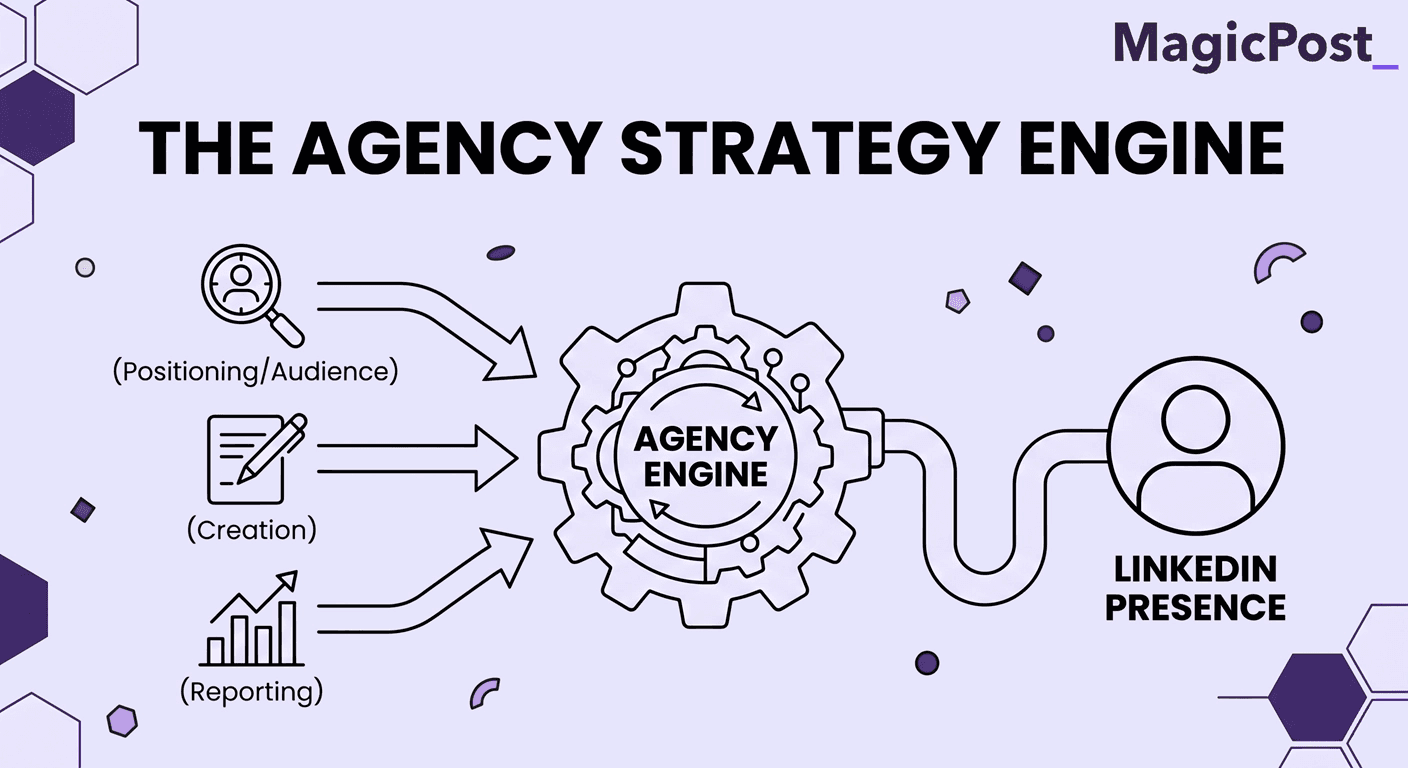
Defining your positioning,
Identifying the content formats that work for your audience,
Creating and scheduling posts, and
Measuring content performance and reporting on it.
In practice, however, most agencies focus on execution rather than strategy. They write posts and schedule them. The strategy part (positioning, audience definition, and content pillars) is either done once at onboarding and rarely revisited, or not done at all.
This distinction matters because a content calendar without a clear strategy produces activity, not results.
Why Most LinkedIn Content Strategies Fail
Most LinkedIn content efforts stall because the foundation is missing, not because the effort you put in isn’t enough. Before any agency or tool can help, three things need to be clear.
Missing Element | What Happens Without It |
|---|---|
A defined audience | Posts reach everyone and connect with no one. Engagement stays low regardless of how well-written the content is. |
A clear positioning statement | Content lacks a consistent point of view. Each post could’ve been written by anyone in the sector. No authority builds over time. |
Content pillars | Topics are chosen randomly based on what feels relevant that week. There’s no coherent narrative for the audience to follow. |
The majority of agencies handle this during a one-off onboarding session. Then, week after week, junior writers produce content against a brief that was written months ago and never updated.
That’s why, even after paying a retainer for six months, many founders feel like their LinkedIn presence still doesn’t sound like them.
✅ Pro Tip: Before you hire anyone or buy any tool, write one sentence that answers: Who are you talking to, what problem do you solve for them, and why should the trust you over anyone else? If you can’t answer than in one sentence, no agency or AI tool will fix it for you.
What Should a LinkedIn Content Strategy Include?
A real LinkedIn content strategy is more than a posting schedule. It’s a system that connects your content to a specific business outcome. Here’s what it looks like in practice.
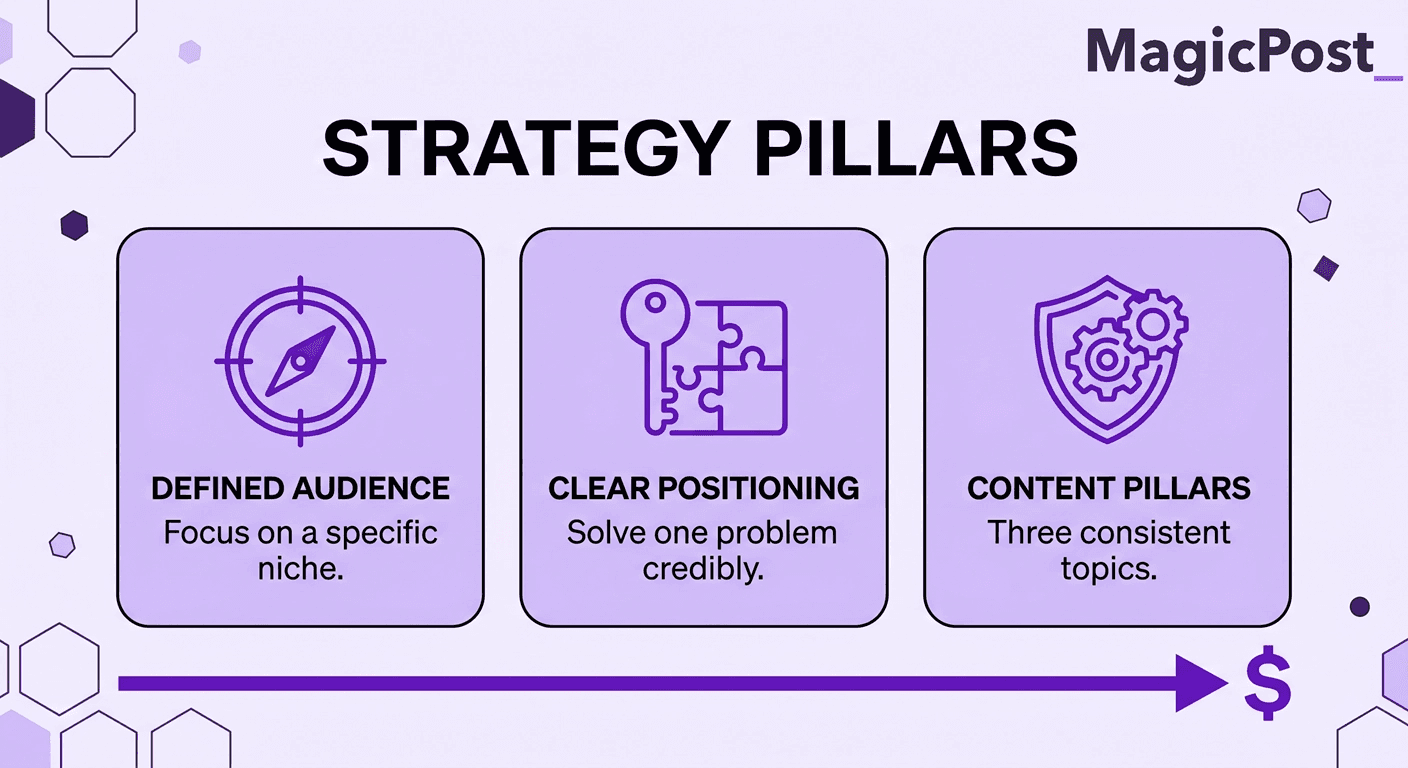
Audience and Positioning
Start with who you’re trying to reach and what you want them to think when they see your name. This isn’t your entire ICP (Ideal Customer Profile). It’s the specific slice of that audience you can speak to most credibly from your own experience.
Your positioning on LinkedIn should be specific enough that someone could describe your content to a colleague in one sentence.
Content Pillars
Content pillars are the three to five topics you return to consistently. They should sit at the intersection of your expertise, your audience's problems, and the outcomes you are trying to drive.
For example, a fractional CFO might build pillars around cash flow, fundraising mistakes, and financial operations for SaaS teams. Every post maps back to one of those pillars, which means the audience always knows what they are getting from you.
Format Mix
Format selection isn’t aesthetic. It’s algorithmic. Carousel and document posts average 24.42% engagement compared to 4.10% for plain text.
That doesn’t mean every post should be a carousel, but it does mean your format mix should be intentional, not whatever is easiest to produce that week.
Publishing Cadence and Workflow
Consistency matters more than frequency. Three posts a week that maintain quality and specificity outperform daily posting that drifts into generic territory by month two.
A sustainable cadence is one you can hold without burning out or cutting corners, whether you’re doing it yourself or working with an agency.
Measurement
Vanity metrics (impressions and likes) tell you whether content is being seen. What actually matters is whether the right people are seeing it.
Profile visits from target job titles, connection requests from your ICP, and inbound messages that start conversations are the signals worth tracking. If your agency reports only on reach and engagement, that’s a problem.
By the Numbers |
|---|
Personal LinkedIn profiles generate five to eight times more engagement than company pages posting identical content. Strategy built around individual voices consistently outperforms corporate broadcasting. |
62% of B2B marketers say LinkedIn generates leads at twice the rate of the next best social platform. The commercial case for investing in LinkedIn strategy is clear. |
LinkedIn native Lead Gen Forms convert at 13% on average, compared to 2.35% for external landing pages. Distribution strategy matters as much as content quality. |
What Does a LinkedIn Content Strategy Agency Do?
Understanding the day-to-day reality of an agency engagement helps you evaluate whether it’s worth the cost. Here’s what a typical workflow looks like after you sign the contract.
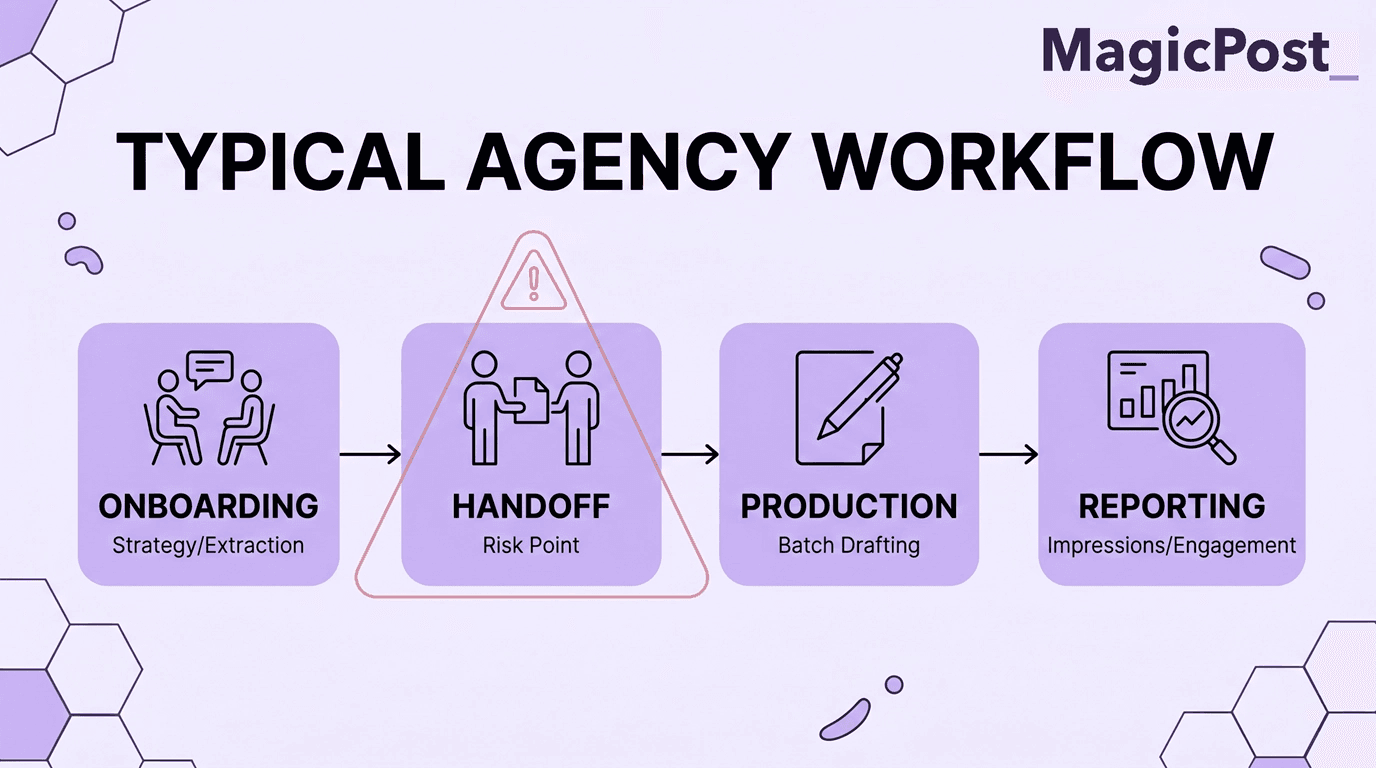
Step 1: Onboarding
Most agencies start with a detailed questionnaire covering your background, tone of voice, target audience, competitors, and audience goals.
A strategist then conducts a 60- to 90-minute interview call to extract your perspective on key topics. This is often the most valuable part of the engagement because it forces clarity that many founders have never put into words.
Step 2: Content Production
After onboarding, a writer (usually a junior, not the strategist you spoke to) produces a batch of posts. These go into a shared document for your review, where you leave comments, and the writer revises. This cycle repeats every one to two weeks.
In practice, the revision process consumes more time than most founders expect because correcting industry jargon and voice mismatches via email threads if slow and frustrating.
Step 3: Scheduling and Publishing
Posts are scheduled through a third-party tool. Importantly, how the agency handles publishing matters:
Tools that publish through LinkedIn’s official OAuth API are fully compliant.
Tools that rely on browser extensions or session automation violate LinkedIn’s Terms of Service and can result in permanent account restrictions.
Always ask your agency how they publish.
Step 4: Reporting
Monthly reports typically cover impressions, engagement rate, follower growth, and occasionally post-level performance. Fewer agencies connect content performance to business outcomes like pipeline or qualified conversations.
If that connection matters to you, build it into the contract from the start.
⚠️ Watch Out: Some lower-tier agencies use engagement pods or automation tools to artificially inflate your metrics. LinkedIn’s algorithm actively detects unnatural interaction patterns and penalizes accounts involved in them, sometimes permanently. Ask any agency you evaluate how they drive engagement and what tools they use to publish.
When Does Hiring a LinkedIn Agency Make Sense?
The decision isn’t simply “agency vs. no agency.” There are three viable models, and the right one depends on your team size, budget, and goals.
Your Situation | Best Model | Why |
|---|---|---|
Enterprise with a large marketing budget, complex paid campaigns, and CRM integration needs | Full-service agency | The orchestration complexity justifies the overhead. Agencies earn their retainer when the work goes beyond organic posting. |
Deep-tech or highly specialized B2B where daily product knowledge is essential | In-house team | A dedicated social media manager ($55,000 to $74,000/year) who lives inside the business produces better content than an agency that needs to be briefed externally. |
Founder, solopreneur, or lean sales team focused on organic thought leadership and inbound pipeline | AI-assisted platform | The goal is consistent, authentic content. An agency adds cost and obstacles without improving voice quality. A platform trained on your past posts produces faster, cheaper, and more consistently on-brand output. |
For most founders and small B2B teams, the third option is the one that actually gets used. Agencies requires ongoing management time that busy founders rarely have.
In contrast, a platform like MagicPost connects to your LinkedIn profile, learns your writing style from your past posts, and generates voice-matched drafts from a subject or URL you provide.
The drafting step goes from 30 minutes to 5. You review, adjust, and schedule. Everything is published through LinkedIn’s official API.
What to Look for When Hiring a LinkedIn Content Strategy Agency
If you’ve evaluated the decision framework and an agency is still the right call, here’s what separates the ones worth hiring from the ones that’ll frustrate you.
Positives | Negatives |
|---|---|
✅ They ask about your business outcomes before your posting frequency. | ❌ Pricing is hidden behind a discovery call and a custom quote with no ballpark figures published anywhere. |
✅ They can show you examples of executive content that sounds genuinely different across their client roster, not templated variations of the same structure. | ❌ They require a 90-day minimum contract before you’ve seen a single piece of content. |
✅ They publish through LinkedIn’s official API and can confirm this clearly. | ❌ The senior strategist who ran your onboarding call isn’t the person who writes your content. |
✅ They offer a short pilot (4 to 8 weeks) before locking you into a long-term contract. | ❌ They talk about engagement rate but can’t explain how they drive it. |
✅ Their reporting connects content performance to pipeline signals, not just impressions. | ❌ They use browser extension tools or automation software that’s not built on LinkedIn’s official API. |
How Much Does a LinkedIn Content Strategy Agency Cost?
Agency pricing follows a clear tier structure. Understanding it upfront prevents sticker shock later.
Tier | Monthly Cost | What You Get | Limitations |
|---|---|---|---|
Entry-level/offshore | $500 to $1,500 | 8 to 12 posts per month, basic scheduling | Generic output, heavy reliance on templates or unedited AI, and minimal strategic input |
Boutique/mid-market | $3,000 to $5,000 | Strategy, 12 to 16 posts, scheduling, monthly report | Annual cost of $36,000 to $60,000 before setup fees. Justifiable only with high ACV. |
Full-service/enterprise | $7,000 to $15,000+ | Multi-format content, paid media, PR alignment, crisis comms | Reserved for high-profile executives. Most founders don't need this level. |
Beyond the retainer, watch for non-refundable setup fees ($750 to $1,000 is common), auto-renewal clauses, and intellectual property terms that give the agency ownership or content produced during the engagement. Read the contract carefully before signing.
Final Thoughts
A LinkedIn content strategy agency earns its place when the work involves complex paid campaigns, multi-stakeholder communications, or PR alignment. For most founders and B2B teams focused on organic thought leadership, the threshold for needing one is higher than agencies would have you believe.
If you want to evaluate specific agencies first, our LinkedIn content agency guide has the full pricing and red flag breakdown.
If you want to build your LinkedIn strategy without the agency overhead, try MagicPost for free today. No credit card is required.
Perguntas Frequentes
What does a LinkedIn content strategy agency do?
A LinkedIn content strategy agency builds a plan for your LinkedIn presence and executes it on your behalf. That typically includes audience and positioning work, content pillar development, post writing and scheduling, and performance reporting.
In practice, the strategic layer is often lighter than the name suggests. Most of the ongoing work is content production. For a full breakdown of costs and what to expect, see our LinkedIn content agency guide.
How much does a LinkedIn content strategy agency cost?
Pricing varies by tier. Entry-level and offshore agencies charge $500 to $1,500 per month for basic content production. Boutique and mid-market agencies typically charge $3,000 to $5,000 per month.
Full-service enterprise agencies start at $7,000 and go well above $15,000 for executives requiring PR alignment and crisis communications. Most agencies also charge non-refundable setup fees of $750 to $1,000 on top of the retainer.
Is a LinkedIn content strategy agency worth it?
It depends on the complexity of what you need. For enterprises running paid campaigns alongside organic, or executives requiring multi-stakeholder communications, agencies earn their cost. For founders and small B2B teams focused on organic thought leadership, the ongoing management overhead and cost rarely justify the retainer.
A voice-matched AI platform produces more consistent, on-brand output faster and at a fraction of the price. See the decision framework in this article, or the full breakdown in our LinkedIn content agency guide.
What is the difference between a LinkedIn content strategy and a content calendar?
A content calendar is a schedule of what gets posted and when. A content strategy defines who you are talking to, what you stand for, which topics you own, what formats serve your audience best, and how content connects to business outcomes.
A calendar without a strategy produces activity. A strategy without a calendar produces nothing. You need both, but the strategy has to come first.
How do I know if a LinkedIn agency is safe to use?
The key question is how they publish. Agencies that post through LinkedIn's official OAuth API are fully compliant. Agencies that use browser extensions, session automation, or third-party scraping tools violate LinkedIn's Terms of Service and put your account at risk of permanent restriction.
Always ask directly how they handle publishing before signing a contract. For more on what causes account restrictions, see our guide to LinkedIn account safety.
What should a LinkedIn content strategy include?
At minimum: a defined target audience, a clear positioning statement, three to five content pillars, a format mix based on algorithmic performance data, a sustainable publishing cadence, and a measurement framework tied to business outcomes rather than vanity metrics.
For a step-by-step guide to building your own strategy, see our LinkedIn content strategy guide.
Liderança de pensamento no LinkedIn: Como construir autoridade em 2026
A liderança de pensamento no LinkedIn consiste em publicar conteúdo que sinaliza expertise. Veja o que constrói autoridade no LinkedIn em 2026 e como fazer isso de forma consistente.
Social Selling no LinkedIn: conquiste vendas B2B com conteúdo (2026)
Social selling no LinkedIn não se trata de enviar mais InMails. Você precisa construir a presença que faz os potenciais clientes responderem antes mesmo de você entrar em contato. Veja como.
Agência de conteúdo para LinkedIn: você realmente precisa de uma em 2026?
Está em dúvida se uma agência de conteúdo para LinkedIn vale o custo? Veja o que elas fazem, quanto cobram e quando uma plataforma dedicada é a melhor escolha.
Ghostwriting no LinkedIn: Como construir e escalar em 2026
O ghostwriting para LinkedIn é um dos serviços que mais crescem no B2B em 2026. Veja como captar a voz dos clientes, gerenciar aprovações e escalar sua operação.
Melhores ferramentas de gerenciamento do LinkedIn em 2026 (testadas e comparadas)
Procurando a melhor ferramenta de gerenciamento do LinkedIn em 2026? Comparamos MagicPost, Taplio, Supergrow, RedactAI e outras em qualidade, segurança e preço.
Como Criar um Calendário Editorial para o LinkedIn (2026)
Aprenda a construir um calendário editorial do LinkedIn que mantenha você consistente, organizado e postando sem estresse. Inclui uma estrutura prática de mix de conteúdo.
Como Medir o Desempenho de Conteúdo no LinkedIn (2026)
Não tem certeza de como medir o desempenho do conteúdo no LinkedIn? Aprenda as 3 métricas que realmente importam, além de benchmarks e um sistema de rastreamento simples.