" height="26.80529977783203px" id="tymKb8bqC" width="128.00300311279295px"/><path d="M 0 2.417 L 0 0 L 12.909 0 L 12.909 2.417 Z" fill="rgb(126, 78, 253)" height="2.417099999999998px" id="aYr4em6zK" transform="translate(128.341 22.325)" width="12.908999999999992px"/></svg>)

"/><stop offset="1" stop-color="rgb(118, 37, 250)"/></linearGradient></defs><g d="M 19.242 21.22 L 19.362 6.204 L 19.272 6.204 L 13.757 21.22 L 10.161 21.22 L 4.796 6.204 L 4.706 6.204 L 4.825 21.22 L 0 21.22 L 0 0 L 7.283 0 L 12.109 13.607 L 12.229 13.607 L 16.844 0 L 24.247 0 L 24.247 21.22 Z M 26.421 26.113 L 26.421 23.445 L 41.407 23.445 L 41.407 26.113 Z" fill="transparent" height="26.112508199679183px" id="DvfaAIHYn" width="41.40731898311435px"><path d="M 19.242 21.22 L 19.362 6.204 L 19.272 6.204 L 13.757 21.22 L 10.161 21.22 L 4.796 6.204 L 4.706 6.204 L 4.825 21.22 L 0 21.22 L 0 0 L 7.283 0 L 12.109 13.607 L 12.229 13.607 L 16.844 0 L 24.247 0 L 24.247 21.22 Z" fill="rgb(46, 46, 46)" height="21.220180016149442px" id="pLsxRCobd" width="24.247352589074694px"/><path d="M 0 2.668 L 0 0 L 14.986 0 L 14.986 2.668 Z" fill="url(%23yD9d4I5GR-3279285344-linear-gradient)" height="2.6675085048549647px" id="yD9d4I5GR" transform="translate(26.421 23.445)" width="14.986002836263765px"/></g></svg>)

Naïlé Titah
Most advice about LinkedIn video tells you to keep it short. The data says the opposite. We measured 100,758 native LinkedIn videos published over the last 12 months, and the highest-engagement clips run 1 to 5 minutes, not 15 seconds. Videos under 30 seconds actually underperform the format's own median.
So this guide does two things. It gives you the measured answer to the question everyone asks (how long, how it performs, who wins with it), and it gives you the craft: how to shoot, caption, upload, and avoid the mistakes that kill an otherwise good video. Start with the chart that reframes everything:
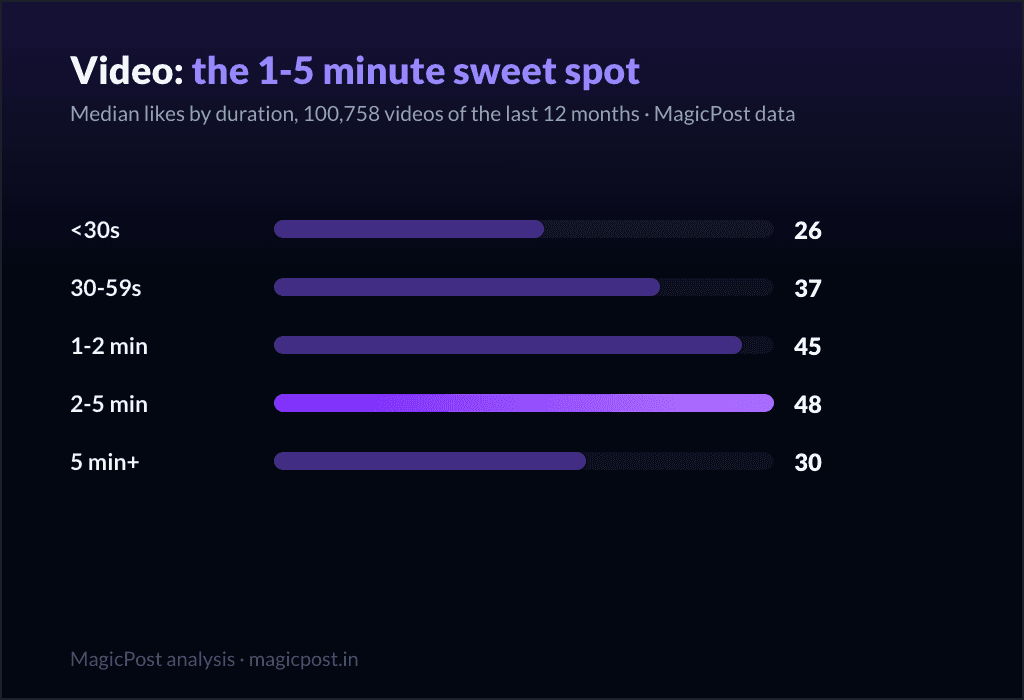
TL;DR: The sweet spot is 1-5 minutes (45-48 median likes vs 26 under 30 seconds), and video is the only format still climbing (11.2% of posts in 2026).
How long should a LinkedIn video be?
Here is the duration curve, every bucket, with the number of videos behind each row so you can see this is not three viral clips talking:
Duration | Videos measured | Median likes |
Under 30s | 28,630 | 26 |
30-59s | 30,645 | 37 |
1-2 min | 26,026 | 45 |
2-5 min | 10,533 | 48 |
5 min+ | 4,924 | 30 |
The sweet spot is 1 to 5 minutes (45 to 48 median likes). Under 30 seconds earns 26, below the format's own median; past 5 minutes engagement falls back to 30 as the audience checks out. The curve is a clean arc: it climbs from 30 seconds to the 2-5 minute peak, then drops.
Now the twist. The median LinkedIn video is only 51 seconds long. Most creators shoot in the worst-performing zone, the under-1-minute band, while the videos that actually win run two to five times longer.
The folklore ("attention spans are short, keep it under 30 seconds") pushes people toward the part of the curve that underperforms. That 51-second median, against a 1-to-5-minute peak, is the gap between what people post and what works.
Across all 100,758 videos, the median is 36 likes and 6 comments. The duration band is the single biggest lever you control on top of that baseline.



Video is the only format still climbing
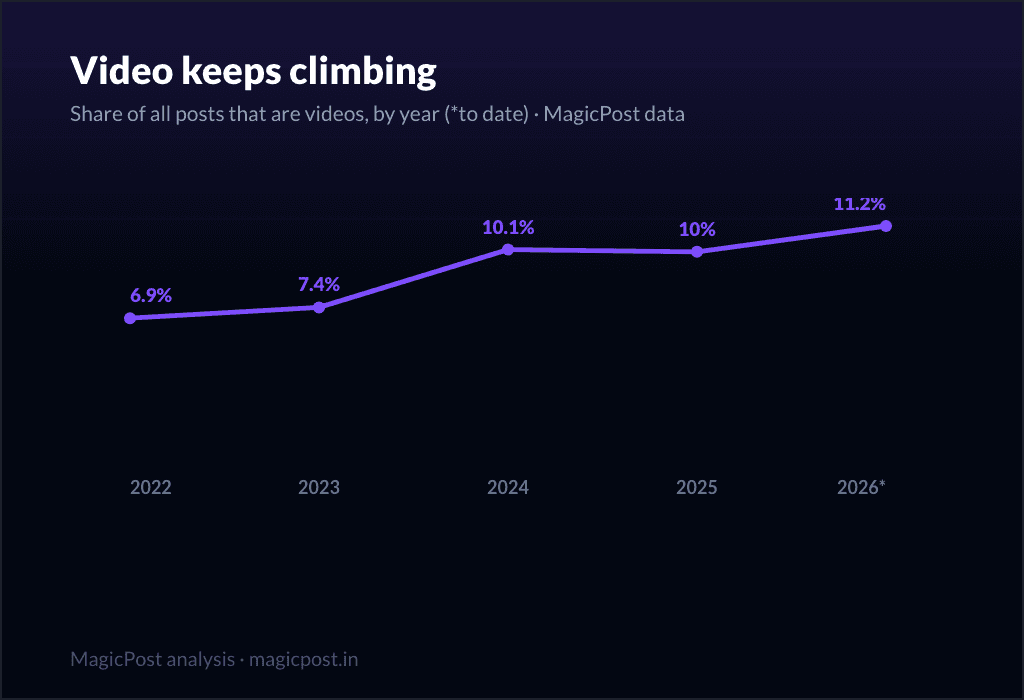
Pull back four years and video is the one format whose median keeps rising while everything else plateaus:
Year | Share of posts that are video | Median likes per video |
2022 | 6.9% | 20 |
2023 | 7.4% | 23 |
2024 | 10.1% | 32 |
2025 | 10.0% | 30 |
2026 (to date) | 11.2% | 38 |
Two things move together here. Video's share of the feed grew from 6.9% in 2022 to 11.2% in 2026 to date, and its median engagement nearly doubled, from 20 to 38 likes.
Most formats got more crowded and saw their median flatten or fade. Video got more crowded and got better. That is rare, and it is the strongest reason to invest in the format now rather than later. (We tell the full four-year story across every format in the best LinkedIn post format study: video has now caught the image post for the first time.)
One caveat worth stating plainly: our corpus grows over time, so year-to-year numbers are medians within each year and should be read as directional. The video trend survives that caveat comfortably; it is the clearest signal in the whole cluster.
Reach: video does not buy you extra eyeballs
A common myth is that LinkedIn floods video with impressions. It does not, at least not by the data. Comparing median impressions on posts with synced analytics:
Videos: 708 median impressions (43,078 posts with synced analytics).
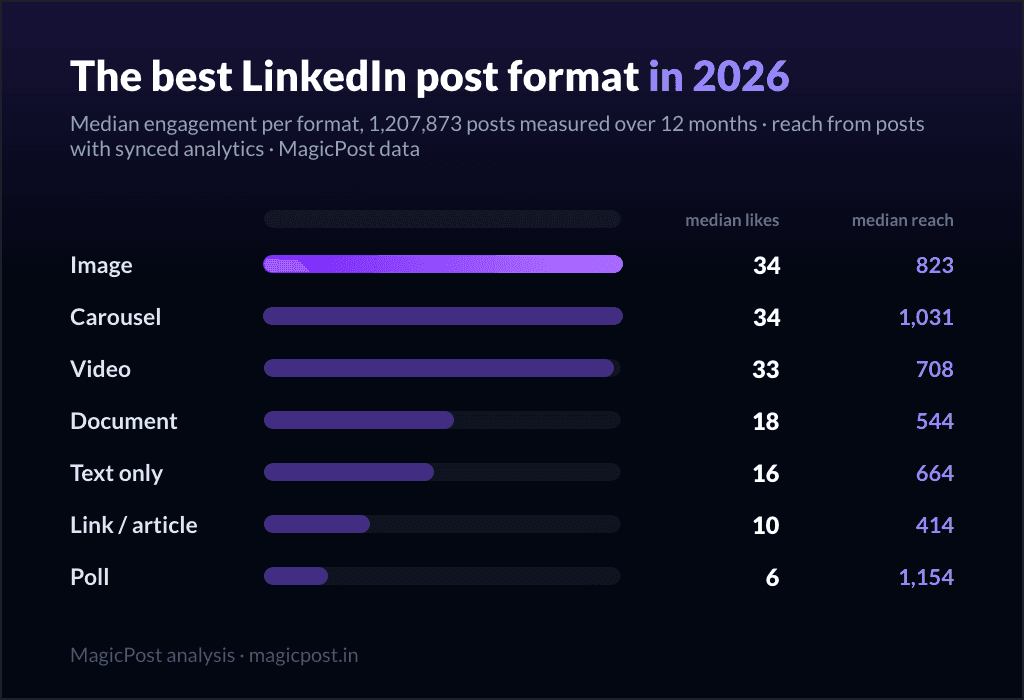
Non-video posts: 770 median impressions (523,879 posts with synced analytics).
Video reach is actually a touch lower than the rest of the feed. So video does not win by being shown more; it wins by being watched. The engagement lift in the duration table is earned on attention, not on a distribution bonus. Treat video as a depth and trust play, not a reach hack.
Video takes effort, so post it when your audience is actually online. A 2-minute video is hours of scripting, shooting and editing; do not burn that on a dead slot. MagicPost lets you schedule your LinkedIn posts for the windows when your people are on the platform, and our data on the best time to post on LinkedIn tells you when those windows are. Batch-record, queue, and let the schedule do the rest.
The video masters (and the warning they come with)
Look at who over-invests in video and you find the platform's biggest voices:
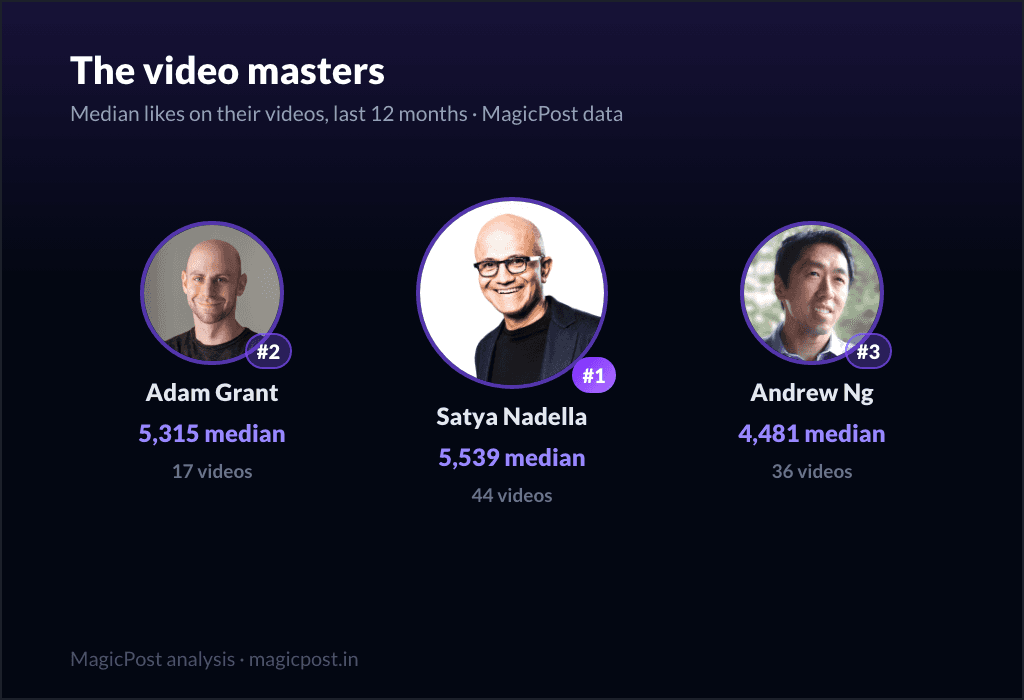
Master | Median likes per video | Videos measured |
5,539 | 44 | |
5,315 | 17 | |
4,481 | 36 |
Satya Nadella posts video constantly (44 measured in 12 months) at 5,539 median likes; Adam Grant (5,315) and Andrew Ng (4,481) round out the podium. The signal: the people with the most to lose from a flat video still pour effort into the format, which tells you they see it working.
The warning: it is a crowded, high-ceiling arena, and these are not casual phone clips. Aim to be the best video in your niche, not the best on the platform.
(Want to study real winning videos instead of three faces? MagicPost's post inspiration library lets you search 2M+ posts by format and topic, so you can watch what actually performs in your space.)
The craft: how to make a LinkedIn video that lands
The measured layer tells you what to aim for. This is how to get there. None of the advice below is invented stats; it is the practical guide, modernized.
Native upload beats a link, every time
Upload the file straight to LinkedIn ("Start a post" then the video icon, then your MP4 or MOV). Do not post a YouTube or Vimeo link and expect the same result.
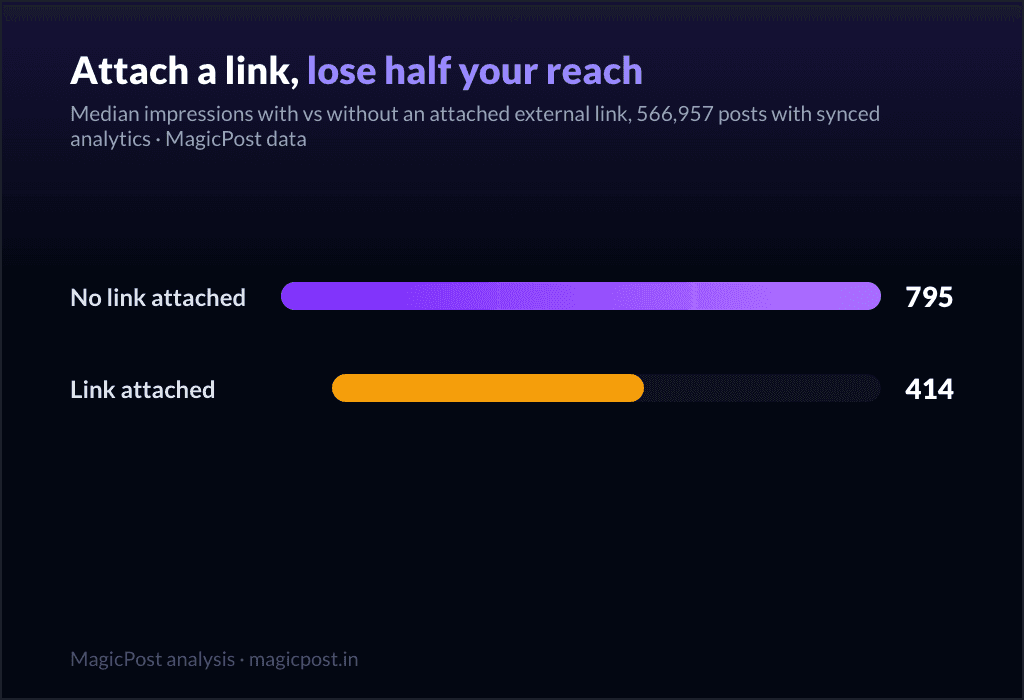
A native video plays inline in the feed, autoplays as people scroll, and is treated as a first-class post. An external video link is just a link: it sends people off-platform and carries the same reach penalty every link post does. If the goal is engagement on LinkedIn, the video has to live on LinkedIn.
Specs that matter in 2026
Format: MP4 or MOV, file size under 5 GB.
Aspect ratio: vertical (4:5 or 9:16) for talking-head and short-form, because most of the feed is mobile and vertical fills more of the screen. Horizontal (16:9) is fine for interviews, demos and screen recordings where width carries information.
Length: LinkedIn allows 3 seconds to 10 minutes on a normal post, but the data says aim for the 1-to-5-minute band. Use the room; do not pad it.
Thumbnail: add a custom cover frame. It is the first thing people see before they hit play, and it keeps your visual branding consistent.
Caption for muted, mobile viewers
Most people watch LinkedIn video with the sound off, scrolling at work. Two consequences:
Burn in subtitles. If your video needs audio to make sense, you lose the silent majority. Readable, well-timed captions keep the message landing without headphones.
Write the post text to add, not repeat. The caption above the video should not transcribe what you say on camera. Use it to set up the topic, add context, and end on a clear call to action ("What is your take?" or "Save this for later"). The video delivers; the text frames and invites.
Win the first 3 seconds
Autoplay gives you about three seconds before a viewer scrolls on. Open on the strongest thing you have: a bold on-screen claim, a surprising number, a direct question, or movement (a gesture, a quick zoom, a prop).
Do not open like a YouTube vlog with a slow "Hey everyone, so today I wanted to talk about..." On LinkedIn you have neither the time nor the patience budget for a runway. Hook first, context second.
Talking-head vs produced
You do not need a studio. A clear talking-head video shot on a phone, with good light and burned-in captions, outperforms an over-produced clip drowning in animations and loud music. The format rewards a face, a voice, and a point of view, that is what makes you more memorable than a static post.
Save "produced" (B-roll, cuts, motion graphics) for when it genuinely serves the story: a demo, a case study, a process walkthrough. Polish should support the message, never bury it.
The mistakes that quietly kill videos
Starting slow, like a vlog intro, instead of hooking in 3 seconds.
Background music so loud it competes with your voice.
No captions, so the muted majority bounces.
Over-animating until it looks unserious for a B2B feed.
Dead air and awkward pauses; keep the flow tight.
Shooting under 30 seconds because "short wins," when the data says 1 to 5 minutes wins.
For repeatable content, batch-record. Once you are warmed up you can shoot five to ten short videos in an hour, then schedule them across the weeks. The first take is always the worst; by the fifth you will see the difference.
What to do with all this
Stop shooting 30-second clips by default. The median video (51 seconds) sits in an underperforming band. Aim for 1 to 5 minutes (45-48 median likes).
Upload native, never as a link. Inline autoplay is the whole advantage.
Caption for muted viewers and hook in 3 seconds. Most of your audience watches on mute, at work.
Bet on the format for the next few years. Video is the only one whose median keeps climbing (20 to 38 since 2022).
Do not expect free reach. Video reach (708 median impressions) is slightly below the feed; it wins on attention, not distribution.
Schedule it. A good video is too much work to waste on a dead time slot. (Carousels are the other format that rewards depth; here is how to build a LinkedIn carousel, and how the LinkedIn algorithm weighs all of this in 2026.)
Put video to work. MagicPost handles the caption, the posting slot and the after-the-fact numbers for every LinkedIn post you make, so a format that costs real hours to produce lands at the right time, in front of the right audience, and gets measured once it is live.
Where this data comes from
The duration numbers on this page are measured from MagicPost's own corpus. Duration and engagement figures: 100,758 native LinkedIn videos published over the last 12 months (reshares and deleted posts excluded), bucketed by length and compared on median likes. The median video runs 51 seconds and earns 36 median likes, 6 median comments. Reach figures come from posts with synced analytics: 43,078 videos (708 median impressions) versus 523,879 non-video posts (770 median impressions), aggregated and anonymized. History: the same corpus from 2022 to mid-2026, medians taken within each year and read directionally because the corpus grows. Video masters: 5,000+ followers, people only, minimum video count in the window, ranked by median likes per video. We use medians rather than averages, which keeps a few viral clips from dragging a duration band away from its real center. Numbers current as of June 2026.
FAQ
How long should a LinkedIn video be?
The measured sweet spot is 1 to 5 minutes. Across 100,758 native videos, 1-2 minute clips earn 45 median likes and 2-5 minute clips earn 48, the two best bands. Videos under 30 seconds earn only 26 (below the format's own median), and past 5 minutes engagement drops back to 30. The catch: the median video is just 51 seconds, so most creators shoot shorter than what performs best.
Is LinkedIn video still worth it in 2026?
Yes, more than any other format. Video is the only LinkedIn format whose median engagement keeps climbing, from 20 median likes in 2022 to 38 in 2026 to date, while its share of the feed grew from 6.9% to 11.2%. Every other format flattened or faded.
Does LinkedIn give videos more reach?
No. On posts with synced analytics, videos earn 708 median impressions versus 770 for non-video posts, so video reach is slightly below the feed, not above it. Video wins on attention and engagement once people watch, not on extra distribution.
Should I upload video natively or post a link?
Always native. A file uploaded straight to LinkedIn (MP4 or MOV, under 5 GB) autoplays inline in the feed and is treated as a first-class post. An external video link sends people off-platform and carries the reach penalty of any link post.
Do I really need captions on LinkedIn video?
Yes. Most people watch with the sound off while scrolling at work, so burned-in subtitles are how your message lands. Pair them with a strong hook in the first 3 seconds (autoplay only gives you about that long before a viewer scrolls past) and post text that adds context rather than repeating what you say on camera.