" height="26.80529977783203px" id="tymKb8bqC" width="128.00300311279295px"/><path d="M 0 2.417 L 0 0 L 12.909 0 L 12.909 2.417 Z" fill="rgb(126, 78, 253)" height="2.417099999999998px" id="aYr4em6zK" transform="translate(128.341 22.325)" width="12.908999999999992px"/></svg>)

"/><stop offset="1" stop-color="rgb(118, 37, 250)"/></linearGradient></defs><g d="M 19.242 21.22 L 19.362 6.204 L 19.272 6.204 L 13.757 21.22 L 10.161 21.22 L 4.796 6.204 L 4.706 6.204 L 4.825 21.22 L 0 21.22 L 0 0 L 7.283 0 L 12.109 13.607 L 12.229 13.607 L 16.844 0 L 24.247 0 L 24.247 21.22 Z M 26.421 26.113 L 26.421 23.445 L 41.407 23.445 L 41.407 26.113 Z" fill="transparent" height="26.112508199679183px" id="DvfaAIHYn" width="41.40731898311435px"><path d="M 19.242 21.22 L 19.362 6.204 L 19.272 6.204 L 13.757 21.22 L 10.161 21.22 L 4.796 6.204 L 4.706 6.204 L 4.825 21.22 L 0 21.22 L 0 0 L 7.283 0 L 12.109 13.607 L 12.229 13.607 L 16.844 0 L 24.247 0 L 24.247 21.22 Z" fill="rgb(46, 46, 46)" height="21.220180016149442px" id="pLsxRCobd" width="24.247352589074694px"/><path d="M 0 2.668 L 0 0 L 14.986 0 L 14.986 2.668 Z" fill="url(%23yD9d4I5GR-3279285344-linear-gradient)" height="2.6675085048549647px" id="yD9d4I5GR" transform="translate(26.421 23.445)" width="14.986002836263765px"/></g></svg>)

Naïlé Titah
Every fact in this review was checked on sociabble.com, G2 and the sources linked below in June 2026.
Sociabble is one of the most respected names in employee advocacy, and judging it fairly means being clear about what it actually is: not a LinkedIn tool, but an all-in-one employee experience platform, advocacy plus internal communications plus intranet, sold to large enterprises. It is genuinely good at that job. The question this review answers is not "is Sociabble any good" (it is) but "is Sociabble the right weight for what you are trying to do," because the gap between a 100-person company wanting more LinkedIn advocacy and a 50,000-person enterprise rolling out a comms platform is the whole story. If you are weighing lighter options, the shortlist is in our Sociabble alternatives guide.
TL;DR: Sociabble is an excellent enterprise employee-experience platform (advocacy + comms + intranet), and a heavy one: ~3-month rollouts, 13-month ROI, custom demo-only pricing, and it is nearly invisible on LinkedIn itself. For LinkedIn-only advocacy, lighter tools fit better.
What Sociabble is
Sociabble describes itself as "the all-in-one employee experience platform, connecting every employee from frontline to HQ." In practice that means several modules in one place: employee advocacy (the part that touches LinkedIn), internal communications, an intranet/newsfeed, and engagement features like gamification and rewards. Its client list is unmistakably enterprise, Accor, AXA, Capgemini, Coca-Cola, EDF, L'Occitane, Primark, and reviewers at that scale are real (one verified G2 review comes from a retailer with 80,000 colleagues). It is a French company, now part of the Poppulo group. This is software bought by communications and HR departments, not by a creator looking to post more.



What its users actually say
On G2, Sociabble holds a strong 4.7/5 across roughly 390 reviews. Read the score with one caveat the platform is open about: a number of those reviews are marked incentivized or collected through G2 campaigns, so the themes matter more than the headline figure. Aggregated, the praise is consistent: ease of use, responsive customer support, and a real lift in employee engagement. The criticisms are just as consistent, and they cluster around weight rather than quality.
The most useful line comes inside a glowing five-star review from a CMO: "It's not a set-it-and-forget-it platform, you need someone driving it." A financial-services reviewer puts the admin side plainly: "It has tons of features, but that also means the architecture can be quite complex for admins to learn." An IT project lead adds that "some advanced configurations and administrative tasks can be complex and require support from the vendor," and that "reporting and analytics could also offer more flexibility," a note echoed by the 80,000-employee retailer ("an opportunity for greater depth and flexibility in certain reports"). None of this says the product is bad. It says the product is big, and big platforms need a driver, a budget, and patience.
The weight, in numbers
This is where a buyer should be honest with themselves. By G2's own data from real customers, Sociabble takes about three months to implement and around 13 months to reach ROI, and its pricing is custom only, quoted by company size and modules behind a demo, with no public price and no self-serve trial. For an enterprise standing up a comms-and-advocacy platform across thousands of employees, those numbers are normal and worth it. For a team that mostly wants its people more visible on LinkedIn next quarter, a three-month rollout and a 13-month payback are a different proposition entirely. The platform's strength, depth across many modules, is the same thing that makes it heavy.
What the LinkedIn record shows
One more piece of context, because it is easy to misread. Sociabble is highly visible in enterprise software circles and almost invisible in the place you might expect a "LinkedIn advocacy" tool to show up: LinkedIn itself. In our research corpus of 1.2M posts, Sociabble was mentioned once in the last twelve months. That is not a knock, it is a clue about category. Sociabble lives inside organizations (intranet, internal comms, admin consoles), not in the public creator conversation. If your goal is a tool whose value is felt by individual posters on LinkedIn, that near-absence is telling; if your goal is an internal platform, it is irrelevant.
Who Sociabble is for
Buy Sociabble if you are a large organization that needs employee advocacy as one piece of a broader employee-experience platform, internal comms, an intranet, frontline reach, and you have the comms/HR ownership and budget to drive it. At that scale it is a category reference, and the implementation time buys real breadth. Look elsewhere if advocacy on LinkedIn is the actual job and the rest is overhead you will not use, if you need to be live in days rather than months, or if you want public, self-serve pricing and a free trial before a sales conversation.
Sociabble vs MagicPost
These are different weight classes, so the honest comparison is narrow: the LinkedIn advocacy slice. Where Sociabble delivers advocacy as one module of an enterprise platform, MagicPost's team mode is that advocacy slice rebuilt as a self-serve LinkedIn product: member spaces for every employee, adoption dashboards (who posted, who stalled, who needs a nudge), AI that writes in each member's own voice with a humanizer built on our published research (AI-sounding posts earn 57% less engagement, measured on 1.2M posts), and everything published through LinkedIn's official API as a verified application with working @mentions and benchmarked, white-label reporting. You start in a day on a no-card trial, not a three-month rollout, and team pricing is public (per user, from €109/mo for two seats with volume discounts, as of June 2026). If you need the intranet and the internal-comms suite, these are not substitutes and Sociabble is your tool; if you need LinkedIn advocacy specifically, MagicPost is three months lighter. The fuller field is in our Sociabble alternatives guide, and the broader category in our best employee advocacy tools roundup.
Sociabble | MagicPost team mode | |
Category | Enterprise experience platform | LinkedIn advocacy product |
Scope | Advocacy + comms + intranet | LinkedIn advocacy + content workflow |
Implementation | ~3 months (G2 avg) | Started in a day |
Pricing | Custom, demo-only | Public, from €109/mo (2 seats) |
Free trial | Not offered | Free, no card |
Voice AI + humanizer | Not its focus | ✅ Per-member, research-backed |
LinkedIn official API + mentions | n/a (multi-channel sharing) | ✅ Verified app, working @mentions |
Best for | Large orgs needing the full platform | Teams that want LinkedIn advocacy now |
The verdict
Sociabble earns its reputation: at enterprise scale, an advocacy-plus-comms-plus-intranet platform with this depth and this client list is a serious, defensible choice, and its own users confirm the substance. The honest caveat is not about quality but about fit. It takes months to stand up, costs enterprise money quoted behind a demo, and needs someone to drive it, and if the job you actually have is "get our people visible on LinkedIn," that is a lot of platform for one slice of value. Match the tool to the weight of the problem: Sociabble for the full enterprise programme, a lighter LinkedIn-native product when advocacy on LinkedIn is the point.
Where these facts come from
Sociabble's positioning, modules, client names and the demo-only pricing model were verified on sociabble.com in June 2026. Review themes, the verbatim quotes and the implementation/ROI figures come from G2 (with the incentivized-review caveat noted). The LinkedIn mention count is drawn from our research corpus across the twelve months to June 2026. The 57% figure is from our published research on 1.2M LinkedIn posts. Corrections land at the next quarterly refresh.
Häufige Fragen
What is Sociabble used for?
Sociabble is an enterprise employee-experience platform combining employee advocacy, internal communications, an intranet/newsfeed and engagement features. The advocacy module is the part that helps employees share to LinkedIn; the rest is internal. It is used by large organizations like AXA, Coca-Cola and Capgemini.
How much does Sociabble cost?
Custom only: pricing is quoted by company size, user count and the modules you need, behind a demo, with no public price and no self-serve trial (as of June 2026). By G2's customer data, it also takes around three months to implement and about 13 months to reach ROI.
Is Sociabble good for LinkedIn advocacy?
It is capable, as one module of a larger platform, and large enterprises rate it well (4.7/5 on G2, with some incentivized reviews). But if LinkedIn advocacy is your only goal, its weight, custom pricing, multi-month rollout and admin complexity may be more than you need; lighter LinkedIn-native tools exist.
What are the best Sociabble alternatives?
For LinkedIn-first advocacy without the enterprise weight, see our Sociabble alternatives guide and our employee advocacy roundup. MagicPost's team mode delivers the advocacy slice self-serve, with public per-user pricing and a no-card trial.
Sociabble vs MagicPost: which one?
Sociabble if you need a full enterprise platform (advocacy plus internal comms plus intranet) and have the ownership to drive it. MagicPost team mode if you want LinkedIn advocacy specifically: per-member voice AI with a research-backed humanizer, official-API publishing, adoption dashboards and benchmarked reports, live in a day, from €109/mo for two seats (as of June 2026).
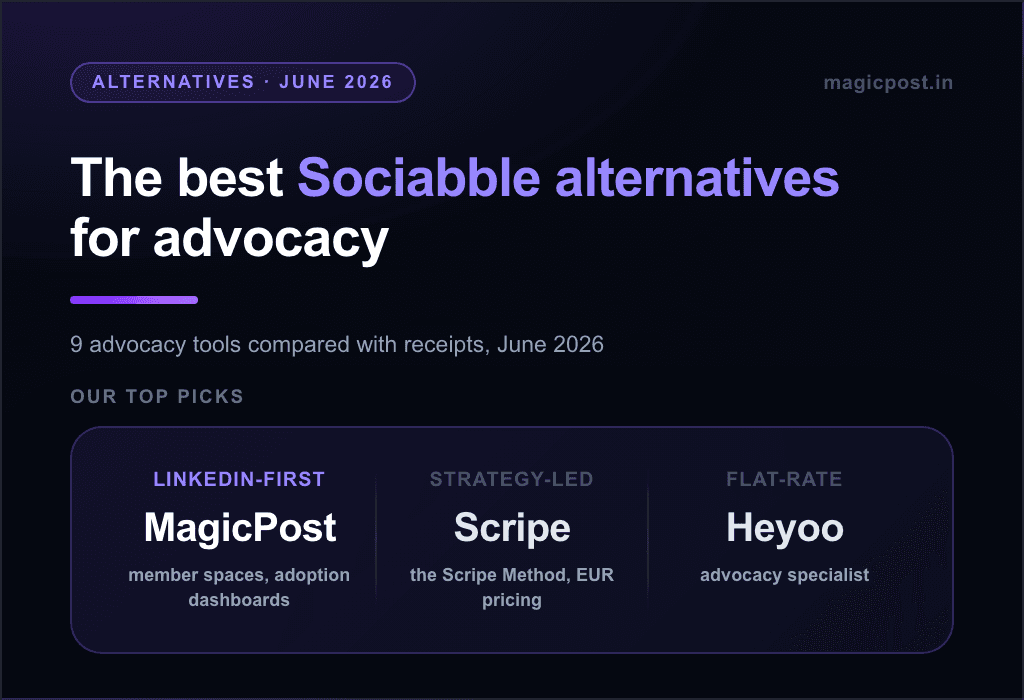
9 Best Sociabble Alternatives for LinkedIn Advocacy (Verified June 2026)
Sociabble is excellent and heavy: 4 modules, ~3-month rollouts, custom pricing. 9 lighter ways to turn employees into LinkedIn voices, compared with receipts, June 2026.
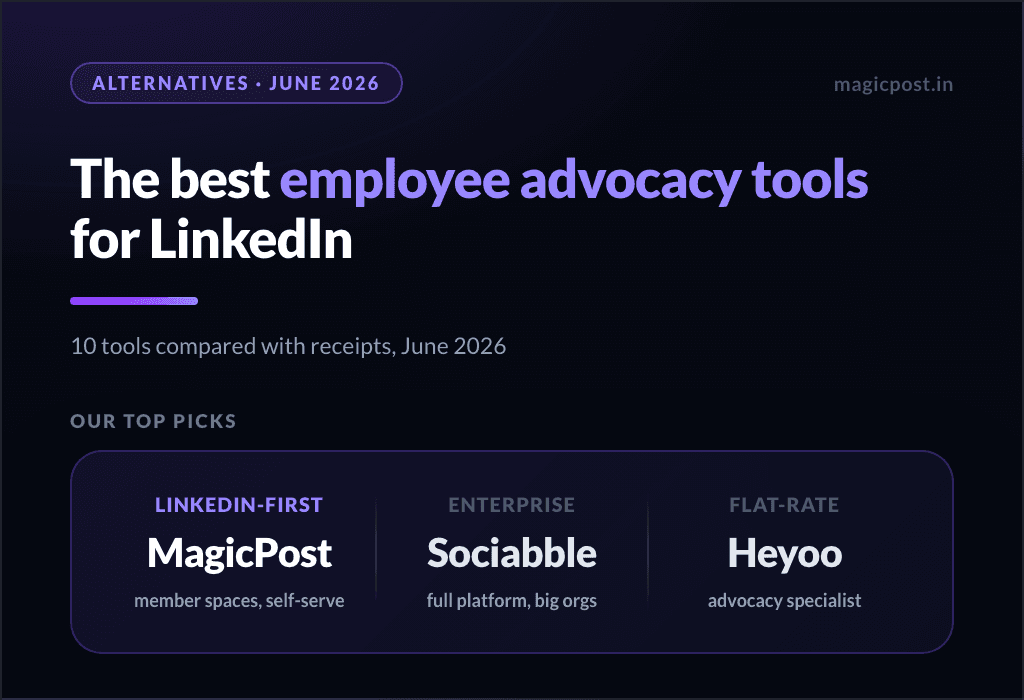
10 Best Employee Advocacy Tools for LinkedIn (Verified June 2026)
From enterprise platforms to self-serve pilots: 10 employee advocacy tools for LinkedIn compared with receipts, pricing models and adoption dashboards, June 2026.
MagicPost Bewertung: Erstellen und Verwalten Sie Ihre LinkedIn-Beiträge
MagicPost ist ein KI-gestütztes Tool, das Ihnen hilft, Ihre LinkedIn-Inhalte effizienter und mit weniger Aufwand zu erstellen, zu planen und zu verwalten.
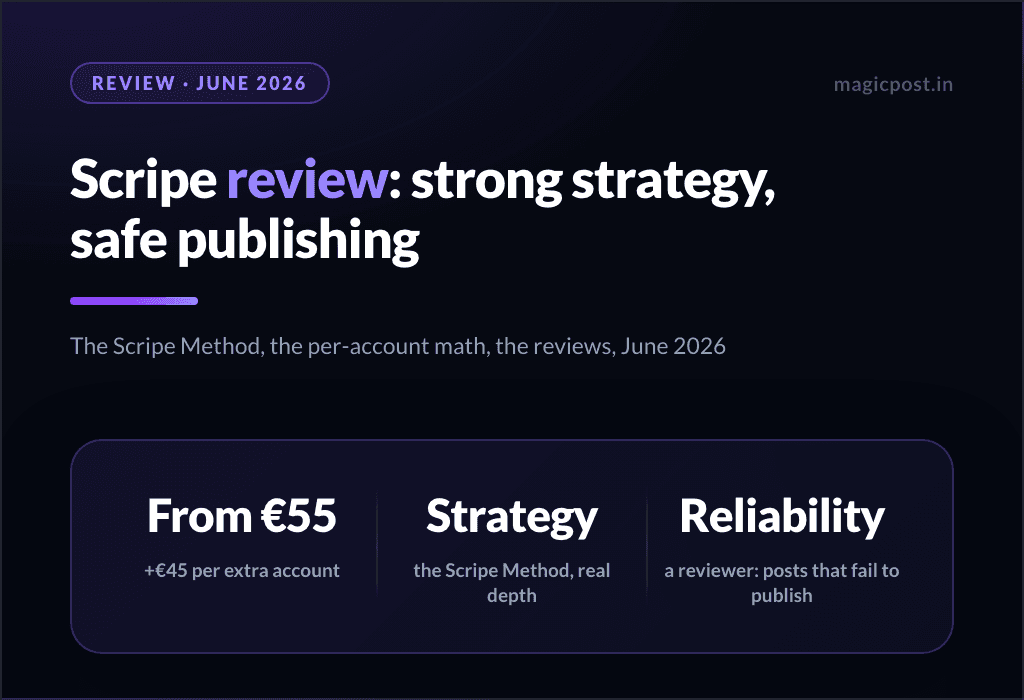
Scripe Bewertung: Pläne, Funktionen, Vor- und Nachteile
Scripe Bewertung: Funktionen, Preise, Pläne, Vor- und Nachteile sowie ein vollständiger Vergleich mit MagicPost, um Ihnen bei der Auswahl des richtigen LinkedIn-Inhaltstools zu helfen.
Magnettu Review (2026): Enterprise-Grade LinkedIn Management
Magnettu review: Is this enterprise LinkedIn platform worth the cost? We examine its features, pricing, pros, cons, and overall value.
CoPostly Bewertung: Funktionen, Preise und Nachteile
CoPostly Bewertung, die Funktionen, Preise, Vor- und Nachteile sowie den Vergleich der Pläne abdeckt, um Ihnen zu helfen zu entscheiden, ob es das richtige LinkedIn-Content-Tool für Sie ist.
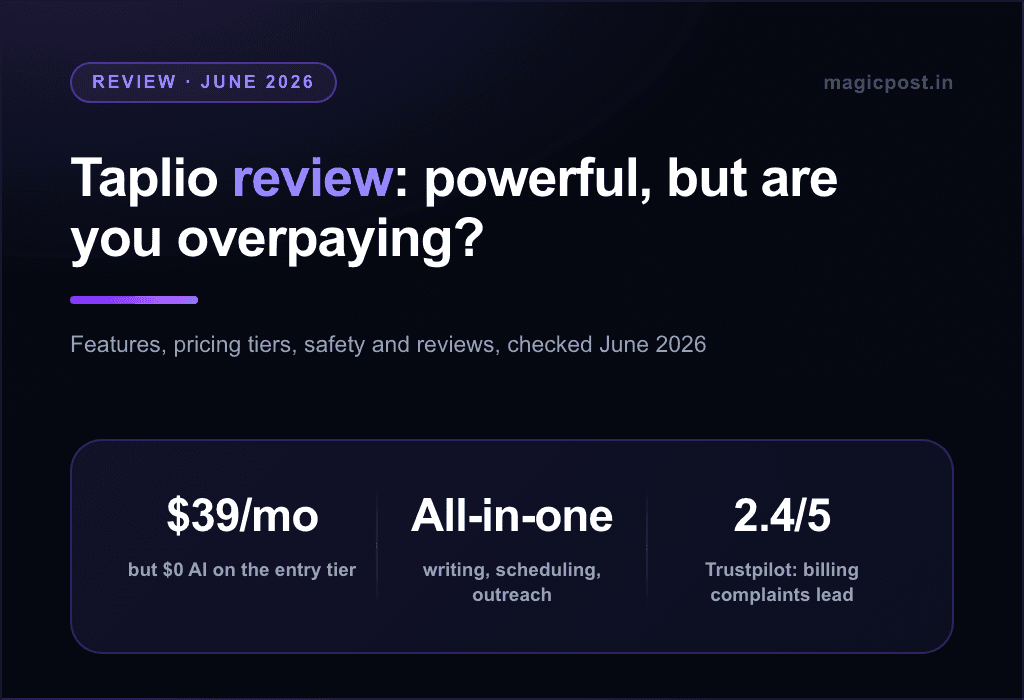
Taplio Testbericht: Leistungsstark, aber zahlen Sie zu viel? (Update 2026)
Überprüfen Sie diese Taplio-Bewertung, um herauszufinden, ob die Funktionen den hohen Preis wert sind, und erkunden Sie Alternativen, die besser zu den Bedürfnissen Ihres Unternehmens passen könnten.
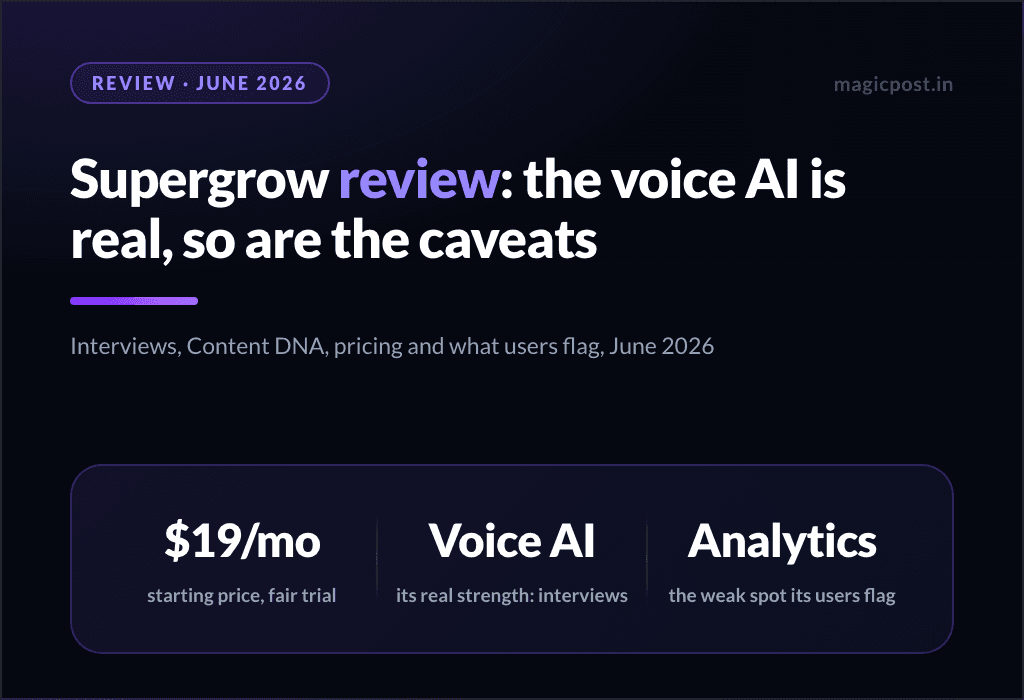
Supergrow Testberichte (2026): Funktionen, Preise, Vor- und Nachteile
Entdecken Sie diese Supergrow-Bewertung: KI-generierte LinkedIn-Posts, Karussells, Planung und mehr. Ist es das richtige Content-Tool für Ihr LinkedIn-Wachstum? Finden Sie es jetzt heraus.
RedactAI Bewertung 2026: Die Vor- und Nachteile
RedactAI Bewertung 2026: vollständige Übersicht über Funktionen, Preise, Vor- und Nachteile. Ist dieser LinkedIn-Beitragsersteller besser als Taplio oder MagicPost? Finde es jetzt heraus.
EasyGen Bewertung: Die Vor- und Nachteile
Hast du schon von EasyGen auf LinkedIn gehört? Schau dir unsere Easygen-Bewertung an, um alle Funktionen zu entdecken, die es bietet, und wie es dir bei deiner LinkedIn-Inhaltsstrategie helfen kann.