" height="26.80529977783203px" id="tymKb8bqC" width="128.00300311279295px"/><path d="M 0 2.417 L 0 0 L 12.909 0 L 12.909 2.417 Z" fill="rgb(126, 78, 253)" height="2.417099999999998px" id="aYr4em6zK" transform="translate(128.341 22.325)" width="12.908999999999992px"/></svg>)

"/><stop offset="1" stop-color="rgb(118, 37, 250)"/></linearGradient></defs><g d="M 19.242 21.22 L 19.362 6.204 L 19.272 6.204 L 13.757 21.22 L 10.161 21.22 L 4.796 6.204 L 4.706 6.204 L 4.825 21.22 L 0 21.22 L 0 0 L 7.283 0 L 12.109 13.607 L 12.229 13.607 L 16.844 0 L 24.247 0 L 24.247 21.22 Z M 26.421 26.113 L 26.421 23.445 L 41.407 23.445 L 41.407 26.113 Z" fill="transparent" height="26.112508199679183px" id="DvfaAIHYn" width="41.40731898311435px"><path d="M 19.242 21.22 L 19.362 6.204 L 19.272 6.204 L 13.757 21.22 L 10.161 21.22 L 4.796 6.204 L 4.706 6.204 L 4.825 21.22 L 0 21.22 L 0 0 L 7.283 0 L 12.109 13.607 L 12.229 13.607 L 16.844 0 L 24.247 0 L 24.247 21.22 Z" fill="rgb(46, 46, 46)" height="21.220180016149442px" id="pLsxRCobd" width="24.247352589074694px"/><path d="M 0 2.668 L 0 0 L 14.986 0 L 14.986 2.668 Z" fill="url(%23yD9d4I5GR-3279285344-linear-gradient)" height="2.6675085048549647px" id="yD9d4I5GR" transform="translate(26.421 23.445)" width="14.986002836263765px"/></g></svg>)

Naïlé Titah
No LinkedIn advice is repeated more than "post a hot take." Pick a sacred cow, kick it, watch the comments roll in. The contrarian post is the most over-prescribed format on the platform, sold as a guaranteed engagement hack to anyone with an opinion and a posting schedule.
So we measured what provocation actually earns. Across 8,357 contrarian posts from the last 12 months, judged on the same engagement-rate scale as every other post type, the verdict is uncomfortable for the hot-take crowd: the contrarian take earns a 0.49% median engagement rate. Good, not great. It beats the platform median of 0.39%, but loses badly to simply celebrating a win, which earns 1.21%, more than twice as much. Provocation works, but it is not the cheat code it is sold as, and the way it works is not the way most people think.
TL;DR: Contrarian takes earn 0.49% median ER: above the 0.39% platform median, far below a sincere win (1.21%). Provocation buys conversation more than likes. The winners have real stakes, earned authority, and a constructive alternative.
The number nobody selling hot takes wants to show you
Here is where the contrarian post sits among the post types we measured, ranked by median engagement rate:
Post type | Posts measured | Median engagement rate | Median likes | Median comments |
Celebrating a win | 23,877 | 1.21% | 66 | 11 |
Contrarian take | 8,357 | 0.49% | 40 | 14 |
Platform median (all posts) | 1,141,932 | 0.39% | n/a | n/a |
The contrarian take clears the platform bar: 0.49% against a 0.39% median across 1.1 million posts. If your goal is "beat average," provocation does that. But sincerity wins the matchup outright: a post that genuinely celebrates a win earns 1.21%, roughly two and a half times the contrarian take, on a sample three times as large.
That is the honest summary of the genre: provocation is overrated. It beats the average post and loses to the sincere one. Anyone who tells you a hot take is the highest-performing thing you can publish is selling you the format, not the data. (For the full ranking, see LinkedIn post types ranked by engagement.)



The one thing contrarian posts genuinely win on
Likes are not where the contrarian post earns its keep. Comments are.
Look again at the table. Celebrating a win earns 66 median likes but only 11 comments. The contrarian take earns fewer likes (40) but more comments (14). The ratio is stark: the win post collects about one comment for every six likes, the contrarian post roughly one for every three. Relative to the applause it gets, provocation generates conversation at more than double the rate.
That makes sense once you think about what a disagreement does. A win invites a thumbs-up and a scroll. A contrarian claim invites a reply, because the reader has a position too and your post just gave them a reason to state it. Provocation buys conversation more than it buys likes. If you want a thread, it is one of the most reliable ways to start one. If you want broad approval, it is the wrong tool.
What separates a real contrarian take from rage-bait
The 0.49% median hides a wide split between posts that earn their conflict and posts that manufacture it. The winners we measured share three things.
Real stakes. Jasmin Alić takes on a piece of advice his whole industry repeats, with his own years of practice as the collateral:
""You can't share 100% of your knowledge." Oh but I can. For free. Every time they complain, I prove them wrong. I've been doing this for years, and I don't plan to stop. Just this year, I gave away: 1." Jasmin Alić, 3,254 likes (post)
The take is sharp, but it is grounded in his own two years of lived experience, not a manufactured villain. That is earned authority, and it is what lets the disagreement land instead of curdling.
A constructive alternative. Gary Vaynerchuk does not just attack a belief; he replaces it with a position he has defended for years:
"A huge agenda of mine is to educate and debate anyone who thinks kindness is a weakness. When I say it I am often confronted with people who say that people take advantage of their kindness or that people will exploit it, I remind them that true kindness is given without expectation which then doesn’t allow..." Gary Vaynerchuk, 3,042 likes (post)
He is contrarian about a behavior most people punish, and offers a better way to read it. The post argues for something, not just against.
And then there is the third category, the one to study and never imitate: rage-bait. Ken Cheng's satire exists precisely to mock it:
"I cried today. Received some devastating news regarding either my child, beloved family member or elderly mentor. I'm heartbroken. The worst part? I didn't have a camera to film my live reaction. None of you got to see my vulnerable authentic self. That is disastrous." Ken Cheng, 4,188 likes (post)
Cheng wins because the post is a joke about engagement-farming, not an act of it. The lesson cuts the other way: a genuine trauma-bait post, written sincerely to harvest sympathy, burns trust the moment readers smell the manufacture. Outrage with no stakes and no alternative is a withdrawal from your credibility, and the median catches up fast.
Want provocation without the rage-bait? The hardest part of a contrarian post is finding a take you can actually defend. MagicPost's AI LinkedIn post generator builds posts from your real experience and your point of view, so the disagreement is grounded in something you can stand behind in the comments, not a hot take you regret by lunch.
Three contrarian templates worth stealing
If you have a genuine take, here are three structures that carry it. Fill in the brackets.
1. The sacred-cow challenge. Jasmin's structure: name the cow, put your own experience on the line, then offer the better path.
"Everyone treats [widely accepted practice] as the obvious right move. After [your real experience], I think it is quietly [wrong / overrated / backwards]. Here is what I do instead: [your constructive alternative]."
2. The unpopular-priority take. A defensible ranking of what matters, backed by a result. It earns conversation because readers want to argue their own priority.
"Most people optimize for [the thing everyone chases]. I optimize for [the thing they ignore], and it has [specific result]. [Popular thing] feels productive. [Your priority] actually moves the needle."
3. The "everyone says X, the data says Y" take.
"Everyone says [common belief]. In my experience, [the opposite] is closer to the truth, because [your evidence]."
One caution on the last one: the bare "It's not X, it's Y" construction has been so heavily used by AI-written posts that the formula now reads as a tell, even when a human writes it. If you reach for it, ground both halves in a concrete, specific claim that only you could make, and skip the punchy one-line version. (We unpack why this phrasing backfires in the "it's not X, it's Y" formula.)
For more angles that do not depend on conflict to perform, MagicPost's LinkedIn post ideas turns your topics into a steady feed of posts worth publishing.
When NOT to publish the contrarian post
Provocation is a tool with a narrow blade. Put it down when:
You do not actually disagree. Manufacturing a contrarian position you do not hold is the fastest route to rage-bait, and readers can tell. The 0.49% median is built on real takes; fake ones drag it down.
You have no alternative to offer. A complaint with no "here is what I do instead" is a withdrawal from trust. The winners always argue for something.
You lack the standing. Earned authority is what lets Jasmin's take land. A contrarian claim from someone with no stake in the topic reads as noise.
You just want the biggest number. If approval is the goal, the data is blunt: a sincere win post earns 1.21%, more than double the contrarian take. Provocation is not your best performer; it is your best conversation-starter. (Not sure which to reach for? Start with what to post on LinkedIn.)
The honest position on the contrarian post is the contrarian one: it is overrated. It clears the bar, it sparks threads, and it has exactly one superpower, conversation. Use it when you have a real take, real stakes, and a real alternative. Skip it the rest of the time, and let the wins do the heavy lifting. The full menu of formats lives in our pillar, the best LinkedIn post templates.
Where the data and examples come from
Every number here is MagicPost's own research. We classified LinkedIn posts from the last 12 months into post types, filtered out reshares and deleted posts, and compared each type on its median engagement rate, defined as a post's likes divided by the author's follower count, never an average, so a handful of viral posts cannot distort the picture. The contrarian take ("Position provocante") is measured on 8,357 posts at 0.49%; celebrating a win ("Fête du succès") on 23,877 posts at 1.21%; the 0.39% baseline is the median across 1,141,932 posts. The example posts are real, quoted verbatim, and linked to their source; we picked them to show the genre's range, not as typical performers (each is well above its type's median). Honest confounder: a contrarian take is often a higher-effort, higher-conviction post than an average update, so part of the gap reflects the author behind the format, not only the format. Figures dated June 2026.
FAQ
Do controversial posts work on LinkedIn?
Partly. Across 8,357 contrarian posts from the last 12 months, the controversial take earns a 0.49% median engagement rate, above the 0.39% platform median across 1.1 million posts, but well below a post that simply celebrates a win (1.21%). So controversial posts beat the average post and lose to the sincere one. Their real strength is conversation: a contrarian take earns 14 median comments against 40 likes, a much higher comment-to-like ratio than most types. They work to start threads, not to win the most approval.
Are contrarian posts the highest-performing LinkedIn format?
No, and that is the most common myth about them. At 0.49% median engagement, the contrarian take beats the platform median (0.39%) but is more than doubled by celebrating a win (1.21%). Hot takes are over-prescribed as a guaranteed engagement hack; the data shows they are good, not great.
How many comments do contrarian LinkedIn posts get?
A median of 14, the standout number for this format, higher than celebrating a win (11) despite contrarian posts earning fewer likes (40 versus 66). A disagreement invites readers to state their own position, while approval invites a like and a scroll. Provocation buys conversation more than it buys likes.
What is the difference between a contrarian post and rage-bait?
Three things. A real contrarian take has actual stakes (the author has skin in the game), earned authority (a reason to be heard on the topic), and a constructive alternative (it argues for something, not only against). Rage-bait has none of these: it manufactures conflict to farm reactions, and burns trust as soon as readers sense it. The winners argue for a better way; the losers just complain.
Should I avoid the "it's not X, it's Y" contrarian formula?
Use it with care. The bare "It's not X, it's Y" phrasing has been so heavily produced by AI-written posts that it now reads as a tell, even when a human writes it. If you use the structure, ground both halves in a specific claim only you could make, and avoid the punchy one-line version. More on why it backfires in the "it's not X, it's Y" pattern.
> Stop guessing which take will land. With MagicPost you can write, schedule and analyze all your LinkedIn content in one place, so you can see what actually earns conversation and double down on it instead of chasing hot takes that burn trust.
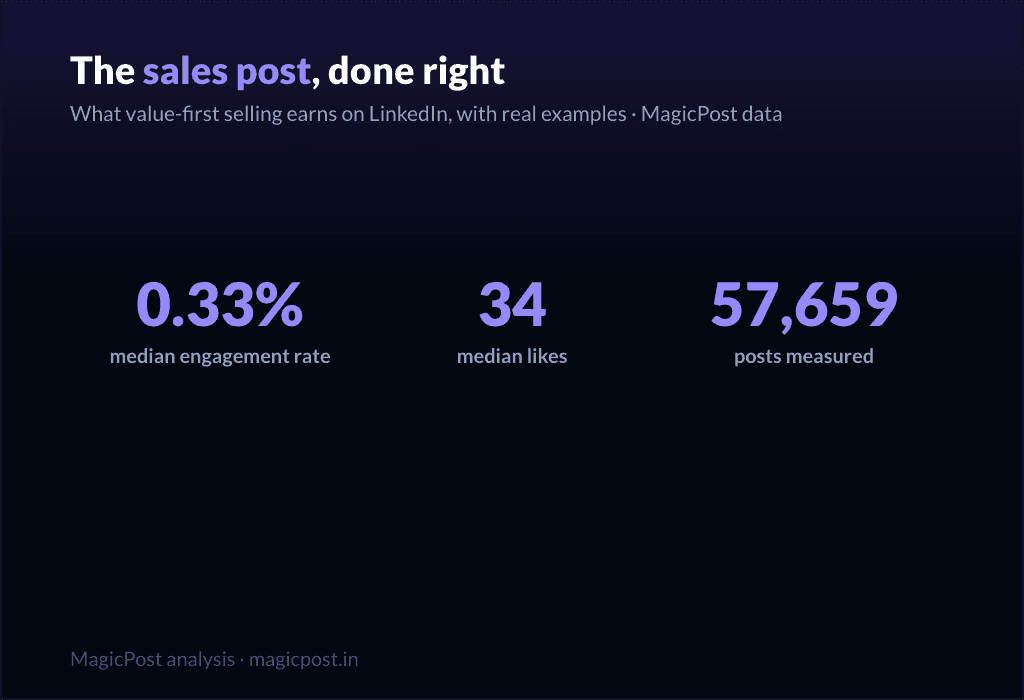
LinkedIn Sales Post Examples: Why Selling Posts Underperform (and the Ones That Work Anyway)
LinkedIn sales post examples: even value-first selling earns 0.33% median ER, below the 0.39% platform median. The ones that work anyway.
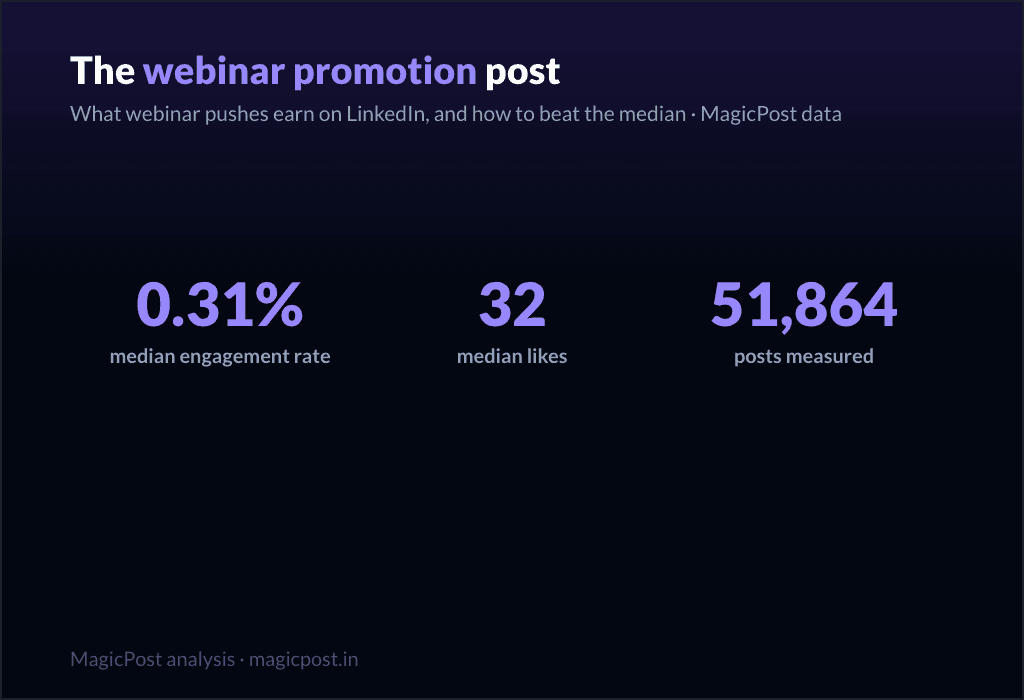
How to Promote a Webinar on LinkedIn (the Standard Signup Post Is the Second-Worst Post Type)
How to promote a webinar on LinkedIn: the standard signup post is the second-worst post type (0.31% ER). The teach-first structure that beats it.
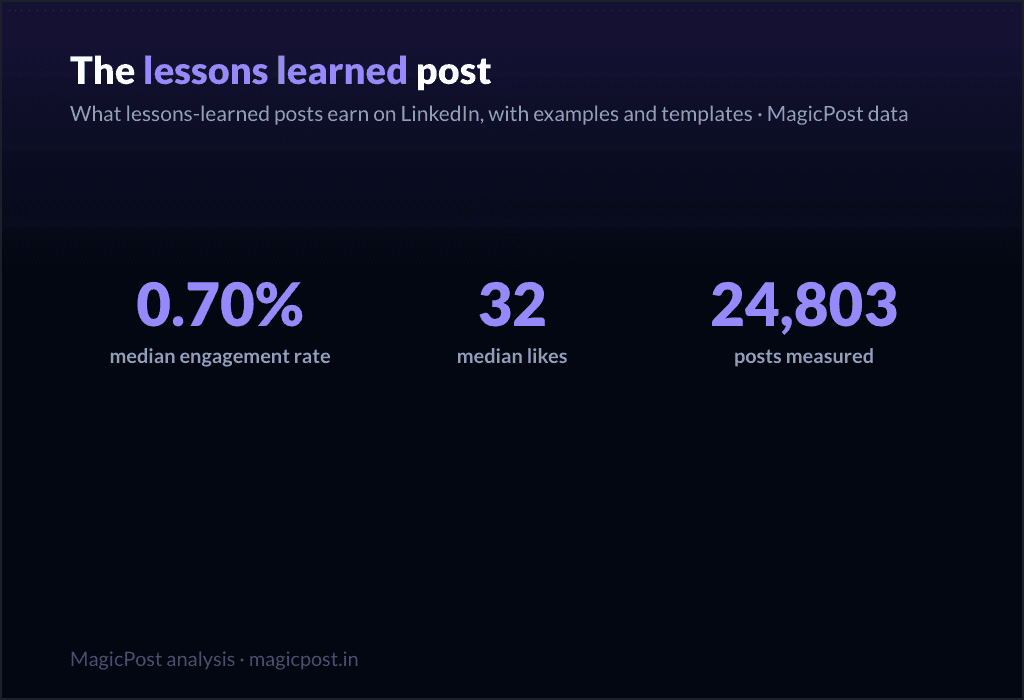
The Lessons Learned LinkedIn Post: Why Earned Advice Beats Expert Advice (0.70% vs 0.44%)
The lessons learned LinkedIn post: earned advice (0.70% ER) beats expert advice (0.44%). The difference is the receipt. Examples and templates.

The Last Day LinkedIn Post: How to Say Goodbye Well (Real Examples + Templates)
The last day LinkedIn post: how to say goodbye well. Real examples (one earned 13,121 likes), 3 templates, and the etiquette of leaving in public.

The Graduation LinkedIn Post: Real Examples, Templates, and How to Make Yours Count
The graduation LinkedIn post: real examples (up to 19,038 likes), 3 templates, and how to make your first professional post count.

The Work Anniversary LinkedIn Post: Beyond the Auto-Generated Badge (Examples + Templates)
The work anniversary LinkedIn post: beyond the auto-badge. Real examples, 3 templates, and the reframe that turns a date into a story.
The Holiday LinkedIn Post: How to Not Sound Like a Corporate Card (Examples + Templates)
The holiday LinkedIn post: how to not sound like a corporate card. Real examples, 3 templates, and why seasonal posts should be scheduled early.
5 Meilleures Modèles de Publications LinkedIn (2026)
5 modèles de publications LinkedIn : narration, liste, réflexion personnelle, coup de gueule et analyse. Guides étape par étape pour créer des publications engageantes et augmenter la visibilité.
13 exemples de publications LinkedIn qui génèrent des résultats (2026)
Voler ces 13 exemples de publications LinkedIn éprouvés pour transformer votre contenu en prospects et en autorité. Comprend des modèles et une déconstruction complète de ce qui fonctionne.
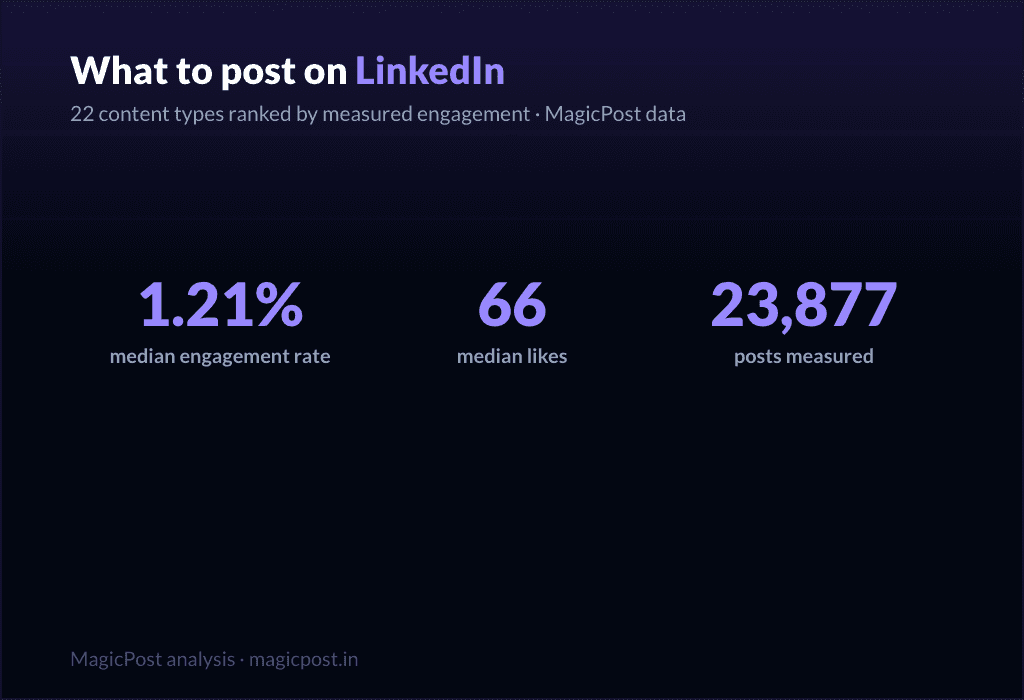
Que publier sur LinkedIn ? (2026)
Boostez votre impact sur LinkedIn avec notre guide d'experts. Découvrez des stratégies de publication puissantes et des types de contenu pour engager efficacement votre réseau.