"Post valuable content" is the advice everyone gives and nobody can act on. Which kind of post actually earns its place in the feed? We measured it.
We took 1,141,932 LinkedIn posts, sorted them into 22 content types, and scored each type on the only metric that survives a follower-count gap: median engagement rate, the share of your followers who like a given post (likes divided by followers). Then we ranked all 22 from best to worst.
This is the decision page. If you want the deep study of how these types behave (the confounders, the format crossovers, the comment data), read its data twin, LinkedIn post types by engagement. This page answers the simpler question you actually came with: what should I post today? The answer is in the table, and then in a framework simple enough to use before your next post.
One number to anchor everything: across all 1,141,932 posts, the median engagement rate is 0.39%. That is the line. A content type above it earns more than its share of attention; a type below it earns less. Now the board.
The 22 content types, ranked
Ranked by median engagement rate, best to worst. Every figure is a median (never an average, so a handful of viral posts cannot move the line), measured on the corpus shown in the "n" column.
# | Content type | Median engagement rate | Median likes | Posts measured (n) |
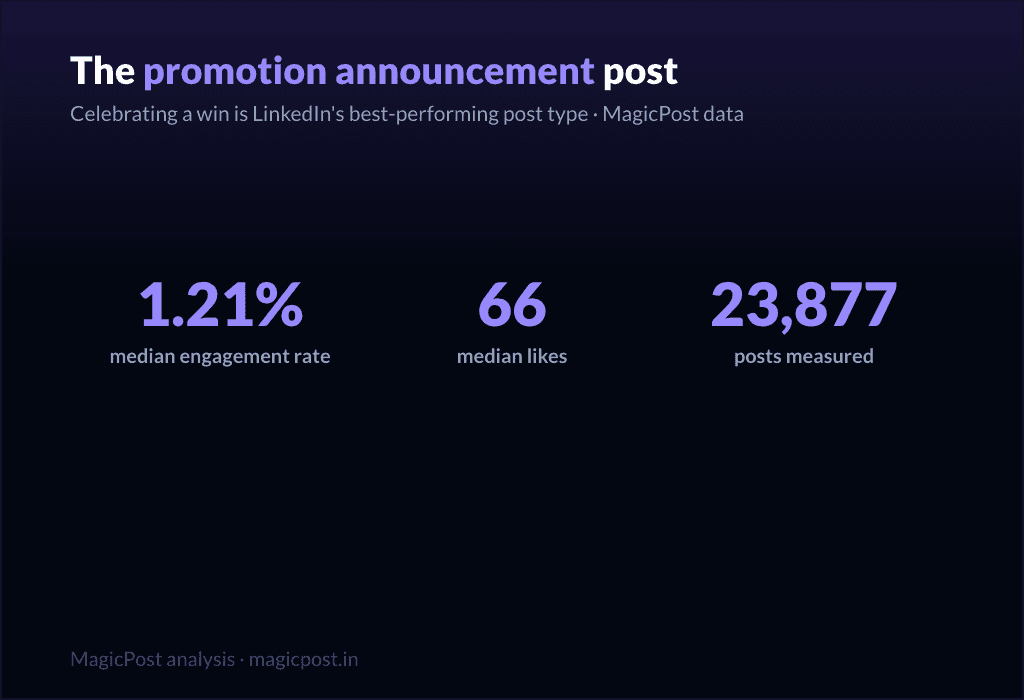
1 | Celebrating a win | 1.21% | 66 | 23,877 |
2 | Challenges overcome | 1.03% | 51 | 16,823 |
3 | Hard moment | 0.80% | 47 | 3,234 |
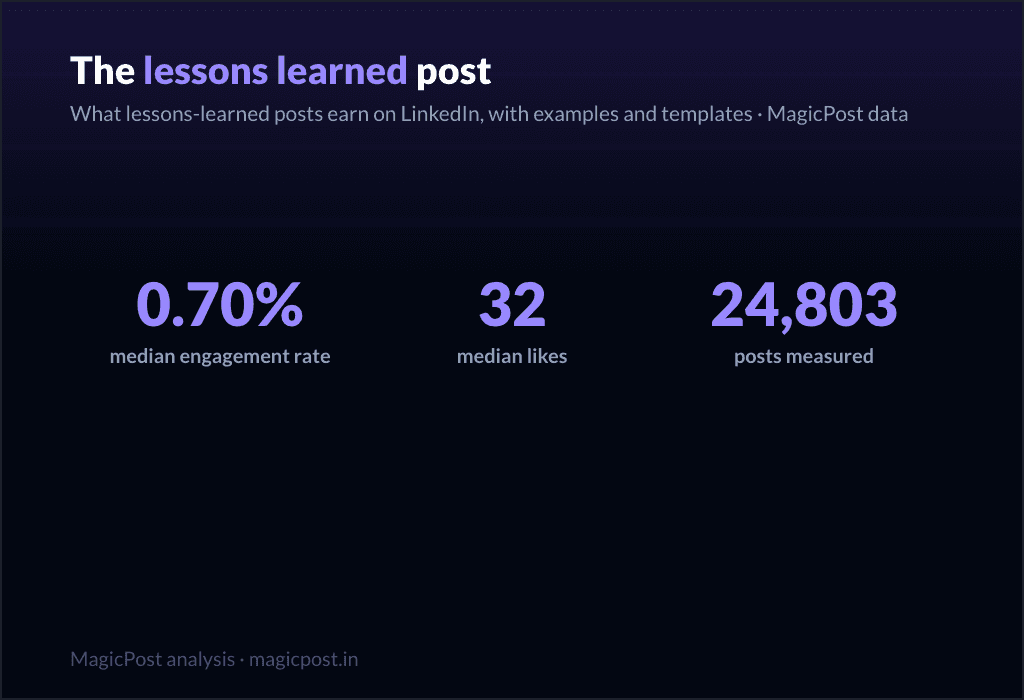
4 | Lessons learned | 0.70% | 32 | 24,803 |
5 | Situation recap | 0.68% | 45 | 11,729 |
6 | Inspiring portrait | 0.65% | 53 | 17,198 |
7 | Field report | 0.63% | 38 | 6,496 |
8 | Positive message | 0.61% | 43 | 32,047 |
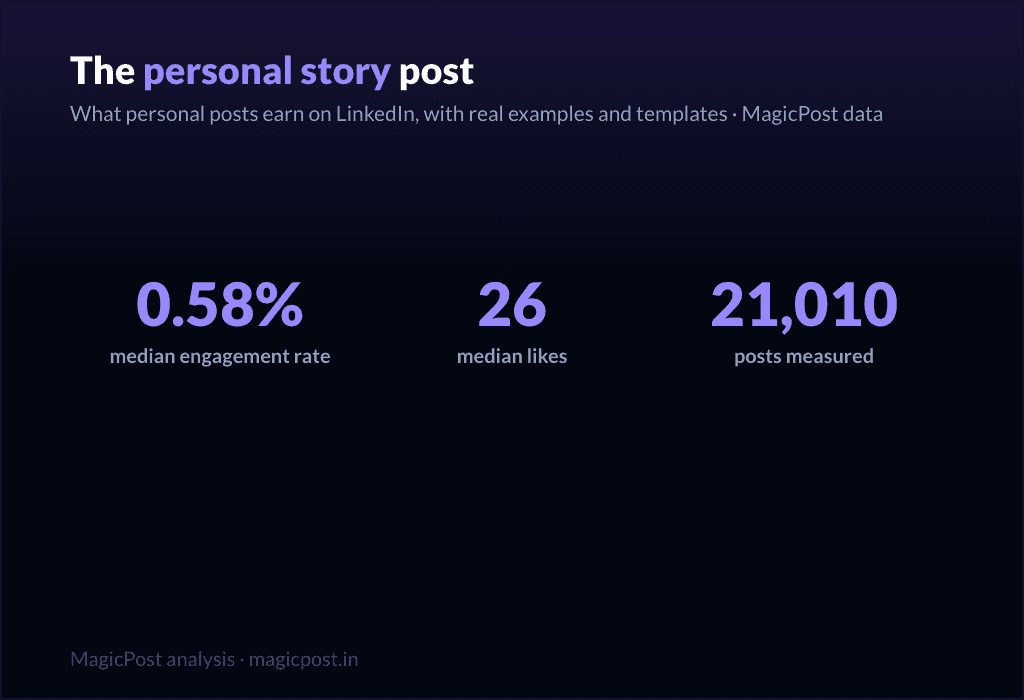
9 | Personal reflection | 0.58% | 26 | 21,010 |
10 | Best practices | 0.52% | 28 | 26,006 |
11 | Tips / rules list | 0.49% | 57 | 9,520 |
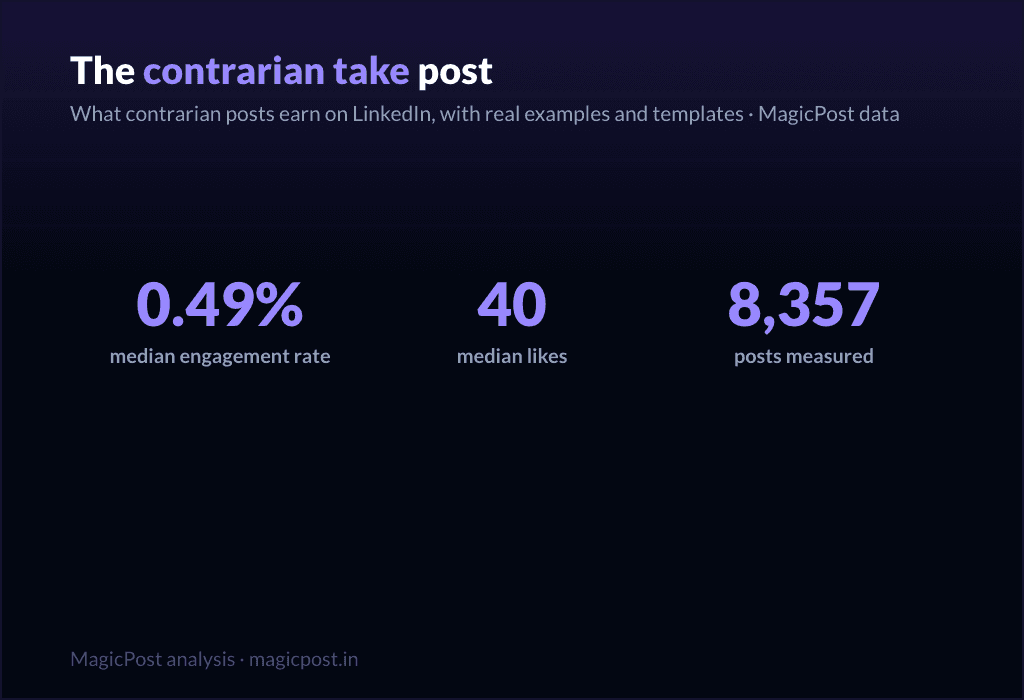
12 | Contrarian take | 0.49% | 40 | 8,357 |
13 | Quick tip | 0.46% | 29 | 3,684 |
14 | Punchy advice | 0.44% | 28 | 142,301 |
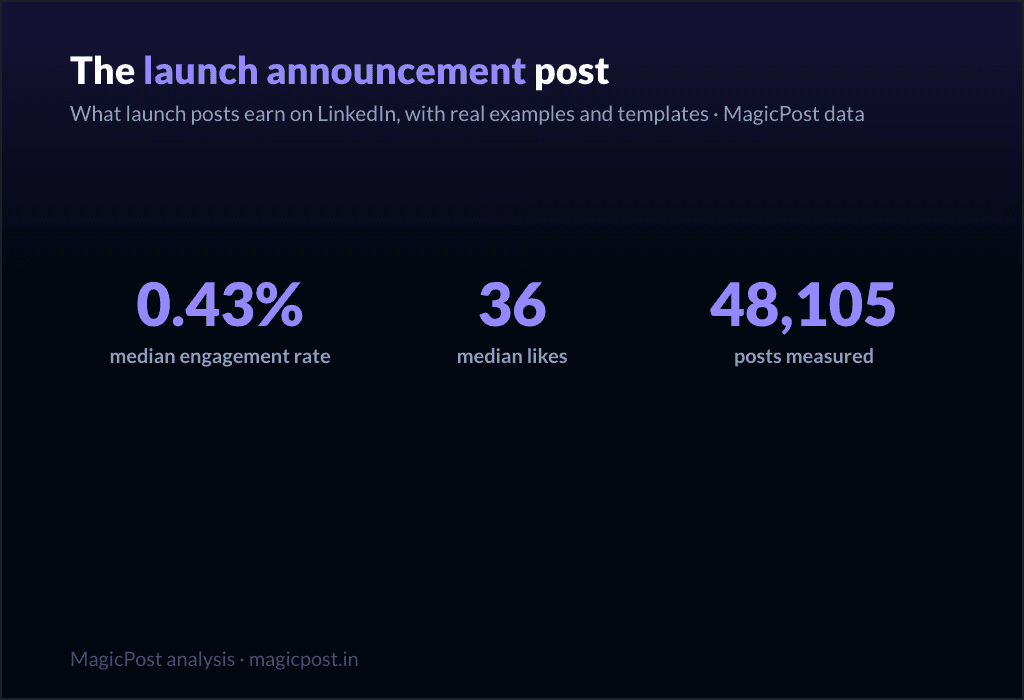
15 | Launch announcement | 0.43% | 36 | 48,105 |
16 | Useful resources | 0.42% | 51 | 8,331 |
17 | Company saga | 0.42% | 35 | 3,379 |
18 | Explainer / analysis | 0.40% | 21 | 83,180 |
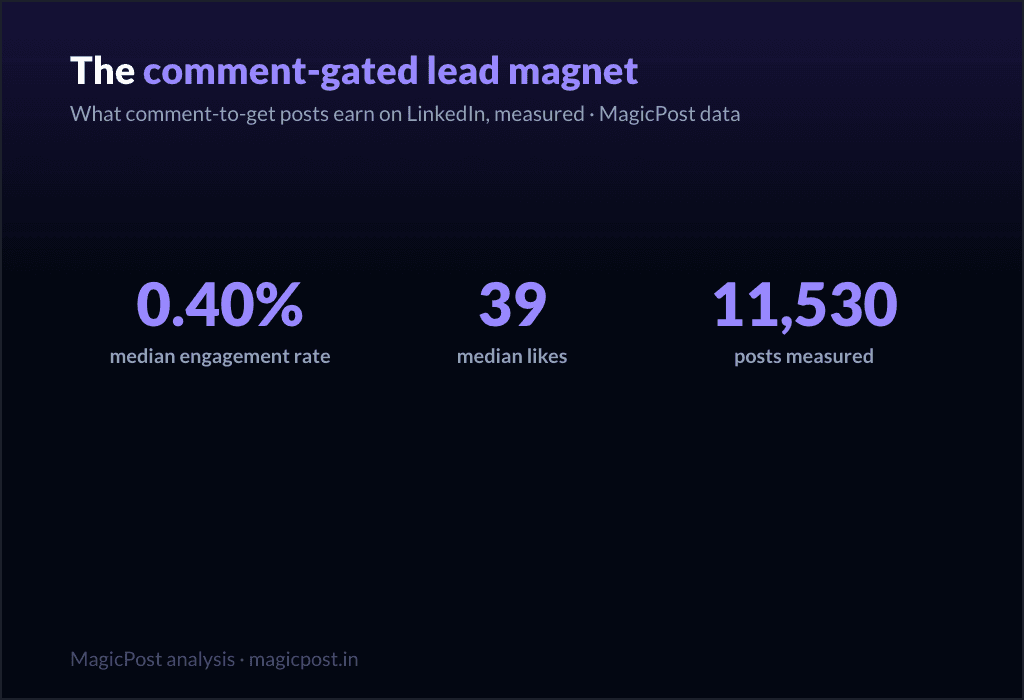
19 | Comment-gated lead magnet | 0.40% | 39 | 11,530 |
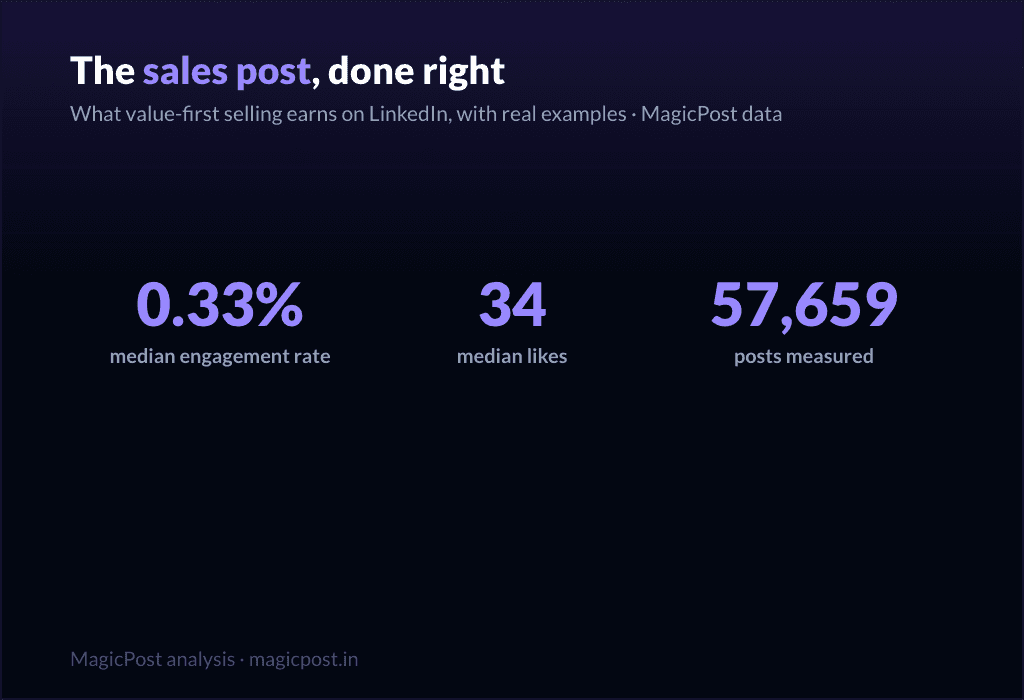
20 | Value-first selling | 0.33% | 34 | 57,659 |
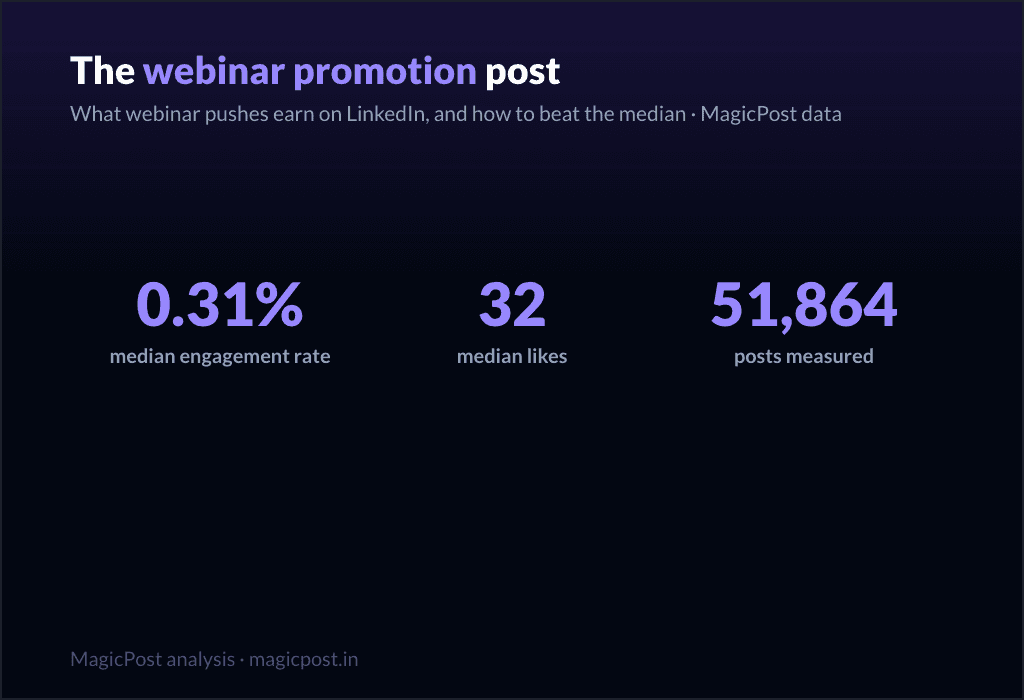
21 | Webinar signup push | 0.31% | 32 | 51,864 |
22 | Podcast / video share | 0.29% | 36 | 32,031 |
Read the top and the bottom together and the pattern jumps out. The five best types (Celebrating a win at 1.21%, Challenges overcome at 1.03%, Hard moment at 0.80%, Lessons learned at 0.70%, Situation recap at 0.68%) are all the same move: a human being telling you something that actually happened to them.
The three worst (Value-first selling at 0.33%, Webinar signup push at 0.31%, Podcast / video share at 0.29%) are all the same move too: a person asking you to do something for them.
That is the whole framework in one sentence. The feed rewards giving and discounts asking. Everything below is just how to act on it.
The give-versus-ask principle
Your audience scrolls LinkedIn for two reasons: to feel something and to learn something.
A "Celebrating a win" post (top of the table, 1.21% engagement rate, 66 median likes on 23,877 posts) gives them both: a small emotional lift plus an implicit lesson in how you got there. A "Webinar signup push" (0.31%, 32 median likes on 51,864 posts) gives them neither; it withdraws attention and hands back homework.
Notice the giving types do not require you to be impressive. "Hard moment" sits third at 0.80% with 47 median likes across 3,234 posts. What travels is not the win or the failure, it is the honesty: lived experience is the one thing a reader cannot get anywhere else.
This is also why "asking" posts are not banned, just rationed. Launch announcement (0.43%, 36 median likes, 48,105 posts) and Value-first selling (0.33%, 34 median likes, 57,659 posts) exist in enormous numbers because they do a job the giving posts cannot: they convert attention into pipeline.
You earn the right to ask by giving first, then ask sparingly. A feed that is all asks goes quiet; a feed that is all gives never sells anything.
A framework you can use before your next post
You do not need to memorize 22 types. You need three questions. Ask them in order and stop at the first "yes." Each answer maps to a ready skeleton in our LinkedIn post templates library, so once you know the type you can fill the blanks in minutes.
1. What happened to you lately? A win, a setback, a turning point, a thing you got wrong? That is your highest-value post. It maps to the top of the table: Celebrating a win (1.21%), Challenges overcome (1.03%), Hard moment (0.80%), Lessons learned (0.70%), Situation recap (0.68%). Start here every time, because story is the format your audience cannot get from anyone but you. The template pages for these are LinkedIn personal story posts and LinkedIn lessons-learned posts.
2. What do you know that they do not? Nothing happened this week, but you have expertise worth sharing. This is the middle of the table: Best practices (0.52%), Tips / rules list (0.49%, and note its 57 median likes, the highest like-count in the whole table after the win post), Contrarian take (0.49%), Explainer / analysis (0.40%). These earn solidly, just under the storytelling tier. The sharpest of them is the LinkedIn contrarian post: a defensible opposite opinion that makes people argue in your comments.
3. What do you need from them? A signup, a demo, a download. This is the bottom of the table, and you use it on purpose and in moderation: Launch announcement (0.43%), Value-first selling (0.33%), Webinar signup push (0.31%). They convert, they do not travel, so they ride on the reach your "give" posts already built. The playbooks live in LinkedIn product launch posts, LinkedIn sales post examples, and effective LinkedIn promotion post examples.
Three questions, one rule: answer the highest one you truthfully can.
The hard part is never the framework, it is the blank page on a Tuesday. That is exactly what MagicPost's post idea engine is for: feed it your topics and your audience, and it returns a steady stream of angles already shaped to the giving types that win, so "I have nothing to post" stops being a reason to fall back on a webinar push.
A weekly mix, grounded in the data
A real feed is not one type repeated. Here is a five-post week built from the table, weighted toward the types that earn:
Two story posts (the top tier, 0.68% to 1.21% engagement rate). A win and a lesson, or a hard moment and a recap. These are your reach engine for the week.
Two expertise posts (the middle tier, 0.40% to 0.52%). A tips list, a contrarian take, an explainer. They keep you useful between stories and prove you know your craft.
One ask post, at most (the bottom tier, 0.29% to 0.43%). A launch, a value-first sell, an event push. It rides on the four posts before it and converts the attention they earned.
Four gives to one ask is the ratio the data argues for. Inspiring portrait (0.65%, sixth overall) is the wildcard worth slotting in occasionally: spotlighting someone else borrows their story and earns like one of your own.
These are content types. The medium you wrap them in (text, image, carousel, video) is a separate lever, and it matters: see the best LinkedIn post format in 2026. Type decides what you say; format decides how far it carries.
What not to post (and why it still exists)
The bottom three types are not mistakes, they are misuses when they become your default:
Podcast / video share (last, 0.29% engagement rate, 36 median likes on 32,031 posts). "Here is the link to my episode." The problem is the link: it sends people off LinkedIn, and the feed answers by showing the post to fewer of them. It exists because creators have podcasts to promote, and it works as an occasional touch, never as a habit.
Webinar signup push (0.31%, 32 median likes on 51,864 posts). A pure ask with a deadline. The 51,864 sample tells you marketers lean on it constantly; the engagement rate tells you their audience tolerates it rather than rewards it. Use it, then go back to giving.
Value-first selling (0.33%, 34 median likes on 57,659 posts). The best of the three because it at least teaches while it sells, which is why 57,659 posts use it. Still below the 0.39% line. It belongs in your mix as the one ask, not as the spine of your strategy.
These three exist for the same plain reason: business needs conversion, not just applause. The error is never publishing them, it is publishing them instead of the stories and expertise that earn the audience you are about to ask something of.
Where this data comes from
These numbers come from MagicPost's own research, not a third-party roundup. We classified 1,141,932 LinkedIn posts from the last 12 months into 22 content types and scored each on median engagement rate, defined as likes divided by the author's follower count, so a 500-follower account and a 50,000-follower account are judged on the same scale. We report the median for each type, so a few viral posts cannot throw off a type's score. The corpus-wide median engagement rate is 0.39%, the benchmark every type is measured against. Each type also carries its median likes and its sample size (the "n" column), so you can see both how well it performs and how often it is used. Honest confounder: people do not choose content types at random, and a "Celebrating a win" post often carries more effort and emotion than a hasty "Webinar signup push," so part of every gap reflects the work behind the type, not the type alone. The full methodology and the type-by-type behavior live in the companion study, LinkedIn post types by engagement.
FAQ
What should you post on LinkedIn?
Start with what happened to you. Across 1,141,932 posts, the three highest-earning content types are all lived experience: Celebrating a win (1.21% median engagement rate, 66 median likes), Challenges overcome (1.03%, 51 median likes), and Hard moment (0.80%, 47 median likes). The simplest rule that explains the whole ranking is give before you ask: posts that give a reader a story, a lesson, or a useful idea sit at the top of the table, while posts that ask the reader for a signup, a sale, or a click sit at the bottom (Value-first selling 0.33%, Webinar signup push 0.31%, Podcast / video share 0.29%). Post mostly gives, ask sparingly.
Which type of LinkedIn post gets the most engagement?
Celebrating a win, by a clear margin: 1.21% median engagement rate and 66 median likes across 23,877 posts, the top of all 22 types we measured. It works because it combines a small emotional lift with an implicit lesson in how the win happened, and because it does not require the author to be impressive, only honest.
How often should I post promotional content on LinkedIn?
Roughly one ask for every four gives. The three "ask" types (Launch announcement 0.43%, Value-first selling 0.33%, Webinar signup push 0.31%) all sit below the 0.39% corpus median, so they convert attention rather than build it. Build the audience with story and expertise posts, then spend it on a single promotional post that rides on the reach those gives already earned.
Are storytelling posts really better than expertise posts on LinkedIn?
On engagement rate, yes, but not by much, and you need both. The story tier runs from 0.68% to 1.21%; the expertise tier (Best practices 0.52%, Tips / rules list 0.49%, Contrarian take 0.49%, Explainer / analysis 0.40%) runs just below it. Stories are your reach engine because no one else can tell them; expertise posts prove you know your craft between stories. A healthy feed alternates the two.
What should I never post on LinkedIn?
Nothing is truly off-limits, but three types should never be your default: Podcast / video share (0.29% median engagement rate, the link sends people off-platform and the feed punishes it), Webinar signup push (0.31%, a pure ask), and Value-first selling (0.33%). All three fall below the 0.39% median. They exist because business needs conversion, and they work as an occasional, deliberate ask. The mistake is publishing them instead of the stories and expertise that earn the audience you are about to ask something of.
> Stop guessing what to post. MagicPost keeps your ideas, drafts, calendar, and post analytics under one roof, so every post in your week is a deliberate choice from the types that earn, not whatever you scraped together five minutes before publishing.