" height="26.80529977783203px" id="tymKb8bqC" width="128.00300311279295px"/><path d="M 0 2.417 L 0 0 L 12.909 0 L 12.909 2.417 Z" fill="rgb(126, 78, 253)" height="2.417099999999998px" id="aYr4em6zK" transform="translate(128.341 22.325)" width="12.908999999999992px"/></svg>)

"/><stop offset="1" stop-color="rgb(118, 37, 250)"/></linearGradient></defs><g d="M 19.242 21.22 L 19.362 6.204 L 19.272 6.204 L 13.757 21.22 L 10.161 21.22 L 4.796 6.204 L 4.706 6.204 L 4.825 21.22 L 0 21.22 L 0 0 L 7.283 0 L 12.109 13.607 L 12.229 13.607 L 16.844 0 L 24.247 0 L 24.247 21.22 Z M 26.421 26.113 L 26.421 23.445 L 41.407 23.445 L 41.407 26.113 Z" fill="transparent" height="26.112508199679183px" id="DvfaAIHYn" width="41.40731898311435px"><path d="M 19.242 21.22 L 19.362 6.204 L 19.272 6.204 L 13.757 21.22 L 10.161 21.22 L 4.796 6.204 L 4.706 6.204 L 4.825 21.22 L 0 21.22 L 0 0 L 7.283 0 L 12.109 13.607 L 12.229 13.607 L 16.844 0 L 24.247 0 L 24.247 21.22 Z" fill="rgb(46, 46, 46)" height="21.220180016149442px" id="pLsxRCobd" width="24.247352589074694px"/><path d="M 0 2.668 L 0 0 L 14.986 0 L 14.986 2.668 Z" fill="url(%23yD9d4I5GR-3279285344-linear-gradient)" height="2.6675085048549647px" id="yD9d4I5GR" transform="translate(26.421 23.445)" width="14.986002836263765px"/></g></svg>)
Inhoud Creatie

Saad Mouaouine
Companies spend thousands every month on job ads and LinkedIn Recruiter seats. Meanwhile, the employees who actually know what it’s like to work there are largely invisible on LinkedIn.
That’s the gap LinkedIn employee branding closes. When your people post consistently, the company reaches candidates who would never see a job post, and the applications that come in are better quality, at a lower cost, with a compounding effect that paid ads can’t replicate.
Here's how to build a program that actually gets employees posting and how to measure whether it’s working.
What Is LinkedIn Employee Branding?
LinkedIn employee branding is the strategy of activating employees to build their own visible presence on LinkedIn by sharing expertise, culture, and perspectives in their own voice in a way that reflects positively on the company and attracts talent organically.
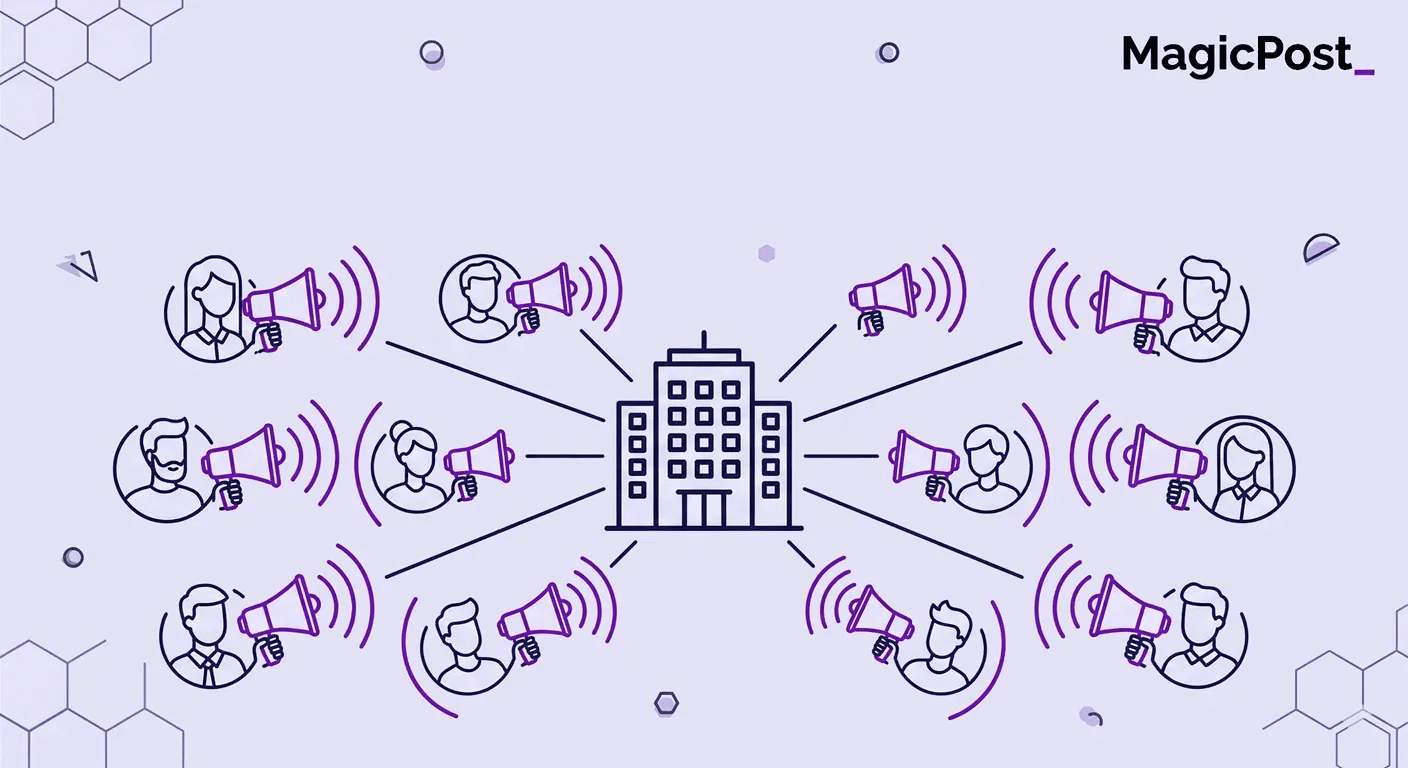
It’s distinct from employer branding at the company page level. Employee content reaches audiences a company page never can: personal posts get up to 561% more reach than identical content from a corporate account.
The goal isn’t to turn employees into marketing channels but to give them the tools and confidence to show up authentically.
Why Does Employee LinkedIn Activity Affect Recruiting Results?
Most candidates don’t apply to job posts cold. Before they submit anything, they research the company.

A big part of that research happens on LinkedIn:
They look at the people who work there,
Read what those people post, and
Form a view of the culture before they speak to a recruiter.
If your team is invisible on LinkedIn, that research phase works against you. Candidates find a quiet company page, a handful of generic posts, and no real signal about what it’s actually like to work there. The ones with options go elsewhere.
According to Indeed, up to 71% of professionals are passive candidates. They’re not actively job hunting but open to the right opportunity. They’re not searching job boards.
The only way to reach them is through content they encounter while scrolling. An employee post about a hard technical problem, a candid observation about culture, or a lesson from a recent project reaches that audience in a way no sponsored job post can.
By the Numbers |
|---|
Companies with strong employer brands see a 50% reduction in cost-per-hire and hire up to 2x faster. |
Employee content gets 561% more reach than the same content posted from a company page. |
Candidates are 3x more likely to trust current employees over official corporate statements when assessing a workplace. |
Companies with weak employer brands pay at least 10% more in salary to attract comparable talent. |
What Does a LinkedIn Employee Branding Program Look Like?
Most employee branding efforts fail at the implementation stage, not the strategy stage. The company sends a few Slack messages asking people to post more, gets a brief flurry of activity, and then nothing. A program that’s sustained looks quite different.
A clear content brief per role: Employees shouldn’t have to figure out what to say. Give each team a starting point: three to five topic areas that reflect their actual expertise and align with the kinds of candidates you want to attract.
Brand guidelines without a script: Employees need to know what’s off-limits and what’s on-brand, but the moment their content sounds like a press release, it stops working. Guidelines that constrain topic and tone without dictating voice are the right level of control.
A simple creation workflow: If posting requires an employee to open four different tools, write from scratch, manually format for mobile, and chase a manager for approval, most won’t bother. The process has to be fast enough to fit inside a normal working day.
Visibility for the program manager: The person running the program needs to see who’s posting, how content is performing, and where the drop-off is happening. Without that visibility, it’s impossible to know what’s working or who needs a nudge.
A way to show employees their impact: People post more when they can see their content is reaching real people. Showing an employee that their post reached 3,000 professionals last week is a better motivator than any internal campaign.
✅ Pro Tip: The employees who become the best ambassadors are almost never the most senior ones. They’re the people who are genuinely enthusiastic about their work and have specific expertise to share. Start the program with volunteers, not mandates. Early wins from willing participants create social proof that makes the reluctant ones more likely to join.
How Do You Get Employees to Actually Post on LinkedIn?
This is where most programs stall. The problem is rarely that employees don’t want to help; it’s that posting feels risky, time-consuming, and unclear. Address those three things and adoption follows.
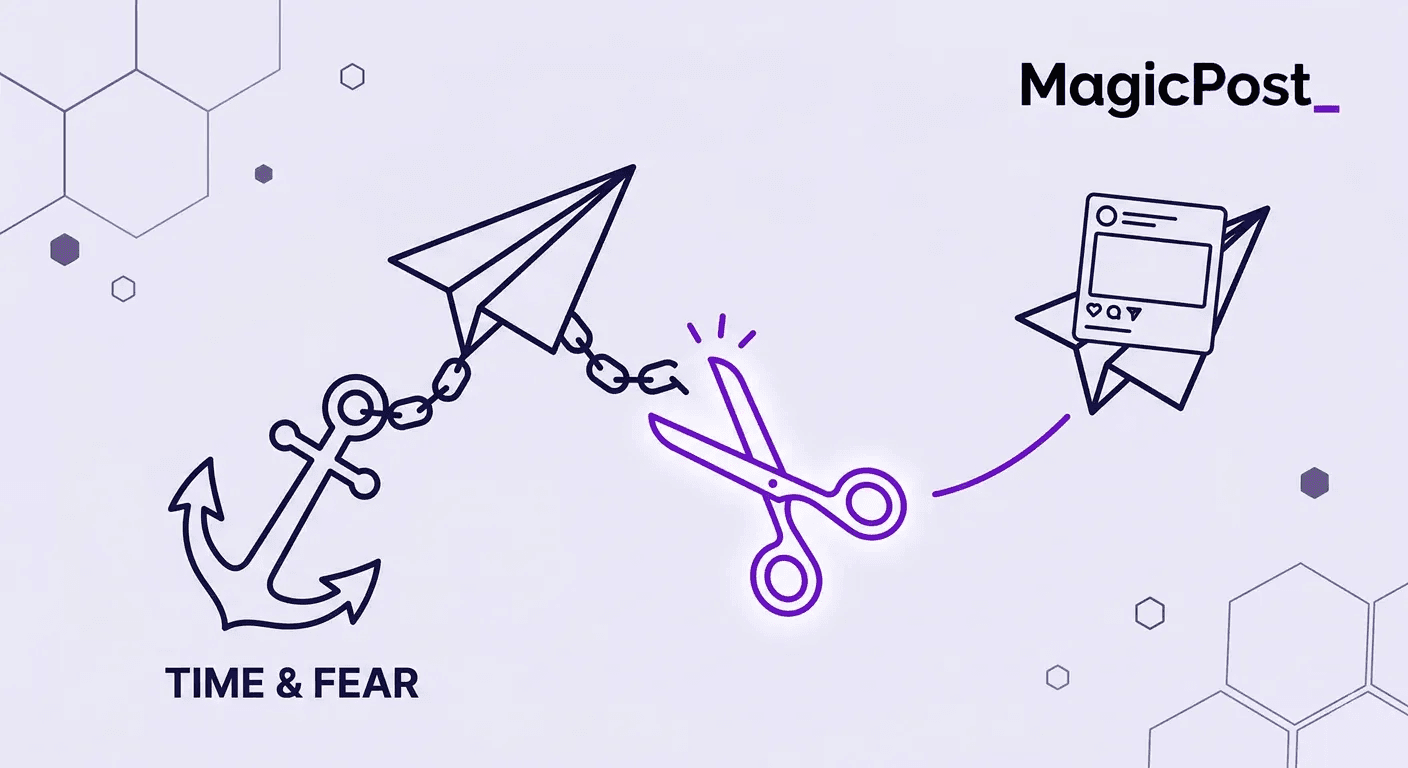
Why Employees Do Not Post on LinkedIn
Here are the most common reasons your employees are reluctant to post on LinkedIn.
They don’t know what to say. “Post about your work” isn’t a brief; employees need specific prompts tied to their actual day-to-day experience.
They’re worried about saying the wrong thing. In larger companies, there’s anxiety about going off-message or posting something that gets them in trouble.
It takes too long. Writing, formatting, and scheduling a LinkedIn post from scratch takes 30 to 60 minutes for most non-writers; that time doesn’t exist on most people's calendars.
They tried it and nothing happened. A post that gets three likes in the first hour can feel demoralizing; without context on what normal looks like, employees assume they’re doing it wrong and stop.
What Actually Changes Employee Posting Behavior
The biggest lever is reducing the time cost. When an employee can generate a draft in their own voice in under two minutes, review it, and schedule it in one click, the activation energy drops dramatically.
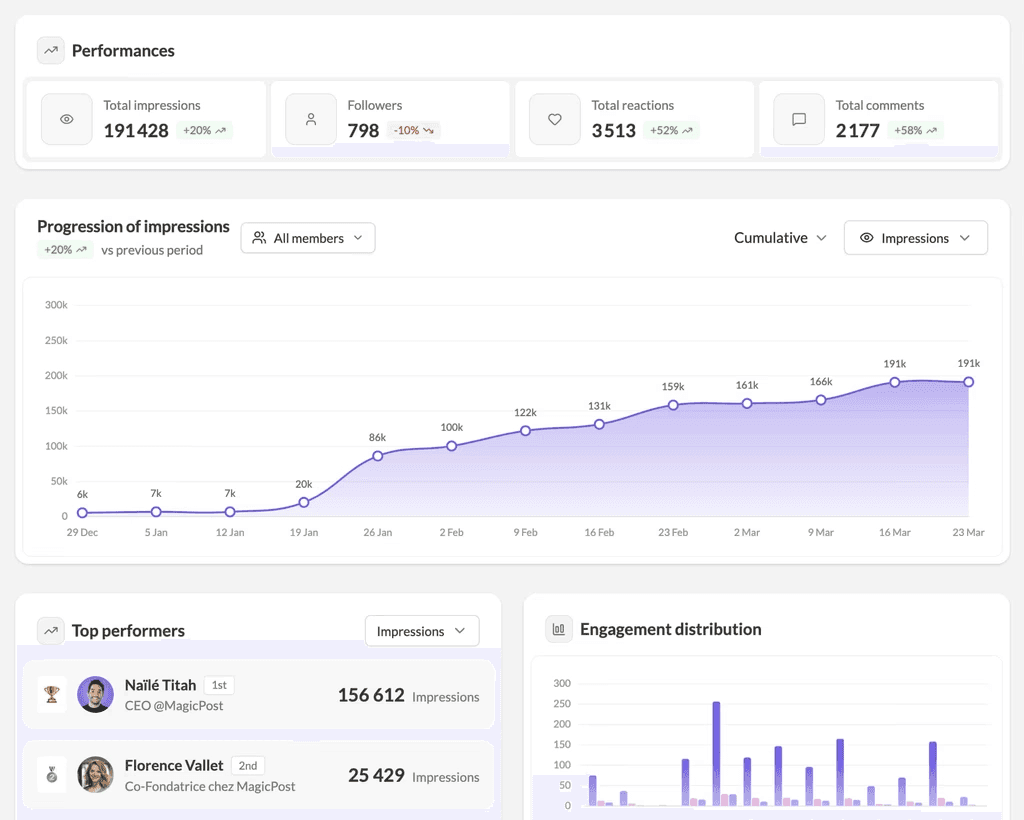
The MagicPost Teams plan is built specifically for this: each team member gets their own workspace where the AI learns their individual voice and generates post ideas tailored to their role. They’re not resharing company content; they’re publishing something that actually sounds like them.
📊 Case Study: Saint-Gobain equipped over 30 members of their HR team this way and saw 3x more content created and a 15% increase in applicants. Audencia put 20 seats to use across their team and achieved 100% adoption and 3x visibility within 45 days. These outcomes come from removing friction, not from running motivational campaigns.
✅ Pro Tip: Run a 30-minute onboarding session where each employee generates and publishes their first post live, in the room. The barrier to a second post is much lower than the barrier to the first. Getting that first win done collectively removes the awkwardness and shows the tool works before anyone has to trust it on their own time.
How to Measure the ROI of Employee Branding on LinkedIn?
Most employee branding programs get killed because the person running them can’t show leadership what it’s producing. The mistake is tracking vanity metrics (impressions, followers, and likes) and presenting them as business outcomes.

Leadership doesn’t care about impressions. They care about cost-per-hire and pipeline. Here are the metrics worth tracking, split by what they measure:
Metric | What It Tells You | How to Track It |
|---|---|---|
Inbound applications from LinkedIn | Whether employee content is generating awareness among relevant candidates | Ask in the application form how candidates heard about you; track LinkedIn specifically |
Quality of hire from LinkedIn channel | Whether candidates coming through LinkedIn are a better fit than those from job boards | Compare offer acceptance rates and 6-month retention for LinkedIn-sourced hires vs other channels |
Cost-per-hire trend | Whether stronger organic presence is reducing dependence on paid ads and external recruiters | Compare quarterly CPH before and after launching the program |
Employee posting activity | Whether the program has actual adoption or is just a policy on paper | Track weekly posts per member. Consistency matters more than spikes |
Reach per employee post | Whether employee content is reaching people outside the immediate network | Available in LinkedIn analytics; MagicPost aggregates this across the whole team |
Time-to-fill trend | Whether a stronger brand is shortening the hiring cycle | Track average days from job post to accepted offer, segmented by role seniority |
The LinkedIn employee advocacy simulator is useful for estimating the reach potential of your team before you start. Input your team size and average view count to see projected organic impressions. It’s helpful for making the business case to leadership before you have real data.
✅ Pro Tip: Build a simple monthly report for leadership that shows three numbers: total reach from employee posts, LinkedIn-sourced applications, and any change in cost-per-hire. Keep it to one slide. The programs that get their budget renewed are the ones where someone is actively making the case in language leadership understands.
What Tools Do Companies Use to Scale Employee LinkedIn Presence?
There are three approaches companies take, and the right one depends on team size and how much central control matters.
Approach | Best For | The Catch |
|---|---|---|
Manual/DIY | Teams of 1–5 where the program manager can personally coach each person | Doesn’t scale; relies entirely on individual motivation and writing ability |
External agency or ghostwriter | Executives who need fully managed, high-polish content and have the budget ($3,000–$10,000+/month) | Voice drift is common across multiple profiles. See our LinkedIn ghostwriting guide for a full breakdown of the tradeoffs. |
Dedicated team advocacy platform | Teams of 5+ where the goal is genuine employee voice at scale with central oversight | Requires a short onboarding investment; employees need to actually use it for it to work |
For the platform approach, the features that matter most are the following:
Voice-matched AI drafting per employee (not shared templates)
Centrally-set brand guidelines
Team activity dashboard
Safe publishing via LinkedIn's official API.
Platforms that use browser extensions or shared credentials introduce real account safety risks that can wipe out years of professional network-building.
MagicPost's Teams plan covers all of this. If you’re comparing options, our Supergrow alternatives comparison and CoPost review cover how MagicPost stacks up. For the broader tool landscape, see the best LinkedIn management tools in 2026.
Turn Your Team's LinkedIn Presence Into a Recruiting Advantage With MagicPost
The companies winning on talent right now aren’t necessarily spending more on recruiting. They’re spending smarter, and a big part of that is making their existing employees visible on LinkedIn in a way that genuinely reflects the company people want to work at.
The hardest part isn’t strategy. It’s getting people to post consistently without it feeling like another thing on their to-do list. Solve that problem and the results follow quickly: 3x, 15% more applicants, and half the cost-per-hire. These outcomes come from activation, not advertising.
Ready to turn your team’s LinkedIn presence into a recruiting advantage? Request a MagicPost Teams demo and see the difference it makes. 30 minutes, no commitment.
Veelgestelde vragen
What is LinkedIn employee branding?
LinkedIn employee branding is the strategy of encouraging and enabling employees to build a visible, authentic presence on LinkedIn in their own voice in a way that strengthens the company's reputation as an employer.
It’s distinct from managing a company page; personal profiles reach networks that a corporate account never can. For context on how it connects to broader LinkedIn programs, see our guide to employee advocacy software.
How does employee LinkedIn activity affect recruiting?
Passive candidates (the majority of the talent pool) research companies on LinkedIn before considering applying. Employee content gives them a genuine signal about culture and what day-to-day work actually looks like.
Companies with active employee presence see faster hiring, lower cost-per-hire, and higher offer acceptance rates. Employee posts also get up to 561% more organic reach than equivalent company page content.
How do you get employees to post on LinkedIn consistently?
Employees don’t post because it takes too long, they don’t know what to say, or they’re worried about getting it wrong.
Using an AI tool that generates drafts in their voice based on their role and topic area, combined with a one-click scheduling workflow, turns posting from a 45-minute task into a 5-minute one. That’s the difference between a program that launches and one that sustains.
What metrics matter for a LinkedIn employee branding program?
The metrics leadership cares about are cost-per-hire trends, LinkedIn-sourced application volume, and quality-of-hire from that channel. For internal management, it’s posting consistency per employee, reach per post, and follower growth across the team.
Use the LinkedIn engagement rate calculator to benchmark individual post performance.
Do employees need to be good writers to participate?
No. Modern employee advocacy tools handle the drafting. The employee provides a subject (a recent project, a lesson learned, or an opinion on something in their field), and the AI generates a post in their specific voice. They review, adjust, and publish. For more on how AI voice matching works, see our guide to automating LinkedIn posts with AI.
The 6 Best Employee Advocacy Software in 2026 (Full Review)
Looking for the best employee advocacy software in 2026? We compared MagicPost, Supergrow, DSMN8, and others so you can find the right fit for your team.
Best LinkedIn Management Tools in 2026 (Tested and Compared)
Looking for the best LinkedIn management tool in 2026? We compared MagicPost, Taplio, Supergrow, RedactAI, and others on quality, safety, and price.
LinkedIn Content Agency: Do You Actually Need One in 2026?
Wondering whether a LinkedIn content agency is worth the cost? Here’s what they do, what they charge, and when a dedicated platform is the better choice.
Wat is LinkedIn engage (en hoe je het kunt beheersen in 2026)
Heb je moeite met je LinkedIn engagement? Leer hoe het LinkedIn-algoritme het meet, de benchmarks voor 2026, en de 4 pijlers om je interacties te verbeteren.
Hoe Executive Communicatie te Beheersen op Linkedin?
Communicatie van leidinggevenden op LinkedIn bevordert vertrouwen, zichtbaarheid en vraag. Leer hoe leiders een sterke stem kunnen opbouwen en met duidelijkheid kunnen posten.
Hoe contentprestaties meten op LinkedIn (2026)
Niet zeker hoe u de content performance op LinkedIn kunt meten? Leer de 3 statistieken die echt van belang zijn, plus benchmarks en een eenvoudig volgsysteem.
8 manieren om echte waarde op LinkedIn te brengen
Leer hoe je waardevolle LinkedIn posts kunt maken die informeren, engage en vertrouwen opbouwen. Ontdek praktische tips, visuele elementen, timing en veelvoorkomende fouten om te vermijden.