Every "best time to post on LinkedIn" guide gives you the same answer: Tuesday to Thursday, 10am to noon. They copy each other, and almost none of them show their work.
So we did the work. At MagicPost, we analyzed 2.7 million LinkedIn posts and measured, for every day and every hour, how much a post beats its author's own normal engagement. Then we cut it by country, in local time, because a single global clock is useless on a platform used in every time zone.
The short version, and it is not what the other guides tell you:
There is no single best time: the answer flips from one country to the next.
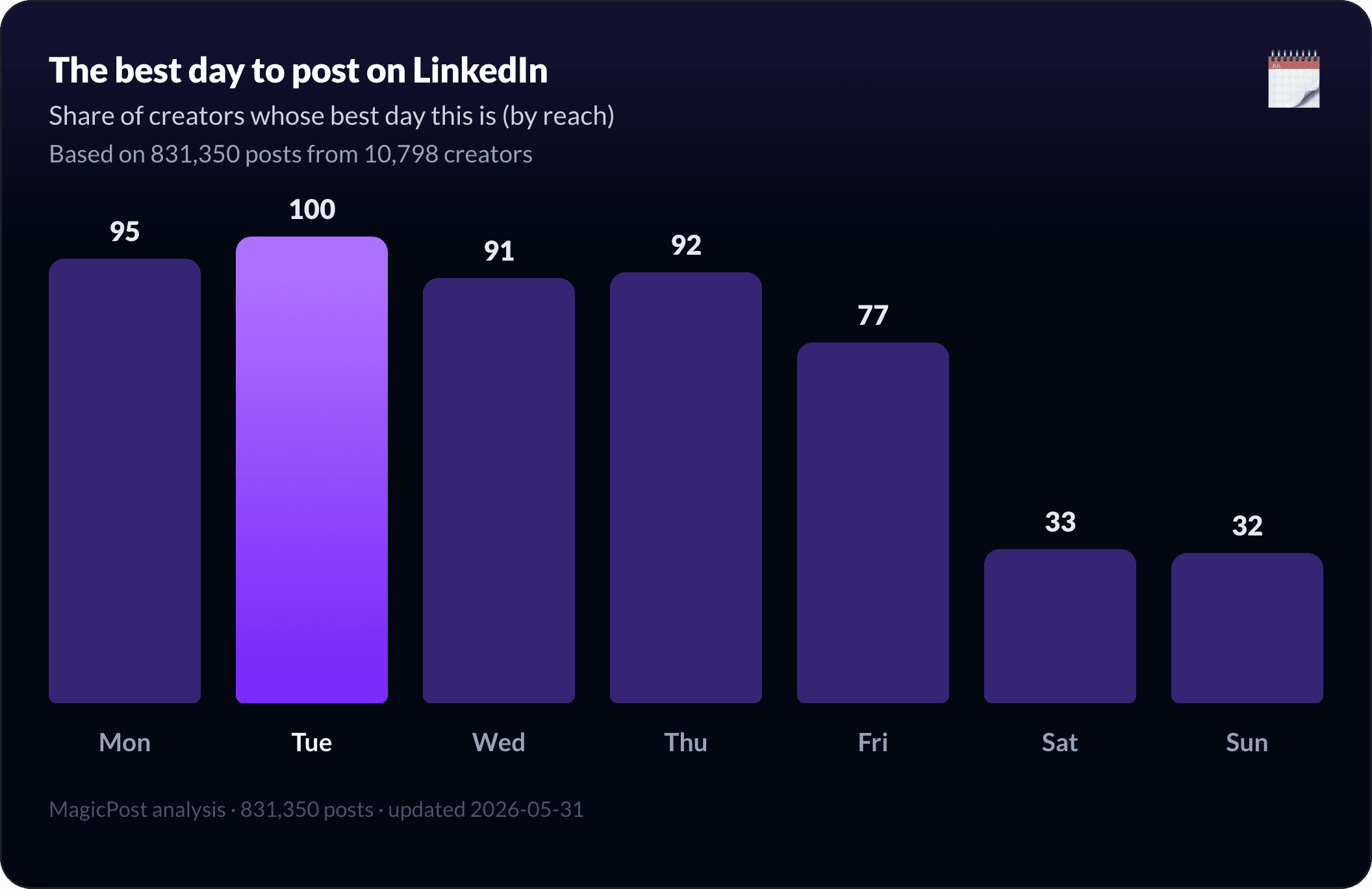
The best day for reach is Tuesday; a Saturday or Sunday peaks for a third as many creators.
In most countries, the best hours are early: 7am to 9am, local time.
The busiest hour is not the best hour. Posts that go out before the 9am rush do better.
How we measured the best time to post on LinkedIn
Two things, kept separate, both from our own data.
When posts perform. For 2,667,049 posts analyzed through May 2026, we compared each post's engagement to that same author's usual engagement. That controls for follower count: a 500-reaction post from someone who normally gets 2,000 is a weak post, and we treat it that way.
We turn that into a score from 0 to 100 for every day-and-hour slot, separately for each country. If you want the baseline those "usual" numbers sit against, we measured the average LinkedIn engagement rate separately.
The best day for reach. Separately, for 10,798 creators (831,350 posts), we looked at real impressions and found which weekday gave each creator their widest reach, then counted the winners. These are the same signals MagicPost uses to recommend a posting time inside the product.
What the 0 to 100 score means, and what it does not
The score is relative, never absolute. A 100 is the slot where posts beat their authors' averages by the widest margin in that country. The floor of the scale means "no better than that author's usual", not "bad".
In the US data, that floor reads as a long plateau around 70 across the working day. A 70 is an ordinary hour, not a dead one. A 44 (Thursday 11pm) is an hour where posts genuinely fall short of what their authors normally get.
Never read the score as an engagement rate. It says nothing about how many reactions a post gets, only how a slot compares with the author's own baseline.
A few more caveats, because timing data is easy to fake:
Hours are local. "8am in the US" means US Eastern; France is Paris time, India is IST.
Scores compare within a country, not across. A 100 in Germany and a 100 in the US each mean "best slot in that country".
Small slots are noisy. Under each country's reliability floor, one viral post can swing the score.
This is correlation, not a promise. Posting at 8am tips the odds. It does not rewrite them.
No industry cut. We have no reliable data by industry, job title or B2B versus B2C, so we do not invent it.
Is there a single best time to post on LinkedIn?
No. The most common mistake is to take one global "best time" and post to it. It cannot work, because LinkedIn runs in every time zone at once.
Blend New York, London, Mumbai and Sydney into a single clock and every country's morning lands on another's midnight: the peaks cancel out. In our global view (in UTC), the best slot is Monday 5am: 5am in London, 6am in Paris, 10:30am in Mumbai.
A global average is an average of averages that applies to nobody.
The signal only shows up one country at a time, in local time. Here is the single best weekday slot in each of the nine countries we have enough data for, with the hour when the crowd posts and the hour when posts perform:
Country | Best slot (local time) | Score | Crowd hour | Perf hour | Posts |
Monday 8am Eastern | 95 | 9am | 8am | 543,472 | |
Friday 7am | 100 | 9am | 7am | 280,585 | |
Monday 7am Paris | 85 | 8am | 7am | 735,919 | |
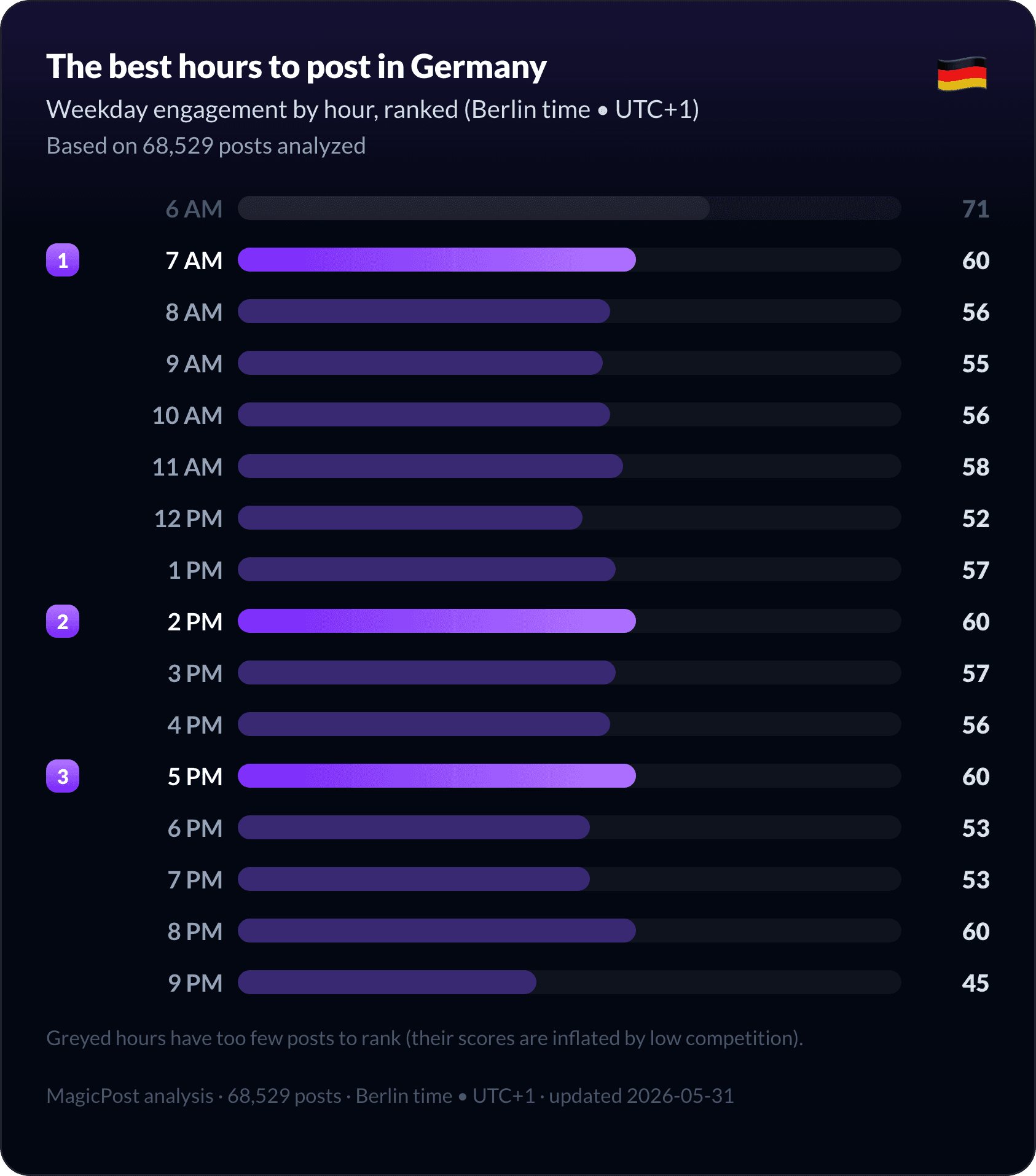
Thursday 8pm Berlin | 74 | 8am | 6am | 68,529 | |
Monday 9am IST | 100 | 10am | 8am | 220,220 | |
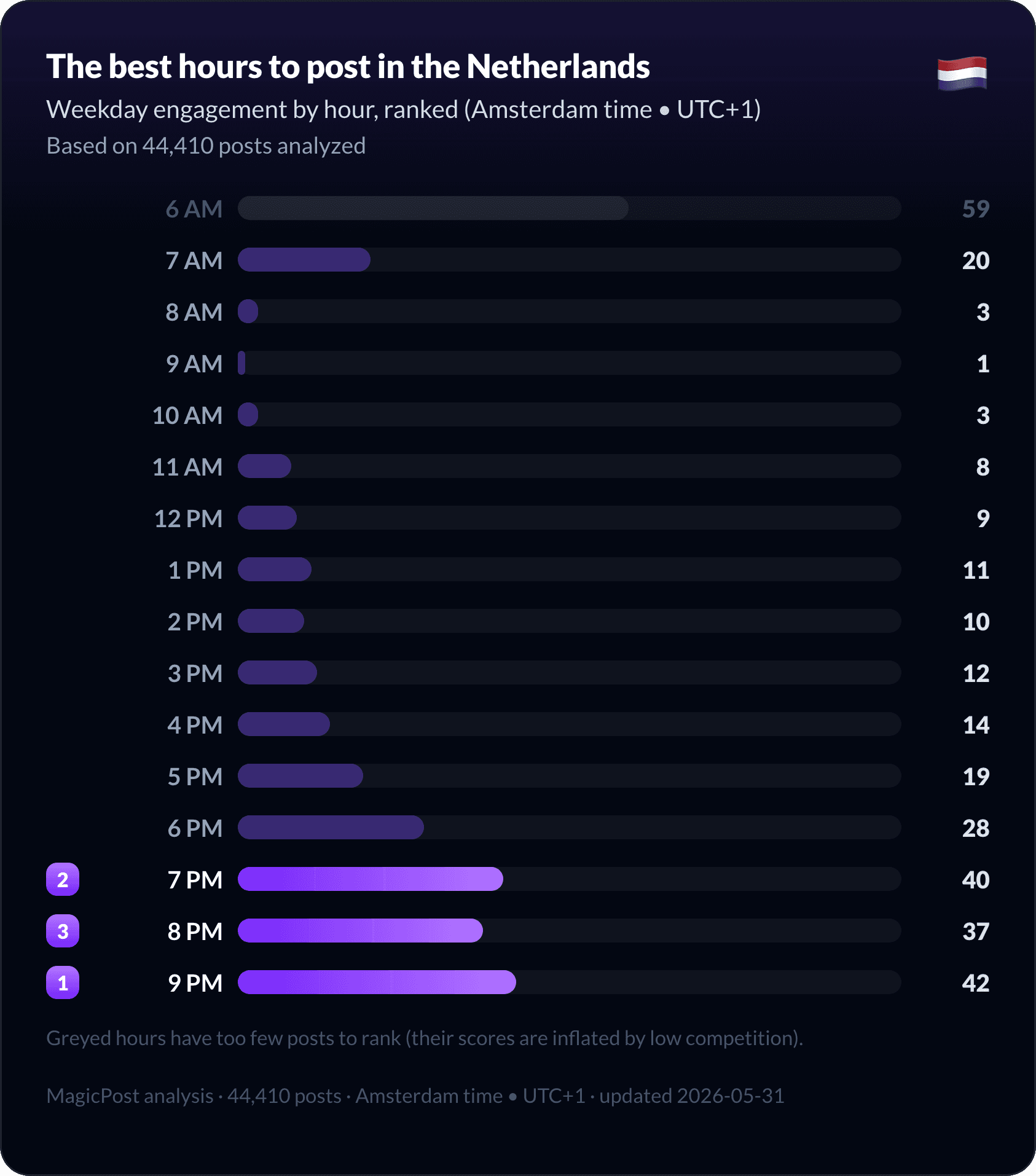
Friday 6pm Amsterdam | 33 | 9am | n/a (thin sample) | 44,410 | |
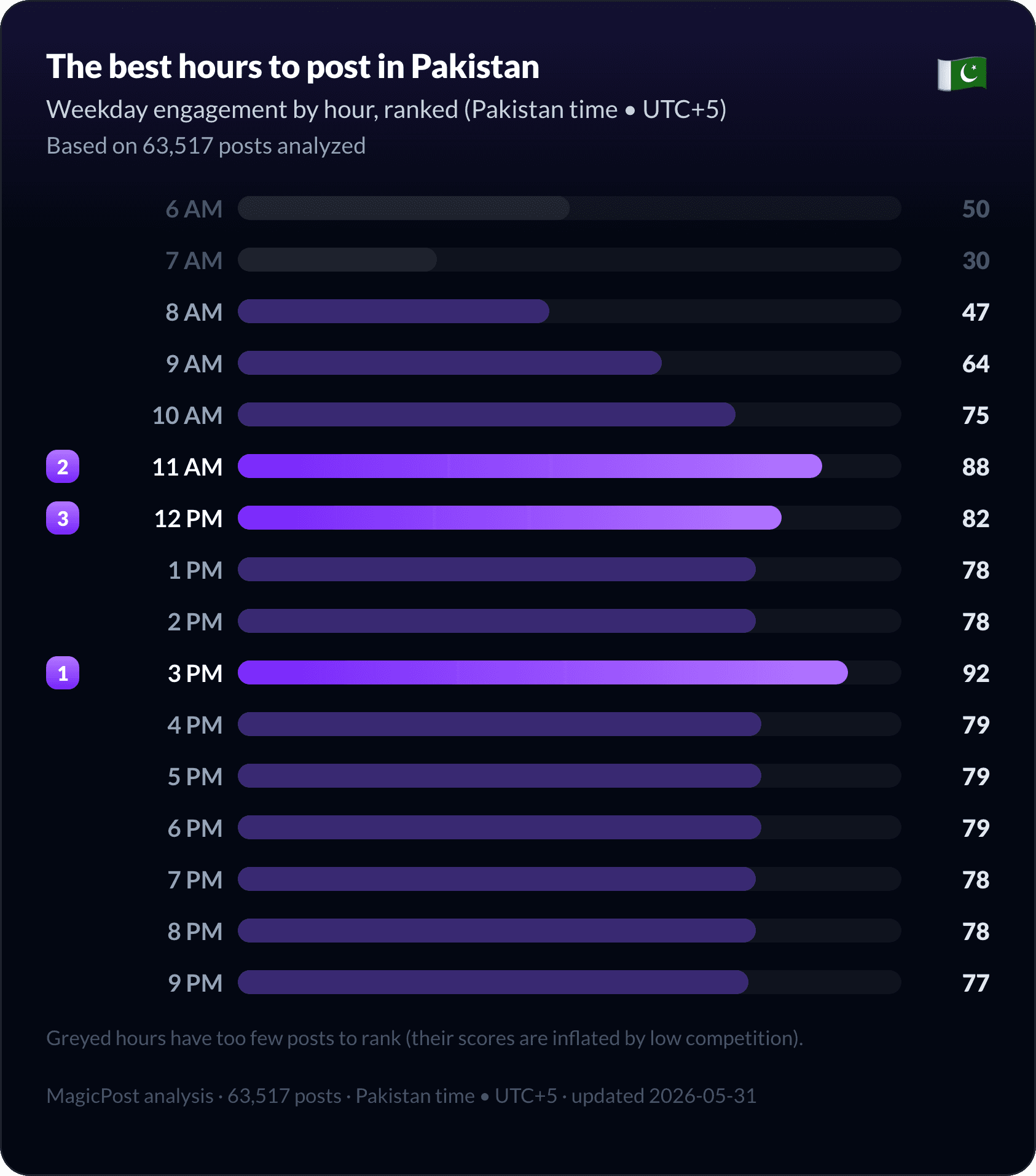
Monday 3pm PKT | 99 | 4pm | 3pm | 63,517 | |
Monday 7am Sydney | 90 | 9am | 5am | 47,469 | |
Monday 11am Eastern | 61 | 9am | 4am | 75,489 |
The Dutch performance hour is left blank on purpose: the Netherlands' highest raw hourly score sits at 3am on 26 posts, a sample too thin for a reliable hour.
In the four big markets (US, UK, France, India), the best slot is a weekday morning and the performance hour sits one to two hours before the crowd hour. That is the pattern the rest of this guide is built on.
The smaller markets are noisier. Germany, the Netherlands, Australia and Canada run on a floor of about 150 posts per slot, so a Thursday 8pm winner in Germany is a lead to test, not a rule. Pakistan is the one market where the whole day shifts: its crowd and its best hour both sit mid-afternoon.
There is no single global hour to post at, so the rest of this guide works country by country, in local time.
What is the best day to post on LinkedIn? Tuesday, and not the weekend
Start with the easy one. Across 10,798 creators, here is the day that gave each of them their widest reach:

The reach score is the share of creators whose best day it is, indexed to Tuesday = 100. The hour columns come from the US timing data (US Eastern, floor of 1,087 posts per slot). Each day links to its own verdict in the best time to post on LinkedIn by day:
Day | Reach score (share of creators) | Best hour US Eastern | Slot score | Crowd hour | Posts analyzed (US) |
95 (1,980 creators) | 8am | 95 | 9am | 95,035 | |
100 (2,075 creators) | 7am | 82 | 9am | 99,884 | |
91 (1,886 creators) | 8am | 87 | 9am | 99,389 | |
92 (1,900 creators) | 7am | 77 | 9am | 95,227 | |
77 (1,607 creators) | 7am | 70 | 9am | 84,566 | |
33 (685 creators) | 10am to noon | 70 | 9am | 34,990 | |
32 (665 creators) | 11am | 100 | 9am | 34,381 |
A note on Friday and Saturday: their highest raw scores (Friday 5am at 78, Saturday 8pm at 76) sit on 694 and 623 posts, under the reliability floor, so the table shows the best hour with enough posts behind it.
The midweek block (Monday to Thursday) is where reach lives. Friday already softens. Then the weekend drops hard: a third as many creators have their best day on a Saturday (33) or a Sunday (32) as on a Tuesday (100). LinkedIn is a work tool, opened on work days.
Two things the table shows that a single "best day" hides. Tuesday wins on reach, but its best hour scores 82, below Monday 8am (95) and Wednesday 8am (87): the strongest single slot of the week is a Monday. And the crowd hour is 9am every single day, weekends included.
The rule that survives all of this: post on a weekday, ideally Tuesday, and treat the weekend as optional. For the full weekday ranking and why the midweek block wins, see the best day to post on LinkedIn.
What is the best time of day to post on LinkedIn? Early, before the feed fills
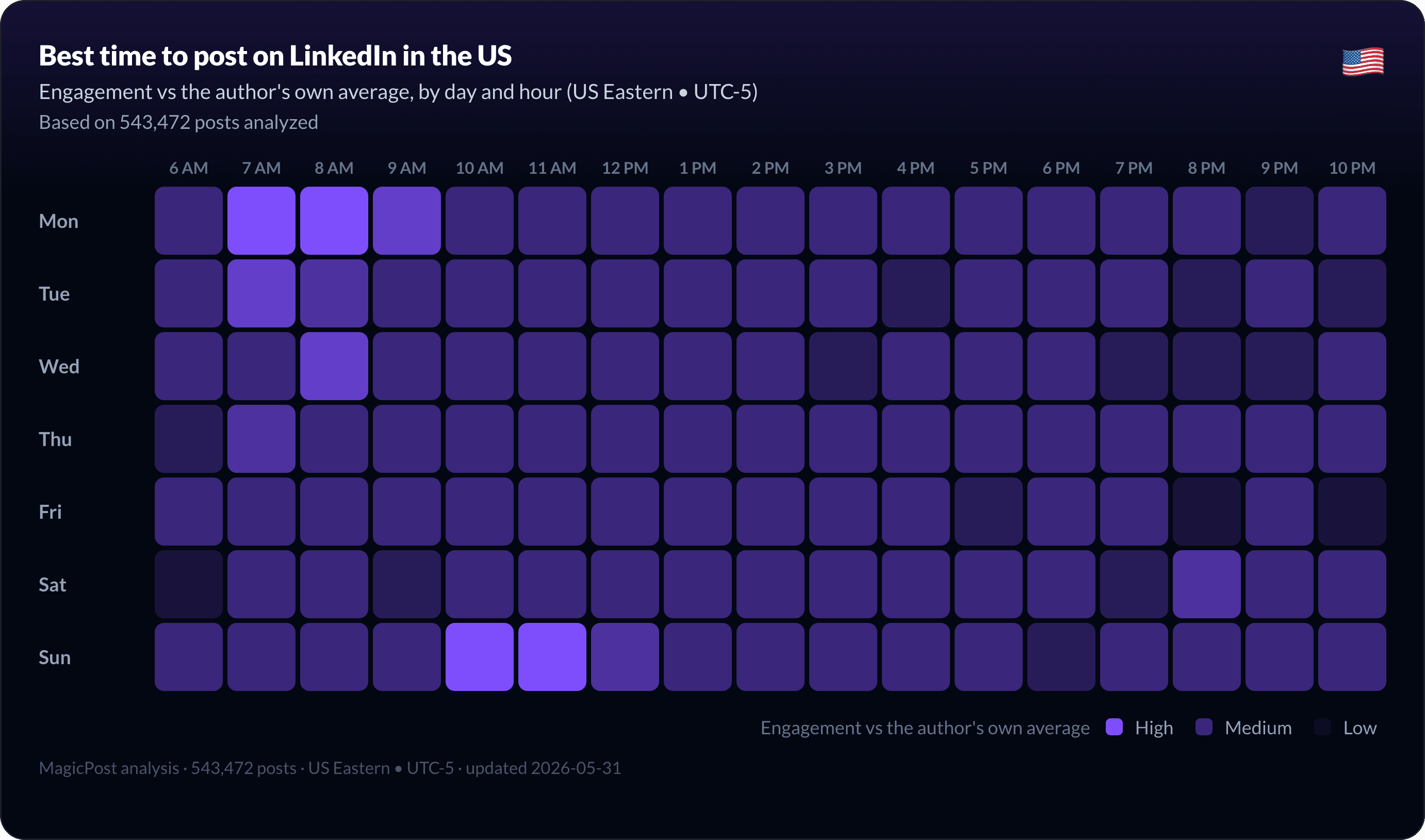
Here is the United States (US Eastern), every day and every hour on one grid, from 543,472 posts:

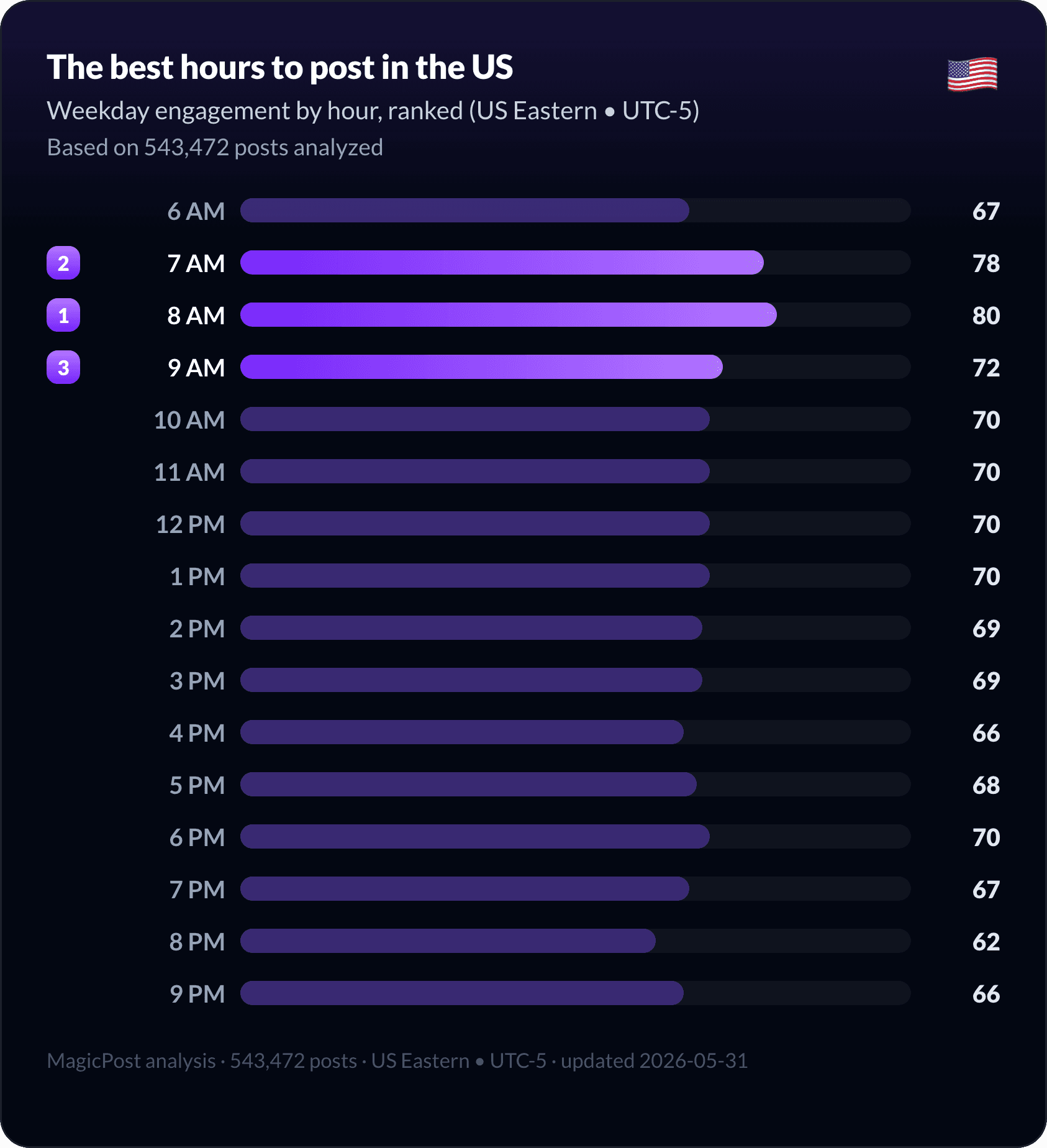
The bright band is narrow: 7am to 9am, Monday to Wednesday. Almost everything else sits on the ordinary plateau, with a few dark cells late at night. Read the same data as a weekday timeline, hour by hour:

The shape is the lesson. Engagement peaks in the early morning, around 7am to 8am, then settles into a long flat plateau for the rest of the working day. From mid-morning to evening, the hour you pick barely changes your odds. The needle really moves in that first window, before the feed fills up.
Zoom in on the single best weekday slots and the story sharpens:

Rank | Window (US Eastern) | Score | Posts in the slot |
1 | Monday 8am | 95 | 10,455 |
2 | Monday 7am | 89 | 3,292 |
3 | Wednesday 8am | 87 | 10,928 |
4 | Tuesday 7am | 82 | 3,342 |
5 | Monday 9am | 80 | 14,003 |
Every top slot is an early-week morning between 7am and 9am. That is the window our engagement score points to: Monday to Wednesday, 7am to 9am, local time.
Why the weekend scores look good and still lose
Weekend slots can post eye-catching scores. Sunday 11am in the US scores 100, the highest cell on the whole grid. We keep it out of the ranking on purpose.
The reason is volume. Sunday 11am carries 3,112 posts, against 14,003 for Monday 9am: about a quarter of a weekday peak hour. The few posts that go out on a Sunday morning beat their authors' averages in front of a small crowd, with almost no competition.
Treat it as a curiosity. If you like experimenting, Sunday late morning is the slot to try. Just do not build your calendar on it.
The pattern repeats across countries, but the exact hours shift. Each market in the country table above has its own guide with the full grid in local time.
Post before the crowd: why the busiest hour is not the best time to post on LinkedIn
The most useful finding in the dataset is a one-hour gap: the hour when most people post and the hour when posts do best are not the same hour.

In the US, posting volume peaks at 9am: 69,398 weekday posts in that hour, and the average slot score drops to 72. One hour earlier, at 8am, volume is a quarter lower (52,632 posts) and the score is 80. At 7am, with 16,376 posts, it is 78.
By 9am, when the feed is flooded, the average post scores measurably lower against its author's usual engagement than it did an hour earlier.
Does "post before the crowd" hold outside the US?
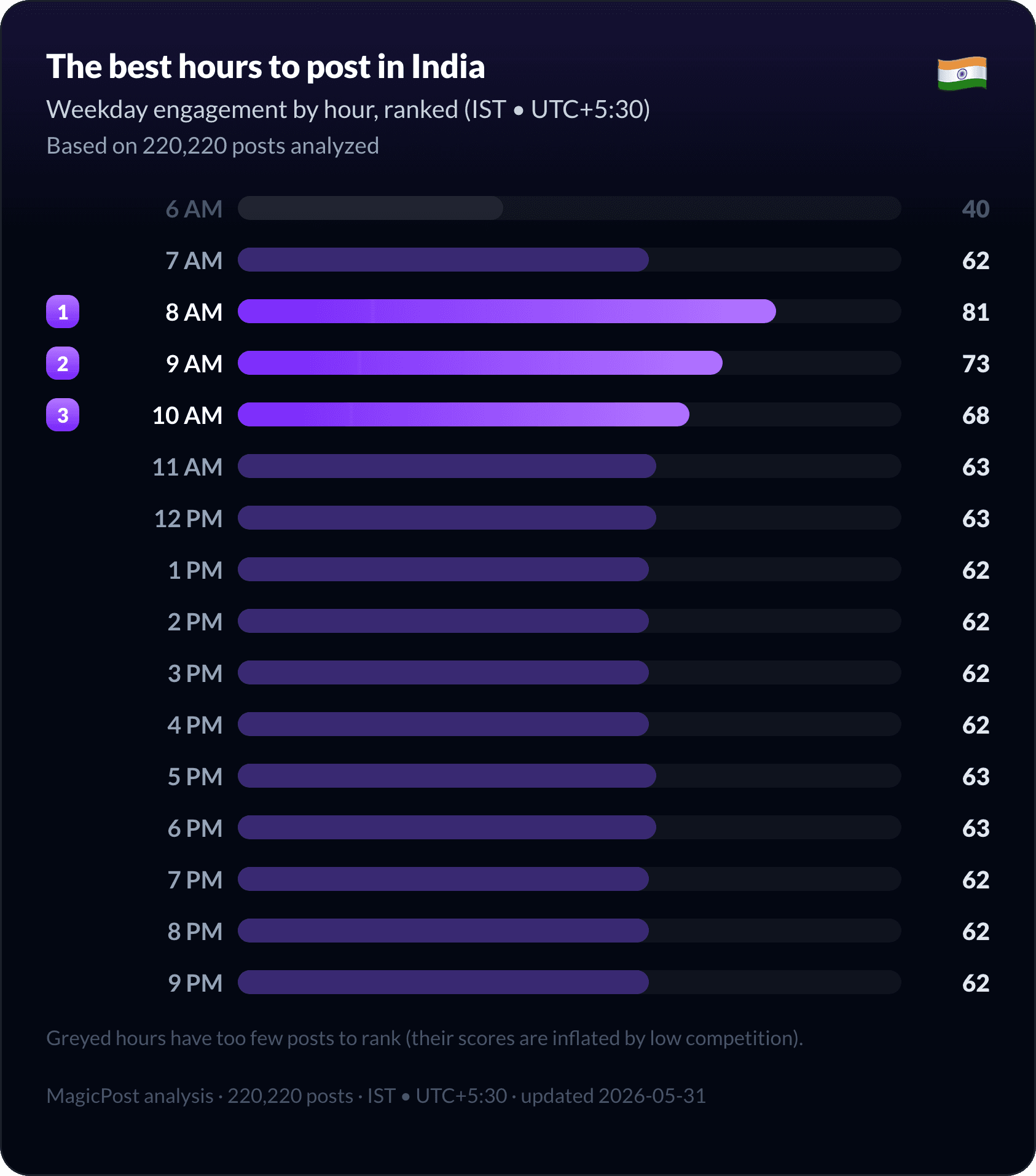
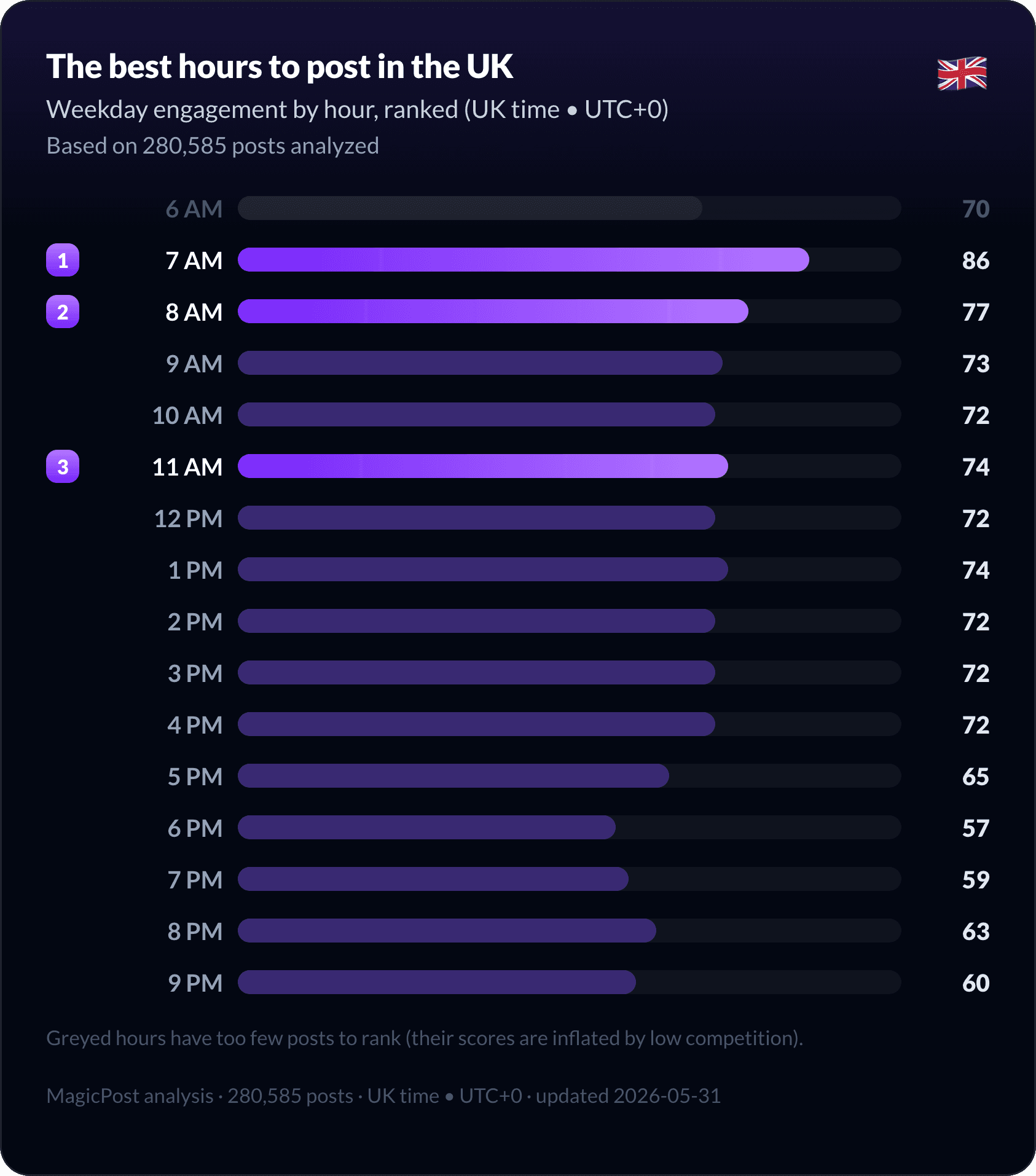
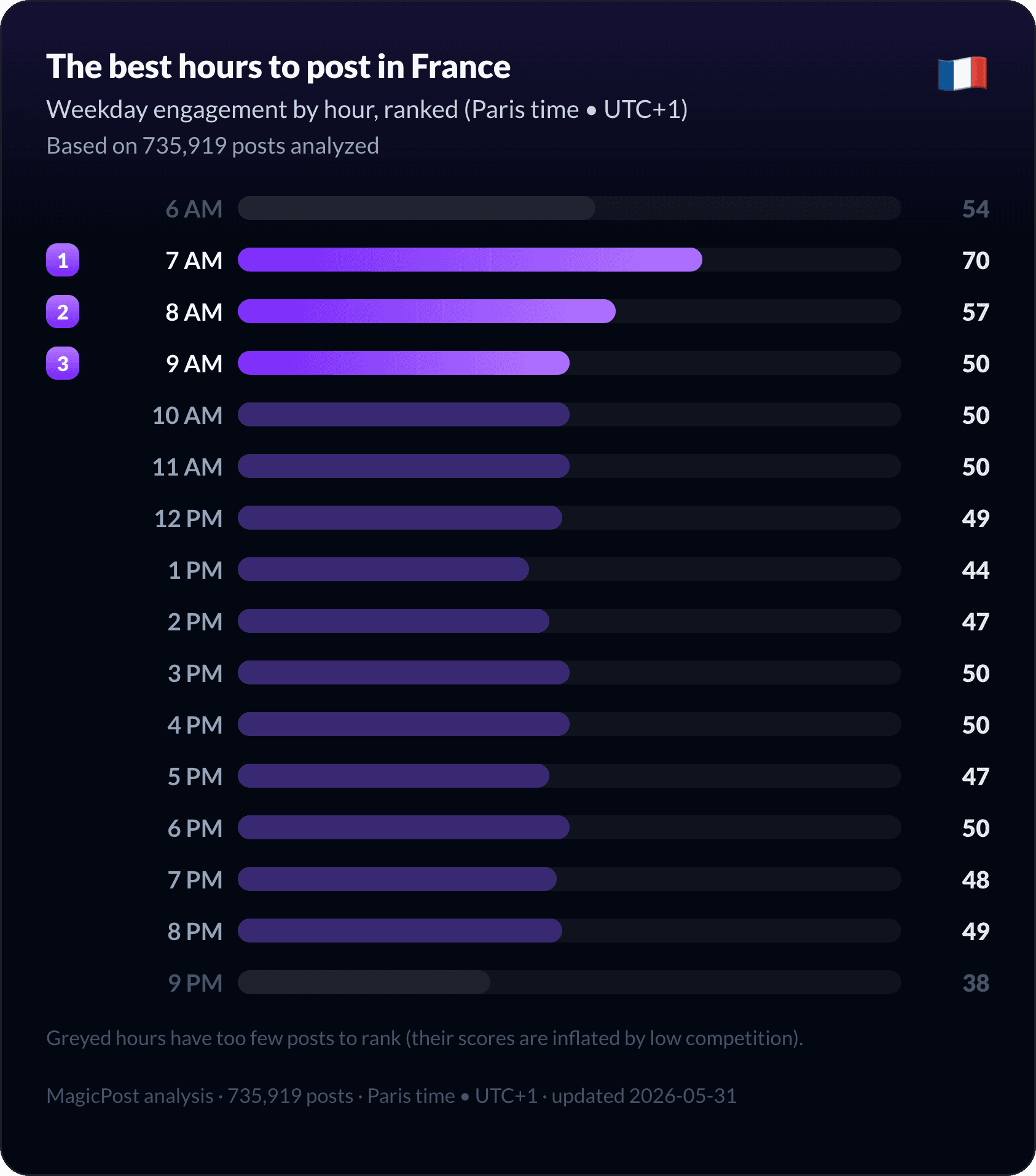
Yes, in every large market we measured. The gap between the crowd hour and the performance hour is one hour in the US and France, two hours in the UK and India, and one hour in the global view:

Market | Crowd hour (local) | Score at the crowd hour | Best hour (local) | Score at the best hour |
United States (Eastern) | 9am | 72 | 8am | 80 |
United Kingdom | 9am | 73 | 7am | 86 |
France (Paris) | 8am | 57 | 7am | 70 |
India (IST) | 10am | 68 | 8am | 81 |
Global (UTC) | 7am | 61 | 6am | 66 |
The UK is the clearest case: 7am carries under a third of the 9am volume (11,083 posts against 35,971) and scores 86 against 73.
France's 8am rush is the biggest single hour of any country we measured, 138,029 posts, and it scores 57. The 7am slot before it, with a fifth of the volume, scores 70.
The first hour does not decide whether a post travels. In our 2026 LinkedIn algorithm study, a typical post had 8% of its final views after one hour and 72% after three days (28,852 posts published through MagicPost, followed hour by hour). The rest of the ranking picture is in how the LinkedIn algorithm works.
The posting hour mostly shapes the start. At 9am your post lands next to everyone else's 9am post. At 7:30am, it is one of the few new things in the feed. Get in before the crowd.
Why Sprout Social says afternoon, Buffer says evening and this data says morning
If you have read other studies, you have seen three different verdicts, and the difference comes from the method.
Study | Dataset | Who posts | Metric | Verdict |
Sprout Social | About 2 billion engagements, 307,000 profiles, three months ending February 2026 | Profiles across six networks, LinkedIn among them | Raw engagement | Tuesday, 11am to 5pm |
Buffer | 4.8 million posts sent through Buffer | Accounts publishing through Buffer | Raw engagement | Weekdays 3pm to 8pm, Wednesday 4pm on top |
MagicPost | 2,667,049 LinkedIn posts | Individual creators, own profile | Score against the author's own average | Weekday mornings, 7am to 9am local |
Supergrow | No own data, blend of four third-party studies | n/a | n/a | Tuesday to Thursday, 10am to noon |
Both measured studies use raw engagement: a post with 400 reactions counts for more than a post with 40, whoever wrote it. That rewards the hours when the biggest accounts happen to post. Brand pages run on office schedules, so raw totals peak late morning to afternoon.
Our score is normalized per author and built on individual creators, 2,667,049 posts scored against the author's own baseline.
It asks a different question: at which hour does your post beat your usual? For a person posting from their own profile, that is the question that matters, and for them the winning window is early morning.
Neither method is wrong. They describe different populations. If you run a company page with a social media team, an afternoon verdict on brand data may fit you. If you post as yourself, use the creator data.
What are the worst times to post on LinkedIn?
The worst time to post on LinkedIn, in MagicPost's US data, is late in the evening on Thursday and Friday: Thursday 11pm scores 44 and Friday 8pm scores 49, against 95 for the best slot of the week.
These are the ten weekday slots where posts fall furthest below their authors' usual engagement, counting only slots with at least 1,000 posts:
Slot (US Eastern) | Score | Posts in the slot |
Thursday 11pm | 44 | 1,007 |
Friday 8pm | 49 | 1,007 |
Tuesday 4pm | 56 | 3,893 |
Tuesday 11pm | 56 | 1,046 |
Tuesday 8pm | 57 | 1,629 |
Wednesday 7pm | 58 | 2,144 |
Thursday 6am | 60 | 1,229 |
Tuesday 10pm | 60 | 1,008 |
Wednesday 9pm | 61 | 1,258 |
Friday 5pm | 62 | 2,580 |
Below the 1,000-post floor, the numbers get starker: Saturday 11pm scores 0 on 569 posts, the single lowest cell we measured, and Friday 11pm scores 31 on 695. In the global view (UTC), the worst well-populated slot is Friday 5pm, which scores 38 on 16,704 posts.
Three dead zones fall out of that:
Late evenings, roughly 7pm to midnight local, once the laptop is closed.
Friday from late afternoon, plus the whole of Saturday night.
Overnight, roughly midnight to 5am local: thin and weak.
You will not be penalized for posting then, you will just be talking to an empty room. For the full breakdown, slot by slot and country by country, see the worst times to post on LinkedIn.
So when is the best time for you to post on LinkedIn?
Put it together:
Pick a weekday. Tuesday is the safest, Monday to Thursday are strong, Friday is weaker, the weekend is for experiments.
Go early, local time. In most markets, 7am to 9am beats mid-morning. The country table above gives the exact hour.
Beat the rush. Post in the half hour before everyone else: 8am rather than 9am in the US, 7am in the UK.
Then watch your own analytics. Our data is the best starting point. Your audience is the final word.
If your people reliably show up at 8pm, trust that over any chart. Your post analytics will tell you where your specific audience actually lands.
Timing is a tiebreaker, not a magic trick. A great post at an average time beats a weak post at the perfect time, every time. Timing helps a good post find its audience faster. It cannot save a bad one.
Our score measures engagement against the author's own average, not final impressions. On final reach, the hour changes the result by 2% at most, according to our 2026 study of the same creators over time. It mainly changes how fast a post starts: at one hour, from 21% fewer to 11% more views than usual for the author.
How often you post moves the needle more than the exact minute, and the mechanics of scheduling a LinkedIn post take two minutes to learn, natively or with one of the best LinkedIn scheduling tools. The MagicPost LinkedIn benchmark republishes the timing data monthly, so you can watch these slots move over time, alongside format and length benchmarks.
Stop doing the math in your head. MagicPost lets you write your post and schedule it for the best window in your time zone, so it goes out before the crowd without you setting a 7am alarm. Try MagicPost free
FAQ
What is the best time to post on LinkedIn in 2026?
MagicPost's analysis of 2,667,049 LinkedIn posts, each scored against its own author's average engagement, finds the best time to post on LinkedIn is 7am to 9am local time on a weekday.
In the US, the single best slot is Monday 8am (score 95/100) and Tuesday is the best day for reach (10,798 creators).
There is no single global hour, because the answer shifts by country: 7am in the UK and France, 8am to 9am in the US and India, mid-afternoon in Pakistan.
What is the best day to post on LinkedIn?
Tuesday is the best day to post on LinkedIn: in MagicPost's data on 10,798 creators and 831,350 posts, more creators got their widest reach on a Tuesday (2,075) than on any other day.
Monday (95), Thursday (92) and Wednesday (91) sit just behind on the same 100-point scale. Friday drops to 77, Saturday to 33 and Sunday to 32.
Is it bad to post at 9am?
Posting at 9am on LinkedIn is the most crowded choice rather than the worst one: in the US it is the busiest weekday hour (69,398 posts) and its average score is 72, against 80 one hour earlier at 8am.
The measured worst slots are the late evenings: Thursday 11pm (44) and Friday 8pm (49). Post at 7am to 8am and you reach the same waking audience with far less competition.
Should I post on the weekend?
Weekend posts on LinkedIn are the best day for only a third as many creators: in MagicPost's data, Saturday scores 33 and Sunday 32 against Tuesday's 100.
There is one quirk, Sunday 11am in the US, which scores 100 on 3,112 posts (about a quarter of a Monday 9am hour) because so few people publish then. It is a slot to experiment with, not to build a calendar on.
Does posting at the "best" time guarantee more reach?
No. MagicPost's timing scores are correlation, not a guarantee: they mark the slots where posts most often beat their authors' average engagement, not final impressions.
On final reach, MagicPost's 2026 algorithm study finds the hour changes the result by 2% at most. It mainly changes how fast a post starts: at one hour, from 21% fewer to 11% more views than usual for the author. It will not rescue a weak post.
When do most people post on LinkedIn?
Most people post on LinkedIn at the start of the local workday: 9am in the US and the UK, 8am in France, 10am in India, and 7am UTC in the global view.
In every one of those markets, the best-performing hour is one to two hours earlier (8am US, 7am UK and France, 8am India): the same audience, a fraction of the competition.
Do posting times really matter on LinkedIn?
Posting times on LinkedIn matter as a tiebreaker, not a magic trick. MagicPost's engagement score puts the best US slot (Monday 8am, 95) above the weekday plateau (about 70), but its 2026 algorithm study finds the hour moves final reach by 2% at most. How often you post and what you post move the needle more than the exact minute.
How was this measured?
MagicPost measured the best time to post on LinkedIn by comparing each of 2,667,049 posts with its own author's typical engagement, so follower count does not distort the result, then scoring every day-and-hour slot from 0 to 100 per country in local time.
The best-day ranking uses a separate dataset: real impressions on 831,350 posts across 10,798 creators, counting which weekday gave each creator their widest reach.