" height="26.80529977783203px" id="tymKb8bqC" width="128.00300311279295px"/><path d="M 0 2.417 L 0 0 L 12.909 0 L 12.909 2.417 Z" fill="rgb(126, 78, 253)" height="2.417099999999998px" id="aYr4em6zK" transform="translate(128.341 22.325)" width="12.908999999999992px"/></svg>)

"/><stop offset="1" stop-color="rgb(118, 37, 250)"/></linearGradient></defs><g d="M 19.242 21.22 L 19.362 6.204 L 19.272 6.204 L 13.757 21.22 L 10.161 21.22 L 4.796 6.204 L 4.706 6.204 L 4.825 21.22 L 0 21.22 L 0 0 L 7.283 0 L 12.109 13.607 L 12.229 13.607 L 16.844 0 L 24.247 0 L 24.247 21.22 Z M 26.421 26.113 L 26.421 23.445 L 41.407 23.445 L 41.407 26.113 Z" fill="transparent" height="26.112508199679183px" id="DvfaAIHYn" width="41.40731898311435px"><path d="M 19.242 21.22 L 19.362 6.204 L 19.272 6.204 L 13.757 21.22 L 10.161 21.22 L 4.796 6.204 L 4.706 6.204 L 4.825 21.22 L 0 21.22 L 0 0 L 7.283 0 L 12.109 13.607 L 12.229 13.607 L 16.844 0 L 24.247 0 L 24.247 21.22 Z" fill="rgb(46, 46, 46)" height="21.220180016149442px" id="pLsxRCobd" width="24.247352589074694px"/><path d="M 0 2.668 L 0 0 L 14.986 0 L 14.986 2.668 Z" fill="url(%23yD9d4I5GR-3279285344-linear-gradient)" height="2.6675085048549647px" id="yD9d4I5GR" transform="translate(26.421 23.445)" width="14.986002836263765px"/></g></svg>)

Naïlé Titah
De ColdIQ-cijfers op deze pagina zijn gemeten uit ons onderzoekscorpus over de twaalf maanden tot juni 2026. Methode en grenzen staan onderaan.
Wie ook maar een beetje rondhangt in de B2B-saleshoek van LinkedIn, is ColdIQ tegengekomen, of je nu wilde of niet. Het AI-salesbureau van Michel Lieben en Alex Vacca is een van de meest zichtbare bedrijven in de go-to-market-wereld, en die zichtbaarheid is geen toeval.
Het is een uitgesproken strategie. In een post die zo'n beetje een manifest is geworden, schreef Lieben dat hij wil dat elke ColdIQ-medewerker beroemd wordt.
De meeste bedrijven zien employee advocacy als een leuke bijkomstigheid. ColdIQ behandelt de individuele reputatie als een groeikanaal en zet daar mensen op in.
Dus deden we het voor de hand liggende: meten wat dat oplevert en daarna de posts zelf lezen om te zien hoe het werkt.
Kort samengevat: ColdIQ maakte van employee advocacy een groeimotor: 5 merkambassadeurs, 427 posts en 88.417 likes in een jaar, met een mediaan van 176 likes per post. We hebben iedereen gemeten en hun posts gelezen. De eerlijke conclusie: zelfs bij ColdIQ komt 63% van één oprichter.
De voetafdruk, gemeten
Over de afgelopen twaalf maanden telt ColdIQ 5 merkambassadeurs in ons corpus (profielen met minstens drie posts in het jaar). Samen publiceerden ze 427 posts en haalden ze 88.417 likes op, met een mediaan van 176 likes per post, op ruwweg 160.000 gezamenlijke volgers.
Even ter vergelijking: die mediaan ligt hoger dan bij bijna elke onderneming die we hebben gemeten, inclusief Microsoft en Google, bedrijven die tienduizenden keren groter zijn dan ColdIQ. Een team van vijf post met het gewicht van een corporate communicatieafdeling, en presteert per post beter dan de meeste daarvan.
ColdIQ-merkambassadeur | Specialiteit | Posts (12 mnd.) | Mediaan likes | Volgers |
Michel Lieben | Oprichtersstem, GTM-teardowns | 179 | 276 | ~73.500 |
Alex Vacca | AI-systemen, tegendraadse meningen | 126 | 154 | ~58.800 |
Ivan Falco | Demand gen, groei verteld | 46 | 86 | ~17.000 |
Anna Hernaman | De weg van de nieuwe merkambassadeur | 41 | 36 | ~3.400 |
Monika Grycz | Technische AI-GTM | 35 | 58 | ~8.000 |



De eerlijke conclusie: zelfs bij ColdIQ komt 63% van één persoon
Eén getal nuanceert het succesverhaal. Bij alle ambitie van "elke medewerker beroemd" blijft het bereik van ColdIQ geconcentreerd: Lieben alleen is goed voor 63% van alle likes van het team.
Dat is werkelijk meer verspreid dan bij de meeste bedrijven die we hebben gemeten, waar één leidinggevende doorgaans 75% tot 95% van alles draagt (het volledige patroon staat in ons onderzoek naar employee advocacy over 1,2 mln. posts).
Maar het is een gezonde realitycheck. Een tweede laag opbouwen en vasthouden, Falco, Grycz, Hernaman, die consequent blijft posten, is het zware en waardevolle werk, en zelfs een bedrijf dat van bekendheid een expliciete strategie heeft gemaakt, leunt voor ruwweg twee derde op zijn oprichter.
Het werk is nooit af; het komt erop neer dat aandeel te blijven verlagen, want een programma dat van één persoon afhangt, is één carrièrestap verwijderd van stilte.
Wat je ervan kunt meenemen
Drie dingen vertalen zich goed van ColdIQ naar een gewoon bedrijf.
De leiding gaat voorop, en zichtbaar. Advocacy die de oprichters zelf niet beoefenen, verspreidt zich niet, en 179 posts per jaar is wat "zichtbaar" betekent.
Geef iedereen een baan die aansluit op hun échte expertise. Teardowns, systemen, demand gen, technische GTM, het dagboek van de nieuwkomer, zodat de content geloofwaardig is in plaats van een centrale boodschap waar iedereen zich aan ergert.
Frequentie wint van perfectie. Het effect komt van opdagen, niet van de incidentele virale hit.
De wrijving zit, altijd, in de inspanning per persoon.
Een Head of Demand Gen of een sceptische senior aanwerving vragen om naast hun eigenlijke werk 40-plus doordachte posts per jaar te schrijven, is een serieus verzoek, en de meeste teams stranden precies daar, en dat is waarom advocacy zo vaak terugvalt op de oprichter.
Die kosten verlagen, zodat een goede post een paar minuten kost en nog steeds klinkt als de persoon wiens naam eronder staat, is het verschil tussen een programma en een hobby van de oprichter.
Een team in een vast ritme van posten en engagement houden, is grotendeels wat het bereik van één oprichter omzet in dat van vijf mensen.
(Het is ook waarom generieke AI het niet oplost: content die door iedereen geschreven had kunnen zijn, bereikt 10 tot 14% minder mensen in onze benchmark.)
Een heel team helpen posten in hun eigen stem is het probleem waar wij voor bouwen, en als je voorbij het stadium van enkel-de-oprichter wilt komen, is dat waar MagicPost for enterprises voor is.
Nu de details, want het interessante aan ColdIQ is niet het totaal, maar hoe vijf verschillende mensen vijf verschillende banen bezetten zonder elkaar in de weg te lopen.
De oprichters zetten de toon
Je kunt de advocacy van ColdIQ niet begrijpen zonder bovenaan te beginnen, want de oprichters posten meer dan wie dan ook en bepalen de huisstijl: concreet, tegendraads, in de ik-vorm, en bijna nooit rechtstreeks over ColdIQ.
Michel Lieben, de teardown-machine
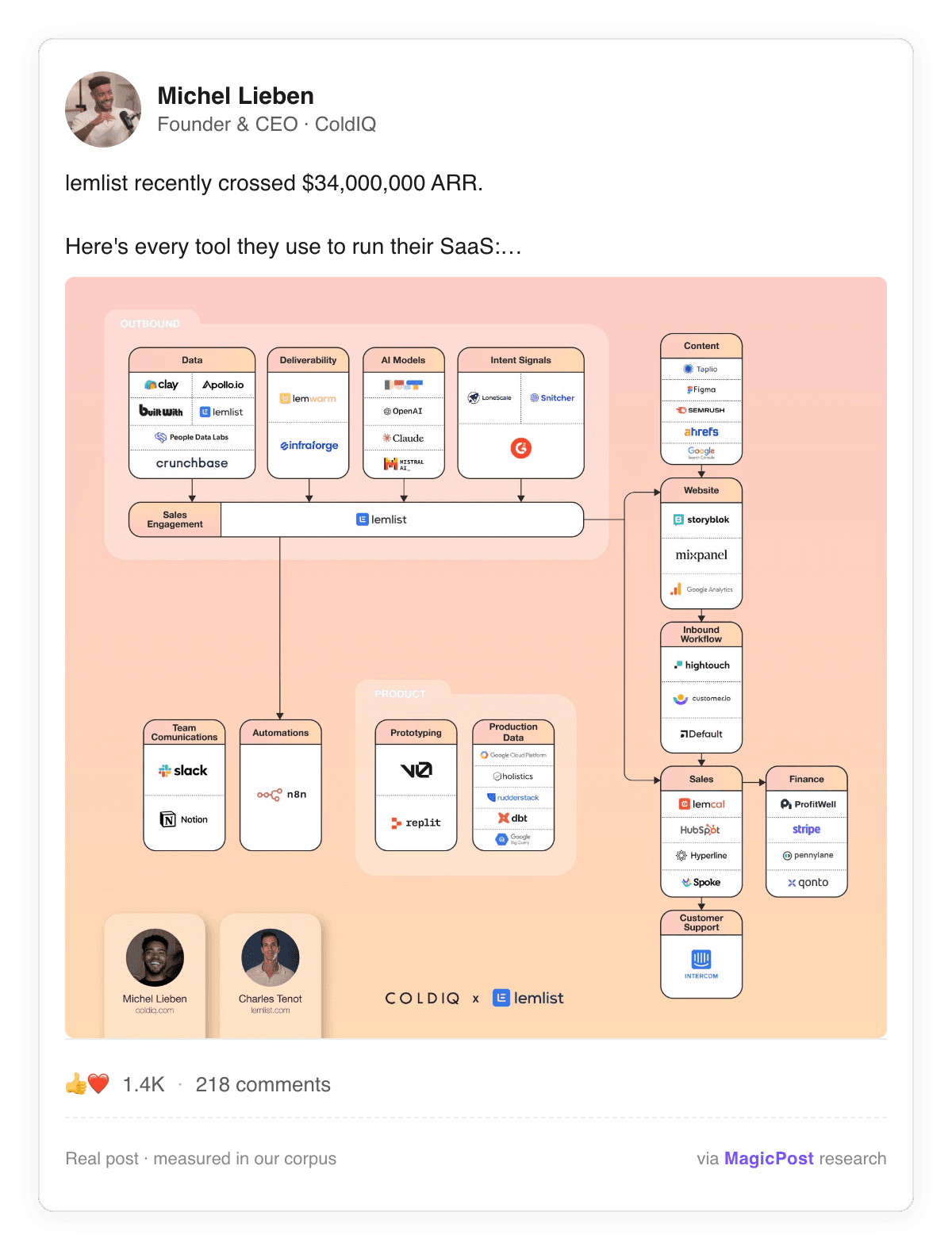
Liebens betrouwbaarste format is het in het openbaar ontleden van de groei van andere bedrijven. Zijn best presterende post van het jaar opent met "lemlist crossed onlangs $34,000,000 ARR. Hier is elke tool die ze gebruiken om hun SaaS te runnen," en loopt met toestemming van de oprichter door de hele stack van een concurrent (1.384 likes).
Bekijk de post van Michel Lieben op LinkedIn ↗
Hij wisselt de teardowns af met scherpe meningen over AI-agents ("AI Agents begonnen werknemers te vervangen. Nu krijgen ze zakelijke creditcards toevertrouwd," 1.111 likes) en, af en toe, pure kwetsbaarheid als oprichter.
De post die je waarschijnlijk het meest vertelt over waarom de strategie werkt, is die over zijn verjaardag: "Ik word vandaag 31. Mijn bedrijf maakte vorige maand $557,000. Maar daarvoor mislukten 7 bedrijven op rij."
Geen van deze posts zijn bedrijfsaankondigingen. Het zijn iemand die in het openbaar nuttig en eerlijk is, en dat is precies wat het bereik oplevert dat een merkpagina nooit zal halen.
Alex Vacca, AI-systemen en tegendraadse hooks
Vacca rijdt op een parallel spoor: AI-gestuurde LinkedIn- en outbound-systemen, verpakt met bewust provocerende hooks. Zijn post "R.I.P. LinkedIn-'experts'" (780 likes, 1.745 reacties) presenteert een doe-het-zelf-alternatief voor goeroes van motiverende content.
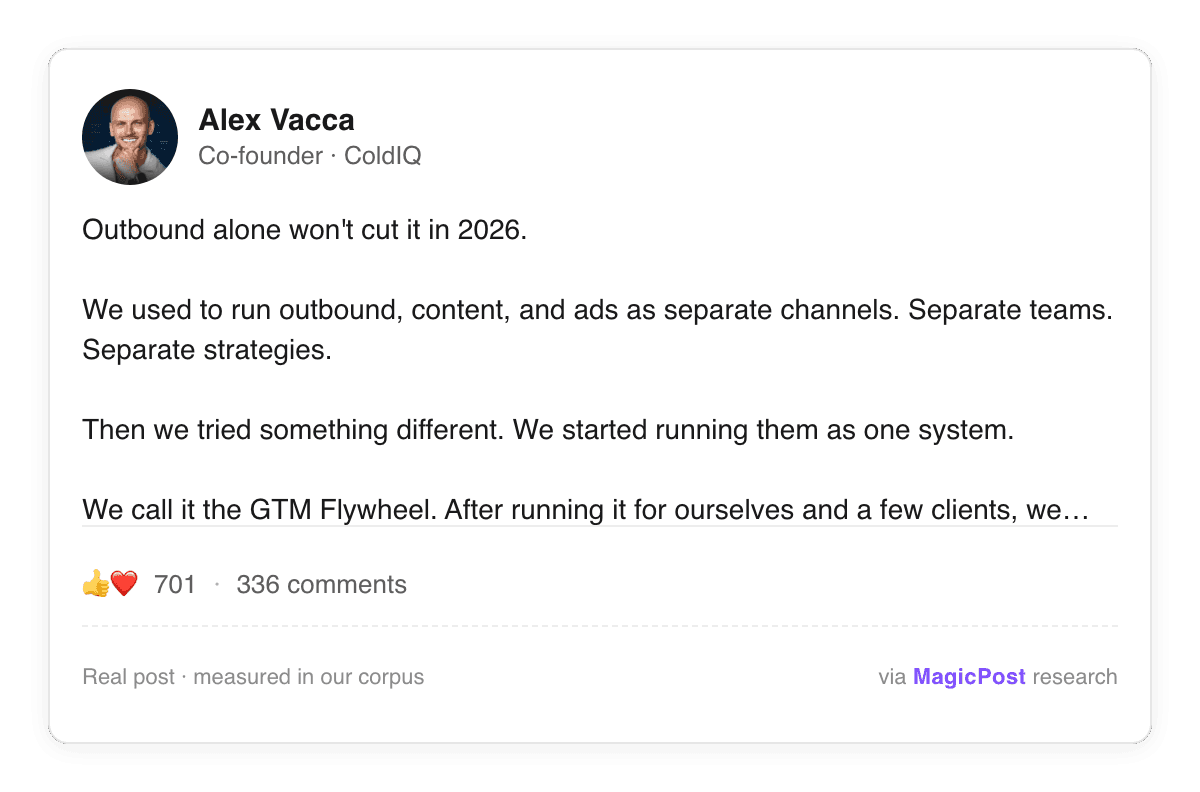
Zijn post "Outbound alleen volstaat niet in 2026" legt de echte werkthese van ColdIQ uit: "We runden outbound, content en ads vroeger als aparte kanalen... Toen begonnen we ze als één systeem te runnen."
Bekijk de post van Alex Vacca op LinkedIn ↗
Het patroon bij beide oprichters verdient een naam, want dat is het navolgbare deel: ze onderwijzen wat ze werkelijk doen, in hun eigen register, in een tempo (179 en 126 posts per jaar) dat de meeste leidinggevenden als een tweede baan zouden beschouwen. Dat volume is toestemming.
Het vertelt de rest van het team dat posten geen zijspoor is; het is hoe het bedrijf groeit.
De tweede laag is het echte verhaal
Genoeg bedrijven hebben een luidruchtige oprichter. Wat ColdIQ onderscheidt, is dat de laag onder de oprichters daadwerkelijk post, en dat iedereen een eigen onderwerp heeft afgebakend.
Ivan Falco, groei live verteld
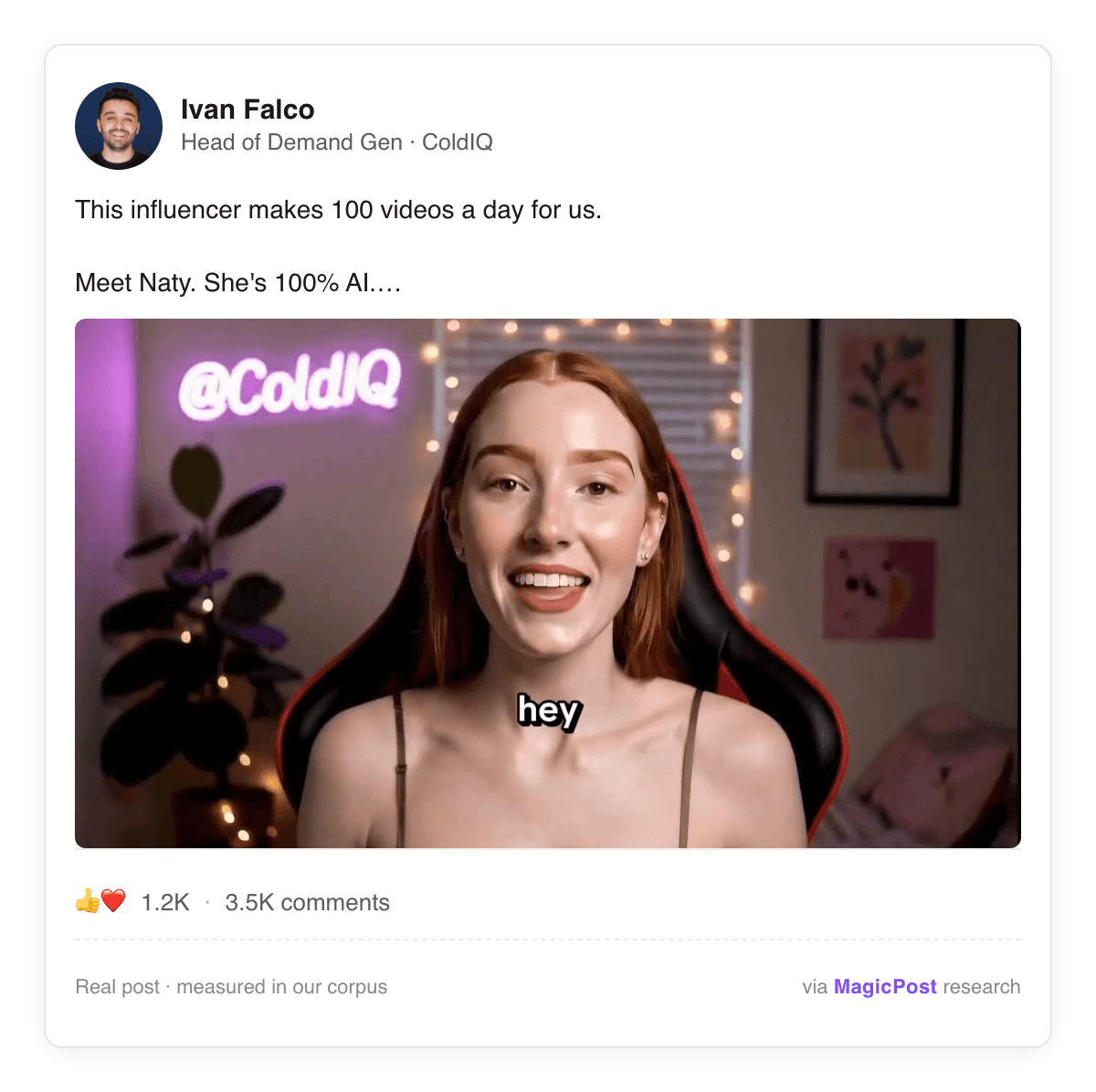
Falco, de Head of Demand Gen, vertelt het groeiverhaal zelf. Zijn post met de meeste engagement van het jaar introduceert "Naty," een "100% AI"-influencer die het bureau runt, en haalde 1.157 likes en ruim 3.500 reacties op, een werkelijk viraal voorwerp.
Bekijk de post van Ivan Falco op LinkedIn ↗
Maar de veelzeggendere post is stiller: "Van $2M naar $5M ARR in 10 maanden. Ik kwam afgelopen augustus bij ColdIQ om de groei te leiden," die zijn eigen onboarding tot content maakt en, niet toevallig, tot werving en geloofwaardigheid voor het bedrijf.
Monika Grycz, de technische GTM-stem
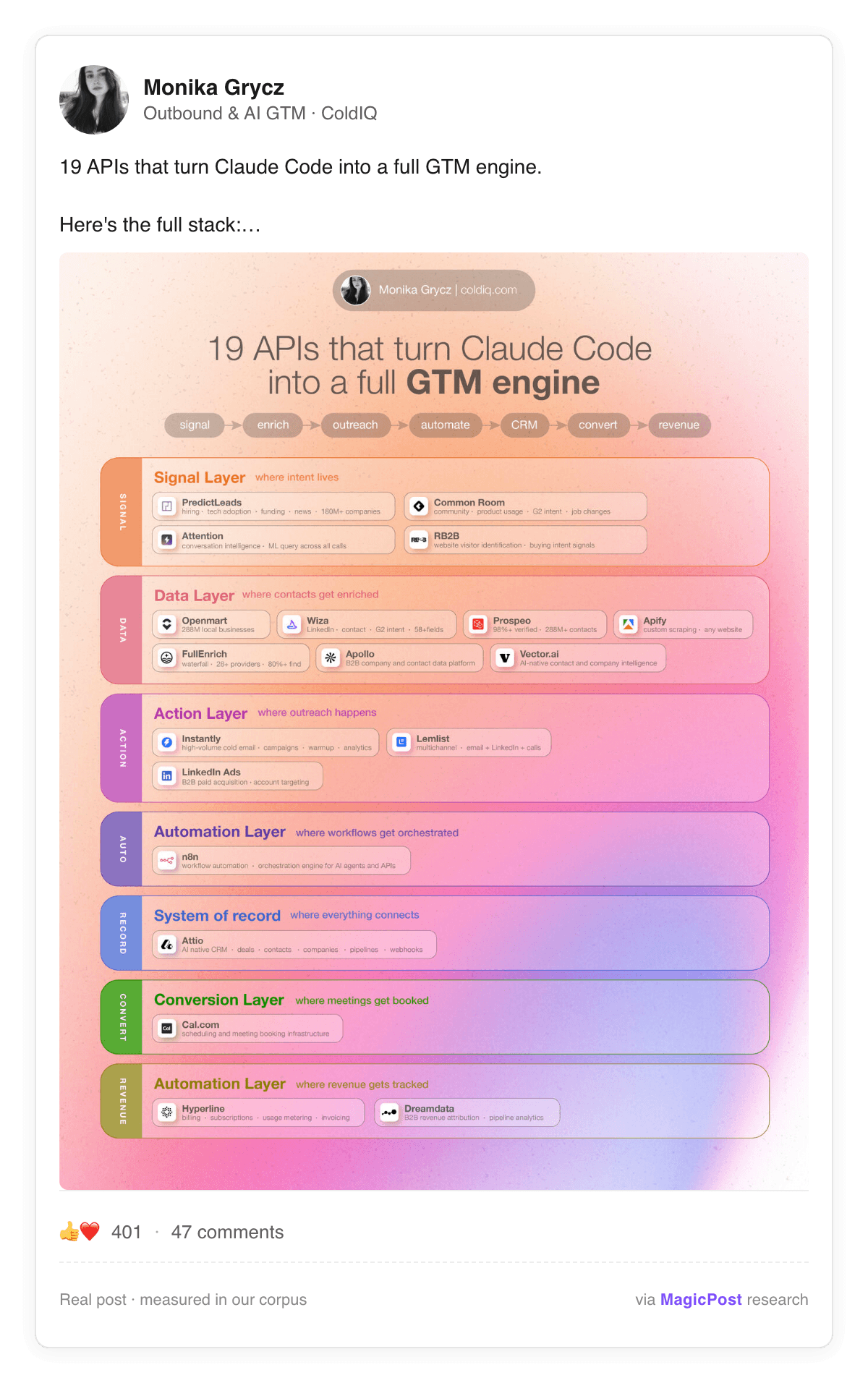
Grycz bezet het meest technische spoor: praktische AI-go-to-market. Haar "19 API's die Claude Code in een volwaardige GTM-motor veranderen" (401 likes) is een buildersbericht, het soort dat diepe geloofwaardigheid oplevert bij een smal publiek met hoge intentie.
Bekijk de post van Monika Grycz op LinkedIn ↗
Ze landt ook de tegendraadse operatorvisie, zoals "We vervingen 5 SDR's door 10 tools en dachten dat we gewonnen hadden. Toen hadden we 5 mensen nodig alleen al om de tools te beheren", het bewijs dat de tweede laag het vertrouwen krijgt om meningen te hebben, niet alleen om de oprichters te versterken.
Anna Hernaman, van "gênant" naar proof of concept
Wil je het allerduidelijkste argument voor het model van ColdIQ, dan is dat Anna Hernaman.
Een senior operator die, naar eigen zeggen, "hielp €20m aan financiering veilig te stellen en creators naar miljoenen op te schalen" terwijl "vrijwel niemand mijn naam kende," begon pas recent te posten, en openlijk: "Ik vond personal branding 'gênant'."
Een paar weken later schreef ze de post die de hele strategie concreet maakt: "2 maanden geleden begon ik op LinkedIn te posten. Vandaag werd ik uitgenodigd op hun hoofdkantoor in Londen."
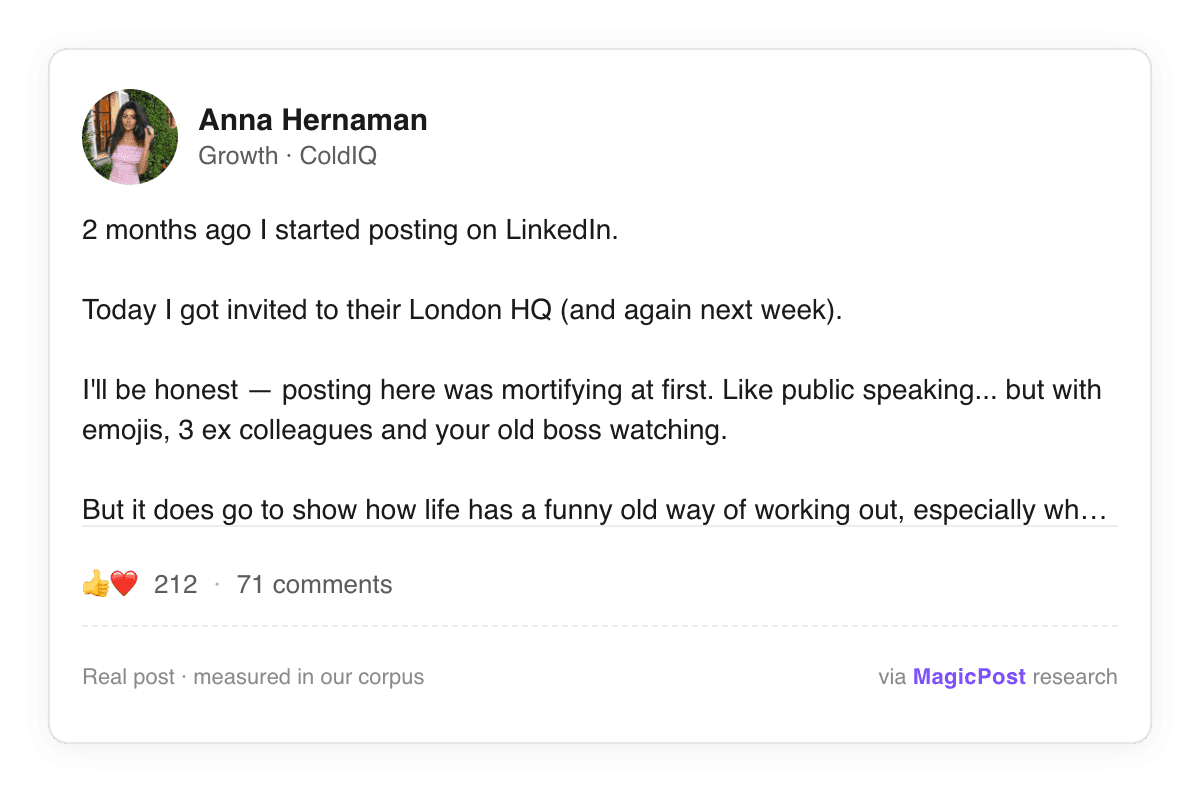
Bekijk de post van Anna Hernaman op LinkedIn ↗
Hernaman laat zien hoe een werkend advocacy-programma er van binnenuit uitziet: niet een ster die hoe dan ook zichtbaar zou worden, maar een scepticus die een reden en de ruimte kreeg, en uitgroeide tot een bijdrager van 41 posts per jaar.
Die omslag is, veel meer nog dan de cijfers van de oprichters, datgene wat de meeste bedrijven niet kunnen fabriceren.
Voor het bredere veld, de bedrijven die dit goed doen en die het slecht doen, zie ons overzicht van de bedrijven die echt winnen met employee advocacy op LinkedIn, of de vergelijkbare motoren bij Clay en lemlist.
Waar deze cijfers vandaan komen
Het aantal merkambassadeurs, het postvolume, de mediane engagement en de concentratie van ColdIQ zijn berekend uit ons onderzoekscorpus (2,8 mln. LinkedIn-posts; 1,2 mln. in het afgelopen jaar) door de auteur van elke post te koppelen aan hun huidige bedrijf en de profielen te tellen met minstens drie posts in het venster; de bedrijfspagina zelf is uitgesloten.
Elke getoonde post is gereproduceerd als een kaart uit ons corpus (tekst, media en engagement exact zoals geregistreerd) en linkt naar de live LinkedIn-post, geverifieerd bereikbaar in juni 2026; engagementcijfers veranderen in de loop van de tijd.
De post "elke medewerker beroemd" dateert van vóór ons venster van twaalf maanden en wordt aangehaald als een publieke intentieverklaring, niet als een gemeten cijfer.
Zoals bij al onze bedrijfsdata is het corpus oververtegenwoordigd in de B2B- en GTM-wereld en is het geen volkstelling, dus deze cijfers beschrijven de voetafdruk van ColdIQ zoals die in onze steekproef verschijnt. Correcties landen bij de volgende kwartaalupdate.
Benieuwd hoe het is om een bewust verspreid programma te runnen, niet alleen een luidruchtige oprichter? Je kunt een korte rondleiding met ons team boeken, of beginnen met de LinkedIn-content van je hele team op één plek beheren en zien hoe ver voorbij de oprichter je kunt komen.
Veelgestelde vragen
Heeft ColdIQ een employee advocacy-programma?
In de praktijk wel, en een ongewoon doelbewuste. Medeoprichter Michel Lieben heeft publiekelijk gezegd dat hij wil dat elke ColdIQ-medewerker beroemd wordt, en de groei van het bedrijf leunt op de persoonlijke LinkedIn-aanwezigheid van het team in plaats van op de bedrijfspagina.
In onze data postten vijf ColdIQ-mensen het afgelopen jaar minstens drie keer, samen goed voor 88.417 likes over 427 posts.
Hoeveel bereik genereert ColdIQ op LinkedIn?
Over de afgelopen twaalf maanden publiceerden de vijf gemeten merkambassadeurs van ColdIQ 427 posts met een mediaan van 176 likes per stuk, samen goed voor 88.417 likes op ruwweg 160.000 gezamenlijke volgers. Die mediane engagement ligt hoger dan bij de meeste grote ondernemingen die we hebben gemeten, hoewel ColdIQ een fractie van hun omvang heeft.
Wie zijn de belangrijkste LinkedIn-stemmen van ColdIQ?
Oprichters Michel Lieben (GTM-teardowns en oprichtersverhalen) en Alex Vacca (AI-systemen en tegendraadse meningen) lopen voorop in volume en bereik.
Daaronder vertelt Ivan Falco de groei van demand gen, dekt Monika Grycz technische AI-go-to-market, en documenteert Anna Hernaman de weg van een senior operator van "personal branding is gênant" naar een vaste bijdrager.
Is de advocacy van ColdIQ echt breed verspreid, of alleen de oprichters?
Allebei. Het is meer verspreid dan bij de meeste bedrijven (de grootste poster is goed voor 63% van het bereik, tegenover 75-95% bij veel ondernemingen), maar het blijft oprichter-zwaar. De echte, moeizamer verworven vooruitgang is de tweede laag, Falco, Grycz en vooral Hernaman, die consequent post in hun eigen banen.
Wat kunnen andere bedrijven leren van ColdIQ?
Drie dingen: de leiding post als eerste en vaak, iedereen krijgt een baan die aansluit op hun échte expertise, en frequentie heeft meer effect dan perfectie. Het lastige voor de meeste teams is de inspanning per persoon, en dat is waar programma's stranden en terugvallen op de oprichter.

Employee advocacy op LinkedIn: 7 merken die het wél lukt (analyse van 1,2 mln. posts)
Het multipliereffect van employee advocacy is echt, maar alleen de bedrijven die hun hele team aan het posten krijgen, plukken er de vruchten van. We analyseerden 1,2 mln. LinkedIn-posts om te zien wie wint, waarom personeelsaantal niet de hefboom is, en hoe je de stille 97% aan het posten krijgt.

10 sterke voorbeelden van employee advocacy om in 2026 te volgen
De beste voorbeelden van employee advocacy voor 2026, waarvan er acht gemeten zijn op 1,2 mln. LinkedIn-posts (ColdIQ, Clay, lemlist, Gong, HubSpot, Microsoft, Salesforce, L'Oréal), plus twee klassiekers. Wat de bedrijven die uitblinken in advocacy echt doen, met cijfers erbij.
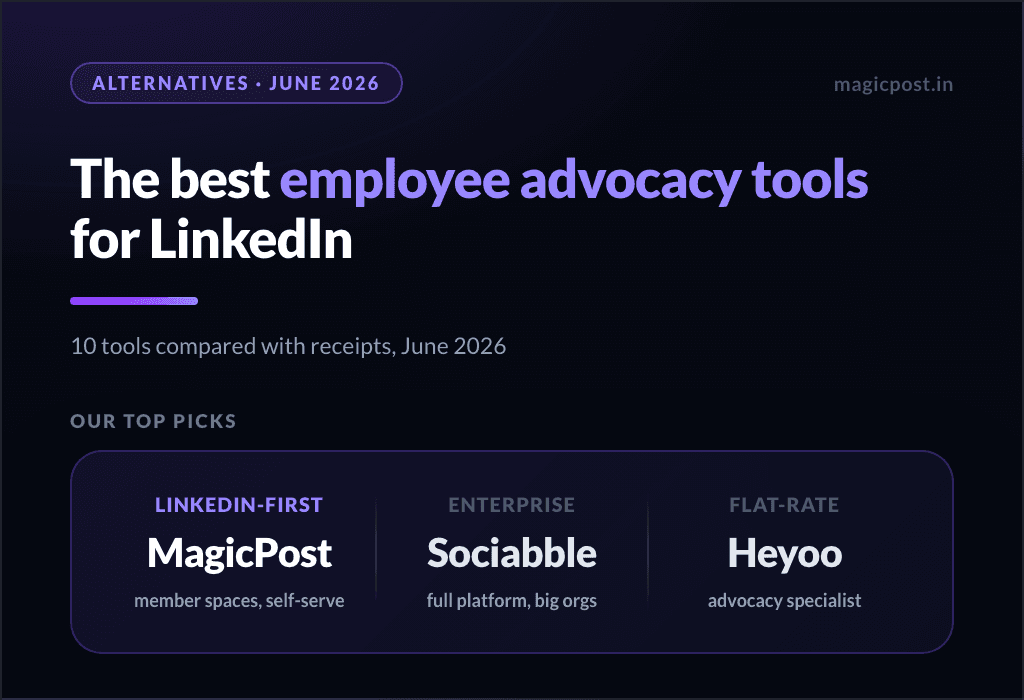
De 10 beste employee advocacy-tools voor LinkedIn (geverifieerd in juni 2026)
Van enterpriseplatforms tot selfservice-pilots: 10 employee advocacy-tools voor LinkedIn vergeleken op basis van bewijs, prijsmodellen en adoptiedashboards, juni 2026.
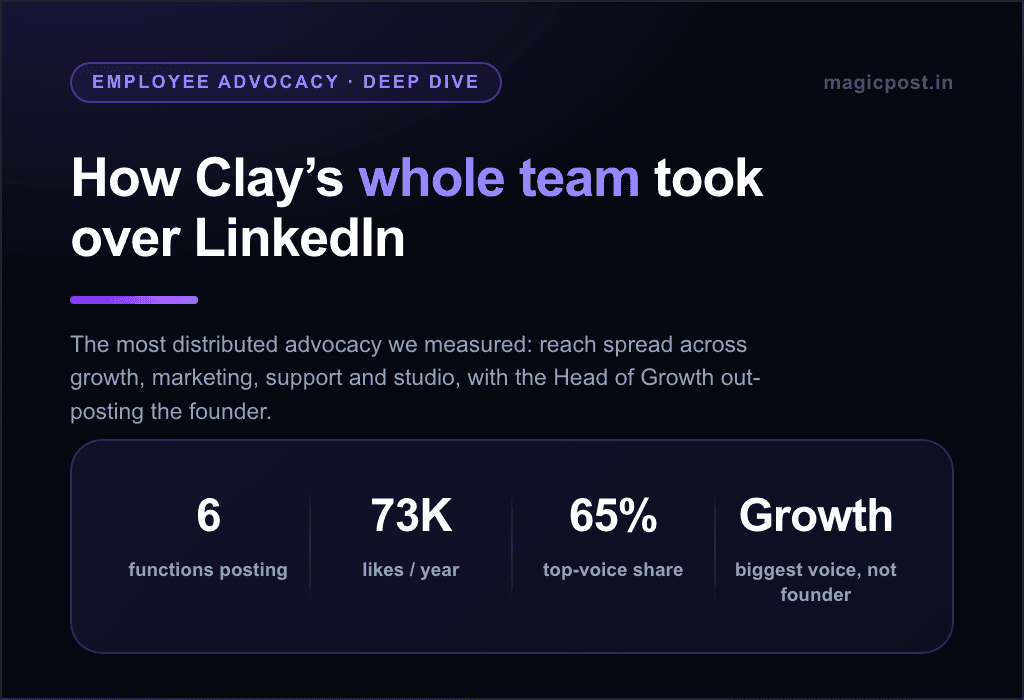
Hoe het hele team van Clay LinkedIn overnam (niet alleen de oprichters)
Clay is overal op LinkedIn, en de data laat zien waarom: het bereik is verspreid over growth, marketing, support en studio, met de Head of Growth die meer post dan de oprichter. We brachten Clays verspreide advocacy in kaart en wat je ervan kunt overnemen.
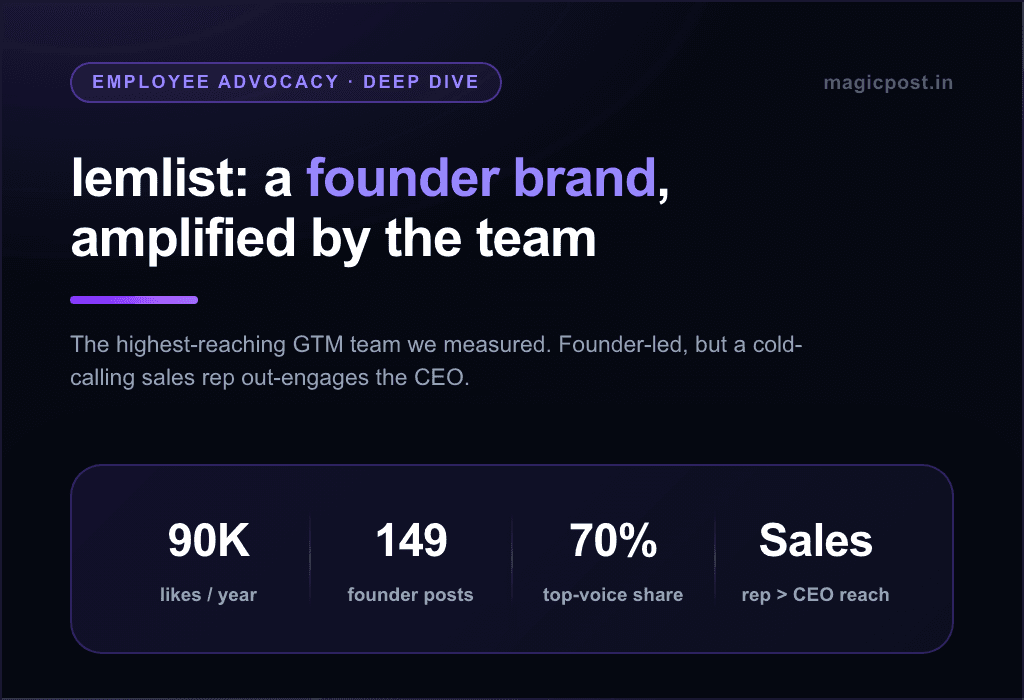
Het advocacy-playbook van lemlist: een founder-merk, versterkt door het hele team
Het LinkedIn-bereik van lemlist begint bij founder Guillaume Moubeche, maar het team draagt het: zelfs een salesmedewerker haalt meer engagement dan de CEO. We hebben de advocacy van lemlist gemeten, plus het founder-merk-plus-team-playbook dat het kopiëren waard is.
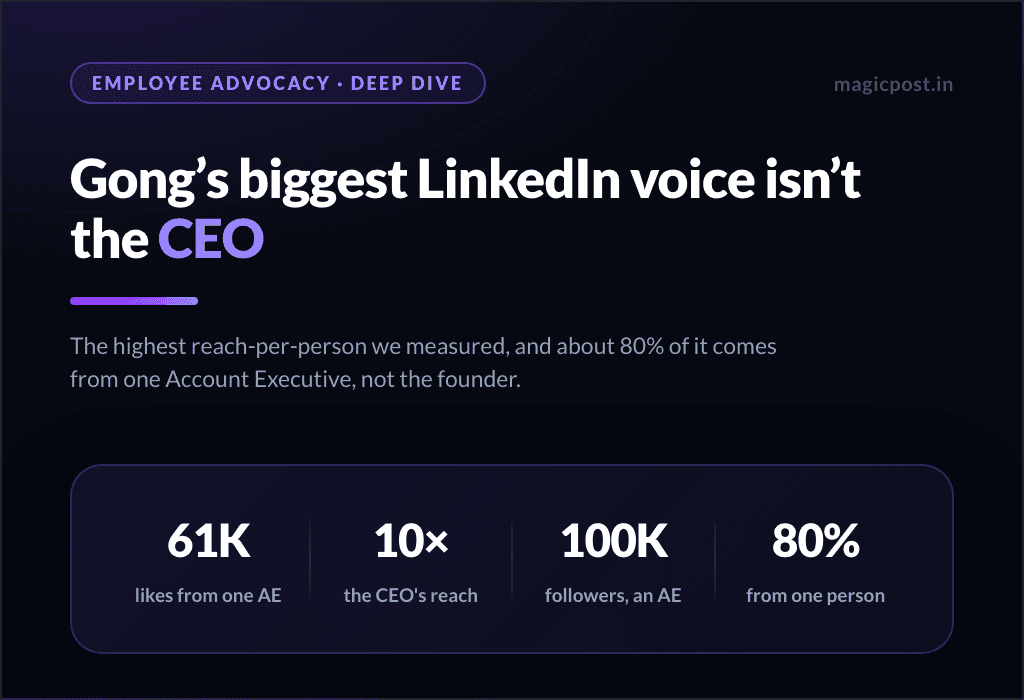
De grootste LinkedIn-stem van Gong is niet de CEO. Het is een verkoper.
Bij Gong is de grootste LinkedIn-stem met afstand een Account Executive, niet de CEO. Hij heeft meer dan tien keer zoveel bereik als de oprichter. We hebben de advocacy van Gong gemeten, en wat dat zegt over waar jouw echte LinkedIn-talent zich verstopt.
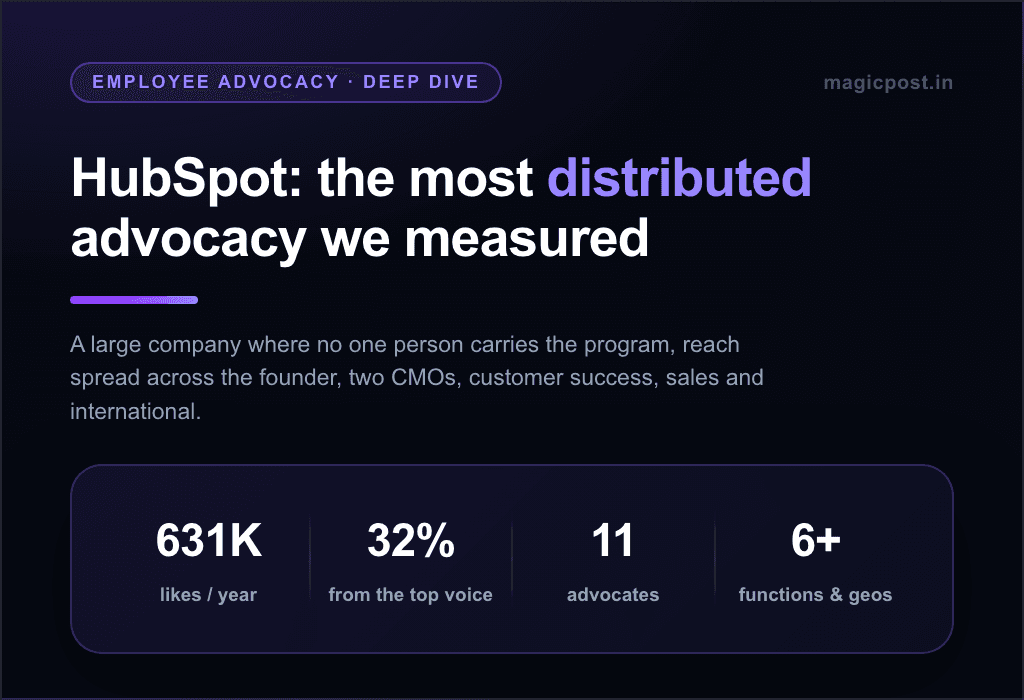
Hoe HubSpot zijn stem op LinkedIn bij elke functie liet horen, niet alleen bij de top
HubSpot draait de breedst verdeelde employee advocacy die we maten: het bereik ligt bij de oprichter, twee CMO's, customer success, sales en internationale teams, niet bij één persoon. We hebben het doorgemeten, sterretje van de overgenomen creators inbegrepen, en laten zien wat bedrijven ervan kunnen overnemen.