Every company figure on this page is measured from our own research corpus and over the twelve months to 7 September 2026. The method, and its limits, are spelled out at the end.
Employee advocacy has one of the most repeated promises in B2B marketing, and it happens to be true: your employees' combined networks dwarf your company page, so when your team posts, your reach multiplies.
LinkedIn's own figures put content shared by employees at roughly eight times the engagement of the same content on a brand page, and a workforce's networks are commonly around ten times larger than the company's follower base. The multiplier is real.
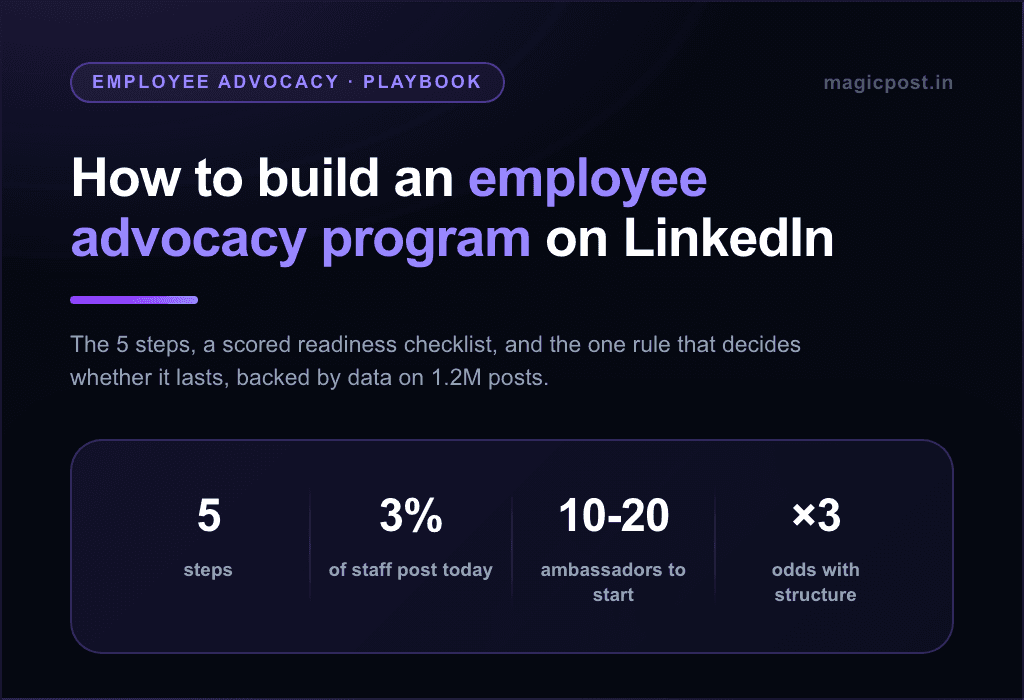
The catch is in a second number from the same research: only about 3% of employees ever share. So most companies never get the multiplier at all. They get one or two people, usually the founder, carrying the whole thing, while everyone else stays silent.
We wanted to see exactly how big that gap is, so we measured it.
Across 1,333,072 LinkedIn posts from 39,729 professionals in our corpus over those twelve months, we mapped who actually posts, how much reach they generate, and what separates the companies that capture the multiplier from the ones that leave it on the table.
In short, within the companies in our research corpus:
Sample: 1,333,072 LinkedIn posts from 39,729 professionals, twelve months to 7 September 2026.
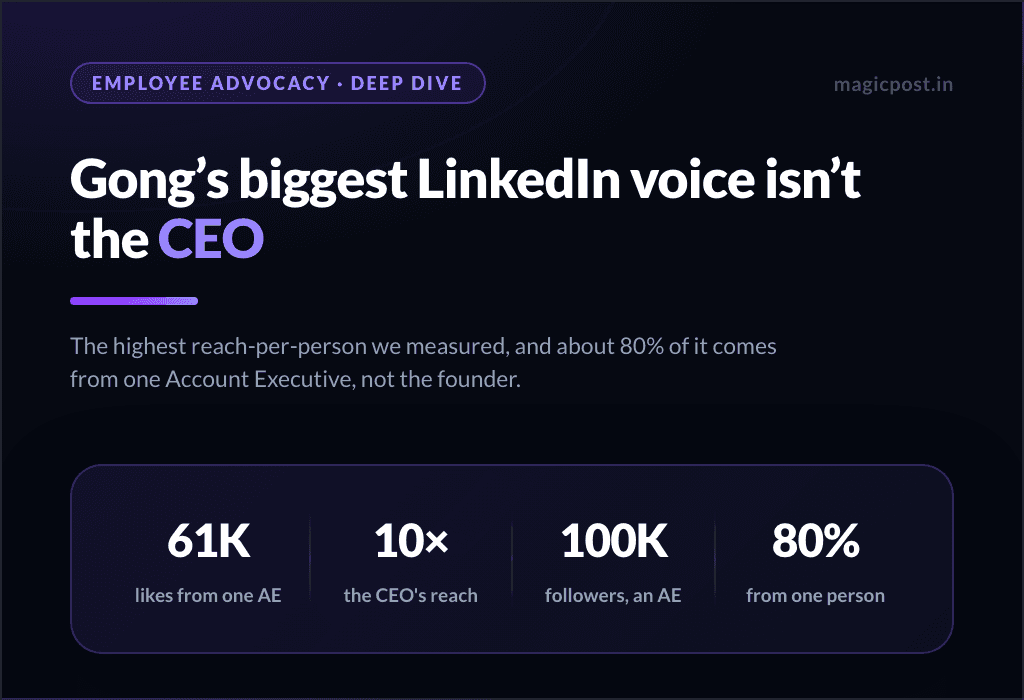
Concentration: one person produces 70% to 96% of company advocacy reach at ColdIQ, Capgemini, SAP, IBM, Oracle, Schneider Electric and Gong.
Distribution: the top poster carries 29% at HubSpot, 35% at AWS, 38% at Clay and 40% at Google.
Fragility: Salesforce went from 29% to 54% and ColdIQ from 63% to 96% in three months, each after one or two departures.
Headcount: Microsoft's 63 advocates post at a median of 81 likes; L'Oréal's 12 post at 310.
The companies that win spread the posting. Most are capped at one person.
The single clearest signal of whether a company is capturing the multiplier is how spread out its reach is. If many people post, the reach comes from many networks.
If it all comes from one person, the company is capped at that one person's audience, no matter how big the headcount behind them. So for a set of well-known companies we measured the share of all employee-advocacy reach produced by the single biggest poster.
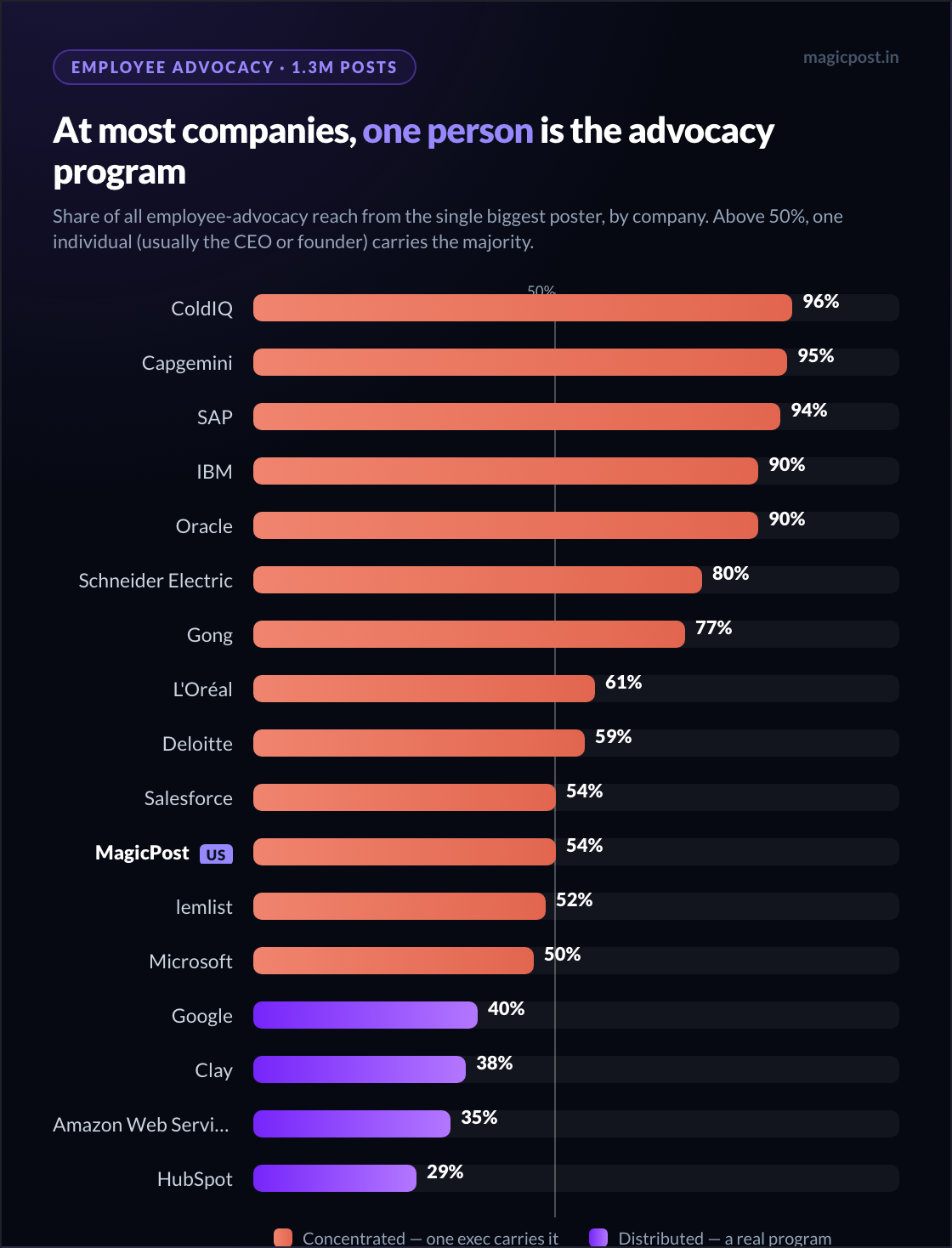
The split is stark. At most companies, one person accounts for 70% to 96% of everything: ColdIQ, Capgemini, SAP, IBM, Oracle, Schneider Electric and Gong all lean on a single founder, executive or star seller.
Eighteen people at IBM clear our activity bar; seventeen of them together are a footnote next to one. Those companies are not capturing the multiplier; they have a prolific executive, which is a different and far more fragile thing. The day that person slows down, the reach goes with them.
The companies that break the pattern are the ones to study.
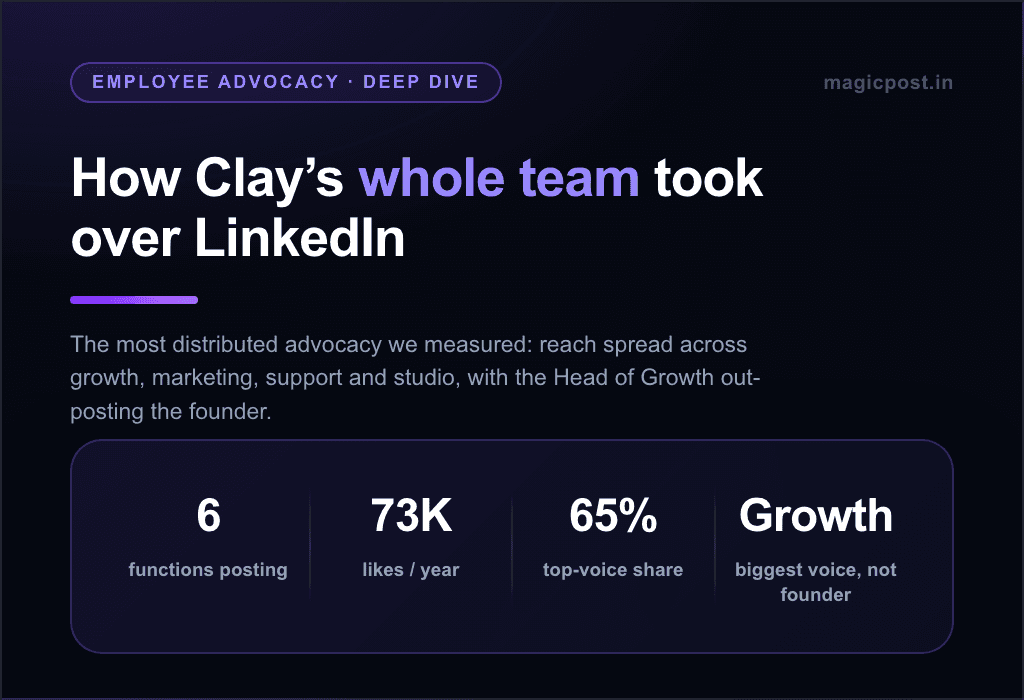
At HubSpot the top poster accounts for just 29% of reach, at AWS 35%, at Clay 38% and at Google 40%, meaning well over half of their reach comes from a genuinely broad cast, sellers, marketers, engineers, not one star.
The pattern breaks the other way too. Salesforce was the most evenly spread enterprise in our June measurement, at 29%; its widest voice has since left the company and the share is now 54%.
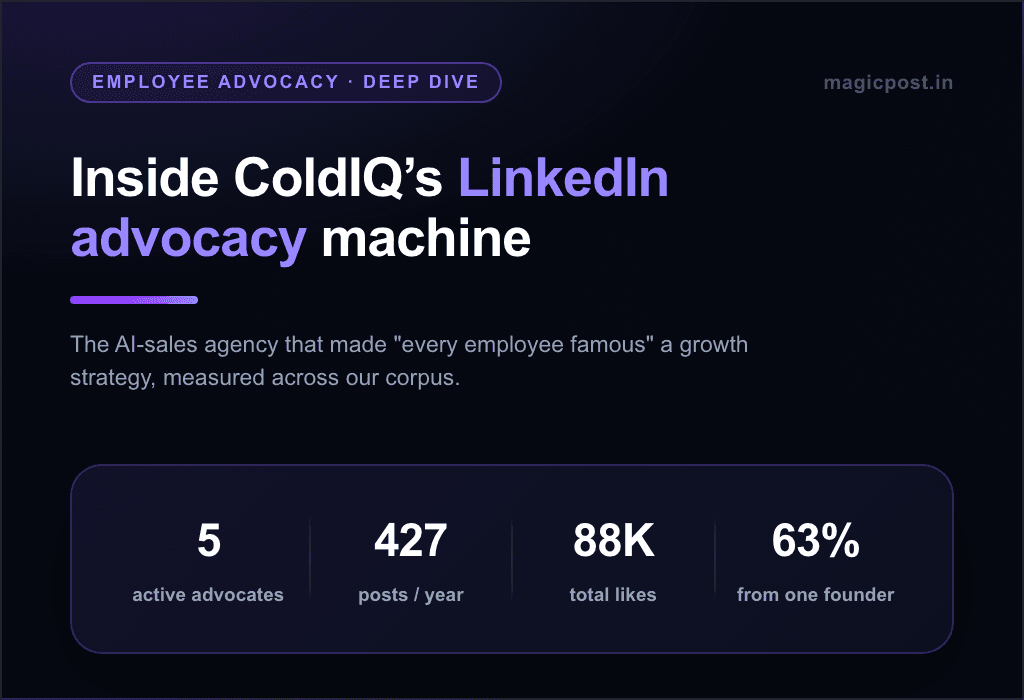
ColdIQ went from five advocates at 63% to two at 96% after two departures. Distribution is a practice, not a status.
For full disclosure, our own company does not sit in that band this time (54% across nine advocates, up from 41% in June), and we publish it precisely because the only program worth writing about is one you can measure on yourself.
The same goes for your own team. Before you decide your advocacy is working, look at the analytics that show where your reach actually comes from.
The gap between a Salesforce and an Oracle is not talent or headcount. It is how many people actually post. And that gap is exactly the reach most companies are leaving on the table.
To put a number on your own gap, estimate how much reach your team is leaving on the table.
It is not headcount. It is participation.
The obvious objection is that big companies should win automatically, more employees, more reach. The data says no. The companies with the most people posting are not the ones whose people get the most reach.
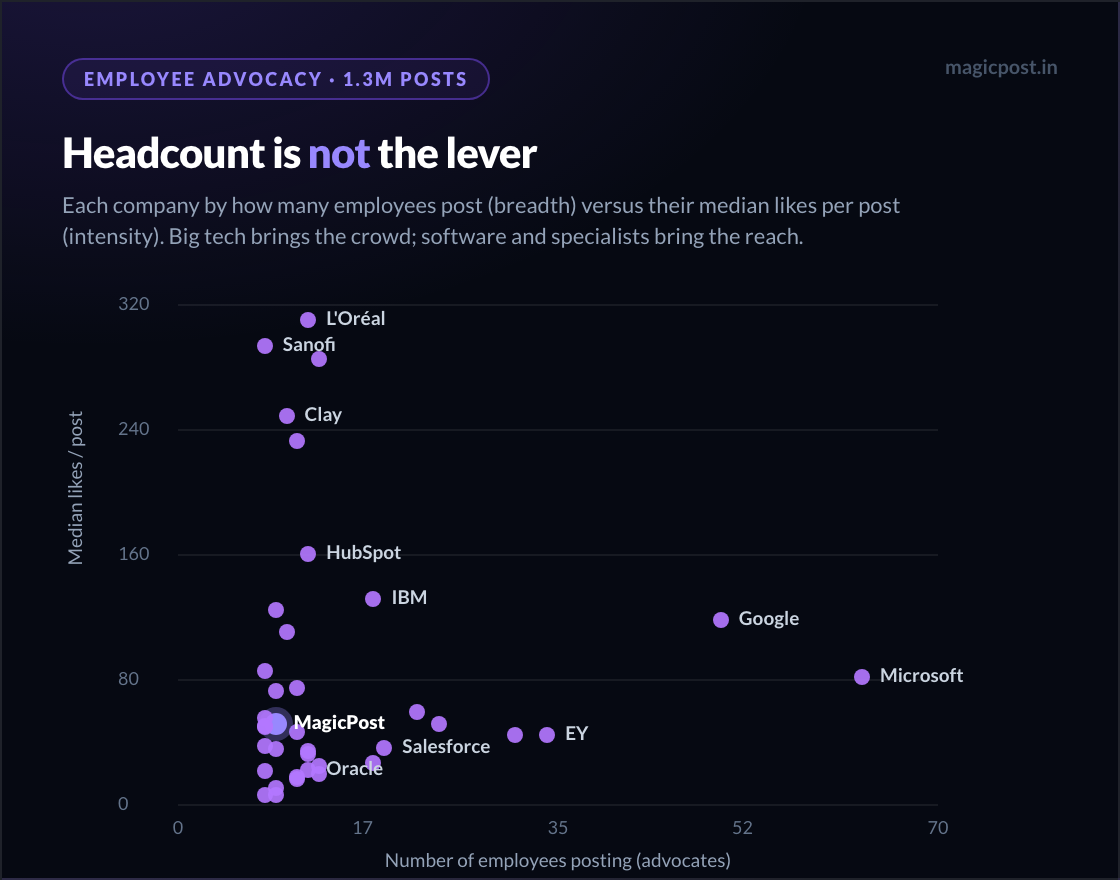
Microsoft has 63 employees clearing the bar, Google 50 and EY 34, real breadth, but their posts earn a median of 81, 118 and 44 likes. L'Oréal, Sanofi, Novo Nordisk and Clay, with 12, 8, 13 and 10 advocates, clear 310, 293, 285 and 248. Headcount is not the lever.
What the winners share is participation that is active and native: senior people posting like it is part of the job, in their own voice, with content built for LinkedIn rather than cross-posted to it. You do not need ten thousand employees.
You need a real cross-section of the ones you have, posting consistently.
Why the other 97% never post (and what gets them started)
If distribution is the whole game, the question becomes why so few employees ever participate. The reasons are mundane and they are the same everywhere: people do not know what to post, they do not have time to write it, and they are afraid of sounding wrong in public.
That is the entire reason advocacy collapses back onto the founder, and it is the thing a real program has to solve.
So a working program removes that friction: editorial direction so people know what to say, light coaching, recognition that makes participation rewarding, and tooling that makes a good post take minutes instead of an evening, while still sounding like the person whose name is on it.
That last point matters more than it looks, because the lazy fix, "just generate it with AI," backfires: generic, interchangeable content reaches 10 to 14% fewer people in our benchmark of millions of LinkedIn posts. The goal is not more posts; it is more people, each in their own voice.
This is the part we build for. Getting a whole team posting in their own voice, with the editorial scaffolding, adoption tracking and per-member voice AI that turns the silent 97% into contributors, is exactly what MagicPost's employee advocacy platform is designed to do.
The operating side of it, the cadence, the roles, the metrics, is in our practical guide to building an employee advocacy program on LinkedIn, and the platforms that support it are compared in our employee advocacy tools roundup and our wider roundup of the best employee advocacy tools for LinkedIn.
What it looks like when it works
The good news in the data: even lean GTM teams run distributed advocacy as well as the enterprise giants.
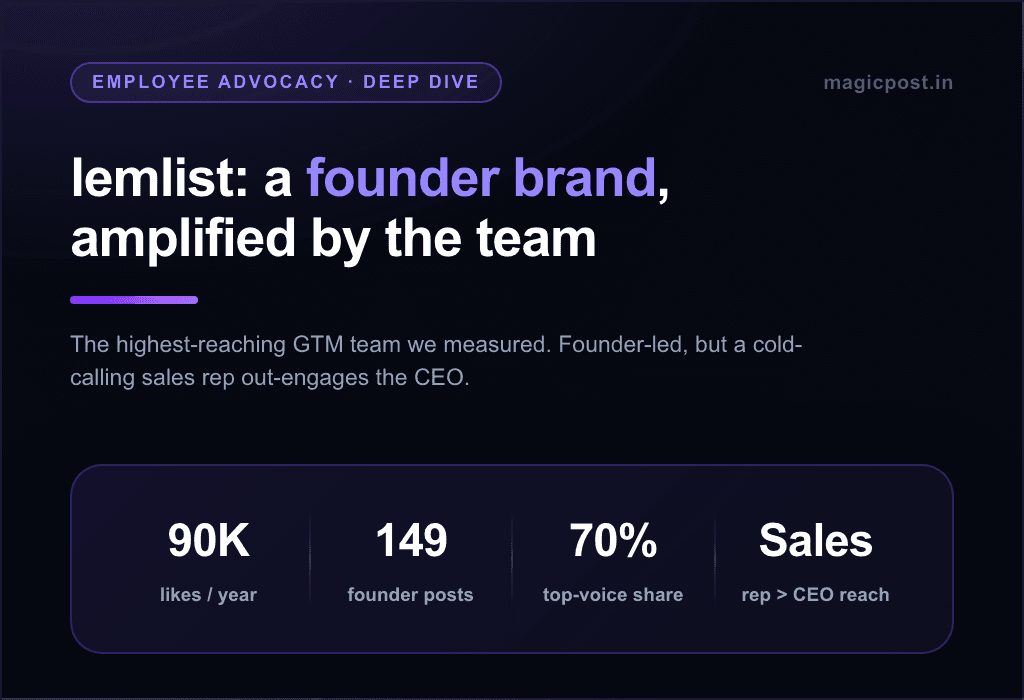
The leanest, hottest programs we measured are small GTM companies that simply decided everyone would post: Clay (ten people, 115k likes in a year, the most evenly spread team of the lot), lemlist (ten advocates, 116k likes) and Gong all out-post companies a thousand times their size.
ColdIQ, five people and 88k likes in our June measurement, is the cautionary tale: two of them have since left, and the program is two people today, 96% of it one founder.
The full set of stories, the ones doing it well and the cautionary ones, is in our roundup of the companies actually winning at employee advocacy on LinkedIn.
The pattern across all of them is the same: leadership goes first (in professional services, Deloitte's partner-led model is the clearest case), every person gets a lane that fits their real expertise, and the company makes posting easy enough that showing up beats burning out.
Where these facts come from
Every company figure here is computed from our research corpus of 3,249,988 LinkedIn posts (1,333,072 in the twelve months to 7 September 2026, from 39,729 distinct professionals), by matching each post's author to their current company and counting only profiles with at least three posts in the window.
Follower and reach figures are aggregated per person, never inflated across posts; the company's own page is excluded; non-company labels are filtered out.
We also removed a handful of creator-economy firms whose staff are individually famous (Anthropic, Substack and similar), because counting them would measure personal fame rather than a program.
One limit matters and we state it plainly: this corpus is made of profiles imported into our research set. It over-indexes the B2B, GTM, sales-tech and creator world, plus big tech, and it is not a census of LinkedIn.
Absence from our data does not mean a company has no advocacy, only that its people are not in our sample.
The external benchmarks we cite (the ~8x engagement figure, the ~10x network and ~3% sharing rules) are LinkedIn's own and widely published; the trust-in-people-over-brands pattern is documented in the Edelman Trust Barometer; and LinkedIn's official guide to employee advocacy is a useful primer. Corrections land at the next quarterly refresh.
Getting a whole team posting in their own voice is the job MagicPost is built for. To see what that looks like on your own team, book a short walkthrough with us.
How MagicPost tracks your team's activity and publishing calendar
FAQ
Does employee advocacy on LinkedIn actually work?
Yes, when it is distributed. LinkedIn's own figures put employee-shared content at roughly eight times the engagement of a brand page, and employees' networks are far larger than most company pages. But the multiplier only materializes when many employees post.
In our measurement of 1.3M posts, most companies' reach comes from a single person, which caps them at one network; the companies that get a broad cross-section posting are the ones that actually capture the multiplier.
Which companies have the best employee advocacy on LinkedIn?
By genuinely distributed reach in our 2026 corpus, HubSpot, AWS, Clay and Google stand out (their top poster accounts for 40% of total reach or less). Among smaller GTM specialists, Clay and lemlist run lean, high-engagement programs where most of the team posts; ColdIQ and Gong show how fast a program collapses onto one voice.
We profile them in our roundup and, program by program, in our employee advocacy case studies measured on the same corpus, as well as in individual company deep-dives, all measured rather than asserted.
Why do only a few employees post, and how do you fix it?
Around 97% of employees never share company content (LinkedIn's own figure), almost always because they do not know what to post, lack the time, or fear sounding wrong in public.
You fix it by removing that friction, not by mandating more posts: give people editorial direction and lanes that fit their expertise, recognize participation, and use tooling that makes a good post take minutes while still sounding like them.
That is the difference between a real program and a founder posting alone.
The adoption levers are detailed in our guide to employee advocacy adoption.
Is it better to have my CEO post or my whole team?
Both, but the whole team is where the upside is. A prolific CEO is valuable, yet our data shows that companies relying on one person are capped at that person's audience and are fragile, the reach disappears the moment they slow down.
The companies winning at advocacy pair leadership visibility with broad participation, which is what multiplies reach and makes it durable.
How do you measure employee advocacy?
We match each LinkedIn post in our corpus to its author's current company, count profiles with at least three posts in the trailing year as "advocates", and measure each company's advocate count, posting volume, median engagement, and how concentrated its reach is (the share from its single biggest poster).
Low concentration signals a genuinely distributed program; high concentration signals one person carrying the company.