" height="26.80529977783203px" id="tymKb8bqC" width="128.00300311279295px"/><path d="M 0 2.417 L 0 0 L 12.909 0 L 12.909 2.417 Z" fill="rgb(126, 78, 253)" height="2.417099999999998px" id="aYr4em6zK" transform="translate(128.341 22.325)" width="12.908999999999992px"/></svg>)

"/><stop offset="1" stop-color="rgb(118, 37, 250)"/></linearGradient></defs><g d="M 19.242 21.22 L 19.362 6.204 L 19.272 6.204 L 13.757 21.22 L 10.161 21.22 L 4.796 6.204 L 4.706 6.204 L 4.825 21.22 L 0 21.22 L 0 0 L 7.283 0 L 12.109 13.607 L 12.229 13.607 L 16.844 0 L 24.247 0 L 24.247 21.22 Z M 26.421 26.113 L 26.421 23.445 L 41.407 23.445 L 41.407 26.113 Z" fill="transparent" height="26.112508199679183px" id="DvfaAIHYn" width="41.40731898311435px"><path d="M 19.242 21.22 L 19.362 6.204 L 19.272 6.204 L 13.757 21.22 L 10.161 21.22 L 4.796 6.204 L 4.706 6.204 L 4.825 21.22 L 0 21.22 L 0 0 L 7.283 0 L 12.109 13.607 L 12.229 13.607 L 16.844 0 L 24.247 0 L 24.247 21.22 Z" fill="rgb(46, 46, 46)" height="21.220180016149442px" id="pLsxRCobd" width="24.247352589074694px"/><path d="M 0 2.668 L 0 0 L 14.986 0 L 14.986 2.668 Z" fill="url(%23yD9d4I5GR-3279285344-linear-gradient)" height="2.6675085048549647px" id="yD9d4I5GR" transform="translate(26.421 23.445)" width="14.986002836263765px"/></g></svg>)

Naïlé Titah
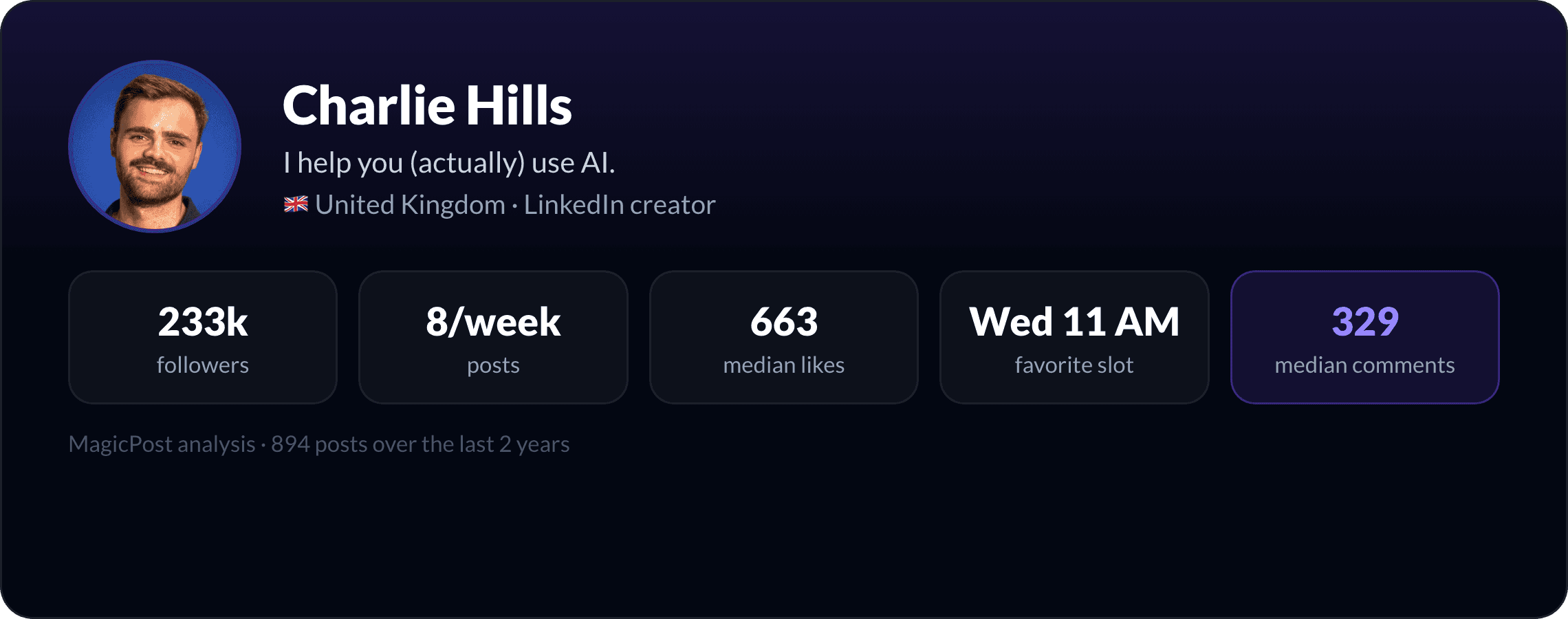
Charlie Hills's headline is four words long: "I help you (actually) use AI." He is one of the UK's most-followed AI marketing voices, and the parenthesis is the whole brand. At MagicPost, we analyzed 894 of his LinkedIn posts (his full public run back to early 2024): what he writes, when, for whom, what works for him, and what makes his style worth studying.
This is who Charlie Hills is, according to the best possible source: his own posts, measured. And the first thing the data shows is a man who turned his own follower count into a serialized story he could re-ship every few months.
His story, in his own posts
Hills is unusually transparent about his own arc, and our data shows he tells it on a loop. The spine is the same every time.
The reset. He dates the start precisely. "It all started on Christmas Day 2023. I reset everything after months of struggle. I committed to posting daily with a plan," he wrote. The "before" is always the same line: "My posts were getting little to no engagement. So, I decided to revamp my profile and strategy."
The job he left. The origin has a villain. "A CEO once told me: 'You're not worth that salary.' Now, I make 5x through LinkedIn," he recounts, dating his exit to "September 2024" after "just over a year at the company." In his own framing: "One year ago today, I traded my 9-to-5 for a 9-to-24/7."
Who he is off the feed. At 150k followers he wrote a full self-portrait: "I'm Charlie. I'm 27 years old. I now live in London... I grew up in rural Sussex, UK. I come from a family of farmers... I grew up with a stutter and delayed speech. I launched a failed startup right after university," closing with the line that explains the brand: "Why I started this personal brand? Not to earn more, but to live more."
The vulnerability he keeps. Unlike most growth creators, Hills posts the hard parts repeatedly. "I grew up with a stutter, had delayed speech, and suffer from anxiety," he wrote before a speaking gig, and elsewhere: "I live with Hidradenitis Suppurativa. A painful, invisible condition that few understand."
Here is the finding no ordinary bio would surface. His single most-repeated post is his own follower count, with the number swapped each time. "I rebuilt my LinkedIn strategy from scratch" runs at least four times in our data, identical skeleton, escalating headline: "from zero to 35k+ in 278 days," then "from zero to 55k+ in 365 days," then "from zero to 115k+ in 494 days," then "from 10k to 100k+ in <365 days." Same 16-step playbook inside, same "Post Tues-Thurs" advice, just a bigger number on the marquee. The milestone post is not a post for Hills, it is a franchise, and the product is the growth itself.



What he actually talks about
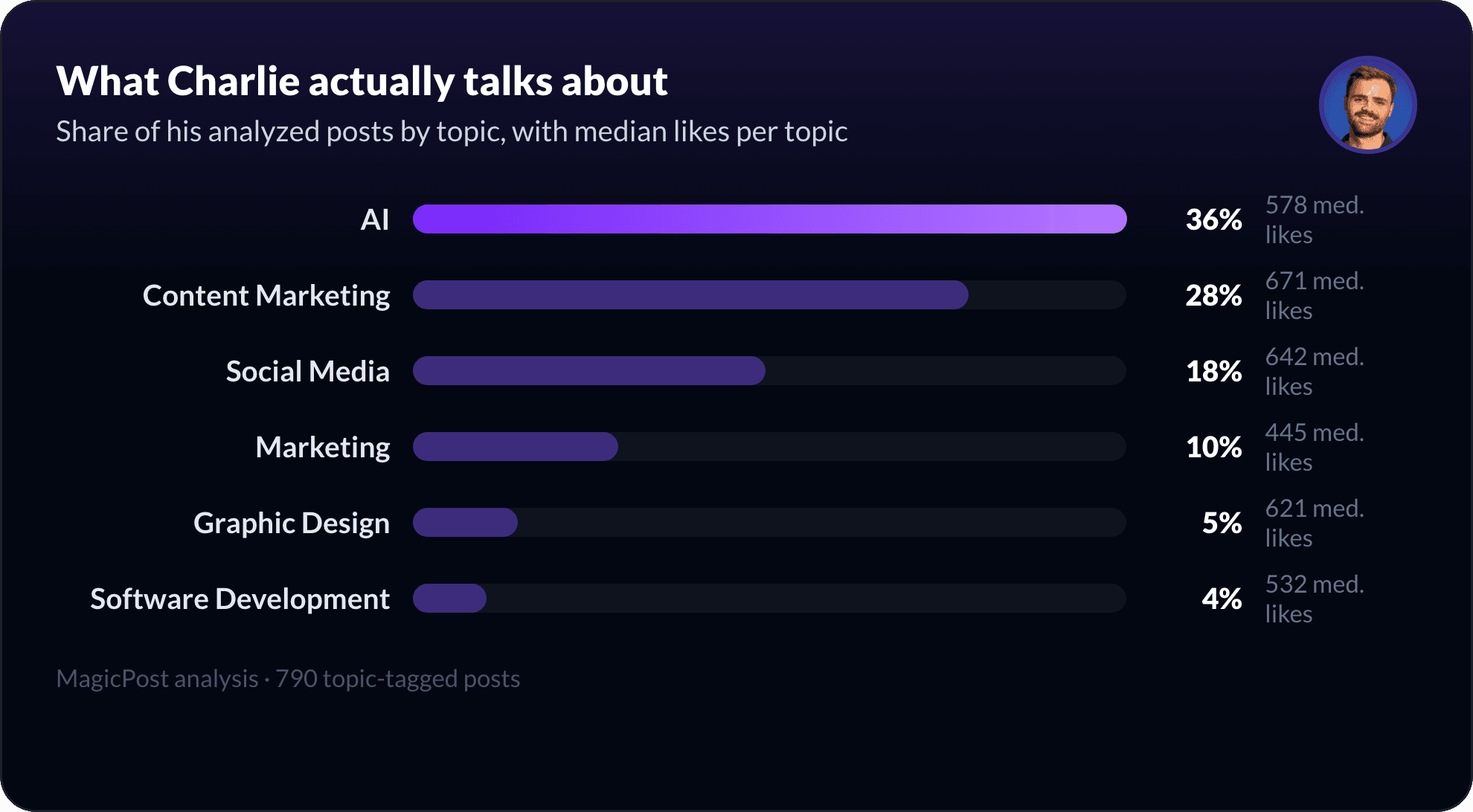
The headline matches the headline: AI is his single biggest topic (about 281 posts), trailed by content marketing and social media. Two numbers below the ranking are more telling:
LinkedIn itself is his best-performing theme (about 870 median likes versus a 663 overall), even though he writes about it less than AI. When the AI guy talks about the platform he is standing on, his audience engages hardest, which is exactly why his growth-milestone posts keep working.
Sorted by register rather than topic, his most common post type by far is value-first selling (about 223 posts), followed by best-practice guides and useful resource round-ups. Hills rarely posts opinion for its own sake. Nearly every post hands you a list, a tool, or a step, and the offer is folded inside the help.
Who he writes for
His reader is the corporate employee who suspects there is a side door, and the early creator who has not found traction yet. He addresses them directly: "if you're reading this as an employee. Think about building your personal brand," and "if you're on the fence about going solo," then "build your brand while employed. Batch create on weekends. Stack your safety net high. Then jump." The promise is reassurance plus a tool stack: "No matter who you are, it helps you attract clients, it enhances your networking, it boosts your visibility."
His best posts of 2026
His three biggest posts of 2026 so far, reproduced from our data (click through to the originals):
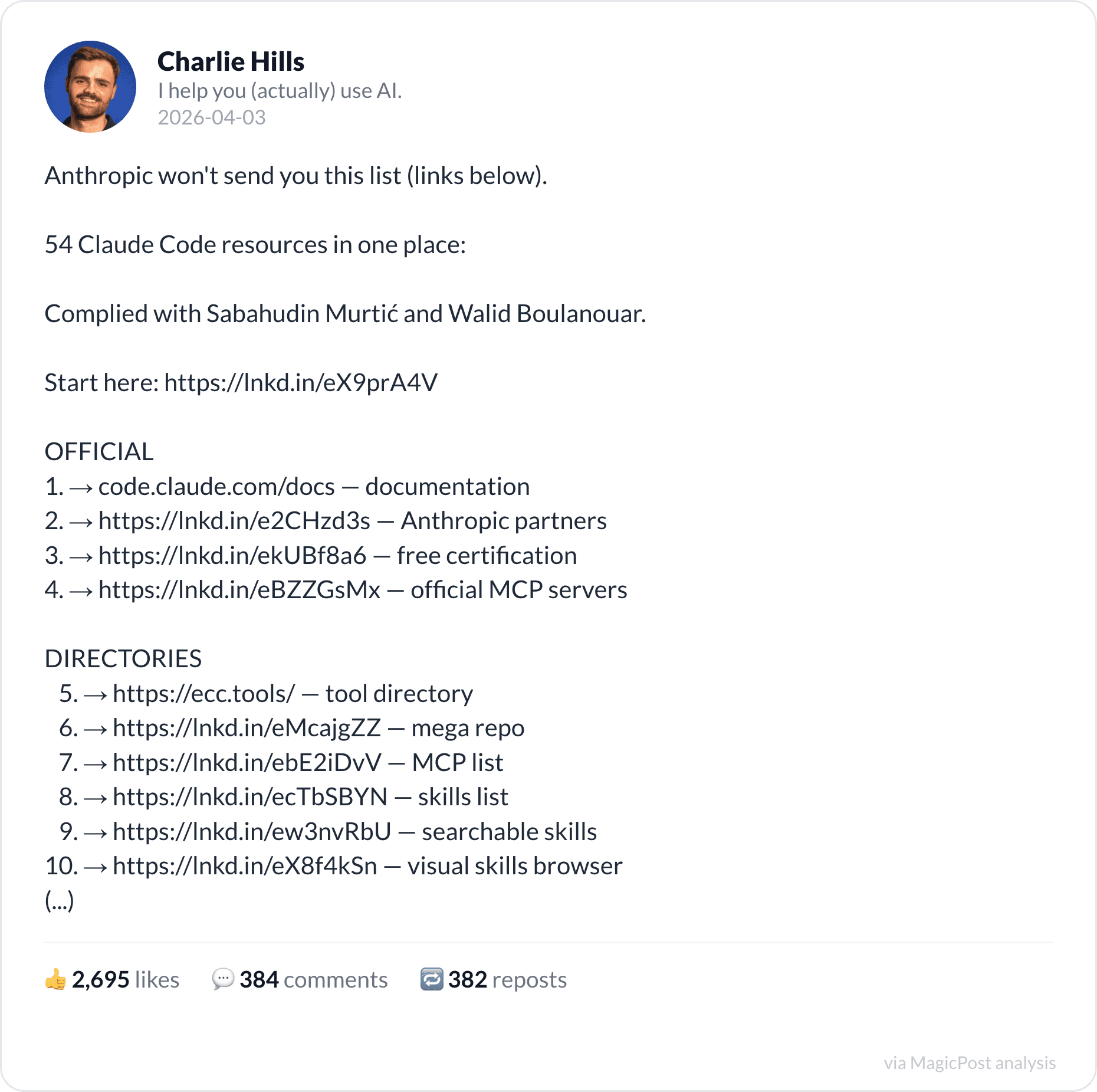
2,695 likes. A 54-link resource dump, "Anthropic won't send you this list," closing with "Repost to help someone in your network." Pure save-and-share utility: the post is a reference document, so people bookmark and reshare instead of scrolling past.
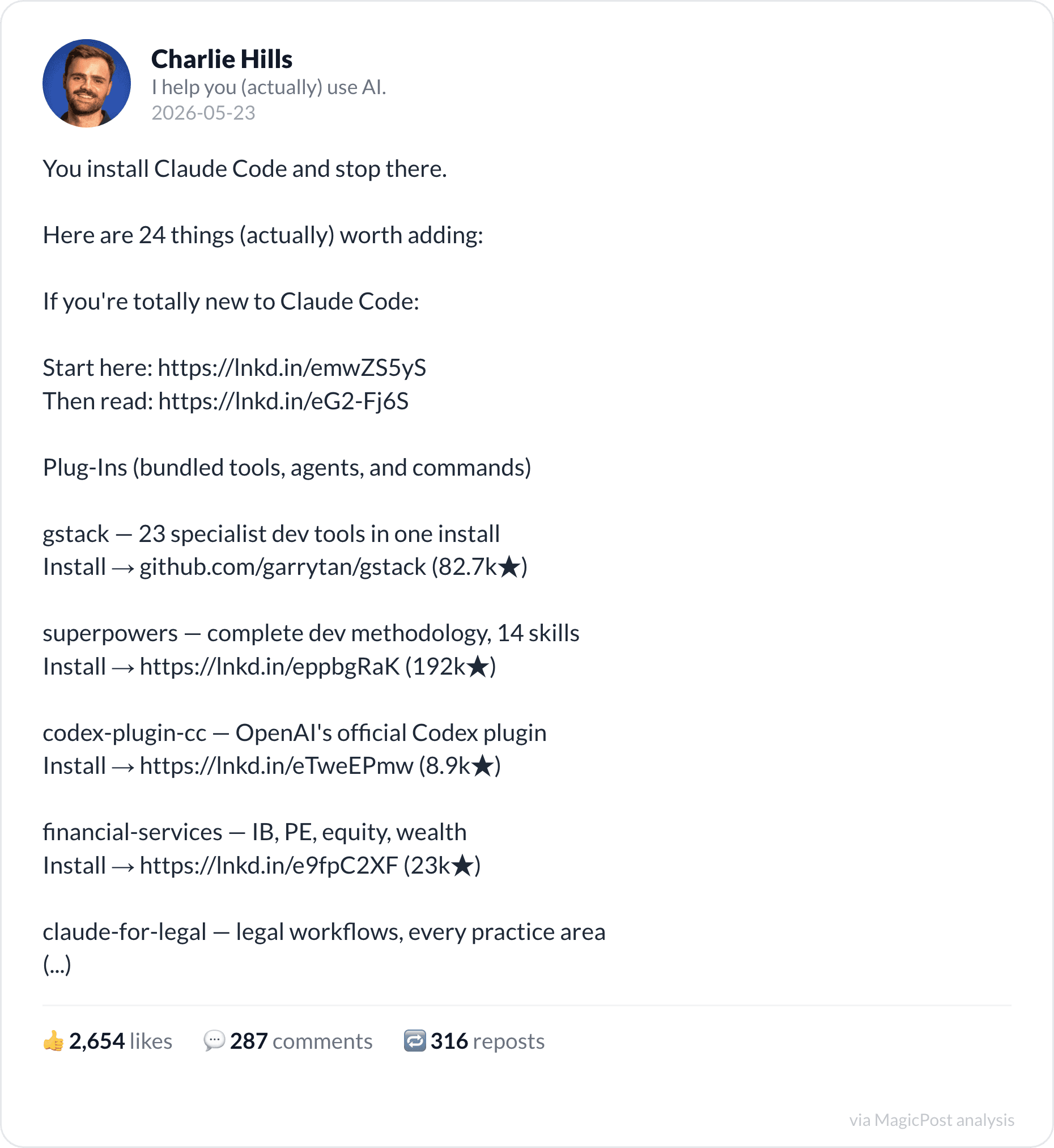
2,654 likes. "You install Claude Code and stop there. Here are 24 things (actually) worth adding." The "(actually)" is his signature tic, and the format is the same engine: a curated install list you would lose if you did not save it.
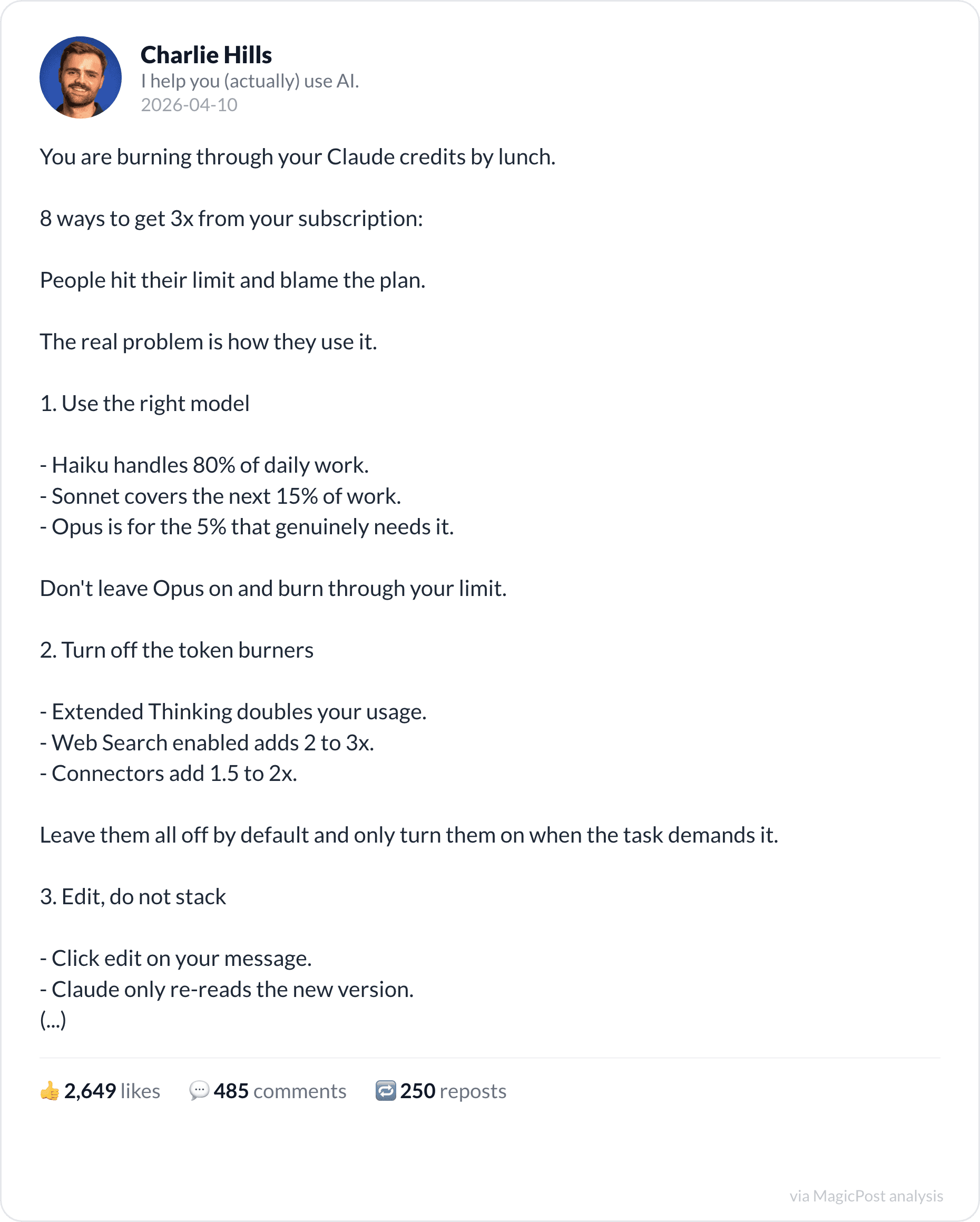
2,649 likes. "You are burning through your Claude credits by lunch. 8 ways to get 3x from your subscription." A problem-you-feel hook ("by lunch") on top of an eight-step fix. All three winners are the same shape: a sharp pain, then a numbered toolkit you want to keep.
Is he still growing?
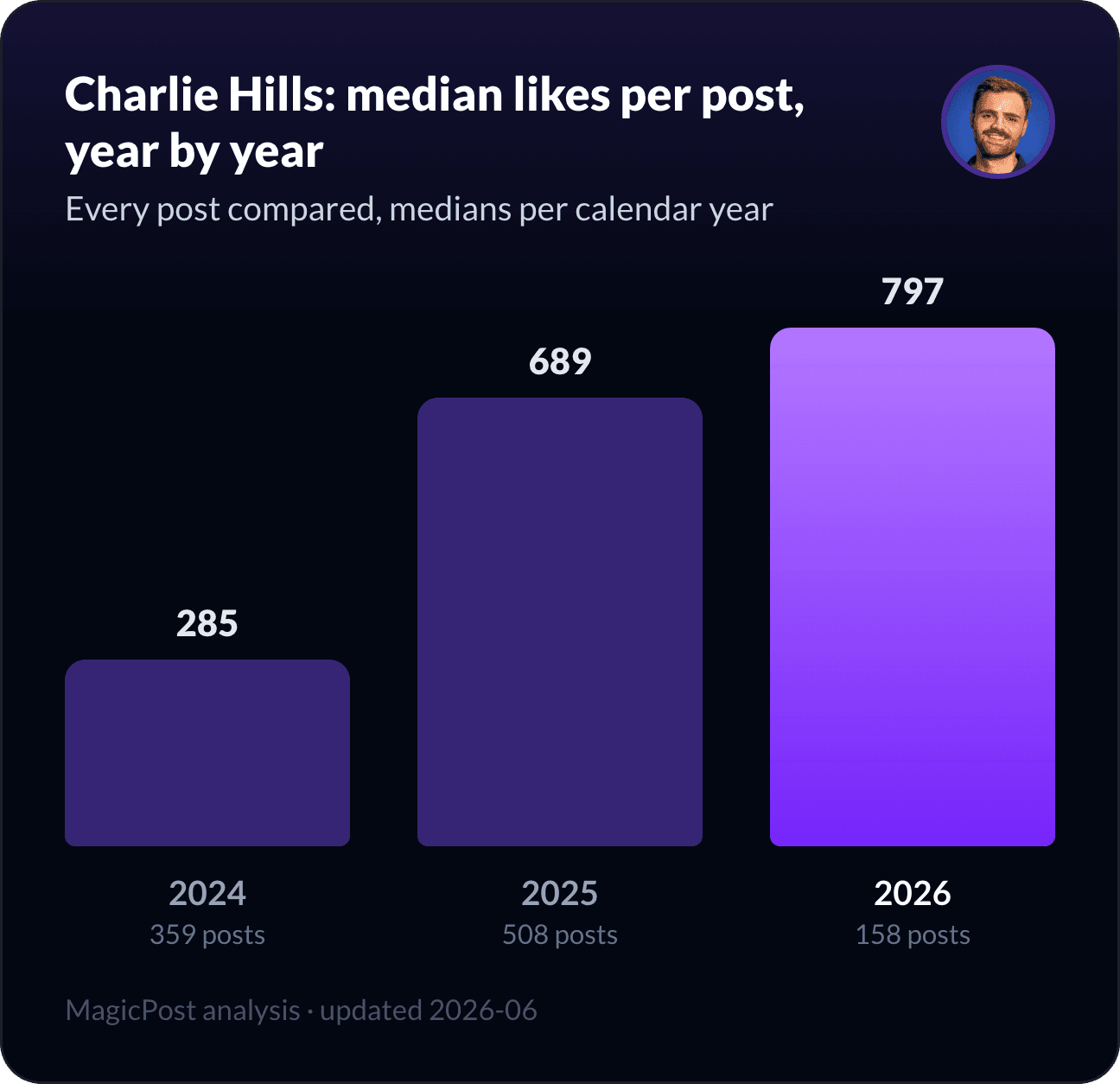
Yes, and steeply. His median post went from about 285 likes in 2024 to 689 in 2025, and 797 so far in 2026, roughly a 2.8x rise across two years while his volume stayed high. That is the rarer trajectory: many creators see engagement compress as they scale, and Hills has done the opposite. One honest note: we measure engagement per post, not followers over time, so this is the story of how hard his posts hit, not a follower curve.
Where do these charts come from? Everything on this page runs on MagicPost's LinkedIn analytics, and it works on your profile too: your best posts, your audience, your benchmark, even a side-by-side with creators like Charlie Hills.
How he writes (the maximalist fingerprint)
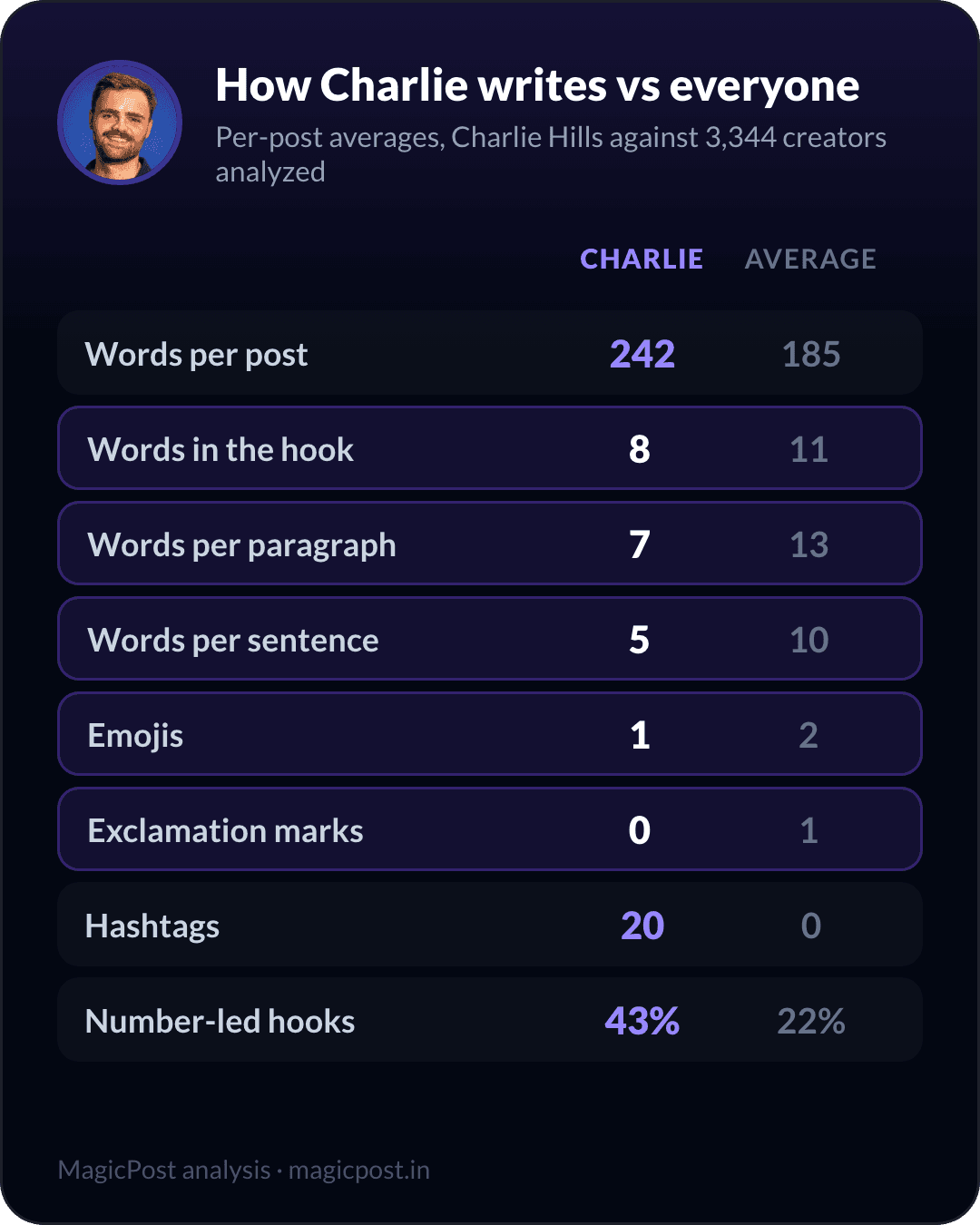
Here is Hills measured against the average creator, and the surprise is that his numbers point in two directions at once:
Metric (per post) | Charlie Hills | Average creator* |
Words | ~242 | 185 |
Words in the hook | 8 | 11 |
Words per paragraph | 7 | 13 |
Words per sentence | 5 | 10 |
Emojis | 1 | 2 |
Hashtags | 20 | 0 |
Exclamation marks | 0 | 1 |
Hooks built on numbers | 43% | 22% |
*Median across the 3,344 creators we analyzed with 20+ posts each.
The interesting tension: inside the lines he is Spartan, around the lines he is maximalist. His sentences run five words against the average ten, his paragraphs seven words against thirteen, the tight white-space rhythm that scans fast on mobile. But the post itself is long (about 242 words against 185) and heavily decorated: roughly 20 hashtags per post against a benchmark of essentially zero, plus about 14 bold passages, the most aggressive formatting in our entire sample. Nearly half his posts open on a number ("8 ways," "24 things," "54 resources"), twice the typical rate. The signature is not minimalism, it is a packed, scannable, list-shaped post engineered to be saved.
The "AI tells" in his style (read this the right way)
Run the AI guy's own writing through the patterns people now call "AI tells," and the result is honest and a little funny:
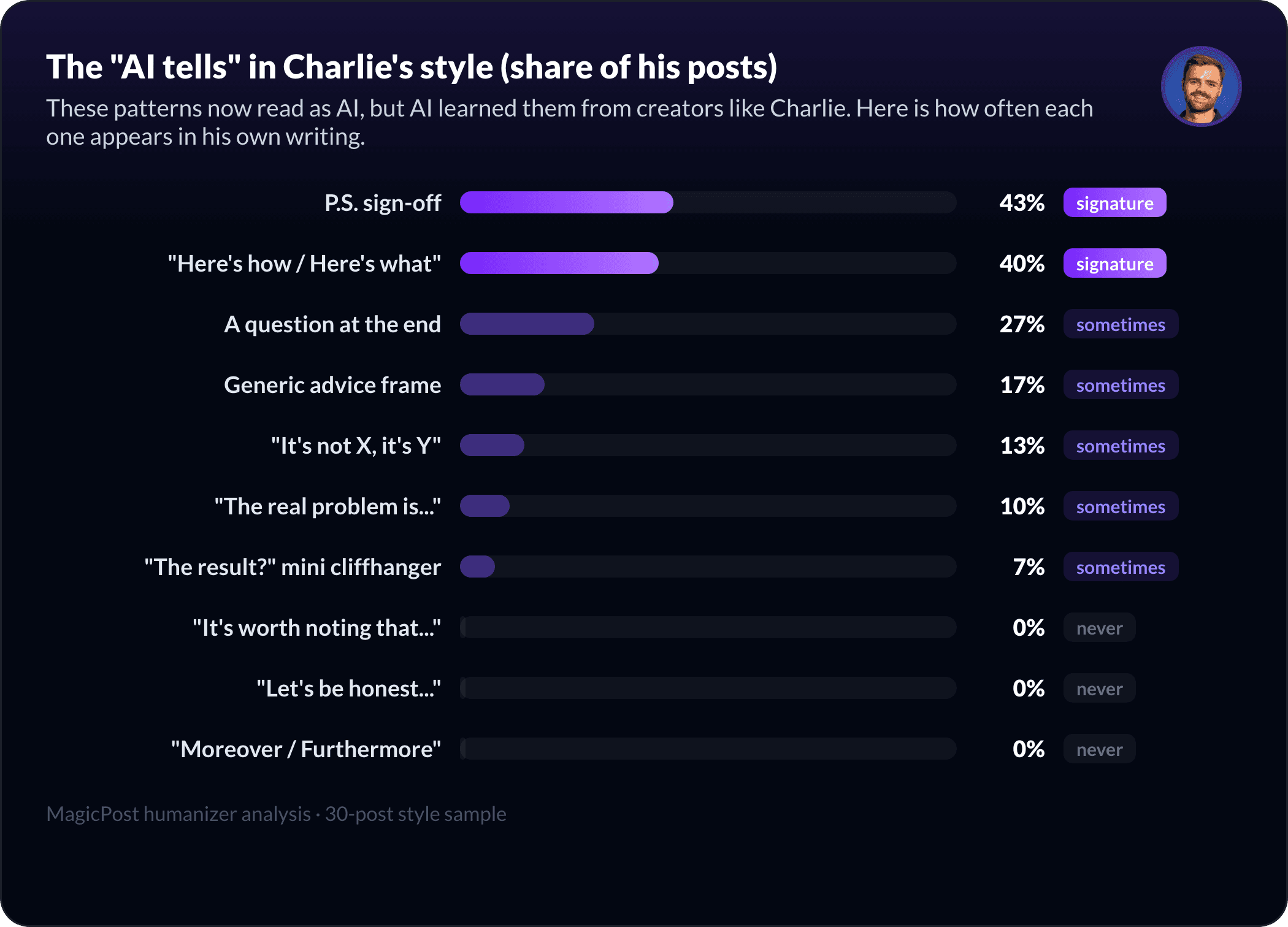
His two characteristic moves are exactly the ones AI loves: a "Here's how" / "Here's what" opener in about 40% of posts, and an automatic P.S. sign-off in about 43% ("P.S. Which one are you installing first?"). A quarter close on a question; about one in eight reach for the "It's not X, it's Y" contrast formula.
Do not read it backwards. Hills does not write like an AI; AI writes like Hills. These moves read as robotic today because the models trained on high-performing creators like him and then deployed every device at once, in every post. Hills uses the opener and the P.S. where they actually earn a click, and the other half of his fingerprint is what AI cannot resist adding and he simply does not: he never hedges ("it's worth noting that..."), never opens a line with "Moreover," never fakes a profound aside. For the man whose pitch is to "(actually) use AI," that discipline is the proof of concept. (Full story: how to spot AI writing on LinkedIn.)
When he posts
Hills publishes about 8.6 times a week, favorite slot 11 AM UK time on a Wednesday, with about 28% of his posts landing on weekends. That late-morning rhythm matches what our UK timing data flags as a strong British window, when the working day is in full flow rather than the early-bird rush. His near-daily volume sits at the busy end of what our posting-frequency study measured, and he built it deliberately: "I've posted every single day. Rain or shine," he wrote. And if part of your own plan is showing up in his comments, that is exactly what an engagement feed is for: his posts, every day, without hunting the timeline.
What to steal from Charlie Hills
Serialize your milestone. His "I rebuilt my LinkedIn strategy" post ran four times with a bigger number each time, and it worked every time. Your progress is reusable content, not a one-off announcement.
Build the save, not the scroll. His three biggest 2026 posts are reference lists people bookmark. Aim for posts worth keeping, not just reading.
Lead with a number. Nearly half his hooks are numbered ("8 ways," "54 resources"), double the average. A count sets a clear promise the reader can feel.
Tight inside, generous outside. Five-word sentences for readability, a long useful body for value. Short rhythm does not have to mean a short post.
Keep the human parts in. The stutter, the anxiety, the failed startup, he posts them on purpose, and they outperform pure tactics. Vulnerability is part of the engine, not a detour from it.
Study him, then study yourself. With MagicPost you can dig into Charlie Hills's numbers the way we just did, analyze your own LinkedIn analytics with the same depth, and write in the spirit of his style. The data on this page is the product.
Where this data comes from
Everything in this article is MagicPost's own research. MagicPost analyzed 894 Charlie Hills posts from his full public run back to early 2024: timing, engagement, topics, writing metrics, and the AI-pattern profile from a 30-post style sample. Every biographical claim is quoted from one of his own public LinkedIn posts and linked to it. Hills is not affiliated with MagicPost; his style is one of those we track most closely, which is why we built this page.
Veelgestelde vragen
Who is Charlie Hills?
A UK-based AI marketing creator (London, originally from Sussex) who runs a LinkedIn content agency and, by his own account, started posting daily on Christmas 2023, left his job in September 2024, and grew past 230,000 LinkedIn followers. His headline is "I help you (actually) use AI."
How does Charlie Hills make money?
By his own public posts: a LinkedIn content agency, a paid bootcamp ("50+ students"), brand and tool collaborations, and a newsletter. He says he "now earns 5x" his old salary through LinkedIn, though he shares no audited revenue figure.
How often does Charlie Hills post on LinkedIn?
About 8.6 posts a week in our data, most often at 11 AM UK time on a Wednesday, with roughly 28% of his posts on weekends.
Does Charlie Hills write with AI?
He openly builds with AI, it is his entire beat, yet his fingerprint is more disciplined than most: he never hedges and never fakes depth. The twist is that AI tools learned from creators like him, which is why two of his signature moves (the "Here's how" opener and the automatic P.S.) are now mislabeled as AI tells.
Is Charlie Hills still growing on LinkedIn?
On engagement, yes: his median likes per post rose from about 285 in 2024 to 689 in 2025 and 797 into 2026, against the more common pattern of reach compressing as a creator scales.
Can I write like Charlie Hills?
You can learn the mechanics: MagicPost learns a creator's writing style (length, rhythm, hooks, signature moves) and helps you write in that spirit, in your own voice.
</content>
</invoke>
The Top LinkedIn Creators to Study in 2026 (By the Data)
The top LinkedIn creators to study in 2026, by the data: 62 creators, six languages, 27 countries, 32,000 posts analyzed by MagicPost. Grouped by what they teach.
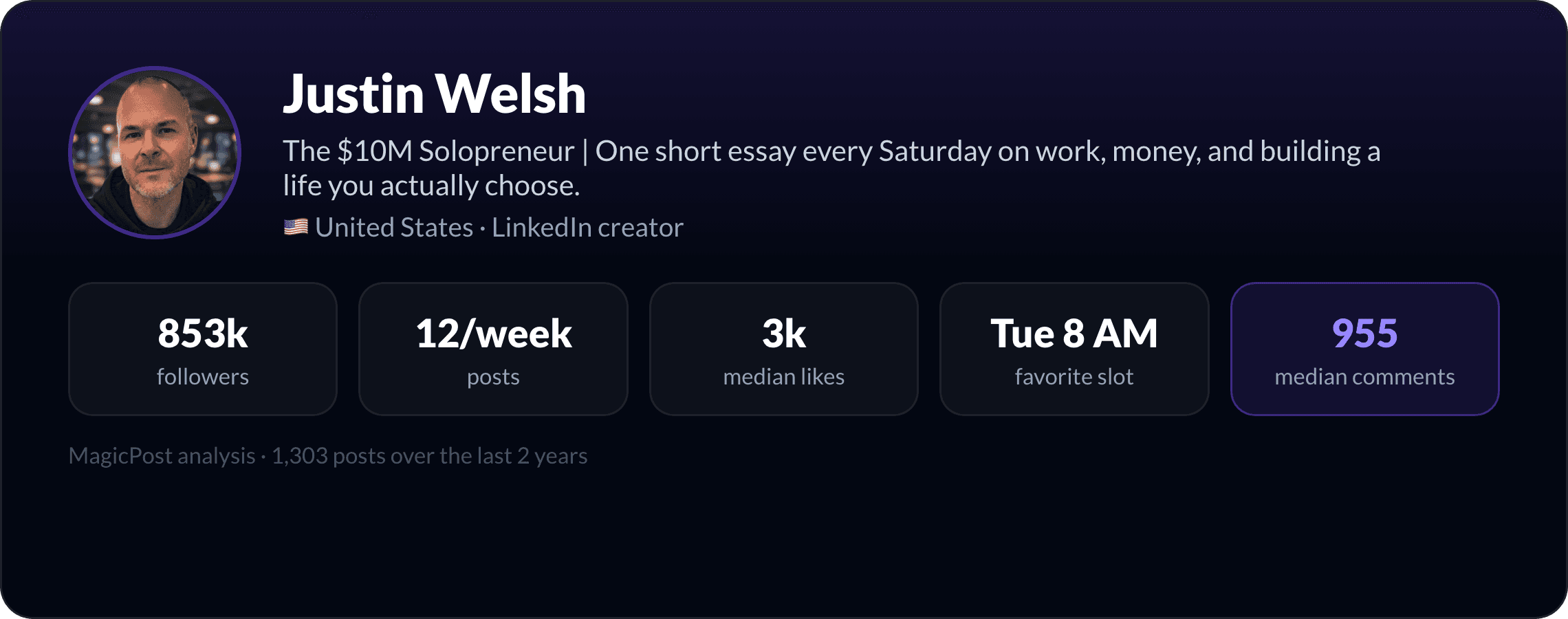
Who Is Justin Welsh? The $10M Solopreneur, Explained by Data (2026)
Who is Justin Welsh? MagicPost analyzed 1,303 of their LinkedIn posts: topics, timing, signature moves and the writing fingerprint behind their growth, with rea
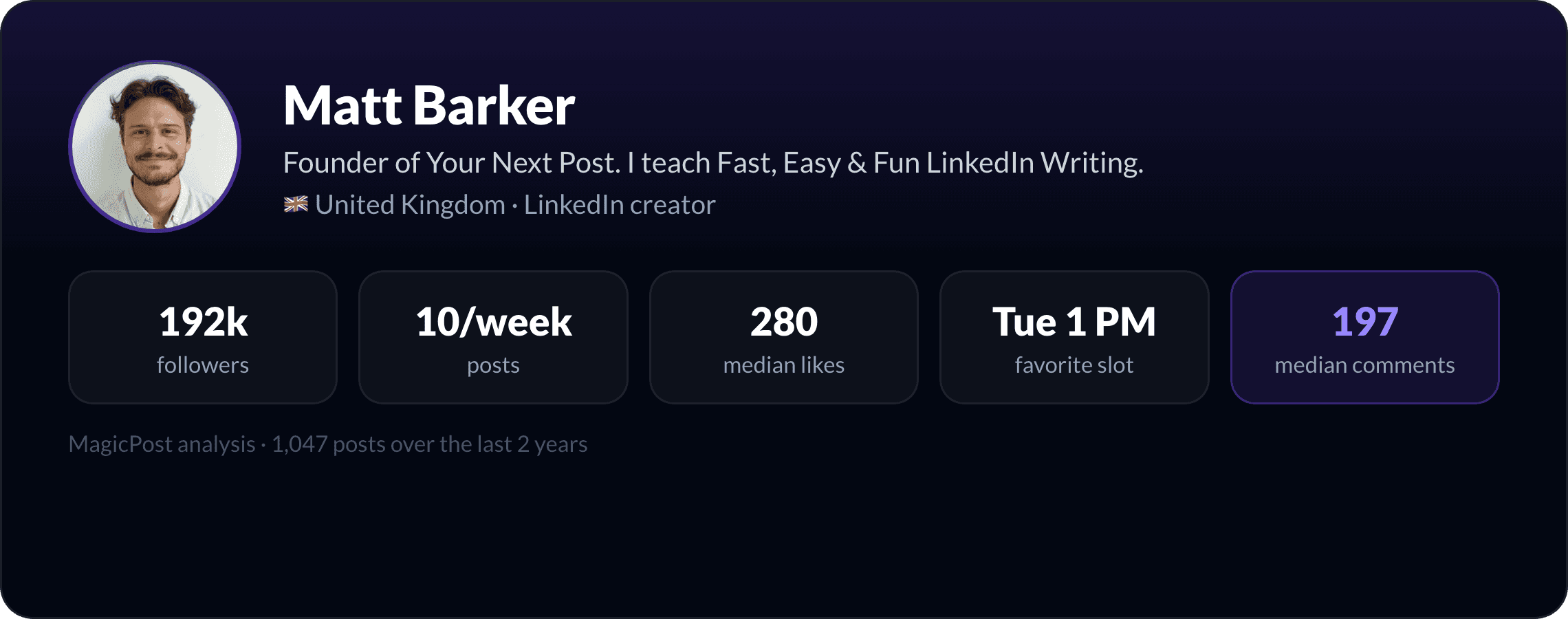
Who Is Matt Barker? The Hook Writer on LinkedIn, by Data (2026)
Who is Matt Barker? MagicPost analyzed 1,047 of their LinkedIn posts: topics, timing, signature moves and the writing fingerprint behind their growth, with real
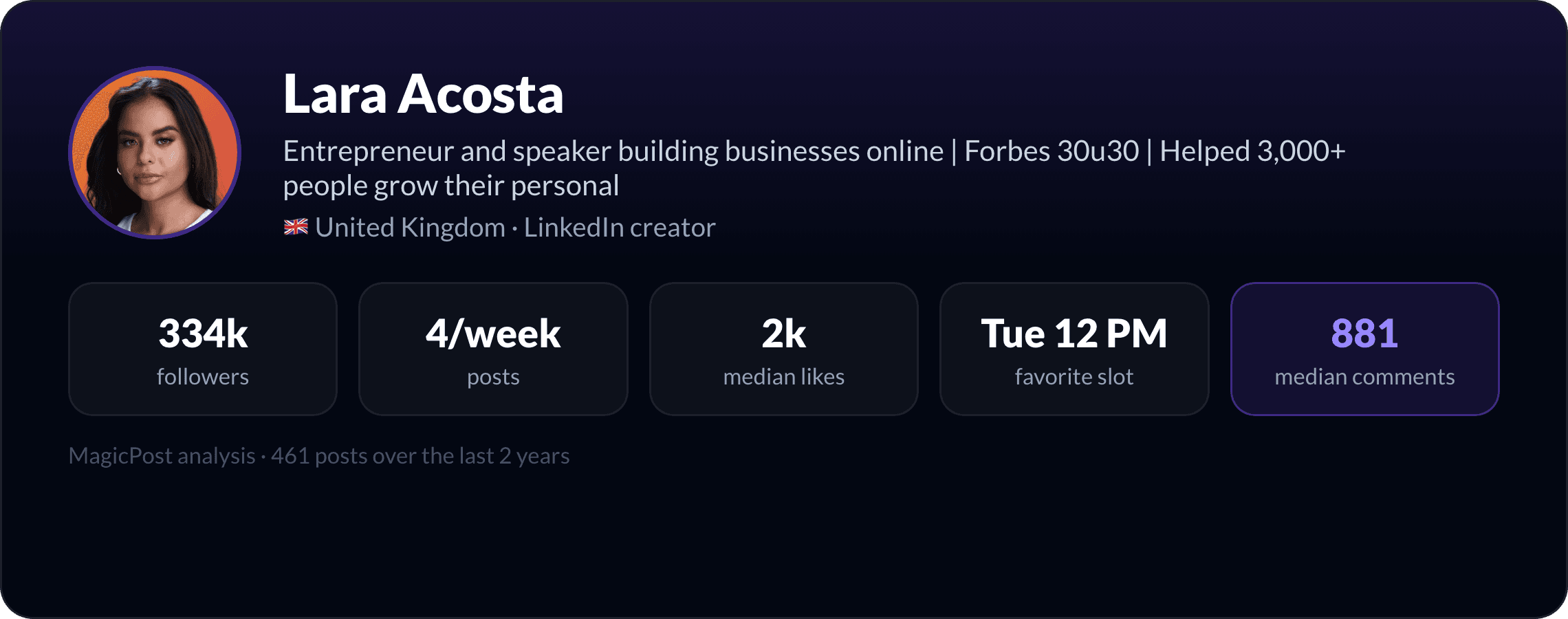
Who Is Lara Acosta? The Forbes 30 Under 30 Comment Machine, Explained by Data (2026)
Who is Lara Acosta? MagicPost analyzed 461 of their LinkedIn posts: topics, timing, signature moves and the writing fingerprint behind their growth, with real n
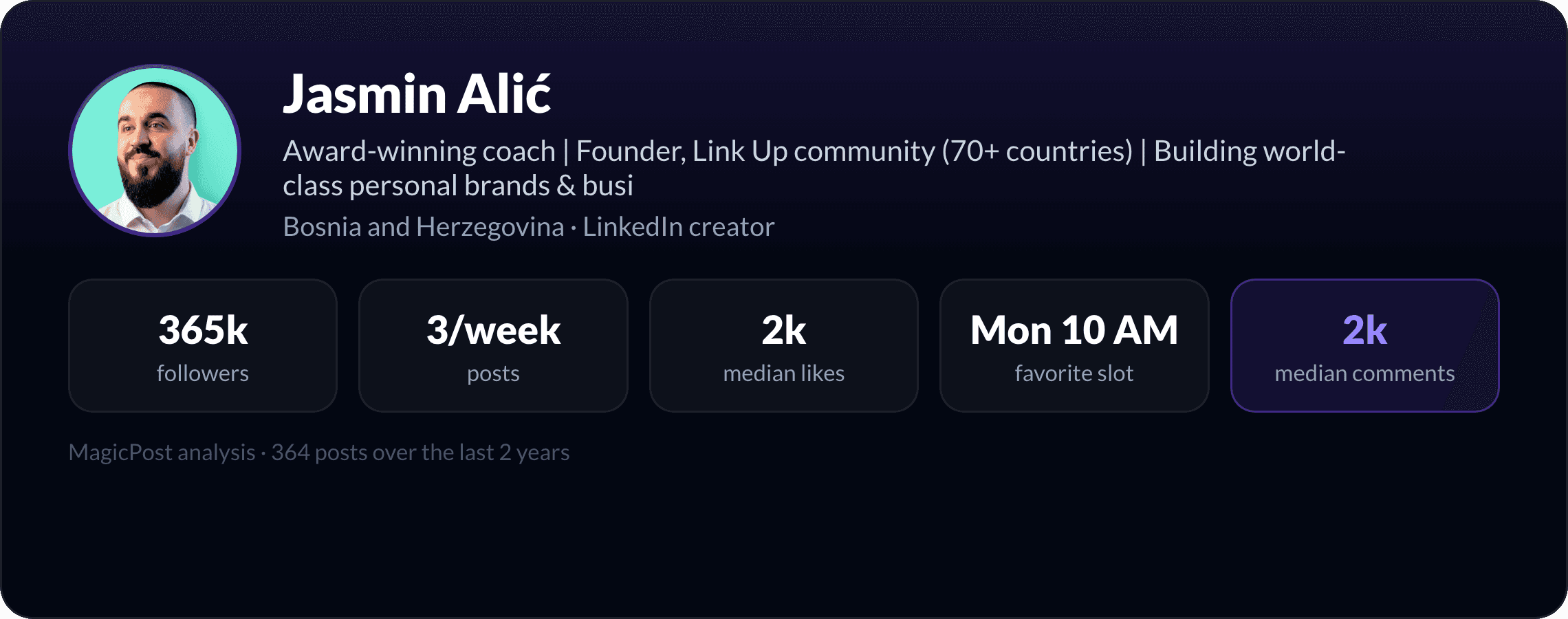
Who Is Jasmin Alić? The Bosnian Coach LinkedIn Mistook for a Bot (2026)
Who is Jasmin Alić? MagicPost analyzed 364 of their LinkedIn posts: topics, timing, signature moves and the writing fingerprint behind their growth, with real n
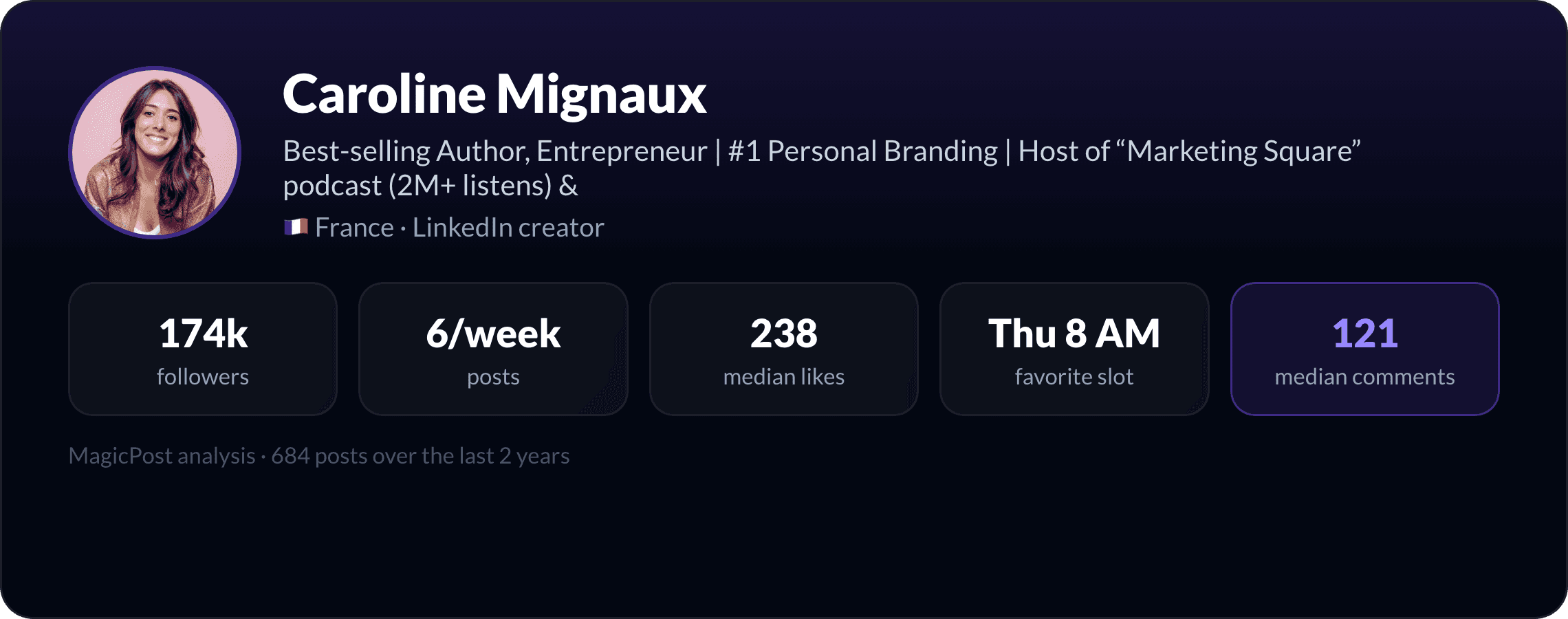
Who Is Caroline Mignaux? France's LinkedIn Top Voice Who Turned Shame Into a Following (2026)
Who is Caroline Mignaux? MagicPost analyzed 684 of their LinkedIn posts: topics, timing, signature moves and the writing fingerprint behind their growth, with r
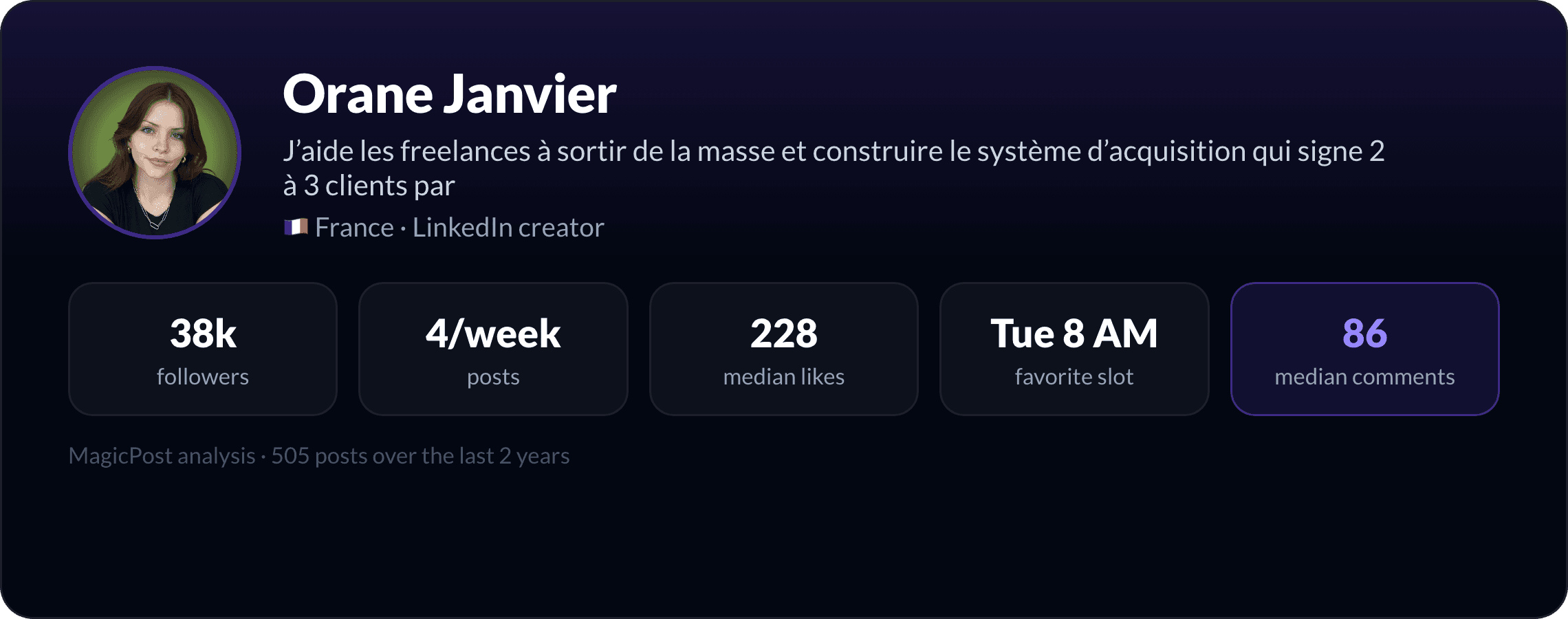
Who Is Orane Janvier? The Freelance Coach LinkedIn Quietly Copies (2026)
Who is Orane Janvier? MagicPost analyzed 505 of their LinkedIn posts: topics, timing, signature moves and the writing fingerprint behind their growth, with real
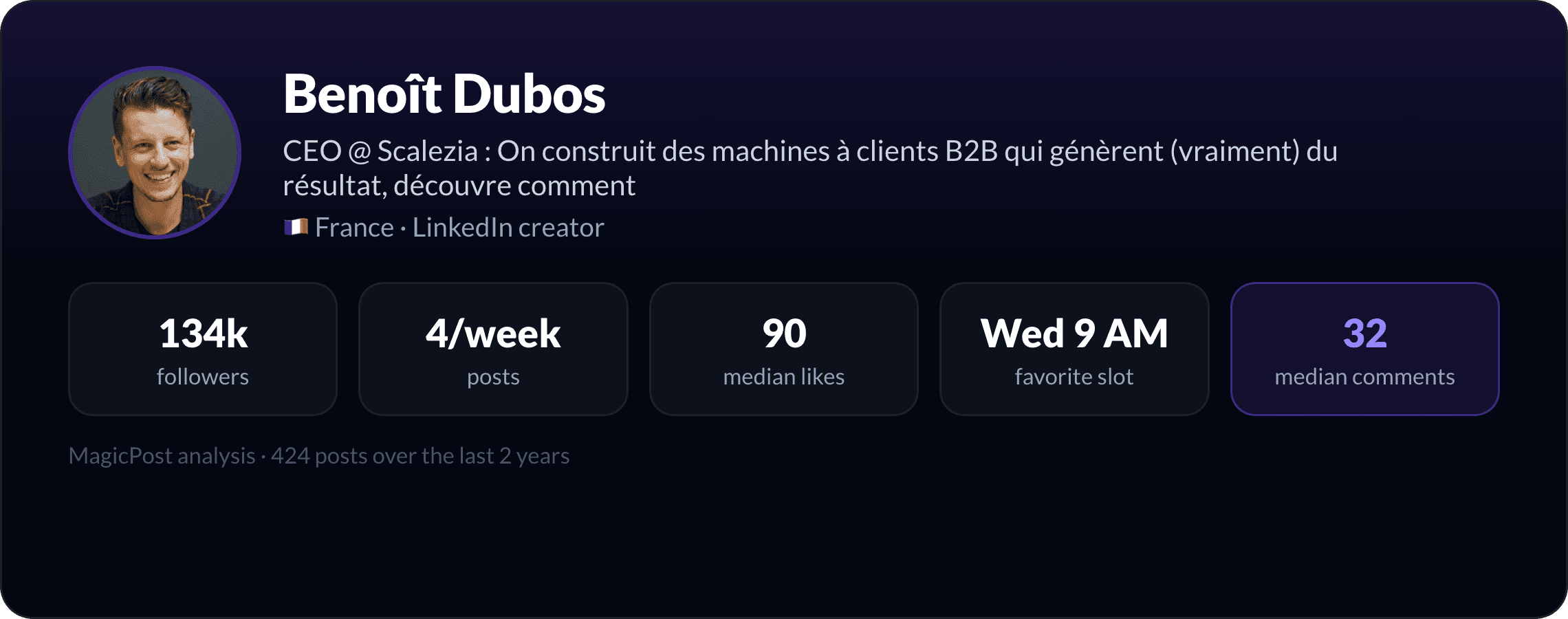
Who Is Benoît Dubos? The Growth Operator Who Turned a Falling Reach Into a Lead Machine (2026)
Who is Benoît Dubos? MagicPost analyzed 424 of their LinkedIn posts: topics, timing, signature moves and the writing fingerprint behind their growth, with real
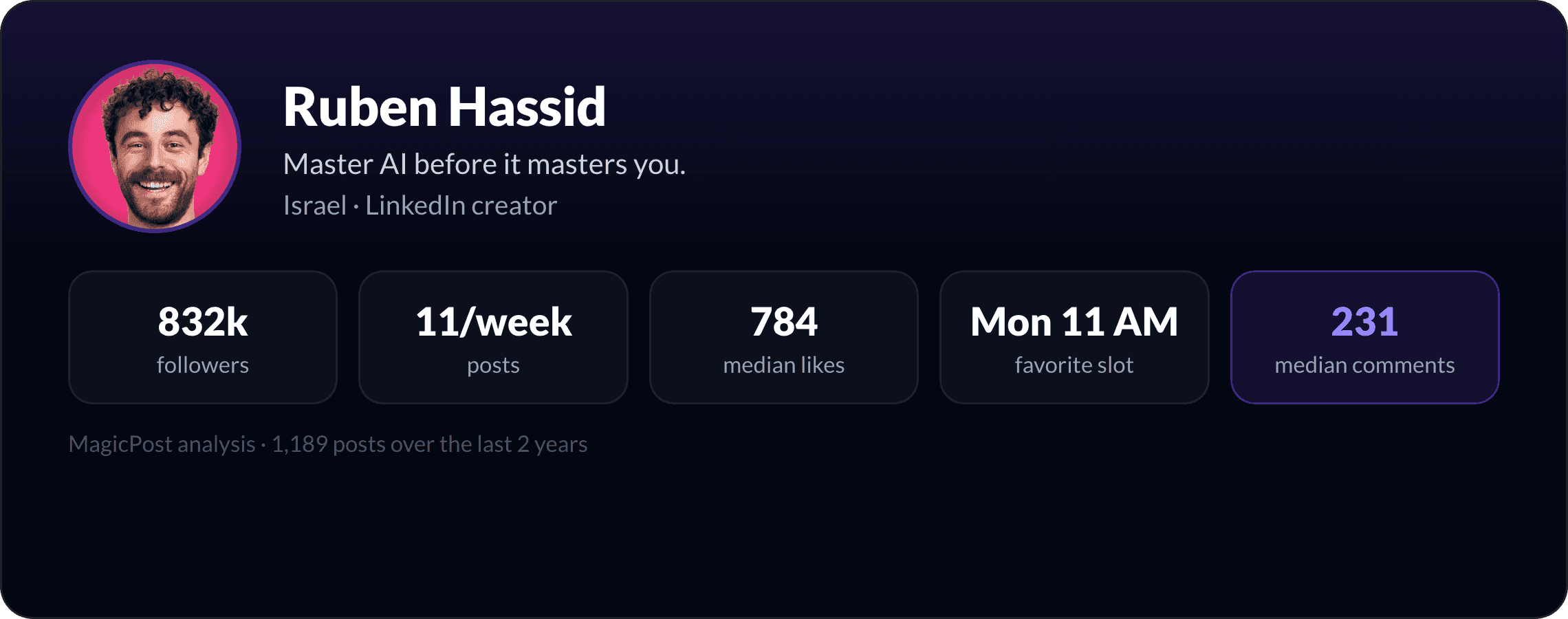
Who Is Ruben Hassid? The "Master AI Before It Masters You" Creator, Explained by Data (2026)
Who is Ruben Hassid? MagicPost analyzed 1,189 of their LinkedIn posts: topics, timing, signature moves and the writing fingerprint behind their growth, with rea
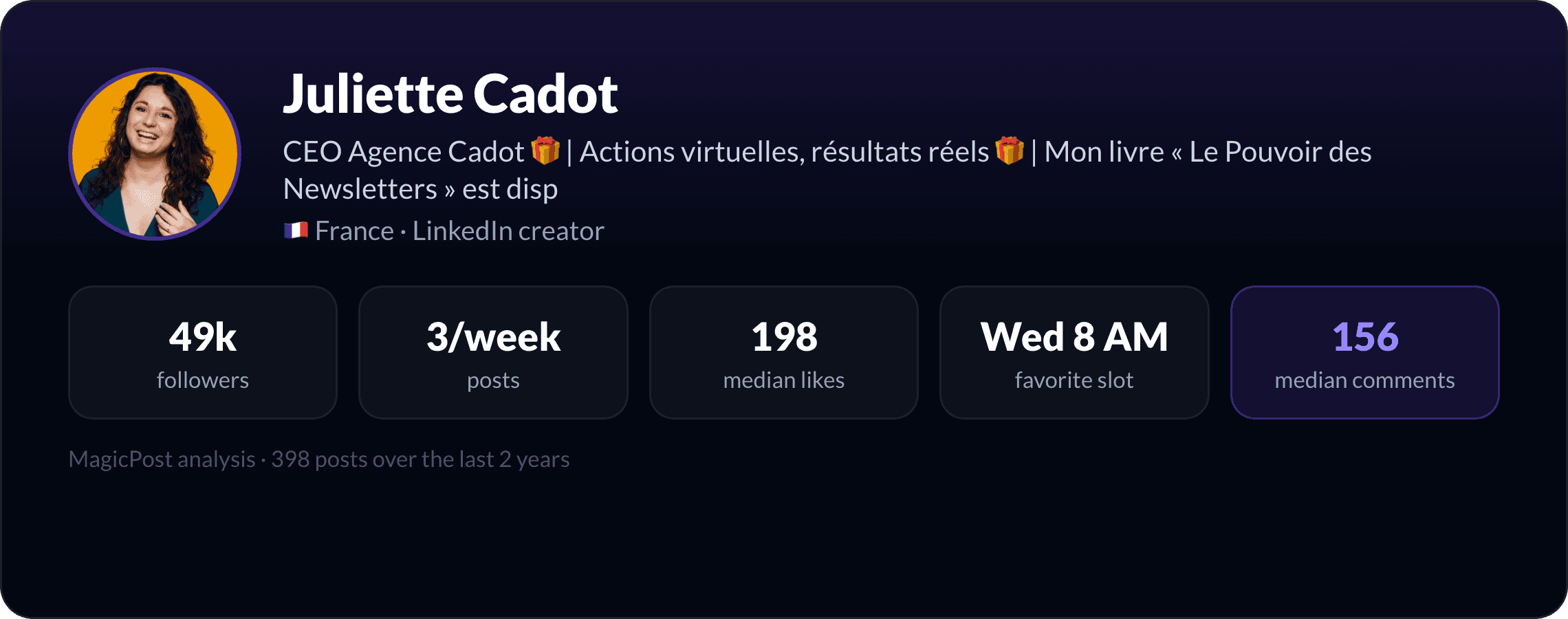
Who Is Juliette Cadot? The Agency Founder Whose Audience Talks Back (2026)
Who is Juliette Cadot? MagicPost analyzed 398 of their LinkedIn posts: topics, timing, signature moves and the writing fingerprint behind their growth, with rea