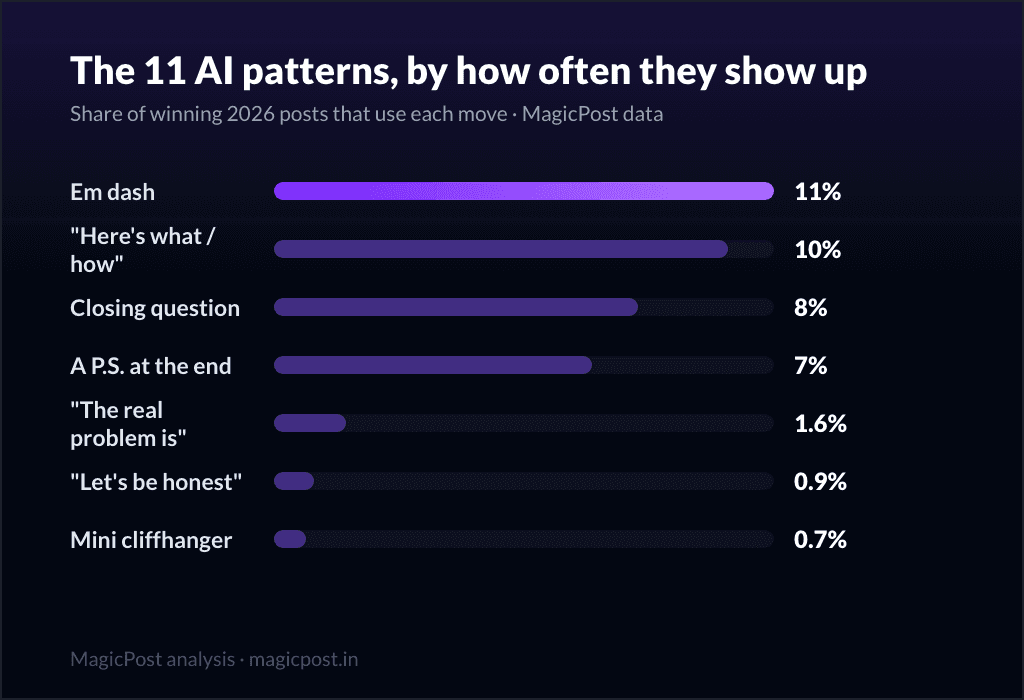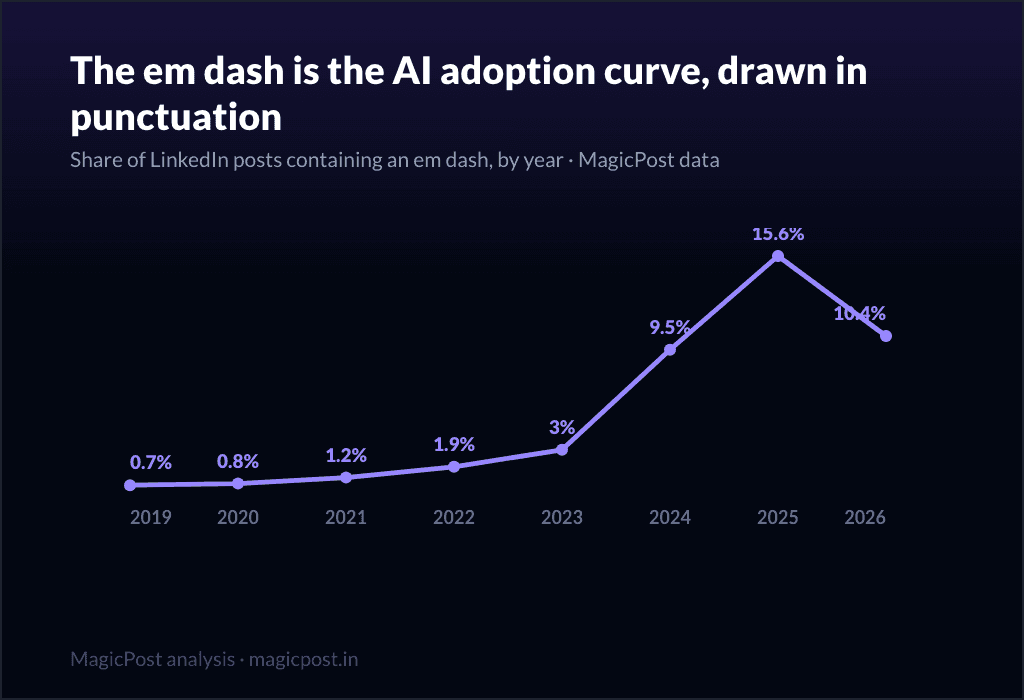
After the em dash, this is the line that most often marks a LinkedIn post as AI:
"Here's how I did it:" "Here's what nobody tells you:" "Here's the breakdown:"
It reads like a hook. As of 2026, it reads like a tax. In our study of 287,000 posts, the "here's how / here's what" turn is one of the four phrasings that measurably cost a post reach, about -4.3% within an author in our English data, against the same author's own baseline.
That penalty did not exist before this year. Here's why, the numbers, and what to write instead.
How Much Reach Do You Lose With AI Openers on LinkedIn?
The assumption is that a confident "Here's how:" lifts a post. The measured reality in 2026 is the reverse. Our study of 287,000 posts holds each author constant (it compares a post only against that same author's other posts, so audience size is neutralised) and isolates each phrasing's effect net of the others.
On that footing, the "here's what / here's how" handoff costs about -4.3% of reach within an author across our English data, a statistically robust effect and one of the four reach-costly turns of 2026.
The damage is upstream, in how many people ever see the post, not in the likes once they do. On likes the line is roughly neutral, about the same median as posts without it, which is exactly why the cost stayed invisible for so long and why so many guides still call it a hook. The reach number is where it shows up.
Two honest caveats, because this is a real study and not a pitch:
The effect is observational, a correlation measured within each author, not a controlled proof.
And it is a second-order lever: reach is still driven first by your audience and the substance of the post. Cleaning the templated phrasing recovers a few percent on your most templated posts. It does not double your reach, and anyone who promises that is selling something. What it does do is stop a stale opener from working against you.
Why Does an AI Hook Turn Into a Reach Penalty on LinkedIn?
The "Here's..." line is a handoff: it ends your setup and walks the reader into the detail, the steps, the list, the breakdown. It is the hinge of every how-to and "save this" post on LinkedIn. And it is everywhere now, for one reason: it is the seam of the explaining-teacher voice that AI slips into by default.
How often LinkedIn posts used a "Here's what / Here's how" handoff, year by year:
Year | Posts using a "Here's..." line |
|---|---|
2021 | 1.8% |
2022 | 2.5% |
2023 | 5.9% |
2024 | 13.1% |
2025 | 16.3% |
2026 (so far) | 14.3% |
ChatGPT launched at the end of 2022. The handoff sat under 3% before that, then grew roughly nine times in three years to more than one post in seven. People did not suddenly start teaching more. Their AI did.
Ask any model for an "actionable" post and it returns a setup, a "Here's how:", and a tidy list, because that explaining structure is its safest default, and this line is the joint in the middle of it.
That saturation is what flipped the line from hook to penalty. When a reader meets the same handoff on post after post, they start reading you as a template, and in 2026 the feed appears to do the same.
In May 2026 LinkedIn began demoting content that reads as "generic or repetitive," holding it back from the wider feed. A post built on the familiar setup-plus-"Here's how:"-plus-list shape is squarely the profile it now suppresses. (Full detail in Does LinkedIn penalize AI content?.)
This is also why the winners are not a counter-example. Of the 100 biggest creators we profiled, 98% use a "Here's..." line at least sometimes, and the ones who keep their reach use it sparingly, in front of a genuinely useful breakdown, not as the opener on every post.
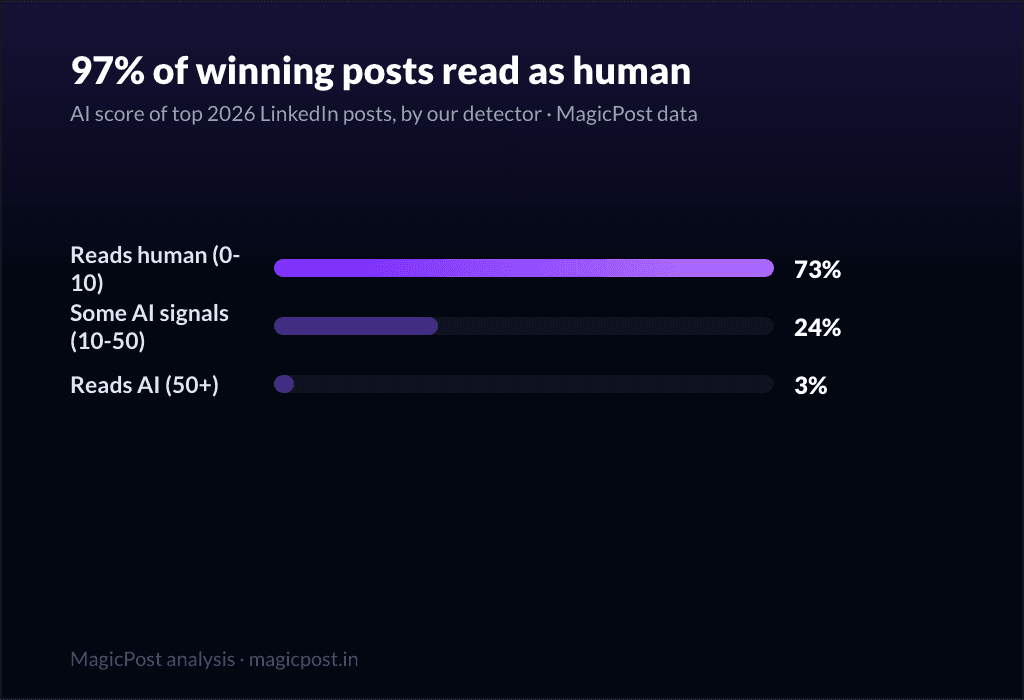
Roughly 97% of high-performing posts read as human to readers, which does not mean AI phrasing is harmless: those winning posts have stripped the templated turn the model reaches for automatically. That stripping is exactly what keeps them reading as human.
What Does a Good LinkedIn Post Opener Look Like?
These are paraphrased from real 2026 posts in the study so no one is quoted by name. Each one announces the payoff instead of delivering it:
"Here's what nobody tells you when you start running your own team:" (announcement, then the lesson)
"Here's what changed everything for the teams I coach:" (announcement, then the change)
"His calendar stayed empty for months. Here's what I told him:" (story, then a handoff into the advice)
"'It's just LinkedIn,' they said. Here's what just LinkedIn actually gave me:" (objection, then a handoff into the receipts)
In each case the announcement is the dead weight. The substance that follows is fine. The fix is to deliver that substance directly instead of trailing it:
Let a colon do it. Your setup line plus a colon already promises the list. "Here's how:" usually adds nothing the colon does not.
Name the payoff. Instead of "Here's what I learned," say what it is: "The one change that actually moved revenue:".
Number it and go. Drop straight into "1." The list itself tells the reader a breakdown is coming.
Cut the handoff. Often you can delete "Here's how it works" and start with the first step. Readers do not need the warning.
Each gets you into the detail without the line everyone, and every model, now reaches for.
AI LinkedIn Post Openers: Case Study
The within-author study has a vivid version at the level of a single account. Take a recruiter we looked at who posts steadily about hiring in tech and healthcare. Across the year, the posts where this person opened with the model's templated reveal ran roughly 18 points below their own clean posts, the ones that started straight on the substance.
Same author, same audience, same niche, the only thing that moved was whether the opener announced the payoff or delivered it.
A SaaS founder in the study shows the same gap from the other direction: their plainest posts, the ones that drop the reader into a concrete claim with no warm-up handoff, are the ones that outrun their own baseline, while the templated-opener posts sit flat.
The pattern repeats across the case studies we built, with the flagged posts landing 18 to 41 points below the same author's clean ones. It is correlational, since topic and format vary too, but it lines up cleanly with the controlled estimate above.
Far from harmless decoration on top of a good post, the opener drags on the post it sits on whenever it is the model's reflex rather than your choice.
What Not to Remove From LinkedIn AI Posts
Worth being precise here, because the easy overcorrection is to scrub everything that sounds "LinkedIn-y," and that backfires. Three of the patterns people lump in with AI phrasing actually help reach in the same study, and you should keep them:
Genuine sincerity and vulnerability (a real, specific admission, not a manufactured one) runs +7 to +10%.
A closing question runs about +3%.
A P.S. or CTA sign-off is reach-positive too.
These are engagement practices, not the AI tax. The "Here's..." handoff is the one to vary and thin out. The honest take-home is narrow on purpose: drop the templated opener the model reaches for, keep the human moves that earn attention.
Final Thoughts on the "Here's How" AI Opener
"Here's how" is not a crime, and it is not banned. It is the honest seam of a good how-to post.
But AI now stamps it onto nearly every post it writes, the feed has started discounting that shape, and the data puts a number on it: in 2026 a "here's what / here's how" opener costs about -4.3% reach within an author in our English data, against the author's own baseline, an effect that was statistically absent before this year.
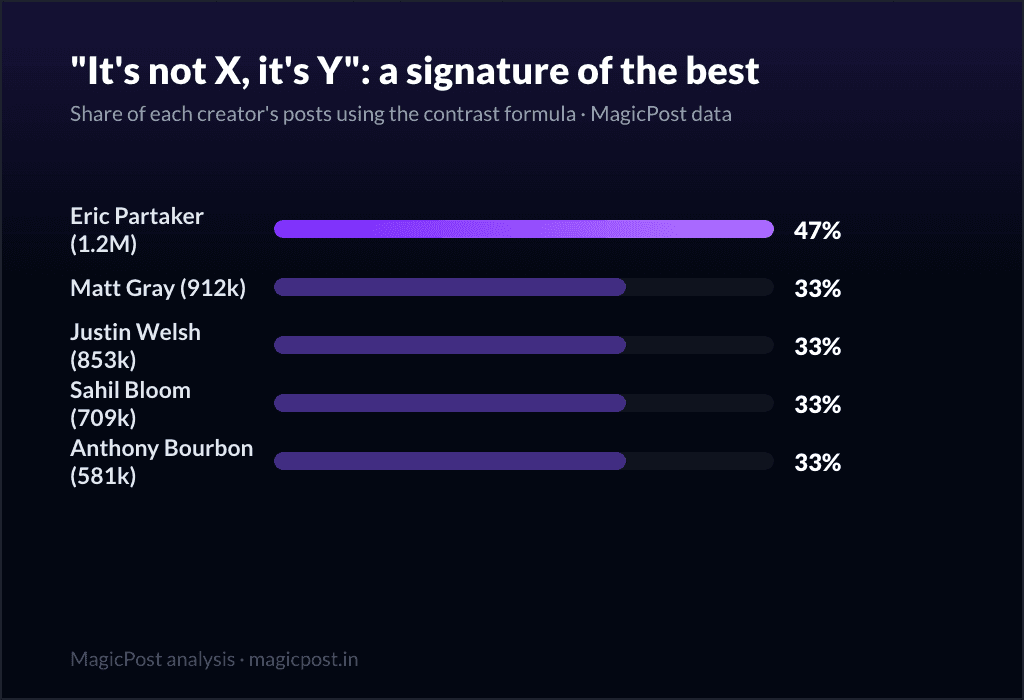
Used once, in front of a real breakdown, it is fine. Used as your reflex opener, it reads as a bot and quietly trims your reach. Deliver the payoff instead of announcing it. (It is one of eleven such patterns; see the full breakdown and the sister deep-dives on the Stop/Start "generic advice" frame and the "It's not X, it's Y" contrast.)
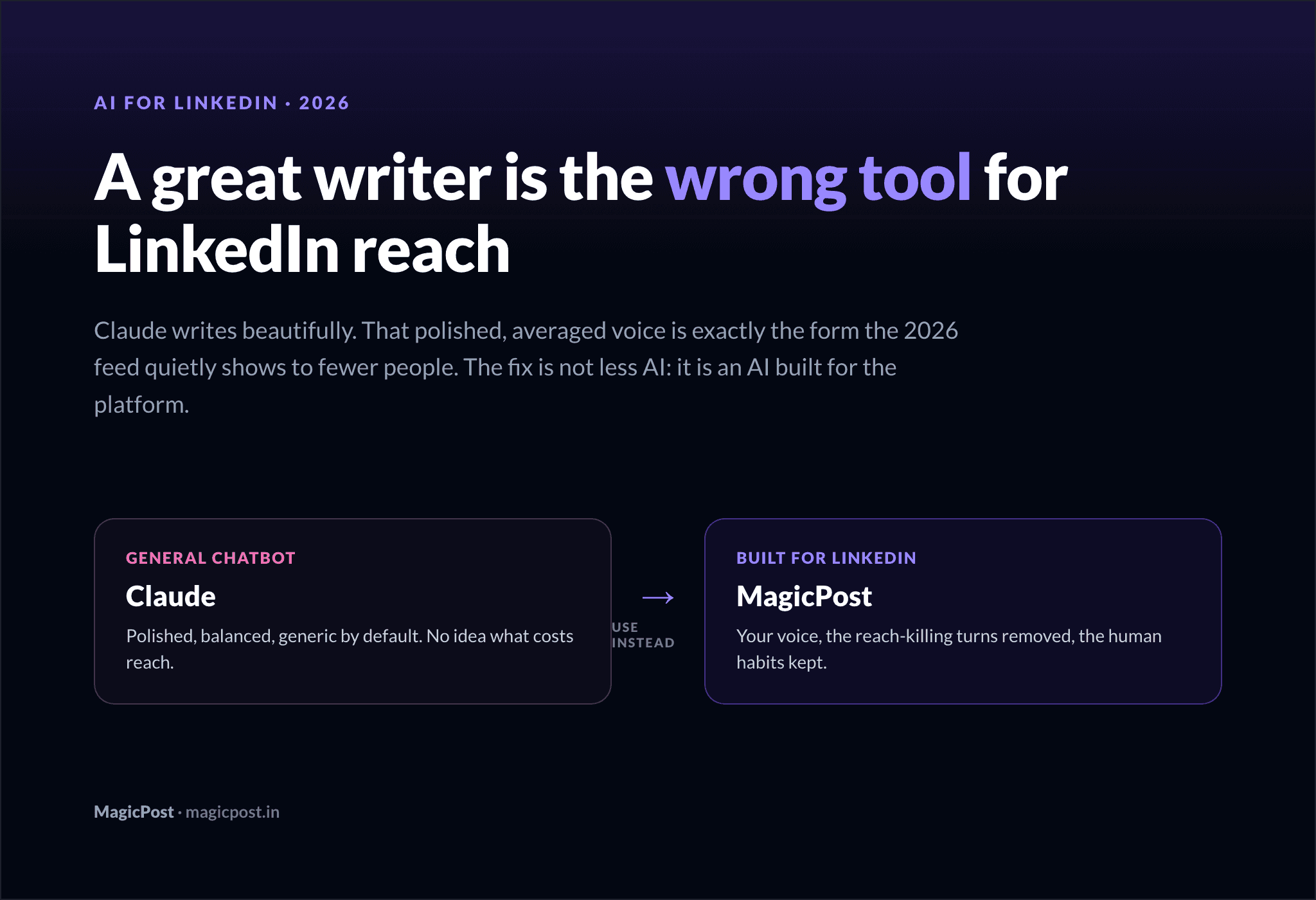
MagicPost's Humanizer strips the templated "Here's..." opener and rewrites it into a direct lead, while leaving your sincerity, questions and sign-offs alone. Try it free.
FAQ
Is "Here's how" a sign of AI on LinkedIn?
It is one of the strongest, after the em dash. Its use went from under 3% of posts in 2022 to over 16% in 2025, tracking AI adoption, because models default to the how-to structure this line holds together. Readers now clock it, especially when every post uses it.
Does it cost reach?
Yes. In 2026, holding each author constant, a "here's what / here's how" opener loses about -4.3% reach within an author in our English data versus the same author's other posts, an effect that was statistically absent before this year.
On likes it is roughly neutral, so the cost lives in reach: fewer people are shown the post in the first place. The effect is observational and second-order (audience still drives reach overall), but it is real and it is measured.
Is "Here's how:" an opener or something else?
Structurally it is a handoff: it ends a setup and introduces the steps or list. That is why it is the staple of actionable, instructional content. Wherever it sits, the move is the same, announce the payoff rather than deliver it, and that is what reads as AI.
Can I still use it?
Yes, occasionally, when a genuinely useful breakdown follows. Just stop making it your reflex: use a colon, name the payoff, or dive straight into step one. Vary it and the tell, and the reach cost, fade.