" height="26.80529977783203px" id="tymKb8bqC" width="128.00300311279295px"/><path d="M 0 2.417 L 0 0 L 12.909 0 L 12.909 2.417 Z" fill="rgb(126, 78, 253)" height="2.417099999999998px" id="aYr4em6zK" transform="translate(128.341 22.325)" width="12.908999999999992px"/></svg>)

"/><stop offset="1" stop-color="rgb(118, 37, 250)"/></linearGradient></defs><g d="M 19.242 21.22 L 19.362 6.204 L 19.272 6.204 L 13.757 21.22 L 10.161 21.22 L 4.796 6.204 L 4.706 6.204 L 4.825 21.22 L 0 21.22 L 0 0 L 7.283 0 L 12.109 13.607 L 12.229 13.607 L 16.844 0 L 24.247 0 L 24.247 21.22 Z M 26.421 26.113 L 26.421 23.445 L 41.407 23.445 L 41.407 26.113 Z" fill="transparent" height="26.112508199679183px" id="DvfaAIHYn" width="41.40731898311435px"><path d="M 19.242 21.22 L 19.362 6.204 L 19.272 6.204 L 13.757 21.22 L 10.161 21.22 L 4.796 6.204 L 4.706 6.204 L 4.825 21.22 L 0 21.22 L 0 0 L 7.283 0 L 12.109 13.607 L 12.229 13.607 L 16.844 0 L 24.247 0 L 24.247 21.22 Z" fill="rgb(46, 46, 46)" height="21.220180016149442px" id="pLsxRCobd" width="24.247352589074694px"/><path d="M 0 2.668 L 0 0 L 14.986 0 L 14.986 2.668 Z" fill="url(%23yD9d4I5GR-3279285344-linear-gradient)" height="2.6675085048549647px" id="yD9d4I5GR" transform="translate(26.421 23.445)" width="14.986002836263765px"/></g></svg>)

Naïlé Titah
There is a strange pressure to the last-day post. You want to thank the people who mattered without writing a yearbook. You want to mark the milestone without sounding like a press release. And somewhere in the back of your mind is the temptation to say the quiet part out loud, the frustration, the manager, the reason you are actually leaving. The good news is that the goodbye post, written well, sits squarely in the kind of content LinkedIn rewards most: vulnerability, gratitude, and a milestone, all in one place.
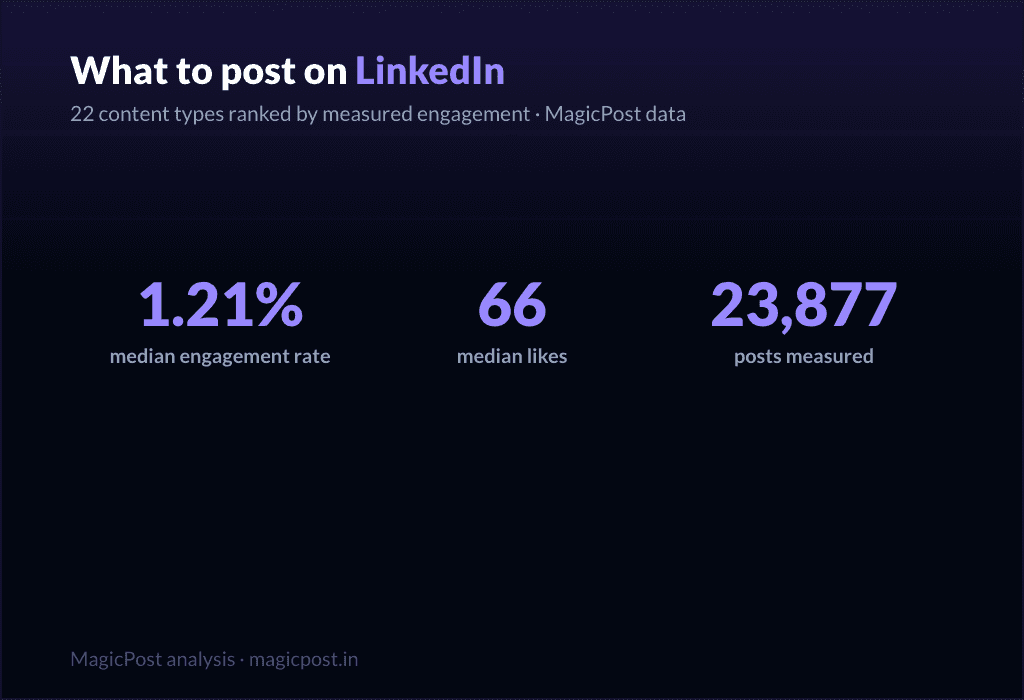
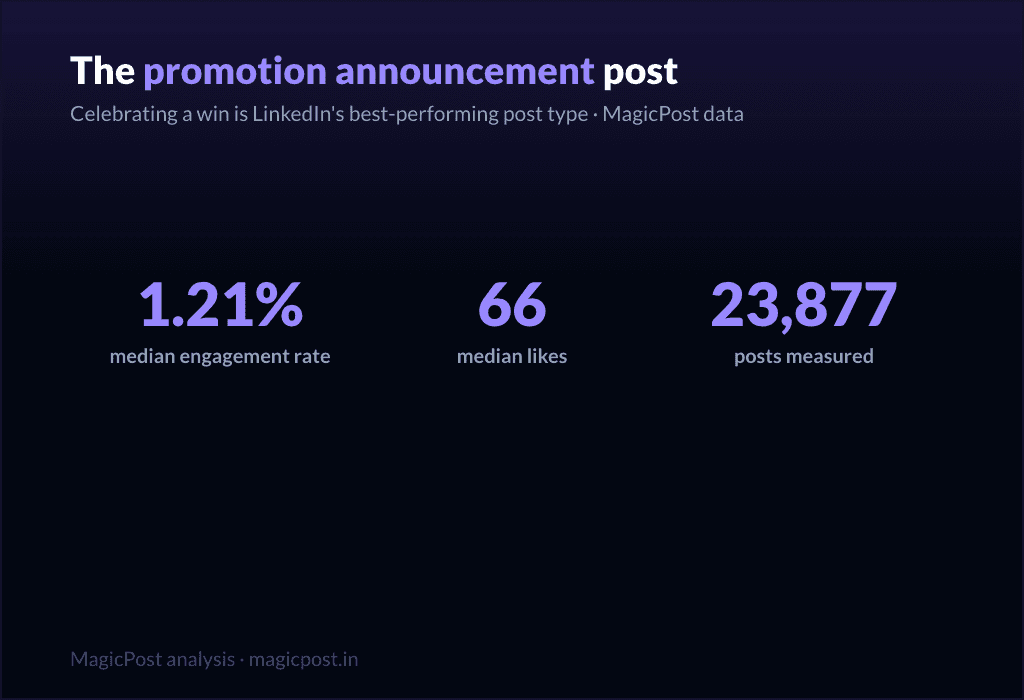
We did not measure "last-day posts" as their own category, and we will not pretend otherwise. But a goodbye post is a blend of two things we did measure. It celebrates a chapter you are proud of, which is the win family: across 23,877 "celebrating a win" posts, the median earns a 1.21% engagement rate (likes divided by followers, median per type so a few viral posts cannot distort it). And it is reflective, which is the personal-reflection family: across 21,010 of those posts, the median earns 0.58%. Both sit at or above the platform median of 0.39% (across 1,141,932 posts). A well-written goodbye lives between those two numbers, and the better ones lean toward the win.
So the question is not whether to post. It is how to write one that lands like the real examples below, and not like a resignation letter someone leaked.
TL;DR: The last-day post blends LinkedIn's two best families: the win (1.21% median ER) and the personal reflection (0.58%). The big ones name people, hold one specific memory, burn no bridges, and give the next chapter one line.
Where a goodbye post sits in the data
Here is the territory, honestly framed. We have no "last-day post" row to show you, so we show you the two families a goodbye post draws from, against the platform median:
Post family | Posts measured | Median engagement rate |
Celebrating a win | 23,877 | 1.21% |
Personal reflection | 21,010 | 0.58% |
Platform median (all posts) | 1,141,932 | 0.39% |
Read it this way. A last-day post that mostly looks back ("here is what these years gave me") behaves like a personal reflection, around 0.58%, already above the 0.39% platform median. A last-day post that frames the exit as an achievement and a forward step ("proud of what we built, excited for what's next") borrows from the win family at 1.21%, the best-performing type of all 22 we studied. The craft, then, is tilting your goodbye toward the win without bragging: name the milestone, not just the sadness. That single choice is the difference between a post your network mourns and a post your network celebrates.



What the big goodbye posts actually do
The numbers point the direction. The real posts show the moves. Here are three that traveled, and what each one gets right.
The plain, gracious exit from the top of the company:
"Today is my last day at Sanofi. While a LinkedIn post can't capture the privilege it's been to lead such amazing teams for more than six years, I want to sincerely thank all Sanofians for their relentless commitment and dedication to improving people's lives." Paul Hudson (236k followers), 13,121 likes. post
No drama, no settling of scores, no hedging. The news is in the first four words, the gratitude is specific to the people, and the tone is warm without being sentimental. This is the highest-engagement goodbye in our sample, and it is also the simplest. That is not a coincidence.
The chapter-close with one specific memory:
"After ~14 years working on Chrome, it's time for a new chapter. When I joined the Google Chrome team, I walked into a group that believed the web could be fast, simple, safe, and a joy to build on." Addy Osmani (257k followers), 5,764 likes. post
Notice the structure: name the tenure, call it a new chapter, then drop back into one concrete memory of who these people were and what they believed. The specificity ("fast, simple, safe, and a joy to build on") is what makes it feel earned rather than generic. He is not closing a job; he is closing a story he can describe.
The short, warm, class-act version:
"Heck of a journey. Today is my last day at IBM. Grateful for the people, the learnings, and the chance to help shape the future of enterprise AI. Thanks to everyone who made the ride unforgettable." Armand Ruiz (206k followers), 2,915 likes. post
Four short lines and done. The milestone, the gratitude, the warmth, the exit. No one reading it wonders why he left or whether there was bad blood, because he did not give them the opening. Brevity here reads as confidence.
What do all three share?
The news up front. "Today is my last day at [Company]." No burying it under three paragraphs of throat-clearing.
Named people, not abstractions. "All Sanofians," "the team that believed," "everyone who made the ride." Gratitude lands when it points at someone.
One specific thing. A memory, a belief, a mission. One concrete detail beats a list of vague thank-yous.
No bridge-burning. None of them settle a score, name a villain, or hint at why they really left. Every one of these people can walk back into that building tomorrow.
The next chapter in one line. "Time for a new chapter." Just enough forward motion to turn an ending into a beginning, without stealing the goodbye's moment.
Staring at a blank goodbye? MagicPost's AI LinkedIn post generator turns "leaving Acme after 5 years, grateful, off to something new" into a post that opens with the news, names the people, holds one real memory, and closes on the next chapter, in your voice. You bring the milestone; it handles the shape, so you never accidentally write the resignation letter instead of the goodbye.
3 last-day post templates you can fill in tonight
Three angles for three temperaments. Fill the brackets with your specifics. The structure is the craft; the chapter is yours.
1. The gratitude exit (warm, people-first, like Paul Hudson)
Today is my last day at [Company].
A LinkedIn post can't hold everything [N years] gave me, but I want to say it plainly:
thank you to [the specific people or teams], for [the one thing they actually did].
I'm walking out grateful, not closing a door.
[One line on what's next, or simply: more on what's next soon.]
2. The chapter-close story (a memory, then forward, like Addy Osmani)
After [N years] at [Company], it's time for a new chapter.
When I joined, I walked into [the team or mission, described as it actually felt].
[One specific memory or belief that defined the place for you.]
I'm carrying that forward into [what's next, or "whatever comes next"].
To everyone who made it that: thank you.
3. The short class act (four lines, done, like Armand Ruiz)
Heck of a journey. Today is my last day at [Company].
Grateful for [the people], [the lessons], and [the chance you got].
Thanks to everyone who made the ride unforgettable. On to the next one.
For more structures across every occasion (launches, promotions, wins, ideas), see the full LinkedIn post templates library.
Etiquette: the two rules that protect you
A goodbye post is mostly upside, but it has two ways to go badly wrong, and both are avoidable.
Post after the exit is public, not before. The order matters more than the timing. Your manager, your team, and HR should hear it from you before they read it in the feed, and the departure should be genuinely confirmed and communicated internally before you announce it. A goodbye post that surprises your own colleagues is the one career post that makes you look careless rather than gracious. There is no prize for being first; there is a real cost to jumping the gun.
Never settle scores in public. This is the whole game. The temptation to name the manager, vent about the culture, or hint at why you "really" left is real, and it is always a trap. Every one of the posts above could have gone there, and none did, which is exactly why they traveled and why those authors can return to that network anytime. A public goodbye is read by your future employers, your old colleagues, and people who have never met you. Keep the grievances offline. The high road is also the high-performing road here: warmth and gratitude are what the data rewards, and what people remember.
One more, lightly: do not over-tag. Naming the two or three people who genuinely shaped your time is moving. Tagging thirty names for reach reads as engagement bait, and the tagged people notice.
The line to hold: announce it once it's public, thank specific people, hold one real memory, point at the next chapter in a single line, and burn no bridges. Get those right and your goodbye sits in the warm, high-engagement territory the data rewards. Get them wrong and a graceful exit reads like a leaked resignation.
If your next move is already lined up, the goodbye and the hello are a natural pair: see our companion guide on how to announce a new job on LinkedIn. If you want the goodbye to read like a story rather than a status update, writing a LinkedIn personal story post shows how to put the journey at the center. And if you are leaving without a next role lined up, our guide on LinkedIn's Open To Work, what it means and whether to use it covers what to do next.
Where the data and examples come from
Everything on this page is MagicPost's own research. We did not measure "last-day posts" as a standalone type, so the numbers here describe the two families a goodbye post blends, not the goodbye post itself. Engagement rate is likes divided by the author's follower count, reported as the median per post type (never the average) so a handful of viral posts cannot distort the picture. The "celebrating a win" family was measured on its full population of 23,877 posts (1.21% median engagement rate); the "personal reflection" family on 21,010 posts (0.58%). The platform median (0.39%) is taken across 1,141,932 posts. Reshares, excluded, and deleted posts are filtered out. The example quotes are verbatim excerpts from real published posts, truncated at sentence boundaries, attributed with name, rounded follower count, and like count at capture; follow each "post" link for the original. Figures dated June 2026.
FAQ
What should you post on your last day at work?
A short, gracious goodbye: state that today is your last day at the company, thank the specific people who mattered with one concrete detail about what they did, hold one real memory or lesson from your time there, and point at the next chapter in a single line. Keep it warm and brief; the best-performing goodbye posts we found are also the simplest. Crucially, post it only after your departure is public and your manager and team have heard it from you directly, and never use it to settle scores, name a difficult boss, or hint at why you "really" left. The high road is also the high-engagement road: gratitude and a milestone are exactly what LinkedIn rewards.
Do last-day or resignation posts perform well on LinkedIn?
We did not isolate last-day posts as their own type, so we cannot give you a single figure for them. But a goodbye post blends two families we did measure: "celebrating a win" (median 1.21% engagement rate across 23,877 posts, the best-performing type of all 22) and "personal reflection" (0.58% across 21,010 posts). Both sit at or above the 0.39% platform median (across 1,141,932 posts). In practice, a goodbye framed as a proud milestone leans toward the win number, while a purely reflective one sits nearer the reflection number. Either way, a well-written goodbye performs above average, because vulnerability, gratitude, and a milestone are the ingredients the feed rewards.
When should I post my last-day announcement?
After your departure is public, not before. Your manager, your team, and HR should hear it directly from you, and the exit should be genuinely confirmed and communicated internally before it appears in the feed. A goodbye post that surprises your own colleagues makes you look careless rather than gracious, and it is hard to undo. There is no advantage to being first to post and a real cost to jumping ahead of the internal conversation.
Should I explain why I'm leaving in the post?
Only at the lightest level, and never as a grievance. You can say "time for a new chapter" or name what's next in one line, but do not use the goodbye to vent about a manager, a culture, or the reason you actually left. A public post is read by future employers and old colleagues alike, and a settled score follows you far longer than the satisfaction lasts. Every high-performing goodbye in our sample stayed warm and named no villains. Keep the grievances offline; keep the post gracious.
How is a last-day post different from a new-job announcement?
They are two halves of the same move and often posted days apart, but the center of gravity is different. A last-day post looks back: gratitude, a milestone, one memory, no bridges burned. A new-job post looks forward: the news, the journey, and what you'll actually be doing next. Write them as a pair, not a single post, so each gets its own moment. For the forward-looking half, see our guide on how to announce a new job on LinkedIn.
> Make every chapter land with the people who care. With MagicPost you can write, schedule and analyze all your LinkedIn content in one place, so your goodbye post, and the hello that follows it, reach the network rooting for you.

The Graduation LinkedIn Post: Real Examples, Templates, and How to Make Yours Count
The graduation LinkedIn post: real examples (up to 19,038 likes), 3 templates, and how to make your first professional post count.
The Work Anniversary LinkedIn Post: Beyond the Auto-Generated Badge (Examples + Templates)
The work anniversary LinkedIn post: beyond the auto-badge. Real examples, 3 templates, and the reframe that turns a date into a story.
The Holiday LinkedIn Post: How to Not Sound Like a Corporate Card (Examples + Templates)
The holiday LinkedIn post: how to not sound like a corporate card. Real examples, 3 templates, and why seasonal posts should be scheduled early.

5 Najlepszych Szablonów Postów na LinkedIn (2026)
5 szablonów postów na LinkedIn: narracja, lista, osobista refleksja, skarga i analiza. Przewodniki krok po kroku, jak stworzyć angażujące posty i zwiększyć widoczność.

13 przykładów postów na LinkedIn, które przynoszą rezultaty (2026)
Ukraść te 13 sprawdzonych przykładów postów na LinkedIn, aby przekształcić swoją treść w potencjalnych klientów i autorytet. Zawiera szablony i pełną dekonstruację tego, co działa.
Co publikować na LinkedIn? (2026)
Zwiększ swój wpływ na LinkedIn dzięki naszemu ekspertowi przewodnikowi. Odkryj potężne strategie publikacji i rodzaje treści, aby skutecznie angażować swoją sieć.
Jak ogłosić nową pracę na LinkedIn: (+ 5 gotowych szablonów)
Opanuj swoje nowe ogłoszenie o pracy na LinkedIn. Rozwijaj swoją sieć, przyciągaj możliwości i zdobądź 5 gotowych szablonów postów, aby uczynić to bezwysiłkowym.
Najlepsze przykłady postów promujących na LinkedIn (2026)
Musisz napisać post sprzedażowy, ale nie wiesz, od czego zacząć? Pokażę ci przykłady najskuteczniejszych postów promocyjnych, które możesz dostosować do swoich potrzeb.
LinkedIn Otwarte na Pracę: Co to jest i jak to działa (2026)
Dowiedz się, jak funkcja LinkedIn Open to Work może przekształcić Twoje poszukiwania pracy w 2025 roku. Wskazówki, zalety, wady i triki, które pomogą Ci wyróżnić się w oczach rekruterów.
Magnesy leadów LinkedIn: Przewodnik po leadach, które naprawdę działają
Odkryj, jak tworzyć potężne magnesy leadowe, które przyciągają jakościowe leady, wzbudzają pragnienie i prowadzą twoją publiczność do zostania płacącymi klientami.