" height="26.80529977783203px" id="tymKb8bqC" width="128.00300311279295px"/><path d="M 0 2.417 L 0 0 L 12.909 0 L 12.909 2.417 Z" fill="rgb(126, 78, 253)" height="2.417099999999998px" id="aYr4em6zK" transform="translate(128.341 22.325)" width="12.908999999999992px"/></svg>)

"/><stop offset="1" stop-color="rgb(118, 37, 250)"/></linearGradient></defs><g d="M 19.242 21.22 L 19.362 6.204 L 19.272 6.204 L 13.757 21.22 L 10.161 21.22 L 4.796 6.204 L 4.706 6.204 L 4.825 21.22 L 0 21.22 L 0 0 L 7.283 0 L 12.109 13.607 L 12.229 13.607 L 16.844 0 L 24.247 0 L 24.247 21.22 Z M 26.421 26.113 L 26.421 23.445 L 41.407 23.445 L 41.407 26.113 Z" fill="transparent" height="26.112508199679183px" id="DvfaAIHYn" width="41.40731898311435px"><path d="M 19.242 21.22 L 19.362 6.204 L 19.272 6.204 L 13.757 21.22 L 10.161 21.22 L 4.796 6.204 L 4.706 6.204 L 4.825 21.22 L 0 21.22 L 0 0 L 7.283 0 L 12.109 13.607 L 12.229 13.607 L 16.844 0 L 24.247 0 L 24.247 21.22 Z" fill="rgb(46, 46, 46)" height="21.220180016149442px" id="pLsxRCobd" width="24.247352589074694px"/><path d="M 0 2.668 L 0 0 L 14.986 0 L 14.986 2.668 Z" fill="url(%23yD9d4I5GR-3279285344-linear-gradient)" height="2.6675085048549647px" id="yD9d4I5GR" transform="translate(26.421 23.445)" width="14.986002836263765px"/></g></svg>)

Naïlé Titah
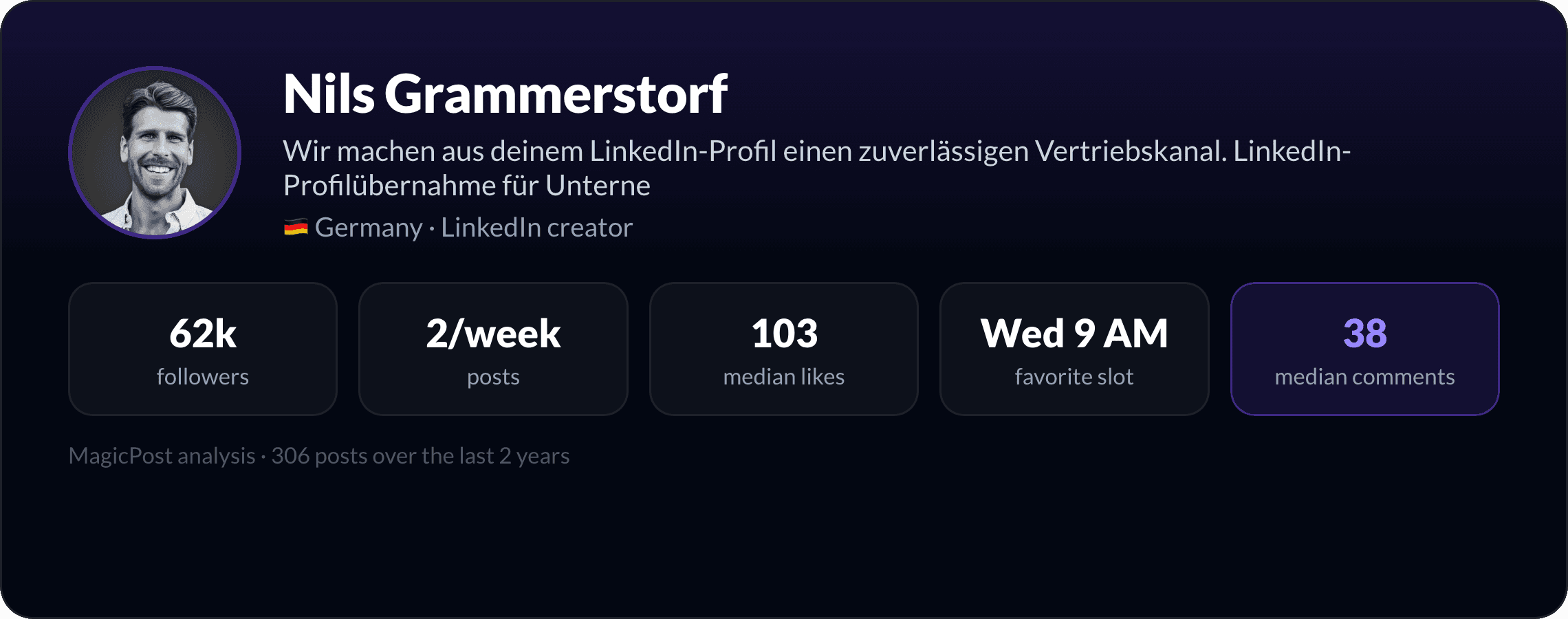
Most LinkedIn founders write about leadership. Nils Grammerstorf, co-founder and CEO of the Berlin agency napoleonfour, writes the same leadership manifesto over and over: he abolished the rules. No fixed start time, no permission to ask, no sick note. At MagicPost we analyzed 306 of his German-language posts (timing, engagement, topics, writing mechanics, and his AI-pattern profile), and one number sums up his whole style: 6 posts in 10 end with a question back to the reader. He does not write to broadcast. He writes to start an argument in the comments, and it works: his typical post pulls 103 likes and 38 comments, a comment density most German creators never touch.
This is who Nils Grammerstorf is, according to the best possible source: his own posts, measured.
His story, in his own posts
Grammerstorf is unusually open about a past most founders would hide: he was, by his own account, a school dropout who could not get an apprenticeship.
The rejection origin story. "Vor 20 Jahren wollte mich niemand als Praktikant. Vor 10 Jahren bekam ich nicht mal einen Ausbildungsplatz." ("20 years ago nobody wanted me as an intern. 10 years ago I couldn't even get an apprenticeship.") He tells it as a kid obsessed with computers, football and girls, with grades bad enough that "Mit meinem Zeugnis landet jede Bewerbung sofort im Papierkorb" ("With my report card, every application goes straight in the bin"). He cold-called companies until one in "einem 350 (!) Einwohnerdorf" ("a village of 350 people") finally gave him a chance.
This is not a one-off. It is his signature franchise: he has republished near-identical versions of that apprenticeship-rejection story at least four separate times (in August 2024, March 2025 and October 2025), plus a harder-edged variant that opens "In der Schule war ich ein VERSAGER" ("In school I was a FAILURE"). The lesson is always the same: "Menschen unterschätzen enorm, was innerhalb von 10 Jahren möglich ist" ("People massively underestimate what is possible within 10 years").
The founder. He went out on his own around 29. The split was abrupt: "Vor 2,5 Jahren hat es mir den Boden unter den Füßen weggezogen" ("2.5 years ago the ground was pulled out from under me"), he writes, describing leaving a company he loved over disagreements about the path forward and building his own. napoleonfour's pitch, from his headline, is turning a founder's LinkedIn profile into "einen zuverlässigen Vertriebskanal" (a reliable sales channel).
The honesty note. Reaching the goals did not feel like he expected. "2024 habe ich alles erreicht, was ich mir zu Beginn der Selbstständigkeit gewünscht habe. (Und trotzdem ging's mir so schlecht wie nie.)" ("In 2024 I reached everything I'd wished for at the start of self-employment. And still I felt worse than ever.") That post credits his team for carrying him, and is the emotional counterweight to the swagger.



What he actually talks about
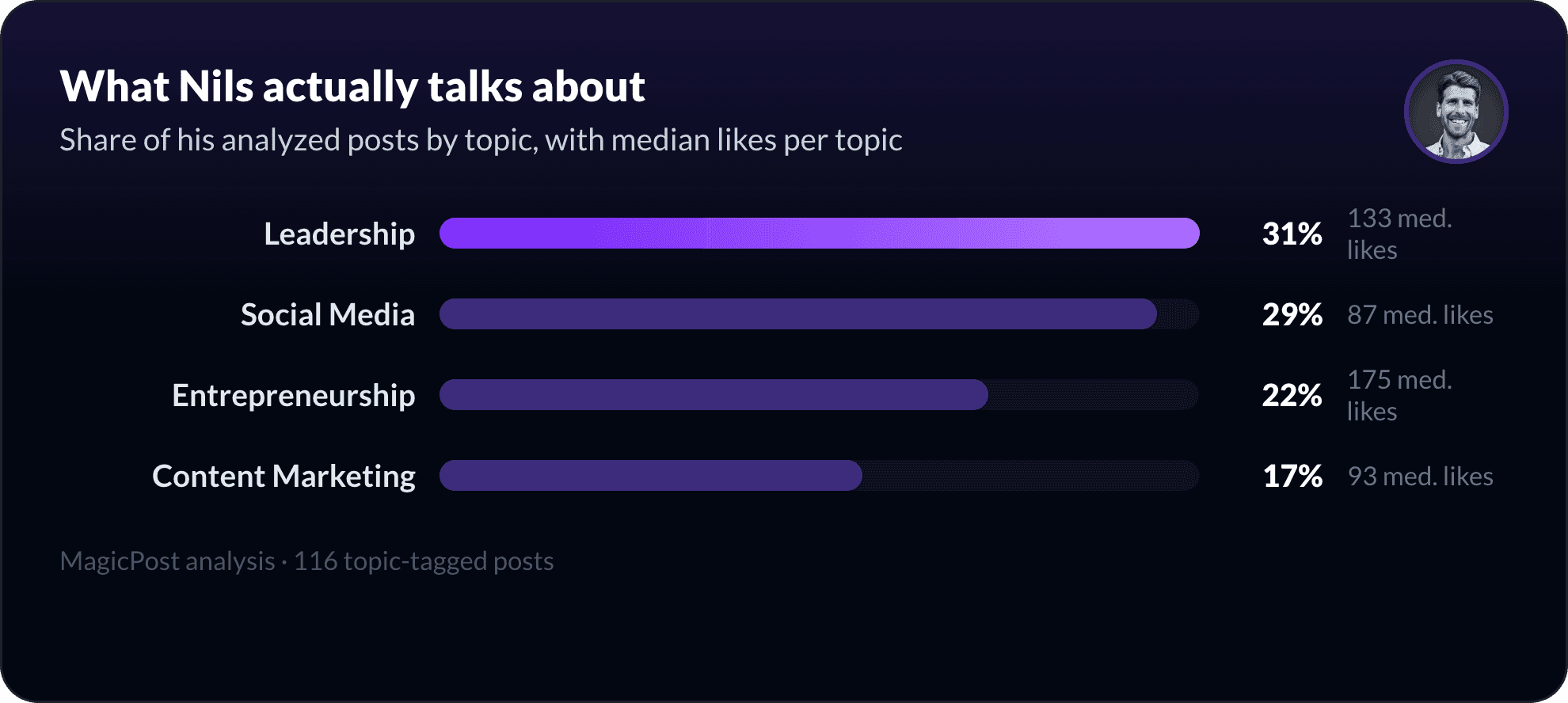
His feed splits four ways: Leadership (his biggest theme), Social Media, Entrepreneurship and Content Marketing. But the topic that ranks third by volume is the one that ranks first by engagement: Entrepreneurship over-performs hard (about 175 median likes versus his overall 103), while Social Media, the topic he sells, under-performs (about 87). In plain terms: his audience rewards him most when he is the founder living the build, not when he is the LinkedIn coach teaching it.
Sorted by register rather than topic, his largest bucket is punchy standalone advice ("Conseil percutant"), followed by deliberately provocative takes and personal reflection. That ordering is the real fingerprint: Grammerstorf is built to provoke. His all-time biggest posts are not how-to guides, they are arguments waiting to happen, about pay, about hiring, about whether your company is your family.
Who he writes for
His reader is the modern German employee and the fellow founder who suspects the old corporate playbook is dead. He literally drafts "der neue deutsche Traum" ("the new German dream"): flexible conditions, remote work, personal growth, health, "und trotzdem Flat White für 4,50€ trinken können" ("and still being able to afford a 4.50 euro flat white"). He addresses that reader directly and constantly, which is why so many posts close on a question: "Könntest du damit umgehen?" ("Could you handle that?"), "Wie ist das bei dir?" ("How is it for you?"). The offer underneath is napoleonfour: he wants founders who think like he does to build their own sales channel the way he built his.
His best posts of 2026
His three biggest posts of 2026 so far, reproduced from our data (click through to the originals):
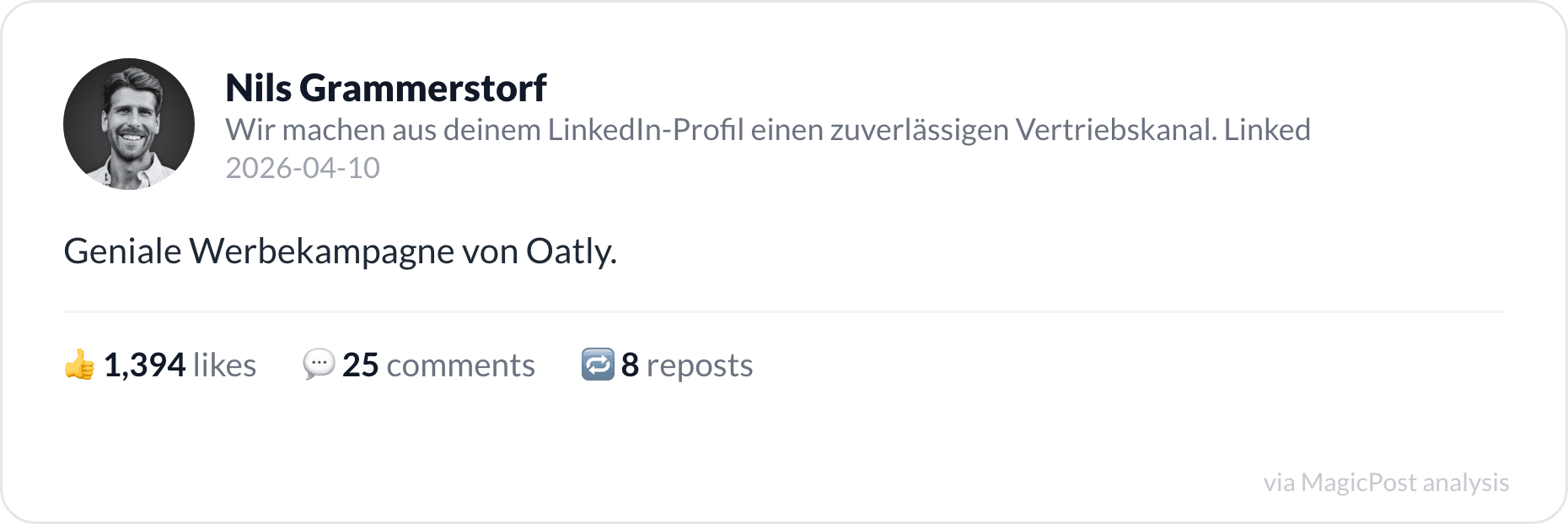
1,394 likes. A marketing teardown opening "Geniale Werbekampagne von Oatly." ("Brilliant ad campaign by Oatly.") Pure value, no product, the brand-analysis genre that travels furthest on his feed.
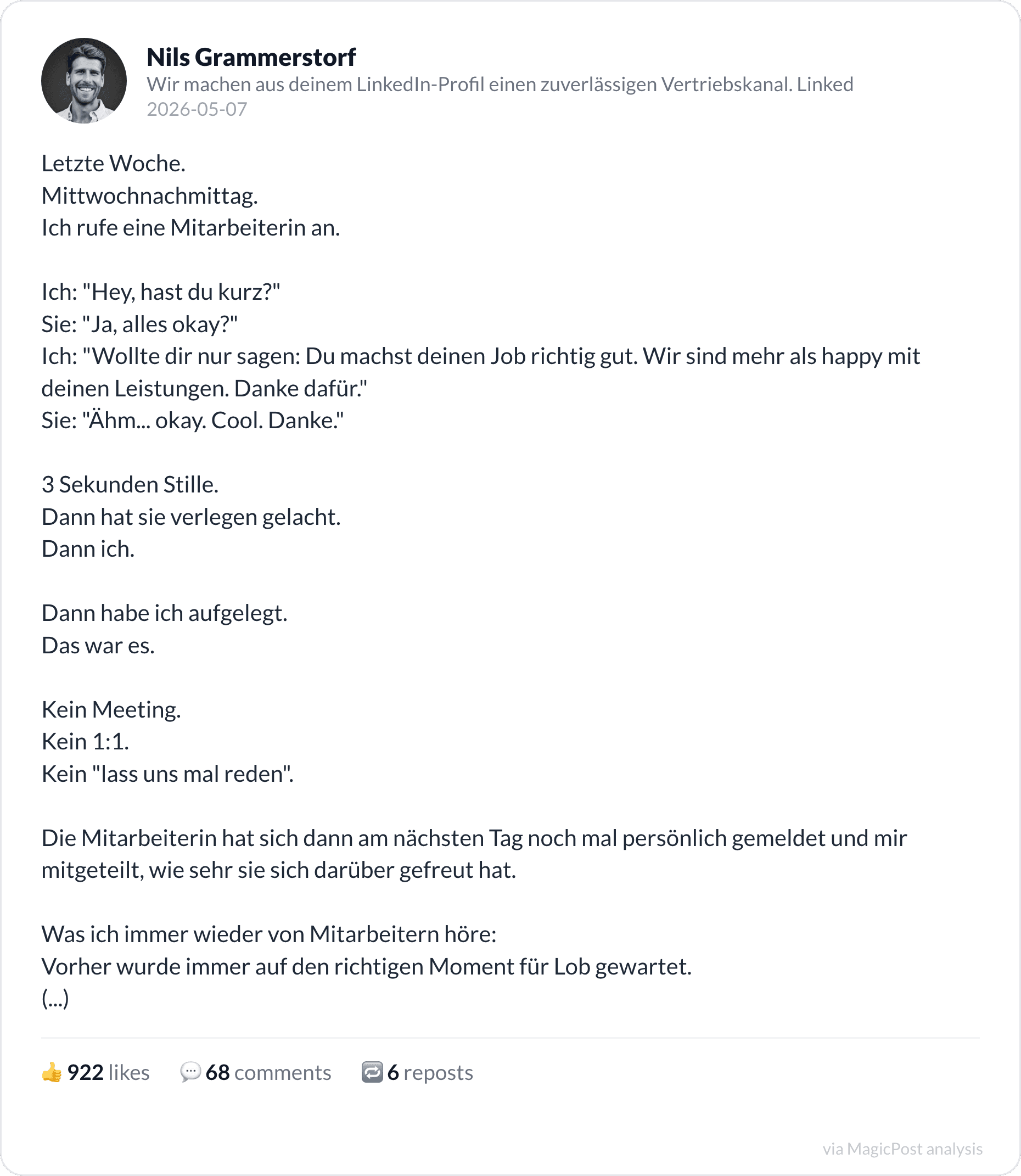
922 likes. A tiny scene: he calls an employee just to say "Du machst deinen Job richtig gut" ("You're doing your job really well"), then hangs up. Built entirely from short dialogue lines, it closes on "Wie ist das bei dir?" ("How is it for you?"), his signature move.
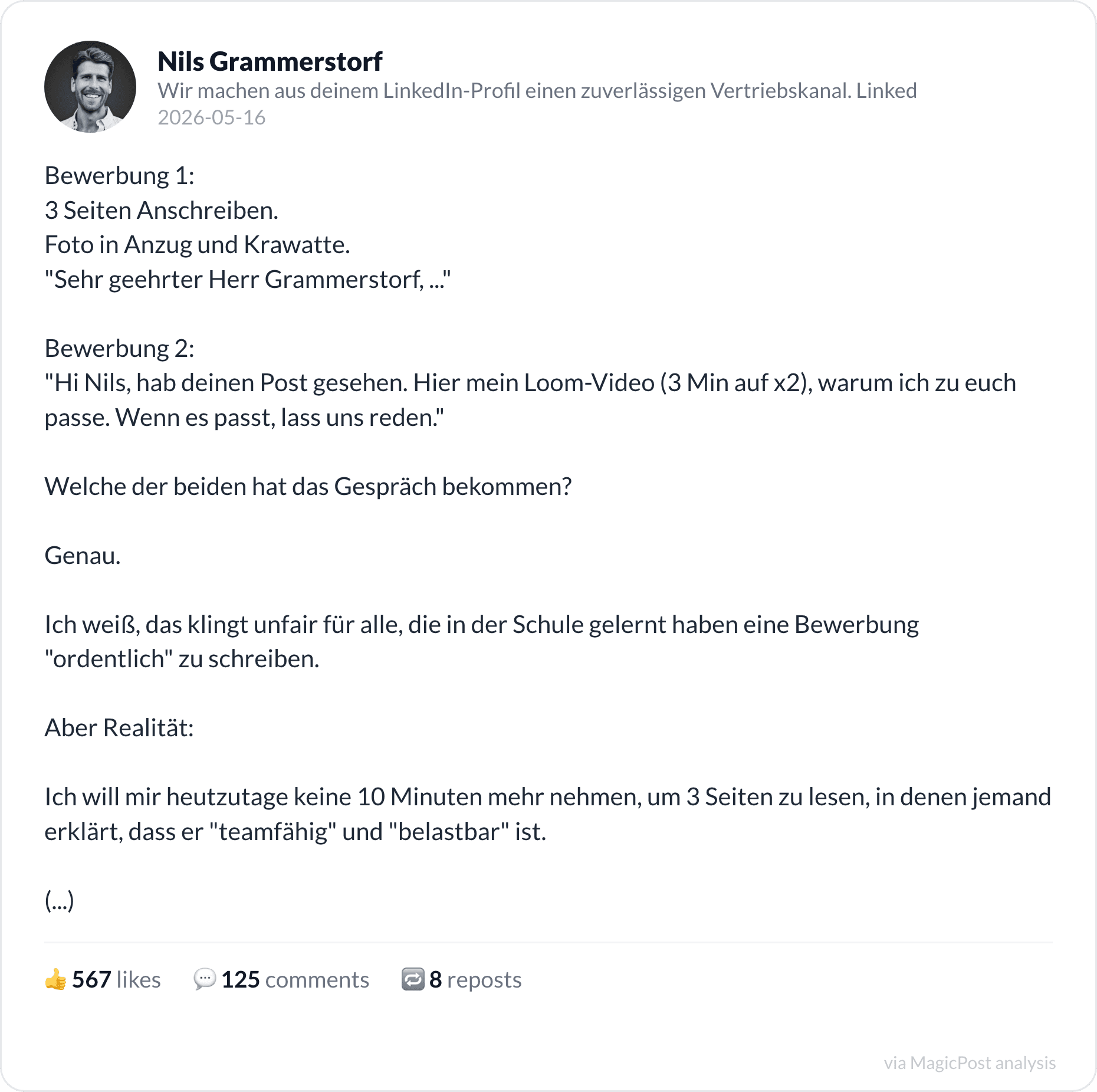
567 likes, 125 comments. The contrarian hiring take: a three-page cover letter versus a 3-minute Loom video, ending "das Ding ist einfach tot" ("the thing is just dead"). The comment count tells the story: provocation engineered to split the room.
Is he still growing?
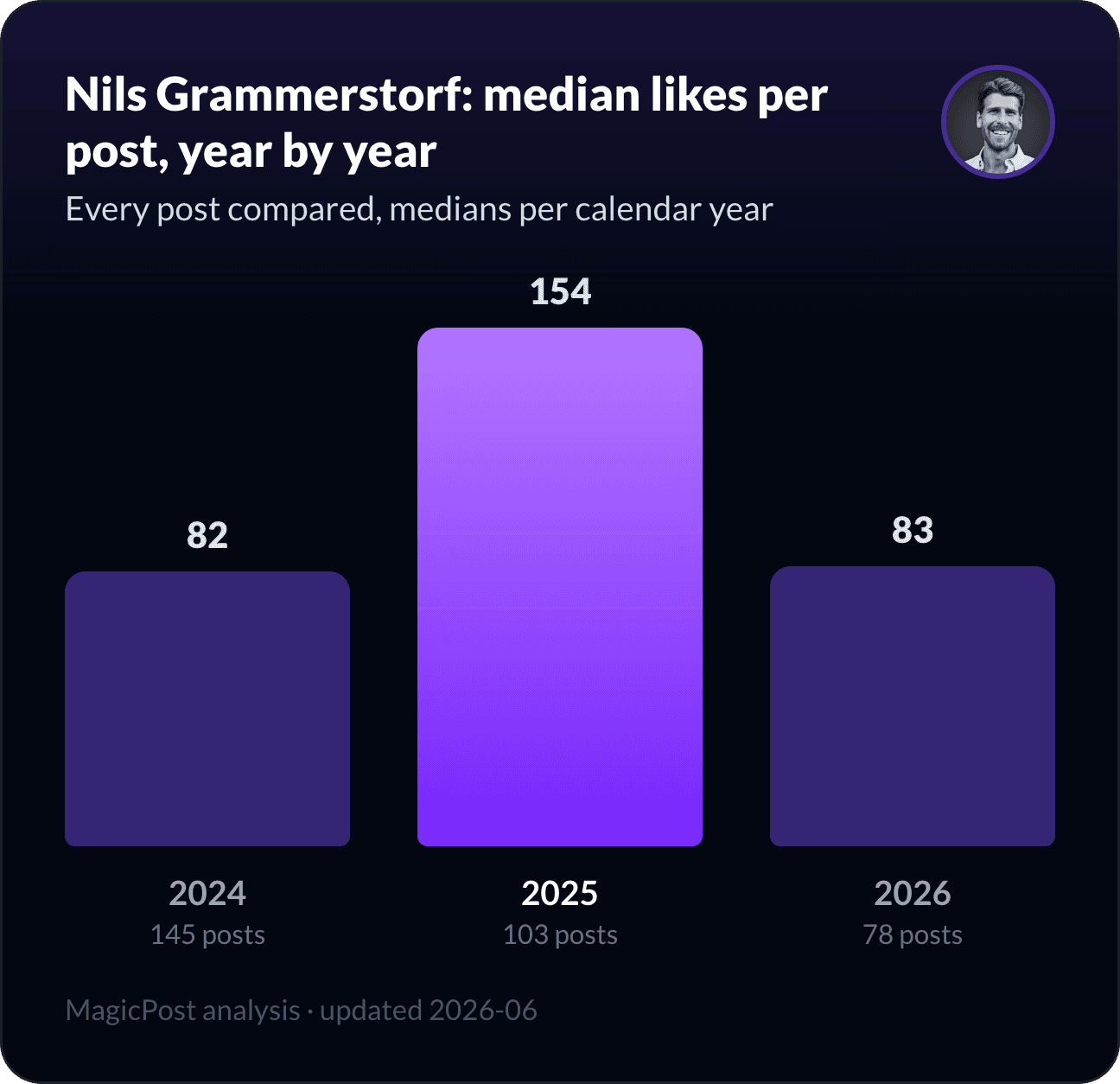
Here the data refuses to flatter him, and that is the honest finding. His median post went from about 82 likes in 2024 up to 154 in 2025 (nearly double), then back down to about 83 in 2026. The 2025 spike was real and big; 2026 has given the whole gain back. One caveat: we measure engagement per post, not follower count over time, so this is how hard his posts land, not his audience size, which has kept climbing past 62,000. Reach compression is the platform-wide shape right now, shared by many top creators we track: a creator can keep gaining followers while median likes settle.
Where do these charts come from? Everything on this page runs on MagicPost's LinkedIn analytics, and it works on your profile too: your best posts, your audience, your benchmark, even a side-by-side with creators like Nils Grammerstorf.
How he writes
Here is Grammerstorf measured against the average creator, and the headline is in the hooks:
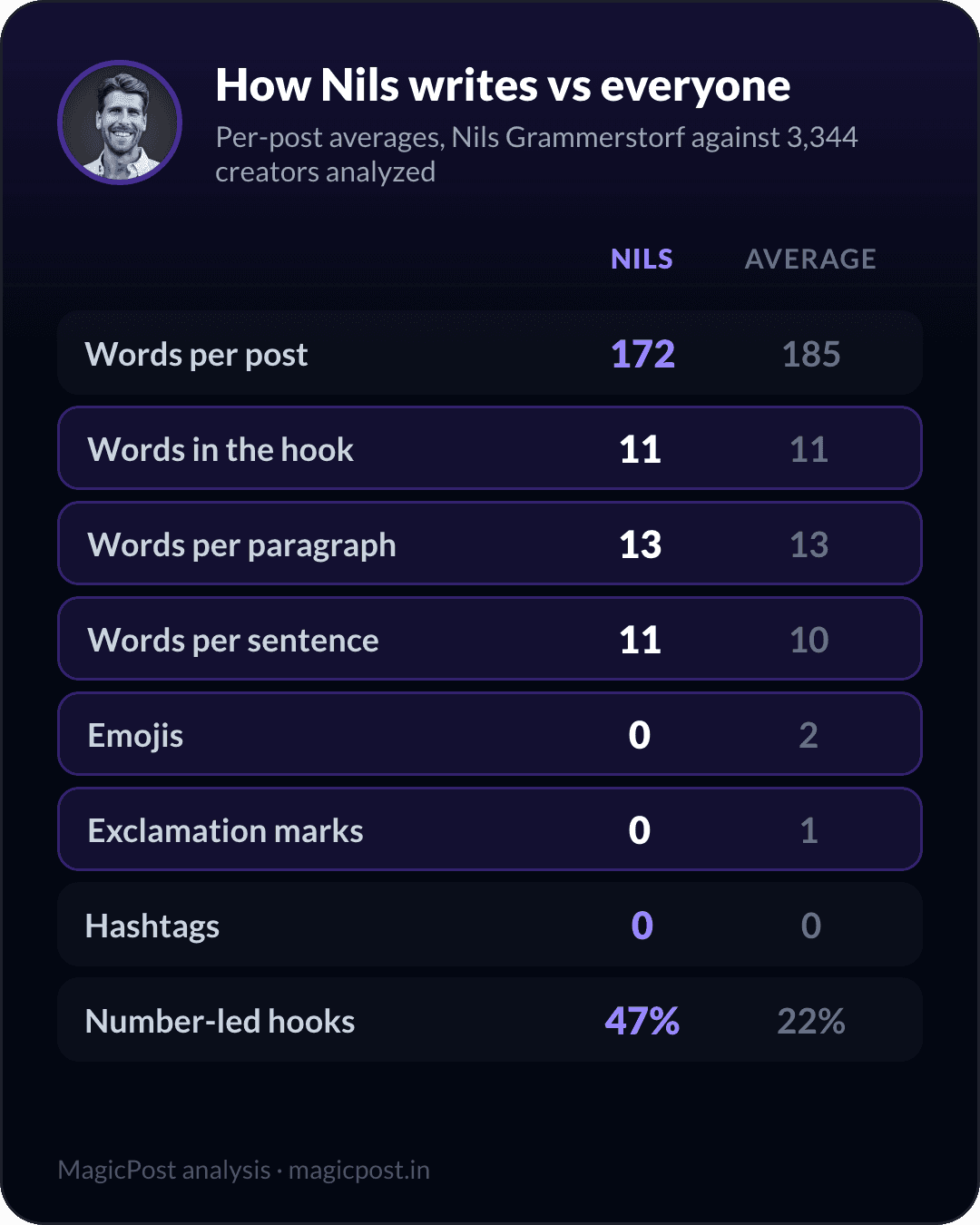
Metric (per post) | Nils Grammerstorf | Average creator* |
Words | ~172 | 185 |
Words in the hook | 11 | 11 |
Words per paragraph | 13 | 13 |
Words per sentence | 11 | 10 |
Emojis | 0 | 2 |
Exclamation marks | 0 | 1 |
Hashtags | 0 | 0 |
Hooks built on numbers | 47% | 22% |
*Median across the 3,344 creators we analyzed with 20+ posts each.
On length, rhythm and paragraph size he sits almost exactly on the average: this is not a white-space minimalist. What sets him apart is two numbers. First, 47% of his hooks are built on a number (a year, a count, a price tag), more than double the 22% benchmark: "2023: KEINE Gehaltserhöhung", "Vor 20 Jahren". The number is the bait. Second, the clean zeros: no emojis and no exclamation marks in the body metrics, despite a playful 😄 showing up inside posts. A numeric hook to stop the scroll, then plain prose to argue the point. When our system describes his style in one word, it says: conversational.
The "AI tells" in his style (read this the right way)
Run Grammerstorf's writing through the patterns people now call "AI tells," and the picture is clear:
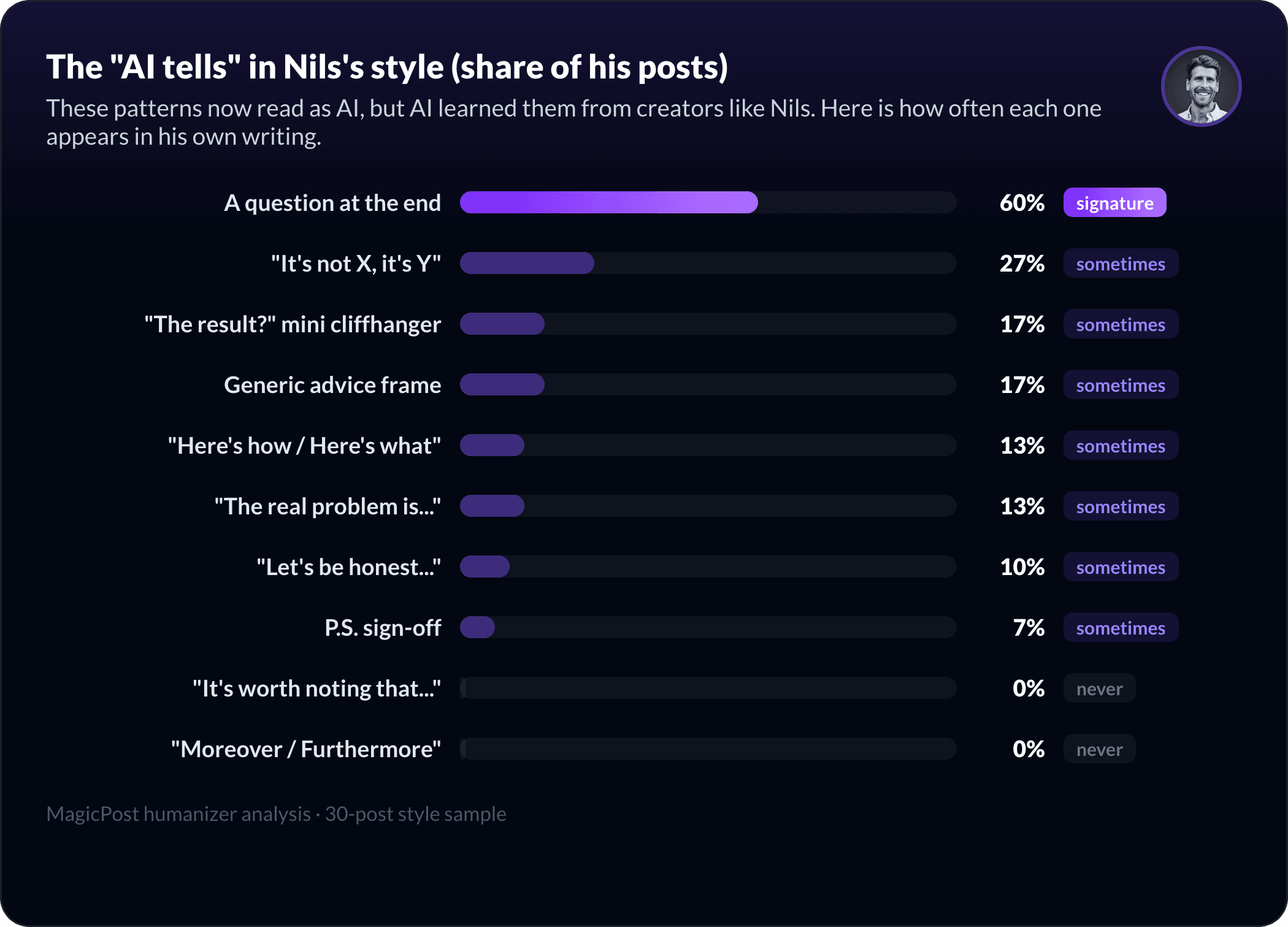
His one characteristic device is the closing question: 6 posts in 10 end by handing the mic to the reader ("Wie gehst du damit um?", "Was ist deine Meinung?"). A quarter use the "It's not X, it's Y" contrast formula, and smaller fractions lean on reveal bridges or a "here's how" frame.
Do not read it backwards. Grammerstorf does not write like an AI; AI writes like him. The closing question reads as a robotic tic when a model bolts it onto every post, but for him it is the whole engagement engine, the reason his comments run so high against his likes. And the other half of his fingerprint is what AI cannot stop adding and he simply does not: he never hedges with "it's worth noting that," and never opens with a stiff transition word like "Moreover" or "Furthermore." The discipline is the signature. (Full story: how to spot AI writing on LinkedIn.)
When he posts
Grammerstorf publishes about 3 times a week, favorite slot 9 AM Berlin time, almost never on weekends (only 5% of posts). Our Germany timing data names him directly as one of the country's reliable 9am posters, right in the early-window sweet spot it recommends, and his roughly 3-a-week cadence is far more sustainable than the daily firehose that our posting-frequency study measures at the top end. His real edge is not volume, it is that high comment count: and if part of your own playbook is showing up in his comments to get on his radar, that is exactly what an engagement feed is for, his posts every day without hunting the timeline.
What to steal from Nils Grammerstorf
End on a real question. Six in ten of his posts hand the reader the mic, and his comments rival his likes because of it. A genuine question beats a generic "Agree?" closer.
Open on a number. Nearly half his hooks are a year, a price or a count. The number stops the scroll before the argument starts.
Build a signature origin story and re-run it. His apprenticeship-rejection story has earned its keep at least four times. Your past is an asset, not a one-off.
Pick a fight worth having. His biggest posts are provocations (the cover letter is dead, the unhappy good employee quits) that split the room on purpose.
Be honest about the lows. "Alles erreicht, und trotzdem ging's mir so schlecht wie nie" is more memorable than any victory lap.
Study him, then study yourself. With MagicPost you can dig into Nils Grammerstorf's numbers the way we just did, analyze your own LinkedIn analytics with the same depth, and write in the spirit of his style, in your own voice. The data on this page is the product.
Where this data comes from
Everything in this article is MagicPost's own research. MagicPost analyzed 306 of Nils Grammerstorf's public LinkedIn posts: timing, engagement, topics, writing metrics, and the AI-pattern profile from a 30-post style sample (high confidence). Every biographical claim is quoted from one of his own public posts and linked to it. His quotes are kept verbatim in German, with an English gloss in parentheses. Grammerstorf is not affiliated with MagicPost; his style is one of those we track most closely.
FAQ
Who is Nils Grammerstorf?
A Berlin-based entrepreneur, co-founder and CEO of the agency napoleonfour, with about 62,000 LinkedIn followers. By his own account a former school dropout who could not land an apprenticeship, he built a sales and personal-branding agency and posts in German about leadership, hiring and the modern way to work.
How does Nils Grammerstorf make money?
By his own public account, through napoleonfour, his agency that turns founders' LinkedIn profiles into a reliable sales channel, alongside consulting and sales training for companies. He has mentioned winning large clients to train their sales teams.
How often does Nils Grammerstorf post on LinkedIn?
About 3 times a week in our data, most often at 9 AM Berlin time, and almost never on weekends (only 5% of his posts).
Does Nils Grammerstorf write with AI?
His style reads intensely human: clean zeros (no emojis or exclamation marks in the metrics) and none of the filler AI adds, no hedging, no stiff transition openers. The one "AI tell" in his fingerprint, the closing question that ends 6 in 10 posts, is not AI mimicry; it is his engagement engine, and AI tools learned the move from creators like him.
Is Nils Grammerstorf still growing on LinkedIn?
His follower count has kept climbing past 62,000, but his median engagement per post nearly doubled in 2025 (from about 82 to 154 likes) and then gave the gain back in 2026 (about 83). That reach-compression shape is common across top creators right now; we measure likes per post, not followers over time.
Can I write like Nils Grammerstorf?
You can learn the mechanics: MagicPost learns a creator's writing style (length, rhythm, hooks, signature moves) and helps you write in that spirit, in your own voice.
The Top LinkedIn Creators to Study in 2026 (By the Data)
The top LinkedIn creators to study in 2026, by the data: 62 creators, six languages, 27 countries, 32,000 posts analyzed by MagicPost. Grouped by what they teach.
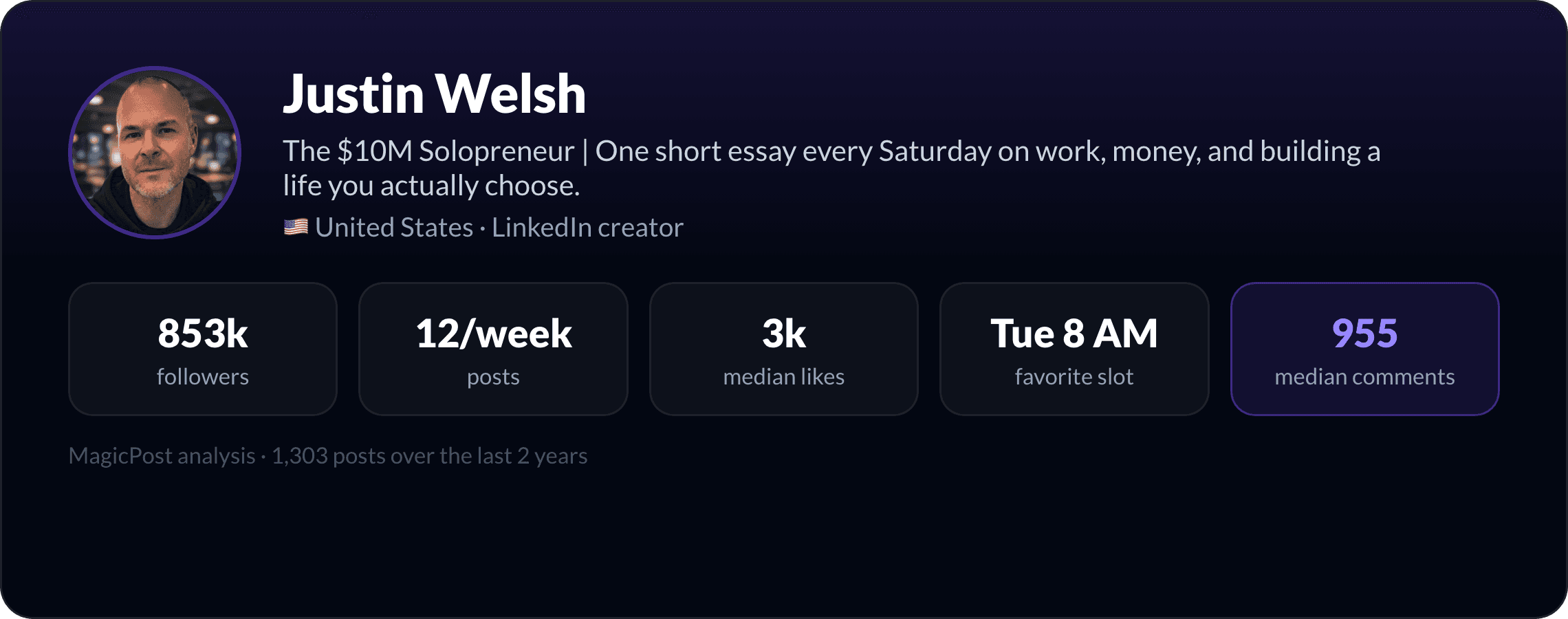
Who Is Justin Welsh? The $10M Solopreneur, Explained by Data (2026)
Who is Justin Welsh? MagicPost analyzed 1,303 of their LinkedIn posts: topics, timing, signature moves and the writing fingerprint behind their growth, with rea
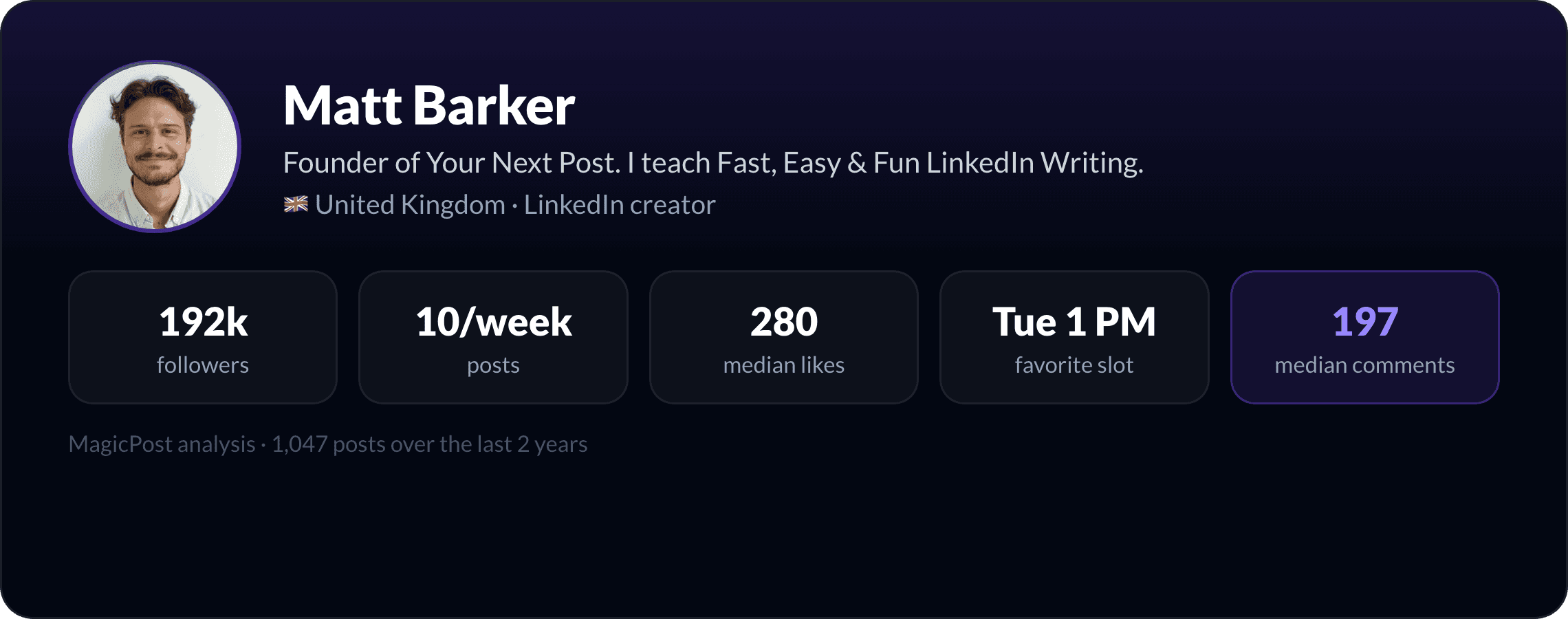
Who Is Matt Barker? The Hook Writer on LinkedIn, by Data (2026)
Who is Matt Barker? MagicPost analyzed 1,047 of their LinkedIn posts: topics, timing, signature moves and the writing fingerprint behind their growth, with real
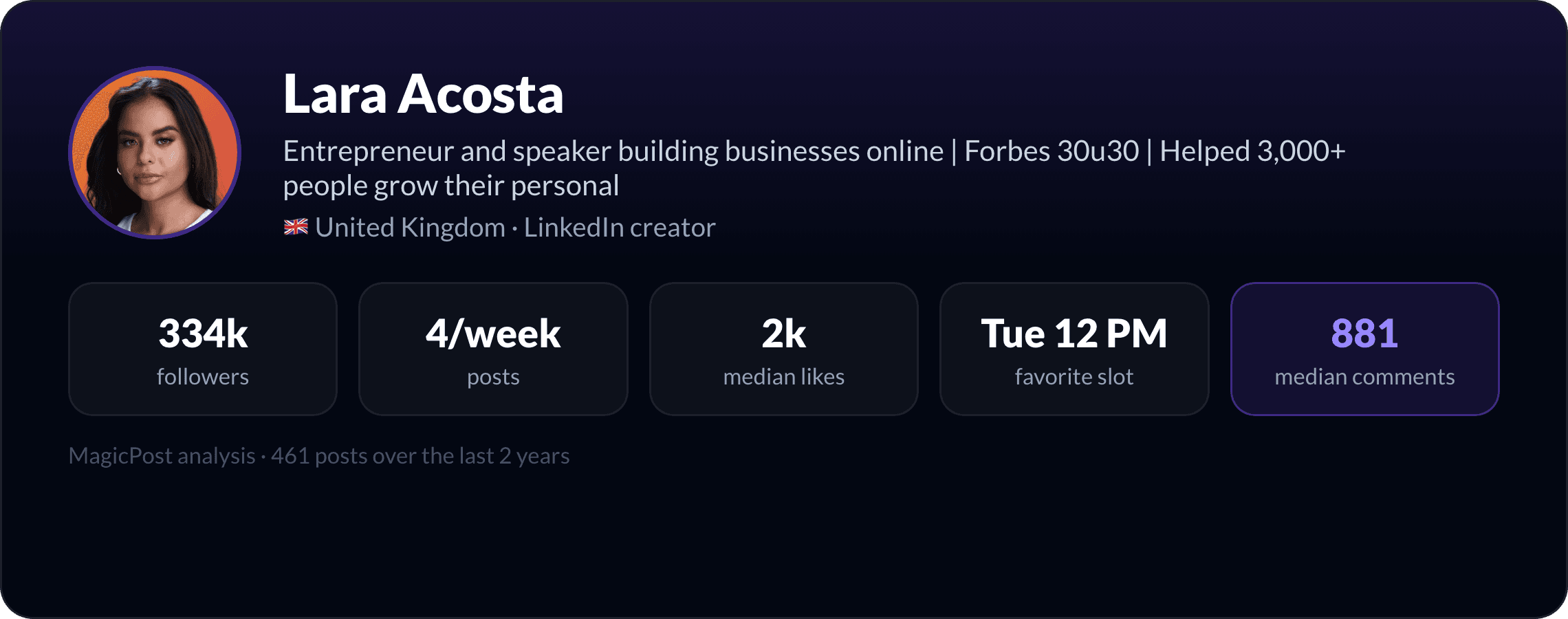
Who Is Lara Acosta? The Forbes 30 Under 30 Comment Machine, Explained by Data (2026)
Who is Lara Acosta? MagicPost analyzed 461 of their LinkedIn posts: topics, timing, signature moves and the writing fingerprint behind their growth, with real n
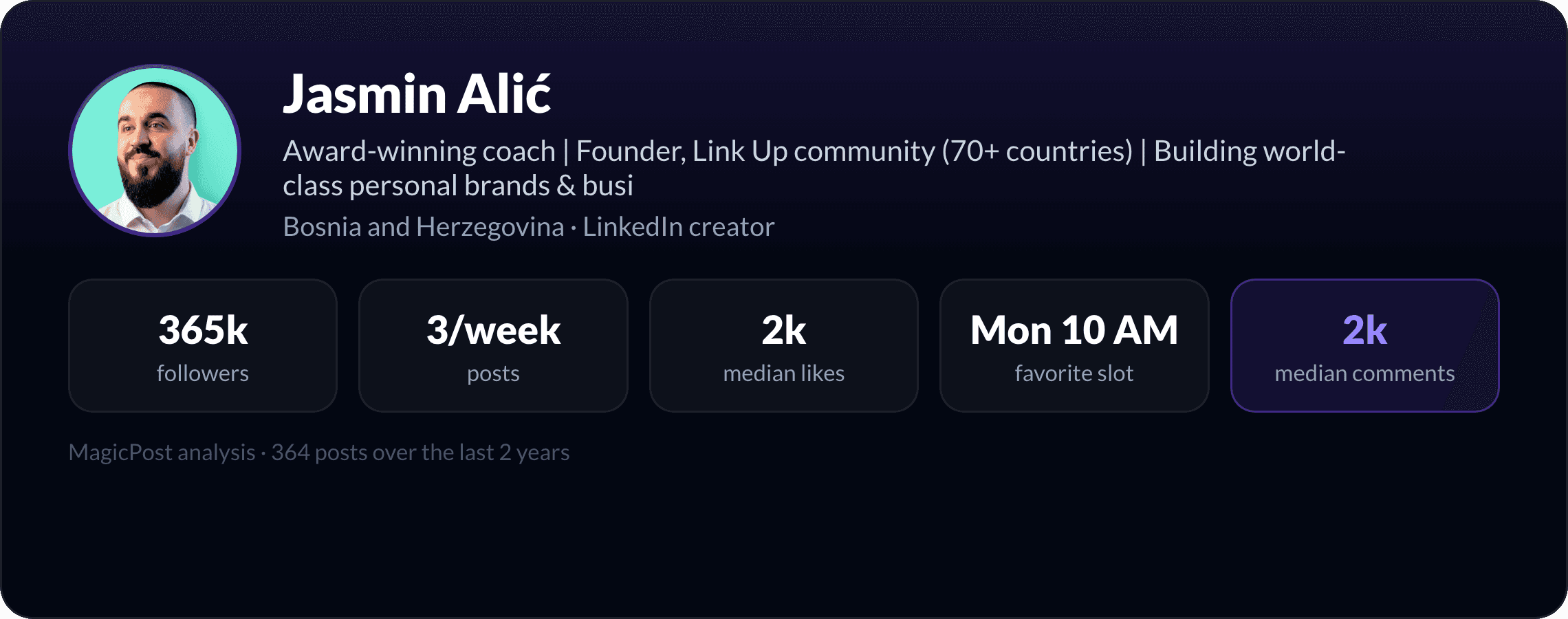
Who Is Jasmin Alić? The Bosnian Coach LinkedIn Mistook for a Bot (2026)
Who is Jasmin Alić? MagicPost analyzed 364 of their LinkedIn posts: topics, timing, signature moves and the writing fingerprint behind their growth, with real n
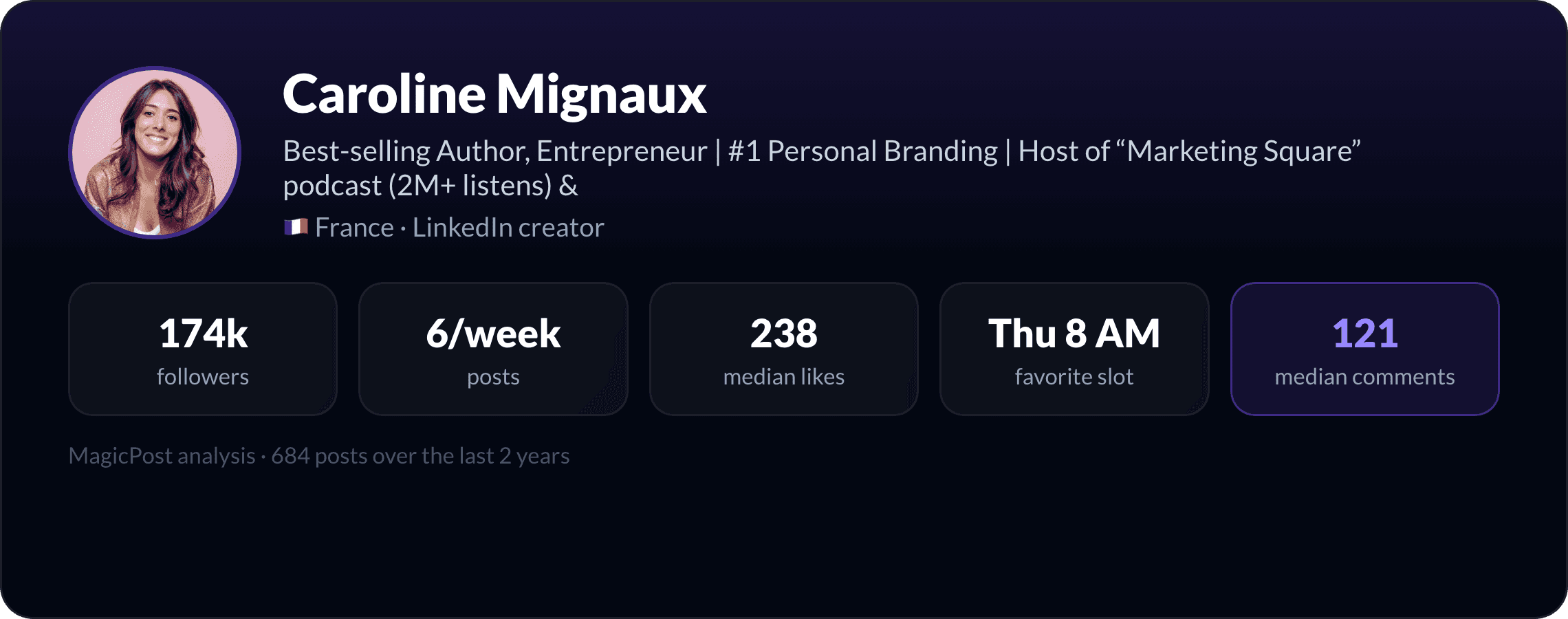
Who Is Caroline Mignaux? France's LinkedIn Top Voice Who Turned Shame Into a Following (2026)
Who is Caroline Mignaux? MagicPost analyzed 684 of their LinkedIn posts: topics, timing, signature moves and the writing fingerprint behind their growth, with r
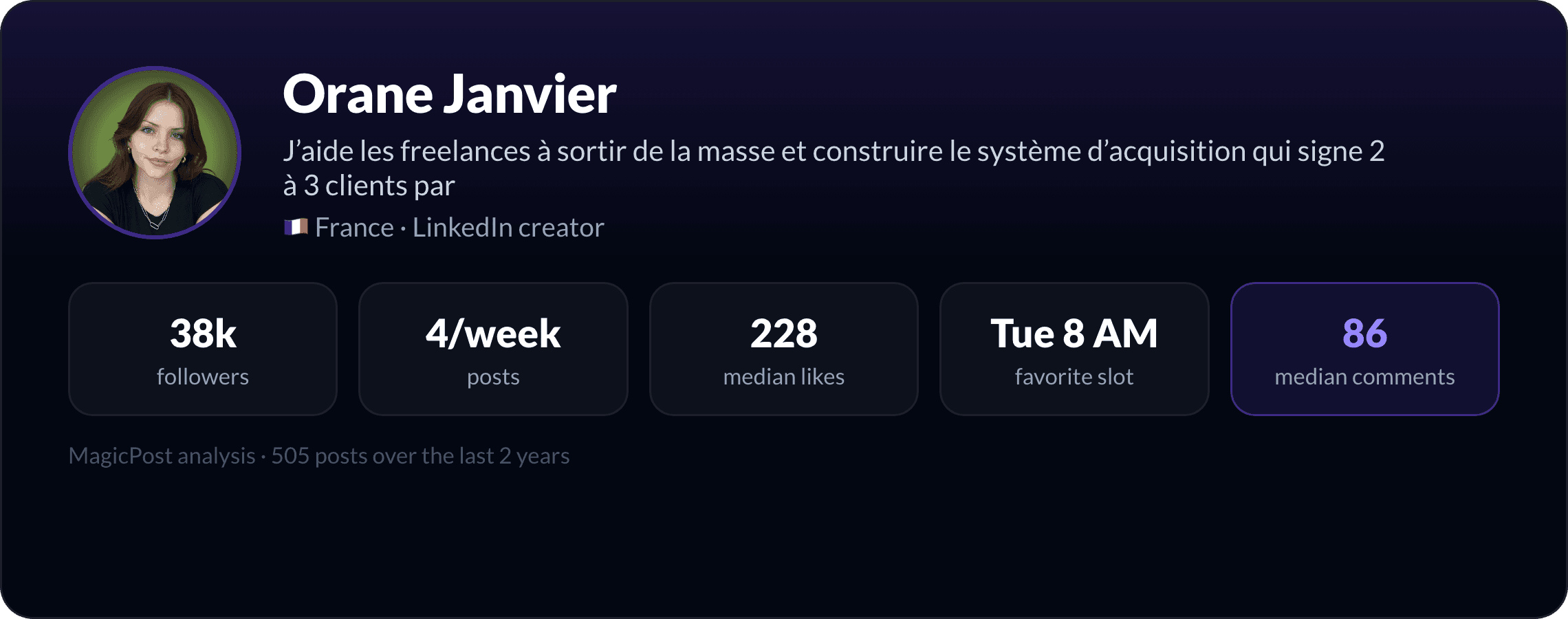
Who Is Orane Janvier? The Freelance Coach LinkedIn Quietly Copies (2026)
Who is Orane Janvier? MagicPost analyzed 505 of their LinkedIn posts: topics, timing, signature moves and the writing fingerprint behind their growth, with real
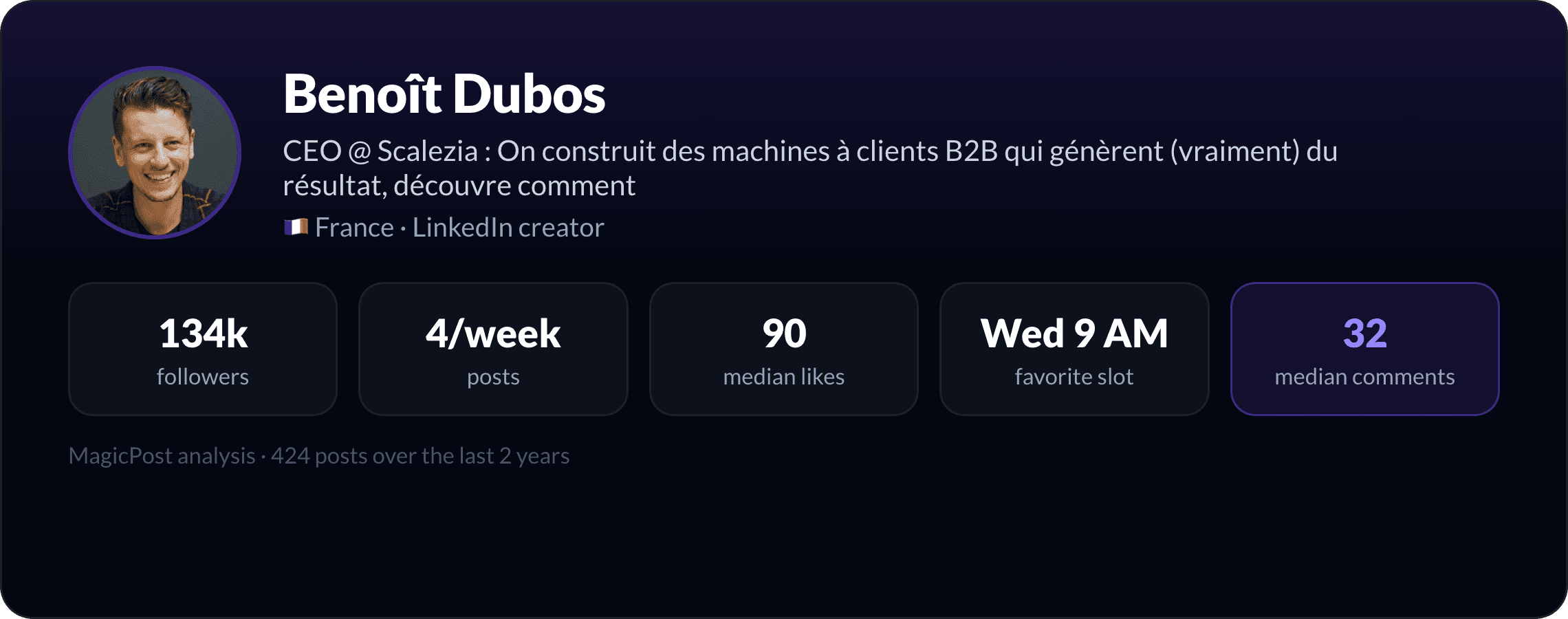
Who Is Benoît Dubos? The Growth Operator Who Turned a Falling Reach Into a Lead Machine (2026)
Who is Benoît Dubos? MagicPost analyzed 424 of their LinkedIn posts: topics, timing, signature moves and the writing fingerprint behind their growth, with real
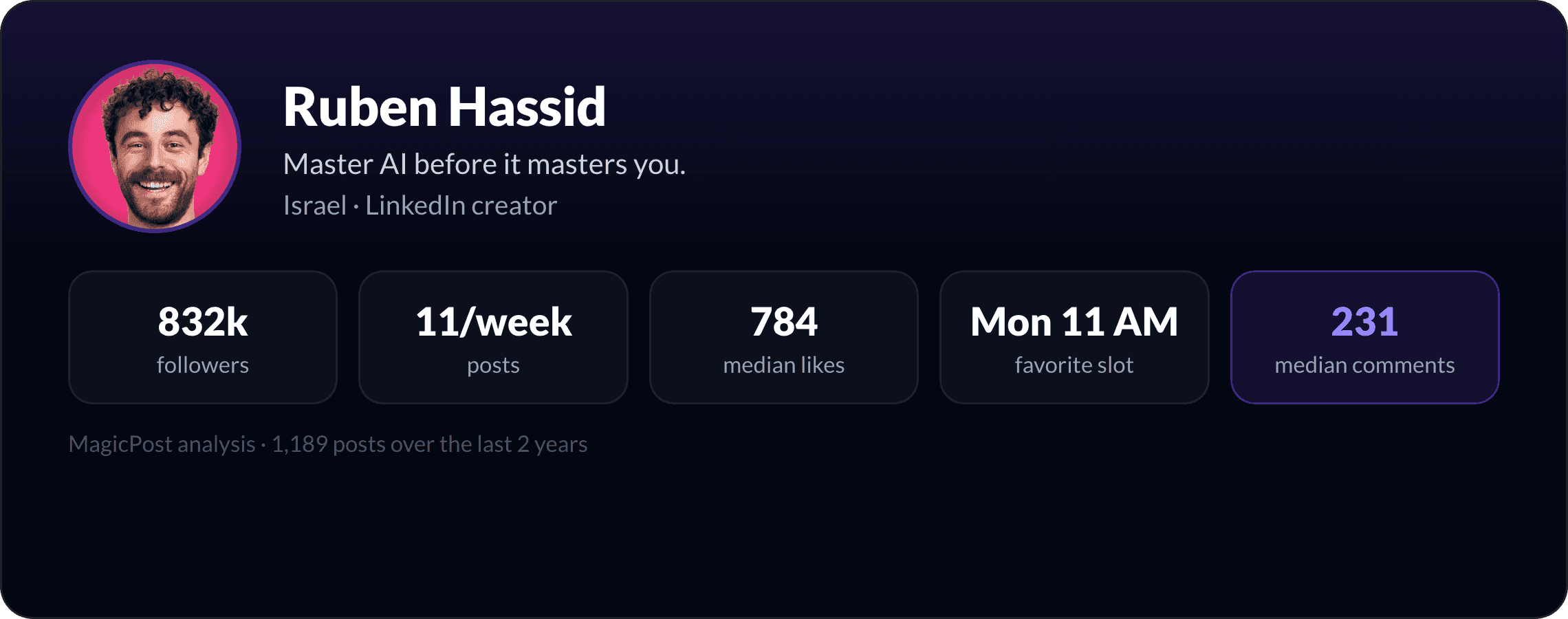
Who Is Ruben Hassid? The "Master AI Before It Masters You" Creator, Explained by Data (2026)
Who is Ruben Hassid? MagicPost analyzed 1,189 of their LinkedIn posts: topics, timing, signature moves and the writing fingerprint behind their growth, with rea
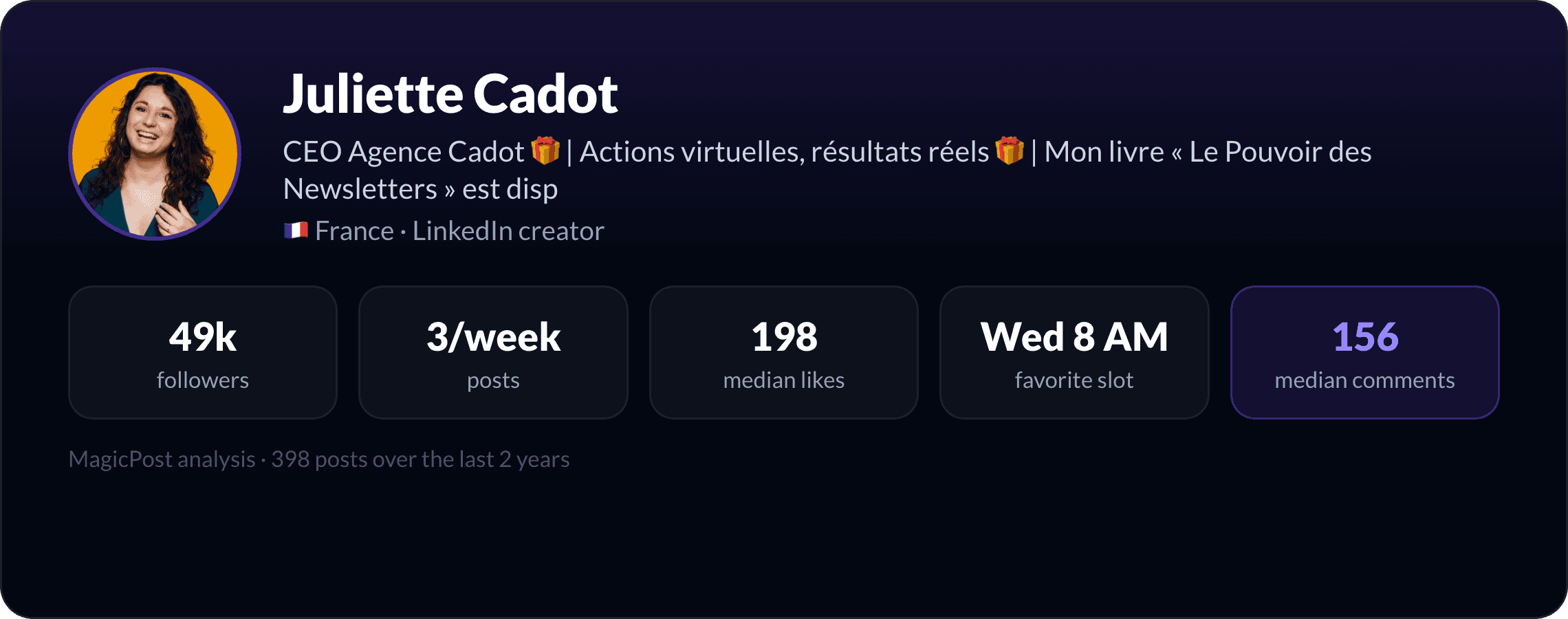
Who Is Juliette Cadot? The Agency Founder Whose Audience Talks Back (2026)
Who is Juliette Cadot? MagicPost analyzed 398 of their LinkedIn posts: topics, timing, signature moves and the writing fingerprint behind their growth, with rea