" height="26.80529977783203px" id="tymKb8bqC" width="128.00300311279295px"/><path d="M 0 2.417 L 0 0 L 12.909 0 L 12.909 2.417 Z" fill="rgb(126, 78, 253)" height="2.417099999999998px" id="aYr4em6zK" transform="translate(128.341 22.325)" width="12.908999999999992px"/></svg>)

"/><stop offset="1" stop-color="rgb(118, 37, 250)"/></linearGradient></defs><g d="M 19.242 21.22 L 19.362 6.204 L 19.272 6.204 L 13.757 21.22 L 10.161 21.22 L 4.796 6.204 L 4.706 6.204 L 4.825 21.22 L 0 21.22 L 0 0 L 7.283 0 L 12.109 13.607 L 12.229 13.607 L 16.844 0 L 24.247 0 L 24.247 21.22 Z M 26.421 26.113 L 26.421 23.445 L 41.407 23.445 L 41.407 26.113 Z" fill="transparent" height="26.112508199679183px" id="DvfaAIHYn" width="41.40731898311435px"><path d="M 19.242 21.22 L 19.362 6.204 L 19.272 6.204 L 13.757 21.22 L 10.161 21.22 L 4.796 6.204 L 4.706 6.204 L 4.825 21.22 L 0 21.22 L 0 0 L 7.283 0 L 12.109 13.607 L 12.229 13.607 L 16.844 0 L 24.247 0 L 24.247 21.22 Z" fill="rgb(46, 46, 46)" height="21.220180016149442px" id="pLsxRCobd" width="24.247352589074694px"/><path d="M 0 2.668 L 0 0 L 14.986 0 L 14.986 2.668 Z" fill="url(%23yD9d4I5GR-3279285344-linear-gradient)" height="2.6675085048549647px" id="yD9d4I5GR" transform="translate(26.421 23.445)" width="14.986002836263765px"/></g></svg>)

Naïlé Titah
There is one sentence shape that, more than any other, makes a LinkedIn post read as AI in 2026:
"It's not X. It's Y."
Creators have turned on it fast. In a post with 1.6M followers behind it, Allie K. Miller listed it first under "insanely obvious signs you used AI." Ruben Hassid (831k) calls it the new em dash. It is the formula people now screenshot as a punchline.
And here is the twist that makes it interesting: it is also the single most common move among the best creators on the platform. So what happened? Let's break it down with the data.
What the formula actually is
It is a two-beat move: negate something, then reframe it. A setup and a reveal.
"It's not about the price. It's about the trust."
"That's not a feature. That's a philosophy."
"Most people think it's a marketing problem. It's a product problem."
"Not X. Not Y. Just Z."
The appeal is real. It creates a tiny moment of tension and then resolves it, which is satisfying to read. That is exactly why good writers reach for it, and exactly why a language model reaches for it on every paragraph.



It is the signature of the best creators
We profiled 100 of the biggest creators on LinkedIn (a median of roughly 79,000 followers). Every single one uses the contrast formula, and 28% use it in nearly every post. It is their number one move, ahead of the "Here's how" opener and everything else.
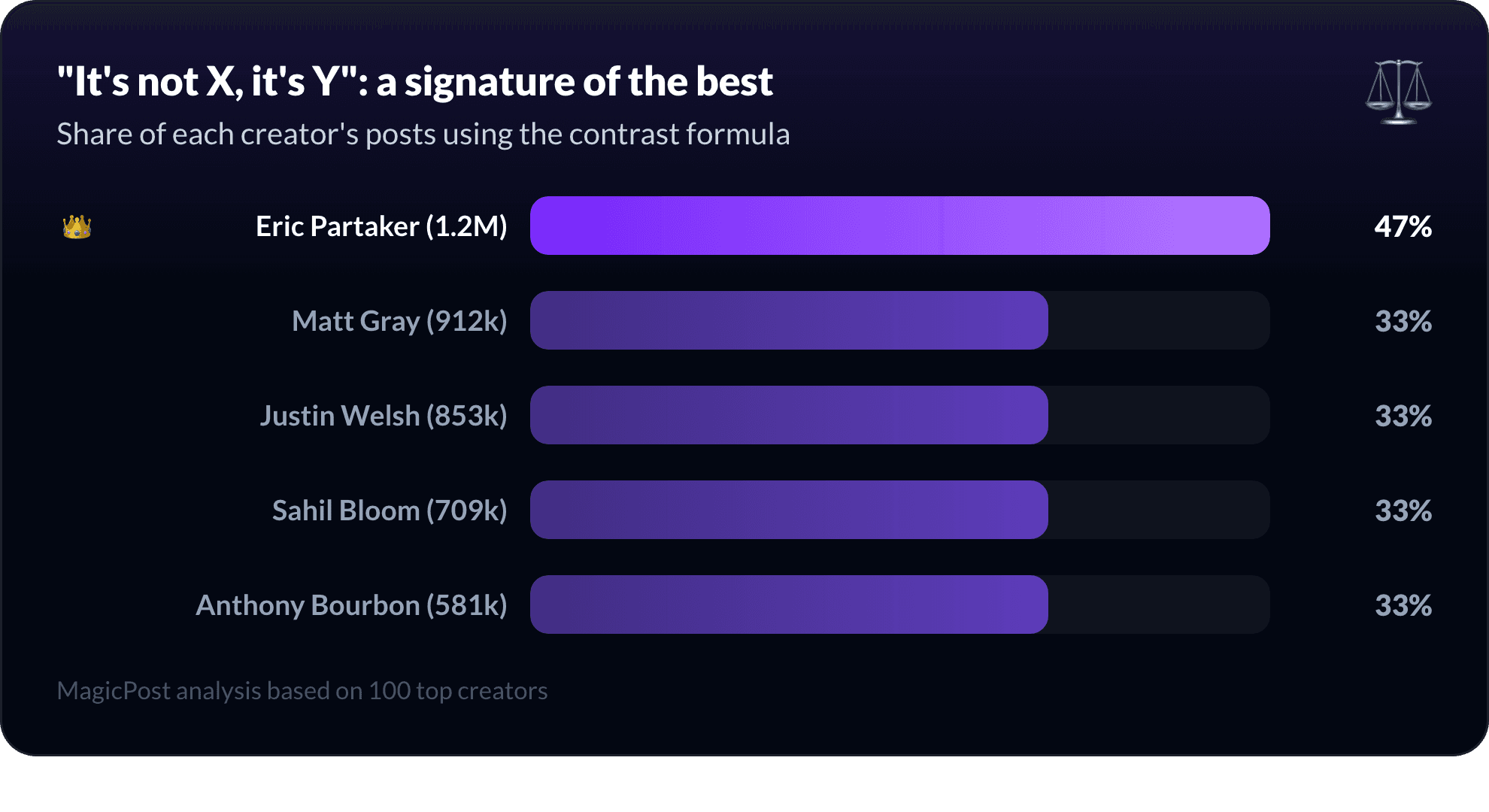
This is not a tic of a few accounts. It is a measured, defining habit right at the top:
Creator | Share of posts using the formula |
Eric Partaker (1.2M followers) | 47% |
Matt Gray (912k) | 33% |
Justin Welsh (853k) | 33% |
Sahil Bloom (709k) | 33% |
Anthony Bourbon (581k) | 33% |
Eric Partaker reaches for it in nearly half of everything he writes. Gary Vaynerchuk (5.9M) writes "It's not always how much money you make, it's how much you spend." Matt Gray likes the move so much he reuses one line, "Your business should work without you, or it's not a business, it's a job," across at least four separate posts. Even Nicolas Cole, who teaches writing for a living, lands in the same band.
So it was never an AI invention. The model learned it from the people who write best, then started using it everywhere. That is the whole reason it reads as a tell: not because it is bad, but because it is now everywhere. (It is one of the eleven moves in our full breakdown of AI patterns on LinkedIn.)
The genuinely unfair part
Take Justin Welsh again. He spent years building one of the cleanest writing styles on LinkedIn, and the contrast line was part of that craft: a move he earned, in a third of his posts, that helped lines like "It's not just about hearing words, it's about understanding the meaning behind them" pull nearly 3,000 likes. It was, in the most literal sense, part of his voice.
Then a language model read a few million posts like his, picked up the move, and started spraying it across everyone's feed. And now the exact sentence shape that made Welsh sound sharp makes a stranger sound like a bot.
Sit with how backwards that is. A signature that took a decade to build now reads as the laziest thing you can post. Not because the writer changed. Because the machines copied him, at scale, until the move stopped meaning "good writer" and started meaning "everyone." That is the strange tax of being good enough to imitate: do something well enough, publicly enough, and AI will turn it into a cliche you get blamed for.
The formula did not get worse. It got common. And on the internet, common is the only thing that kills a good line.
Why it became the number one tell
Two forces, same as the rest of the AI house style.
First, the models trained on it. Language models learn from millions of human sentences, and this is one of the highest-performing shapes in the training data, so they reproduce it constantly. What a human used once for effect, the model uses three times a post.
Second, the community caught on, loudly. The most-shared posts about AI writing now name this formula directly. Will McTighe (439k), who says he analyzed over 300,000 posts, lists "the same 'It's not X, it's Y' hooks" among the moves that stopped working. Audrey Chia files it under "fake contrast." Once a pattern becomes a punchline, every use of it carries a little static.
What LinkedIn has to do with it
In May 2026, LinkedIn announced it would demote content that "feels generic or repetitive" and "lacks any real unique perspective," and reported catching generic content with about 94% accuracy. It did not name this formula, or any phrase. But a post built around a reflexive contrast line with nothing specific underneath it is close to the definition of "generic and repetitive." That is why we call it the formula LinkedIn is quietly penalizing: not by name, but by exactly the profile it now demotes. (Full detail in Does LinkedIn penalize AI content?.)
So should you stop using it?
No. A single, earned "it's not X, it's Y" with a real point underneath it is still a strong line, the same way it always was for the creators above. The problem is never one use. It is the reflex, the repetition, and the empty version that contrasts nothing real.
Tell the difference with one test: strip the formula and see if a point remains.
Empty: "It's not about working harder, it's about working smarter." (Remove the formula and there is nothing left. Pure shape.)
Earned: "I cut my week from 60 hours to 40 and revenue didn't move. Half my schedule was theater." (Same idea, a real thing happened.)
Four ways to create tension without the formula
If you want the hook without the tell, reach for one of these instead. Each does the job the formula does, building a little tension, without the now-flagged shape.
Lead with the surprising specific. Skip the setup and open on the fact. "95% of the time you'll ever spend with your kids is gone by the time they turn 18." The number is the hook.
Tell the moment, not the maxim. Instead of contrasting two abstractions, show the scene. "A client emailed at 11pm just to say the onboarding finally made sense."
Show the gap with real numbers. "What costs a client $50,000 and 3 years to figure out, they get in 90 days." The contrast is in the figures, not the formula.
Just say Y. Drop the "not X" warm-up entirely and state your point flat. Most of the time the negated half was filler anyway.
The goal is not to ban a sentence shape. It is to make sure there is a real thought where the shape used to be.
MagicPost's Humanizer flags reflexive contrast lines that contrast nothing and keeps the ones that land. Try it free.
SSS
Is "it's not X, it's Y" really a sign of AI?
It is the most-cited one in 2026. But it is not proof: every top creator uses it too. The tell is using it on reflex, in every post, with nothing specific underneath.
Does the formula get more engagement?
Not in likes. In our data, posts using it landed about the same median likes as everything else (130 vs 127). They do get slightly more comments. It is a habit, not an edge.
Can I still use it?
Yes, once, when it frames a real point. Strip the formula; if a genuine idea remains, keep it. If nothing is left, it was filler.
Why does AI use it so much?
Because it learned from human writing, where the formula is a high-performing move. The model just overuses it, in every paragraph, which is what turns a good line into a tell.
How to Spot an AI-Written LinkedIn Post: 11 Patterns (We Analyzed 46,000 Posts)
We analyzed 46,000 LinkedIn posts to find the 11 patterns that make a post read as AI in 2026, with real examples from top creators and how to fix each.
Is the Em Dash a Sign of AI on LinkedIn? Yes, and Here Is the Fix
Is the em dash a sign of AI on LinkedIn? Yes. Em-dash use jumped from under 2% of posts to over 15% with ChatGPT. The data, and what to use instead.
"Here's How" and "Here's What": LinkedIn's Most Common AI Handoff
"Here's how" is LinkedIn's most common AI handoff. It went from under 3% of posts to over 16% with ChatGPT. Why it reads as AI, and how to vary it.
The AI Words Everyone Tells You to Avoid Are Already Dead on LinkedIn
The famous AI words to avoid (delve, tapestry) are already dead on LinkedIn. We checked 129,000 posts. The real tells moved from vocabulary to structure.
Does LinkedIn Penalize AI Content? What the Data and LinkedIn's Own Crackdown Say (2026)
Does LinkedIn penalize AI content? Not exactly. It demotes generic posts, not AI. We scored 46,000 top posts and 97% read as human. Here is what happens.
AI Writing on LinkedIn in 2026: The Patterns, and Where They Actually Came From
AI gave LinkedIn a house style. Here are the patterns that now read as AI in 2026, and the uncomfortable truth about where they actually came from.