Short answer: on LinkedIn in 2026, yes. The em dash is now read as a sign of AI, and the data backs it up. If you drop one into a post, a large slice of your audience will quietly assume a bot wrote it.
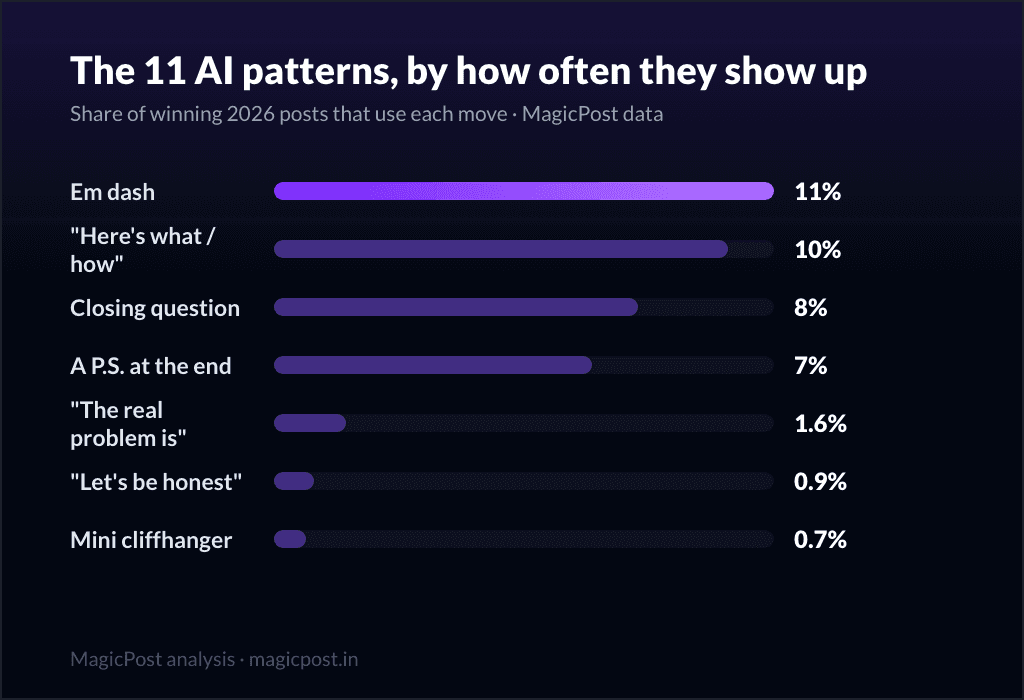
But the em dash is a vocabulary signal: a single character readers clock. What actually costs you reach in 2026 is something bigger that often travels with it: four templated turns of phrase. We measured it.
Across our English posts, each of these turns drags a post roughly -4% to -7% below the same author's normal output, audience held constant. That effect was statistically absent before 2026 (the full study is here).
So this page does two jobs: swap the em dash, the fastest fix, then watch for the four structural turns that the algorithm now actually demotes.
The timing gives it away
Look at how often LinkedIn posts contained an em dash, year by year:
Year | Posts with an em dash |
2021 | 1.2% |
2022 | 1.9% |
2023 | 3.0% |
2024 | 9.5% |
2025 | 15.6% |
2026 (so far) | 10.4% |
ChatGPT launched at the end of 2022. For years before that the em dash sat flat, around 1 to 2% of posts. Then, the moment AI writing tools spread, it multiplied roughly eight times in three years, to nearly one post in six.
Punctuation does not change that fast on its own. People did not suddenly rediscover a key they had ignored for years. Their AI did. What that curve really traces is the adoption of AI writing tools, drawn out in punctuation. That is about as clear as a tell gets.
What that means for your posts
This is no longer a quiet statistical signal. It is a reflex in your readers. We found 588 posts arguing about the em dash and AI. The whole platform has been trained to spot it.
So the moment you publish a post with an em dash, a chunk of your audience stops reading your idea and starts reading your punctuation. They assume you did not write it. Fair or not, that assumption is now the cost of the character.
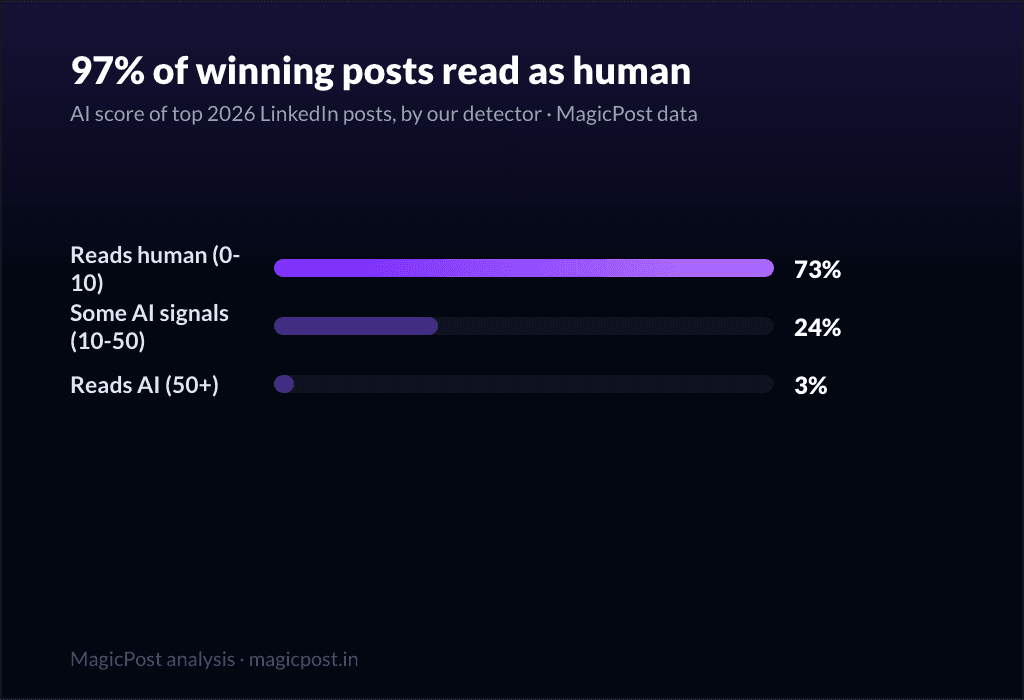
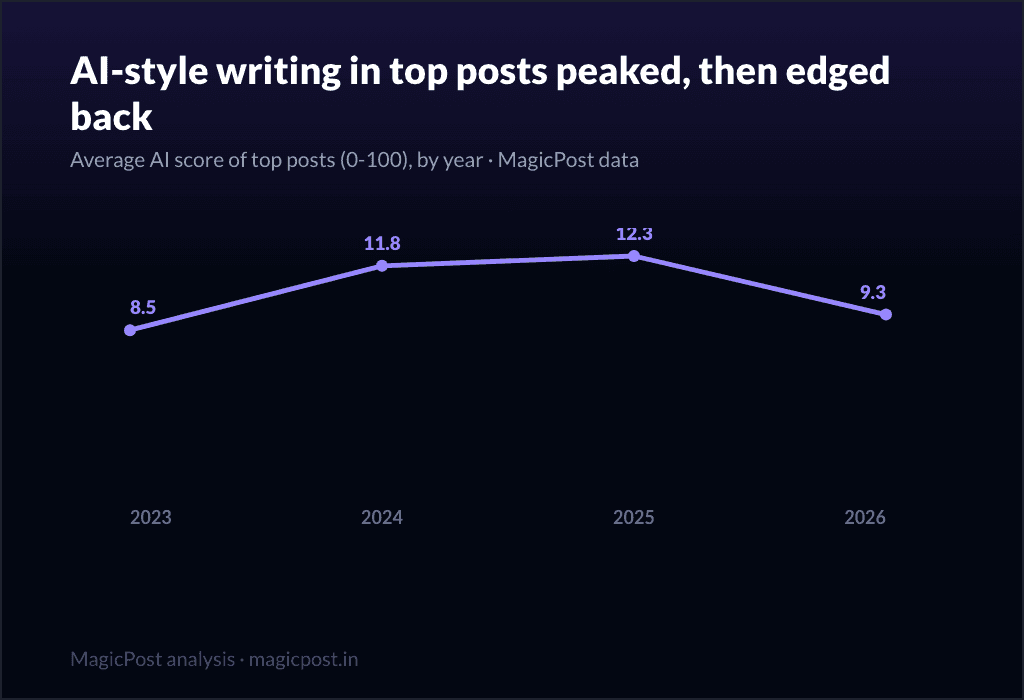
And it is not only readers. As of 2026, LinkedIn itself is now demoting posts that read as generic AI, keeping them from spreading beyond your immediate network (we cover exactly how in Does LinkedIn penalize AI content?). So looking like AI carries two costs at once: your readers discount you, and the algorithm buries you.
One split matters here, because it changes what you should fix. The em dash is mostly a perception cost: readers clock it. The reach cost we can actually measure lives in structure, not punctuation, and it shows up in four templated turns of phrase (more on those below).
We do not have a measured reach number for the em dash itself, and we will not invent one. Treat it as the visible flag that gets your post read as AI; treat the four turns as the thing the algorithm is pricing.
To be clear, the em dash is not bad writing. It was a sharp tool for centuries. But that argument lost. On LinkedIn today, it reads as AI, and how your post is read is the only thing that decides how it lands.
What to use instead
The good news: every job the em dash does, simpler punctuation does without the AI smell. Four swaps cover almost every case.
A full stop. The em dash usually marks a hard turn. A period makes the same turn, harder. Instead of one long breath, give it two: "I thought it would work. It didn't."
A comma. For a quick aside, a comma carries it fine: "My first launch, the one nobody remembers, taught me more than any win since."
A colon. When the dash sets up a payoff, a colon is built for exactly that: a setup, then the reveal.
Parentheses. For a true aside (like this one), parentheses do the work and read as unmistakably human.
Rewrite habit: when you reach for an em dash, stop and ask which of those four you actually mean. You will almost always find one that is cleaner.
The four turns of phrase that cost you reach
Swapping the em dash makes you look less like AI in one second. But it is the easiest signal to fix, which means it is also the shallowest.
The em dash changes how readers feel about your post; these four templated structures change how far it travels. They are what our 2026 study found measurably below an author's own baseline, and the effect was statistically absent before this year.
1. The generic advice frame: "Stop X, start Y" / "the key is." The most reliable reach-killer on the list (around -6.7% within an author in our English data). A real example we found, reworded: a coach writing "Stop describing the tool. Start owning the result." Strong rhythm, zero specifics. The fix is to name the concrete action instead of the template.
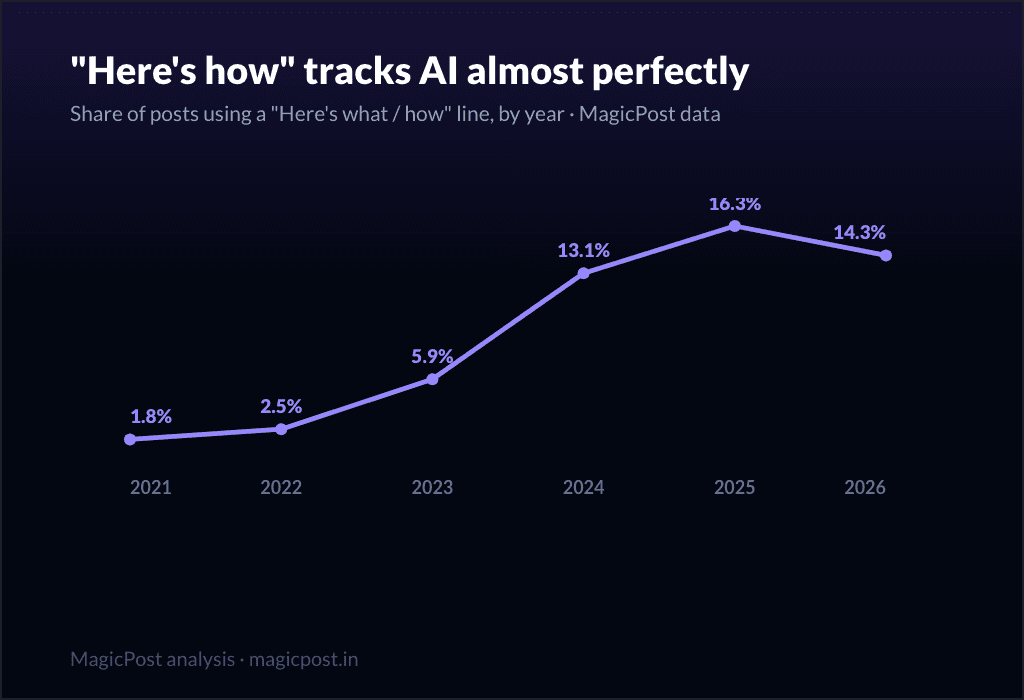
2. The announcement opener: "Here's what nobody tells you" / "Here's how." About -4.3% within an author across our English data. A real example, paraphrased: a consultant opening "Here's what nobody tells you when you run your own team." The phrase is a drumroll with nothing behind it yet. Open straight on the substance.
3. The dramatic reveal bridge: "The result?" About -4.8% within an author across our English data. A real example, reworded: a sales writer listing broken workflows, then "The result? Deals slip through the cracks." The fix is to chain the consequence directly, so the line reads "...so deals slip through the cracks."
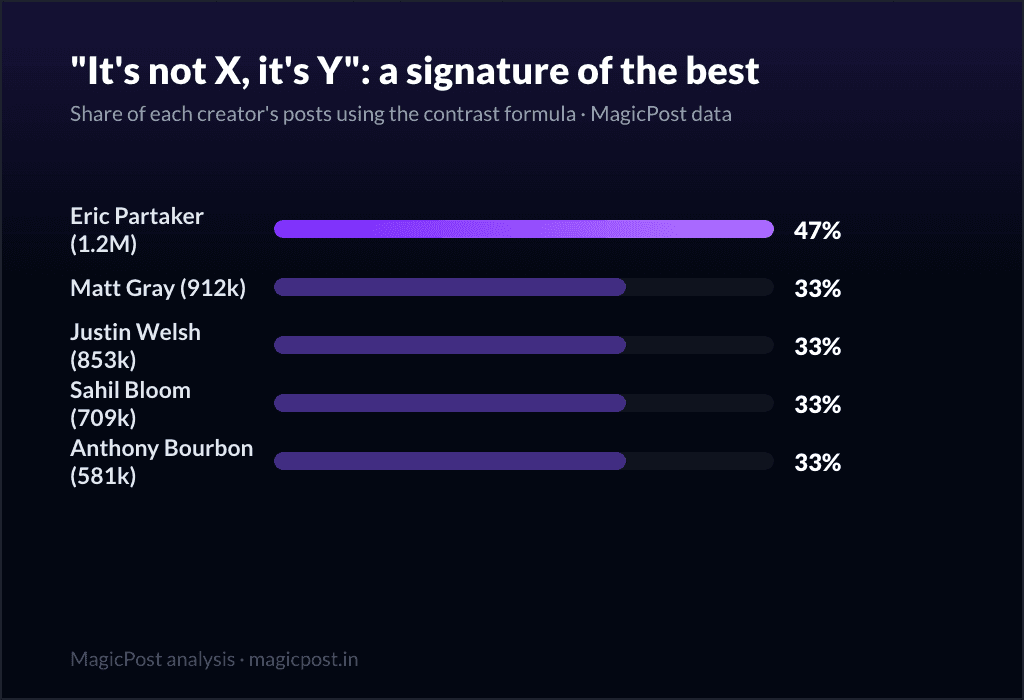
4. The negate-then-reframe contrast: "It's not X, it's Y." About -4.9% within an author across our English data. A real example, paraphrased: a founder writing "That's not a hiring problem. It's a process problem." State it directly instead, without the negate-then-flip pivot.
These do not look like AI when you read one in isolation. They look like good LinkedIn writing, which is exactly why they spread, and exactly why the platform has started discounting them.
The proof inside a single author
The cleanest evidence is what happens within one person's feed, where their audience never changes. A SaaS founder in the study averaged -1% on posts carrying one of these turns and +40% on the clean ones: a 41-point gap. A recruiter showed a 36-point gap, with the flagged posts running 18% below their normal reach.
Across the case studies, the templated posts landed 18 to 41 points below the same author's clean posts. That is correlational, topic and format vary too, but it lines up with the controlled estimate, and the audience explanation is ruled out by design.
What helps, and must never be stripped
Not everything that sounds "LinkedIn-y" hurts you. Three moves are reach-positive in the same data, and you should keep them:
Genuine sincerity or vulnerability (+4.6% within an author). A real opener, reworded: "This month I hit 40K in revenue. This morning I realised I have no friends to celebrate with." That candor earns reach.
A closing question (does not hurt reach, and pulls comments), the kind that ends on the real thing the reader is avoiding.
A P.S. or CTA sign-off that points to the next step.
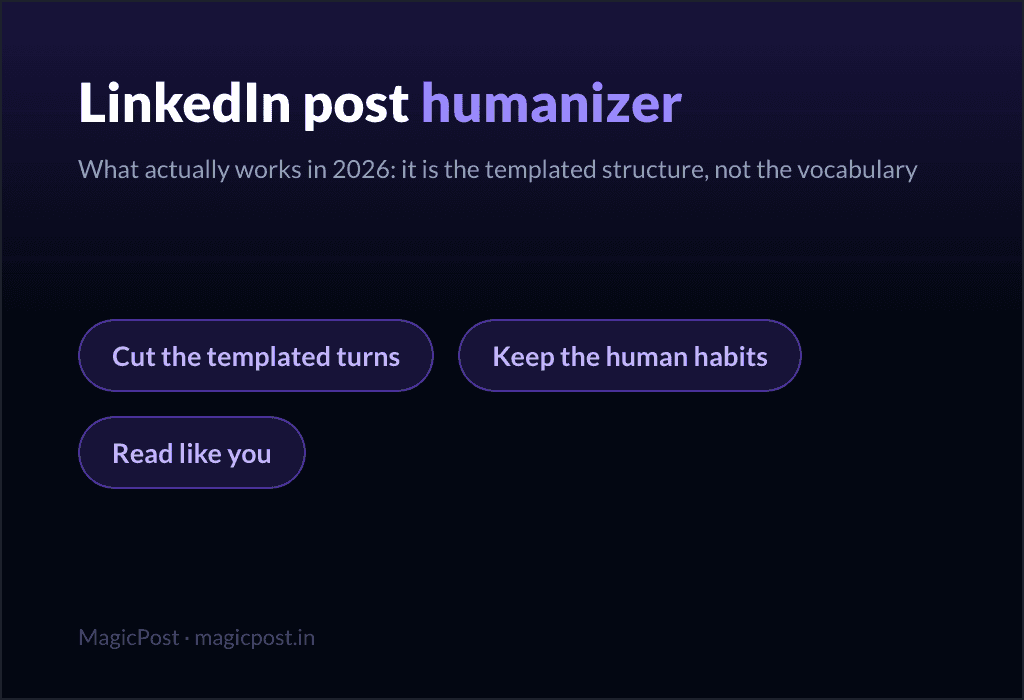
A "humanizer" that flattens those along with the four turns is doing harm. The goal is to cut the templated structure, not the personality.
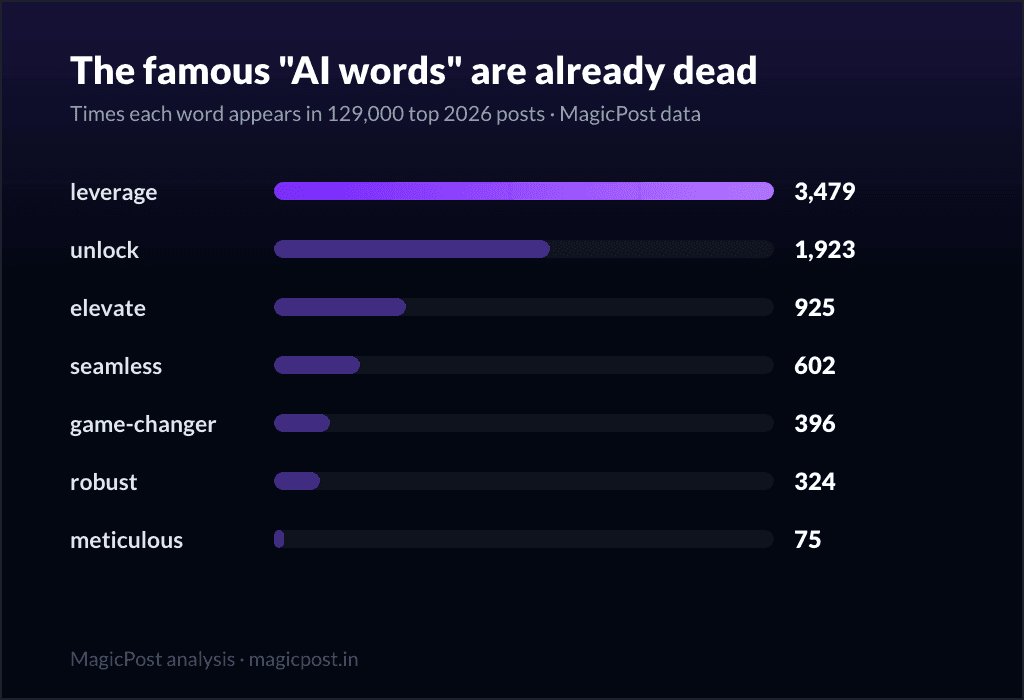
The other deeper tells worth watching are essay connectors like "Moreover" and "Furthermore" at the start of a line, and throat-clearing hedges like "it's worth noting that." The full list is in How to spot an AI-written LinkedIn post.
Fix the dash first because it is fast. Then fix the four turns, because that is what the algorithm is actually counting.
The verdict: is the em dash a sign of AI?
Is the em dash a sign of AI on LinkedIn? Yes. The timing proves it, and your readers believe it. Swap it in four characters and move on. Then spend the real effort where the reach actually leaks: the four templated turns of phrase, which our 2026 data shows the algorithm now prices, post by post, below your own baseline.
Worth noting: this entire article was written without a single em dash. If we can explain the em dash for 1,200 words without using one, your LinkedIn post can survive without one too.
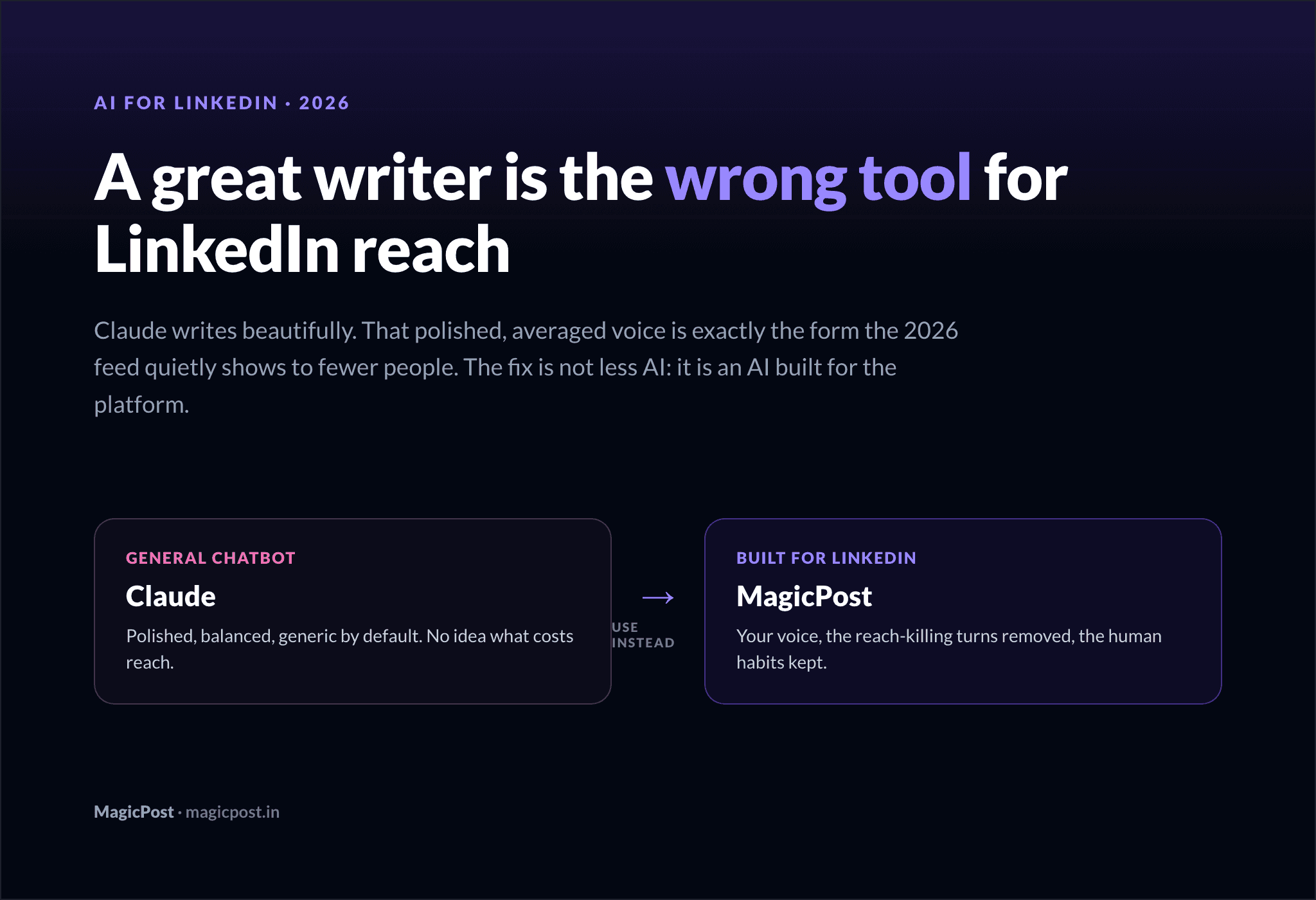
MagicPost's Humanizer strips the em dash and rewrites the reach-killing turns automatically, while keeping the candor, the closing question, and the sign-off that actually earn reach. Try it free.
FAQ
Is using an em dash a sign of ChatGPT?
On LinkedIn, yes. Em-dash use in posts went from under 2% in 2022 to over 15% in 2025, tracking the rise of AI writing tools almost exactly. Readers now treat it as a tell, so a single one will get your post read as AI.
Should I stop using em dashes on LinkedIn?
Yes, if you care how your posts are received. Replace them with a period, a comma, a colon, or parentheses depending on the job. It is the fastest single change you can make to not look like AI.
Is the em dash actually bad writing?
No. It is good, classic punctuation, and strong writers have used it for centuries. But on LinkedIn in 2026 it reads as AI regardless, and perception is what decides how your post performs.
Will an em dash hurt my reach?
Indirectly. We do not have a measured reach number for the em dash on its own; it is mainly a perception flag.
What we did measure costing reach in 2026 is the templated structure that tends to travel with it: four turns of phrase ("Stop X, start Y", "Here's what nobody tells you", "The result?", "It's not X, it's Y") that each run about -4% to -7% below an author's own baseline in our English data.
The full numbers are in our reach study, and the mechanism is in Does LinkedIn penalize AI content?