No, LinkedIn does not penalize AI content as such. Since the week of July 27, 2026, the posts that lose reach are the ones with no concrete detail and no lived experience, whoever or whatever wrote them.
LinkedIn does not ban AI and will not punish you for opening ChatGPT. In May 2026 it said it would show less generic content, the kind that sounds polished but says nothing. On July 30, 2026, it announced classifiers that identify AI slop and show less of it in suggested posts and in posts from outside your network. AI produces a lot of generic text, which is why the two get mixed up.
In our study of AI slop on LinkedIn (40,937 posts from 660 creators, each post compared with its own author's average), posts with no concrete detail and no lived experience ran 13% below their author's average post between April 1 and July 26, 2026, and 23% below since. A post rated 30 points more AI-sounding, at equal substance, got about 9% fewer impressions than a comparable post before July 27 and shows no extra cost we can detect since.
AI turns of phrase still cost a little. Measured inside each author's own feed, so audience size is neutralised, four templated turns already pulled reach down in our English posts in 2025 (our earlier study):
Templated turn (your own narration) | Reach vs the same author's other posts (English, June to Dec. 2025) |
|---|---|
Generic advice frame ("Stop X, start Y" / "If you want to…") | −6.6% |
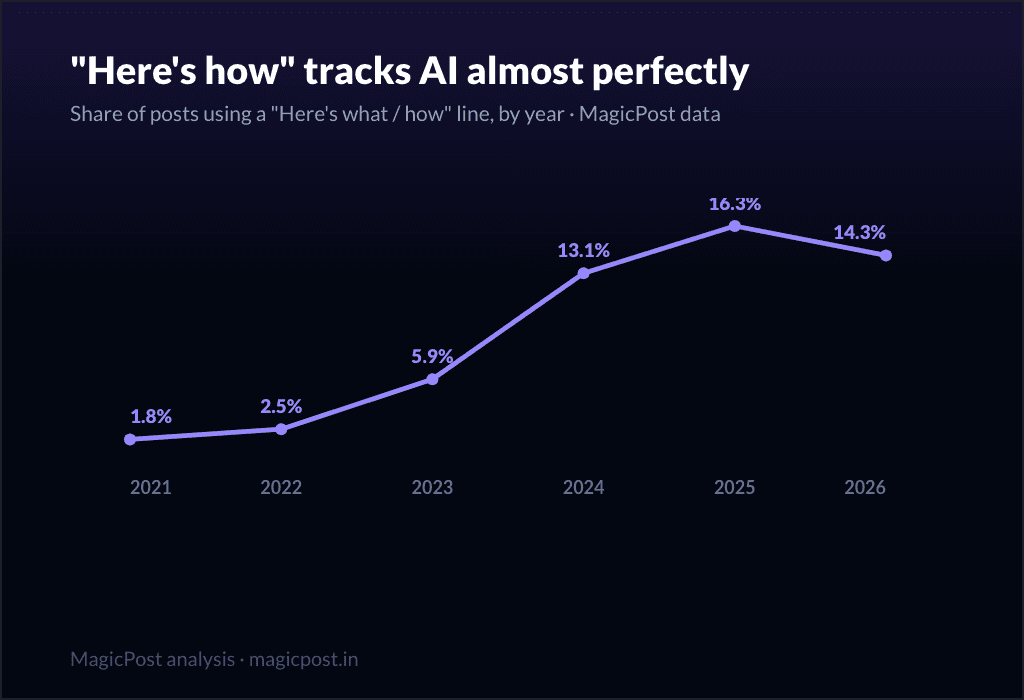
"Here's what / Here's how / what nobody tells you" | −4.1% |
The dramatic "The result?" bridge | −3.0% |
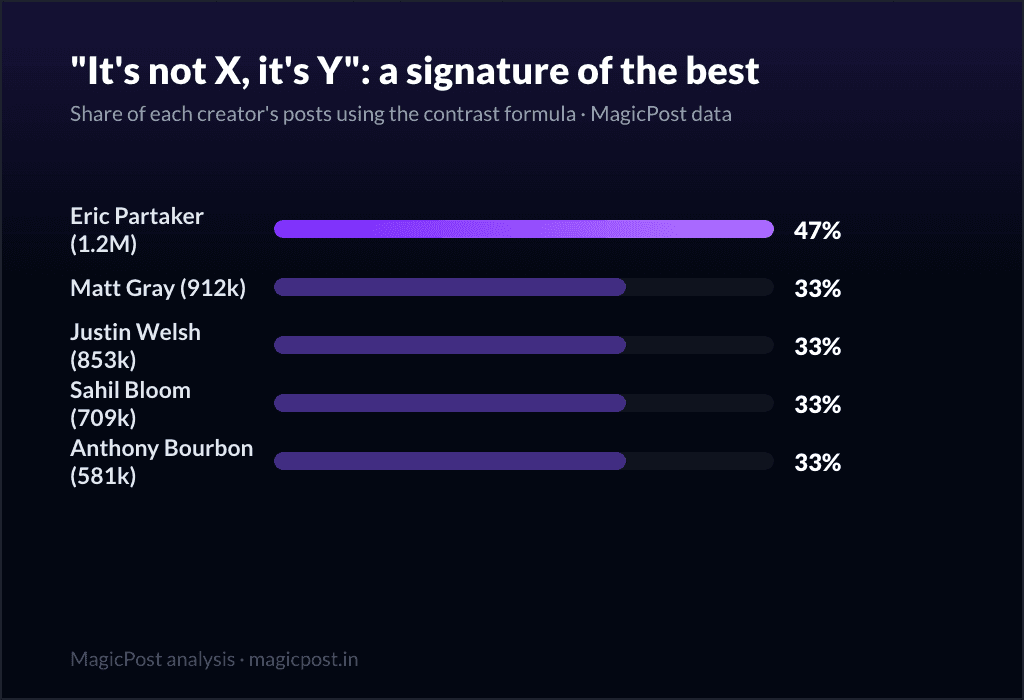
"It's not X, it's Y" contrast | −5.1% |
These are within-author numbers: the same person's posts that lean on these turns travel a little less than their own posts that do not, about 3% to 7% below the author's own normal. Posts carrying at least one of them sat about 3% below their author's average in 2025, and again in 2026 up to July 26.
These are observational effects (reach is still driven mostly by your audience, and correlation is not proof), so nobody here is promising to double your reach. The July 27 shift and LinkedIn's July 30 announcement land in the same week, but we do not see how LinkedIn ranks posts, so we read that as timing. The sections below start with what LinkedIn said, then move to the data and to how to write with AI.
Does LinkedIn Penalize AI Content?
In May 2026, LinkedIn made its position official. In a post titled "Keeping conversations real on LinkedIn", Laura Lorenzetti (VP and Executive Editor, LinkedIn Global Editorial) announced a crackdown on what she called "AI slop": "low-effort, AI-generated content that may sound polished on the surface but lacks any real unique perspective or substance."
The key line, in LinkedIn's own words:
"It's ok to use AI to help you write, but your posts and comments need to represent your voice and your perspectives. The ultimate value comes from the human behind the tool."
So the target is empty content, not AI as such. LinkedIn says its systems now tell apart content that "adds perspective, context, or expertise" from content that "feels generic or repetitive, even if it appears polished on the surface."
Do AI Posts Drop Your LinkedIn Reach?
The shift is showing up in the raw numbers. Our May 2026 benchmark of 18,784 LinkedIn posts tracks median impressions per post against the month before, by follower size:
Followers | Median impressions per post | vs April 2026 |
|---|---|---|
Under 1K | 207 | +8% |
1K to 5K | 413 | -6% |
5K to 10K | 689 | -10% |
10K to 25K | 1,500 | -11% |
25K to 50K | 2,200 | -30% |
50K to 100K | 7,000 | -13% |
100K+ | 11,800 | -16% |
Every tier above 1,000 followers lost ground in a single month, with the mid-sized 25K to 50K range hit hardest. Only the smallest accounts held or grew. The benchmark shows reach falling, not why; that part is below.
The creators who live in the feed see the same thing. Pierre Hérubel, who has posted on LinkedIn since 2022, runs a 170,000-follower account, and whose agency ships more than 500 B2B posts a month, watches the shift move across hundreds of accounts at once.
He names the root cause the "AI Slop Trap": you are busy, you open an AI tool, paste in a post you admired, ask for "something similar," publish in 30 seconds, and repeat three times a week.
Two months later your reach is flat and you have not pulled a single inbound lead. His self-test is worth stealing: "Could a competent AI generate something 90% as good as this in 30 seconds, given my topic?"
If yes, it is slop. If no, it is what he calls signature content, the posts nobody else could write because they sit on expertise only you have.
His test is about substance, and the data points the same way: since July 27, 2026, the posts that lose the most reach are the ones with no concrete detail and no lived experience. The templated turns we break down below are what "anyone's AI could generate in 30 seconds" often looks like on the page, and on their own they cost a little reach.
What Happens When Your LinkedIn Content Gets Penalized?
This matters, because "penalty" sounds like a ban. It is not. The real mechanism, straight from the announcement, is narrower:
What people fear | What LinkedIn actually does |
|---|---|
Your post gets removed | It stays up. Nothing is deleted. |
Your account gets punished | No account-level penalty mentioned. |
AI writing is banned | AI-assisted writing is explicitly fine. |
The real effect | Generic-looking posts are less likely to be distributed beyond your immediate network. |
In LinkedIn's words, when content reads as generic AI, "it is less likely to be widely distributed beyond a person's immediate network." Your connections may still see it. The wider feed will not. And the detection is not a toy: LinkedIn reports it is "correctly identifying generic content 94% of the time" in early testing.
So the downside takes the form of silence rather than a strike. Your post simply stops traveling.
Which LinkedIn Content Form Performs Best?
We looked at this from the content side. Across 45,965 top posts from 2026, scored with our own AI detector:
AI score (our detector, 0-100) | Share of top posts |
|---|---|
Reads clearly human (0-10) | 73% |
Some AI signals (10-50) | 24% |
Reads clearly AI (50+) | 3.1% |
Only about 1 in 30 high-performing posts reads as clearly AI. That alone does not prove AI wording sinks a post: top posts tend to come from people with something specific to say, and a post built on a real detail rarely reads like a template.
Posts that travel sound like a person with a point of view.
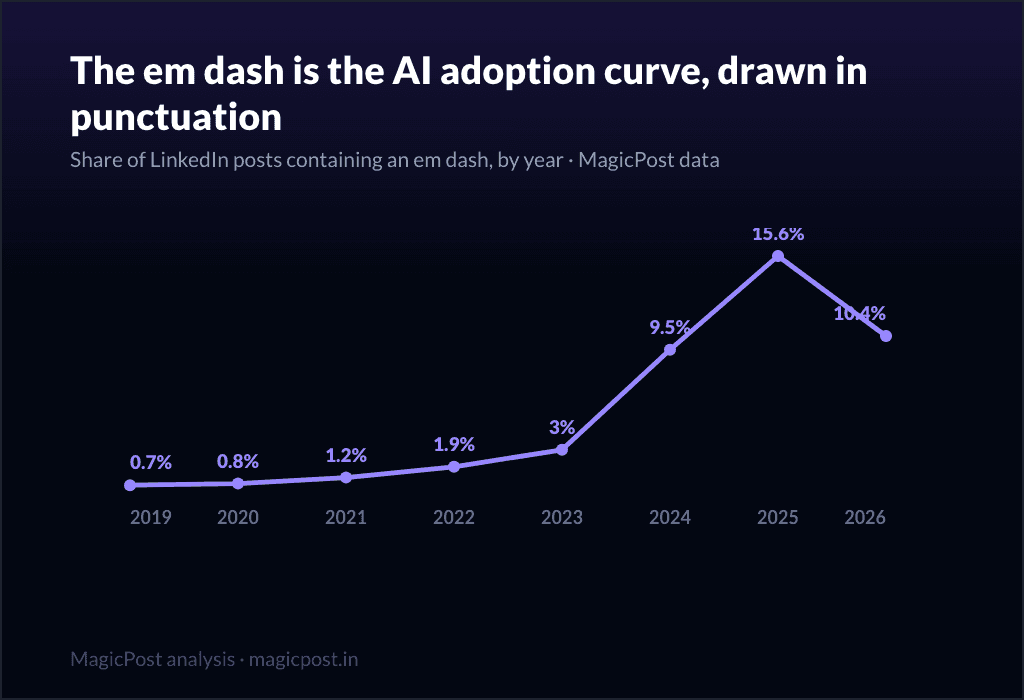
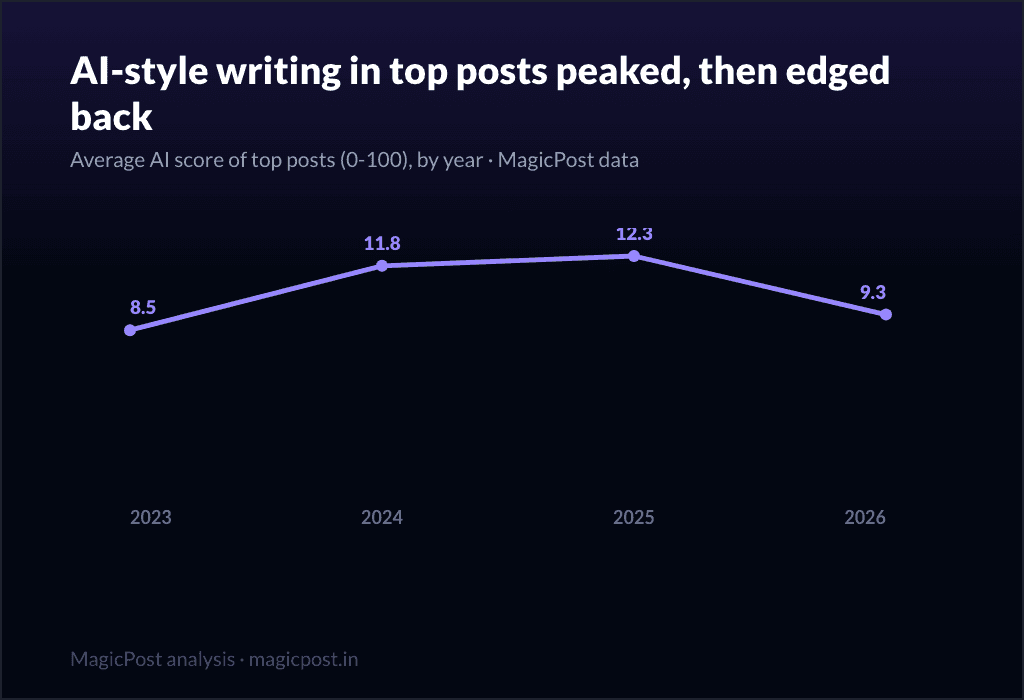
There is even a time signal. AI-style writing in top posts climbed every year through 2025, then edged back down in early 2026:
Year | Average AI score of top posts |
2023 | 8.5 |
|---|---|
2024 | 11.8 |
2025 | 12.3 |
2026 (so far) | 9.3 |
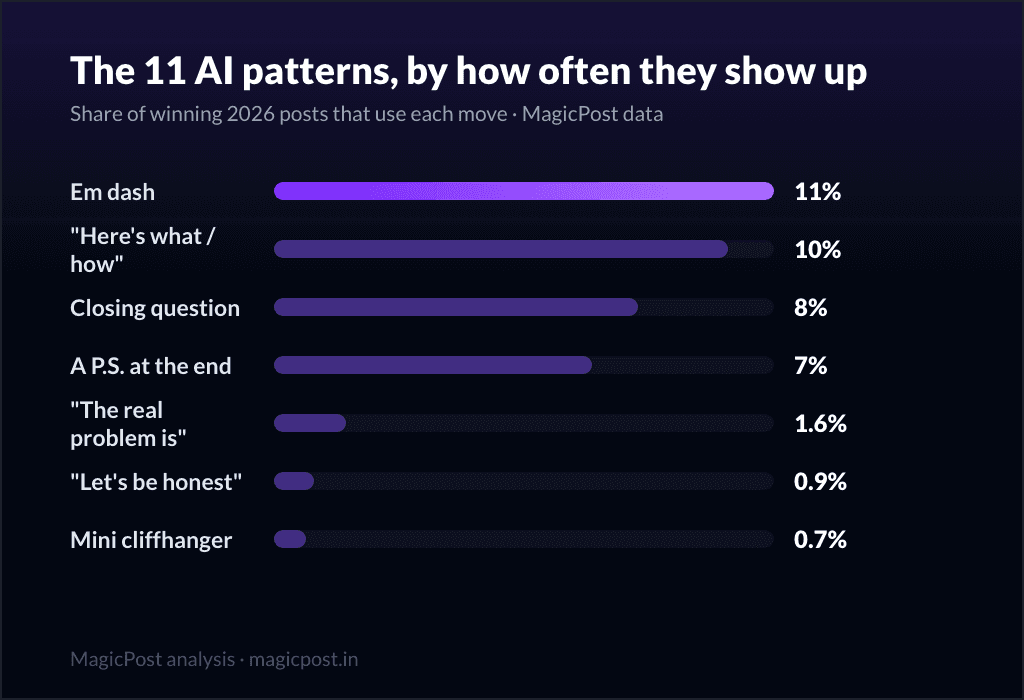
We will not over-read a half-year. Creators do seem to be cleaning up their writing: in our English data, the share of posts using one of the four costly turns below fell from 26% in April 2026 to 14% in September.
4 LinkedIn AI Post Markers That Cost You Reach
We did not just score posts as "AI" or "human" in the aggregate. We isolated specific templated phrasings and measured what each one does to reach, within the same author, so the result is not contaminated by who has the bigger audience.
Four turns of phrase each pulled reach down by a few percent in 2025, and the cost has stayed modest since. That cost is real and modest, far smaller than what a post with nothing concrete in it loses. The figures below are for English posts, June to December 2025.
Generic advice frame: "Stop X. Start Y." / "If you want to…" (about −6.6%, the costliest on the list). In the data it shows up as lines like "Stop describing the tool. Start owning the result." or "Stop chasing likes and start solving problems." The fix is to name the concrete, specific action instead of dressing it up in the template.
"Here's what / Here's how / what nobody tells you" (about −4.1%). The data is full of openers like "Here's what nobody tells you when you run your team" or "Here's how it works." It announces a payoff instead of delivering one. Open straight on the substance and the announcement disappears. (More in the spoke on this opener.)
The dramatic "The result?" bridge (about −3.0%). It reads like "…records, and missing information. The result? Deals slip through the cracks." The fix is to chain the consequence directly: "…so deals slip through the cracks." No drumroll.
"It's not X, it's Y" contrast (about −5.1%). It surfaces as "That's not a branding question. It's a system question." State the point straight instead: "This is a system question." See the spoke on the contrast formula.
All four are measured within a single author's English posts, so audience size cannot explain them. In our study of the July 2026 shift, AI turns of phrase cost about 4% at equal substance before July 27, with no extra cost we can detect since.
How to Improve Your LinkedIn Reach
Not everything that "sounds LinkedIn-y" is penalised, and this matters as much as the list above. Three things that often get lumped in with AI phrasing cost nothing in the same data, and two of them are reach-positive, so you should keep them:
Move | Reach effect |
|---|---|
Genuine sincerity / a vulnerable admission | +7% to +10% |
A real question at the end of the post | +3% |
A P.S. or CTA sign-off | positive in 2025, flat since July 27, 2026 |
A closing question like "…the question she'd been avoiding: 'Am I on track?'" or a candid opener that admits a real struggle are not the problem. They are engagement practices that work.
The line is not "anything that feels like a pattern is bad." It is that those four specific templated turns carry a modest cost, while sincerity and a real closing question pay you back and a clean sign-off costs nothing.
One creator, two regimes
Watching a single creator makes the pattern visible. Comparing a person to themselves holds audience size and follower count constant, but their posts still differ in what they say.
Take a recruiting consultant in our 2026 English sample with 15 posts.
Three of them lean on the "The result?" bridge. Those three averaged about 18% below the consultant's own median reach, while the dozen posts without the templated turn ran about 18% above it, a gap of roughly 36 points between the same person's flagged and clean posts.
One of the flagged posts opens with a setup about companies bringing a function in-house too early, then drops the drumroll: "The result?" The clean ones just state the situation plainly and let it land.
A different English creator, a brand strategist, shows the same shape with the contrast formula. Their flagged posts (built on "That's not a branding question.
It's a system question.") landed right at their baseline, while their clean posts ran nearly 40 points higher, a post like "Most creators miss this: clients decide before they ever DM you. They notice whether your brand feels grounded or performative." Same author, same audience, and the clean post also says something more concrete.
Creator (anonymised) | Posts with a flagged turn | Their own clean posts | Gap |
|---|---|---|---|
A recruiting consultant | −18% vs their median | +18% | ~36 points |
A brand strategist | about baseline | +40% | ~40 points |
A SaaS founder | −2% | +20% | ~22 points |
This is correlational (topic and format vary across a person's posts too), so it is suggestive rather than proof. These gaps are far larger than the few percent the turns cost at equal substance, so most of each gap comes from what the posts say, not from the turn itself.
What Content Does LinkedIn Penalize?
It helps to keep two things separate: what LinkedIn says it targets, and what that looks like in a real post.
What LinkedIn says: Its announcement is careful and short on specifics. It targets content that "feels generic or repetitive, even if it appears polished on the surface" and that "lacks any real unique perspective or substance."
On comments, it also names automation, "comments members create and post at scale using automation tools, with little or no human involvement," and "responses that simply restate the original post without sharing anything new." That is the whole official list. LinkedIn does not name a single banned word or phrase.
What "generic" looks like in practice: This part is our analysis, not LinkedIn's. "Generic and repetitive" is not one thing; it is a set of recognizable moves run on autopilot, and four of them (the turns above) carry a modest reach cost on their own.
We mapped the full set in the pillar, How to spot an AI-written LinkedIn post. What costs the most is a post with no first-hand angle at all, whatever turns of phrase it uses.
LinkedIn says it shows less of content with no point of view, and our data points the same way. Since July 27, 2026, the posts that lose the most reach are the ones with no concrete detail and no lived experience. The templated turns are often what those posts look like on the page, and they cost a little on their own, but the missing substance costs far more.
What a Good LinkedIn Post Looks Like
The line is clearest with an example. Here is one idea, "I changed how I work and my business grew," written two ways. Same claim, opposite outcomes.
The version that stalls stacks four of the templated turns from our data, with nothing specific underneath:
Here's how I grew my business this year. 👇 It's not about working harder. It's about working smarter. The best founders all understand one thing: focus beats hustle. And here's the part nobody talks about: most people never make the shift. Stop trading time for money. Start building systems.
Every line is a move you have read a thousand times: the "Here's how" opener, the "it's not X, it's Y" contrast, a generic advice frame, a teasing bridge. Holding each author constant, each of those turns runs about 3% to 7% below the author's own normal in our English data. The bigger problem sits underneath: no number, no client, nothing that happened to anyone.
That is the textbook "generic and repetitive" post LinkedIn says it shows less of.
The version that travels says the same thing with one real story:
Last year my agency hit a wall at $40k a month. I was working 70-hour weeks just to keep it there. So I fired our three lowest-margin clients: 60% of my hours for 20% of the revenue.
Revenue dropped to $31k the next month. I almost reversed the call. Then it climbed: $52k, $68k, $81k. Same hours, better clients. I should have done it a year earlier.
No opener formula, no contrast template. Just a number, a decision, a cost, and a human admission. Nothing a model could have produced, because it happened to one person.
This is the kind of post that gained the most in our study of AI slop on LinkedIn. Against a comparable post by the same creator, posts with a concrete detail got 14% more impressions since July 27, 2026, up from 2% before, and posts built on a lived experience got 25% more, up from 7%. That specificity is also what the generator's humanizer is built to protect.
How to Use AI on LinkedIn Without Getting Penalized
You do not have to choose between using AI and getting reach. You do have to give each post something only you could write, then clean the templated turns out of the draft. Five concrete habits, starting with the one that is worth the most:
Anchor every post in one thing only you could say. A real number, a named client situation, a mistake that cost you something. Since July 27, 2026, against a comparable post by the same creator, a concrete detail has brought 14% more impressions and a lived experience 25% more. A model cannot invent either for you.
Let AI draft, never decide. Use it to get words on the page faster, in ChatGPT or a dedicated LinkedIn tool. The opinion, the example, the conclusion: those are yours, or the post has no author.
Then cut the four templated turns and rewrite them straight. Replace "Stop X, start Y" with the concrete action, the "Here's what" opener with the substance itself, the "The result?" bridge with a direct "so…", and the "It's not X, it's Y" pivot with the plain statement. Each costs a few percent of reach, so do this once the post has something to say.
Keep the moves that HELP. A genuine vulnerable admission and a real question at the end add reach in the same data, and a P.S. sign-off costs nothing. Strip the four turns, not these.
Cut the dead giveaways too. No "Moreover" or "Furthermore" to open a line, no "it's worth noting that." They are among the cleanest tells there are. Then do the read-aloud test: if a sentence does not come out of your mouth the way you would say it, rewrite it.
None of this games a filter. It gives readers a post with an author behind it, written with AI as a tool.
MagicPost's Humanizer handles the cleaning part. It keeps the moves that fit your voice, strips the generic pile-up that reads as AI, and removes the dead giveaways before you post. The detail only you could add still has to come from you.
FAQ
Does LinkedIn ban or remove AI-generated posts?
No. Posts are not removed and there is no account penalty. Generic-looking AI content is simply distributed less, mostly staying within your immediate network instead of reaching the wider feed.
Is it against the rules to use AI to write LinkedIn posts?
No. LinkedIn's own line is "it's ok to use AI to help you write, but your posts and comments need to represent your voice and your perspectives."
The tool is fine. What loses reach is a post with no concrete detail and no lived experience, and four common AI turns of phrase also cost a few percent each, so an AI draft still needs your own detail and a cleanup before you post.
How does LinkedIn detect AI content?
It uses systems trained with its editorial team to tell apart content that adds perspective from content that feels generic or repetitive. LinkedIn reported about 94% accuracy at flagging generic content in early testing.
Will using ChatGPT hurt my reach?
Using ChatGPT does not hurt your reach by itself. A ChatGPT draft published unedited often has no concrete detail and nothing that happened to you, and since July 27, 2026, LinkedIn posts like that sit 23% below their author's average post, against 13% before.
The templated turns ChatGPT likes ("Stop X, start Y", "Here's what…", "The result?", "It's not X, it's Y") cost a little on top, about 3% to 7% each within the same author in our English data, as they already did in 2025.
The fix is to add what only you know, then edit for your voice. You can keep using AI for the draft.
How do I make AI-assisted posts sound human?
Lead with first-hand specifics, cut the stock phrases, and keep your own voice. Or run the draft through MagicPost's Humanizer, which does it automatically.