

Saving a LinkedIn post and actually using it later are two different habits. Most people are good at the first one and terrible at the second.
It's one of the most powerful signals you can send to LinkedIn's algorithm. A save is worth 5x more reach than a like for the person whose post you saved, and LinkedIn now shows creators exactly how many times their posts have been saved. Saving good content is genuinely good for the people you follow.
This guide covers how to manage LinkedIn saved posts and the tools that make it less of a graveyard.
Why Save LinkedIn Posts?
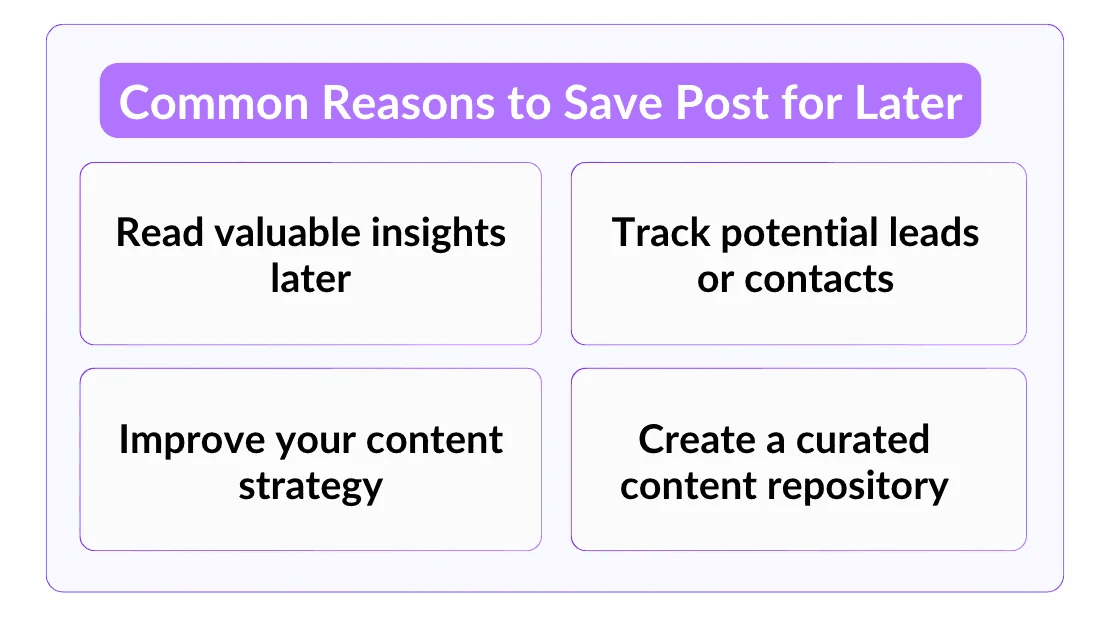
Saving LinkedIn posts is actually very useful for several reasons. Here’s why it’s a good habit to develop:
Content Inspiration and Study
If you're working on your LinkedIn content strategy, saving posts from creators you admire gives you a reference library to study.
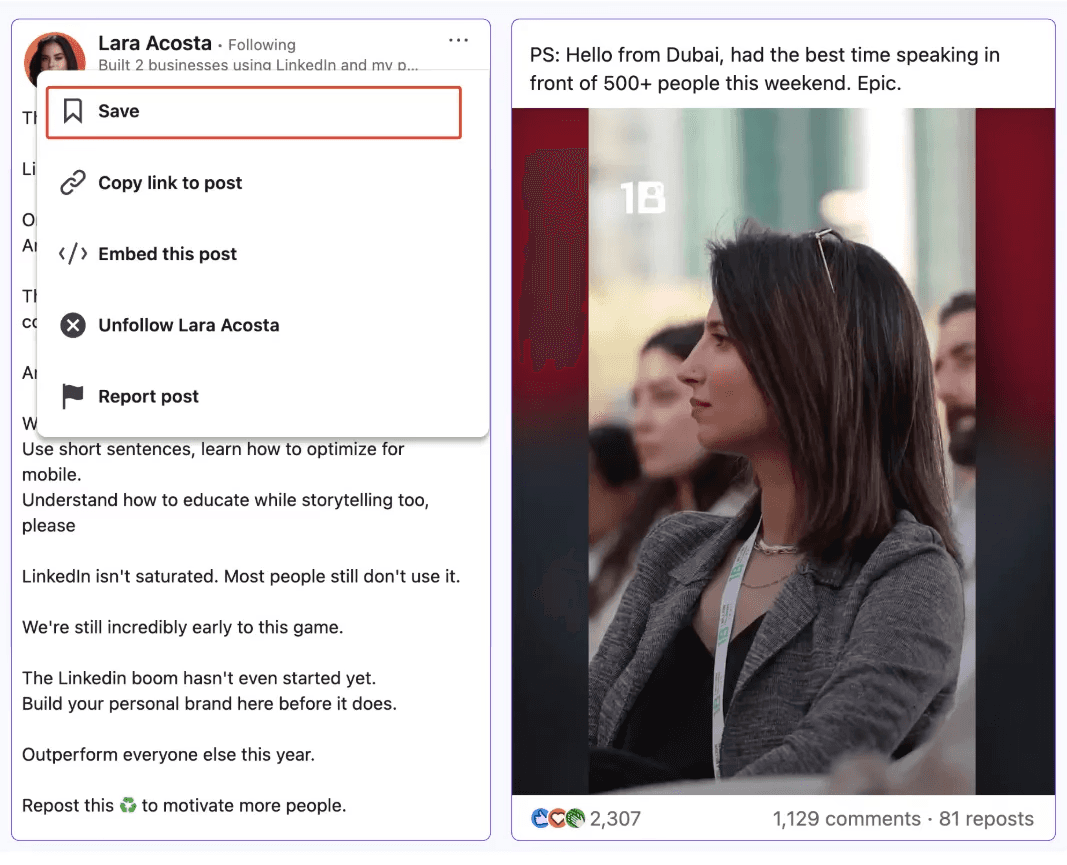
You’ll learn what kind of hook they use, how they structure their posts’ body, and which CTA generated 300 comments. Essentially, your saved posts become a personal swipe file you can return to when you're stuck.
Lead Tracking and Sales
If you use LinkedIn for sales or business development, saving posts from potential clients or partners is a lightweight way to track their activity without a CRM.
You can return to a saved post before sending a connection request, reference something they wrote in your opening message, or track a conversation thread you want to follow up on.
Job Opportunities
With 6 people hired through LinkedIn every minute globally, the platform is a serious job search tool. Saving a job post or a recruiter's post about an open role lets you come back to it when you're ready, without losing it in the feed.
Supporting Creators You Follow
This one is underappreciated. When you save someone's post, LinkedIn counts it as a high-value engagement signal worth 5x more to their reach than a like.
If you regularly consume someone's content and want to support them without necessarily commenting, saving their posts is one of the most effective things you can do.
How to Save a LinkedIn Post on Desktop
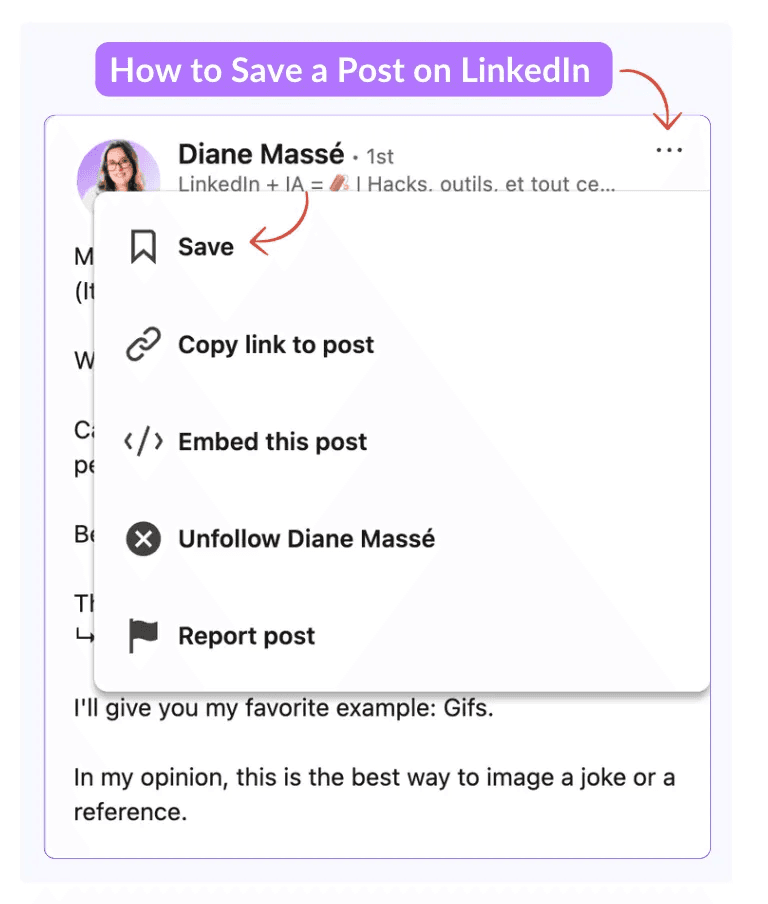
The process is same for posts, articles, and job listings:
Find the post in your feed or on someone's profile.
Click the three dots (...) in the top-right corner of the post.
Select “Save” from the dropdown. A confirmation will appear at the bottom of your screen.
For LinkedIn articles, the save icon appears at the top right of the article next to the author’s profile photo. Click it and the article is added to the same saved items list.
How to Save a LinkedIn Post on Mobile
The process mirrors desktop with a slightly different layout:
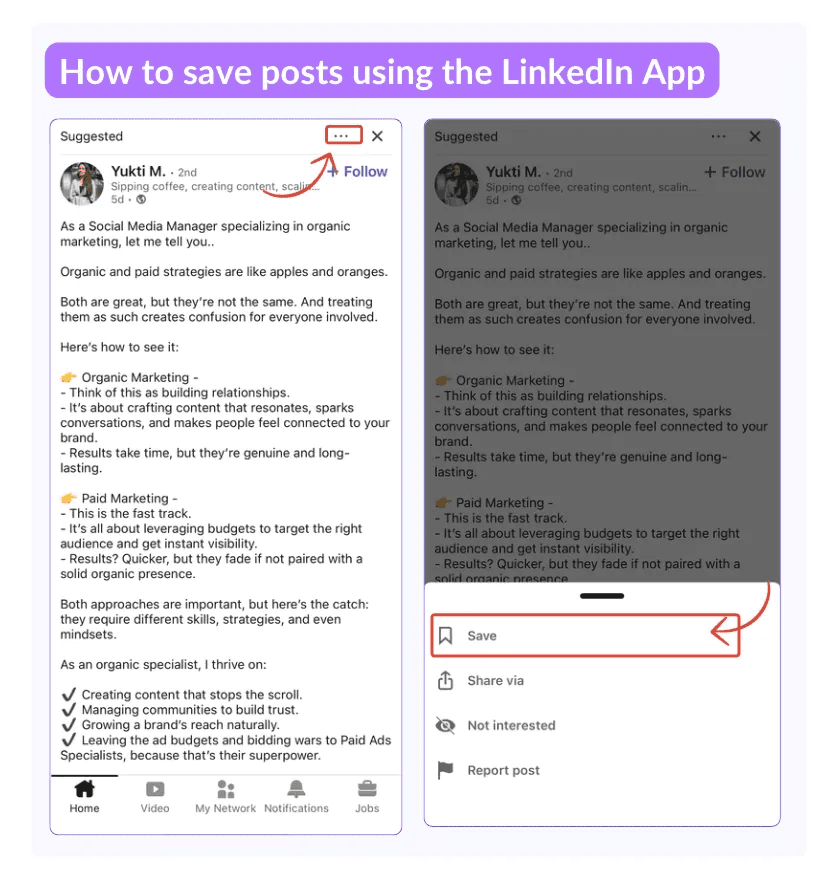
Open the LinkedIn app and find the post you want to save.
Tap the three dots (…) in the top-right corner of the post.
Tap “Save” from the menu that appears.
💡 Pro Tip: If you save a post by mistake, tap the same three dots again and select “Unsave.” The post is removed from your list immediately with no notification to the original poster.
How to Find Your Saved LinkedIn Posts on Desktop
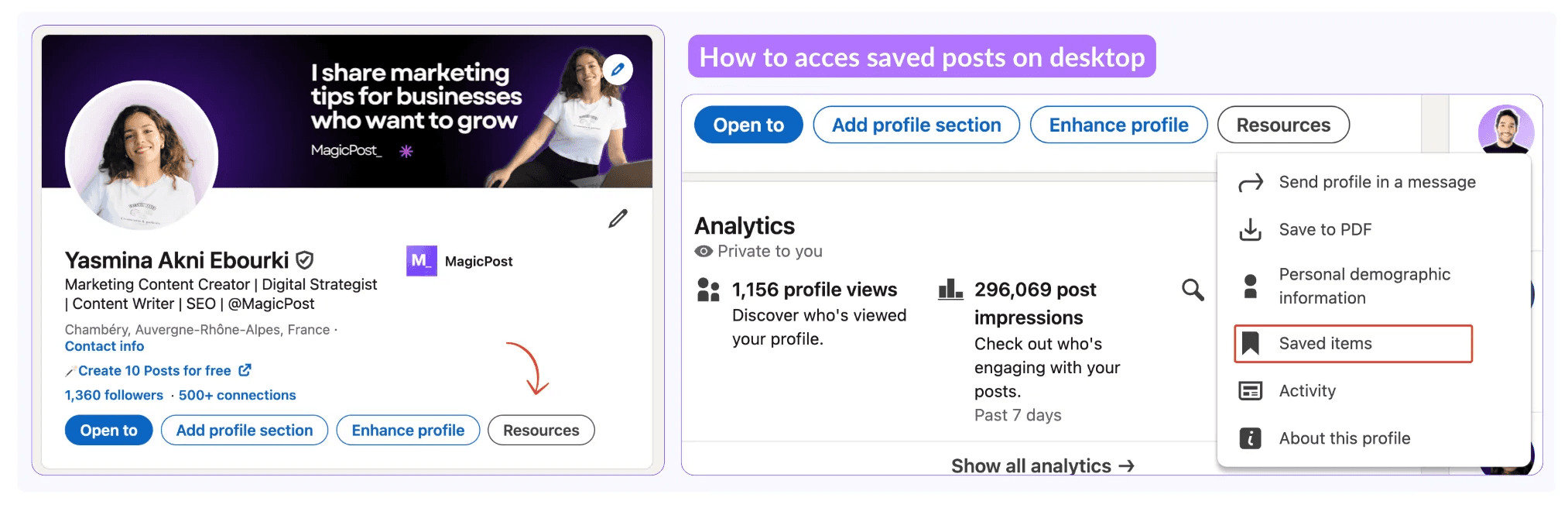
LinkedIn buries saved posts more than it should. Here’s how to to get there:
Click your profile photo or name to go to your profile
Scroll to the Resources section below your intro
Click “saved items;” it’s the third item in the list.
How to Find Your Saved LinkedIn Posts on Mobile
Finding saved LinkedIn posts on mobile is similar to the process on desktop.
Open the LinkedIn app and tap your profile photo to go to your profile.
Tap the three dots (…) near your profile photo.
Select “saved items” from the dropdown menu.
All saved content (posts, articles, videos, and job listings) appears in one list with no sorting or filtering options. This is LinkedIn's biggest limitation with the saved posts feature, and it's why the management section and tools below matter.
How to Manage Your LinkedIn Saved Posts
The saved items list gets unwieldy fast. Without a strategy, it becomes a scroll-through archive you never actually use.
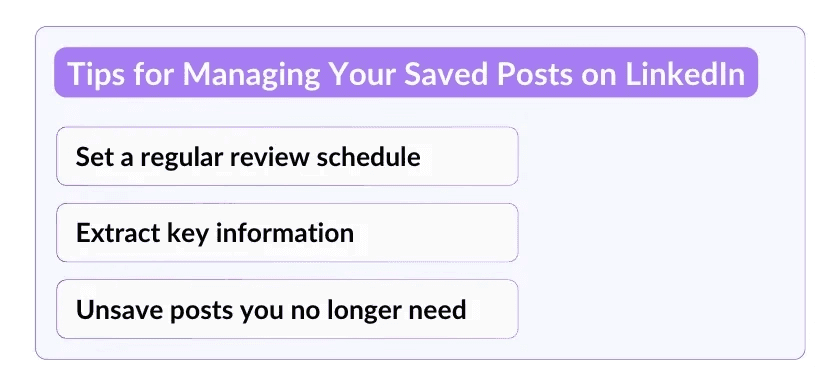
Here’s how to keep it functional.
1. Review Weekly, Not Eventually
Set aside 10 to 15 minutes once a week to go through recent saves. Ask two questions about each item: is this still relevant to something I'm working on, and have I extracted anything useful from it?
If the answer to both is no, unsave it. Treat it like an inbox; the goal is to process high quality material, not to accumulate junk.
2. Extract Before the Post Disappears
LinkedIn posts can be edited or deleted by their authors at any time. If a post contains a framework, a statistic, or an insight you genuinely want to keep, copy the key information into a note or document before relying on the saved post as your only copy.
Don't save a post and assume it will always be there.
3. Unsave Regularly
Clutter is the enemy of usefulness. If you've read something, applied it, or decided it's no longer relevant, unsave it.
Click the three dots (...) on any saved post and select “Unsave.” Regular decluttering keeps your saved list small enough to be navigable.
Tools for Organizing LinkedIn Saved Posts
LinkedIn's native saved items feature has no folders, no tags, and no search. For anyone who saves content regularly, that limitation becomes a real problem. These two tools address it:
Dewey
Dewey syncs your LinkedIn saved posts into an organized dashboard with folders, tags, notes, and fast search.
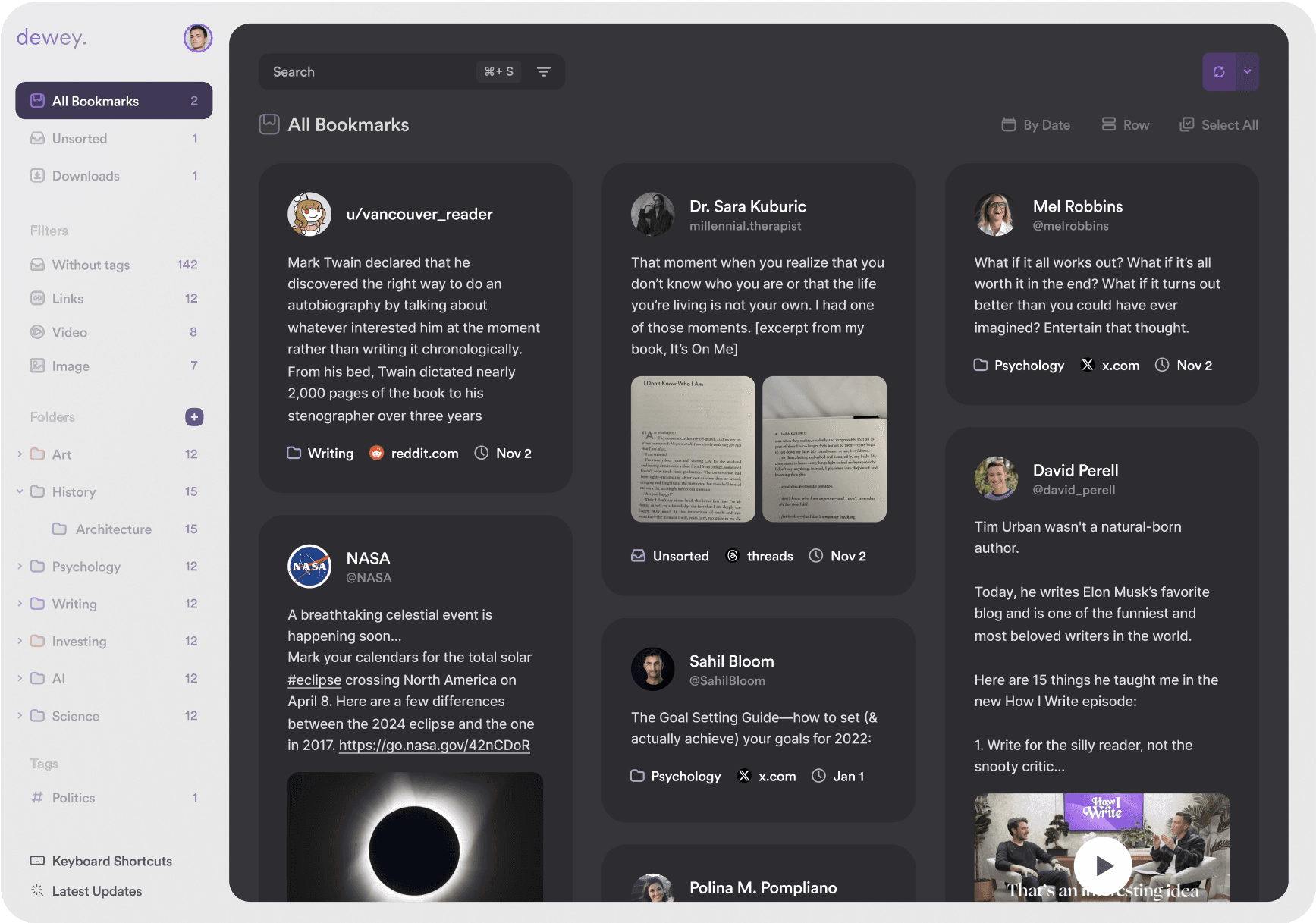
It also exports your full library to CSV, Google Sheets, or searchable PDFs. It’s useful if you want to use saved content in a research or content workflow outside LinkedIn.
Here are its key features:
Custom folders and nested folders for organization
Notes on each saved post for context or reminders
AI bulk tagging to categorize large libraries quickly
Export to CSV, PDF, or Google Sheets
Search across bookmarks, tags, authors, and notes
⚠️ Note: Dewey’s free tier is limited. Most useful features including re-syncing and exporting require a paid subscription. A 7-day free trial is available with no credit card upfront.
LinkedMash
LinkedMash is a newer, LinkedIn-specific tool built around organizing saved posts with tags and topics and syncing them to Notion, Google Sheets, or Airtable.
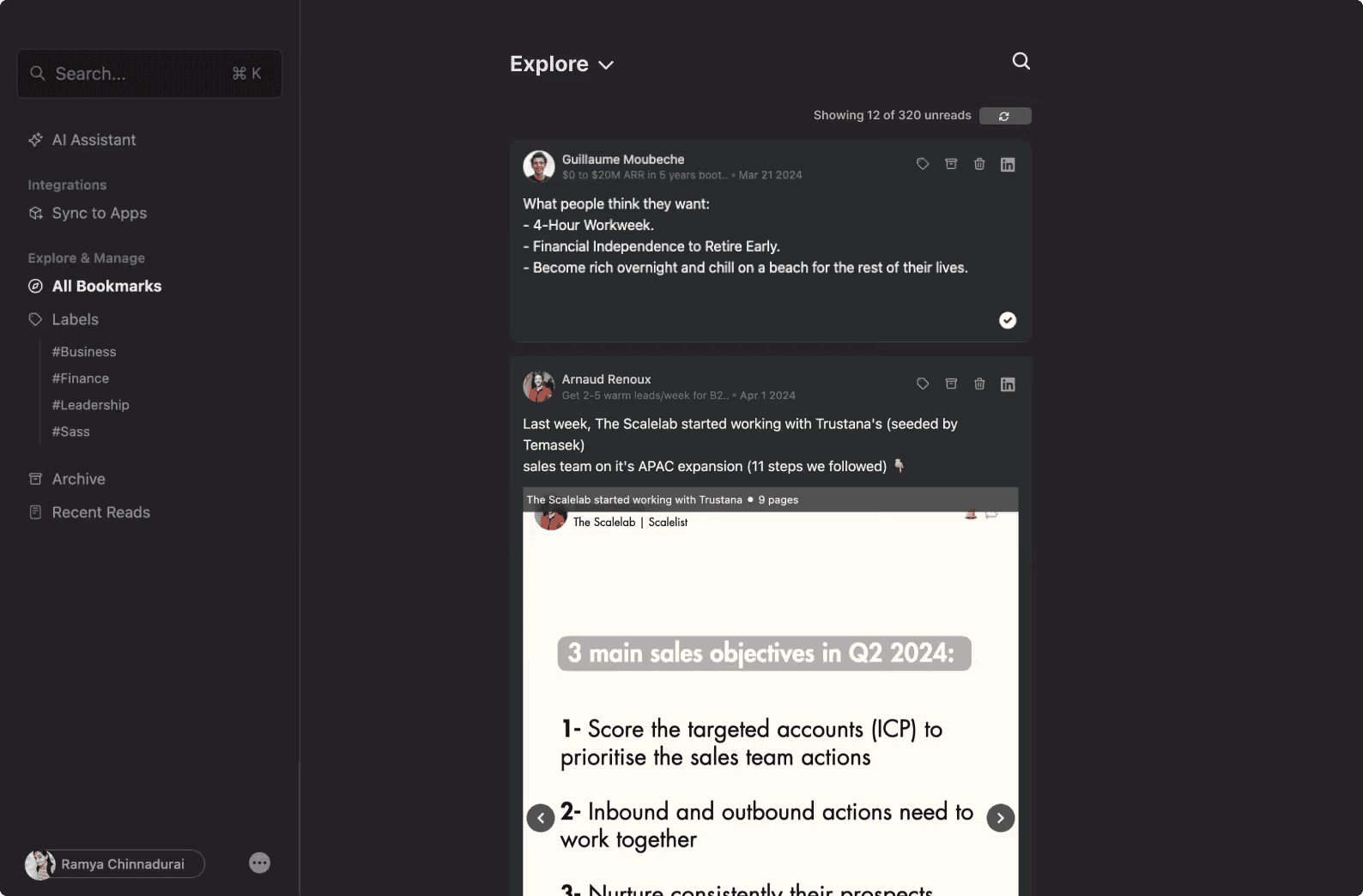
It's more focused than Dewey; it does one thing rather than managing bookmarks across multiple platforms.
Key features:
Tag and organize posts by topic or workflow
Export to Notion, Google Sheets, and Airtable
Search across saved content by keyword
AI tools to turn saved posts into actionable notes
⚠️ Note: LinkedMash is still in beta. It works well for LinkedIn-specific organization but is less mature than Dewey. A 7-day free trial with limited export is available; the paid plan is $99/year.
💡 Pro Tip: If you don't want to pay for a tool, the simplest alternative is a dedicated Notion page or Google Doc with a table that includes “post title,” “author,” “link,” “date saved,” and one line on why you saved it. It’s low-tech but surprisingly effective for keeping saves from going stale.
Make Your LinkedIn Activity Work Harder
Saving posts you find valuable is one side of LinkedIn, but creating posts worth saving is the other, and saves are now one of the strongest signals for reach on the platform.
If you want to write content that earns saves rather than just likes, we have a solution.
MagicPost helps you write posts in your own voice, preview them before publishing, and schedule consistently. Try MagicPost for free today; no credit card is required.
FAQ
Do saves affect LinkedIn's algorithm?
Yes, significantly. A save counts as 5x more reach impact than a like for the original poster. LinkedIn also began showing save counts publicly in September 2025, meaning creators can now see exactly how many times their posts have been saved.
For your own content, posts that earn saves consistently drive stronger reach and follower growth than posts that only earn likes. See our guide on how to increase LinkedIn impressions for the full breakdown.
Can people see your saved posts on LinkedIn?
No. Your saved posts are completely private. Only you can see your saved items list. The post author doesn't know you've saved their post, and your connections can't view your saved content.
How do I find saved posts on LinkedIn?
On desktop: go to your profile, scroll to Resources, and click Saved items. On mobile: tap your profile photo, tap the three dots near your profile picture, and select Saved items. All saved content (posts, articles, videos, and job listings) appears in the same list.
How can I find saved videos on LinkedIn?
LinkedIn doesn't separate saved content by format. Videos, articles, text posts, carousels, and job listings all appear in the same Saved items list. There's currently no way to filter by content type within LinkedIn natively; this is one of the limitations that tools like Dewey and LinkedMash address.
How many posts can I save on LinkedIn?
LinkedIn doesn't impose a limit on saved posts. You can save as many as you want. The practical limitation is that the list has no search, folders, or tags, so a very large saved list becomes hard to navigate without a third-party tool.