You have less than a second to earn the second line. On LinkedIn, the first line is the whole game: it is what shows in the feed before "see more," and it decides whether anyone reads the other 200 words you wrote. So every creator coaches the same advice. Open with a question. It feels intuitive, it feels engaging, it is everywhere.
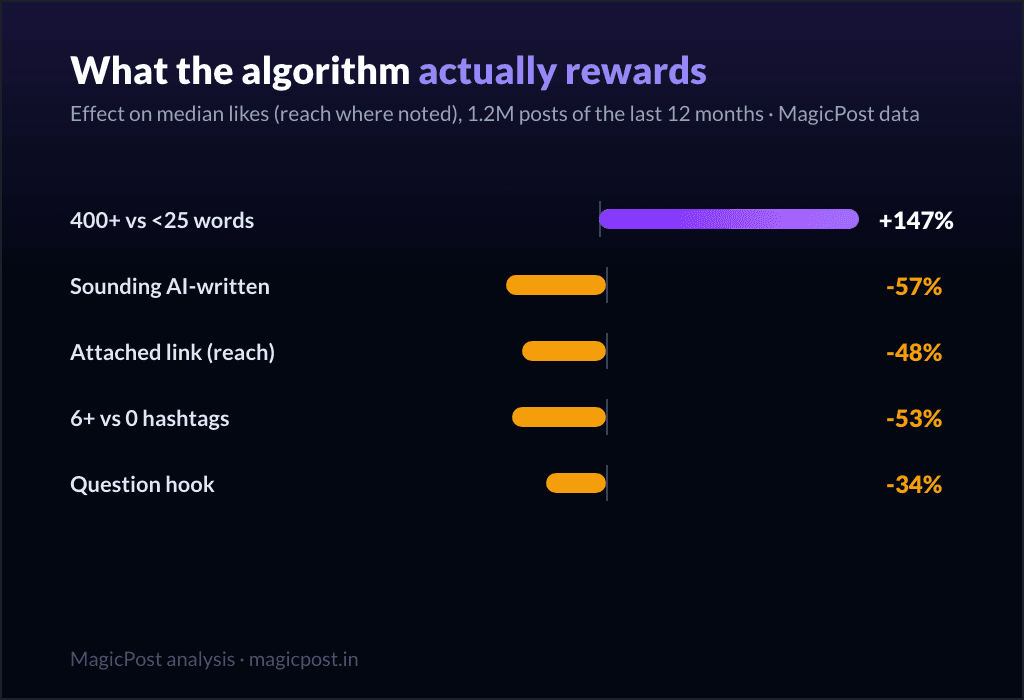
We put it to 1,179,958 posts published over the last 12 months, and the advice is wrong. Posts whose first line is a question earn 19 median likes. Posts whose first line is not a question earn 29. That is a 34% penalty for doing the single most-taught thing in LinkedIn hook advice.
This page does two things. First, the data: what first lines actually move engagement, measured, not guessed. Then the craft: a library of strong hook examples grouped by type, salvaged from years of what works, so you have something to write tomorrow morning. Start with the finding that breaks the rule.
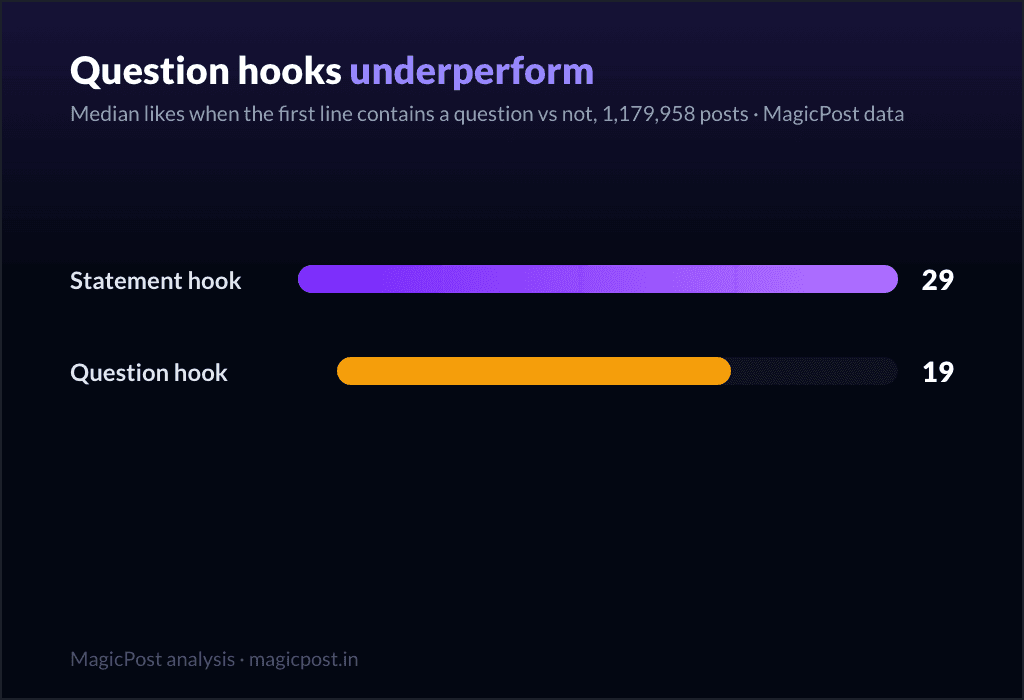
The contrarian finding: question hooks underperform
First line | Posts measured | Median likes | Median comments |
Opens with a question | 143,789 | 19 | 4 |
Does not open with a question | 1,036,169 | 29 | 6 |
Two thirds of a million people teach "open with a question." Over a million posts say it costs you a third of your engagement, and fewer comments too (4 versus 6). That last part is the awkward one, because the question is supposed to buy comments. It does not. The median question-opener earns fewer of them.
This is a big sample on both sides (143,789 question-led posts, over a million without), so this is not a quirk of a few viral outliers. Every figure here is a median, so a handful of mega-posts cannot tilt it either.
And the gap holds at every size
The obvious objection: maybe big accounts just do not ask questions, and they drag the "no question" number up. They do not. We re-ran the split inside each follower band, and the penalty survives in all three:
Follower band | No question (median likes) | Question hook (median likes) |
Under 5k | 13 | 10 |
5k to 50k | 34 | 26 |
50k+ | 187 | 129 |
Small, medium or large, the question-opener loses. At 50k+ followers the gap is the widest in absolute terms (187 versus 129). The effect is a property of how the feed reads first lines, not of who is posting.
Why questions fail (our hypotheses)
The data is solid. The why is interpretation, so read these as hypotheses, not measured facts:
Low-effort signal. A question is the cheapest possible opener. It asks the reader to do the work the writer did not. The feed, and the reader, may read it as filler.
Engagement-bait fatigue. "Agree?" and "Thoughts?" have been used to farm comments for so long that readers (and likely the ranking) have learned to discount the move.
The reader answers "no" and scrolls. "Ever struggle with X?" invites a silent answer. Half the audience thinks "no," and a "no" is permission to keep scrolling. A statement gives no such exit.
None of this means a question can never open a post. It means the default should be a statement, and a question should earn its place.
What actually wins: numbers and brevity
If questions lose, what wins? Two things the data is clear on.
Number-led hooks overperform
First line | Posts measured | Median likes |
Contains a number | 278,996 | 35 |
No number | 900,964 | 26 |
A first line with a number in it earns 35 median likes against 26 without. That is the mirror image of the question finding: specificity reads as signal. "3 things," "I lost $40k," "47% of teams," a number is a promise the post is concrete, countable and real. Vagueness reads as filler; a number reads as proof.
Short first lines win
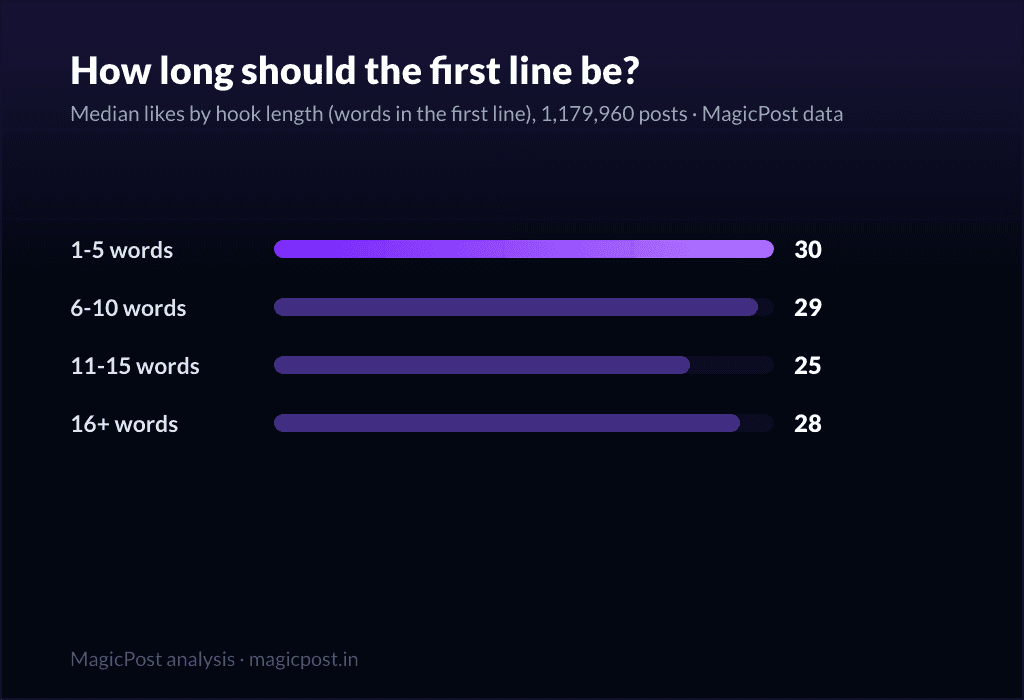
First line length | Posts measured | Median likes |
1 to 5 words | 144,760 | 30 |
6 to 10 words | 436,663 | 29 |
11 to 15 words | 280,014 | 25 |
16+ words | 318,523 | 28 |
The shortest first lines win: 1 to 5 words earn 30 median likes, and it stays high through 10 words (29), dips in the 11-to-15 band (25), and recovers slightly past 16 words (28, often the start of a longer narrative open). Punchy beats paragraph. The first line is a door, not the room. Make it small enough to walk through.
Put the three findings together and the rule writes itself: a short, specific statement beats a long, vague question. That is the opposite of the standard hook advice, and it is what 1.2 million posts show.
Write hooks that sound like you, not like a template. The MagicPost AI post generator drafts openers in your own voice and tone, and it already writes with these patterns in mind: short first lines, specifics over vague questions, no engagement-bait.
How this fits the rest of the anatomy
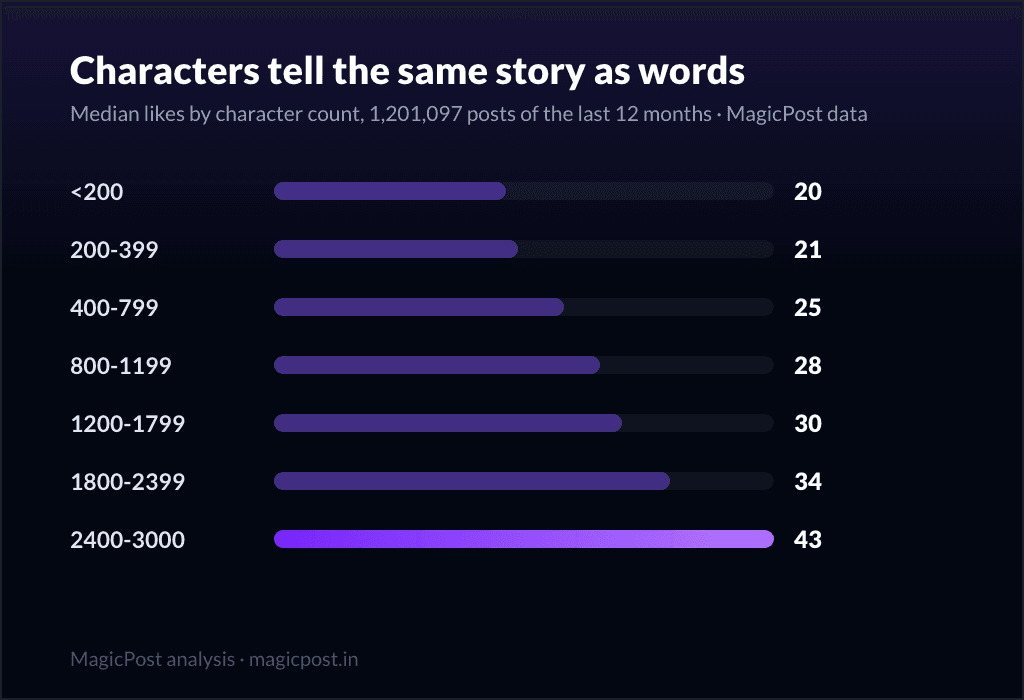
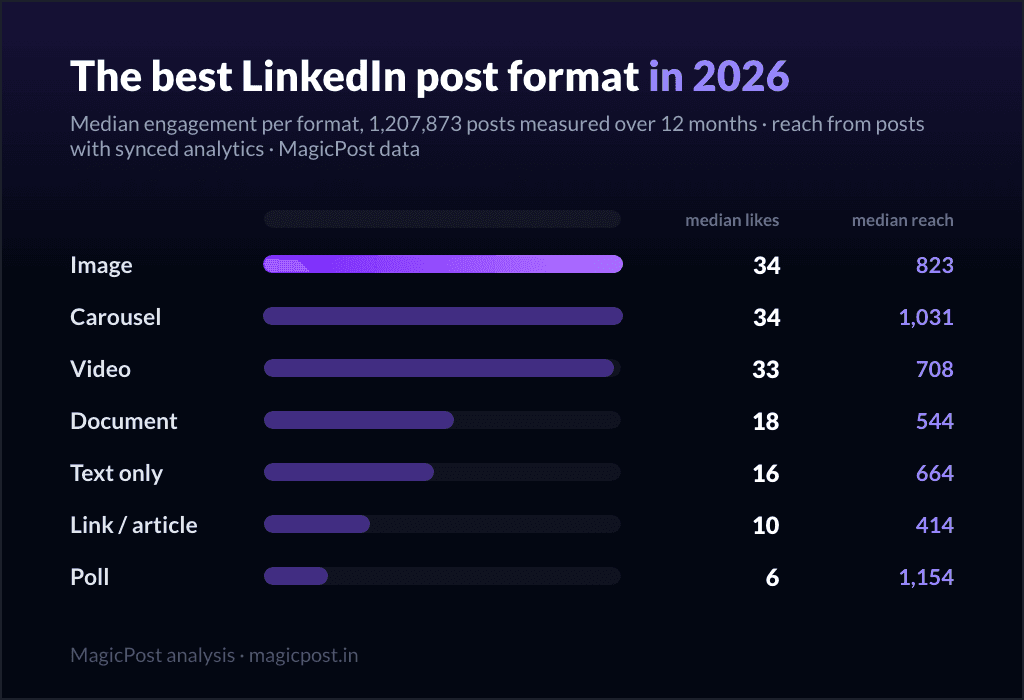
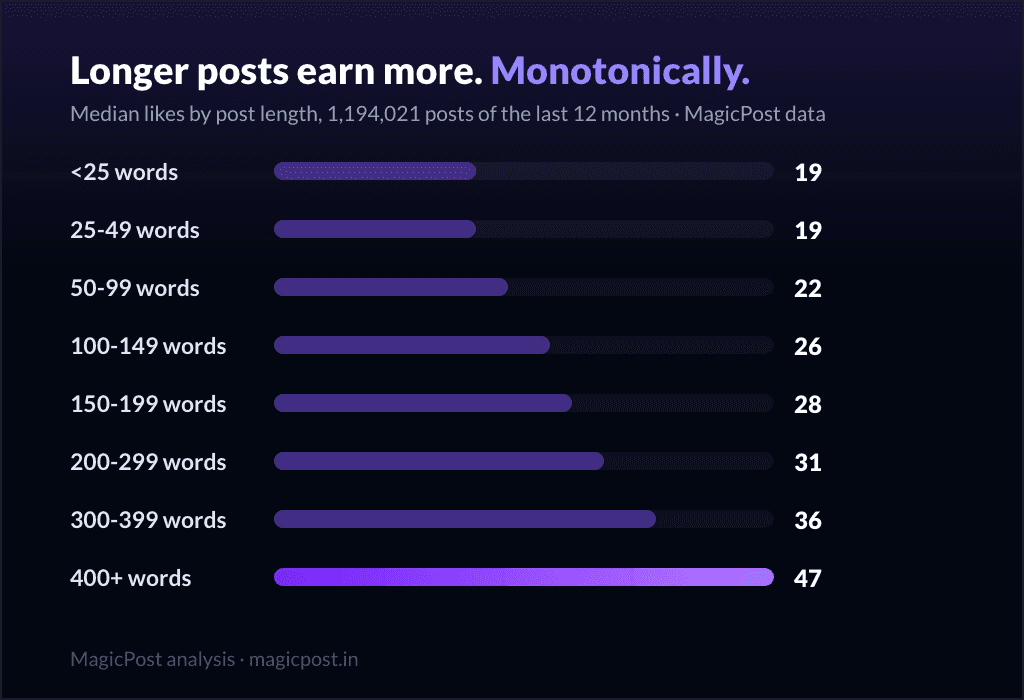
The hook does not work alone. A great first line still needs a post worth the click behind it (longer, structured text outperforms short takes in every length band we measured), and the format and the algorithm's other levers set the ceiling the hook lets you reach.
Even the opener emoji plays a part: the one marker that clears the "see more" line is worth choosing on purpose, which our LinkedIn emoji data breaks down. The hook gets the read; everything else keeps it.
20 LinkedIn hook examples, grouped by what works
Now the craft. The data tells you the shape of a winning first line (short, specific, rarely a question). It cannot write the line for you.
So here is a working library, grouped by type, with the strongest patterns first and the question-style openers flagged for what the data says about them. These are examples to adapt in your own voice, not measured templates. (Want to see hooks in the wild instead of on a page? You can browse 2M+ real posts and study how top creators open.)
Number and result hooks (the overperformers)
The data's favorite. Open with a specific, countable claim:
The data point. "We tested 3 LinkedIn engagement strategies. One had 300% more impact than the others."
The statistic. "70% of LinkedIn users never engage with a single post. The other 30% do three things in common."
The fast-track. "It took me 3 years to learn this. I will give it to you in one post."
The case study. "I rewrote one cold email. Reply rate went from 4% to 19%."
The how-to with a number. "Improve your LinkedIn profile in 5 minutes. Here are the 5 fixes."
Contrarian and myth-busting hooks
A bold statement that creates friction. Statements, not questions, so they hit the brevity rule too. (The best of these puncture a real LinkedIn myth your audience half-believes.)
The challenge. "Traditional networking is dead. Online connections are the future."
The myth-buster. "Everyone says you must post daily to grow. I grew with two posts a week."
The unpopular take. "Your cold outreach is fine. It is the offer underneath it that's losing."
The reframe. "You do not have a productivity problem. You have a priorities problem."
Story and confession hooks
Open mid-scene. Emotion and vulnerability earn the read:
The cold open. "My hands were shaking. I read the email three times."
The confession. "I got fired on a Tuesday. It was the best thing that happened to my career."
The personal win. "I just wrapped a project that took 9 months. Here is what almost killed it."
The turning point. "Five years ago I had 200 followers and zero clients. One change fixed both."
Data point and trend hooks
Anchor to something concrete and current:
The trend. "AI tools just changed content creation for good. Most teams are still posting like it is 2021."
The behind-the-scenes. "We ship a product every 6 weeks. The process fits on one page."
The resource. "This one template cut my proposal time in half. Stealing it is encouraged."
The announcement. "After 3 years of building, it is finally live."
Question hooks (use sparingly, given the data)
These are the ones the data says underperform by 34%. They are not banned, but make them earn their place: tie them to a sharp, specific tension, and never use a generic "Thoughts?" opener.
The relatable struggle. "Ever sent a connection request and heard nothing back?" (Use only when the pain is sharp and universal.)
The "what if." "What if you could double your engagement posting half as often?" (Works best when the rest of the post actually delivers the proof.)
The problem call-out. "Drowning in a to-do list that never ends?" (Pair it immediately with a concrete fix, or it reads as bait.)
Pick a hook, rewrite it in your own words and your own numbers, and keep the first line short. The data is on the side of the writers who do.
Where this data comes from
The measured numbers here are ours, run on our own corpus rather than a cited study. Figures: 1,179,958 LinkedIn posts published over the last 12 months (reshares, deleted and excluded posts filtered out), grouped by a property of the first line, compared on median engagement. "Opens with a question" means the first line of the post contains a question mark; "contains a number" means the first line contains a digit; hook length counts the words in the first line. The follower-band control re-runs the question split inside each band (under 5k, 5k to 50k, 50k+). We use medians throughout, not means, so a few viral posts cannot tilt any cell. The hook examples are craft, offered as patterns to adapt, not measured templates. The figures reflect our June 2026 pull and shift as the corpus grows.
FAQ
What is a LinkedIn hook?
A LinkedIn hook is the first line of your post: the opening sentence that shows in the feed before "see more" and decides whether anyone reads the rest. A strong hook creates curiosity, tension or a specific promise in a handful of words. In our data, the best-performing hooks are short (1 to 5 words earn the most engagement) and specific (first lines with a number earn 35 median likes versus 26 without).
Do question hooks work on LinkedIn?
Less than almost any other opener, despite the common advice. Across 1.2 million posts, first lines that open with a question earn 19 median likes versus 29 for posts that do not (a 34% penalty), and they collect fewer comments too (4 versus 6). The gap holds in every follower band. Use a question only when it ties to a sharp, specific tension, and never a generic "Thoughts?" opener.
What kind of LinkedIn hook gets the most engagement?
First lines with a number do best: 35 median likes versus 26 for first lines without one. Specificity reads as signal. Short statements also outperform long ones: 1-to-5-word first lines earn 30 median likes, dropping to 25 for 11-to-15-word openers. The winning pattern is a short, specific statement rather than a long, vague question.
How long should a LinkedIn hook be?
Short. First lines of 1 to 5 words earn the most engagement (30 median likes), and performance stays high through 10 words (29), then dips for longer openers (25 for 11 to 15 words). The first line is a door, not the room: keep it small enough to walk through, then let the post deliver.
Should I open with a statistic or a story on LinkedIn?
Both beat a question. A first line with a number earns 35 median likes versus 26 without, and a short, specific statement (a result, a confession, a bold claim) consistently outperforms a vague opener. A story works well as a "cold open" that drops the reader mid-scene. Pick whichever you can make specific in five words or fewer.
> Put it to work. MagicPost pulls your drafting, scheduling and analytics into one place, hooks included, so your first lines perform instead of guessing.