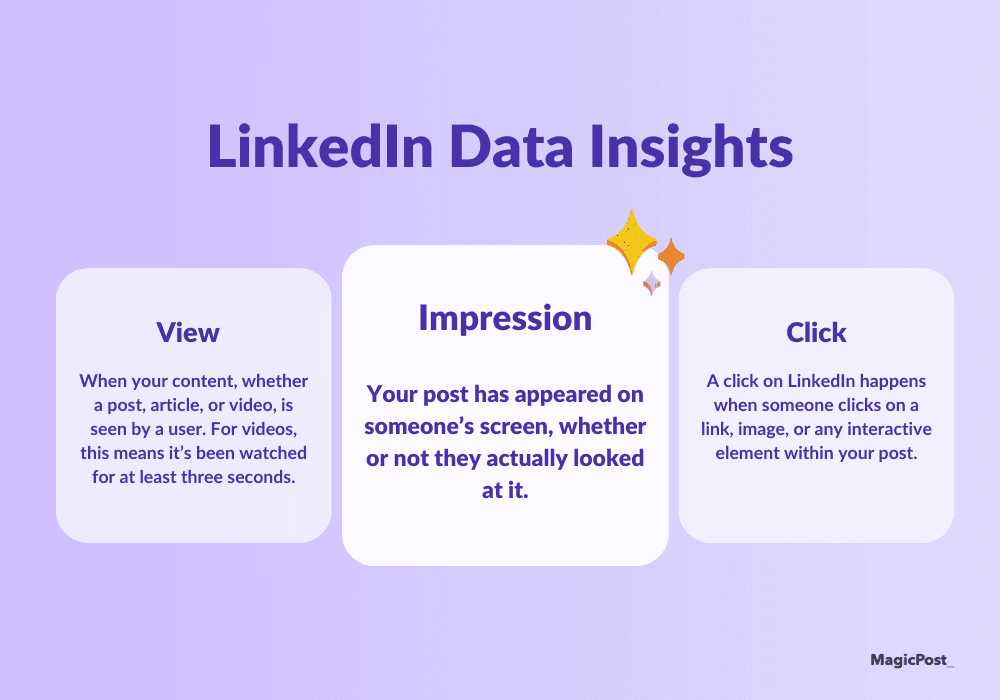
A LinkedIn post impression is one display of your post on a signed-in member's screen. LinkedIn counts it when at least 50% of the post is visible for at least 300 milliseconds, and it counts the same person again every time the post comes back into view.
That is the whole definition, and it explains most of the confusion: impressions measure displays, not people, not reads, not clicks.
LinkedIn is not built for virality either. It says so itself: the feed is designed for sharing professional knowledge with colleagues and prospects, not for reach at any cost.
So this article sticks to the metric: what LinkedIn counts as an impression, how it counts, what separates impressions from unique impressions and members reached, and why your numbers differ from one screen to the next.
What Are Post Impressions
An impression is one display of your post on someone's LinkedIn feed or profile, whether or not they do anything with it. LinkedIn's own definition, in its post analytics documentation, is "the number of times your post was shown on LinkedIn".
Scrolled past? That's an impression.
Lingered for a second? Still an impression.
Came back to it the next day? A second impression, from the same person.
Impressions are not views, and not clicks. A view only exists for some formats: LinkedIn counts a video view after two continuous seconds of playback, and an article view when the article opens. A click is narrower still: a visit to a link in your post, or a visit to your profile from the post.
LinkedIn adds one line that most people skip: post analytics are estimates and may not be precise. Keep that in mind before comparing two screens to the unit.
How LinkedIn Counts Impressions
LinkedIn counts an impression on a viewability rule: your post must be at least 50% visible on a signed-in member's screen or browser window for at least 300 milliseconds. Below that, a display does not count.
Once you publish, the algorithm tests the post on a first slice of feeds: your connections, your followers, the people who react to and comment on your posts. What that first group does decides whether the post travels further.
Every time the post lands on a feed and clears the viewability rule, that is one impression. LinkedIn also splits them into in network (members who follow or are connected to you) and out of network, which tells you whether the post left your circle.
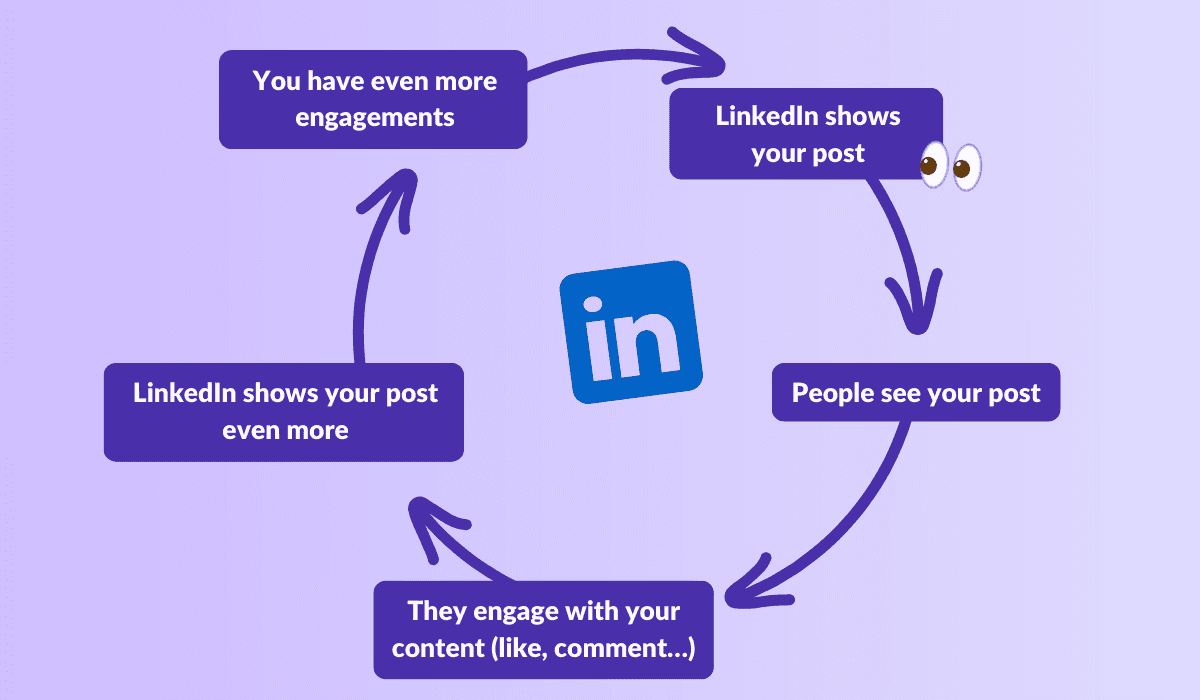
Reactions, comments and reposts are a separate family of metrics. They feed the algorithm's decision to show the post to more people, but they are counted as engagement, never as impressions.
Why your impressions differ from one LinkedIn screen to another
The number under a post in your feed, the post analytics page and a third-party dashboard rarely agree, and it is not a bug. Four reasons, all documented:
Estimates. LinkedIn labels post analytics as estimates, and its own screens can disagree with each other by a few units.
Day versus post. LinkedIn attributes impressions to the day they happen. An analytics tool attaches them to the post, so a post published on the 30th shows different totals in a daily chart and in a post table.
What is excluded. Reshares and posts published in groups are not tracked by the API, and a boosted post's figures include the paid reach without a flag.
Retention windows. LinkedIn keeps impressions and engagement counts for 1,000 days, members reached for 400 days and viewer demographics for 180 days: on an older post, some numbers simply no longer exist.
Add sync timing (a tool that syncs nightly is up to a day behind the feed) and you have the full list. The MagicPost help center walks through why your metrics differ from LinkedIn's in detail.
What is the Difference Between Impressions and Unique Impressions on LinkedIn?
Three numbers tell you how many people saw your post, and LinkedIn does not use the same name for them everywhere: impressions, unique impressions and members reached.
Metric | What it counts | Where LinkedIn shows it |
|---|---|---|
Impressions | Every display of the post, repeats included: the same person seeing it five times counts five. | Post analytics on profiles and Company Pages |
Unique impressions | Distinct viewers: five displays to one person count once. | Company Page analytics |
Members reached | The number of distinct members and Pages that saw the post, an estimate that excludes repeat views. | Post analytics on your personal profile |
Unique impressions and members reached answer the same question, "how many people", with two labels: one on Pages, one on personal posts. Impressions answer "how many times". The ratio between the two is where the reading starts.
How to read the ratio between impressions and unique impressions
Low ratio of unique viewers (1,000 impressions, 200 members reached). The same 200 people saw the post about five times each. The post circulates inside a small group, probably your close connections, and is not breaking out to new feeds.
High ratio of unique viewers (1,000 impressions, 800 members reached). Almost every display went to a different person. The post is travelling across the network and reaching people who had not seen your name before.
In short: impressions tell you how much your post was displayed; unique impressions and members reached tell you how many people saw it.
What a normal impression count looks like
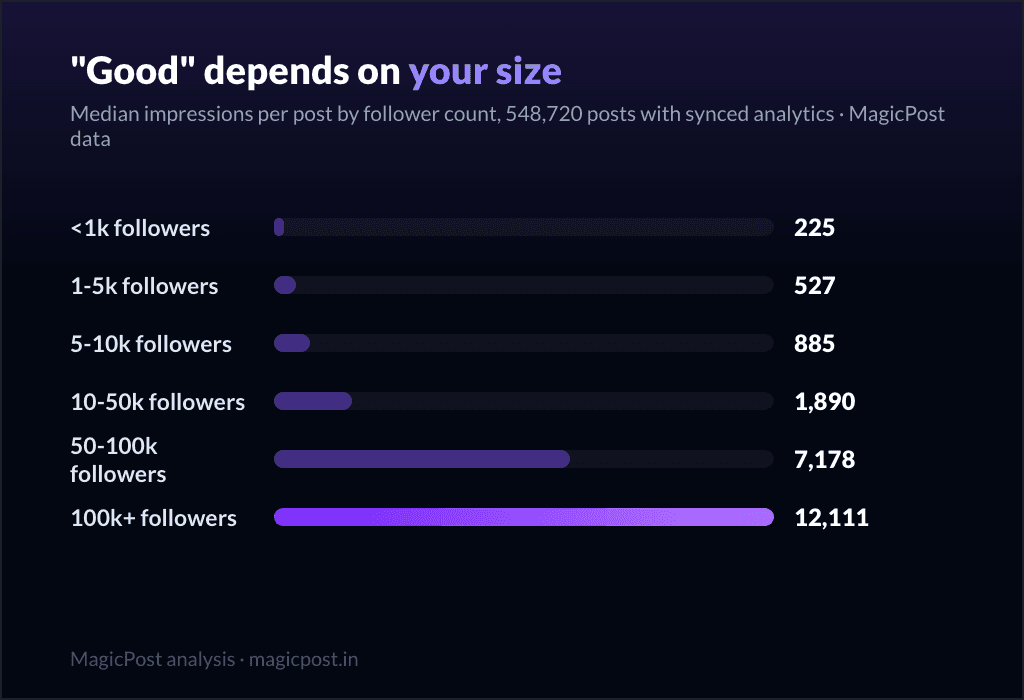
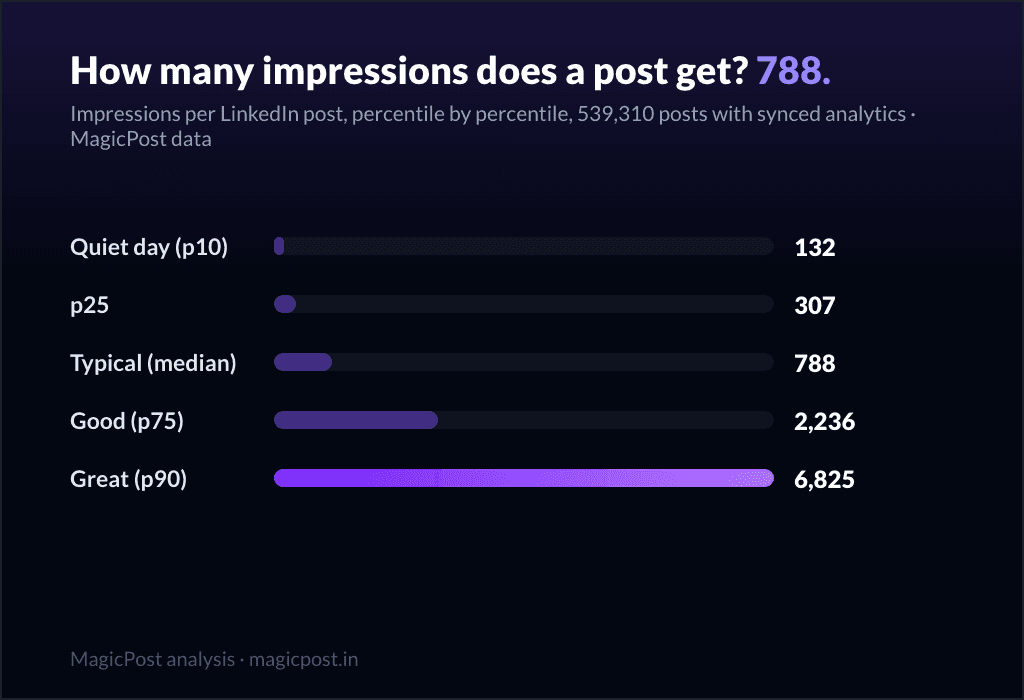
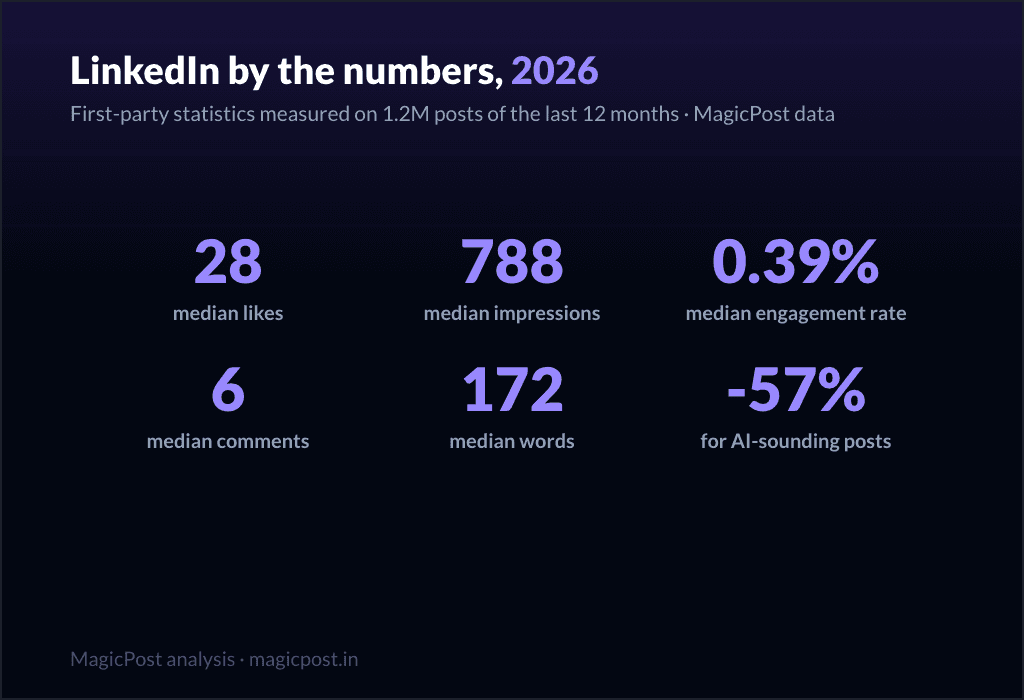
Impressions only make sense against the size of the account. In the July 2026 edition of the MagicPost LinkedIn impressions benchmark, computed on 24,420 public posts, the median post got 192 impressions under 1K followers and 12.2K above 100K followers; the top 10% of posts under 1K followers cleared 1,083.
Whether your own number is good for your size is a different question, with its own ladder: how many impressions are good on LinkedIn.
How to Boost LinkedIn Impressions
Impressions follow the same mechanics for everyone: a first slice of feeds, an engagement test, then wider distribution. The levers below act on that test. The full playbook, with numbers, is in how to increase impressions on LinkedIn.
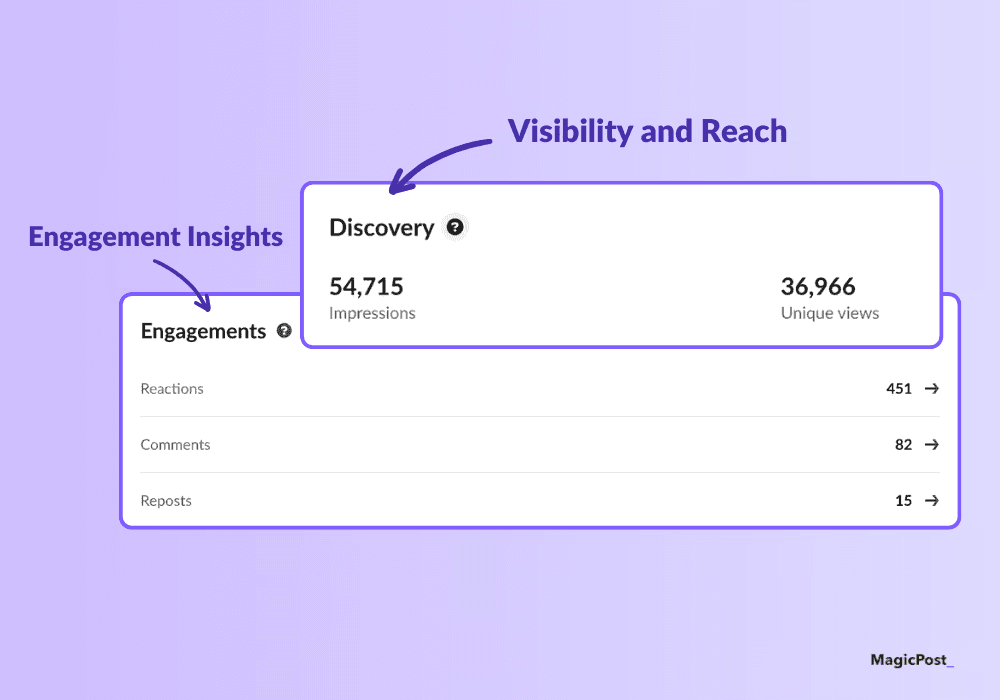
1. Create Excellent Content
The most important thing is to share content with hooks that grab attention and offer real value. Focus on what your audience cares about.
Share industry insights, practical tips, or your own professional experiences that make people pause and interact.
2. Post At The Right Time
If you post when your audience is most active, your posts are more likely to be seen and get more impressions.
Early mornings, lunchtime and late afternoons on weekdays work for many people. Still, the best time for you depends on who you want to reach.
Find out more in our dedicated article about the best time to post on LinkedIn.
3. Use Visuals
Don't rely on text alone. Add images, videos or infographics to your posts when they carry the point. Visual content is naturally more appealing and receives higher interaction rates.
4. Engage with Your Network
Social media requires being social. Don't just post and leave; you have to
React, comment on, and share your connections' content.
React and reply to comments that people leave under your content
This builds relationships and improves your own visibility. The more you stay active, the more the LinkedIn algorithm will push your content to a wider audience.
5. Use Hashtags
Use relevant hashtags to make your content discoverable.
By adding industry-specific or trending tags, you expand your post's reach beyond your immediate connections, making sure that new audiences will see your work.
6. Consider Paid Promotion
If you want to reach even more people, try LinkedIn's paid ads. Sponsored posts can help you get your content in front of the right audience quickly. Remember that a boosted post's impressions then include the paid reach.
Tools to increase LinkedIn Performance
LinkedIn shows you each post's impressions and members reached. What it does not show is the context: no engagement rate per post, no benchmark against creators your size, no breakdown of who engages, and no report you can hand to someone else.
That context is the job of a LinkedIn analytics tool. MagicPost reads your metrics through LinkedIn's official API, with no extension and no session cookie, and adds:
Every post in one table, with unique views, saves and clicks as columns.
Each post scored against the median of your last 20.
Benchmarks by follower bracket: impressions, formats, best days.
Audience by country, job family, seniority, company size and industry.
CSV and multi-page PDF exports.
There is no free plan: the full dashboard comes with a free trial that needs no card.
See your impressions in context. MagicPost's LinkedIn analytics tool puts every post's impressions and members reached next to your own median and the benchmark for your follower bracket, so a number is never just a number.
Takeaway
An impression is a display, counted with repeats; members reached and unique impressions count people. LinkedIn calls both estimates, so read trends and ratios, not single units.
Impressions matter, but what really counts is sharing content your audience connects with, building relationships, and encouraging real conversations.
Start tracking your post impressions with MagicPost's LinkedIn analytics, and check the monthly LinkedIn benchmark to see what a normal post gets at your size.
FAQ
What are post impressions on LinkedIn?
A LinkedIn post impression is one display of your post on a signed-in member's screen. LinkedIn counts it when at least 50% of the post is visible for at least 300 milliseconds, and it counts the same person again each time the post comes back into view. LinkedIn defines it as the number of times your post was shown on LinkedIn, and labels the figure an estimate.
What is the difference between impressions and members reached on LinkedIn?
Impressions count displays, repeats included: one person seeing your post five times adds five. Members reached counts distinct members and Pages that saw the post at least once, as an estimate that excludes repeat views, so it is always equal to or lower than impressions. On Company Pages the same idea is labelled unique impressions.
Why are my LinkedIn impressions different on different screens?
Because LinkedIn labels post analytics as estimates, attributes impressions to the day they happen while analytics tools attach them to the post, excludes reshares and group posts from the API, folds paid reach into a boosted post's figures, and keeps members reached for only 400 days and viewer demographics for 180 days. A dashboard that syncs nightly also runs up to a day behind the feed.
Does LinkedIn count the same person twice in impressions?
Yes. Every time your post clears the viewability rule on a member's screen, LinkedIn adds an impression, even for someone who has already seen it. To count people once, look at members reached on a personal post or unique impressions on a Company Page.