" height="26.80529977783203px" id="tymKb8bqC" width="128.00300311279295px"/><path d="M 0 2.417 L 0 0 L 12.909 0 L 12.909 2.417 Z" fill="rgb(126, 78, 253)" height="2.417099999999998px" id="aYr4em6zK" transform="translate(128.341 22.325)" width="12.908999999999992px"/></svg>)

"/><stop offset="1" stop-color="rgb(118, 37, 250)"/></linearGradient></defs><g d="M 19.242 21.22 L 19.362 6.204 L 19.272 6.204 L 13.757 21.22 L 10.161 21.22 L 4.796 6.204 L 4.706 6.204 L 4.825 21.22 L 0 21.22 L 0 0 L 7.283 0 L 12.109 13.607 L 12.229 13.607 L 16.844 0 L 24.247 0 L 24.247 21.22 Z M 26.421 26.113 L 26.421 23.445 L 41.407 23.445 L 41.407 26.113 Z" fill="transparent" height="26.112508199679183px" id="DvfaAIHYn" width="41.40731898311435px"><path d="M 19.242 21.22 L 19.362 6.204 L 19.272 6.204 L 13.757 21.22 L 10.161 21.22 L 4.796 6.204 L 4.706 6.204 L 4.825 21.22 L 0 21.22 L 0 0 L 7.283 0 L 12.109 13.607 L 12.229 13.607 L 16.844 0 L 24.247 0 L 24.247 21.22 Z" fill="rgb(46, 46, 46)" height="21.220180016149442px" id="pLsxRCobd" width="24.247352589074694px"/><path d="M 0 2.668 L 0 0 L 14.986 0 L 14.986 2.668 Z" fill="url(%23yD9d4I5GR-3279285344-linear-gradient)" height="2.6675085048549647px" id="yD9d4I5GR" transform="translate(26.421 23.445)" width="14.986002836263765px"/></g></svg>)

Naïlé Titah
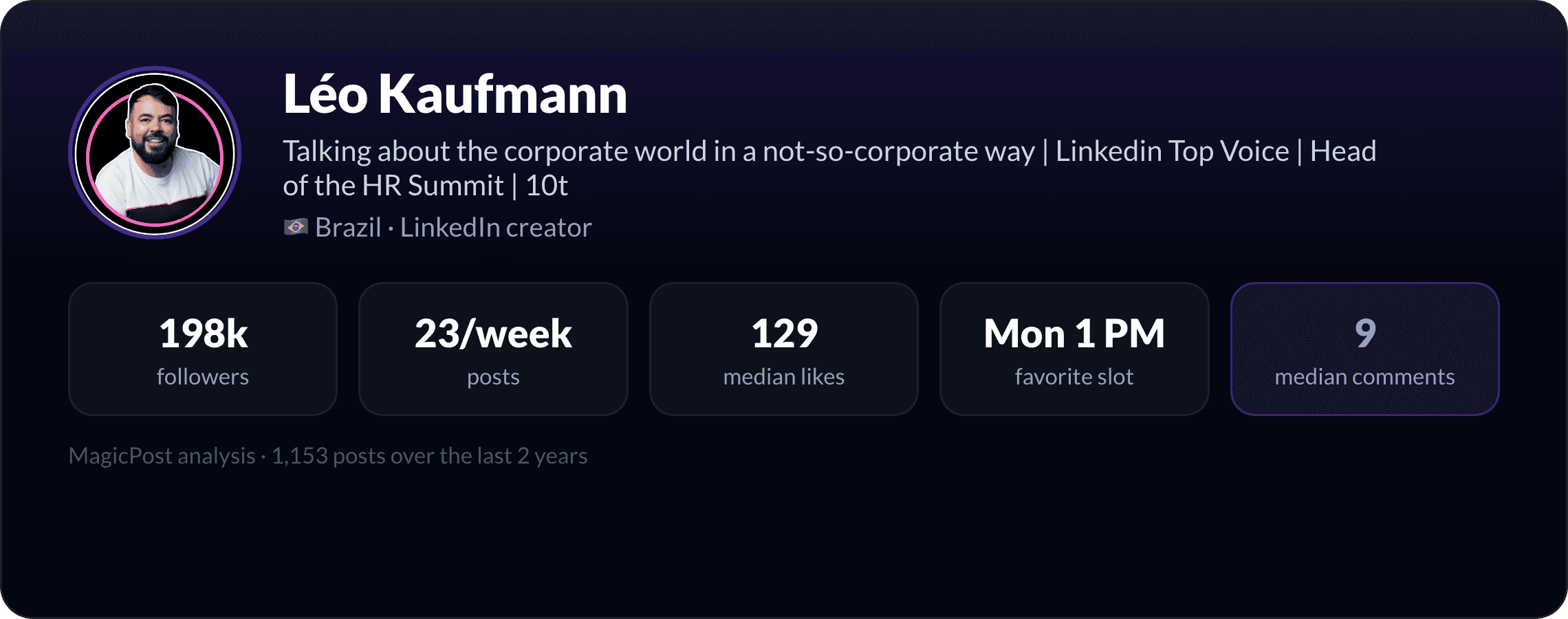
Léo Kaufmann describes himself as "talking about the corporate world in a not-so-corporate way," and the number that defines him is the gap between his floor and his ceiling. At MagicPost, we analyzed 1,153 of his LinkedIn posts: his typical post earns 129 likes, yet his biggest of 2026 is a single nine-word line that pulled 9,471. That distance, roughly 70 to 1, is the whole story of how this São Paulo creator built an audience of nearly 198,000 followers out of HR and the workplace.
This is who Léo Kaufmann is, according to the best source: his own posts, measured.
His story, in his own posts
Kaufmann does not hide his trajectory, and the data shows which chapters he treats as load-bearing.
The non-obvious career. His origin story is a string of left turns he is proud of: "Quando decidi sair do Exército... saí da área comercial para assumir a direção e a curadoria de conteúdo do RH Summit," he writes ("When I decided to leave the Army... I left the commercial area to take over the direction and curation of the RH Summit"). His through-line: "todas as vezes que escolho o não óbvio, eu me reencontro. Eu sou mais eu. Eu sou mais feliz" ("every time I choose the non-obvious, I find myself again. I am more me. I am happier").
The summit he built from an idea. His company line and his emotional center is the RH Summit, an HR conference he narrates obsessively as it grows. He reframes the category itself: "deixou de ser sobre RH e passou a ser sobre Resultados Humanos" ("it stopped being about HR and started being about Human Results"), an event he says drew "mais de 7.000 pessoas" ("more than 7,000 people").
The mission statement post. When he crossed 200,000 followers, he wrote the clearest description of his own brand anyone could ask for: "Sempre foi sobre provocar pensamento, não agradar algoritmo. Sobre cutucar desconfortos reais do mundo corporativo, não vender frase pronta de sucesso," he writes ("It was always about provoking thought, not pleasing the algorithm. About poking at the real discomforts of the corporate world, not selling ready-made success phrases"). And the tone, in his words: "Tem humor, ironia e uma dose saudável de acidez" ("There's humor, irony and a healthy dose of acidity").
One pattern our data surfaces that a normal bio never would: his single most successful idea is not a fresh post, it is a re-run. His all-time best post, the "demissão por exaustão" essay at 16,432 likes ("Nem todo pedido de demissão é por causa de uma proposta melhor... Às vezes, é só exaustão mesmo," or "Not every resignation is for a better offer... Sometimes, it's just plain exhaustion"), first ran in June 2025. He shipped a near-identical version in May 2026 that pulled 7,497 likes. When a story lands this hard, Kaufmann does not retire it.



What he actually talks about
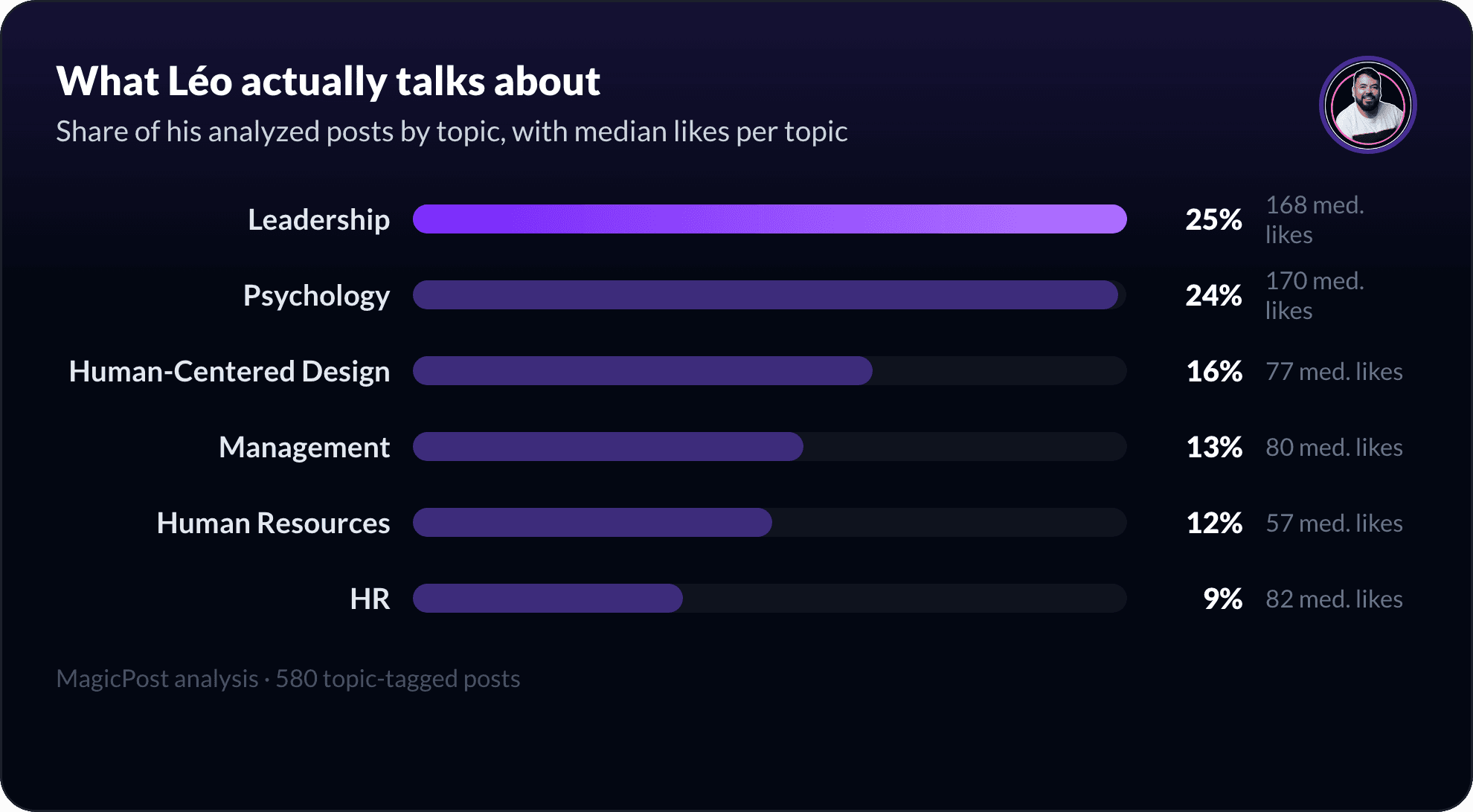
His feed is the workplace from the inside: Leadership and Psychology are his two largest topics (about 143 and 141 posts), with management, HR and human-centered themes filling the rest. Two details beat the ranking:
His best-performing theme is not the biggest one. When Kaufmann writes about language and communication, the median is about 267 likes, roughly double his Leadership median (168) and Psychology median (170), and more than triple his pure Human Resources posts (about 57). The audience rewards him most when he is a writer about how people talk, not an HR specialist.
Sorted by register rather than topic, his most common deliberate mode is the provocative position and the hard-hitting tip, ahead of straight explanation. He is built to make you take a side, exactly what his own manifesto promised.
Who he writes for
His reader is the person inside the corporate machine who suspects it is broken: the worker burning out quietly, the HR professional caught between discourse and practice. His audience, by his own count, is not a fan club: "200 mil pessoas não significam unanimidade. Significam relevância construída no atrito, no diálogo e, muitas vezes, no desconforto," he writes ("200,000 people don't mean unanimity. They mean relevance built on friction, on dialogue and, often, on discomfort"). He even invites disagreement: "Ou concorda, ou discorda, ou se incomoda" ("Either you agree, or you disagree, or you're bothered"), and any of the three, he says, beats being ignored.
His best posts of 2026
His three biggest posts of 2026, from our data (click through to the originals):
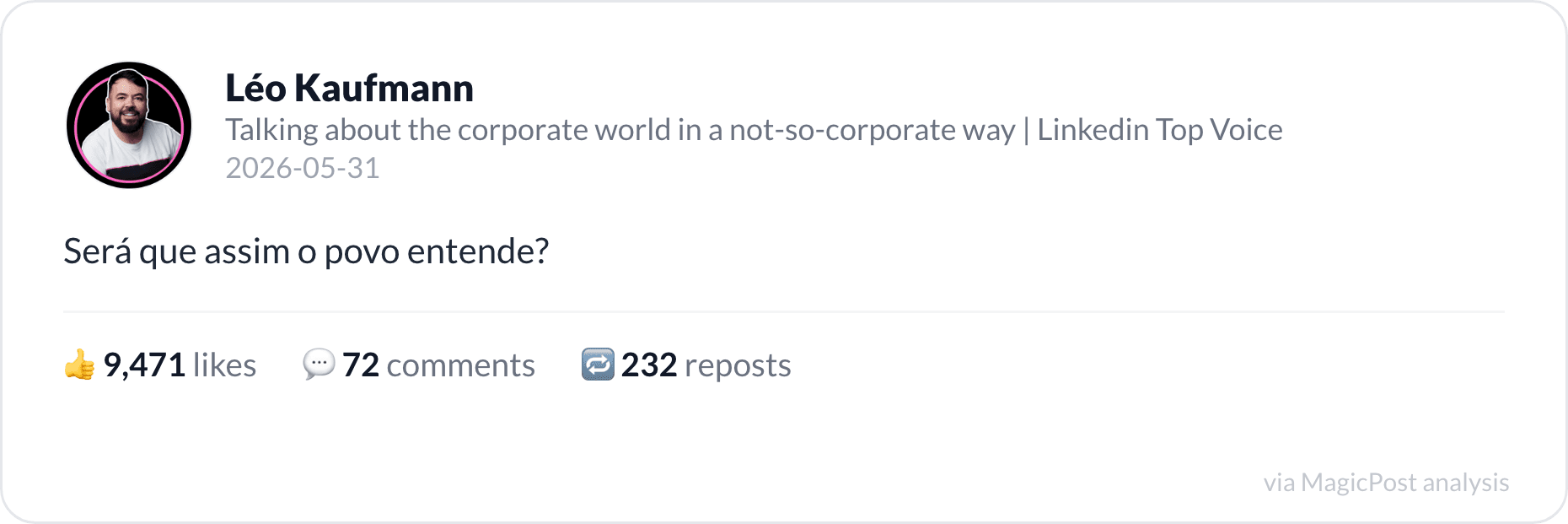
9,471 likes. The entire post is nine words: "Será que assim o povo entende?" ("Maybe this way people will get it?"). A sharp, ironic caption riding on shared content, proof that for Kaufmann the one-liner can outrun the essay.
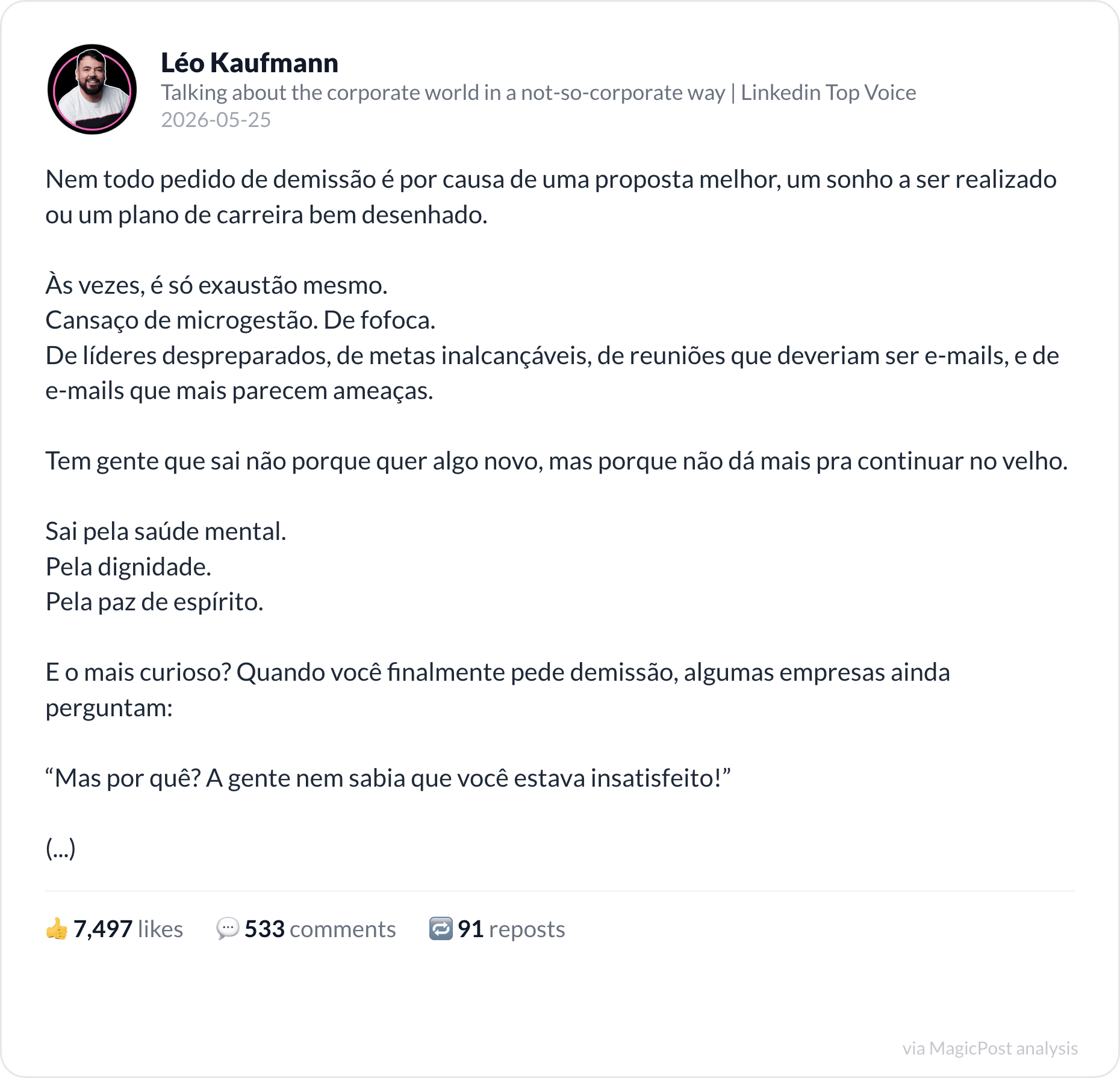
7,497 likes. The "demissão por exaustão" essay, his signature franchise, re-run in May 2026. Its engine is a stack of contrasts landing on a verdict: "Você só se escolheu" ("You just chose yourself").
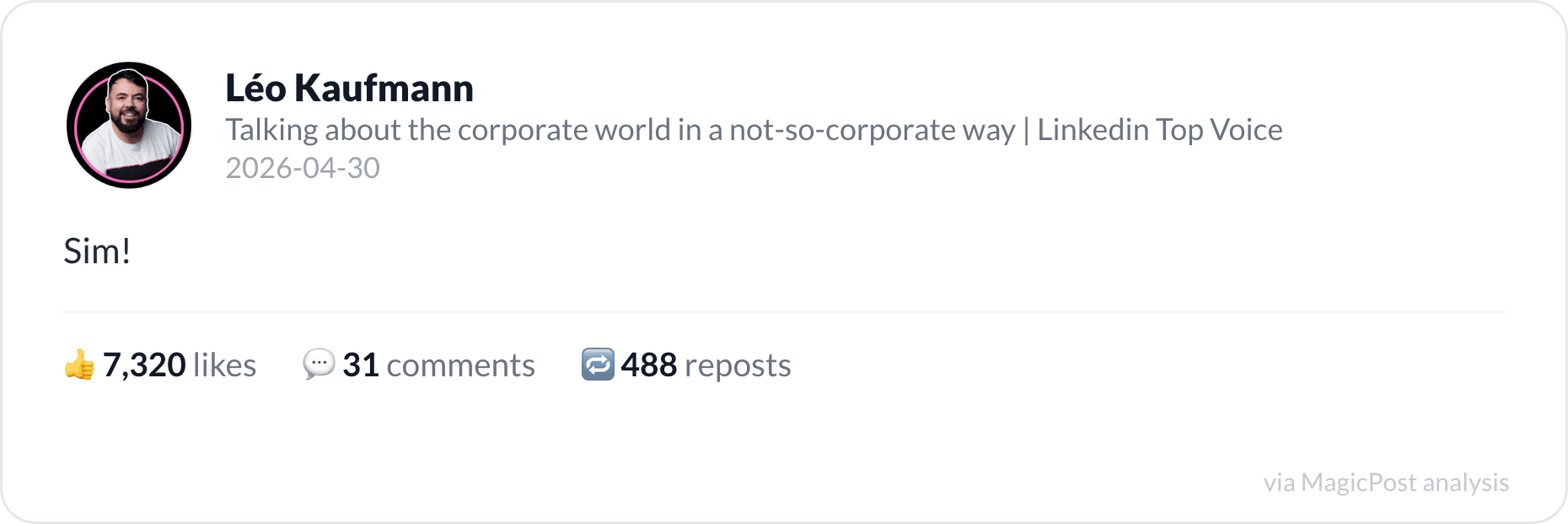
6,804 likes. Another single line: "Gente com quem você pode rir, debater, discutir, divergir... sem que isso vire um campo de batalhas!" ("People you can laugh, debate, argue, disagree with... without it becoming a battlefield!"). A value named in one breath, and the audience nods.
Is he still growing?
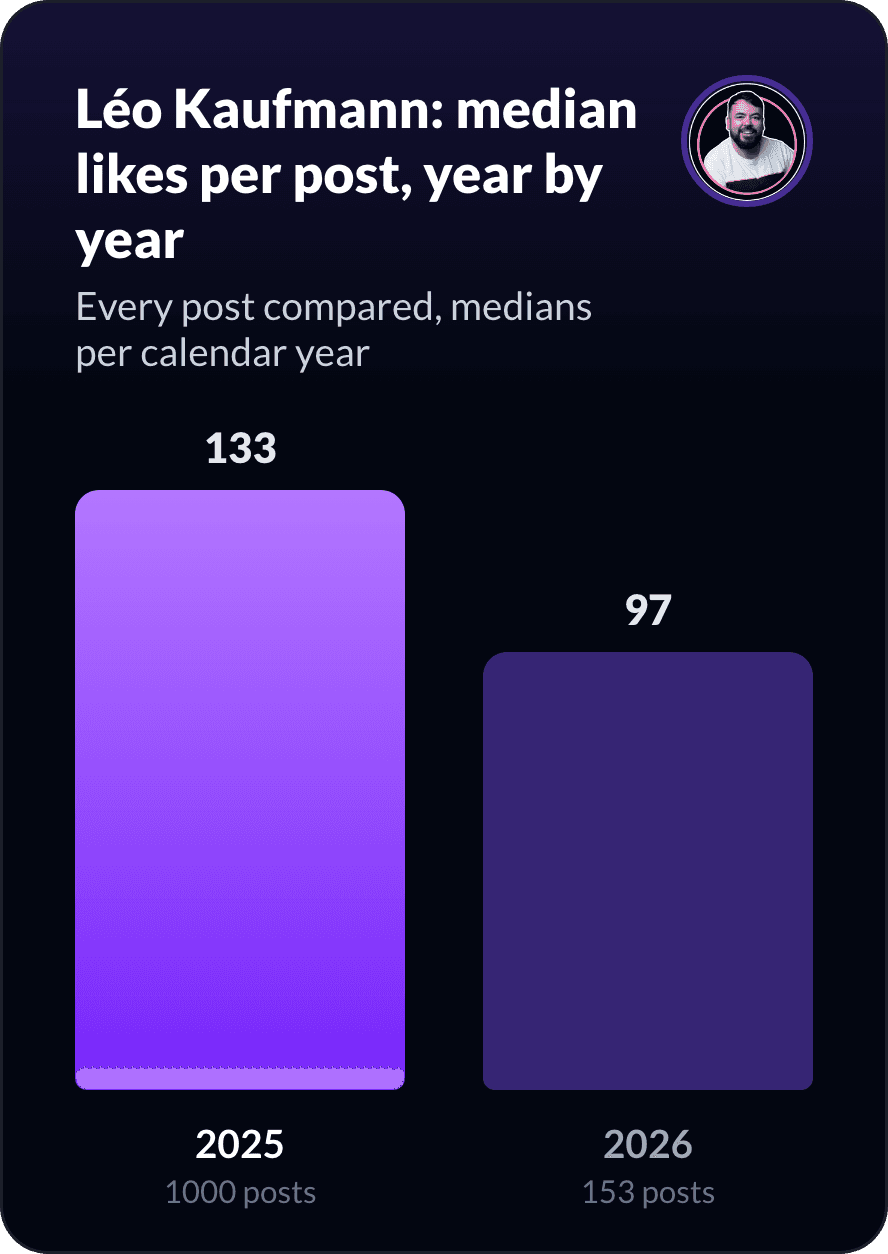
Here the data is honest in a way a follower chart never is. His median post earned about 133 likes in 2025 and about 97 so far in 2026, a real step down in per-post engagement even as his audience climbed past 198,000. This is the most common shape on LinkedIn right now: reach per post compresses as a creator scales and the feed gets crowded, so the median softens while the top stays enormous (his 2026 ceiling is still near 9,500 likes). One honest note: we measure engagement, not follower count over time, so this is how hard his average post hits, not the size of his audience, which by his own posts is still rising.
Where do these charts come from? Everything on this page runs on MagicPost's LinkedIn analytics, and it works on your profile too: your best posts, your audience, your benchmark, even a side-by-side with creators like Léo Kaufmann.
How he writes
Here is Kaufmann measured against the average creator, and the headline is not "short":
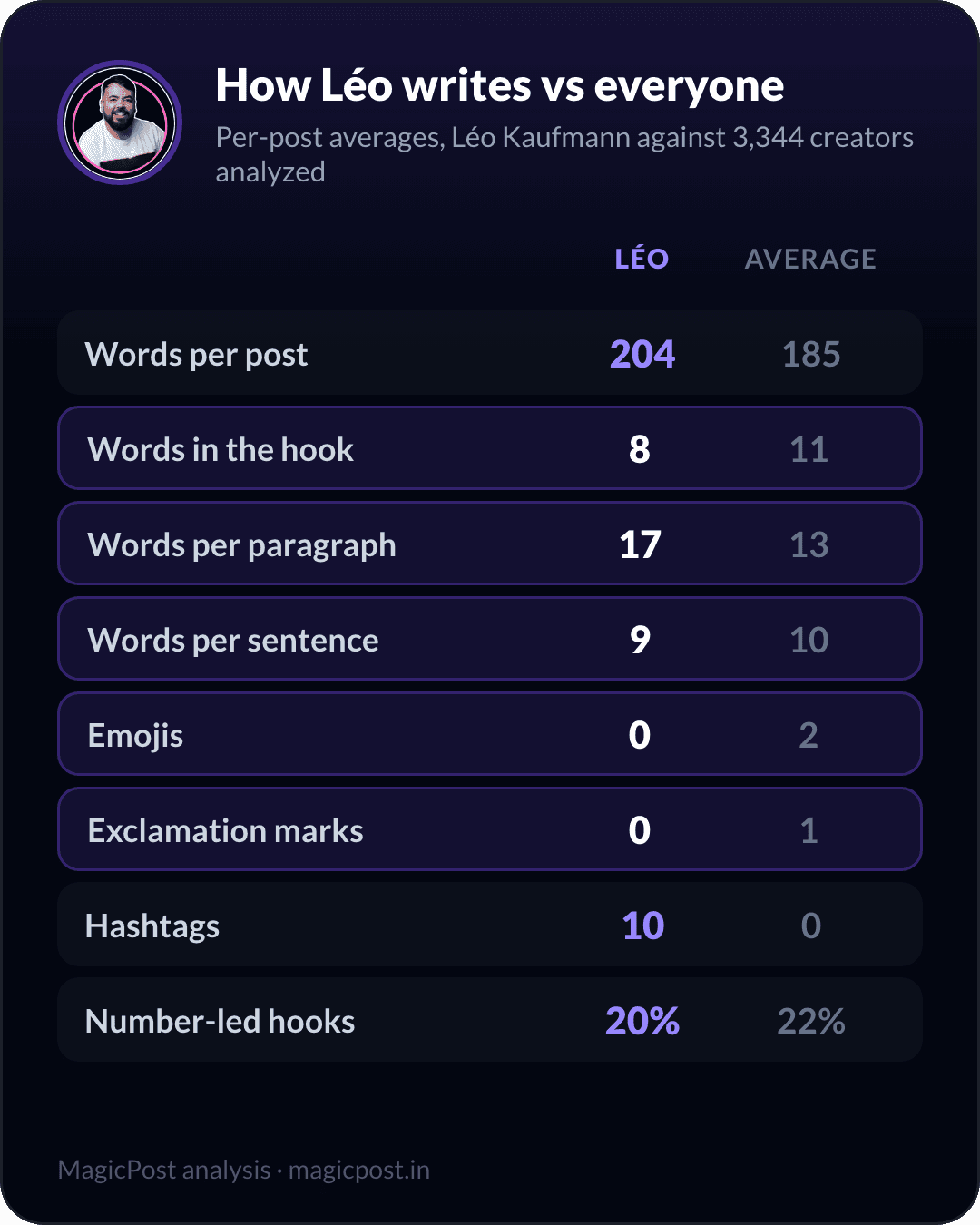
Metric (per post) | Léo Kaufmann | Average creator* |
Words | 204 | 185 |
Words in the hook | 8 | 11 |
Words per paragraph | 17 | 13 |
Words per sentence | 9 | 10 |
Emojis | 0 | 2 |
Hashtags | 10 | 0 |
Exclamation marks | 0 | 1 |
Hooks built on numbers | 20% | 22% |
*Median across the 3,344 creators we analyzed with 20+ posts each.
He writes longer than average, not shorter: 204 words against 185, with chunky 17-word paragraphs against the typical 13. His sentences sit at a normal 9 words, so the density is in the paragraphs, blocks of prose, not the one-line white-space style. Two numbers jump out. He uses zero emojis in the body where the average creator uses two, which keeps his tone clean and dry. And he runs about 10 hashtags per post against a benchmark of essentially zero, a habit most top creators dropped years ago: the one old-school move he kept. The picture is a writer who leans on argument and rhythm, the stacked contrast and the short verdict line, not formatting tricks. When our system describes his style in one word, it says: punchy.
The "AI tells" in his style (read this the right way)
Run Kaufmann's writing through the patterns people now call "AI tells," and one device stands out:
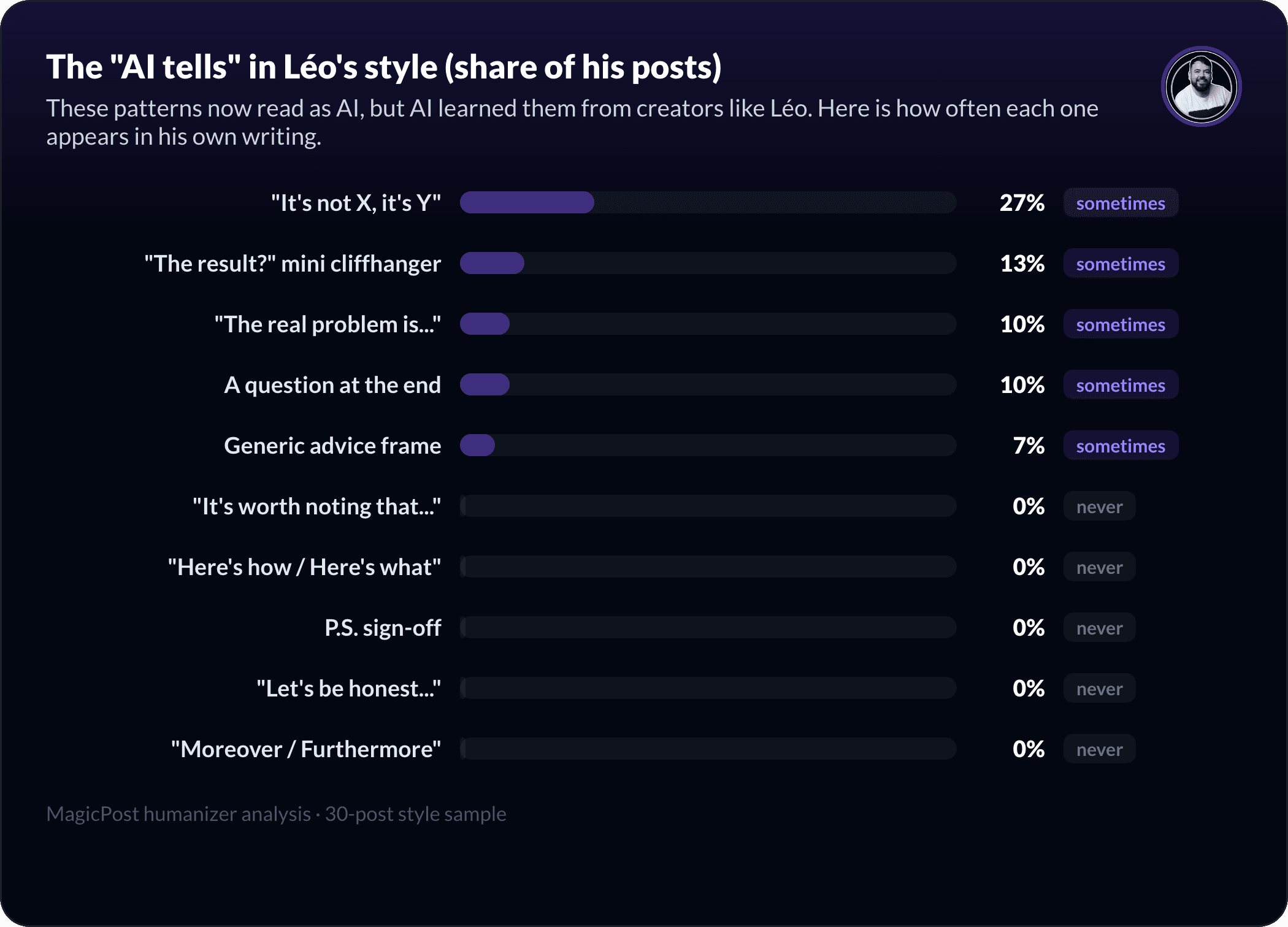
More than one in four of his posts uses the "It's not X, it's Y" contrast formula (about 27%), the single most flagged "AI" pattern on LinkedIn. You saw it powering his biggest essays: "Não é sobre salário, é sobre respeito" ("It's not about salary, it's about respect"). A smaller share lean on a reveal bridge or a closing question (about 1 in 8 each).
Do not read it backwards. Kaufmann does not write like an AI; AI writes like Kaufmann. The contrast formula reads as robotic today because the models trained on the best creators of this platform, then stacked all their moves into every post. Kaufmann uses this one because it is the literal engine of his arguments, where it lands. The rest of his fingerprint is exactly what AI cannot stop adding and he never does: he never hedges, never opens with "Here's how," never bolts on an automatic P.S., never leads with a "Moreover"-style transition. The discipline is the signature. (Full story: how to spot AI writing on LinkedIn.)
When he posts
Kaufmann publishes a heavy about 23 times a week, favorite slot Monday around 1 PM São Paulo time, with 21% of his posts in the morning and a meaningful 23% on weekends. His volume sits at the very top of what our posting-frequency study measured, and his early-afternoon, Monday-leaning rhythm is its own bet (general guidance lives in our best-time-to-post data). Do not start at 23 a week; that pace is the output of a content director who treats this as his job. And if part of your own playbook is showing up in his comments, that is what an engagement feed is for: his posts, every day, without hunting the timeline.
What to steal from Léo Kaufmann
One sharp line can beat a whole essay. His top 2026 post is nine words. If you have a verdict the room already feels, say it alone and let it breathe.
Argue in contrasts. "Não é sobre X, é sobre Y" is his core move, in a quarter of his posts. Used once, it is a hook, not an AI tell.
Build a signature story and re-run it. His "exhaustion resignation" essay earned 16,000+ likes, then 7,000+ on its re-run. Your strongest idea is an asset, not a one-off.
Pick a position, invite disagreement. He treats friction as proof of relevance. Posts built to make people take a side travel further than neutral ones.
Write longer when the argument earns it. He runs above the average word count, as long as every paragraph carries weight.
Study him, then study yourself. With MagicPost you can dig into Léo Kaufmann's numbers the way we just did, analyze your own LinkedIn analytics with the same depth, and write in the spirit of his style. The data on this page is the product.
Where this data comes from
Everything in this article is MagicPost's own research: 1,153 of Léo Kaufmann's LinkedIn posts analyzed for timing, engagement, topics, writing metrics, and the AI-pattern profile from a 30-post style sample. Every biographical claim is quoted from one of his own public LinkedIn posts and linked to it. Kaufmann is not affiliated with MagicPost; his style is one of those we track closely, which is why we built this page.
Frequently Asked Questions
Who is Léo Kaufmann?
A São Paulo content creator and LinkedIn Top Voice who is Director of Content and Curator of the RH Summit, an HR conference in Brazil. He posts about leadership, psychology and the workplace "in a not-so-corporate way," to about 198,000 followers.
How does Léo Kaufmann make money?
By his own public posts, his work centers on the RH Summit, the HR event he directs and curates, which he says drew more than 7,000 people and dozens of sponsoring brands. He came up through commercial and training roles before content.
How often does Léo Kaufmann post on LinkedIn?
About 23 posts a week in our data, most often around 1 PM São Paulo time, with Monday his most frequent day and 23% of posts on weekends.
Does Léo Kaufmann write with AI?
His style reads intensely human: heavy on argument, irony and stacked contrasts, with none of the filler AI adds. The twist is that AI tools learned from creators like him, which is why about a quarter of his posts contain the "It's not X, it's Y" pattern people now mislabel as an AI tell.
Is Léo Kaufmann still growing on LinkedIn?
His follower count is still rising (past 198,000), though median likes per post softened from about 133 in 2025 to about 97 in 2026, the reach-compression pattern common to creators scaling on the platform now.
Can I write like Léo Kaufmann?
You can learn the mechanics: MagicPost learns a creator's writing style (length, rhythm, hooks, signature moves) and helps you write in that spirit, in your own voice.
The Top LinkedIn Creators to Study in 2026 (By the Data)
The top LinkedIn creators to study in 2026, by the data: 62 creators, six languages, 27 countries, 32,000 posts analyzed by MagicPost. Grouped by what they teach.
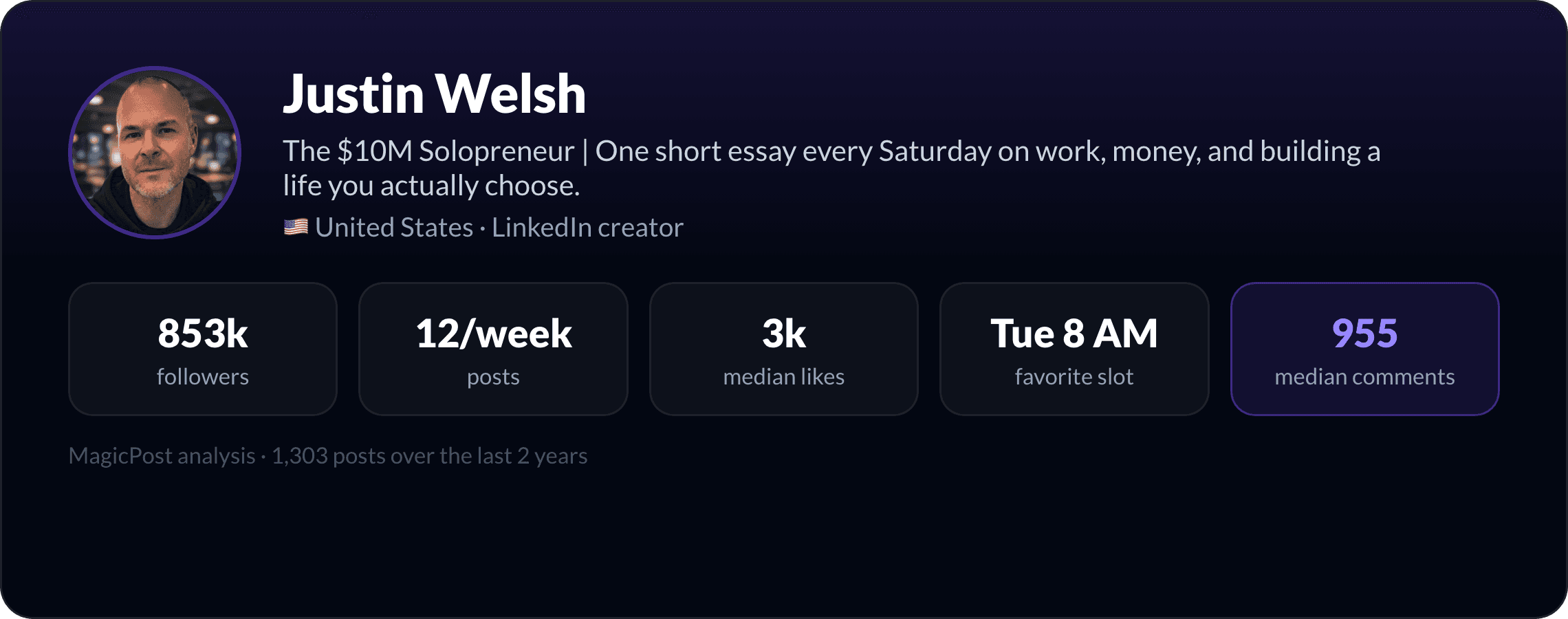
Who Is Justin Welsh? The $10M Solopreneur, Explained by Data (2026)
Who is Justin Welsh? MagicPost analyzed 1,303 of their LinkedIn posts: topics, timing, signature moves and the writing fingerprint behind their growth, with rea
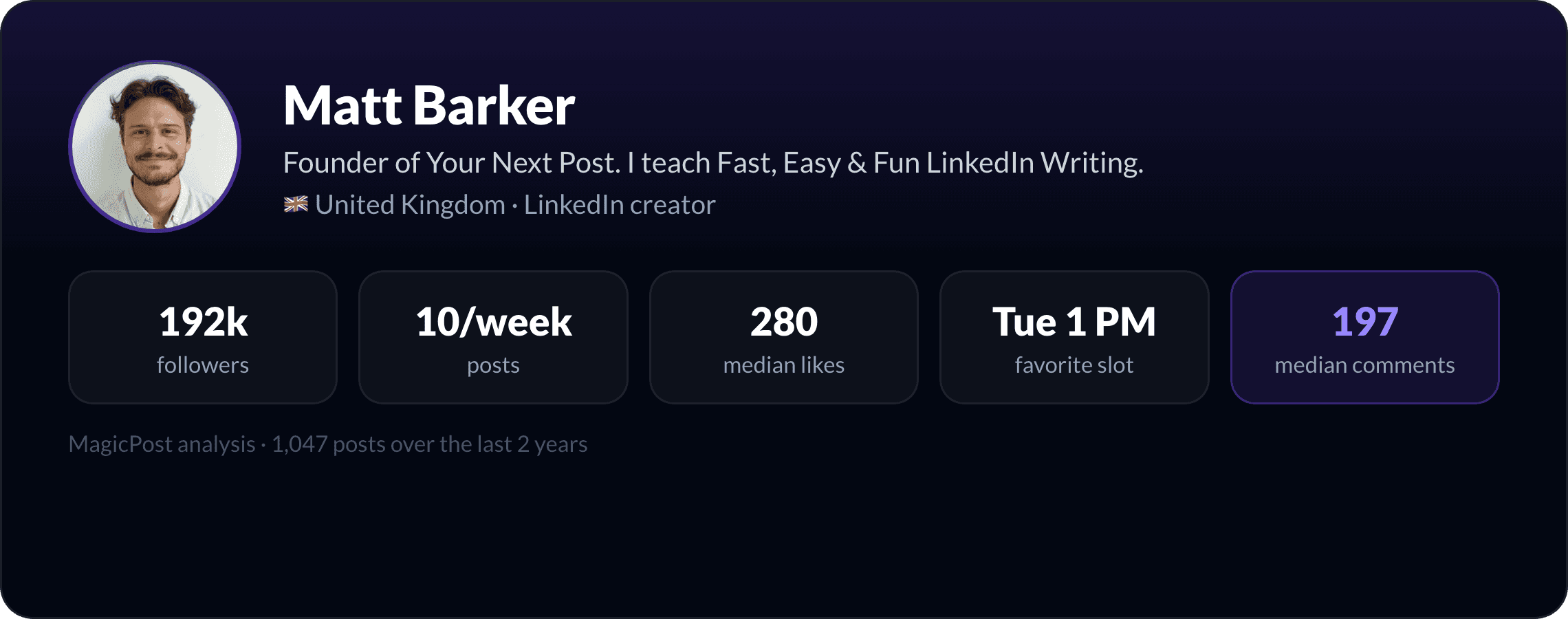
Who Is Matt Barker? The Hook Writer on LinkedIn, by Data (2026)
Who is Matt Barker? MagicPost analyzed 1,047 of their LinkedIn posts: topics, timing, signature moves and the writing fingerprint behind their growth, with real
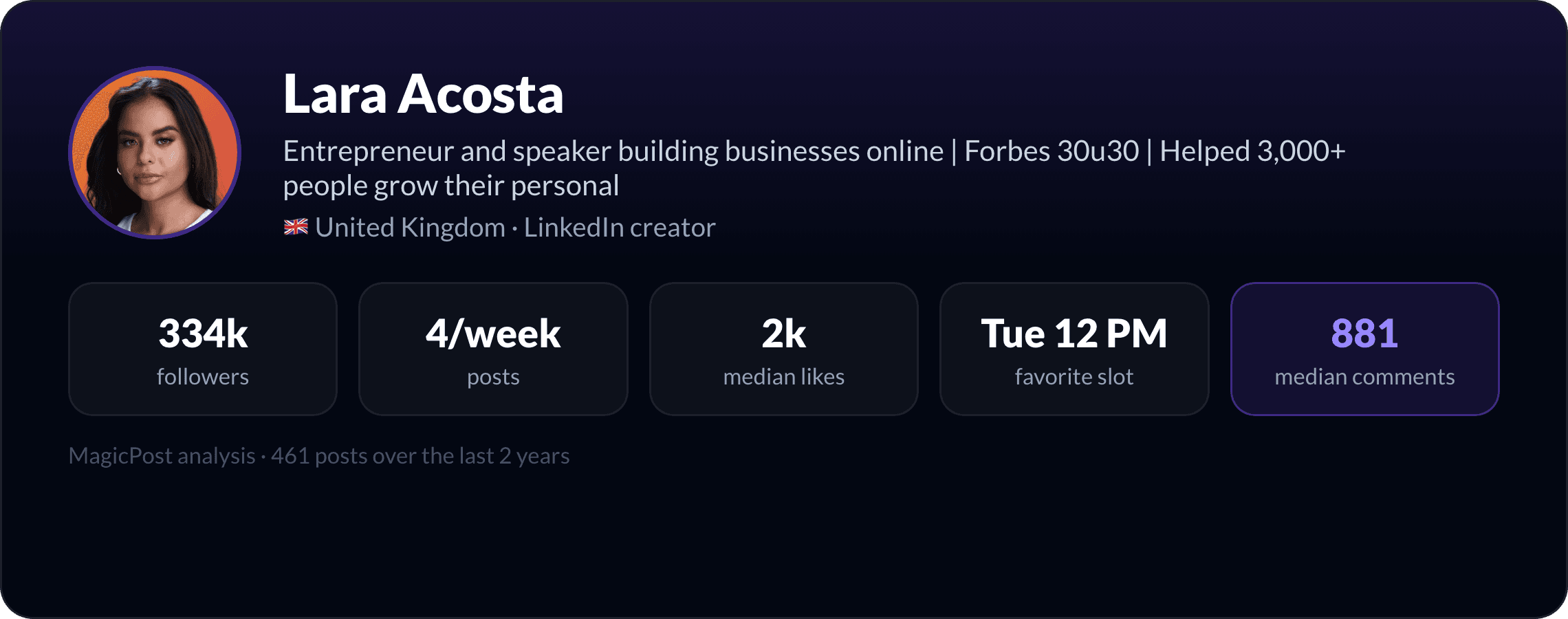
Who Is Lara Acosta? The Forbes 30 Under 30 Comment Machine, Explained by Data (2026)
Who is Lara Acosta? MagicPost analyzed 461 of their LinkedIn posts: topics, timing, signature moves and the writing fingerprint behind their growth, with real n
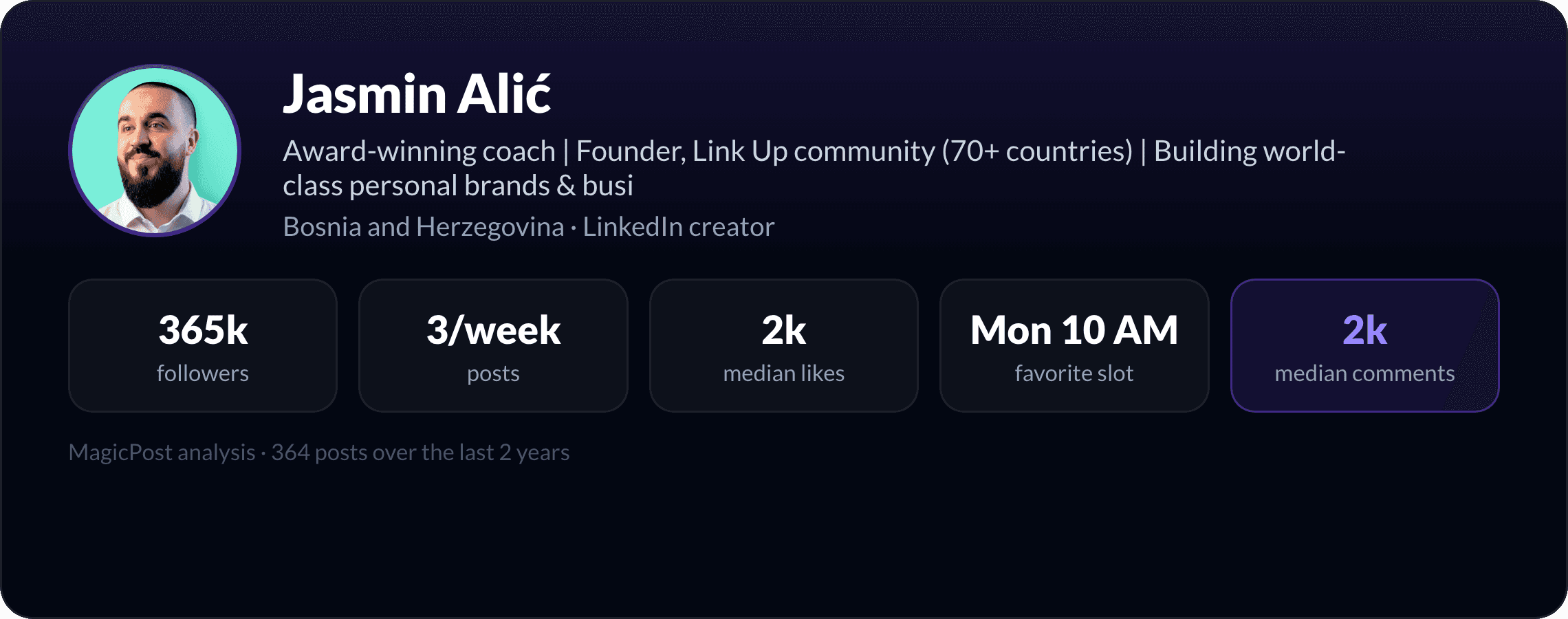
Who Is Jasmin Alić? The Bosnian Coach LinkedIn Mistook for a Bot (2026)
Who is Jasmin Alić? MagicPost analyzed 364 of their LinkedIn posts: topics, timing, signature moves and the writing fingerprint behind their growth, with real n
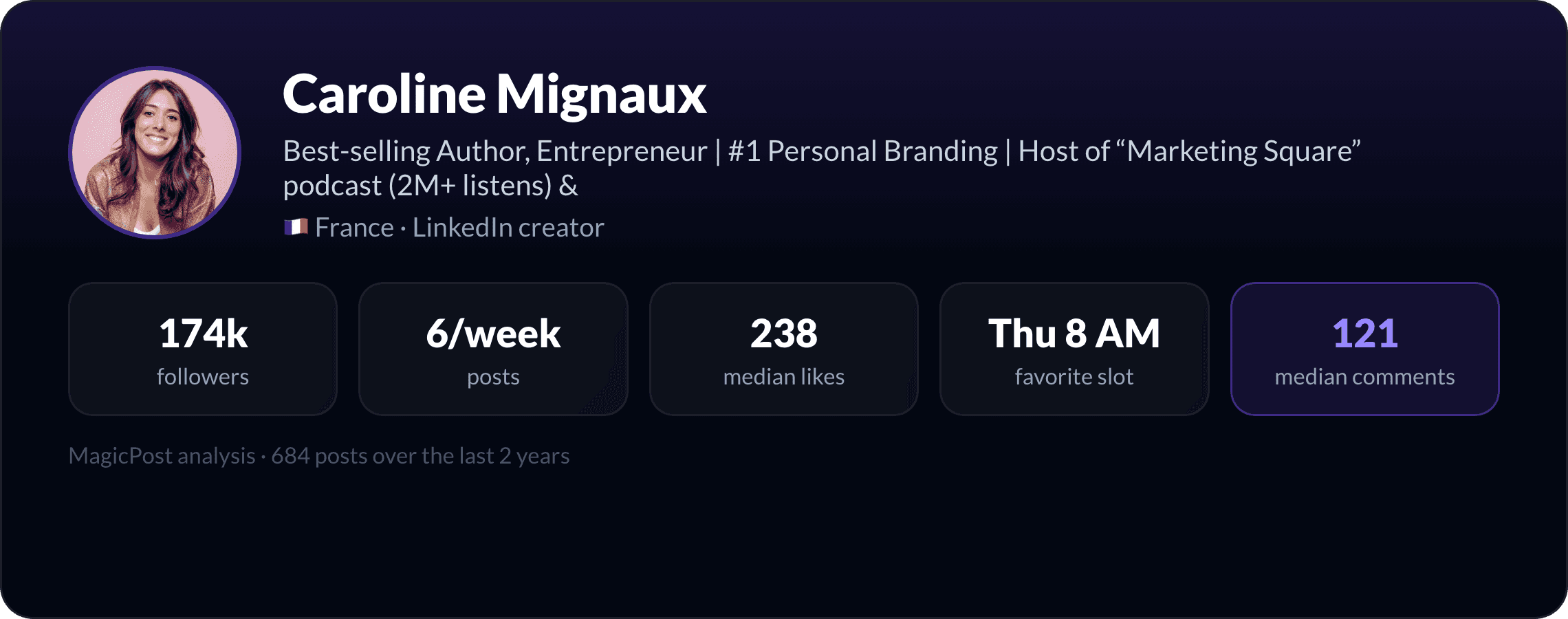
Who Is Caroline Mignaux? France's LinkedIn Top Voice Who Turned Shame Into a Following (2026)
Who is Caroline Mignaux? MagicPost analyzed 684 of their LinkedIn posts: topics, timing, signature moves and the writing fingerprint behind their growth, with r
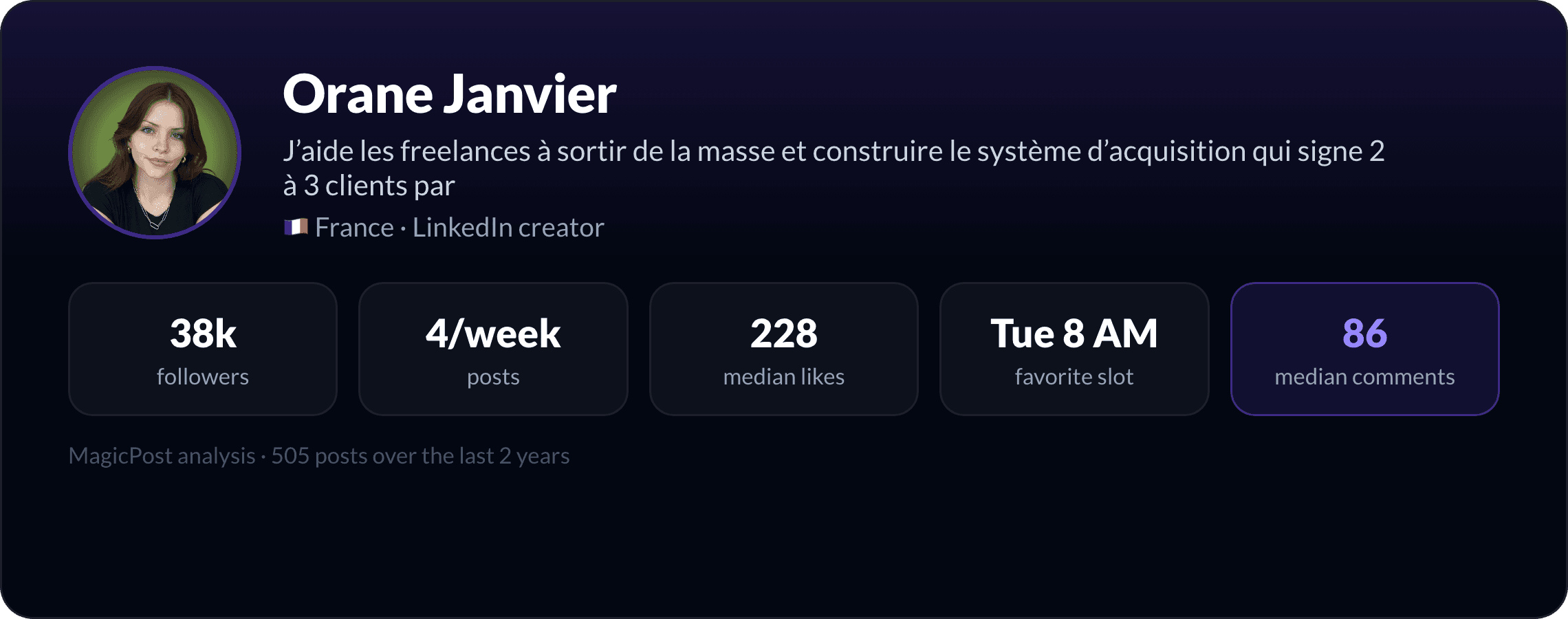
Who Is Orane Janvier? The Freelance Coach LinkedIn Quietly Copies (2026)
Who is Orane Janvier? MagicPost analyzed 505 of their LinkedIn posts: topics, timing, signature moves and the writing fingerprint behind their growth, with real
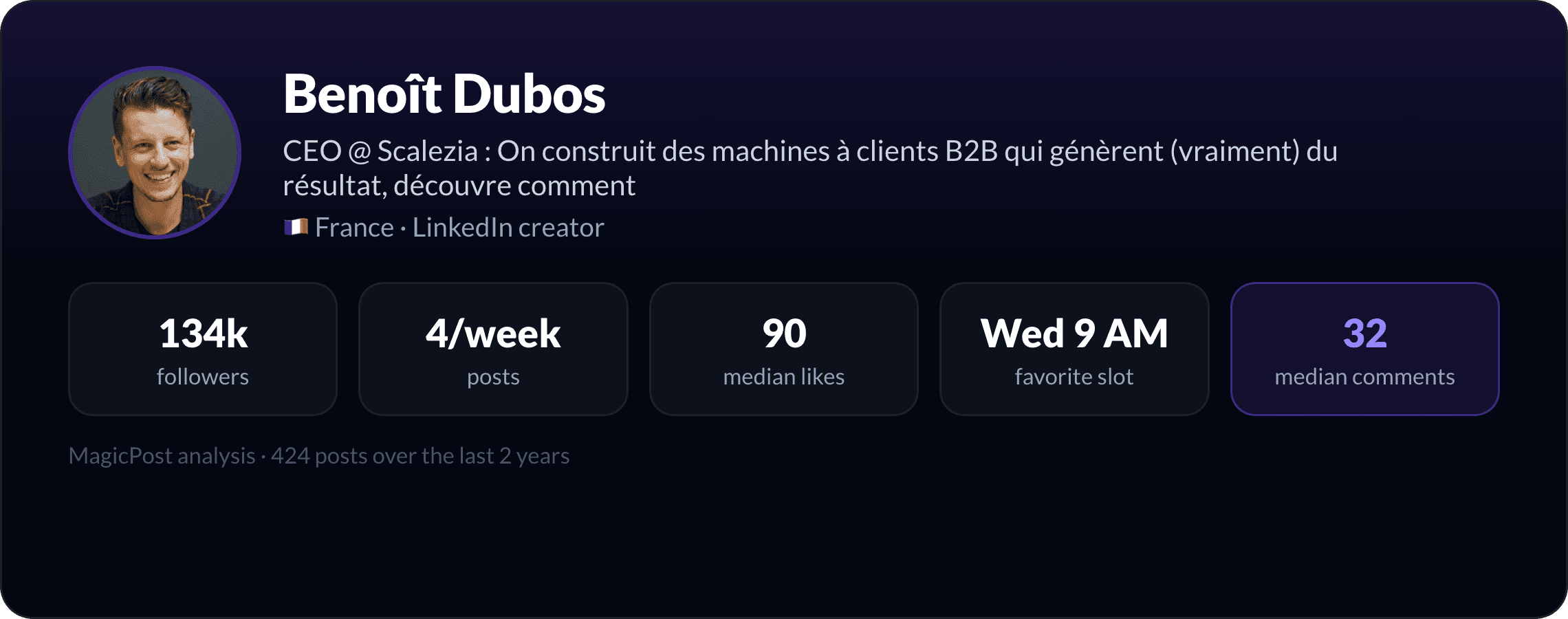
Who Is Benoît Dubos? The Growth Operator Who Turned a Falling Reach Into a Lead Machine (2026)
Who is Benoît Dubos? MagicPost analyzed 424 of their LinkedIn posts: topics, timing, signature moves and the writing fingerprint behind their growth, with real
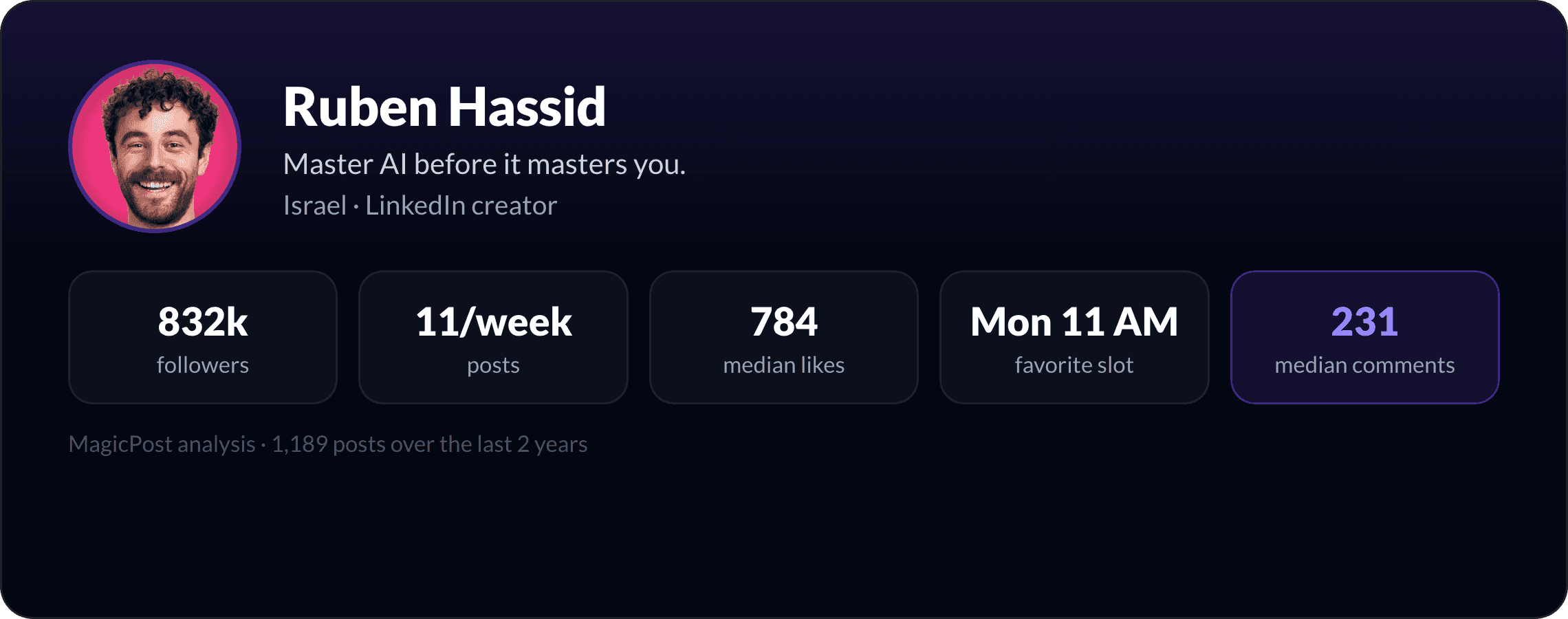
Who Is Ruben Hassid? The "Master AI Before It Masters You" Creator, Explained by Data (2026)
Who is Ruben Hassid? MagicPost analyzed 1,189 of their LinkedIn posts: topics, timing, signature moves and the writing fingerprint behind their growth, with rea
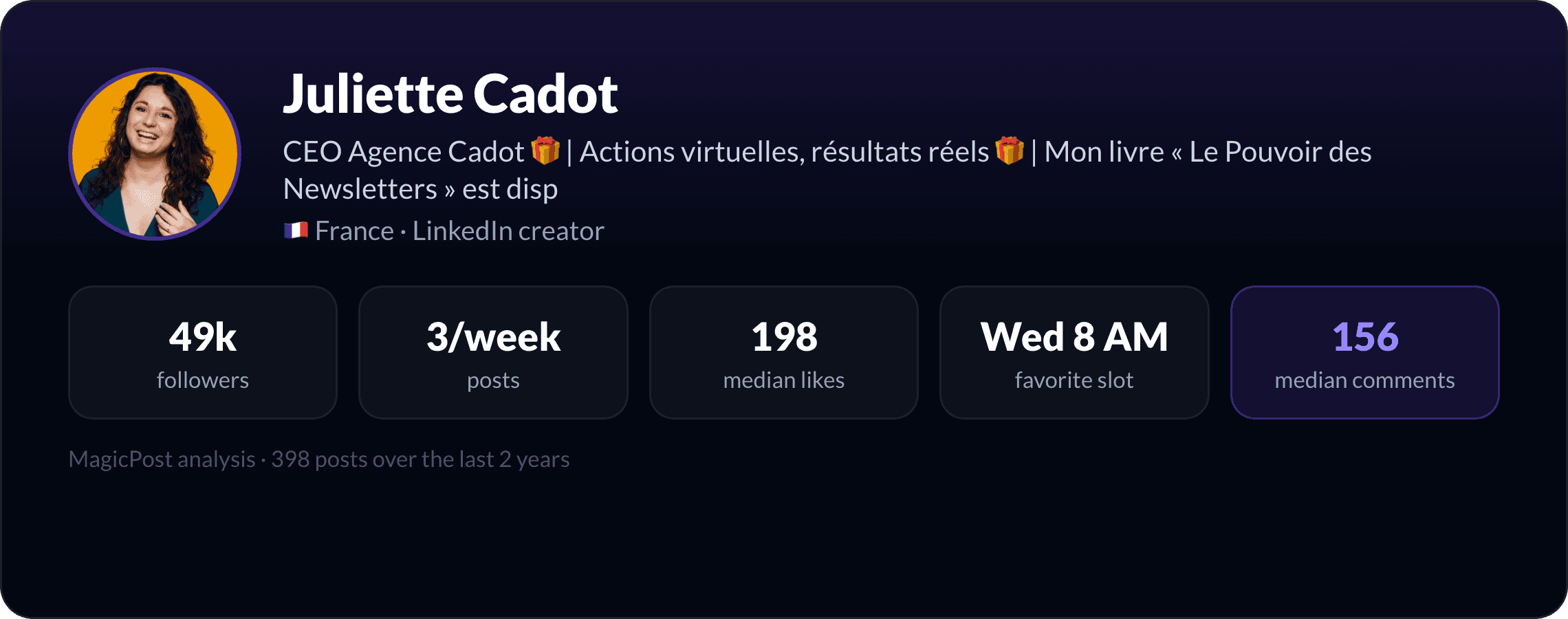
Who Is Juliette Cadot? The Agency Founder Whose Audience Talks Back (2026)
Who is Juliette Cadot? MagicPost analyzed 398 of their LinkedIn posts: topics, timing, signature moves and the writing fingerprint behind their growth, with rea