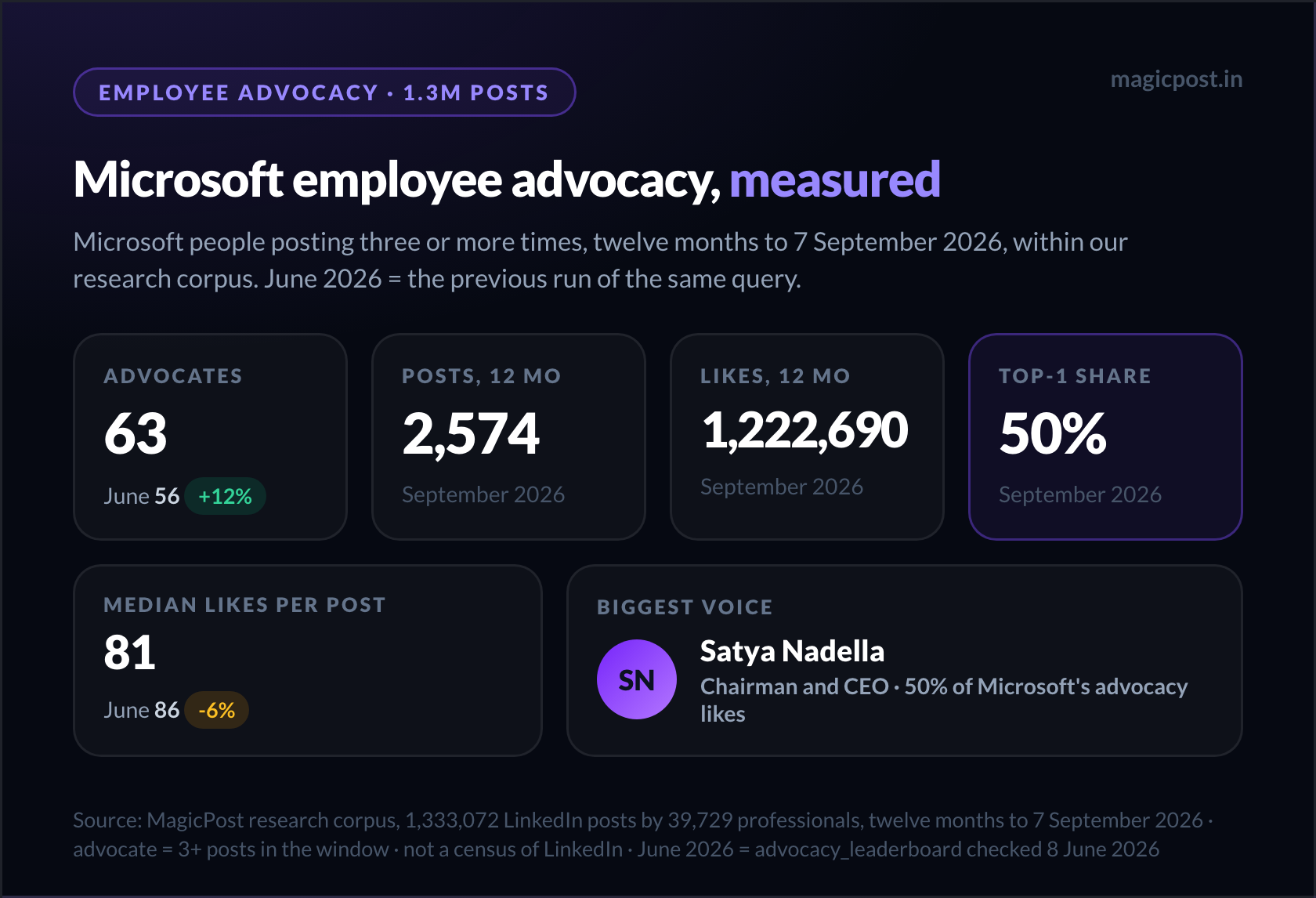
Microsoft employee advocacy is the widest footprint in our research corpus: 63 people posting at least three times in the past twelve months, 2,574 posts, and 1.2 million likes. No other company we measured has more voices.
The Microsoft figures on this page are measured from our research corpus over the twelve months to September 2026. Method and limits are at the end.
It is also, by one measure, a single voice. Satya Nadella's 105 posts are 50% of those likes, and the median Microsoft post gets 81, a quarter of what L'Oréal's twelve advocates manage. This page is about the gap between the most people and the most reach per person.
The Microsoft employee advocacy footprint, measured
Microsoft people in our corpus produced 2,574 posts and 1,222,690 likes across the window, from 63 advocates. That is 19,408 likes per advocate, second only to Google among companies with more than 30 voices, and a median of 81 likes per post.
In June the same query found 56 advocates, 2,688 posts and a median of 86. So the set widened by seven people while the typical post lost a little.
Microsoft voice | Role | Posts (12 mo) | Median likes | Likes (12 mo) |
Satya Nadella | Chairman and CEO | 105 | 5,064 | 611,757 |
Mustafa Suleyman | CEO, Microsoft AI | 92 | 1,352 | 158,283 |
Greg Coquillo | AI Infrastructure Product Leader | 200 | 272 | 65,939 |
Emma Walmsley | Board Director (former CEO, GSK) | 14 | 2,040 | 50,142 |
Mette Louise Kaagaard | GM, Microsoft Denmark and Iceland | 59 | 327 | 32,320 |
Nick Cosentino | Principal Software Engineering Manager | 384 | 10 | 30,953 |
These six are 78% of Microsoft's likes. The other 57 advocates share the remaining 22%, about 273,000 likes between them, which is still more than every company in the corpus except Google, AWS and HubSpot produce in total.
Combined, the 63 profiles reach 15.1 million followers. Twelve million of those follow one account.
What is distinctive: breadth without intensity
Distributed advocacy is usually read off the advocate count. Microsoft is the case that breaks that habit.
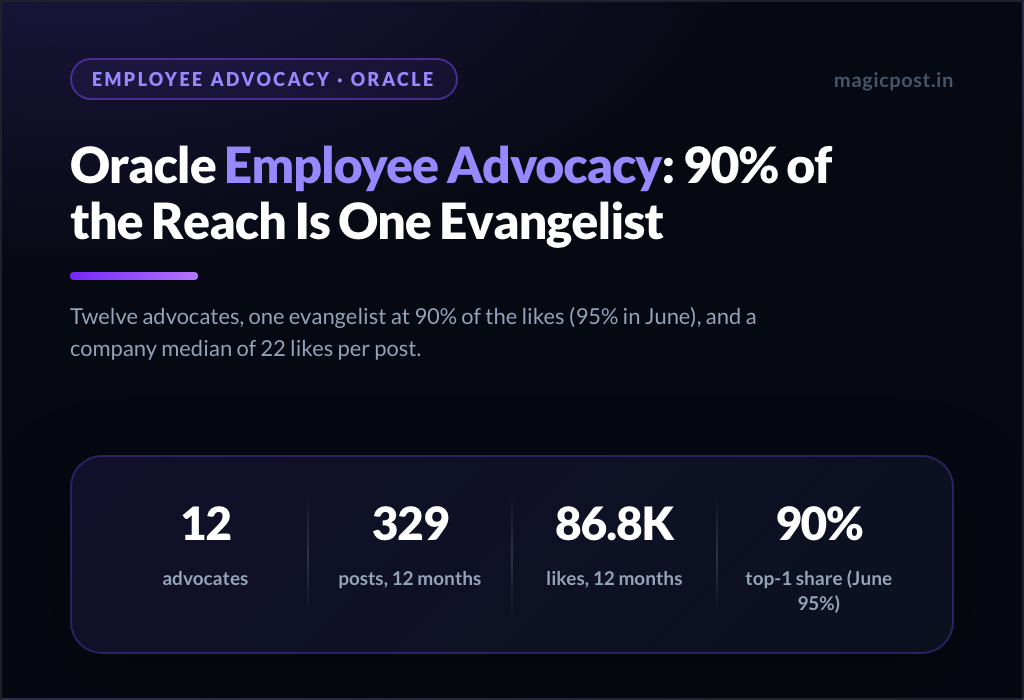
Put the median next to the count. Microsoft: 63 advocates, median 81 likes. EY: 34 advocates, median 44.
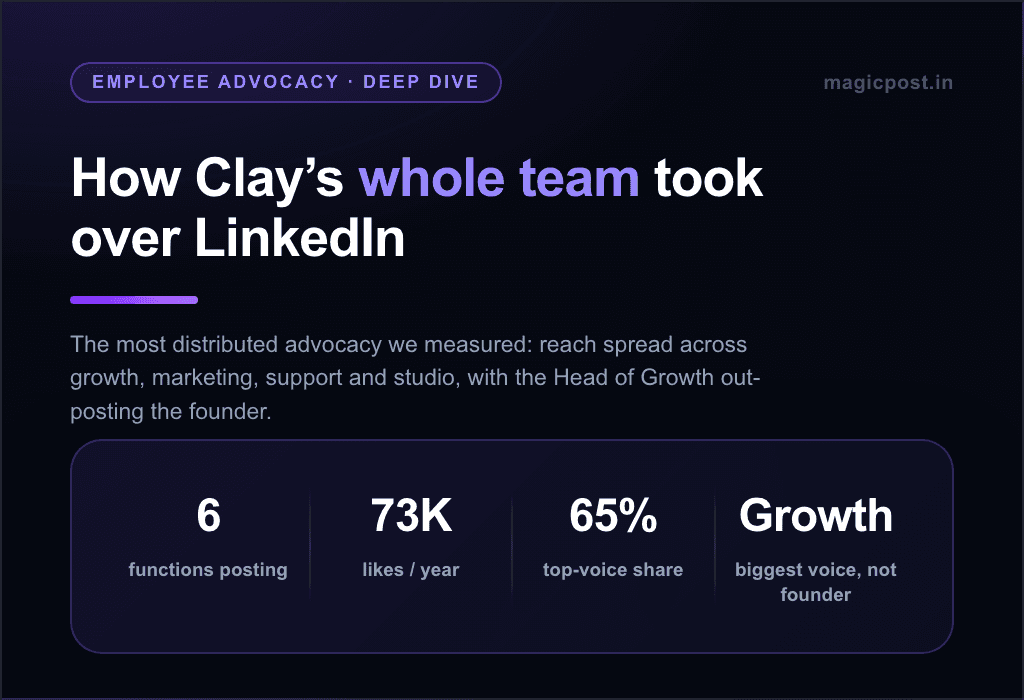
Now the small sets: L'Oréal, 12 advocates, median 310. Sanofi, 8, median 293. Novo Nordisk, 13, median 285. Clay, 10, median 248.
The companies with the most voices post at a quarter of the intensity of the companies with a dozen. Headcount buys breadth. It does not buy reach per post, and in this corpus the two run in opposite directions.
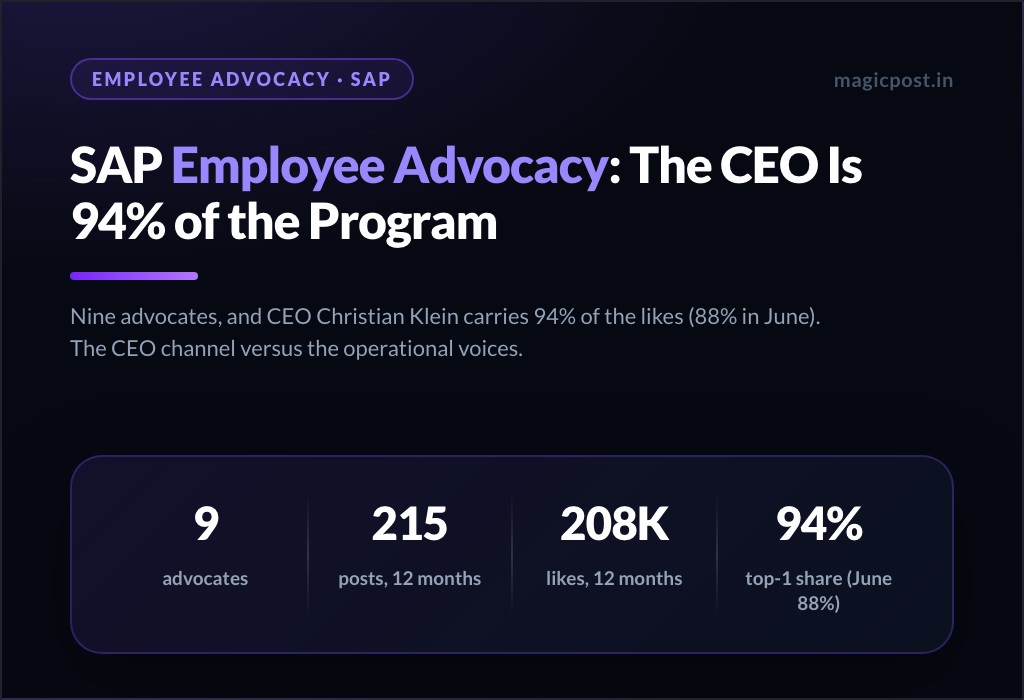
The other reading is concentration. Half of Microsoft's reach is its CEO. Take him out and the remaining 62 people still produce 611,000 likes, with Mustafa Suleyman at about a quarter of that.
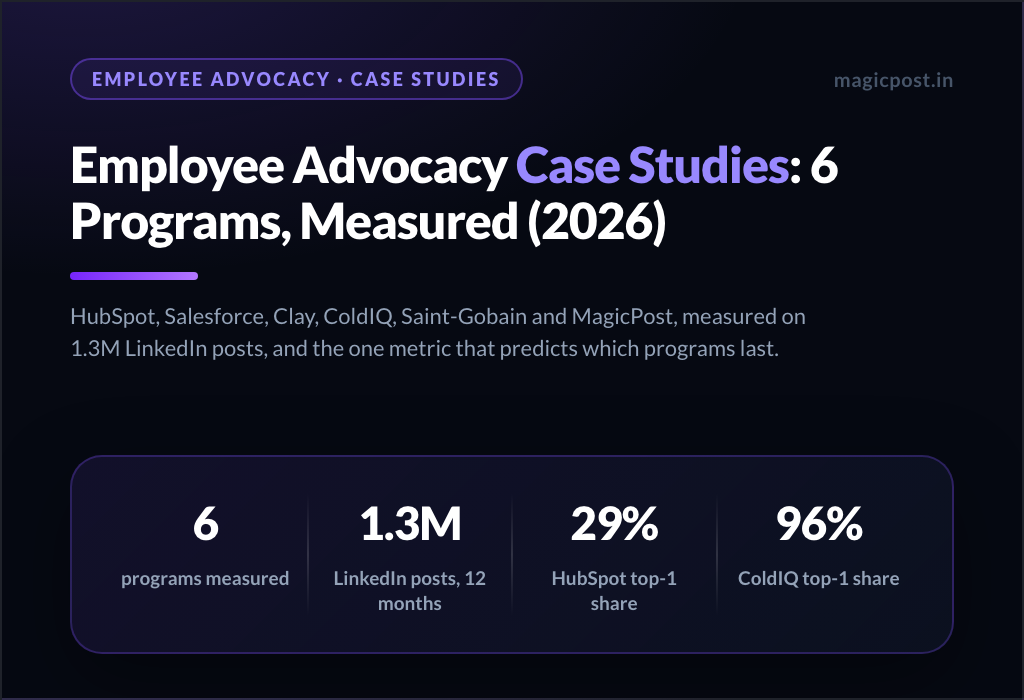
Google, the second-widest set at 50 advocates, sits at 40% top-1; AWS, at 31, sits at 35%. HubSpot holds 29% with twelve.
So Microsoft is wide, CEO-heavy, and thin per post, all at once. The full distribution of who carries reach at each company is in our study of 1.3 million posts.
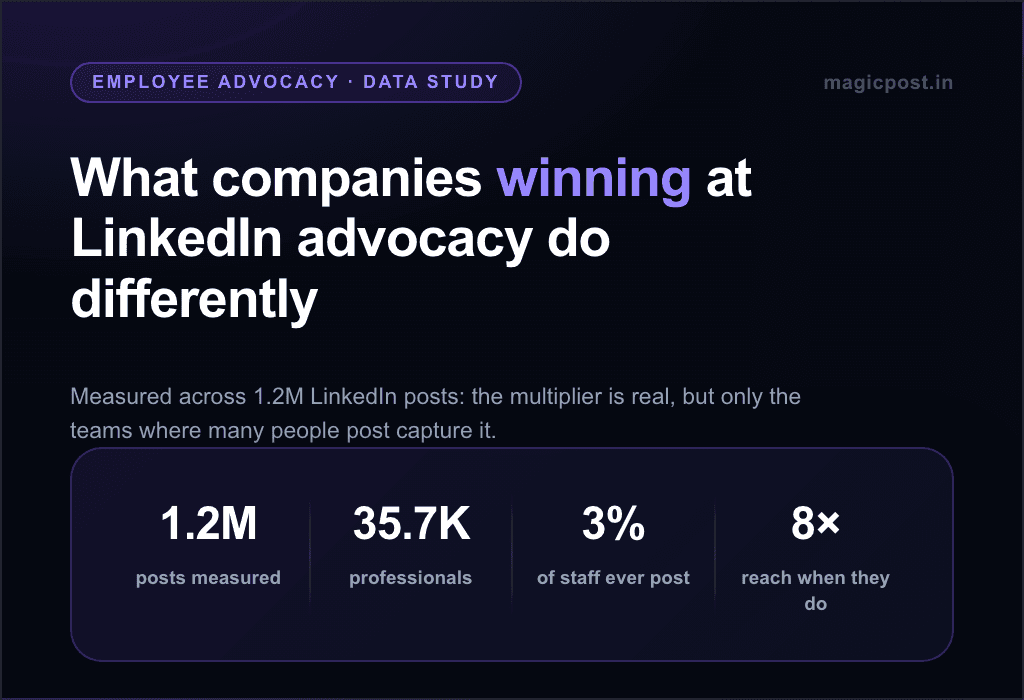
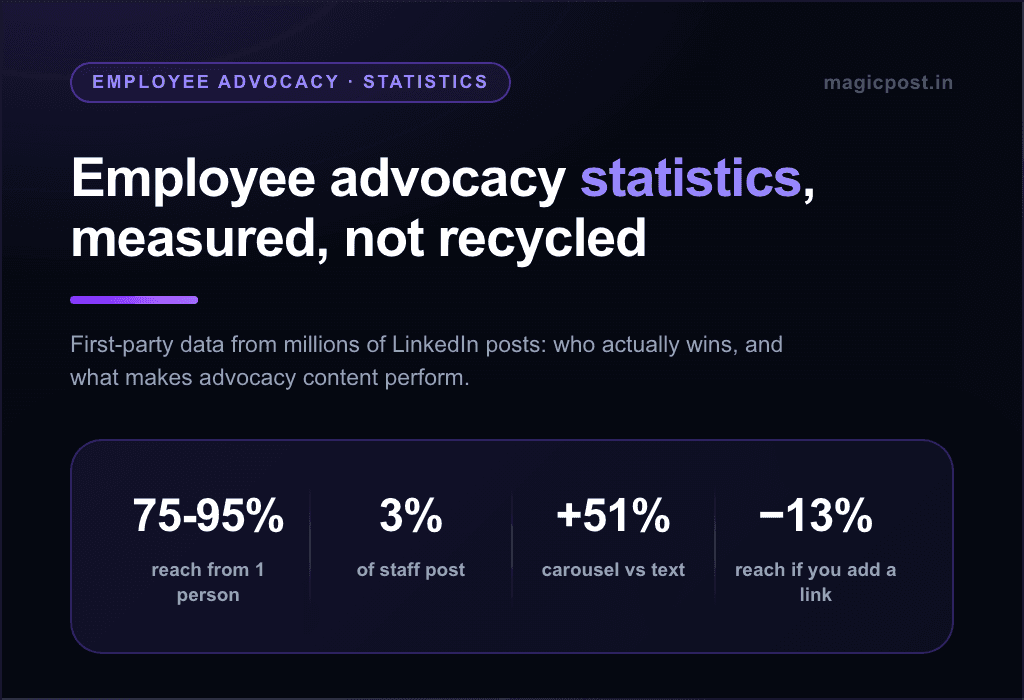
One more scale note. LinkedIn's Official Guide to Employee Advocacy puts the share of employees who ever share company content at about 3%. Our corpus cannot measure non-posters, so we cannot say what fraction of Microsoft's workforce the 63 represent.
What you can take from Microsoft's employee advocacy
Anyone who reports "number of active advocates" to a leadership team can take three corrections from the Microsoft numbers.
Report the median alongside the count. Sixty-three voices at 81 likes and twelve at 310 are different programs. The count goes up with headcount; the median goes up with content. Employee advocacy statistics that stop at the count hide the second number, which only per-member LinkedIn analytics surface.
Separate the CEO's line from the program's line. Nadella's 611,757 likes are the company page with a face. They say nothing about whether the other 62 people are reaching anyone. Read the program with the top voice removed, then decide if it is distributed.
Volume is its own lane, and the one that scales. Nick Cosentino's 384 posts, the most of anyone in the set, produce 30,953 likes at a median of 10. Mette Louise Kaagaard's 59 posts produce 32,320. Same total, six and a half times the posting.
The employee advocacy examples that hold up over time tend to have a practitioner lane, an executive lane and a regional lane, each with its own format. Microsoft has all three, at very different intensities, which is what makes it worth reading voice by voice.
How each Microsoft voice works
Satya Nadella, Chairman and CEO, the announcement
Nadella posts about twice a week, 105 times in the window, to 12 million followers, at a median of 5,064 likes. Each of his posts is worth roughly 60 median Microsoft posts.
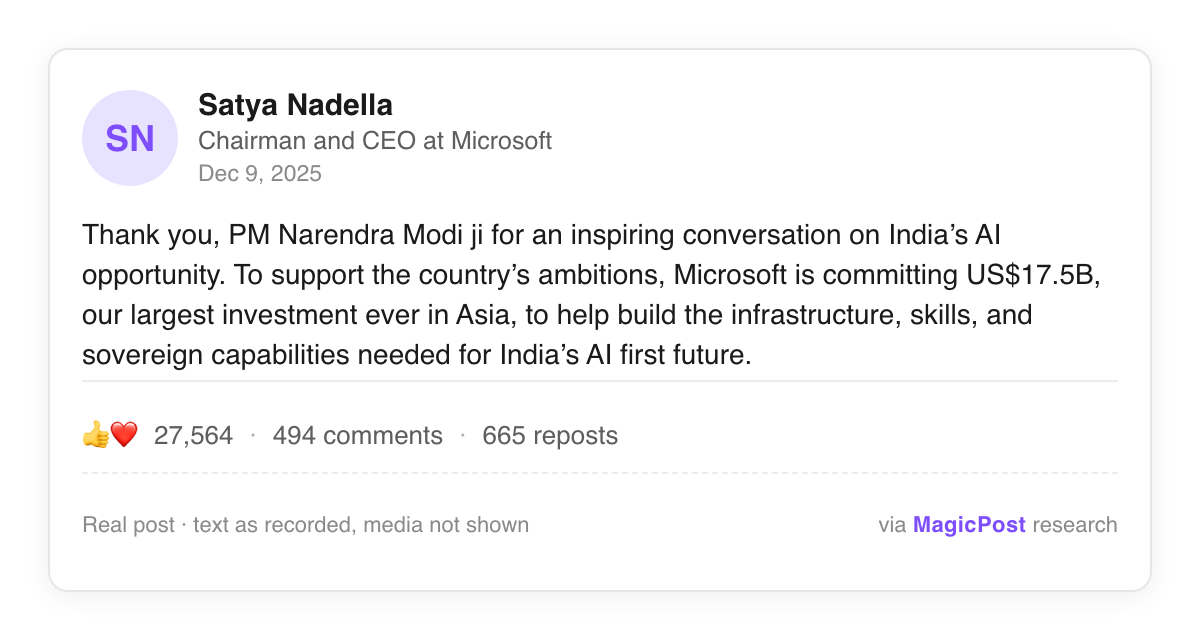
His biggest of the year, from December 2025, thanks Prime Minister Narendra Modi and commits US$17.5B to India's AI infrastructure, Microsoft's largest investment in Asia: 27,564 likes, 665 reposts. See the post.
His August 2026 post, a photo of the first production Vera Rubin systems arriving at Microsoft data centres, with thanks to NVIDIA and the Azure hardware teams, reached 17,813 likes and 654 reposts. See the post.
Both are capital announcements with a named partner. That is the CEO lane at this scale: the post is the press release, and the account is the distribution. It cannot be copied by anyone else in the company, which is exactly why it should be read separately.
Mustafa Suleyman, CEO of Microsoft AI, the second executive
Suleyman posts almost as often as Nadella, 92 times, to 529,687 followers, at a median of 1,352 likes. He is 13% of Microsoft's reach and the only other voice above 10%.
His top post, from January 2026, announces the Maia 200 inference chip with performance figures against Amazon's and Google's silicon: 10,934 likes and 736 reposts, the most reshared post in the set.
His second-best is a text-only post from October 2025 on hiring people who took big swings and missed over people who played it safe: 7,450 likes and 444 comments.
The second post is the one to study. No product, no chart, no announcement, and it still reached two thirds of the chip launch. A management opinion from a named executive is a lane most companies never open.
Greg Coquillo, AI infrastructure product leader, the explainer
Coquillo is the practitioner-creator in the set: 200 posts, 229,290 followers, a median of 272 likes, and 65,939 likes in the year. He posts more than the two CEOs combined and reaches a technical audience neither of them addresses.
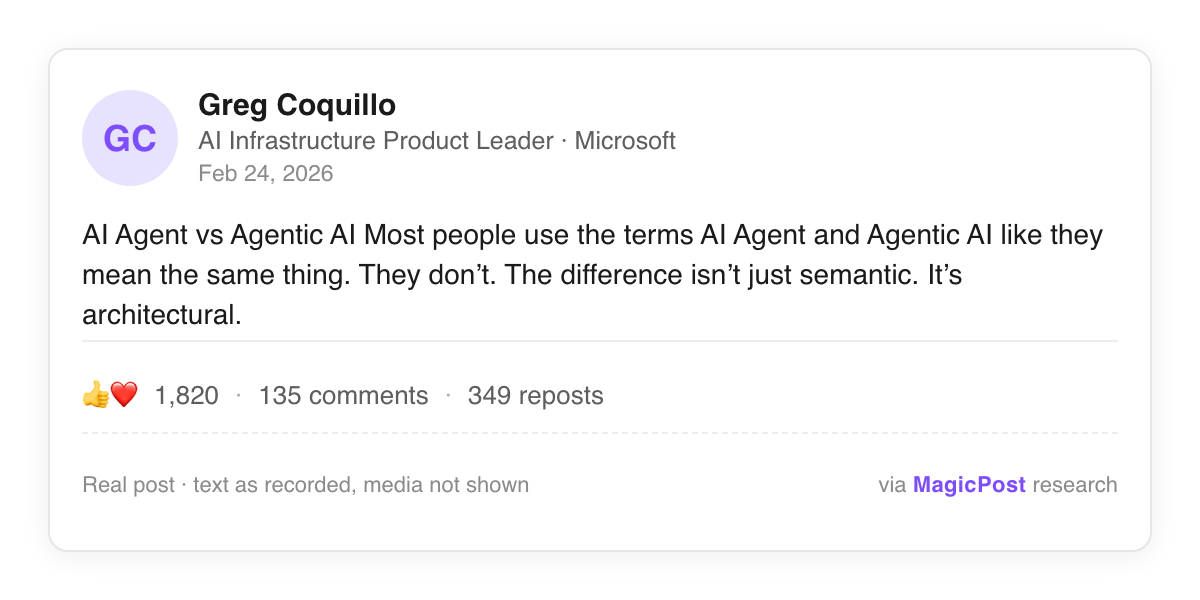
His best post, from February 2026, is a layer-by-layer breakdown of the difference between an AI agent and agentic AI, from models to memory to orchestration: 1,820 likes and 349 reposts. See the post.
His April post does the same for the architecture of Claude Code, a tool Microsoft does not make: 1,481 likes and 252 reposts. See the post.
Reposts run at one in five likes on both, the highest ratio in the table. Explainers get saved and forwarded; announcements get liked. A product leader writing about the field, including competitors' tools, is the most replicable voice on this page.
Emma Walmsley, board director, the borrowed reach
Walmsley sits on Microsoft's board and was, until the end of 2025, CEO of GSK. Her profile names Microsoft, so our match places her 14 posts and 50,142 likes in the Microsoft column. We flag it because her reach is not Microsoft's.
Her two biggest posts of the year are both about GSK. The September 2025 announcement of her successor as CEO reached 12,351 likes. See the post. Her December 2025 post, looking back on nine years in the role in her final days, reached 12,027. See the post.
A median of 2,040 likes on 14 posts is the highest intensity in the set after Nadella. It is also 4% of Microsoft's measured advocacy that belongs to another company's farewell. Board members are an edge case in this kind of measurement, and this is what the edge looks like.
Mette Louise Kaagaard, GM Denmark and Iceland, the regional voice
Kaagaard ran Microsoft Denmark and Iceland and posts in Danish to 26,330 followers, the smallest following of the six, at a median of 327 likes. Her 59 posts produced 32,320 likes, more than Cosentino's 384.
Her two biggest posts are her exit. In August 2026 she announced she would join Netcompany as Commercial Chief AI Officer on 1 September: 4,126 likes and 750 comments. See the post.
In May she posted a photo of her worn access card after three and a half years and said her time at Microsoft was ending: 3,526 likes, 493 comments. See the post.
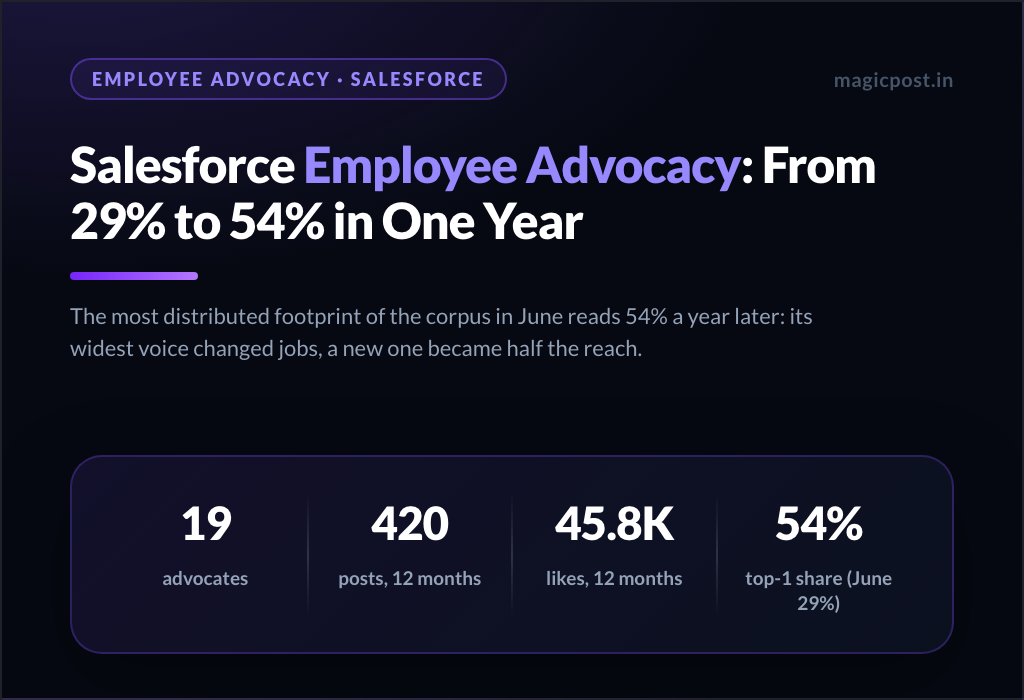
Comments at one in six likes, on both, is a local audience talking back. A country GM in the local language reaches people the global account never will. The next twelve-month window loses this voice, the same way Salesforce lost its widest one.
Nick Cosentino, engineering manager, the volume lane
Cosentino, a Principal Software Engineering Manager with 30,612 followers, posted 384 times in the window, more than anyone else at Microsoft in our corpus. His median is 10 likes.
The total, 30,953 likes, puts him sixth. The path there is the opposite of Walmsley's: nearly a post a day at a small, steady reach, rather than fourteen posts at a large one.
Both land in the same place on the table. Only one scales to a team of engineers.
Where these numbers come from
Every Microsoft number on this page comes from one query over our research corpus: 1.3 million LinkedIn posts in the window (3.2 million in total) by 39,729 distinct posters.
A post counts for Microsoft when its author's profile names Microsoft as their company; a person counts as an advocate from three posts. The company page is left out.
Read the scope narrowly. The corpus is the set of profiles MagicPost has imported, heavy on B2B, sales-tech and big tech, and it is not a census of LinkedIn, so "63 advocates" means 63 within the companies in our research corpus, not 63 at Microsoft.
The June figures are the same query run three months earlier. Post text and engagement are as recorded on the day, with a link to the live post where one is public; Danish posts are paraphrased rather than translate-quoted. Figures drift, and corrections land at the next refresh.
Measure Microsoft-scale employee advocacy per person
If your advocacy report counts voices and stops there, the median and the top-1 share are the two numbers it is missing.
MagicPost for enterprises is a LinkedIn employee advocacy platform that measures both per person, so a team of sixty can see whether it is reaching people or standing behind one account.
Preguntas frecuentes
Does Microsoft have an employee advocacy program?
Microsoft's employee advocacy footprint is the widest in our research corpus, at 63 people with three or more posts in the past twelve months, 2,574 posts and 1.2 million likes. Whether a managed program sits behind those 63 people is not something the data can show.
The data does show that CEO Satya Nadella is half of the reach, and the median post lands at 81 likes, so the footprint is broad, top-heavy and thin per post all at once.
Who are Microsoft's biggest voices on LinkedIn?
Satya Nadella is the largest Microsoft voice in our corpus, with 611,757 likes on 105 posts. Mustafa Suleyman, CEO of Microsoft AI, follows at 158,283, then Greg Coquillo, an AI infrastructure product leader, at 65,939.
Board director Emma Walmsley, Denmark and Iceland GM Mette Louise Kaagaard and engineering manager Nick Cosentino complete the top six.
Is Microsoft's employee advocacy distributed?
Microsoft's employee advocacy is wide but not distributed by the usual measure: one person holds 50% of the reach, against 29% at HubSpot, 35% at AWS and 40% at Google in the same corpus.
With the CEO removed, the remaining 62 voices still produce about 611,000 likes, with Mustafa Suleyman at roughly a quarter of that.
What can other companies learn from Microsoft's employee advocacy?
Microsoft shows that the number of advocates says little about reach: 63 voices at a median of 81 likes trail twelve L'Oréal voices at 310. Report the median alongside the count, read the program with the CEO removed, and build a practitioner lane like Greg Coquillo's explainers.
That lane is the one a company of any size can copy.