Le sondage est le post le plus facile à publier sur LinkedIn. Quatre mots, quatre options, un clic, et le fil fait le reste. Il devrait donc être le meilleur ami des créateurs. Les données disent l'inverse.
Nous avons mis 11 123 sondages publiés sur les 12 derniers mois sur le même tableau de bord que tous les autres formats, remonté quatre ans d'historique pour voir si le format monte ou s'éteint, puis regardé ceux qui tirent le plus des sondages pour en trouver le plafond.
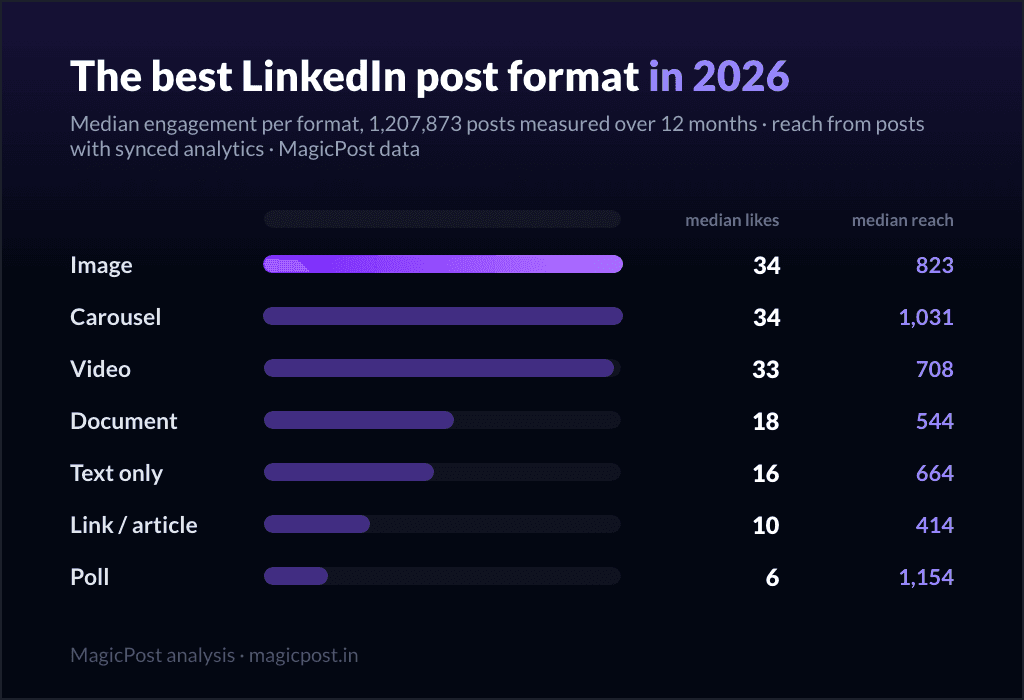
En résumé : le sondage obtient l'engagement médian le plus faible de tous les formats LinkedIn (6 likes médians, contre 34 pour un post image), mais il touche plus de monde que n'importe quel autre format (1 154 impressions médianes). On le voit, puis on l'ignore. Ce paradoxe est toute l'histoire, alors commençons par le tableau.
Où se situe le sondage face aux autres formats LinkedIn
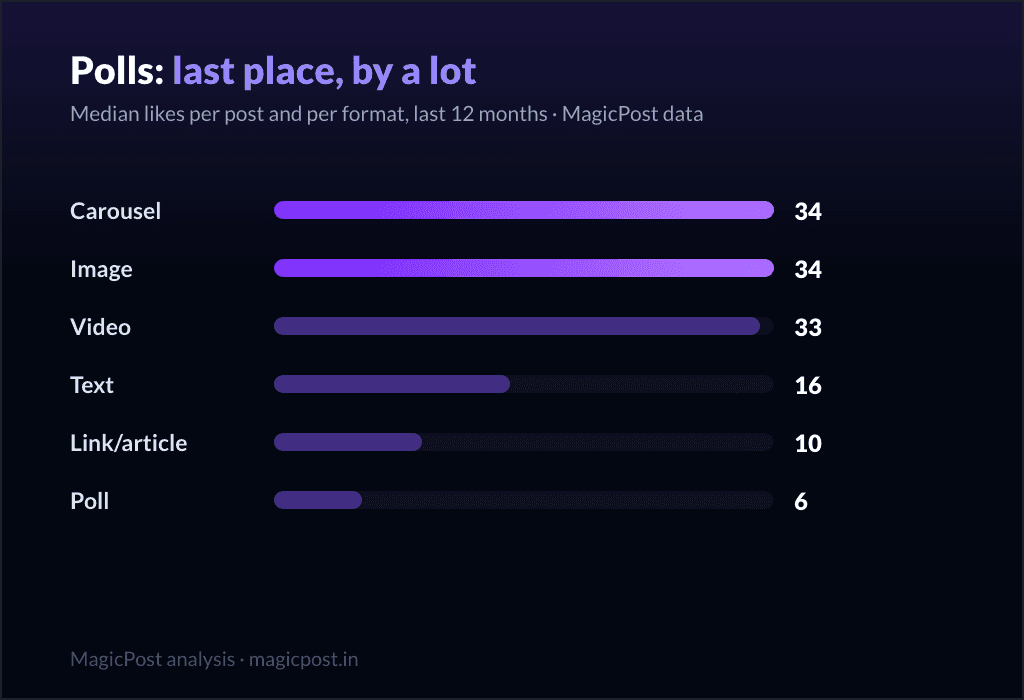
Classé par likes médians sur notre corpus de 12 mois, le sondage finit bon dernier :
Format | Posts mesurés | Likes médians | Commentaires médians |
Carrousel | 69 864 | 34 | 9 |
Image | 731 288 | 34 | 7 |
Vidéo | 122 157 | 33 | 6 |
Texte seul | 195 708 | 16 | 4 |
Lien / article | 71 329 | 10 | 1 |
Sondage | 11 123 | 6 | 3 |
Un sondage récolte 6 likes médians. Le même créateur qui publie une image en récolte 34. L'écart n'a rien d'un arrondi : c'est la différence entre un post qui circule et un post qui s'arrête net. (Le classement complet des formats se trouve dans notre étude pilier, le meilleur format de post LinkedIn en 2026.)
Le seul chiffre sur lequel les sondages ne perdent pas : les commentaires. Un sondage récolte 3 commentaires médians, au coude à coude avec le texte (4) et confortablement devant les posts avec lien (1). Voter demande peu d'effort, et le sondage est conçu pour en récolter. Gardez-le en tête, c'est la seule tâche pour laquelle il est vraiment fait.
Le retournement : les sondages sont vus
C'est là que le sondage cesse d'être un simple échec pour devenir un piège. Quand on regarde la portée au lieu de l'engagement, le classement s'inverse :
Type de post | Posts aux analytics synchronisés | Impressions médianes |
Sondage | 6 209 | 1 154 |
Tout le reste | 560 748 | 760 |
Ces chiffres de portée viennent du sous-ensemble des posts dont les analytics sont synchronisés : 6 209 sondages et 560 748 posts qui ne sont pas des sondages. Le sondage médian est vu par 1 154 personnes, contre 760 pour un post ordinaire. L'algorithme de LinkedIn pousse activement les sondages dans davantage de fils, sans doute parce qu'un vote est le signal d'engagement le moins cher qu'il puisse fabriquer. (Plus de détails sur ce que le fil récompense dans le fonctionnement de l'algorithme LinkedIn en 2026.)
Un sondage vous achète donc environ 50 % de portée en plus et la convertit en une fraction des likes. Vous louez une plus grande scène pour y jouer un numéro plus discret. Chacune de ces 1 154 impressions aurait pu servir à un post qui, lui, aurait construit quelque chose.
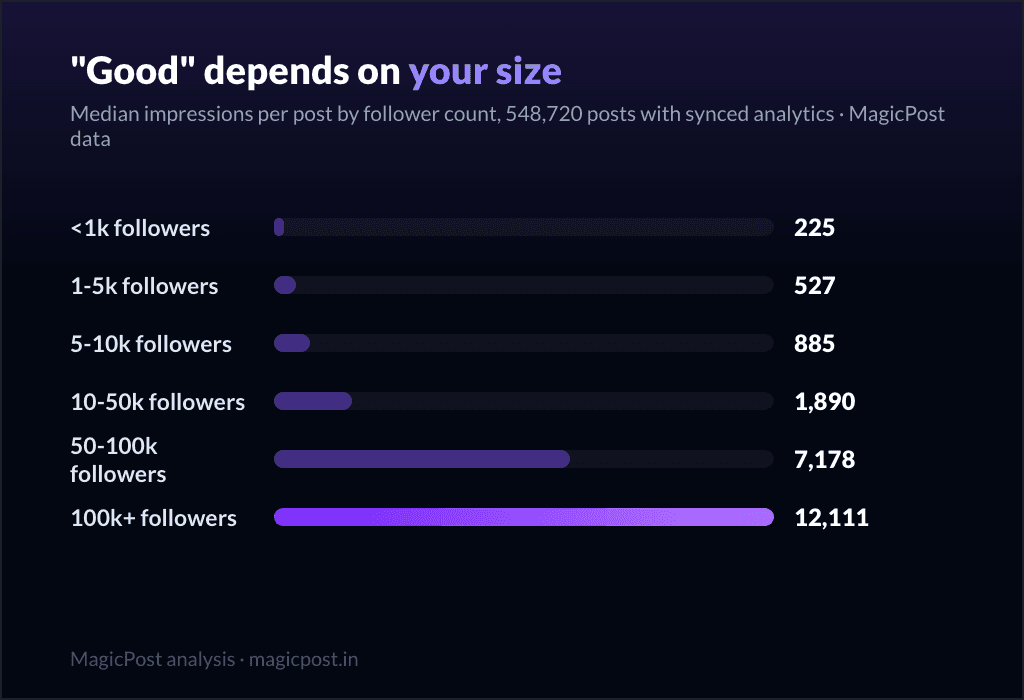
Si vous ne savez pas si 1 154 représente beaucoup pour un compte de votre taille, tout dépend de votre audience : ce qui compte comme une bonne portée LinkedIn selon votre taille.
Les sondages excellent dans un seul exercice : récolter des votes
Si l'engagement est le mauvais tableau de bord pour un sondage, quel est le bon ? Les votes. Et sur ce tableau, le sondage fait bien son travail. Sur les 1 378 sondages de notre corpus pour lesquels nous disposons du nombre de votes :
Votes médians par sondage : 52.
Top 10 % des sondages (p90) : 965 votes.
Cinquante-deux réponses, c'est un vrai échantillon. Si vous avez réellement une question à poser, le sondage est l'outil de collecte de votes le plus efficace que propose LinkedIn : aucun message privé à relancer, aucun tableur, aucun lien de questionnaire qui divise votre portée par deux. Le format n'est pas cassé. Il est simplement optimisé pour la collecte de données et pas pour la distribution, alors que la plupart des gens publient des sondages en attendant la seconde.
Quatre ans de sondages : les touristes sont venus, puis repartis
L'instantané sur 12 mois masque une vague. Part des posts LinkedIn qui étaient des sondages, année par année, à côté de ce que rapportait le sondage médian :
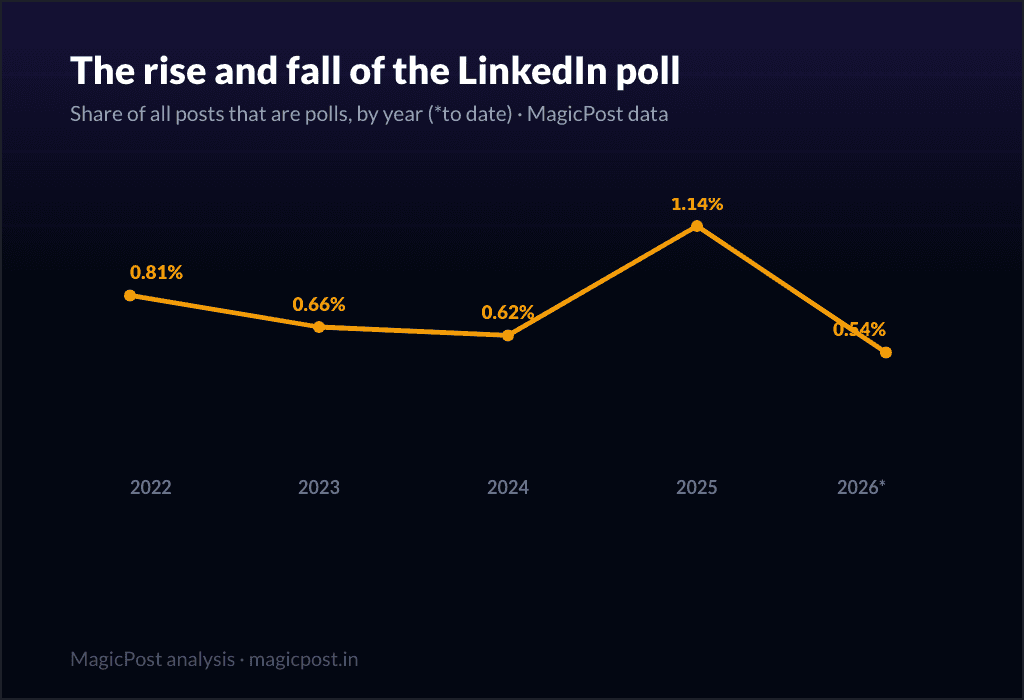
Année | Sondages mesurés | Part de tous les posts | Likes médians par sondage |
2022 | 530 | 0,81 % | 4 |
2023 | 1 130 | 0,66 % | 3 |
2024 | 3 738 | 0,62 % | 4 |
2025 | 15 346 | 1,14 % | 5 |
2026 | 2 541 | 0,54 % | 9 |
Lisez d'abord la colonne des parts. Les sondages sont restés discrètement sous la barre du 1 % du fil pendant des années, puis ont bondi à 1,14 % de tous les posts en 2025 quand la foule des hacks d'engagement les a découverts, avant de retomber à 0,54 % en 2026. La bulle a gonflé et éclaté en douze mois environ.
Lisez maintenant la colonne d'engagement. Pendant que les touristes affluaient, le sondage médian ne rapportait presque rien : 3 à 5 likes sur toute la durée du boom. Une fois les touristes partis, les survivants s'en sortent un peu mieux : 9 likes médians en 2026, la meilleure année jamais enregistrée et plus du double de la médiane de l'époque du boom.
Les personnes qui publient encore des sondages en 2026 sont surtout celles qui le font exprès, et le chiffre le leur rend. (Le chiffre 2026 couvre une année partielle et un échantillon plus mince : lisez-le comme une tendance, pas comme un retournement.)
Le schéma est celui que nous observons dans tout ce groupe d'articles : un format est vendu comme un hack, la médiane s'effondre sous le volume de posts bâclés, le hack meurt, et le format revient au petit groupe qui avait une vraie raison de l'utiliser.
Même les maîtres du sondage subissent la décote
La meilleure preuve que le sondage plafonne l'engagement se trouve tout en haut du classement. Nous avons sorti les créateurs les plus performants sur les sondages (au moins 6 sondages sur la période, plus de 5 000 abonnés, personnes uniquement) et comparé ce qu'ils obtiennent sur un sondage à leur médiane globale :
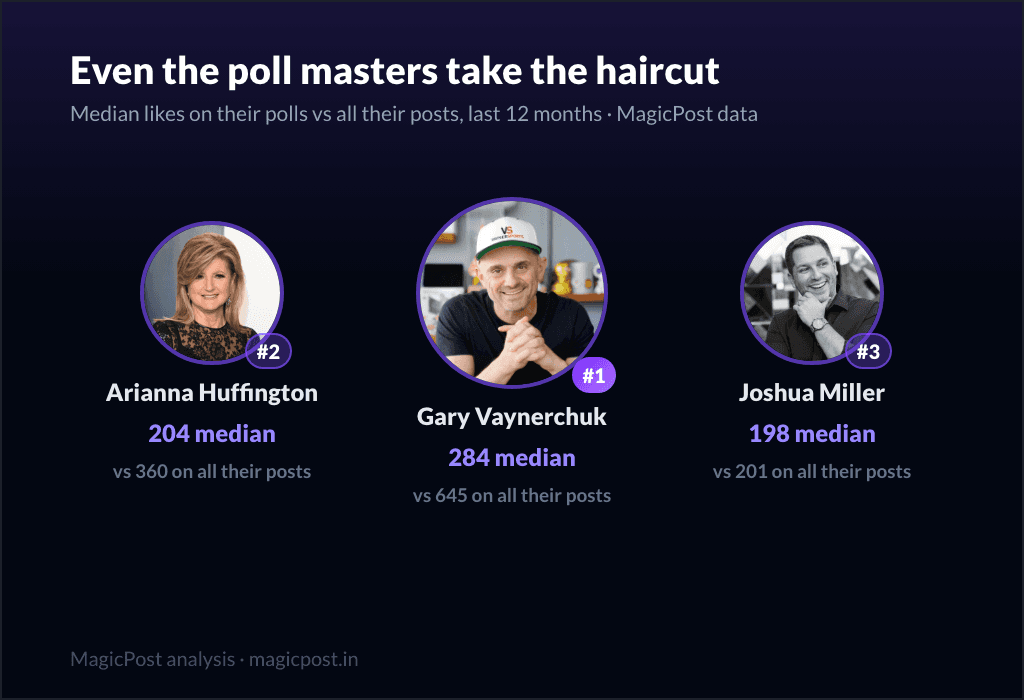
Créateur | Likes médians par sondage | Leur médiane globale | Sondages mesurés |
284 | 645 | 9 | |
Arianna Huffington | 204 | 360 | 26 |
Joshua Miller | 198 | 201 | 22 |
Gary Vaynerchuk est le meilleur performeur sur sondage que nous ayons mesuré : 284 likes médians par sondage. Impressionnant, jusqu'à ce qu'on voie qu'il obtient 645 sur l'ensemble de ses posts. Ses sondages font plus de deux fois moins bien que sa propre référence.
Arianna Huffington subit la même décote (204 sur les sondages contre 360 au global). La seule quasi-exception est Joshua Miller (198 contre 201), et il y parvient en traitant les sondages comme une véritable étude d'audience plutôt que comme du remplissage.
La leçon n'est pas « vous utilisez mal les sondages ». C'est que le format a un plafond qui s'applique même à ceux qui l'utilisent le mieux. Si un sondage coûte à Gary Vaynerchuk la moitié de son engagement, il vous coûtera au moins autant.
Si le sondage n'est pas la réponse, que publier à la place ? C'est la vraie question, et elle a une meilleure réponse que « au hasard ». Les idées de posts LinkedIn de MagicPost transforment vos sujets et votre audience en un flux régulier d'angles qui méritent d'être publiés, pour que votre portée serve à du contenu qui la convertit, et pas à un vote dont vous n'aviez pas besoin.
Alors, QUAND faut-il utiliser un sondage ?
Le sondage est un outil, pas une erreur. Sortez-le quand le vote lui-même est le but :
Étudier votre audience. Vous voulez réellement savoir ce qu'elle pense avant de construire quelque chose : une décision produit, un sujet pour la semaine prochaine, un format d'atelier. Le sondage médian vous donne 52 réponses exploitables, vite et gratuitement.
Une décision que vous suivrez vraiment. « Lequel de ces deux sujets dois-je traiter ensuite ? » fait un excellent sondage, parce que le résultat change ce que vous faites et que votre audience voit son vote compter.
Une touche d'engagement délibérée, de temps en temps. Un sondage touche plus de monde que votre post moyen, donc bien placé il peut vous remettre devant des abonnés endormis. À utiliser avec parcimonie : la portée est réelle, le retour en engagement ne l'est pas.
Et évitez-le quand :
Vous sortez un sondage parce que vous n'avez rien d'autre à publier. C'est le piège dont était faite la flambée de 2025, et la médiane (3 à 5 likes à l'époque) en est le reçu.
Vous posez une fausse question pour appâter l'engagement (« D'accord ? Votez oui. »). LinkedIn pousse les impressions, mais les lecteurs ont appris à passer leur chemin, et c'est exactement comme ça qu'un format finit vu sans être récompensé. (« Les sondages piègent l'algorithme » fait partie des croyances qui ne survivent pas aux données : les mythes LinkedIn à laisser tomber.)
Vous avez besoin que le post installe votre autorité ou circule. Pour ça, les formats visuels rapportent environ cinq fois plus d'engagement. Mettez le même effort dans une image ou un carrousel et l'écart est sans appel.
Le résumé en une ligne : un sondage est un questionnaire, pas un post. Jugez-le comme un questionnaire et il est bon. Jugez-le comme du contenu et il finit dernier.
D'où viennent ces données (méthodologie sondages)
Les chiffres présentés ici viennent de la recherche propriétaire de MagicPost. Les données de format et d'engagement proviennent du même corpus que notre étude pilier : les posts LinkedIn publiés sur les 12 derniers mois, repartages et posts exclus filtrés, posts supprimés retirés, regroupés par format et comparés sur l'engagement médian, jamais sur des moyennes, pour qu'une poignée de sondages viraux ne puisse pas déformer le tableau. L'engagement des sondages est mesuré sur 11 123 sondages. Les chiffres de portée viennent uniquement des posts dont les analytics sont synchronisés (6 209 sondages et 560 748 posts qui ne sont pas des sondages), agrégés et anonymisés. Les chiffres de votes viennent des 1 378 sondages pour lesquels le nombre de votes était disponible. L'historique couvre 2022 à mi-2026, avec des médianes calculées à l'intérieur de chaque année ; comme le corpus grandit avec le temps et que 2026 est une année partielle, les comparaisons d'une année à l'autre sont directionnelles par construction. Maîtres du sondage : au moins 6 sondages sur la période, plus de 5 000 abonnés, personnes uniquement. Ce que cela n'isole pas : les gens ne choisissent pas leur format au hasard, et beaucoup de sondages sont des posts bâclés publiés faute d'avoir autre chose à dire, donc une partie de l'écart reflète l'effort derrière le format, pas seulement le format lui-même. La section sur les maîtres du sondage corrige ce biais en comparant chaque créateur à sa propre référence. Les chiffres reflètent l'extraction de juin 2026 et bougent à mesure que le corpus se rafraîchit.
FAQ
Les sondages LinkedIn fonctionnent-ils ?
Plutôt non, si « fonctionner » veut dire engagement. Mesuré sur 11 123 sondages des 12 derniers mois, le sondage médian ne récolte que 6 likes, le plus bas de tous les formats LinkedIn (un post image ou carrousel en récolte 34). Les sondages sont bien plus vus que les autres posts (1 154 impressions médianes contre 760, sur les posts aux analytics synchronisés), mais cette portée ne se convertit presque en rien. La seule chose que les sondages font bien, c'est récolter des votes : le sondage médian en rassemble 52. Le sondage fonctionne donc comme outil gratuit d'étude d'audience, et échoue comme format de contenu.
Quel engagement obtient un sondage LinkedIn ?
Une médiane de 6 likes et 3 commentaires, sur 11 123 sondages publiés ces 12 derniers mois. Pour comparaison, les posts image et carrousel obtiennent 34 likes médians, la vidéo 33 et les posts texte seul 16. Le sondage finit dernier sur les likes parmi tous les formats que nous avons mesurés.
Les sondages obtiennent-ils plus de portée sur LinkedIn ?
Oui. Sur les posts aux analytics synchronisés (6 209 sondages et 560 748 posts qui ne sont pas des sondages), le sondage médian a touché 1 154 personnes contre 760 pour un post ordinaire, soit environ 50 % de plus. L'algorithme de LinkedIn distribue activement les sondages, mais ces impressions supplémentaires ne se transforment pas en engagement supplémentaire, ce qui vaut au format sa meilleure description : vu, pas récompensé.
Quand faut-il utiliser un sondage LinkedIn ?
Quand le vote lui-même est l'objectif : étudier votre audience, trancher une décision que vous suivrez vraiment, ou repasser ponctuellement devant des abonnés endormis. Le sondage médian récolte 52 votes, ce qui en fait un outil de questionnaire gratuit et efficace. Évitez le sondage comme contenu quotidien ou comme appât à engagement, parce que même les meilleurs subissent une forte décote : Gary Vaynerchuk obtient 284 likes médians par sondage contre 645 sur l'ensemble de ses posts.
Les sondages LinkedIn sont-ils en train de mourir ?
Le battage, oui. Les sondages ont bondi à 1,14 % de tous les posts en 2025 quand la foule des hacks d'engagement les a adoptés, avant de retomber à 0,54 % en 2026. Fait intéressant, le sondage médian a rapporté davantage en 2026 (9 likes) que pendant le boom (3 à 5), parce que les touristes bâcleurs sont partis et que ceux qui utilisent les sondages exprès sont restés. Le format n'est pas mort, il revient simplement à son vrai cas d'usage, étroit.
> Arrêtez de louer une portée que vous ne convertissez pas. MagicPost réunit la rédaction, la planification et les analytics de vos posts LinkedIn au même endroit, pour que chaque post mérite sa place dans le fil au lieu d'acheter des impressions qu'un sondage jette.