" height="26.80529977783203px" id="tymKb8bqC" width="128.00300311279295px"/><path d="M 0 2.417 L 0 0 L 12.909 0 L 12.909 2.417 Z" fill="rgb(126, 78, 253)" height="2.417099999999998px" id="aYr4em6zK" transform="translate(128.341 22.325)" width="12.908999999999992px"/></svg>)

"/><stop offset="1" stop-color="rgb(118, 37, 250)"/></linearGradient></defs><g d="M 19.242 21.22 L 19.362 6.204 L 19.272 6.204 L 13.757 21.22 L 10.161 21.22 L 4.796 6.204 L 4.706 6.204 L 4.825 21.22 L 0 21.22 L 0 0 L 7.283 0 L 12.109 13.607 L 12.229 13.607 L 16.844 0 L 24.247 0 L 24.247 21.22 Z M 26.421 26.113 L 26.421 23.445 L 41.407 23.445 L 41.407 26.113 Z" fill="transparent" height="26.112508199679183px" id="DvfaAIHYn" width="41.40731898311435px"><path d="M 19.242 21.22 L 19.362 6.204 L 19.272 6.204 L 13.757 21.22 L 10.161 21.22 L 4.796 6.204 L 4.706 6.204 L 4.825 21.22 L 0 21.22 L 0 0 L 7.283 0 L 12.109 13.607 L 12.229 13.607 L 16.844 0 L 24.247 0 L 24.247 21.22 Z" fill="rgb(46, 46, 46)" height="21.220180016149442px" id="pLsxRCobd" width="24.247352589074694px"/><path d="M 0 2.668 L 0 0 L 14.986 0 L 14.986 2.668 Z" fill="url(%23yD9d4I5GR-3279285344-linear-gradient)" height="2.6675085048549647px" id="yD9d4I5GR" transform="translate(26.421 23.445)" width="14.986002836263765px"/></g></svg>)

Naïlé Titah
The advice you read about LinkedIn says to be useful. Share your expertise. Teach something. So most people write posts that sound like a lightly edited slide deck, then wonder why the feed scrolls past them. The data says they have it backwards. The single best thing you can post on LinkedIn is not what you know. It is what you went through.
We measured this on the full corpus, comparing post types by their median engagement rate (likes divided by followers, taken as the median per type so a handful of viral posts cannot inflate the number). Two kinds of personal story sit at the very top. A post about a challenge you overcame earns a 1.03% median engagement rate. A post about a genuinely hard moment earns 0.80%. The platform median, across 1,141,932 posts, is 0.39%. Lived experience earns roughly two to two-and-a-half times what the average post does, while the polished, punchy advice everyone is told to write sits at 0.44%, barely above the floor.
That is the whole argument in three numbers. Now the harder part: vulnerability only works when it follows rules, and most "vulnerable" posts break every one of them.
TL;DR: Lived experience crushes expertise content: challenges overcome earn 1.03% median ER and hard moments 0.80%, vs the 0.39% platform median. Vulnerability has rules: stakes without self-pity, specificity without oversharing. 3 templates included.
The scoreboard: stories beat expertise
Here is where the three personal-story types land against the platform median:
Post type | Posts measured | Median engagement rate | Median likes | Median comments |
Challenges overcome | 16,823 | 1.03% | 51 | 14 |
Hard moment | 3,234 | 0.80% | 47 | 16 |
Personal reflection | 21,010 | 0.58% | 26 | 8 |
Platform median (all posts) | 1,141,932 | 0.39% | n/a | n/a |
Read the engagement-rate column first. A story about overcoming something is the strongest performer of any type we studied, at 1.03%, more than two and a half times the platform median. A raw hard-moment post lands at 0.80%, still double the median. Even a quiet personal reflection, the least dramatic of the three, beats the average post at 0.58%.
Now look at comments. The hard-moment post earns the most discussion of the three (16 median comments against only 47 likes), because pain invites people to respond rather than tap a button. These are conversations, not applause. (For how every post type ranks against each other, see our study on which LinkedIn post types actually drive engagement.)
Compare that with the type LinkedIn gurus push hardest. Punchy advice (the "here are 5 things I learned" format) was measured on 142,301 posts, the most-published type in our data, and earns a 0.44% median engagement rate. The most common post on LinkedIn is also one of the least rewarded. The crowd is writing the thing that does not work.



What the winning examples actually share
Numbers tell you stories win. The posts themselves tell you why. Here are three real ones, one per type.
A challenge overcome, with stakes you feel in the first line:
"<1% chance. And it happened to me. May 2025. I'm in a call, at my coworking space in Barcelona. My phone rings. A stem cell registry. \"You're a potential match for a patient.\" I cut my trip short and flew home. Two days after I landed, I went straight to the hospital to get my blood drawn." Nanda Dijkhuizen (8k followers), 6,302 likes. see the post
Note the follower count. Nanda has 8,000 followers and pulled 6,302 likes, an engagement rate most six-figure accounts never touch. The story did that, not the audience size.
A hard moment, told about someone else but landing on everyone:
"One of my friends got fired the day he returned from paternity leave. He just had his first kid and took 4 months off, which the company allowed. We talked just before he came back and he was so excited to be back at work. That morning, he logged into his laptop and saw a random meeting with HR for 9:15am." Tobi Oluwole (386k followers), 2,996 likes. see the post
There is no advice in that opening. No lesson yet. Just a specific scene with a clock on it (9:15am), and you already need to know what happens next.
A personal reflection, honest about the writer's own contradictions:
"I have friends who make $42,000 a year, work 9 to 4, but they’re pumped .. and they’ll text me about how happy they are to be the coach of their kids’ baseball team .. and that’s amazing! I’m actually weirdly envious But then I have friends who have $100M in the bank who are still hungry .. who want to do even more .." Gary Vaynerchuk (5.9M followers), 4,721 likes. see the post
What do these three share?
Stakes in the first line. "<1% chance." "got fired the day he returned from paternity leave." You know within one sentence what is at risk emotionally. The first line is the entire job. (More on that in our guide to LinkedIn hooks: the opening line carries the story or kills it.)
Specificity over summary. A coworking space in Barcelona. A 9:15am HR meeting. $42,000 a year. Concrete detail separates a story from a status update. Vague vulnerability ("it was a tough time") reads as a performance; a named time and place reads as true.
No moral hammer. None of these three open by telling you what to think. The lesson, if any, is earned by the end, not announced at the start.
That is the recipe. Stakes, specifics, restraint.
Want stories like these without the blank-page paralysis? MagicPost's AI LinkedIn post generator turns a rough memory, a half-formed idea, or a single sentence into a structured post that opens with stakes and lands the lesson, in your voice. You bring the experience. It handles the shape.
Three templates you can fill in tonight
Each of these maps to one of the three winning types. Fill the brackets with your own specifics. The structure is the craft; the truth is yours.
1. The turning point (maps to "challenges overcome", the 1.03% type)
[The improbable fact, stated cold]. And it happened to me.
[Date or moment]. I was [exact place, doing exact thing] when [the thing that changed everything].
At first, [your honest first reaction, even if it was not heroic].
So I [the decision or the small first step].
[What it cost, or what it took].
[Where you are now, in one plain line. No "and the lesson is".]
2. The failure that taught you something (maps to "hard moment", the 0.80% type)
[The hard event, in one specific sentence with a real detail].
[One line of context: who was involved, what was at stake].
[The scene, told slowly. Let the reader sit in it.]
I kept thinking [the thought you could not shake].
What I know now that I did not know then: [the earned lesson, stated once, quietly].
3. The quiet reflection (maps to "personal reflection", the 0.58% type)
[An honest contradiction you carry]. I think about it more than I admit.
I have [people / experiences of one kind] who [do or feel one way].
And I have [people / experiences of the opposite kind] who [do or feel the other way].
[What the contrast reveals, without resolving it neatly].
Maybe [the open question you are actually sitting with].
Not sure which of your own stories is worth telling? Our LinkedIn post ideas tool turns your background and audience into a steady list of angles, including the lived-experience ones most people forget they have.
The mistakes that turn vulnerability into a liability
Stories win, but a badly told one does more damage than no post at all. Three traps come up again and again.
Trauma-dumping. A hard moment works because it is shaped: a scene, a turn, a point where the reader exhales. Raw pain with no shape is not a story, it is a burden handed to strangers. The test is simple. Are you posting because the reader gets something, or because you need to say it? If it is the second, write it in a journal. The 0.80% engagement rate on hard-moment posts comes from the crafted ones, not from the ones that bled.
Humble-bragging. "I was so nervous before my keynote to 5,000 people." "I almost turned down the seven-figure offer." This is the fake-vulnerability arc everyone now recognizes: a tiny, flattering wound wrapped around a flex. Readers spot it instantly. Real stakes mean you might actually look bad. If your "vulnerable" post makes you look better than before you posted it, it is not vulnerable.
The manufactured arc. Struggle, single tear, neat lesson, call to action. The internet has read this exact shape ten thousand times, and AI-assisted writing has made it more uniform and easier to detect. (We dug into how detectable the formula has become in our piece on the state of AI writing on LinkedIn.) The fix is the one the winning examples used: keep the detail only you would know, cut the moral anyone could have written.
The line to hold: stakes without self-pity, specificity without oversharing, an earned lesson without a moral hammer. Get those three right and your story sits in the 1% engagement-rate territory. Get them wrong and it sits below the 0.39% floor with the punchy-advice crowd.
For where personal stories fit alongside everything else worth publishing, see our broader guide on what to post on LinkedIn and the full LinkedIn post templates library.
Where the data and examples come from
Everything on this page is MagicPost's own research. Engagement rate is likes divided by the author's follower count, reported as the median per post type (never the average) so a handful of viral posts cannot distort the picture. The three personal-story types were measured on their full populations: 16,823 challenges-overcome posts, 3,234 hard-moment posts, and 21,010 personal-reflection posts. The platform median (0.39%) is taken across 1,141,932 posts, and the punchy-advice comparison (0.44%) across 142,301. Reshares, excluded, and deleted posts are filtered out. The example quotes are verbatim excerpts from real published posts, truncated at sentence boundaries, attributed with name, rounded follower count, and like count at capture; follow each "see the post" link for the original. Figures dated June 2026.
FAQ
Do personal stories work on LinkedIn?
Yes, better than almost anything else. Measured across the full corpus, posts about a challenge you overcame earn a 1.03% median engagement rate and posts about a genuinely hard moment earn 0.80%, against a platform median of 0.39% (the median taken across 1,141,932 posts). That is roughly two to two-and-a-half times the typical post. Even a quiet personal reflection earns 0.58%, still well above the median, while the "punchy advice" format most people are told to write sits at just 0.44%. Lived experience beats polished expertise on LinkedIn, and the gap is not close.
What makes a personal story post perform well?
Three things, drawn from the posts that actually won. First, stakes in the first line: the reader should know within one sentence what is at risk emotionally. Second, specificity over summary, a named time, place, or number ("9:15am", "<1% chance", "$42,000 a year") instead of vague phrases like "a tough time". Third, restraint, no moral announced at the top and no lesson hammered at the end. The story earns its point or it does not need one.
How is this different from a "lessons learned" post?
A lessons-learned post leads with the lesson and uses the story as evidence. A personal story does the opposite: it leads with the scene and lets the lesson stay quiet, or leaves it out entirely. That difference matters in the data. Story-first types (challenges overcome at 1.03%, hard moments at 0.80%) outperform the more didactic, advice-forward formats, which cluster nearer the 0.39% to 0.44% range. People come for the story and stay for the meaning, not the other way around.
How often should I post personal stories?
One strong personal story a week is a healthy rhythm, surrounded by lighter formats so every post is not a saga. The point is not volume, it is that your highest-engagement posts should be the ones only you could write. For a full content mix, see our what to post on LinkedIn guide.
> Turn your experience into a feed that performs. With MagicPost you can write, schedule and analyze all your LinkedIn content in one place, so the stories only you can tell reach the people who need to hear them, on a rhythm you can actually keep.
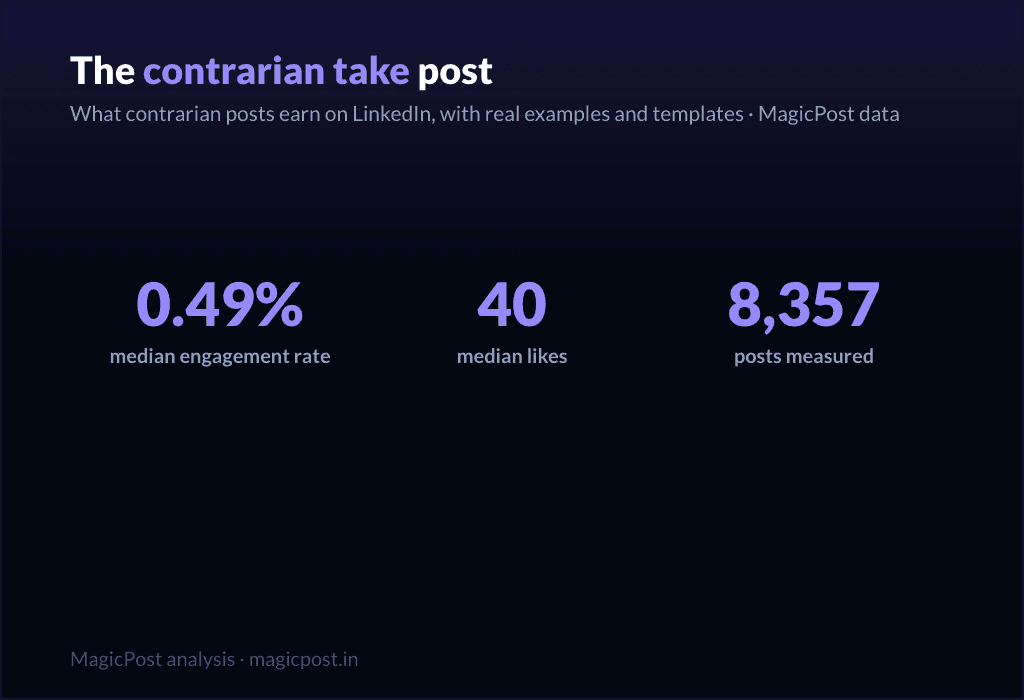
The Contrarian LinkedIn Post: What Provocation Actually Earns (Spoiler: Less Than You Think)
The contrarian LinkedIn post, measured: 0.49% median ER. Better than average, far below sincerity. What separates real takes from rage-bait.
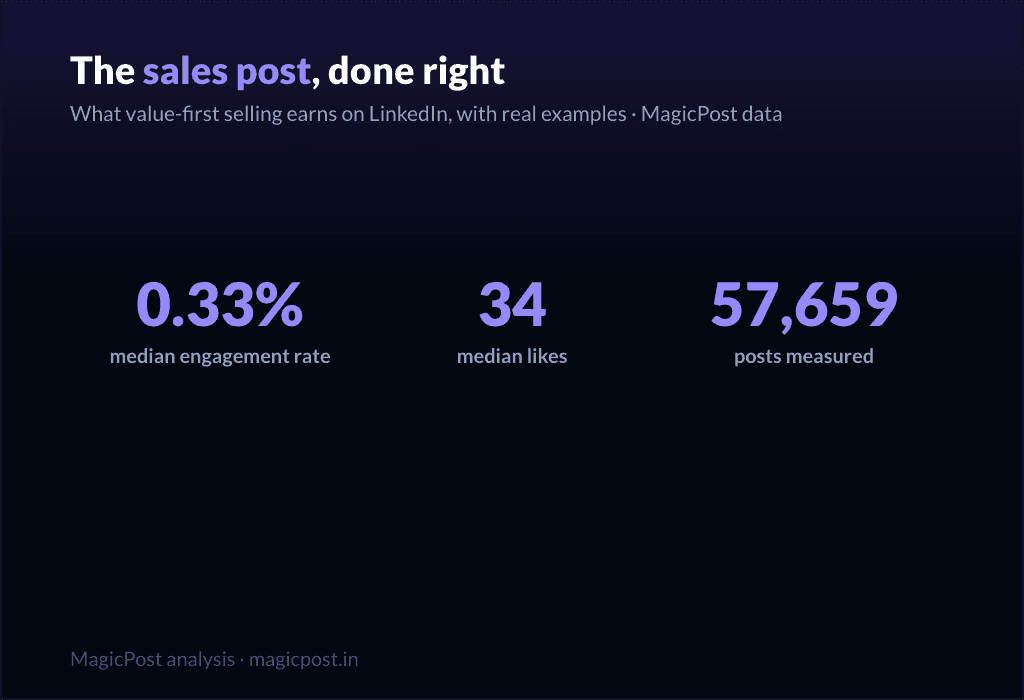
LinkedIn Sales Post Examples: Why Selling Posts Underperform (and the Ones That Work Anyway)
LinkedIn sales post examples: even value-first selling earns 0.33% median ER, below the 0.39% platform median. The ones that work anyway.
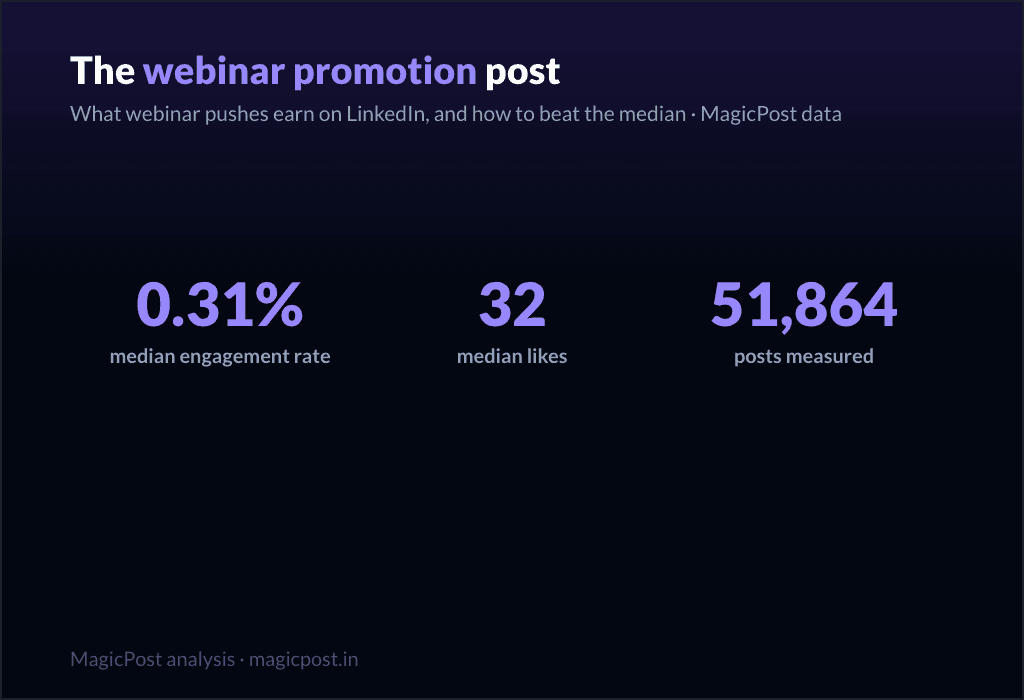
How to Promote a Webinar on LinkedIn (the Standard Signup Post Is the Second-Worst Post Type)
How to promote a webinar on LinkedIn: the standard signup post is the second-worst post type (0.31% ER). The teach-first structure that beats it.
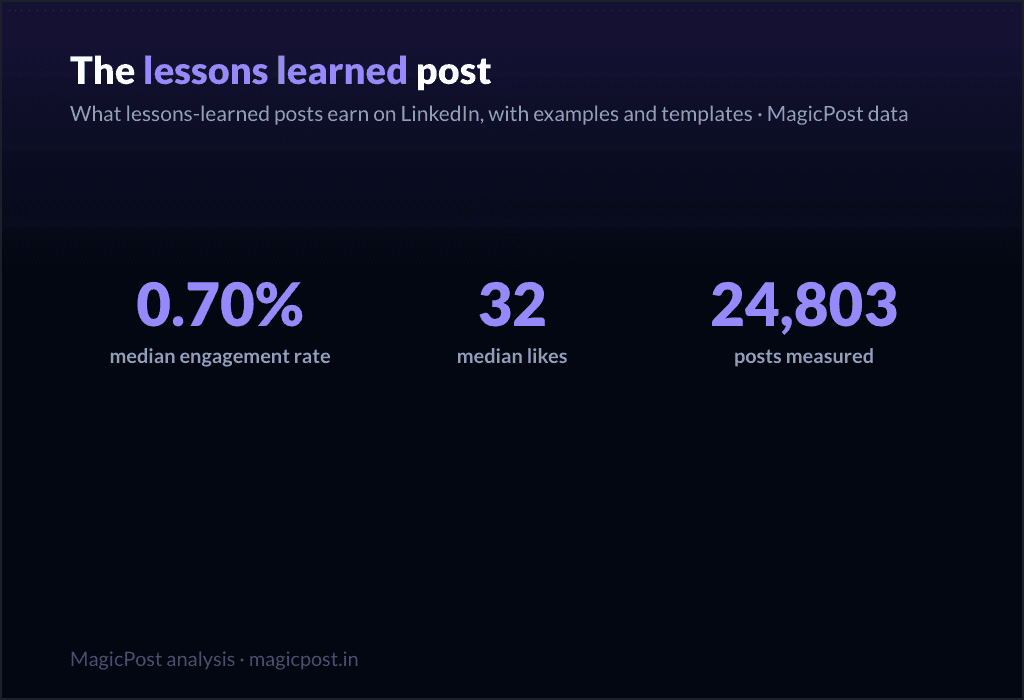
The Lessons Learned LinkedIn Post: Why Earned Advice Beats Expert Advice (0.70% vs 0.44%)
The lessons learned LinkedIn post: earned advice (0.70% ER) beats expert advice (0.44%). The difference is the receipt. Examples and templates.
The Last Day LinkedIn Post: How to Say Goodbye Well (Real Examples + Templates)
The last day LinkedIn post: how to say goodbye well. Real examples (one earned 13,121 likes), 3 templates, and the etiquette of leaving in public.

The Graduation LinkedIn Post: Real Examples, Templates, and How to Make Yours Count
The graduation LinkedIn post: real examples (up to 19,038 likes), 3 templates, and how to make your first professional post count.

The Work Anniversary LinkedIn Post: Beyond the Auto-Generated Badge (Examples + Templates)
The work anniversary LinkedIn post: beyond the auto-badge. Real examples, 3 templates, and the reframe that turns a date into a story.
The Holiday LinkedIn Post: How to Not Sound Like a Corporate Card (Examples + Templates)
The holiday LinkedIn post: how to not sound like a corporate card. Real examples, 3 templates, and why seasonal posts should be scheduled early.
5 Meilleures Modèles de Publications LinkedIn (2026)
5 modèles de publications LinkedIn : narration, liste, réflexion personnelle, coup de gueule et analyse. Guides étape par étape pour créer des publications engageantes et augmenter la visibilité.
13 exemples de publications LinkedIn qui génèrent des résultats (2026)
Voler ces 13 exemples de publications LinkedIn éprouvés pour transformer votre contenu en prospects et en autorité. Comprend des modèles et une déconstruction complète de ce qui fonctionne.