" height="26.80529977783203px" id="tymKb8bqC" width="128.00300311279295px"/><path d="M 0 2.417 L 0 0 L 12.909 0 L 12.909 2.417 Z" fill="rgb(126, 78, 253)" height="2.417099999999998px" id="aYr4em6zK" transform="translate(128.341 22.325)" width="12.908999999999992px"/></svg>)

"/><stop offset="1" stop-color="rgb(118, 37, 250)"/></linearGradient></defs><g d="M 19.242 21.22 L 19.362 6.204 L 19.272 6.204 L 13.757 21.22 L 10.161 21.22 L 4.796 6.204 L 4.706 6.204 L 4.825 21.22 L 0 21.22 L 0 0 L 7.283 0 L 12.109 13.607 L 12.229 13.607 L 16.844 0 L 24.247 0 L 24.247 21.22 Z M 26.421 26.113 L 26.421 23.445 L 41.407 23.445 L 41.407 26.113 Z" fill="transparent" height="26.112508199679183px" id="DvfaAIHYn" width="41.40731898311435px"><path d="M 19.242 21.22 L 19.362 6.204 L 19.272 6.204 L 13.757 21.22 L 10.161 21.22 L 4.796 6.204 L 4.706 6.204 L 4.825 21.22 L 0 21.22 L 0 0 L 7.283 0 L 12.109 13.607 L 12.229 13.607 L 16.844 0 L 24.247 0 L 24.247 21.22 Z" fill="rgb(46, 46, 46)" height="21.220180016149442px" id="pLsxRCobd" width="24.247352589074694px"/><path d="M 0 2.668 L 0 0 L 14.986 0 L 14.986 2.668 Z" fill="url(%23yD9d4I5GR-3279285344-linear-gradient)" height="2.6675085048549647px" id="yD9d4I5GR" transform="translate(26.421 23.445)" width="14.986002836263765px"/></g></svg>)

Naïlé Titah
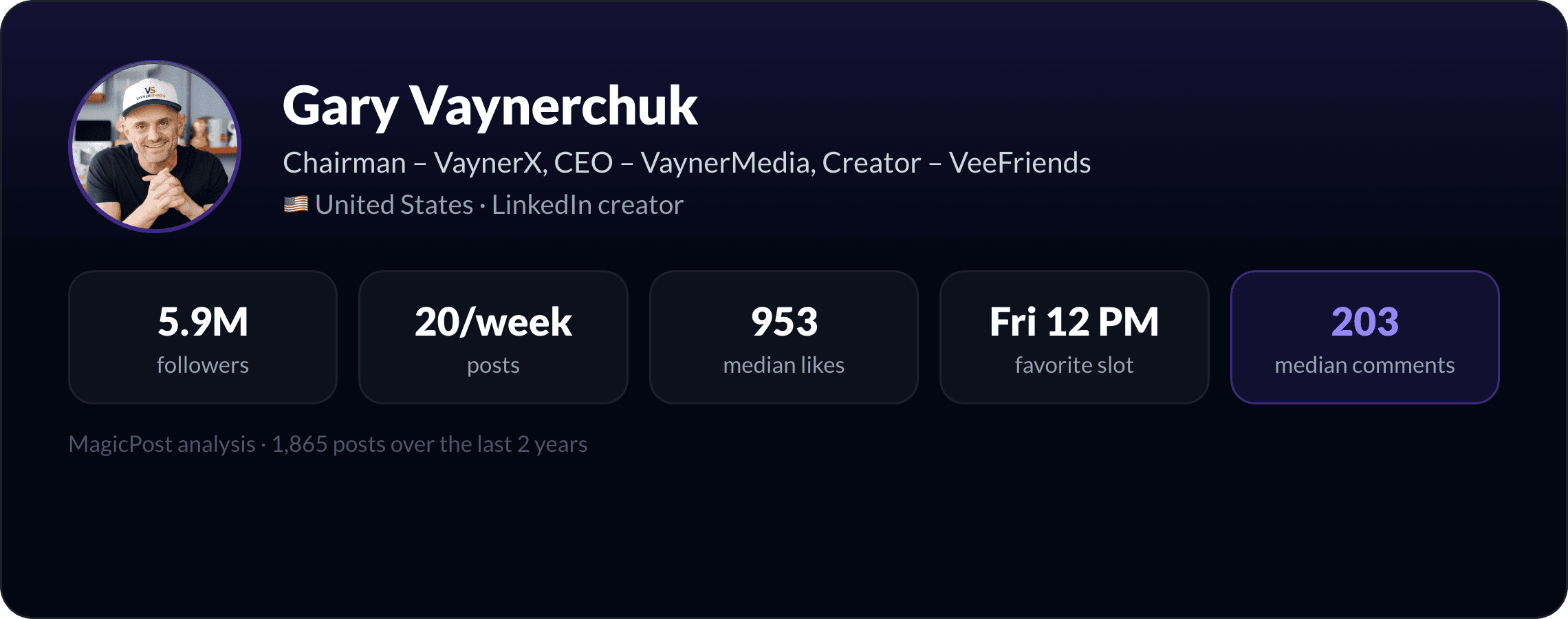
Gary Vaynerchuk has almost 5.9 million LinkedIn followers, by far the largest account we track. With a number that big, you would expect a machine cranking out hustle slogans. The data says something gentler: of his most personal, introspective posts, the single idea he returns to most is not money or grind. It is kindness, written and rewritten so many times it has become a franchise.
At MagicPost, we analyzed 1,865 of his LinkedIn posts: what he writes, when, for whom, and what makes his style worth studying. This is who Gary Vaynerchuk is, according to the best possible source: his own posts, measured.
His story, in his own posts
We hold no outside biography of him here, and we do not need one. He tells his own story on LinkedIn, and the data shows which chapters he keeps coming back to.
The wine table. His origin scene is a 2007 photo he reposts as proof of the slow climb. "Picture of my brother AJ and I when we would go to tech conferences and be the 'help' and serve wine at events," he writes. "From behind the table, we would promote my new wine show on this thing called YouTube."
The mistake he never hid. He frames one of his worst calls as a teaching tool: "One of my biggest career mistakes was moving Wine Library TV from YouTube to Viddler," he admits. "I could have had millions more subscribers had I stayed on YouTube... It's so fun to be a marathon runner in a world full of sprinters."
The report card on the wall. "I have my report card framed in my office and I make sure everybody sees it. D's.. Fs .. worst in class," he writes. "Because once people see 'success,' they don't see the sh*t beforehand."
The plan, still running. In a 2025 post he draws a straight line across 35 years: "1990 me had a plan ... 2025 me is executing it," attached to the kindness manifesto we will get to in a moment.
One detail our data surfaces that a normal bio never would: his most personal idea is not a post, it is a franchise. Across his introspective writing, the line "I want to build big businesses and buy the Jets, but I want to do it by being a good guy" appears in at least six near-identical kindness essays, reshipped from 2024 into 2026, pulling thousands of likes every time. His "shortcuts just don't exist" patience piece got the same treatment. The lesson is itself very GaryVee: when a message matters, you do not retire it, you repeat it until it lands.



What he actually talks about
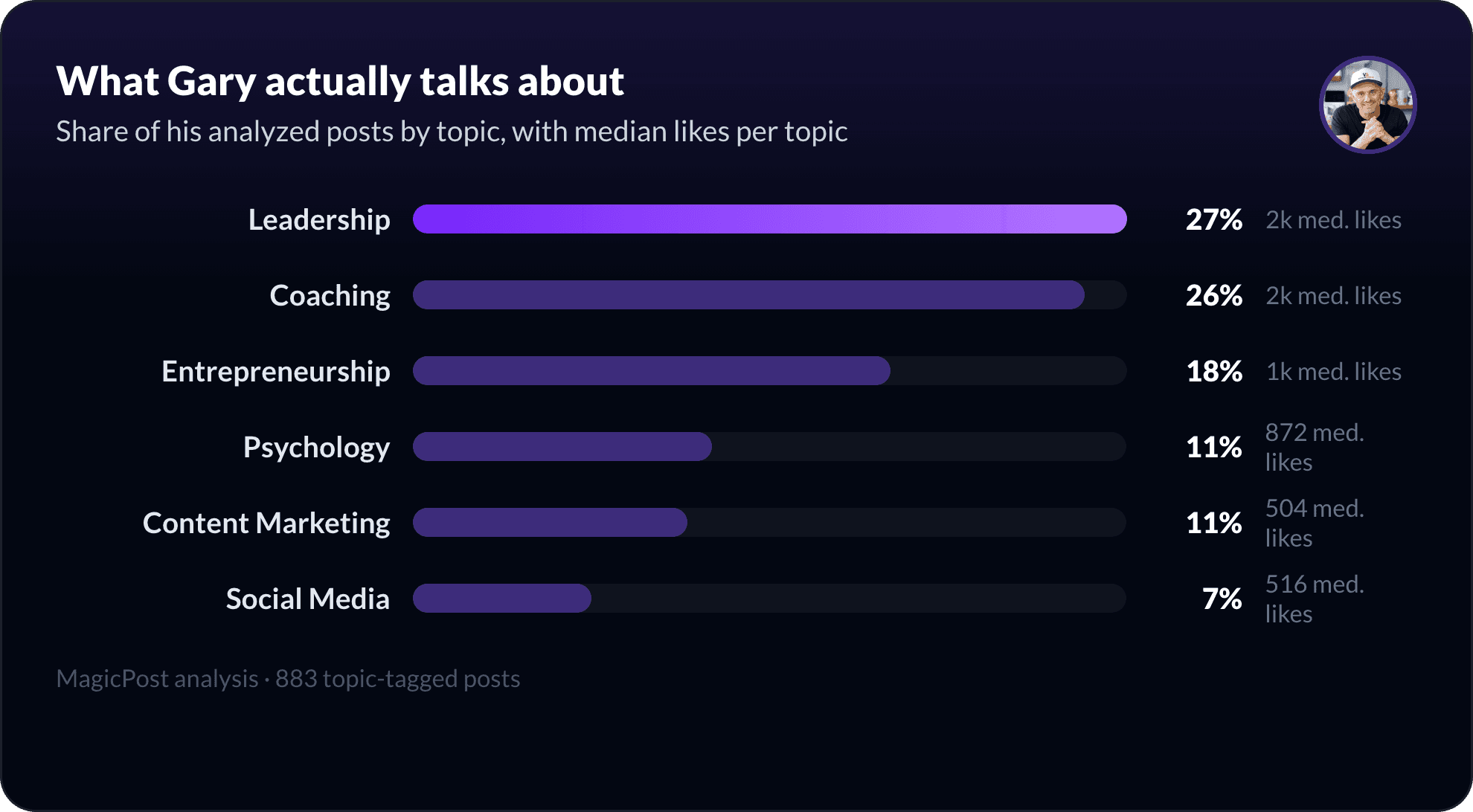
You might expect marketing and social media at the top from the founder of a media company. They are near the bottom. Leadership and Coaching dominate his feed, with Entrepreneurship and Psychology close behind. Two numbers are more interesting than the ranking:
His softest topics out-perform his business ones. Wellness posts pull a median around 2,783 likes and Coaching around 2,246, both far above his Content Marketing (about 504) and Social Media (about 516). When he talks about how to live rather than how to market, his audience leans in hardest.
Sorted by register rather than topic, well over half his analyzed posts are punchy standalone advice, with a large block of straight positive-message posts and a smaller seam of personal reflection. He sells far less than you would guess: the man caricatured as "always selling" mostly hands out conviction for free.
Who he writes for
His reader is the ambitious person who is quietly miserable about it. He writes to two extremes at once and tells them the same thing. "I have friends who make $42,000 a year, work 9 to 4, but they're pumped," he writes, "but then I have friends who have $100M in the bank who are still hungry... and yet they'll complain to me about 'no work-life balance.'" His verdict to both: "There's no 'right' way.. YOU decide your work-life balance." He ends on instructions, not questions: "waking up smiling is everything... fight for it."
His best posts of 2026
His biggest posts of 2026 so far, reproduced from our data (click through to the originals):
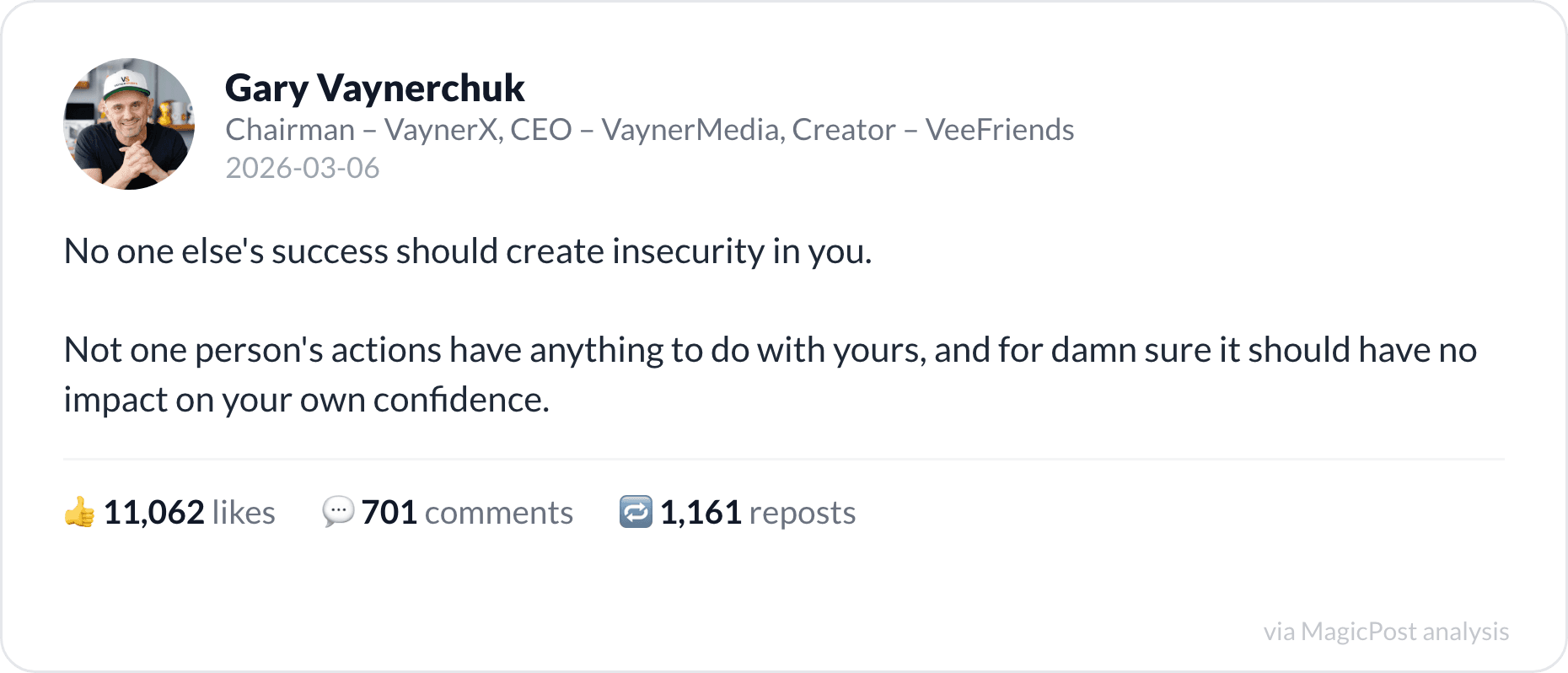
11,062 likes. Three sentences, no product, no hashtag: "No one else's success should create insecurity in you." It is short enough to screenshot and aimed straight at the reader's anxiety, the emotional engine of his whole feed.
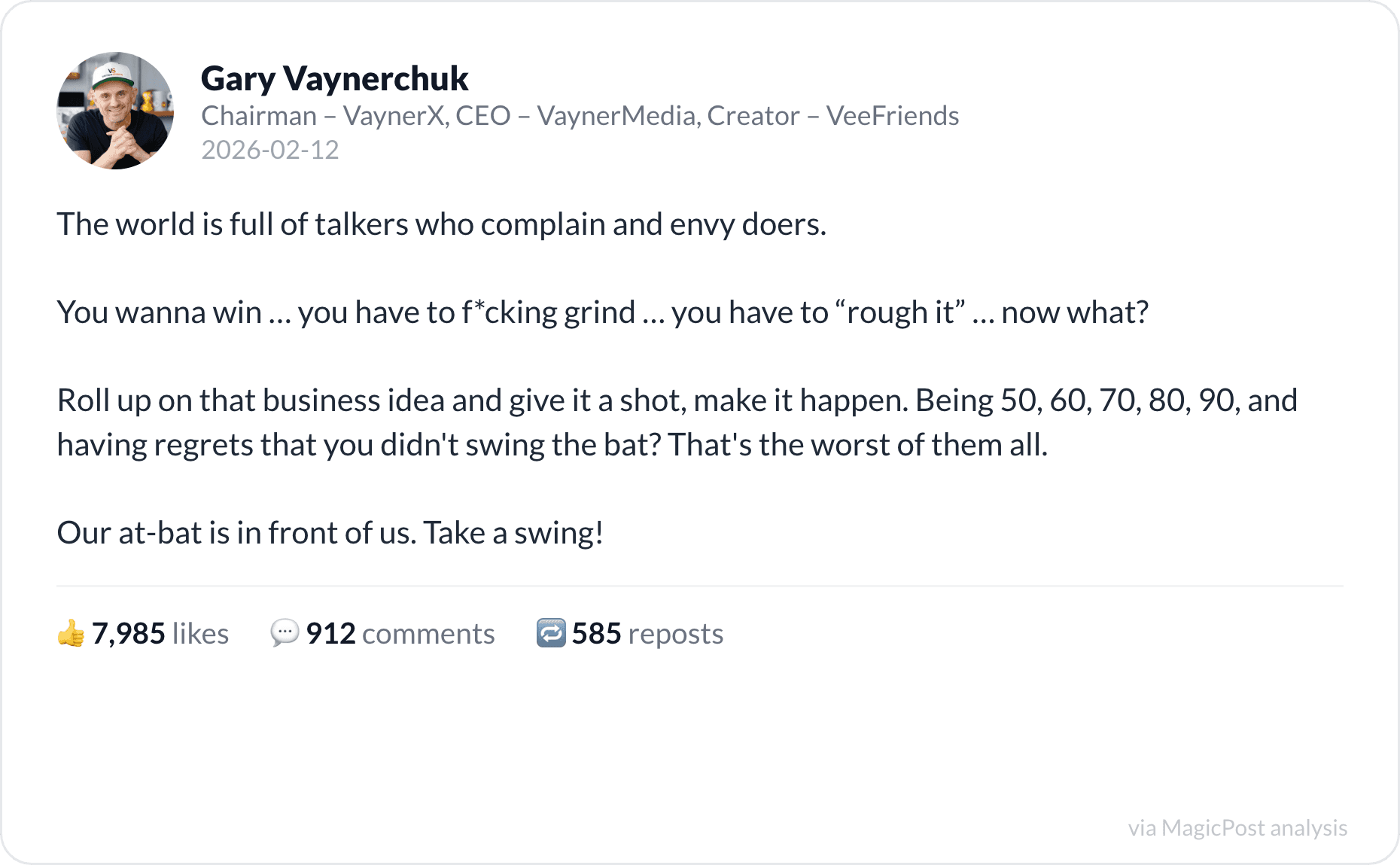
7,985 likes. The classic GaryVee cadence: "The world is full of talkers who complain and envy doers." He stacks the fear of late-life regret ("Being 50, 60, 70, 80, 90, and having regrets that you didn't swing the bat? That's the worst of them all") and lands on a baseball image.
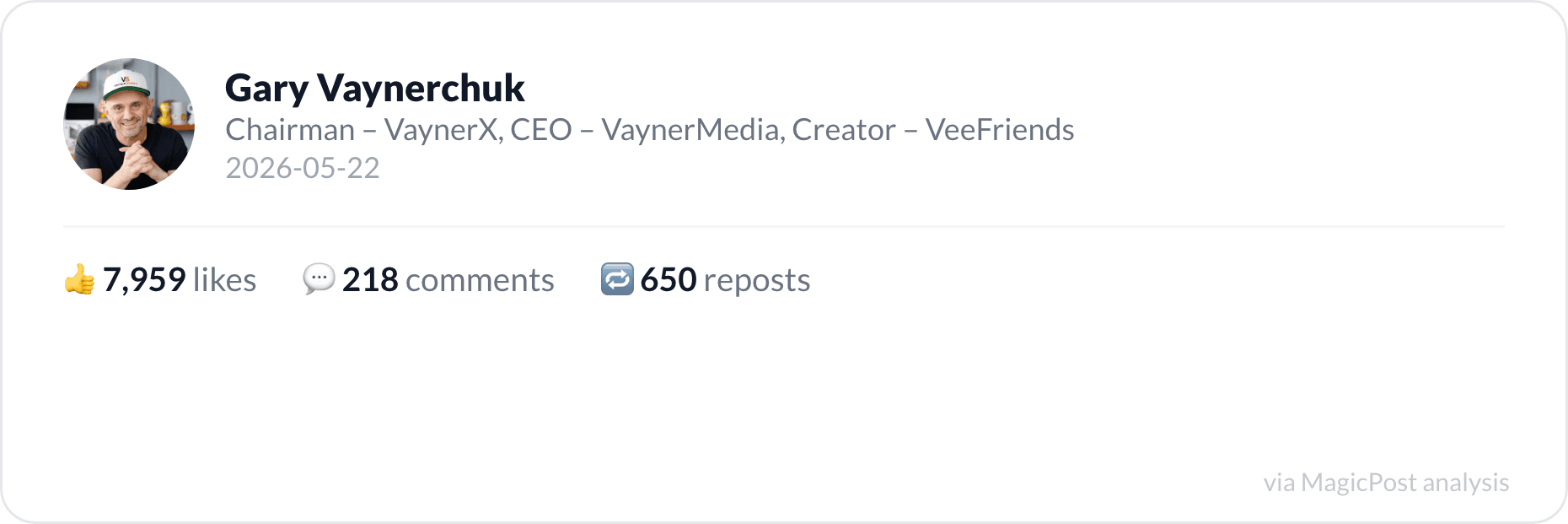
7,959 likes. His third-biggest post of the year carried no caption text at all (it ran on the video alone) and still cleared 650 reposts. The audience shows up for the message even when there are no words to read.
Is he still growing?
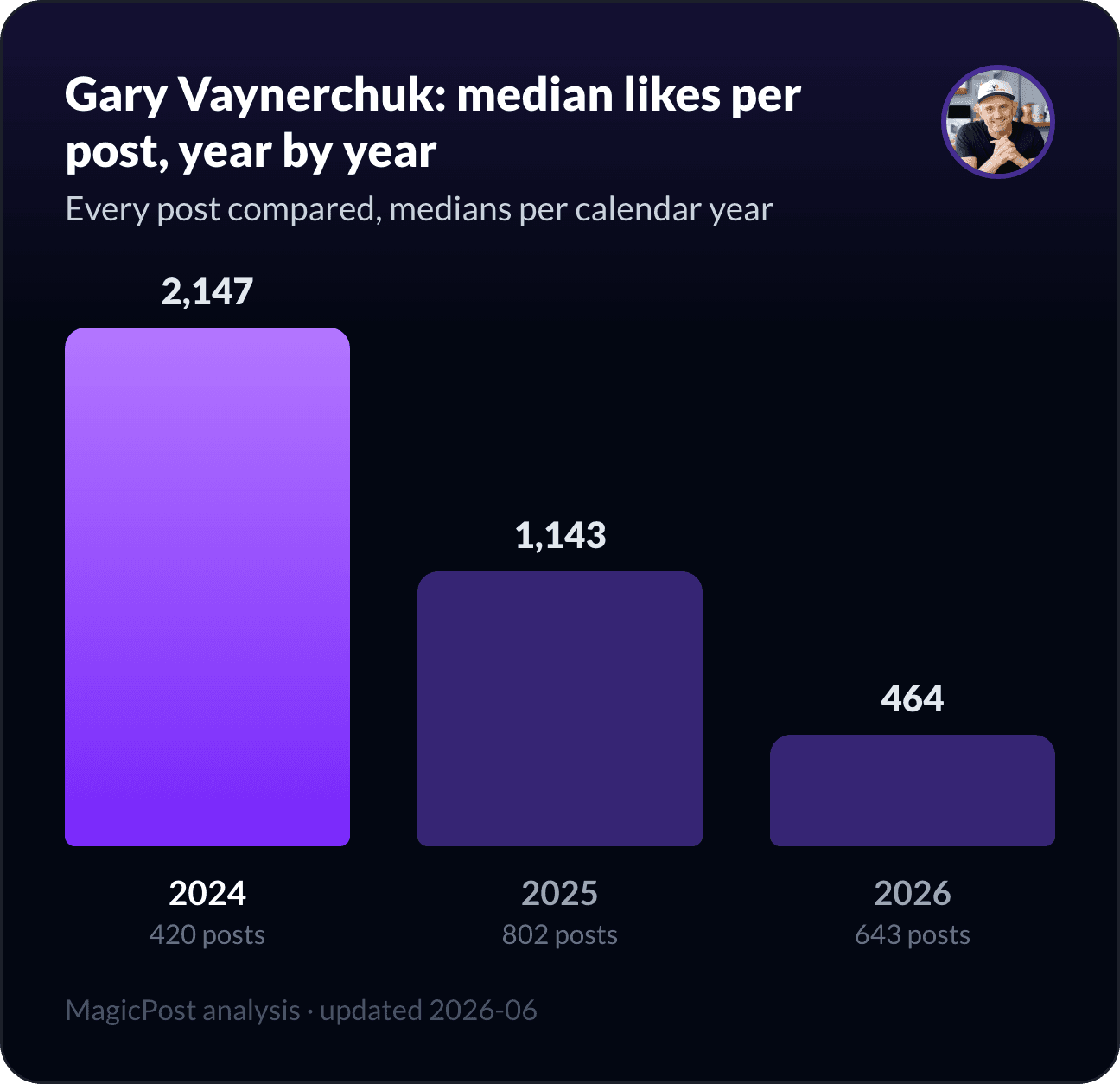
Here is the honest chart, and it goes the other way. His median post fell from about 2,147 likes in 2024 to 1,143 in 2025 to 464 in 2026, even as his volume stayed enormous. For perspective, his all-time biggest post, the "zero expectations" reflection from September 2024, did 115,284 likes. Nothing in 2026 came within a tenth of it.
Two honest caveats. First, we measure engagement per post, not follower count over time, so this is the story of how hard each post hits, not of his audience size, still close to 5.9 million. Second, this declining-likes shape is the most common one we see across big LinkedIn accounts since 2024, as the platform spreads attention thinner: it is the platform's curve as much as anyone's, and at 464 median likes he still out-engages most creators outright.
Where do these charts come from? Everything on this page runs on MagicPost's LinkedIn analytics, and it works on your profile too: your best posts, your audience, your benchmark, even a side-by-side with creators like him.
How he writes
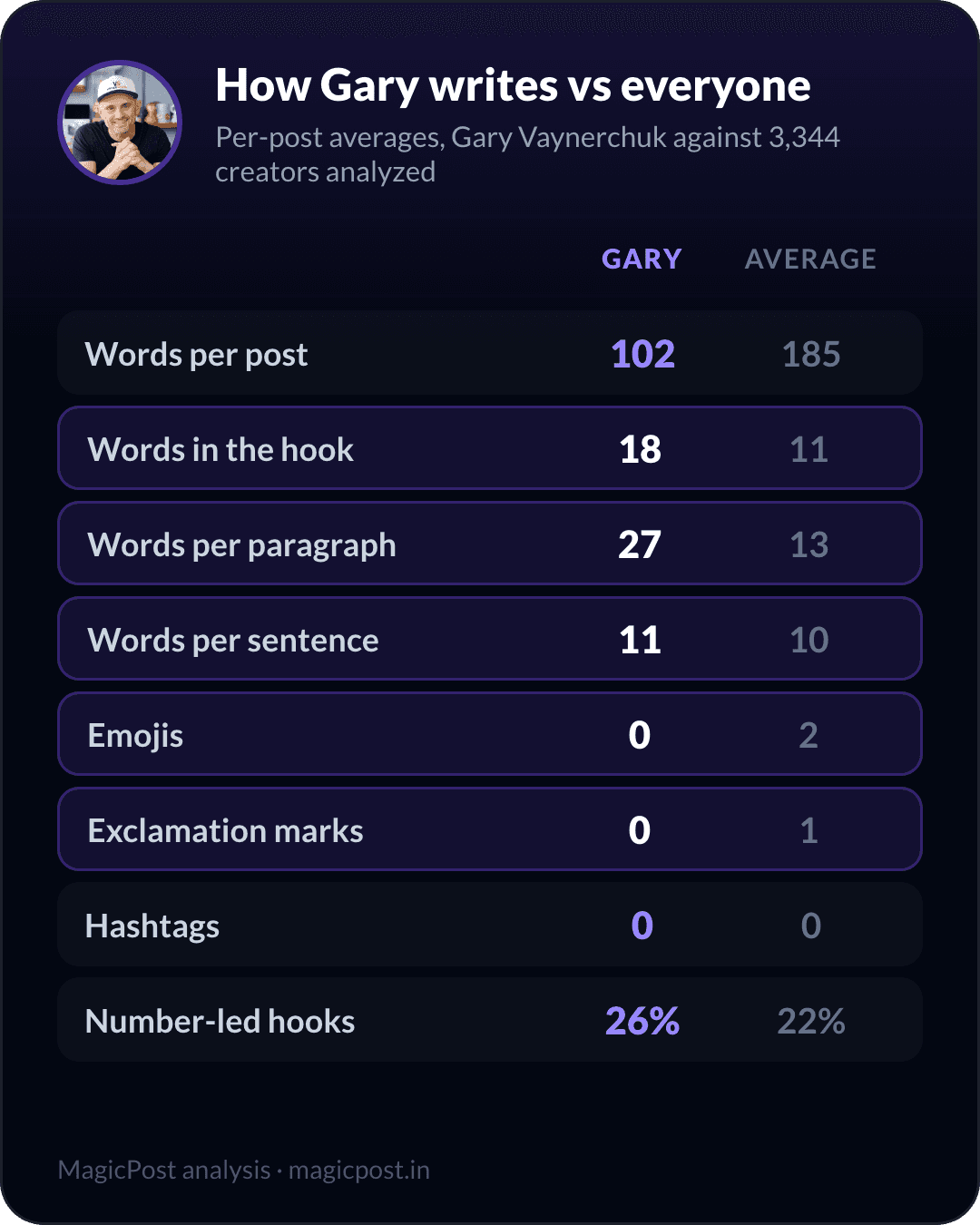
Here is Gary Vaynerchuk measured against the average creator, and the headline is not "short."
Metric (per post) | Gary Vaynerchuk | Average creator* |
Words | ~102 | 185 |
Words in the hook | 18 | 11 |
Words per paragraph | 27 | 13 |
Words per sentence | 11 | 10 |
Emojis | 0 | 2 |
Exclamation marks | 0 | 1 |
Hashtags | 0 | 0 |
Hooks built on numbers | 26% | 22% |
*Median across the 3,344 creators we analyzed with 20+ posts each.
He writes about half as many words as the average creator (102 versus 185), so on volume he reads short. But look at the shape: his typical paragraph runs 27 words, more than double the 13-word norm, and his opening line is 18 words against the usual 11. That is the opposite of the white-space, one-line-per-paragraph style most LinkedIn advice preaches. He thinks out loud in long, breathless paragraphs stitched together with ellipses, then keeps the whole thing short. And the zeros are real: no hashtags, no bold, no exclamation marks, and essentially no emojis in the prose (when emotion overflows he reaches for hearts at the very end). When our system describes his style in one word, it says: bold.
The "AI tells" in his style (read this the right way)
Run his writing through the patterns people now call "AI tells," and the fingerprint is unusually clean.
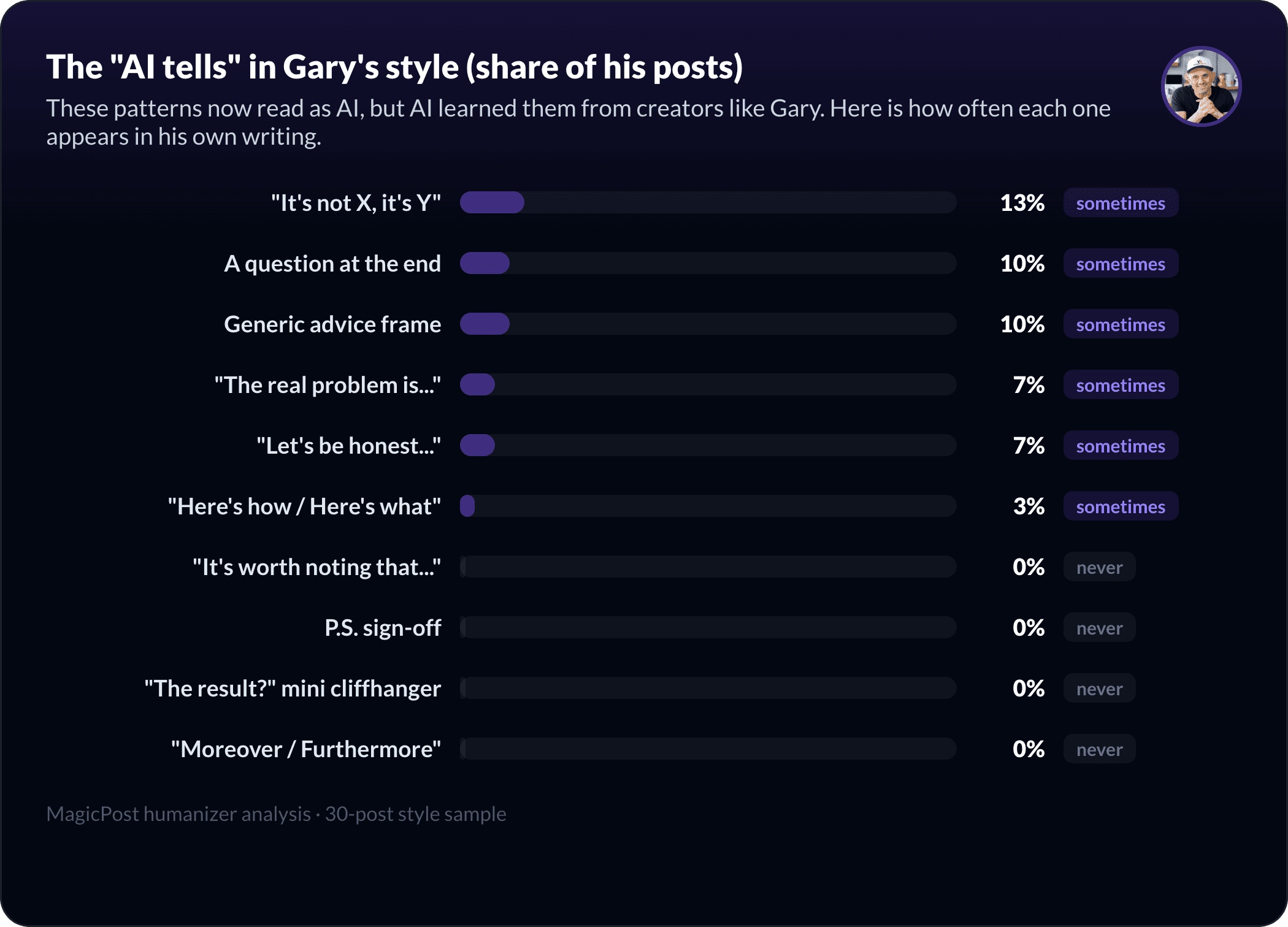
About one post in eight uses the "It's not X, it's Y" contrast formula ("It's not a cynical point of view... it's a very optimistic point of view"), the single most flagged "AI" pattern on LinkedIn. A tenth lean on a generic advice frame or a closing question. The rest barely registers.
Do not read it backwards. Gary Vaynerchuk does not write like an AI; AI writes like him. These moves read robotic today because the models trained on the best creators of this platform and then bolted every device on at once, in every post. He uses the contrast formula occasionally, where it earns its place. The rest of his fingerprint is what AI cannot resist adding and he refuses to: he never hedges with "it's worth noting," never opens with a stiff "Moreover," never bolts on an automatic "P.S." His writing reads human because it is messy, lowercase, profane and a little repetitive, everything a model sands off. (Full story: how to spot AI writing on LinkedIn.)
When he posts
Gary Vaynerchuk publishes about 20 posts a week, his favorite slot is noon US Eastern, and his most frequent day is Friday, with 23% of posts on weekends. The midday slot is a deliberate signature, not the early-morning window our US timing data flags as the safe default, and his cadence sits at the top of what our posting-frequency study measured. Do not try to start at 20 a week: that volume is the output of a media company built around one person. And if part of your playbook is showing up in his comments, that is what an engagement feed is for: his posts, every day, without hunting the timeline.
What to steal from Gary Vaynerchuk
Repeat your core message until it sticks. His kindness essay ran at least six times across two years and earned thousands of likes each time. One conviction, restated, beats ten clever one-offs.
Lead with the soft topic. His wellness and coaching posts out-engage his marketing posts by a wide margin. "How to live" can out-pull "how to work," even for a marketer.
Frame your worst mistake as the lesson. The Viddler call and the framed report card both turn failure into proof of the long game.
Write the way you talk. Long messy paragraphs, lowercase, ellipses, no formatting tricks. The lack of polish is what reads human in an AI era.
One strong move per post, not six. The contrast formula in roughly one post in eight, never stacked with every other trick: the difference between a signature and an AI tell.
Study him, then study yourself. With MagicPost you can dig into Gary Vaynerchuk's numbers the way we just did, analyze your own with the same depth, and write in the spirit of his style, in your own voice. The data on this page is the product.
Where this data comes from
Everything in this article is MagicPost's own research. MagicPost analyzed 1,865 Gary Vaynerchuk posts: timing, engagement, topics, writing metrics, and the AI-pattern profile from a 30-post style sample. Every biographical claim is quoted from one of his own public LinkedIn posts and linked to it; we hold no outside biography and make none up. Gary Vaynerchuk is not affiliated with MagicPost; his is one of the styles we track most closely, which is why we built this page.
FAQ
Who is Gary Vaynerchuk?
By his LinkedIn headline, the Chairman of VaynerX, CEO of VaynerMedia, and creator of VeeFriends, with close to 5.9 million followers. In his own posts he describes himself as the kid promoting "my new wine show on this thing called YouTube" in 2007, and who was "worst in class" at school.
How does Gary Vaynerchuk make money?
His posts here are about mindset rather than his finances, so we will not guess. His LinkedIn headline identifies him as Chairman of VaynerX, CEO of VaynerMedia and creator of VeeFriends, and he references "build[ing] big businesses."
How often does Gary Vaynerchuk post on LinkedIn?
About 20 posts a week in our data, most often at noon US Eastern, with Friday his most frequent day and 23% of posts on weekends.
Does Gary Vaynerchuk write with AI?
His writing is messy, lowercase and human, with one of the cleaner "AI tell" fingerprints we measure: no hedging, no stiff transitions, no automatic sign-offs. The twist is that AI tools learned from creators like him, which is why about one post in eight contains the "It's not X, it's Y" pattern people now mislabel as an AI tell.
Is Gary Vaynerchuk still growing on LinkedIn?
His follower count is near 5.9 million, but his median likes per post have fallen each year (about 2,147 in 2024, 1,143 in 2025, 464 in 2026), the same reach-compression shape we see across most large LinkedIn accounts since 2024. We measure engagement per post, not followers over time.
Can I write like Gary Vaynerchuk?
You can learn the mechanics: MagicPost learns a creator's writing style (length, rhythm, hooks, signature moves) and helps you write in that spirit, in your voice.
The Top LinkedIn Creators to Study in 2026 (By the Data)
The top LinkedIn creators to study in 2026, by the data: 62 creators, six languages, 27 countries, 32,000 posts analyzed by MagicPost. Grouped by what they teach.
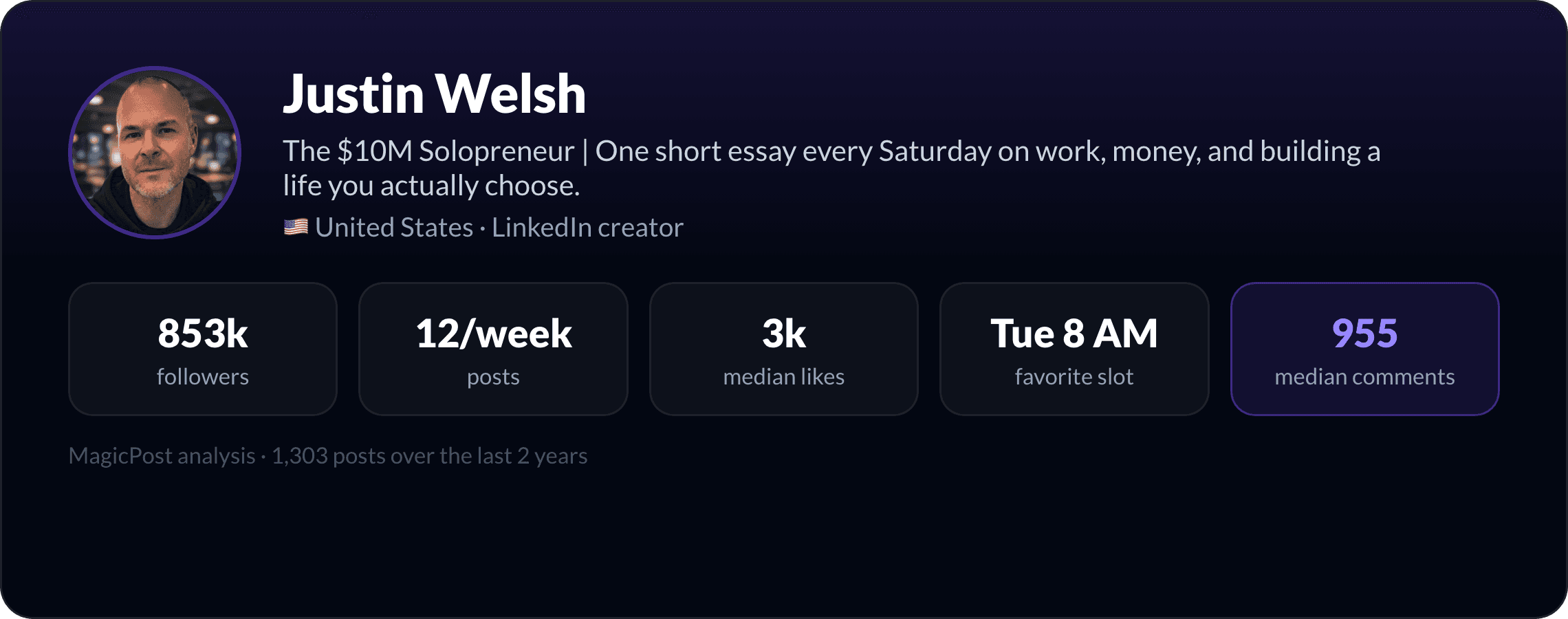
Who Is Justin Welsh? The $10M Solopreneur, Explained by Data (2026)
Who is Justin Welsh? MagicPost analyzed 1,303 of their LinkedIn posts: topics, timing, signature moves and the writing fingerprint behind their growth, with rea
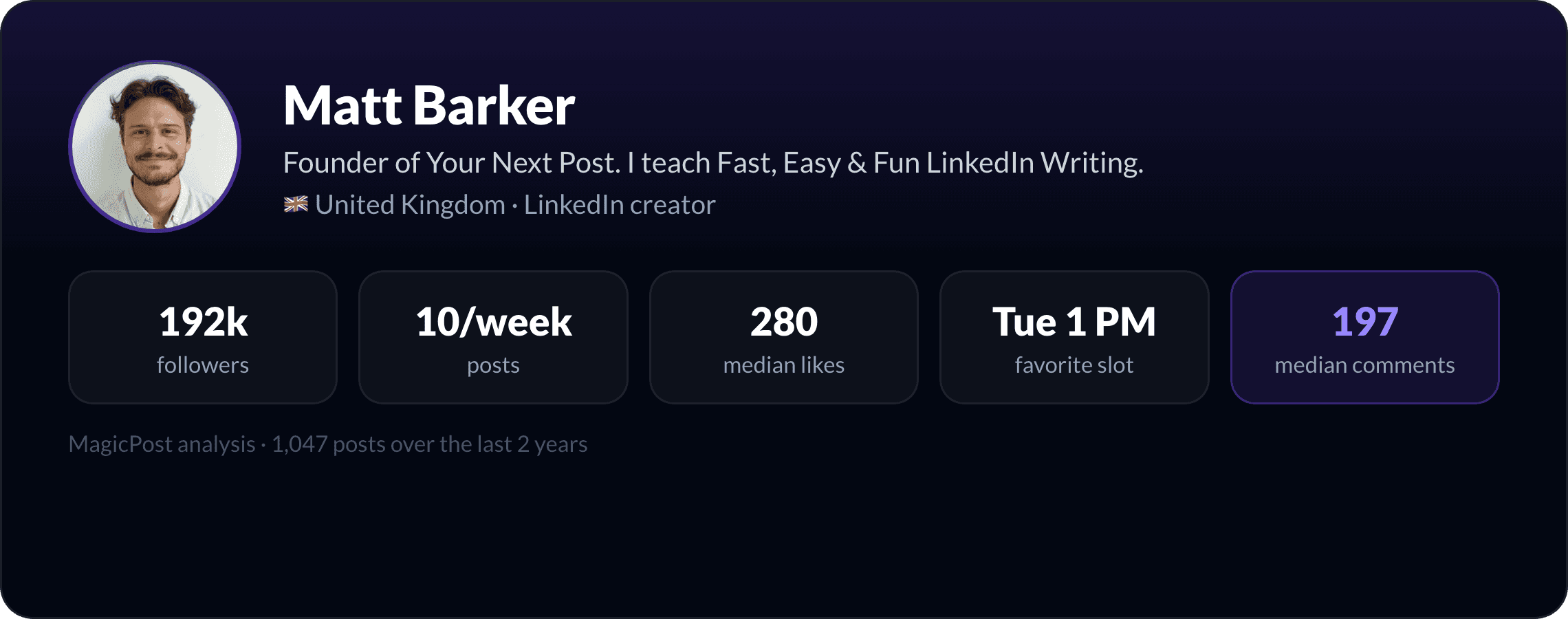
Who Is Matt Barker? The Hook Writer on LinkedIn, by Data (2026)
Who is Matt Barker? MagicPost analyzed 1,047 of their LinkedIn posts: topics, timing, signature moves and the writing fingerprint behind their growth, with real
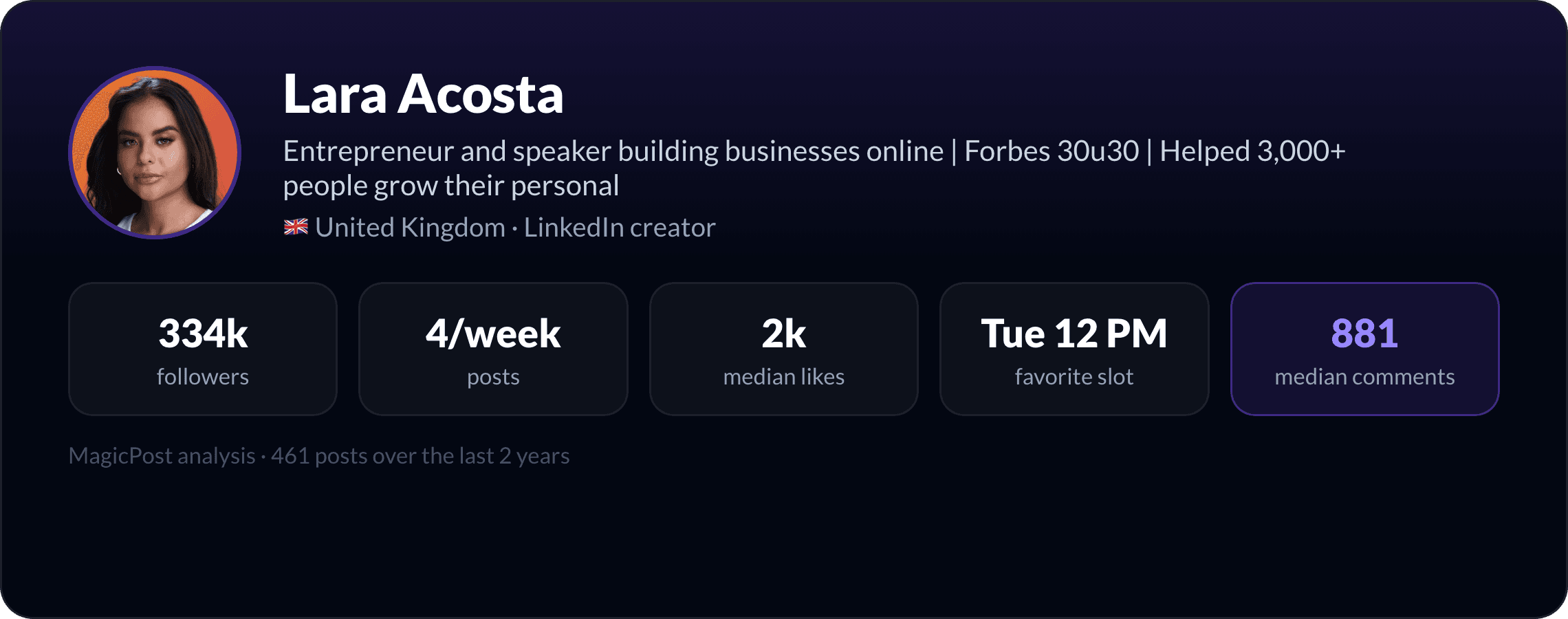
Who Is Lara Acosta? The Forbes 30 Under 30 Comment Machine, Explained by Data (2026)
Who is Lara Acosta? MagicPost analyzed 461 of their LinkedIn posts: topics, timing, signature moves and the writing fingerprint behind their growth, with real n
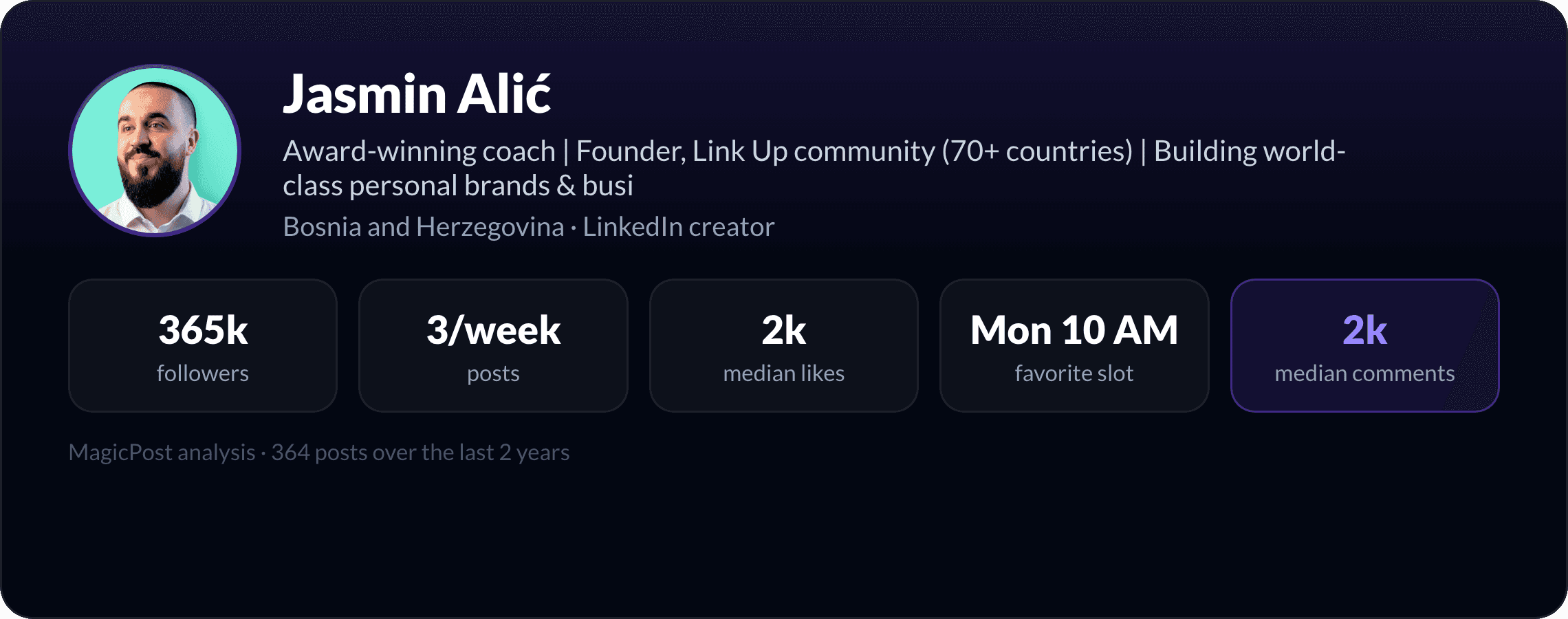
Who Is Jasmin Alić? The Bosnian Coach LinkedIn Mistook for a Bot (2026)
Who is Jasmin Alić? MagicPost analyzed 364 of their LinkedIn posts: topics, timing, signature moves and the writing fingerprint behind their growth, with real n
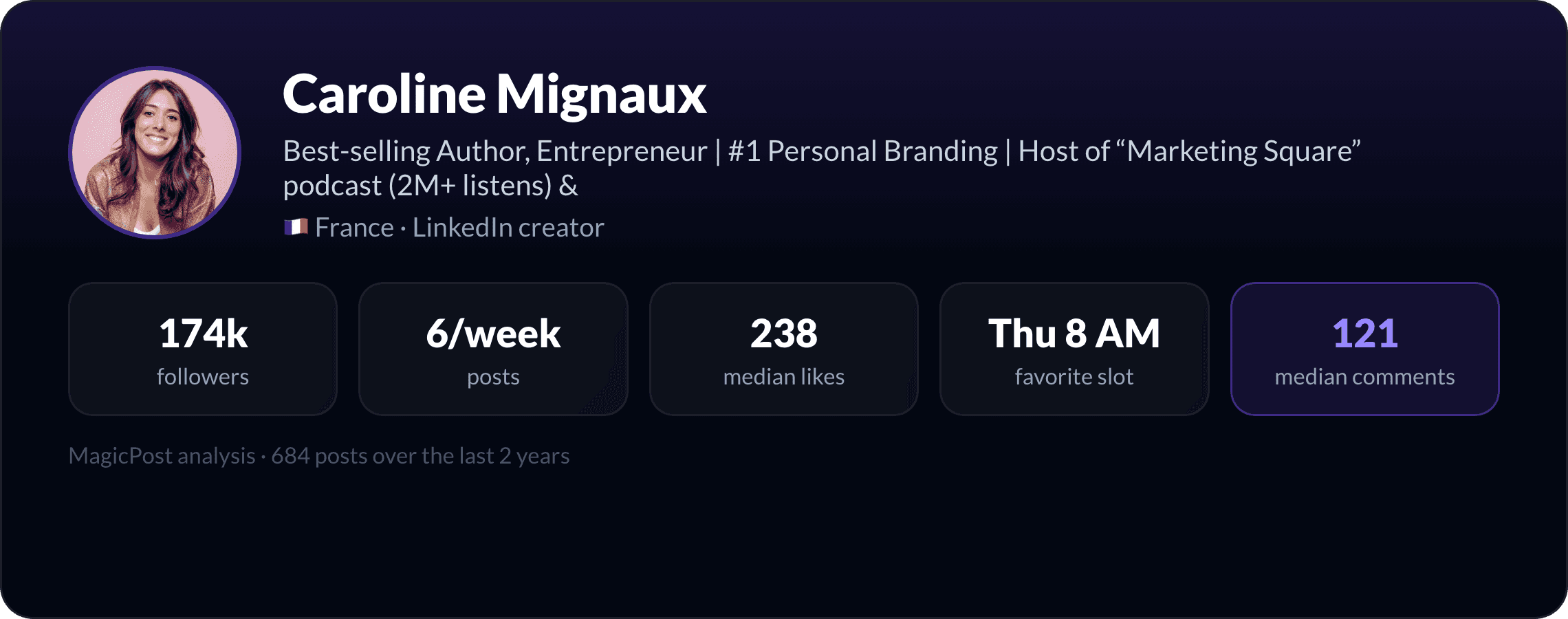
Who Is Caroline Mignaux? France's LinkedIn Top Voice Who Turned Shame Into a Following (2026)
Who is Caroline Mignaux? MagicPost analyzed 684 of their LinkedIn posts: topics, timing, signature moves and the writing fingerprint behind their growth, with r
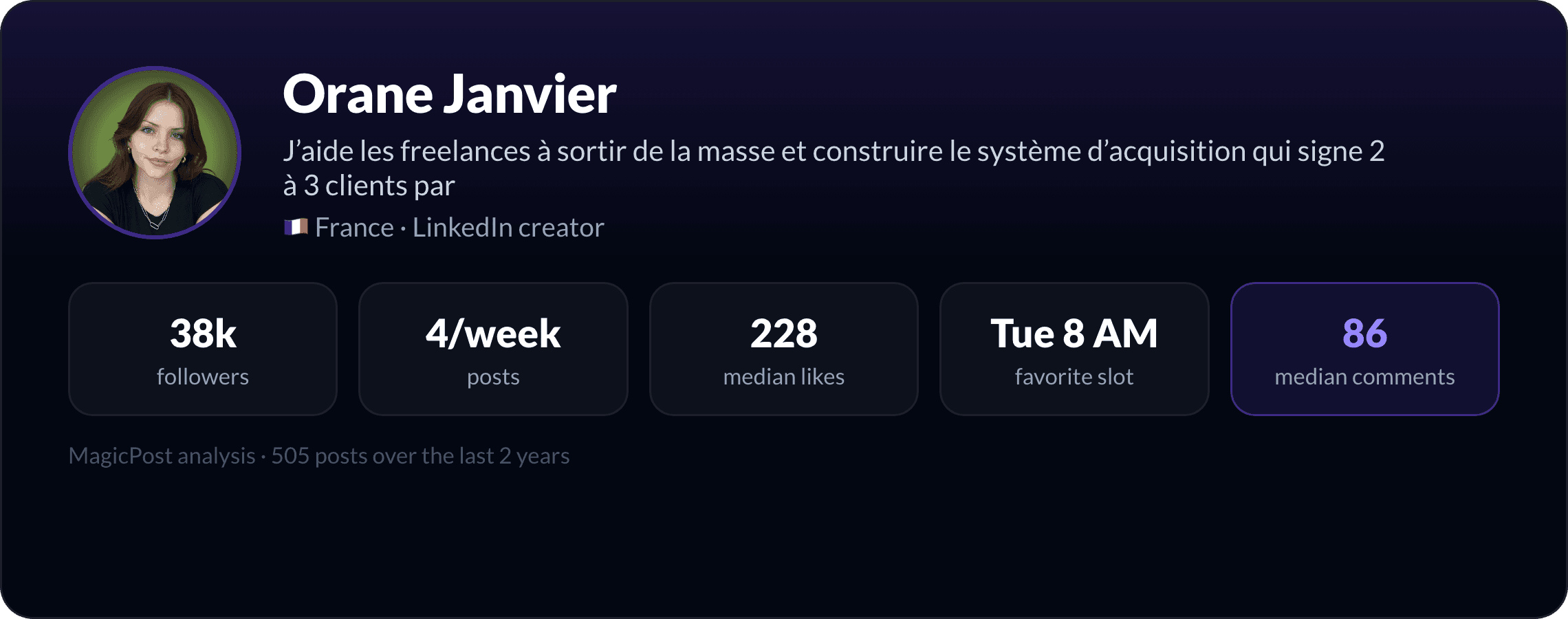
Who Is Orane Janvier? The Freelance Coach LinkedIn Quietly Copies (2026)
Who is Orane Janvier? MagicPost analyzed 505 of their LinkedIn posts: topics, timing, signature moves and the writing fingerprint behind their growth, with real
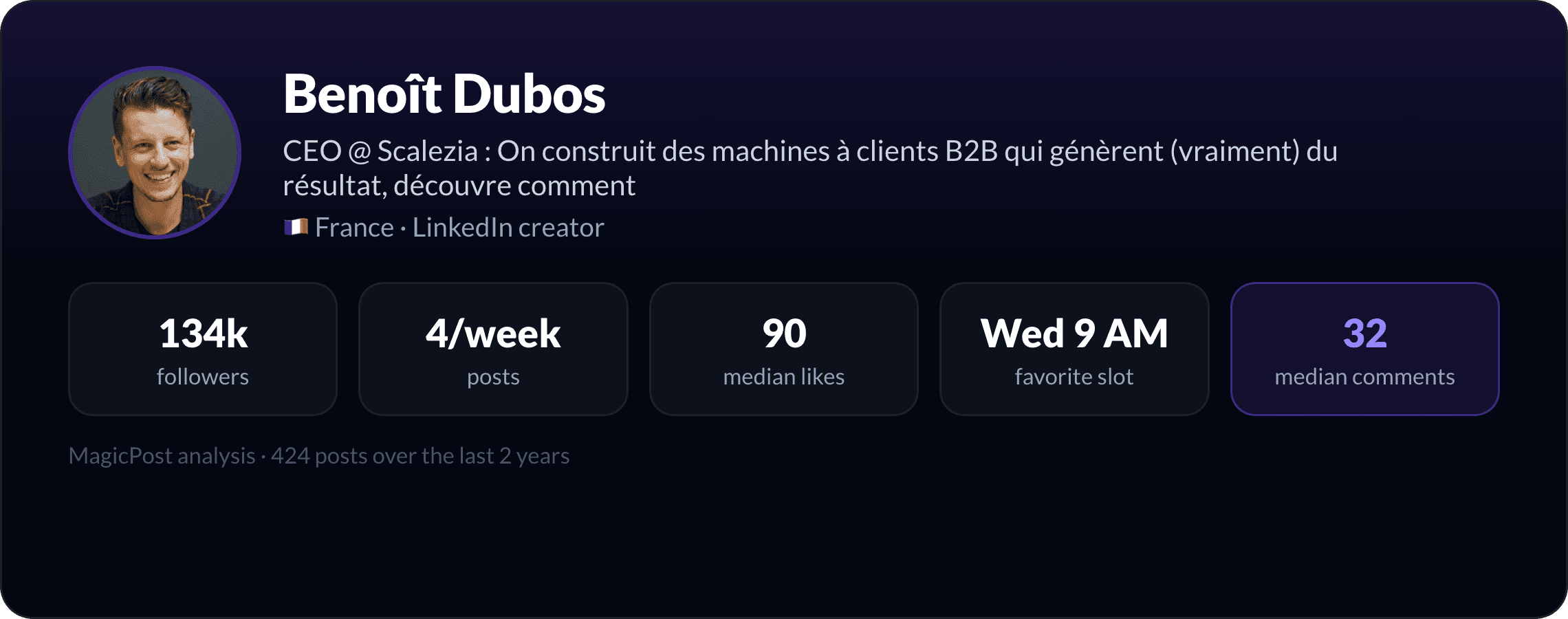
Who Is Benoît Dubos? The Growth Operator Who Turned a Falling Reach Into a Lead Machine (2026)
Who is Benoît Dubos? MagicPost analyzed 424 of their LinkedIn posts: topics, timing, signature moves and the writing fingerprint behind their growth, with real
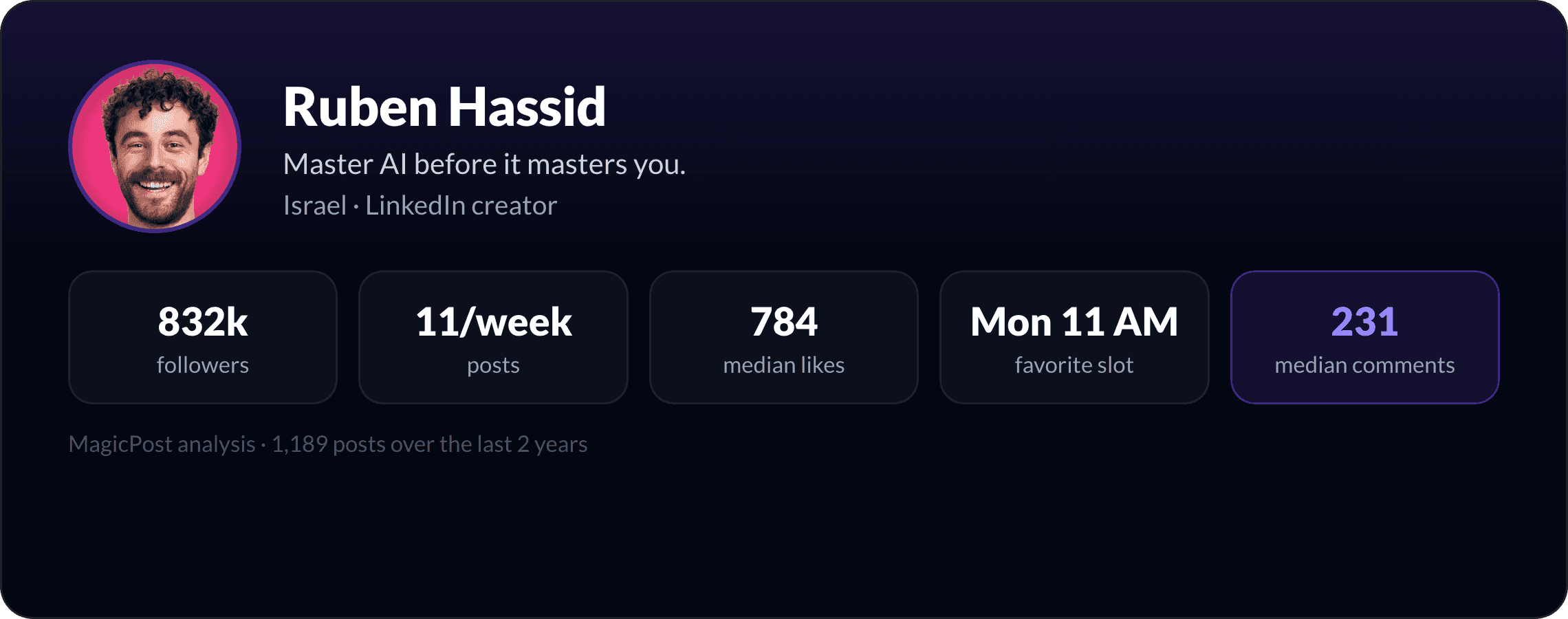
Who Is Ruben Hassid? The "Master AI Before It Masters You" Creator, Explained by Data (2026)
Who is Ruben Hassid? MagicPost analyzed 1,189 of their LinkedIn posts: topics, timing, signature moves and the writing fingerprint behind their growth, with rea
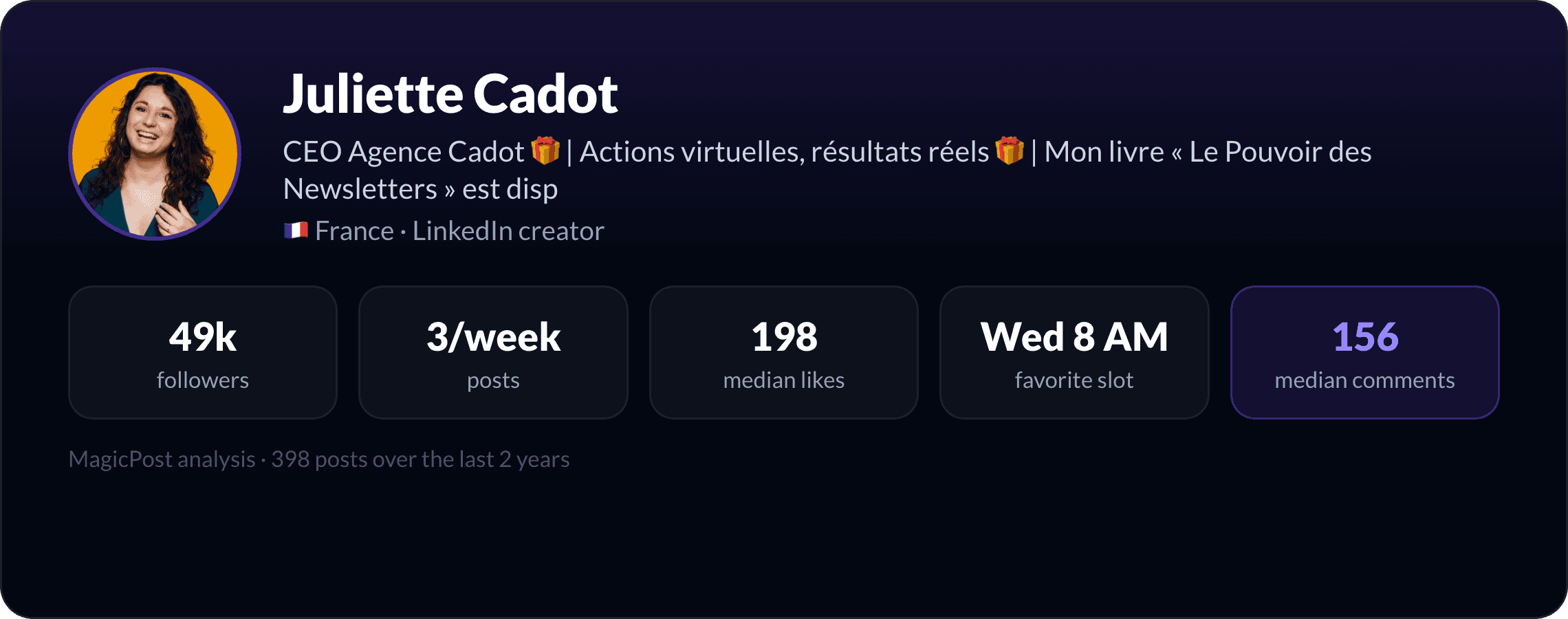
Who Is Juliette Cadot? The Agency Founder Whose Audience Talks Back (2026)
Who is Juliette Cadot? MagicPost analyzed 398 of their LinkedIn posts: topics, timing, signature moves and the writing fingerprint behind their growth, with rea