Short answer for the US: post on a weekday morning, around 7am to 8am Eastern, just before the rush. At MagicPost, we measured this across 543,472 US posts, and the most useful finding is that the busiest hour is not the best one.
Everything below is in US Eastern time (UTC-5). If you are on the West Coast, slide it back three hours.
The best hours to post on LinkedIn in the US
Every hour of the US working day, scored:

The morning wins. Engagement peaks at 8am (score 80, with 7am close behind at 78), then settles into a long, flat plateau for the rest of the working day: 9am to 1pm sit at 70 to 72, and 4pm at 66.
From mid-morning to evening, the exact hour you pick barely moves your odds. The lift is concentrated in that early window, before the feed fills up.
So the simple rule: aim for 7am to 8am Eastern on a weekday. After that, any working hour is roughly equal, and the evening tails off.
The five US slots that beat the rest
Zoom into specific weekday slots and the same story holds:

Rank | Window (US Eastern) | Score |
1 | Monday 8am | 95 |
2 | Monday 7am | 89 |
3 | Wednesday 8am | 87 |
4 | Tuesday 7am | 82 |
5 | Monday 9am | 80 |
Every one of them is an early-week morning between 7am and 9am. The repeatable advice: Monday to Wednesday, 7am to 9am Eastern.
What about the weekend? We keep it out of the ranking deliberately. Sunday 11am scores 100 and Sunday 10am 93 in the US, but on 3,112 and 3,271 posts, about a third of the 10,455 behind Monday 8am.
The score is relative to each author's own average, so read it as a real effect measured on a smaller pool. Use it for the occasional experiment, not as your main slot.
Why 9am, the busiest hour, is a trap
This is the single most useful thing in the US data. The hour when the most people post is not the hour when posts do best.

US posting volume peaks at 9am: that is when everyone hits publish. But the best-performing hours are 7am and 8am, just before the wave. By 9am, when the feed is flooded, the average post does measurably worse than it did an hour earlier.
Here is why. LinkedIn hands your post to a first batch of readers, then widens reach only if that batch reacts.
At 9am Eastern, half of corporate America is publishing at once, so your post is one of thousands competing for the same opening view.
At 7:30am the feed is still thin, your post is one of the few fresh things in it, and that first batch reads it cleanly. The early slot is simply less crowded.
The US week, mapped hour by hour
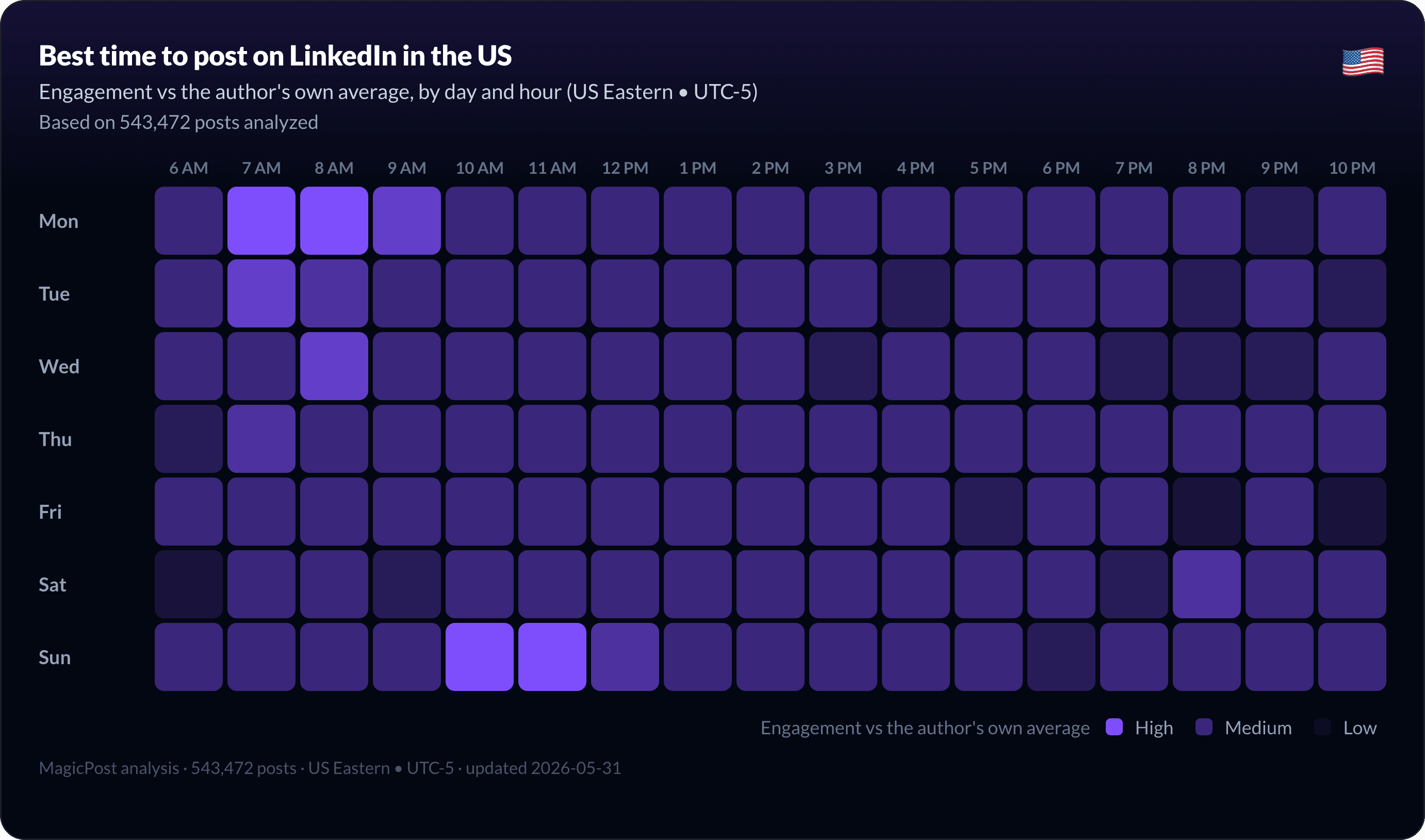
The complete picture, every day and hour for the US, colored by how well posts perform:

Notice how calm most of it is. Outside the early-morning hotspots and the late-night floor at the end of the week, the grid is fairly even.
The lowest well-sampled cells are Saturday 11pm (0, on 569 posts), Friday 11pm (31, on 695) and Monday 3am (42): not penalties, just hours where a post does no better than its author's usual. Those dead zones repeat across markets: see the worst times to post on LinkedIn.
That is the real shape of US timing: a few slots genuinely help, most of the working week is interchangeable, and Sunday late morning is the weekend's one bright spot.
Your own feed can disagree with the national grid. MagicPost's LinkedIn analytics put every post you published next to your own median, so you can see which US slots actually pay off for your audience.
What about the best day in the US?
For Americans, the day matters less than the hour. Across the US data, weekday engagement is remarkably flat (Monday edges it, but Monday through Friday sit within a few points of each other).
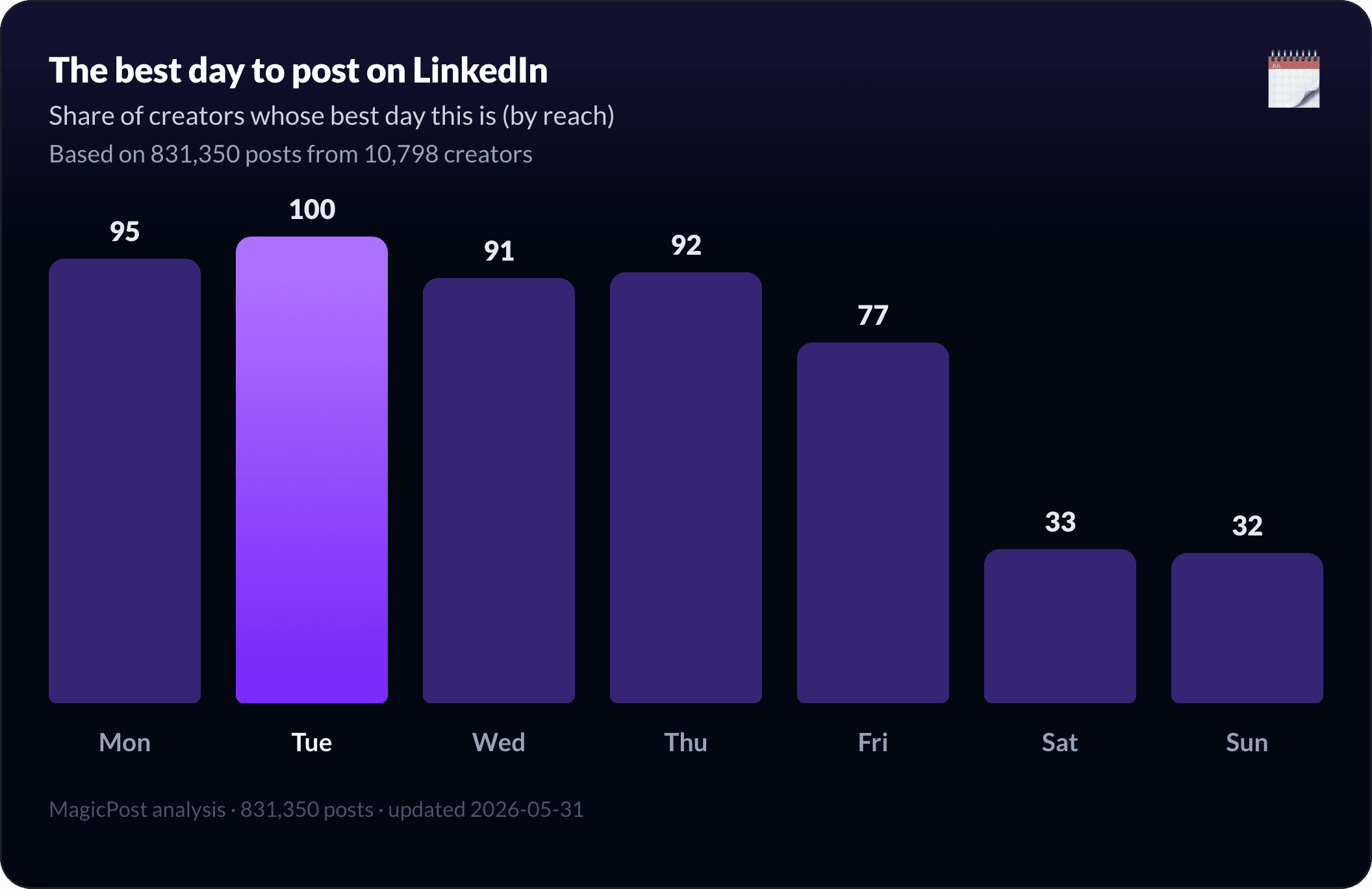
The bigger national pattern, measured by reach, still points to the early-week block: see the best day to post on LinkedIn, where Tuesday leads and a third as many creators have their best day on a weekend (685 for Saturday and 665 for Sunday, against 2,075 for Tuesday).
And by day? The best time to post on LinkedIn by day of the week gives each weekday its own hour.
Put together: a weekday, early morning, Eastern time. That is the whole US recommendation.
A note on time zones
We analyzed US posts in Eastern time (UTC-5), because it is the largest single US business zone. Two caveats:
The US spans four zones. If your audience is mostly on the West Coast, shift these times back three hours (8am Eastern is 5am Pacific, so you would aim a little later in absolute terms). Post to where your audience actually is.
Daylight saving moves Eastern between UTC-5 and UTC-4 across the year. The local clock hours above hold either way; only the UTC offset shifts.
Do the biggest US creators post this early?
Mostly, yes, and the few who do not are the exceptions that prove it. We pulled the posting habits of the top US creators we track, across their last two years of posts:
Justin Welsh (853k followers) posts most often at 8am Eastern, with more than half of his posts in the 6 to 9am window.
Matt Gray (911k) does the same: 8am is his go-to slot, and 71% of his posts go out in the morning.
Sahil Bloom (709k) and Jade Bonacolta (476k) are 8am posters too (two thirds and 84% of their posts in the morning, respectively).
The two outliers run the other way: Simon Sinek (8.9M) and Gary Vaynerchuk (5.9M) post most often around noon. At that scale, the audience comes to you whatever the clock says.
The pattern is hard to miss: the creators who built their reach post by post live in the early-morning window our data points to. The celebrities can afford not to.
Best time to post on LinkedIn in other countries
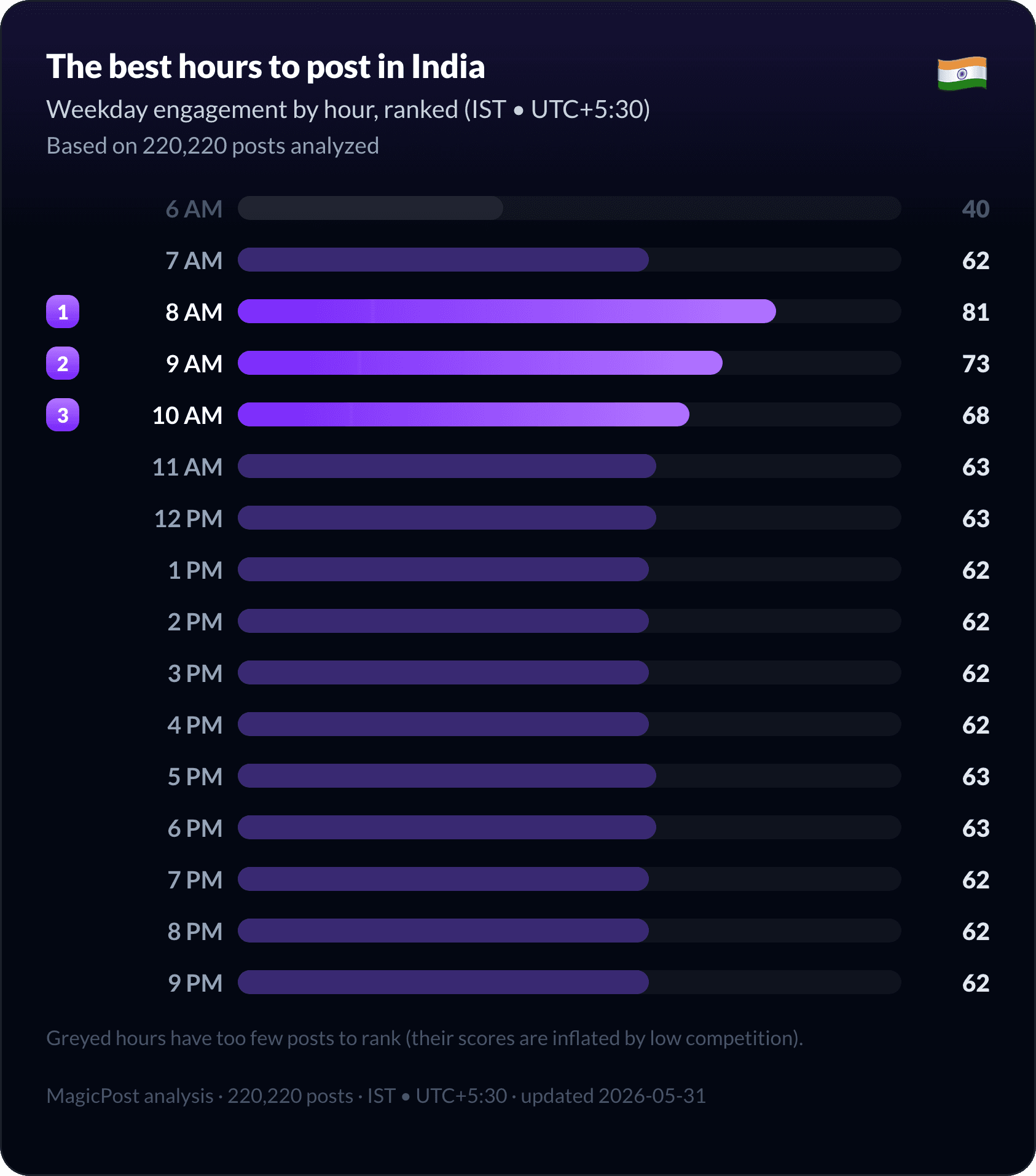
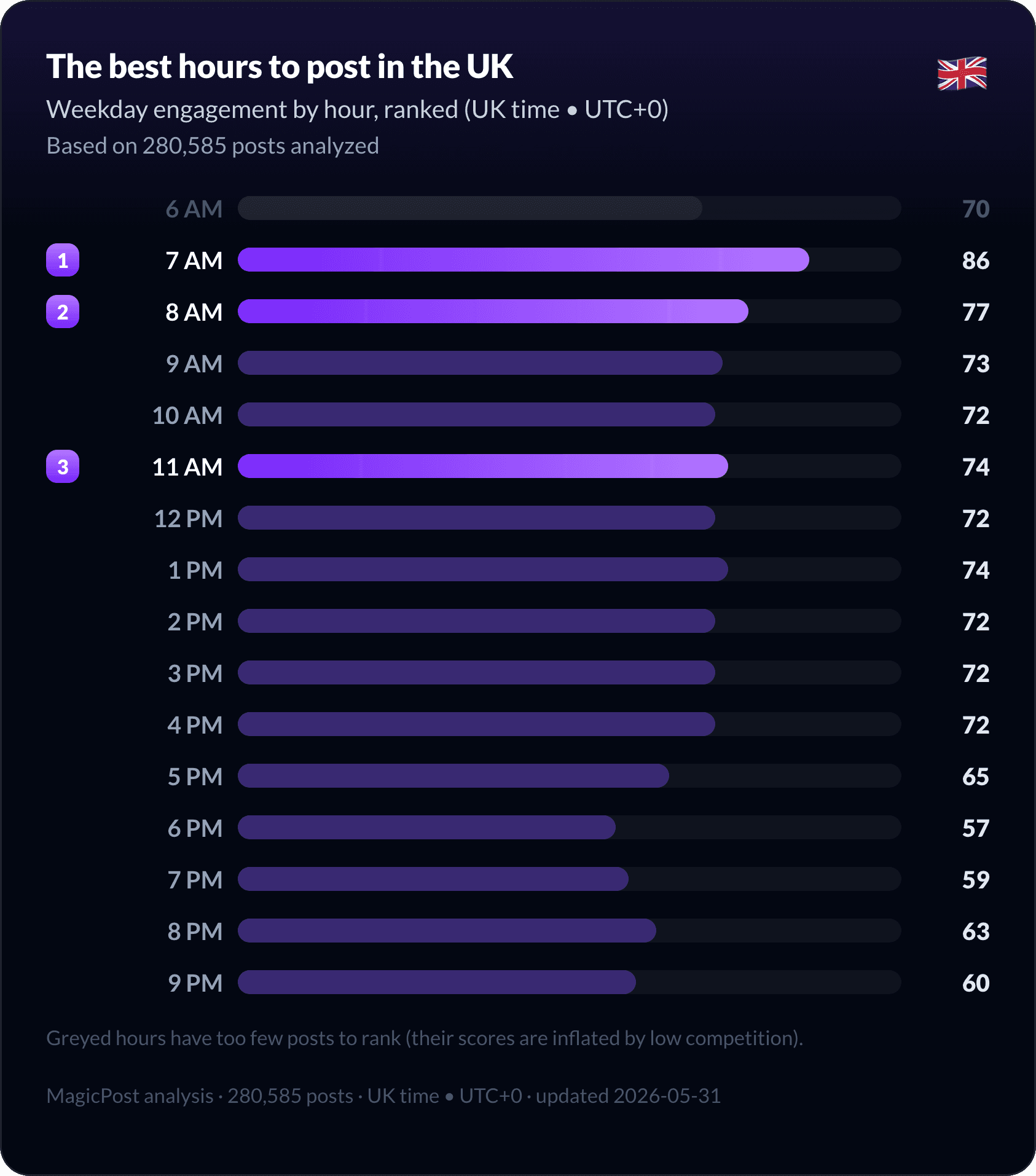
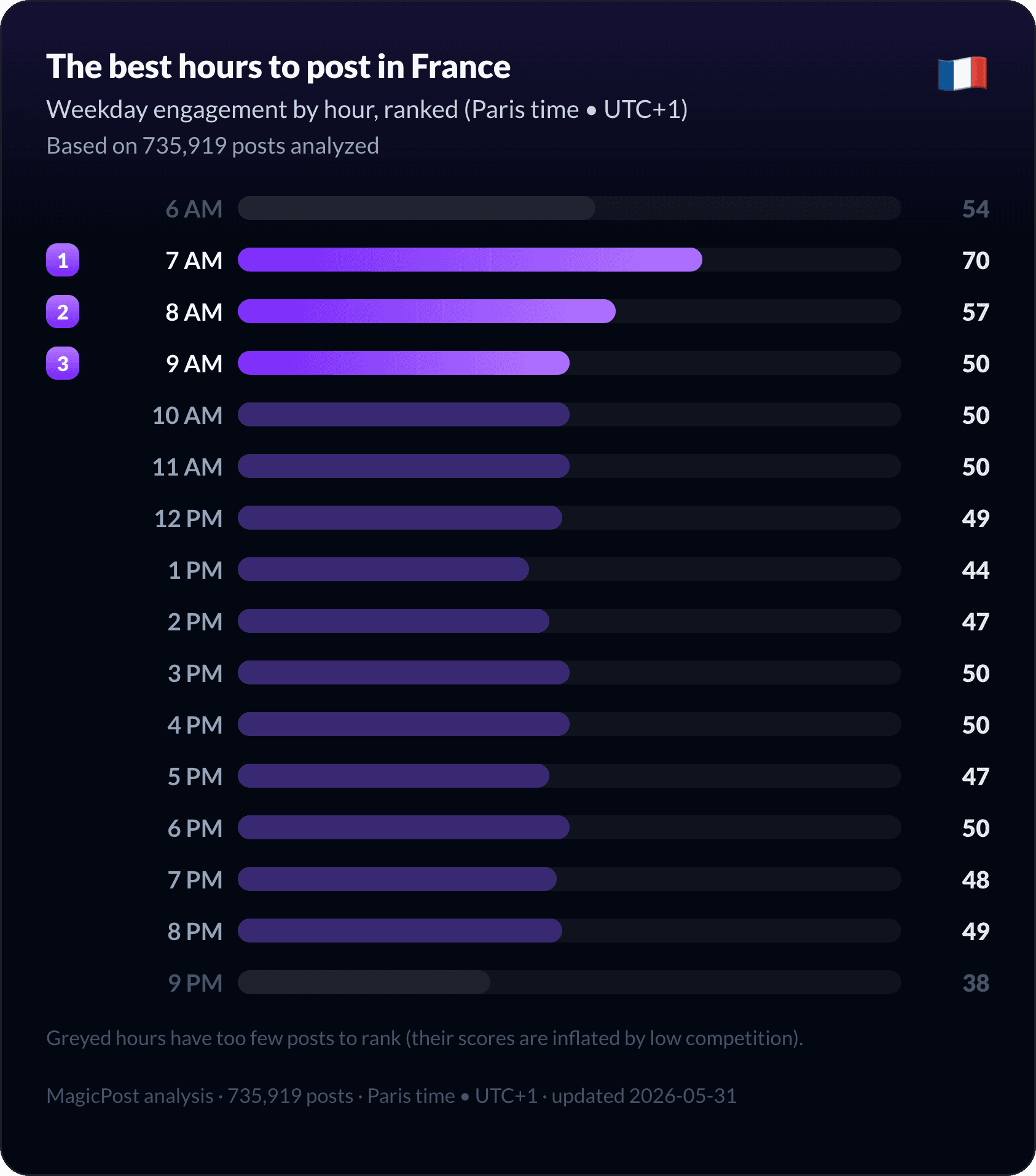
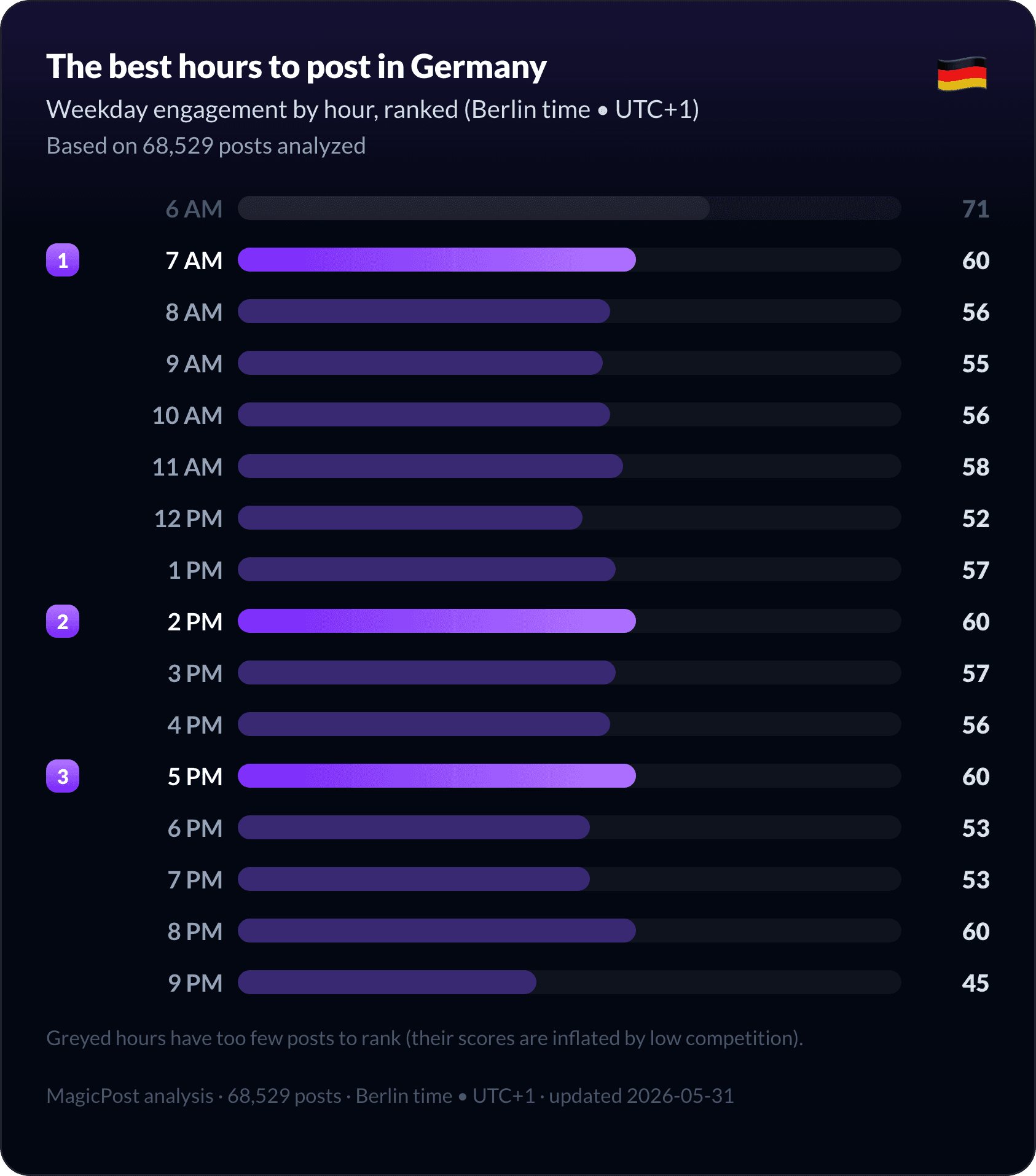
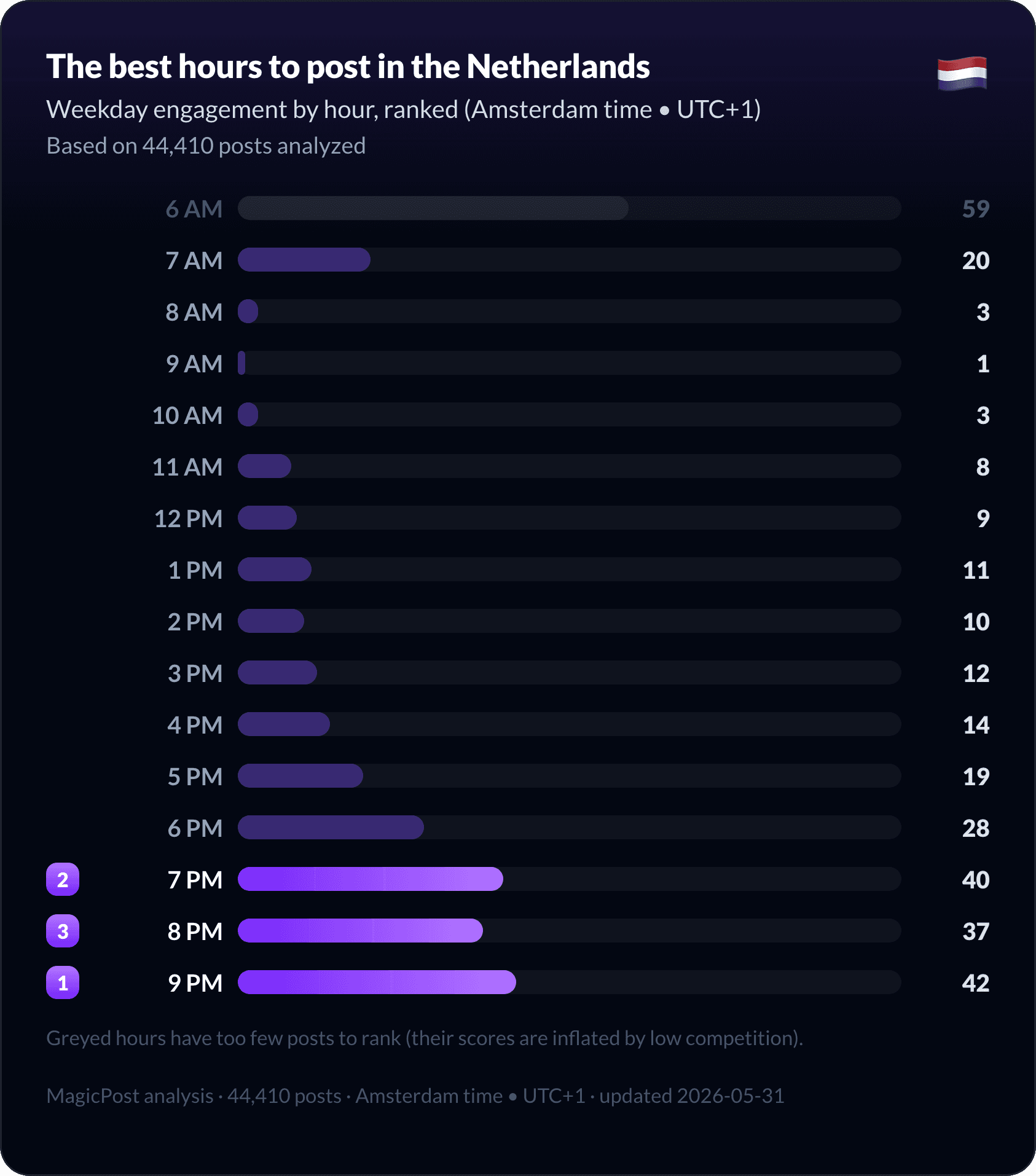
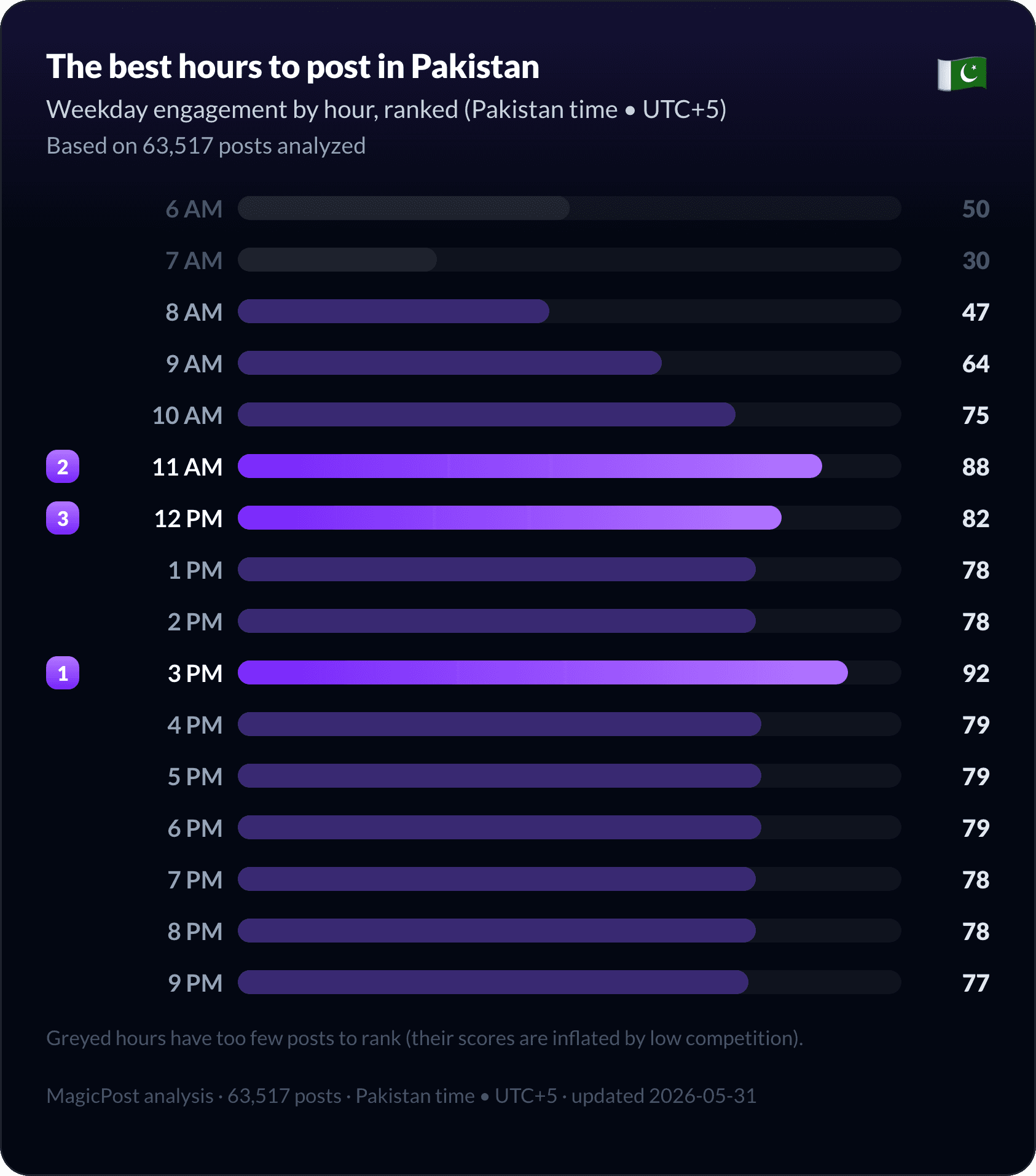
Timing is local. The US morning peak is not the same moment as anyone else's:
The worldwide picture, 2,667,049 posts: best time to post on LinkedIn
A caveat: this is correlation, not a promise. Timing buys a strong post a faster start. It does nothing for a post that has nothing to say.
Set it once, post on time. Write your US posts whenever you have a minute, and let MagicPost schedule them for 7am to 8am Eastern, before the crowd, with no early alarm. Try MagicPost free
Where this data comes from
These numbers are MagicPost's own, measured first-hand rather than gathered from other people's studies. We analyzed 543,472 US LinkedIn posts published through May 2026, in US Eastern time. Each post is graded against its own author's usual engagement, so a few huge accounts cannot bend the curve.
The creator habits are read straight from the public posts of the US accounts we track. It is the same dataset that drives MagicPost's built-in posting-time suggestions.
The score is relative, not an engagement rate. For absolute numbers, MagicPost's LinkedIn benchmark publishes median engagement rates by follower count every month.
FAQ
What is the best time to post on LinkedIn in the US?
MagicPost's data on 543,472 US LinkedIn posts puts the best time to post on LinkedIn in the US at 7am to 8am Eastern on a weekday, with Monday 8am the single best slot (score 95 out of 100).
It lands just before 9am, when most people post and competition spikes.
Why is 9am not the best time if everyone posts then?
Because everyone posts then. At 9am you compete hardest for that first batch of views. Posting at 7am to 8am, before the rush, tends to perform better in our US data.
When is the best time to post on LinkedIn in EST?
7am to 8am EST on a weekday, with Monday and Wednesday the strongest. That window sits just before the 9am EST posting rush, which is when competition peaks.
What is the best time to post on LinkedIn on the West Coast (PST)?
Shift the Eastern times to your zone. The pattern (early weekday morning, before the local 9am crowd) holds; the clock time changes. Post to your audience's local time, not the server's.
What is the best day to post on LinkedIn in the US?
Day matters less than hour for US audiences, since weekday engagement is fairly flat. Nationally, the early-week block (Tuesday especially) leads for reach. See our best day guide.
How was this measured?
We compared each post's engagement to its own author's typical engagement (so follower count does not distort it) across 543,472 US posts, and scored every day-and-hour slot from 0 to 100 in US Eastern time.