" height="26.80529977783203px" id="tymKb8bqC" width="128.00300311279295px"/><path d="M 0 2.417 L 0 0 L 12.909 0 L 12.909 2.417 Z" fill="rgb(126, 78, 253)" height="2.417099999999998px" id="aYr4em6zK" transform="translate(128.341 22.325)" width="12.908999999999992px"/></svg>)

"/><stop offset="1" stop-color="rgb(118, 37, 250)"/></linearGradient></defs><g d="M 19.242 21.22 L 19.362 6.204 L 19.272 6.204 L 13.757 21.22 L 10.161 21.22 L 4.796 6.204 L 4.706 6.204 L 4.825 21.22 L 0 21.22 L 0 0 L 7.283 0 L 12.109 13.607 L 12.229 13.607 L 16.844 0 L 24.247 0 L 24.247 21.22 Z M 26.421 26.113 L 26.421 23.445 L 41.407 23.445 L 41.407 26.113 Z" fill="transparent" height="26.112508199679183px" id="DvfaAIHYn" width="41.40731898311435px"><path d="M 19.242 21.22 L 19.362 6.204 L 19.272 6.204 L 13.757 21.22 L 10.161 21.22 L 4.796 6.204 L 4.706 6.204 L 4.825 21.22 L 0 21.22 L 0 0 L 7.283 0 L 12.109 13.607 L 12.229 13.607 L 16.844 0 L 24.247 0 L 24.247 21.22 Z" fill="rgb(46, 46, 46)" height="21.220180016149442px" id="pLsxRCobd" width="24.247352589074694px"/><path d="M 0 2.668 L 0 0 L 14.986 0 L 14.986 2.668 Z" fill="url(%23yD9d4I5GR-3279285344-linear-gradient)" height="2.6675085048549647px" id="yD9d4I5GR" transform="translate(26.421 23.445)" width="14.986002836263765px"/></g></svg>)

Naïlé Titah
A product launch is one of the few posts your audience actually wants to root for. You built a thing, you are putting it into the world, and people who follow you are primed to cheer. A launch starts with goodwill in the bank.
Then most people spend it on a press release.
The typical launch post leads with the product name, lists the features, and ends with a link. It reads like a brochure, and the feed treats it like one. We measured what launch posts actually earn, then pulled the ones that worked to see what they do differently. The pattern is consistent, and it is not about the product at all.
TL;DR: Launch posts earn 0.43% median ER, just above the 0.39% platform median. The winners lead with the problem or the journey, never the feature list. Real examples from Sinek and Welsh plus 3 fill-in templates.
What a launch post actually earns
Here is where the "Launch announcement" type lands, measured across 48,105 posts in our corpus:
Metric | Launch announcement | Platform median |
Engagement rate | 0.43% | 0.39% |
Median likes | 36 | 28 |
Median comments | 5 | 10 |
A launch post earns a 0.43% median engagement rate, just above the 0.39% platform median. So launches are not a magic format: they sit slightly ahead of an average post, and behind the best-performing types in our 22-type engagement ranking. The goodwill is real, but thin: about a tenth above baseline, not a multiple.
Look closer at the two interaction columns. Median likes (36) run above the platform median (28), but median comments (5) run below it. That is the signature of a post people approve of but do not debate: a launch invites a reaction ("nice, congrats"), not a conversation. So the easy wins are clear. You are already getting the likes; the whole game is earning the comment, the save, the click. And that comes from how you open, not from what you ship.



What the launches that work actually share
We pulled the launch posts that outperformed and read them side by side. None of them open with the product. Every one opens with a reason the product needs to exist. Three habits show up again and again.
They lead with the problem, not the name. The first thing you read is the pain the product solves, described from the reader's life, not the company's roadmap. By the time the product appears, you already want it.
They tell the journey. The strongest launches read as the end of a story the author has been living: years in a job that did not fit, a problem they kept hitting, a thing they wished existed. The product is the payoff, not the premise.
They earn the announcement. Because the post spends its first half on a problem or a story, the "that's why we built X" line lands as a relief, not a pitch.
If that sounds like more work than "Excited to announce," it is. It is also the difference between 0.39% and something worth posting for. (If you are still deciding whether a launch even belongs in your rotation, our guide to what to post on LinkedIn maps the whole mix.)
Three real launches, read closely
These are real public posts. Notice how many lines you read before you learn what is being launched. That is the point.
Simon Sinek's launch of Leaderful opens on the gap between getting a title and growing into one, and only then names the thing:
Getting the title is the easy part. The real challenge of leadership is growing into it. Most leaders spend their days solving problems, running meetings, and supporting their teams,with very little space to pause and actually work on becoming better leaders. That’s why we built Leaderful.
Simon Sinek (8910k followers), 6,986 likes, see the post. The structure is the whole lesson: three sentences of problem, then one line of product, introduced with "That's why we built." The reader has agreed with the problem before the launch arrives.
Justin Welsh's launch reads as the end of a sixteen-year story, and the product is the resolution of it:
The goal is no more meaningless work. Let me explain: I spent 16 years in corporate. Endless meetings about meetings. Projects that went nowhere. Tasks that didn't matter. Work that felt hollow. I wasn't tired of working. I was tired of working on things that didn't matter. Then I left and built my own thing.
Justin Welsh (853k followers), 5,406 likes, see the post. There is no feature list and no "excited to announce," just a mission statement, a backstory you can feel, and a build that resolves it. The launch is emotional before it is commercial.
A third Welsh launch opens by attacking a belief the reader already holds, its own kind of problem-first hook:
Everyone says pick two. Let's build all three! If you build it right, you can: 1) Make a lot of money 2) Help a lot of people 3) Have a lot of fun Most people think they need to choose...
Justin Welsh (853k followers), 5,711 likes, see the post. It earned 1,455 comments, far above the 5-comment median for the type, precisely because it opens with a tension worth arguing about instead of an announcement worth scrolling past.
Three launches, three different doors in (a problem, a journey, a belief), and not one of them leads with the product name. That is the template.
Want a launch post in your own voice, not a press release? Describe what you are shipping and who it is for, and MagicPost's AI LinkedIn post generator drafts the problem-first opening, the journey, and the ask, in your tone, so you spend your launch-day goodwill on a post people actually read instead of a brochure they scroll past.
Three templates you can fill in today
Craft these so they are clearly yours. Keep the specifics real: no invented numbers, no borrowed stories. The structure is the help; the truth is yours.
1. Problem-first. When to use it: your product solves a pain your audience feels and can name.
[The painful, everyday version of the problem, in your reader's words.]
[Why the usual fixes don't work / why it persists.]
That's why we built [product]: [one line on what it changes].
[What it does, in one plain sentence, no feature list.]
[The ask: try it / tell me what you'd want / link in comments.]
2. Journey-first. When to use it: the product is the payoff of a story you have genuinely lived.
[The before: where you were, what frustrated you, for how long.]
[The turning point that made you start building.]
[What you learned along the way that shaped the product.]
Today, [product] is live. [One line on who it's for and why.]
[The ask: a real, specific next step.]
3. Social-proof-first. When to use it: you have real early results, a waitlist, or beta users who can speak.
[A specific thing an early user said or did, quoted or described honestly.]
[The problem that result points to.]
[product] does [the one thing], and that's why [the result happened].
[Who it's for now that it's open to everyone.]
[The ask, tied to the proof.]
Each one keeps the product out of the first line and puts the ask in the last. That ordering is the single highest-leverage edit you can make to a launch post.
The mistakes that flatten a launch
Leading with the feature list. "Introducing X, with Y and Z" tells the reader what the product has, never why they should care. The launches that work invert it: problem, then product, then (maybe) one capability. Save the spec sheet for the landing page.
No ask. A launch with no clear next step harvests the easy likes and stops there, which is exactly the 36-likes-5-comments shape the data shows. Tell people precisely what to do: try it, comment for the link, reply with what they'd want next.
Burying it under a link card. A launch is the one time you most want people to read, and a link preview is the element that most reliably suppresses reach. Put the link in the first comment instead, or skip it and let the ask do the work. (We measured that penalty in how external links cut your LinkedIn reach.)
Treating it like a one-off. The posts around a launch do the selling. If your launch is the only time your audience hears the problem, it lands cold, which is where a steady supply of LinkedIn post ideas on the same problem pays off in the weeks before you ship. For the soft-sell posts that warm the audience up, see our LinkedIn sales post examples.
Where the data and examples come from
The engagement figures come from MagicPost's own research: an analysis of 1.1 million LinkedIn posts, classified by intent, with each type scored on median engagement rate against followers (never averages, so a handful of viral launches cannot distort the picture). The "Launch announcement" type covers 48,105 posts, with a 0.43% median engagement rate against the 0.39% platform median. The example posts are real, public LinkedIn posts, quoted verbatim, linked, and attributed; we picked the most instructive launches rather than the highest-liked. Figures dated June 2026.
FAQ
What should a LinkedIn product launch post say?
A LinkedIn product launch post should open with the problem your product solves, told in your reader's own words, and only name the product once the reader already wants it. The launches that work in our data follow a simple order: problem (or a personal journey), then "that's why we built X," then one plain sentence on what it does, then a clear ask (try it, comment for the link, tell me what you'd want next). Avoid leading with the product name and a feature list, which reads as a press release. A well-built launch earns roughly a 0.43% engagement rate, just above the 0.39% platform median, and the way you open is what moves it.
How well do launch posts perform on LinkedIn?
Across 48,105 launch posts in our study, the median engagement rate is 0.43%, slightly above the 0.39% platform median. Median likes run at 36 (above the 28-like platform median), but median comments sit at 5 (below the platform's 10). People approve of launches and tap like, but they do not debate them. The opportunity is in earning the comment and the click, which comes from a problem-first opening and a clear ask rather than a feature list.
Should I put the product link in a LinkedIn launch post?
Not in the body. A link preview attaches a card that reliably suppresses reach, and a launch is the one post where you most want distribution. Put the link in the first comment, or leave it out and let your ask carry the reader to the next step. This is the single most common reason a launch underperforms its goodwill.
How is a launch post different from a sales post?
A launch is an event: it announces something new, once, and rides a burst of goodwill. A sales post is ongoing: it sells an existing offer through value, without an announcement to lean on. They share a backbone (problem first, product second, clear ask), but a launch has a moment to capitalize on, so it can be more direct. For the full library of structures, see our LinkedIn post templates pillar.
> Plan the launch, not just the post. With MagicPost you can write, schedule, and analyze every post around your launch in one place, so the announcement lands on an audience you have already warmed up instead of a cold feed.
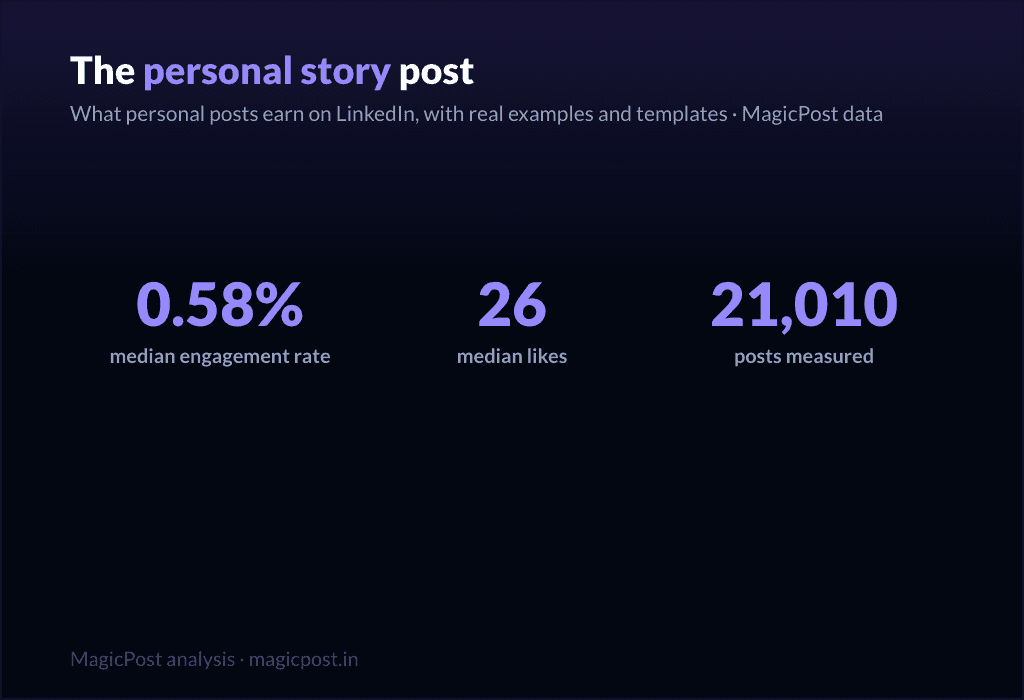
The Personal Story LinkedIn Post: Why Vulnerability Wins (and How to Write Yours)
The personal story LinkedIn post: challenges overcome earn 1.03% median ER, hard moments 0.80%, vs 0.39% platform median. Examples and templates.
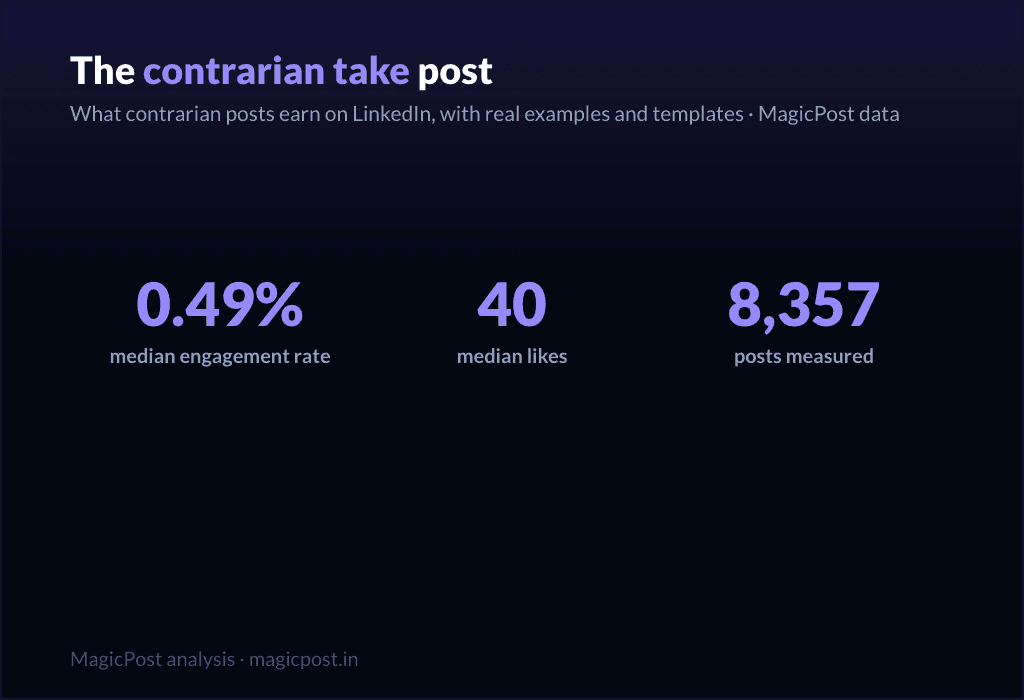
The Contrarian LinkedIn Post: What Provocation Actually Earns (Spoiler: Less Than You Think)
The contrarian LinkedIn post, measured: 0.49% median ER. Better than average, far below sincerity. What separates real takes from rage-bait.
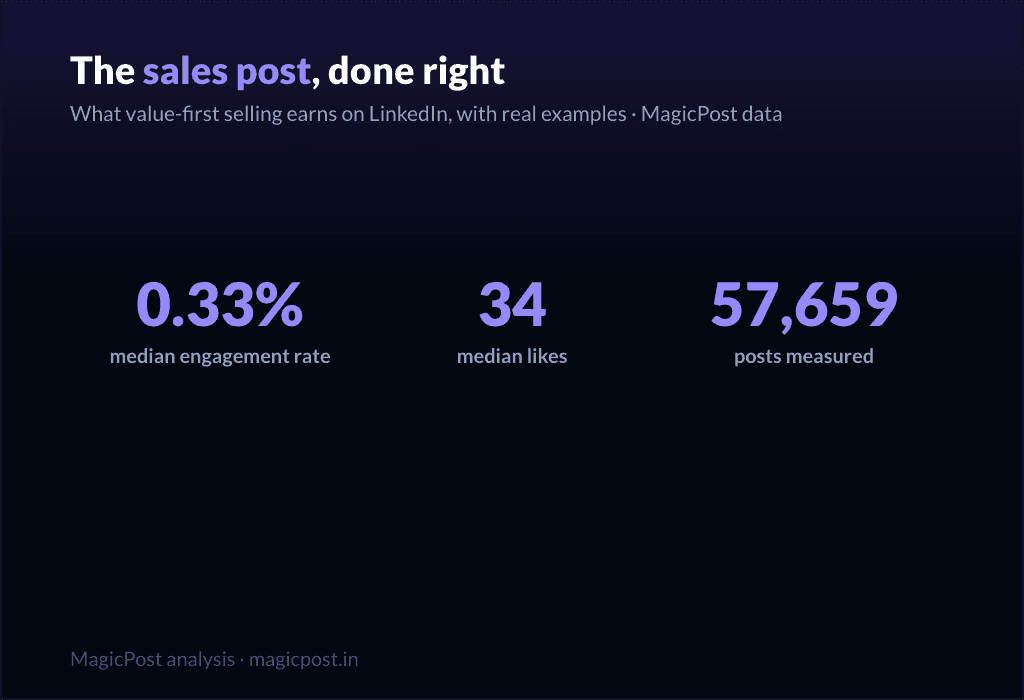
LinkedIn Sales Post Examples: Why Selling Posts Underperform (and the Ones That Work Anyway)
LinkedIn sales post examples: even value-first selling earns 0.33% median ER, below the 0.39% platform median. The ones that work anyway.
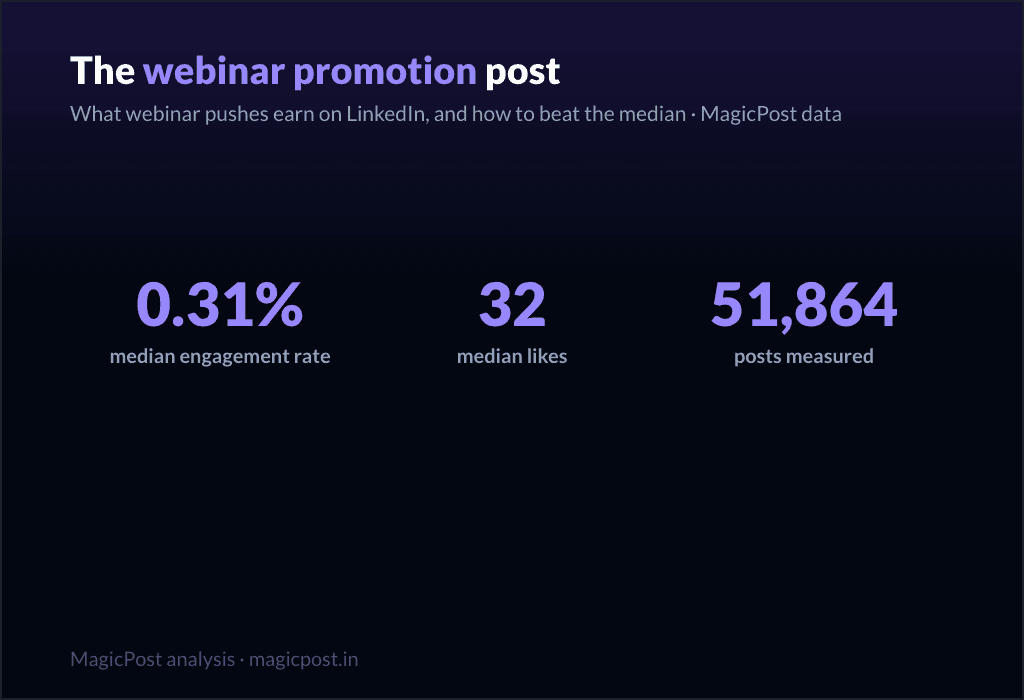
How to Promote a Webinar on LinkedIn (the Standard Signup Post Is the Second-Worst Post Type)
How to promote a webinar on LinkedIn: the standard signup post is the second-worst post type (0.31% ER). The teach-first structure that beats it.
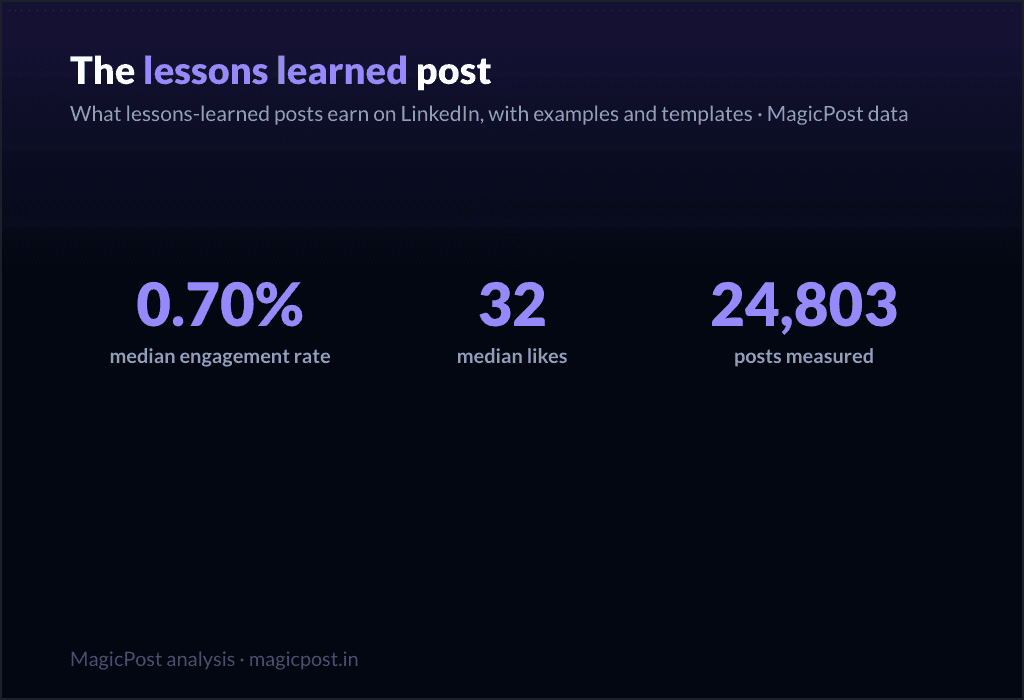
The Lessons Learned LinkedIn Post: Why Earned Advice Beats Expert Advice (0.70% vs 0.44%)
The lessons learned LinkedIn post: earned advice (0.70% ER) beats expert advice (0.44%). The difference is the receipt. Examples and templates.
The Last Day LinkedIn Post: How to Say Goodbye Well (Real Examples + Templates)
The last day LinkedIn post: how to say goodbye well. Real examples (one earned 13,121 likes), 3 templates, and the etiquette of leaving in public.
The Graduation LinkedIn Post: Real Examples, Templates, and How to Make Yours Count
The graduation LinkedIn post: real examples (up to 19,038 likes), 3 templates, and how to make your first professional post count.
The Work Anniversary LinkedIn Post: Beyond the Auto-Generated Badge (Examples + Templates)
The work anniversary LinkedIn post: beyond the auto-badge. Real examples, 3 templates, and the reframe that turns a date into a story.
The Holiday LinkedIn Post: How to Not Sound Like a Corporate Card (Examples + Templates)
The holiday LinkedIn post: how to not sound like a corporate card. Real examples, 3 templates, and why seasonal posts should be scheduled early.
5 Template Post LinkedIn Terbaik (2026)
5 template pos LinkedIn: narasi, daftar, refleksi pribadi, keluhan, dan analisis. Panduan langkah-demi-langkah untuk membuat pos yang menarik dan meningkatkan visibilitas.