"Never put a link in your post, the algorithm hates it." You have read this a hundred times, always stated as gospel, never with a number behind it. So we ran the numbers on 566,957 LinkedIn posts with synced analytics, published in the 12 months up to June 2026, split by whether they carried an external link and where exactly that link sat. The aggregate answer is brutal, and then it splits into a nuance that almost nobody states correctly.
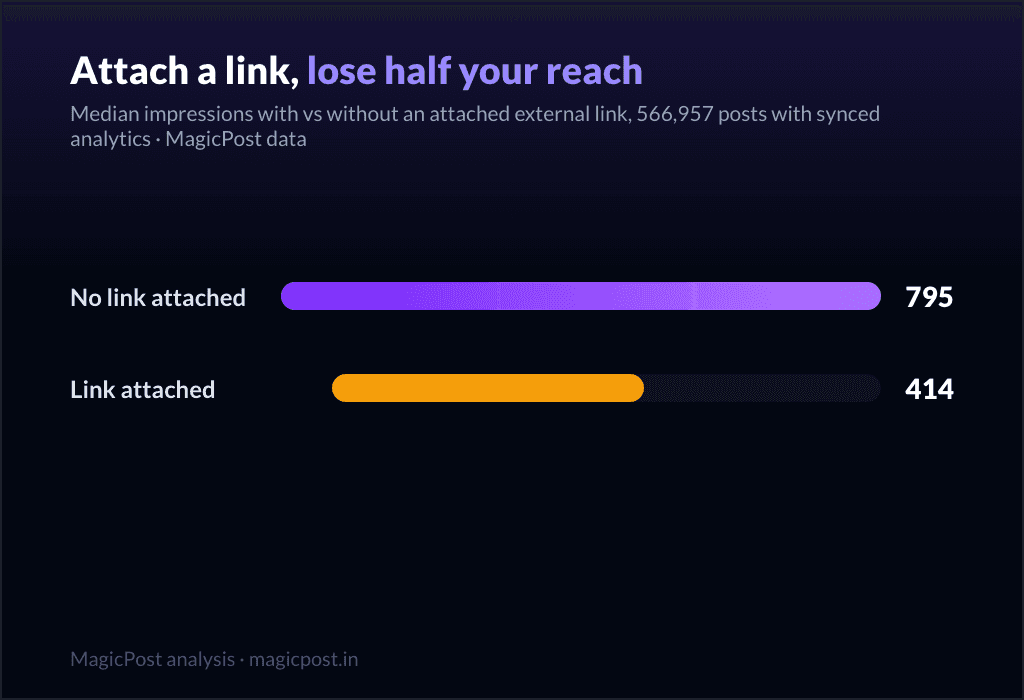
The short version: a post with an attached link preview earns 414 median impressions against 795 for a post without one, and 6 median likes against 19. Reach roughly halved, engagement cut to a third. That is the headline everyone half-remembers.
The longer version: in that pooled raw data, the whole gap sat on the attached preview card. A URL typed inside the post body did as well as no link at all. Since mid-May 2026, that no longer holds: against the same author's posts without links, a typed URL sits 21% below, a link card 19%. Start with the board.
Link cards vs in-body URLs: the reach numbers
Every table in this article measures impressions on the same pool: 566,957 posts with synced analytics, published in the 12 months up to June 2026, aggregated and anonymized, compared on raw medians so no viral outlier can distort a row.
Post | Posts measured | Median impressions | Median likes |
No attached link | 534,030 | 795 | 19 |
Attached external link | 32,927 | 414 | 6 |
Posts that carry an attached link preview reach 414 median impressions versus 795 without one. That is reach roughly halved, and the engagement gap is even wider: 6 median likes versus 19.
If you stopped reading here you would conclude that linking out is a mistake. In this pooled data you would be half right, and the missing half, plus what the same authors' posts show since mid-May 2026, is the whole point of this page.
The nuance in the raw medians: the card, not the URL
A link can sit in a post in two very different ways. An attached link is one you paste so that LinkedIn renders a preview card (the image-plus-title box under your text, what we count as the "article" format). An in-body link is a URL sitting inside the words of your post, no card. We split the same 566,957 posts three ways.
Where the link is | Posts measured | Median impressions | Median likes |
Attached preview card | 32,927 | 414 | 6 |
In the post body | 69,166 | 858 | 20 |
No link at all | 464,864 | 786 | 19 |
In this pooled data, a URL in the post body earned 858 median impressions, slightly more than the 786 of posts with no link at all, and 20 median likes versus 19. The gap sat entirely on the attached preview card: 414 impressions, less than half of either alternative.
Raw medians mix very different creators, and most of these posts predate mid-May 2026. Our study of LinkedIn algorithm changes in 2026 compares each author with their own posts without links. Since mid-May 2026, a typed URL sits 21% below them (12% before), a link card 19% below (39% before), a “link in the comments” line 16% below (8% before).
So the in-body URL was never free against the same author, and since mid-May it costs about as much as a card. Citing a source or pointing to your own site now has a price wherever the link goes.
Want to see what links do to YOUR reach? MagicPost's LinkedIn analytics break your own posts down the same way: which ones carried a link card, what they reached, where you stand against these medians. Guessing is optional once you can read it.
What this does not prove: attached links are almost all "articles"
Here is the confounder, stated up front rather than buried. Posts with an attached preview card are, by construction, the article format on LinkedIn. So when we compare "attached link" to "no link," we are partly comparing the article format to image, text and video posts, and the article format is the weakest performer on LinkedIn anyway. Some of the 414-versus-795 gap is the format, not the link itself.
So we put the formats side by side, on the same synced-analytics pool.
Post type | Posts measured | Median impressions | Median likes |
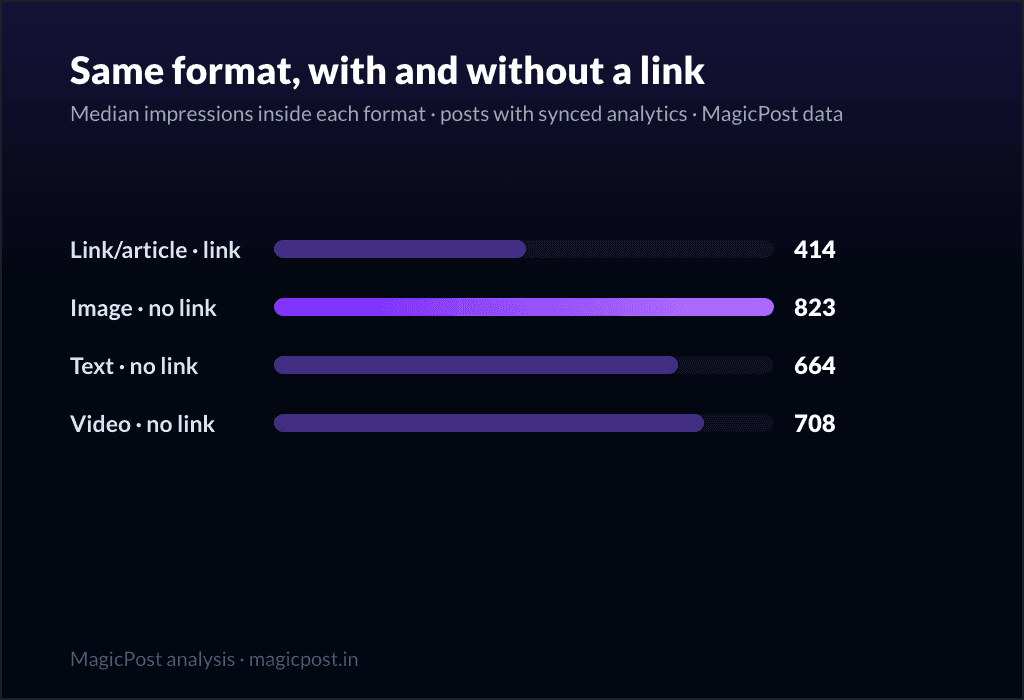
Article (attached link) | 32,897 | 414 | 6 |
Image, no link | 347,689 | 823 | 23 |
Video, no link | 43,078 | 708 | 17 |
Text only, no link | 98,249 | 664 | 11 |
The attached-link/article post (414 impressions) trails even the humblest link-free format, text-only at 664. So part of the gap is format weakness. In the same pooled data, a post carrying a URL in its body instead of an attached card showed no drop (858 versus 786).
The format confound explains why article posts look bad in raw medians; it does not rescue the attached card. Against the author's own posts without links, a card still sits 19% below since mid-May 2026, close to the 21% of a typed URL.
Does it hold for small accounts?
Yes, in every follower band we measured in the pooled data. We re-ran the attached-versus-no-link split inside three audience sizes, on the same synced-analytics pool.
Follower band | No attached link | Attached link |
Under 5k | 455 | 266 |
5k to 50k | 1,401 | 726 |
50k+ | 9,140 | 3,705 |
The attached-link reach cut is roughly a halving at every size: 455 to 266 for small accounts, 1,401 to 726 in the mid band, 9,140 to 3,705 for the largest. (The absolute numbers climb steeply with audience, which is its own story in what counts as good LinkedIn reach for your size.)
Big or small, posts with a preview card reached about half as many people in this raw data. The gap scales with you rather than sparing the small accounts or hitting the large ones harder.
Four years of creators learning this the hard way
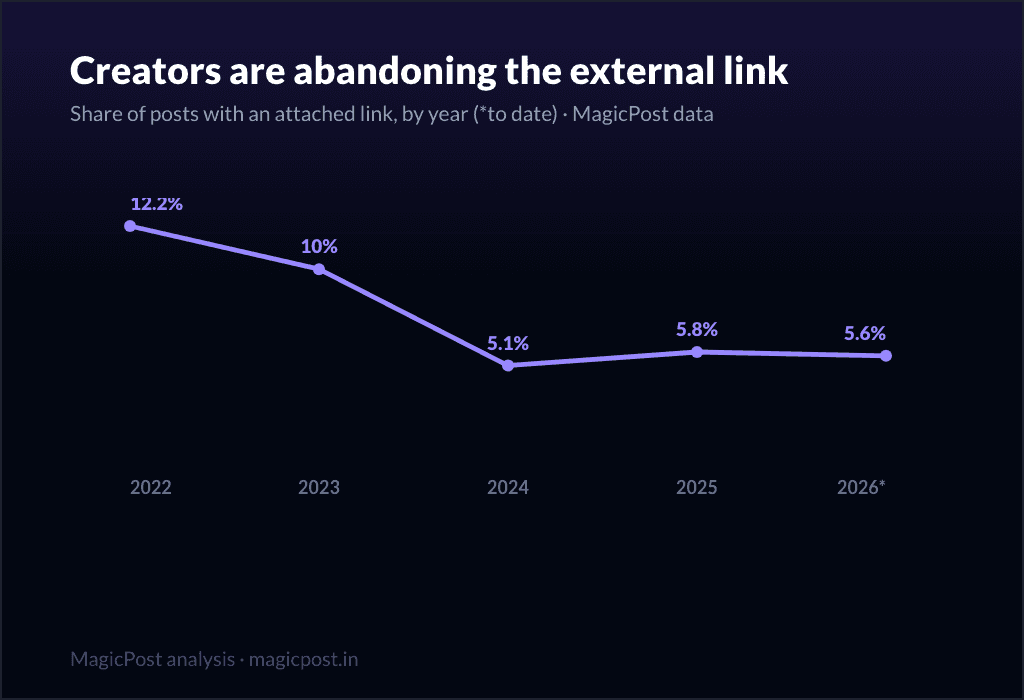
If attached links cost reach, you would expect creators to abandon them over time. They did. We tracked the share of posts carrying an attached link by year.
Year | Posts measured | Share with attached link |
2022 | 65,739 | 12.2% |
2023 | 170,452 | 10.0% |
2024 | 606,050 | 5.1% |
2025 | 1,342,058 | 5.8% |
2026 | 468,845 | 5.6% |
Attached links fell from 12.2% of posts in 2022 to 5.6% in 2026, less than half their former share, with the sharp drop landing in 2024. This is creators learning the cost the slow way.
The advice "do not link out" became folklore because, for attached cards, the raw numbers backed it. The in-body URL looked harmless in those same numbers; against the same author's posts without links, it cost 12% before mid-May 2026 and 21% since. (History note: our corpus grows over time, so read year-to-year shares as directional; the halving survives that caveat comfortably. More on these dynamics in how the LinkedIn algorithm works in 2026.)
So where do you put the link?
Three options. Since mid-May 2026 they cost within a few points of each other, so the choice depends on what the post is for.
In the post body, as plain text. In the pooled raw data, in-body links earned 858 median impressions, on par with link-free posts (786). Our 2026 algorithm study measures each author against their own posts without links: there, a typed URL sits 21% below since mid-May 2026 (12% before). It spares you the preview card, not the reach cost.
In the first comment. This is the most popular advice on LinkedIn. This page's data does not isolate it: it separates attached cards from in-body URLs and from no link. Our later study of LinkedIn comment bait did measure posts that tell readers the link is in the comments: they sit about 11% below their author's average post, before and after late July 2026, while posts ending on a “Comment KEYWORD” line fell to about half.
The 2026 algorithm study uses another base, the author's posts without links: on that base, a “link in the comments” line sits 16% below since mid-May 2026 (8% before). Either way, the first comment costs some reach, about as much as the other two placements.
As an attached preview card. The clear loser in the raw medians (414 impressions). Since mid-May 2026 it sits 19% below the author's posts without links, down from 39% before, so it is no longer far behind the other two. Use it when the post's job is to drive a click and impressions are secondary.
The instinct most creators absorbed ("links kill reach, so never link") was too blunt for the raw data, where only the card cost reach. Since mid-May 2026, every placement costs between 16% and 21% against the same author's posts without links. If reach is the post's main job, leave the link out.
See the cost before you pay it. MagicPost puts drafting, scheduling and analytics for your LinkedIn posts in a single place, so you can watch in your own numbers what an attached link does to a post before you ever spend the reach on it.
Where this data comes from (link reach methodology)
These figures are MagicPost's own first-party research. The reach figures come from 566,957 LinkedIn posts with synced analytics (the sum of 534,030 posts without an attached link and 32,927 with one), published over the last 12 months, reshares and deleted posts excluded, aggregated and anonymized. "Attached link" means a post that renders a LinkedIn preview card (the article format); "in-body link" means a URL inside the post text with no card; "no link" means neither. The three-way split covers 32,927 attached, 69,166 in-body and 464,864 link-free posts. Follower-band and by-format cuts use the same pool. History tracks the share of posts carrying an attached link from 2022 to mid-2026, medians and shares computed within each year and directional by construction since the corpus grows. We use medians throughout, so one viral post cannot move a row. The data is the June 2026 cut and gets refreshed as new posts come in. The same-author figures before and since mid-May 2026 (typed URL, link card, “link in the comments” line, each against the author's posts without links) come from our separate 2026 algorithm study of 687,000 LinkedIn posts.
FAQ
Do external links kill your LinkedIn reach?
Yes, wherever the link sits. In pooled raw data to June 2026 (566,957 posts), posts with an attached preview card earned 414 median impressions versus 795 without one, and URLs in the post body 858. Since mid-May 2026, against the same author's posts without links, a typed URL sits 21% below, a link card 19%, a “link in the comments” line 16%.
Does LinkedIn penalize links in posts?
Our data shows how much links cost, not why. In a 566,957-post raw sample up to June 2026, attached-card posts reached 414 median impressions, in-body URLs 858, link-free posts 786. Since mid-May 2026, against the same author's posts without links, every placement sits lower: a typed URL 21%, a link card 19%, a “link in the comments” line 16%.
Should I put my link in the first comment?
Putting your link in the first comment costs some reach: posts that point to a link in the comments sit about 11% below their author's average post, before and after late July 2026, in MagicPost's comment-bait study of 684,000 LinkedIn posts.
MagicPost's 2026 algorithm study uses another base, the author's posts without links: there, a “link in the comments” line sits 16% below since mid-May 2026 (8% before), a typed URL 21%, a link card 19%. So the body is no longer the safer spot.
Are link posts really worse, or is it just the article format?
Both play a part. Attached-link posts are almost all the article format, the weakest in our raw medians to June 2026 (414 impressions, below text-only at 664). In that pooled data, a URL in the body showed no drop (858 versus 786). Against the same author's posts without links, a typed URL sat 12% below before mid-May 2026, 21% since.
How much reach does an attached link cost on LinkedIn?
In pooled raw data up to June 2026, roughly half at every audience size: median impressions fall from 455 to 266 under 5k followers, 1,401 to 726 for 5k to 50k, 9,140 to 3,705 for 50k+. Against the same author's posts without links, a link card sits 19% below since mid-May 2026, 39% before.