" height="26.80529977783203px" id="tymKb8bqC" width="128.00300311279295px"/><path d="M 0 2.417 L 0 0 L 12.909 0 L 12.909 2.417 Z" fill="rgb(126, 78, 253)" height="2.417099999999998px" id="aYr4em6zK" transform="translate(128.341 22.325)" width="12.908999999999992px"/></svg>)

"/><stop offset="1" stop-color="rgb(118, 37, 250)"/></linearGradient></defs><g d="M 19.242 21.22 L 19.362 6.204 L 19.272 6.204 L 13.757 21.22 L 10.161 21.22 L 4.796 6.204 L 4.706 6.204 L 4.825 21.22 L 0 21.22 L 0 0 L 7.283 0 L 12.109 13.607 L 12.229 13.607 L 16.844 0 L 24.247 0 L 24.247 21.22 Z M 26.421 26.113 L 26.421 23.445 L 41.407 23.445 L 41.407 26.113 Z" fill="transparent" height="26.112508199679183px" id="DvfaAIHYn" width="41.40731898311435px"><path d="M 19.242 21.22 L 19.362 6.204 L 19.272 6.204 L 13.757 21.22 L 10.161 21.22 L 4.796 6.204 L 4.706 6.204 L 4.825 21.22 L 0 21.22 L 0 0 L 7.283 0 L 12.109 13.607 L 12.229 13.607 L 16.844 0 L 24.247 0 L 24.247 21.22 Z" fill="rgb(46, 46, 46)" height="21.220180016149442px" id="pLsxRCobd" width="24.247352589074694px"/><path d="M 0 2.668 L 0 0 L 14.986 0 L 14.986 2.668 Z" fill="url(%23yD9d4I5GR-3279285344-linear-gradient)" height="2.6675085048549647px" id="yD9d4I5GR" transform="translate(26.421 23.445)" width="14.986002836263765px"/></g></svg>)

Naïlé Titah
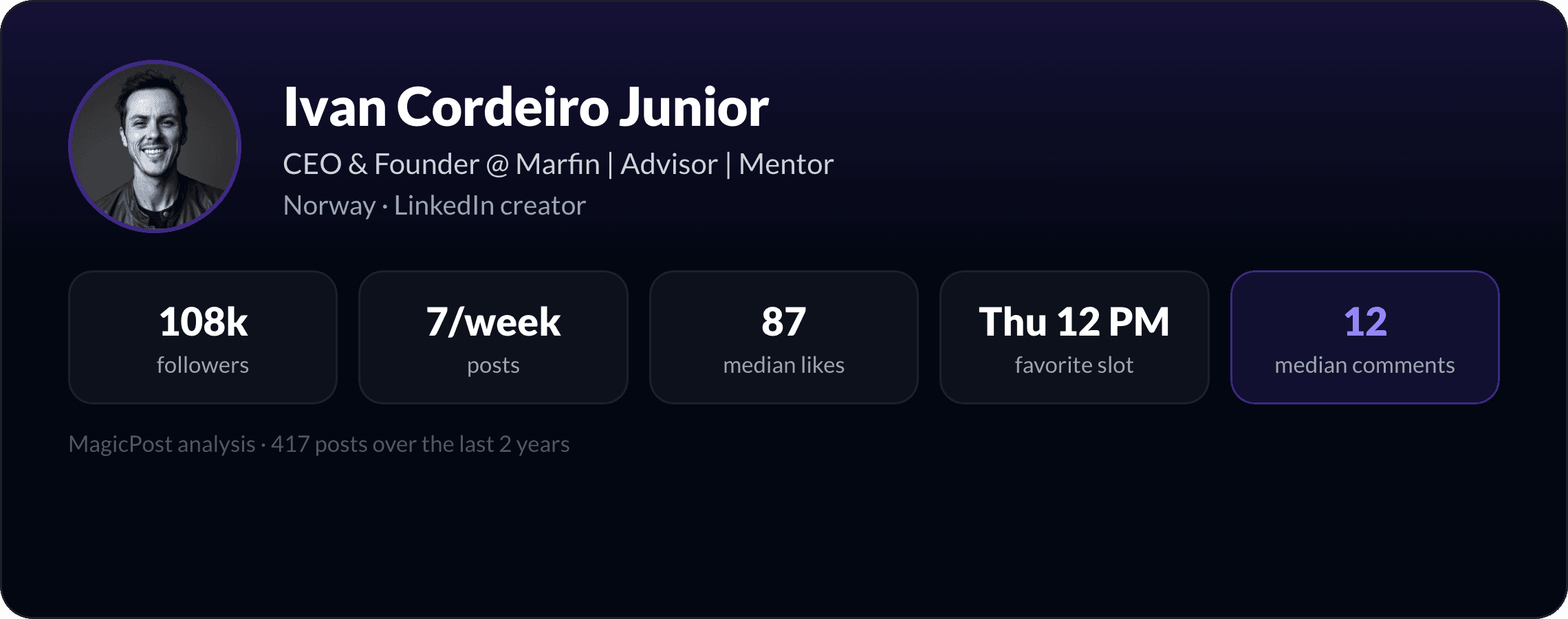
Ivan Cordeiro Junior is a Brazilian founder who runs his company Marfin from Oslo and writes in Portuguese to one of LinkedIn's most engaged audiences on management. At MagicPost, we analyzed 417 of his LinkedIn posts: what he writes, when, for whom, and what makes his style worth studying.
Here is the finding that frames everything else. Ivan is a CEO and venture builder, but his posts about being a CEO are not what his audience rewards. His Leadership posts pull a median of 313 likes, and his Entrepreneurship posts a median of 41, against an overall median of 87. The man whose day job is building companies gets four times the engagement when he turns around and tells employees the brutal truth about the bosses building them.
This is who Ivan Cordeiro Junior is, according to his own posts, measured.
His story, in his own posts
Ivan does not hide the scars. His most revealing post is a year-by-year timeline he published in October 2025, and it reads like a confession:
"2015: pedi demissão. Apostei tudo no meu primeiro negócio. Falhei. ... 2018: falhei de novo. Depressão profunda. 2019: voltei a viver. ... 2022: blitzscaling. Deu errado. Inverno de VC. Layoffs. Dívida multi-milionária. 2023: ... Mudo pra Noruega. Recomeço sozinho." (2015: I quit. Bet everything on my first business. Failed. ... 2018: failed again. Deep depression. 2019: came back to life. ... 2022: blitzscaling. It went wrong. VC winter. Layoffs. Multi-million debt. 2023: ... I move to Norway. Start over alone.) His conclusion is the spine of his whole brand: "Sucesso e fracasso coexistem." (Success and failure coexist.)
The near-collapse, told twice. That timeline is not a one-off. He re-tells the same 2022 chapter as a standalone post in April 2026: "Em 2022 eu quase quebrei a Marfin. Blitzscaling. Essa foi a palavra bonita que usei pra justificar crescer rápido demais." (In 2022 I almost broke Marfin. Blitzscaling. That was the pretty word I used to justify growing too fast.) And again, with its most quotable image, in a May 2026 post about trying to sell the company twice to competitors who ignored him: "A barata virou Fênix." (The cockroach became a Phoenix.) That arc is his signature story, recycled across at least three posts.
The bottom of the well. He has posted the depression openly. In a 2026 post built around an old photo: "Por fora, era o fundador tocando o barco. Por dentro, era um cara com depressão tentando não afundar." (On the outside, the founder steering the ship. Inside, a guy with depression trying not to sink.) He even indicts his younger self: "Eu fui um péssimo gestor," he wrote, rereading performance reviews from 2019, "E senti vergonha. E nojo." (I was a terrible manager. ... And I felt shame. And disgust.)



What he actually talks about
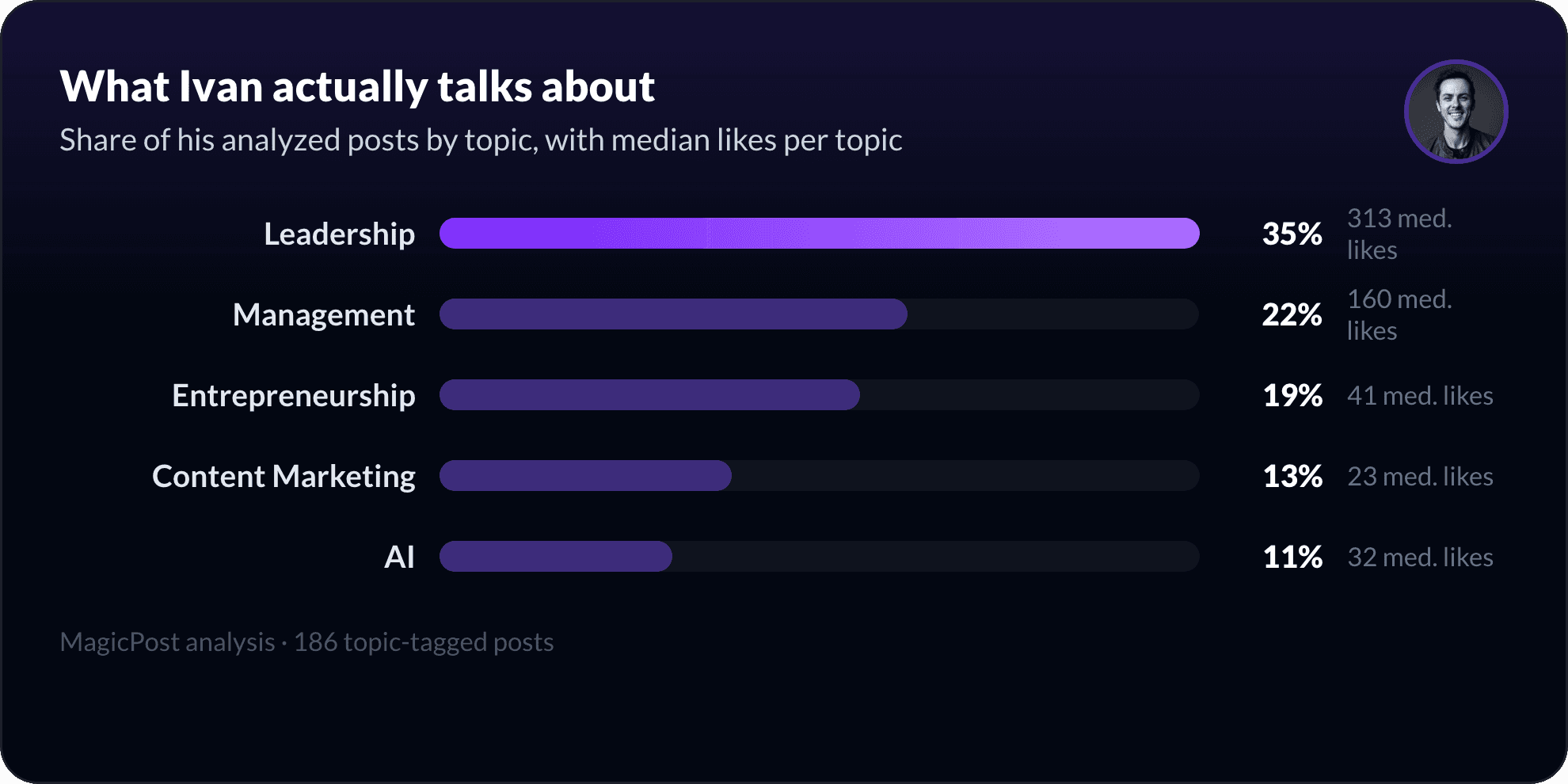
The mix tells the story of a founder writing against his own kind. Leadership and Management are his two biggest themes, and they are also his two best performers (median 313 and 160 likes). Entrepreneurship, his actual profession, ranks third by volume and dead last by engagement (median 41). Content Marketing and AI trail further behind.
Read by register rather than topic, the split is just as telling. The largest bucket is punchy standalone advice, about a third of everything he writes; the second largest is launch announcements for his many products. So the pattern is: he sells often, but the posts that travel are the ones with no product in them at all, the ones where he stands with the employee against the system he himself runs.
Who he writes for
His reader is not the founder. It is the talented employee trapped in a badly run company. He writes lines aimed straight at them: "Gente talentosa não sai por salário. Sai porque cansou de ser freada." (Talented people do not leave over salary. They leave because they are tired of being held back.) And the warning that competence will not save you: "Se o seu chefe não gostar de você... Ele vai dar um jeito de te demitir," because "O jogo corporativo não premia os mais competentes. Premia os mais estratégicos." (The corporate game does not reward the most competent. It rewards the most strategic.)
His best posts of 2026
His three biggest posts of 2026 so far, reproduced from our data (click through to the originals):
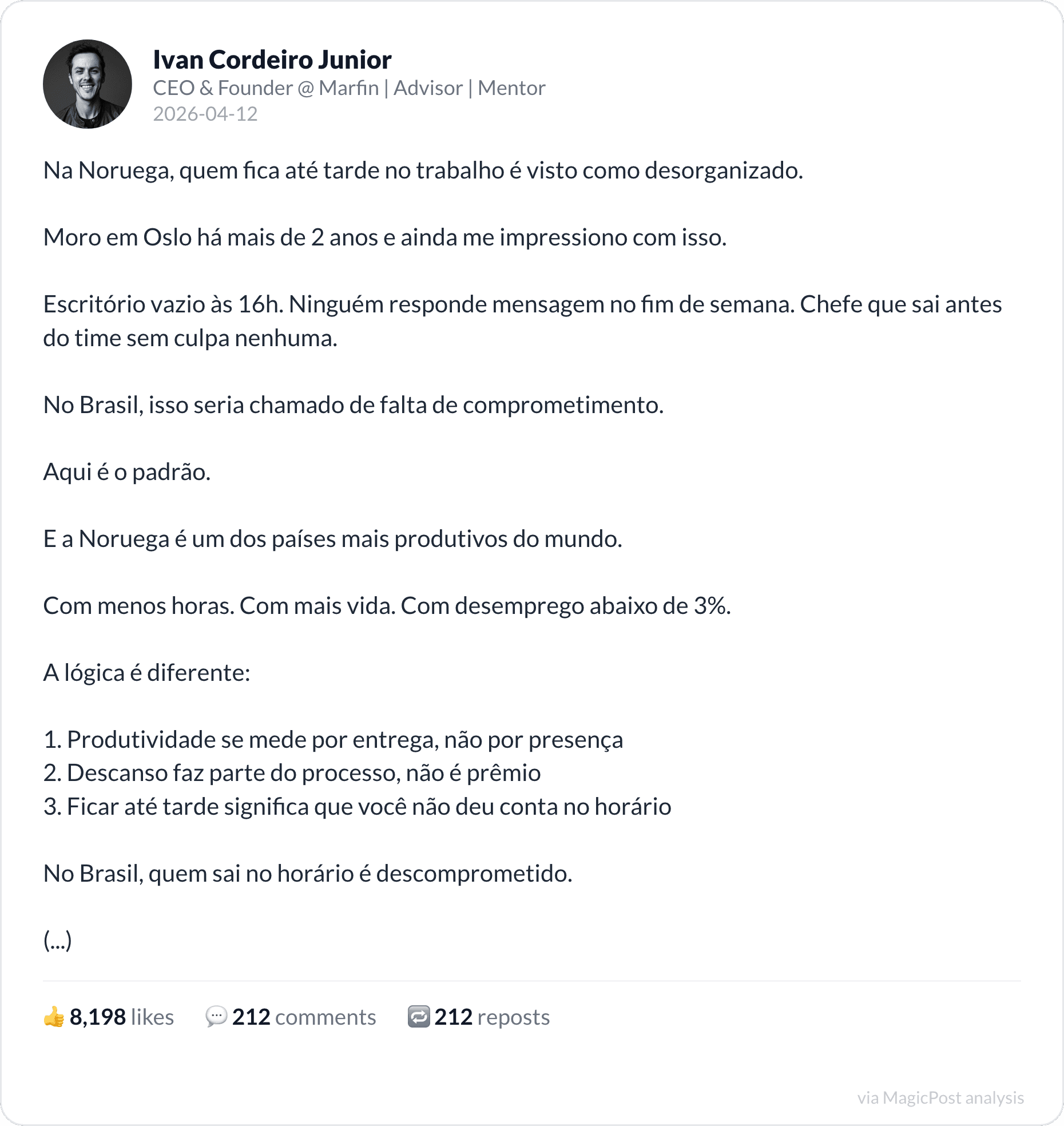
8,198 likes. "Na Noruega, quem fica até tarde no trabalho é visto como desorganizado." (In Norway, whoever stays late at work is seen as disorganized.) A clean two-worlds contrast (Brazil versus Norway) using his own relocation as proof, ending on a contrast he refuses to soften: "Mesma atitude. Duas leituras opostas." (Same attitude. Two opposite readings.)
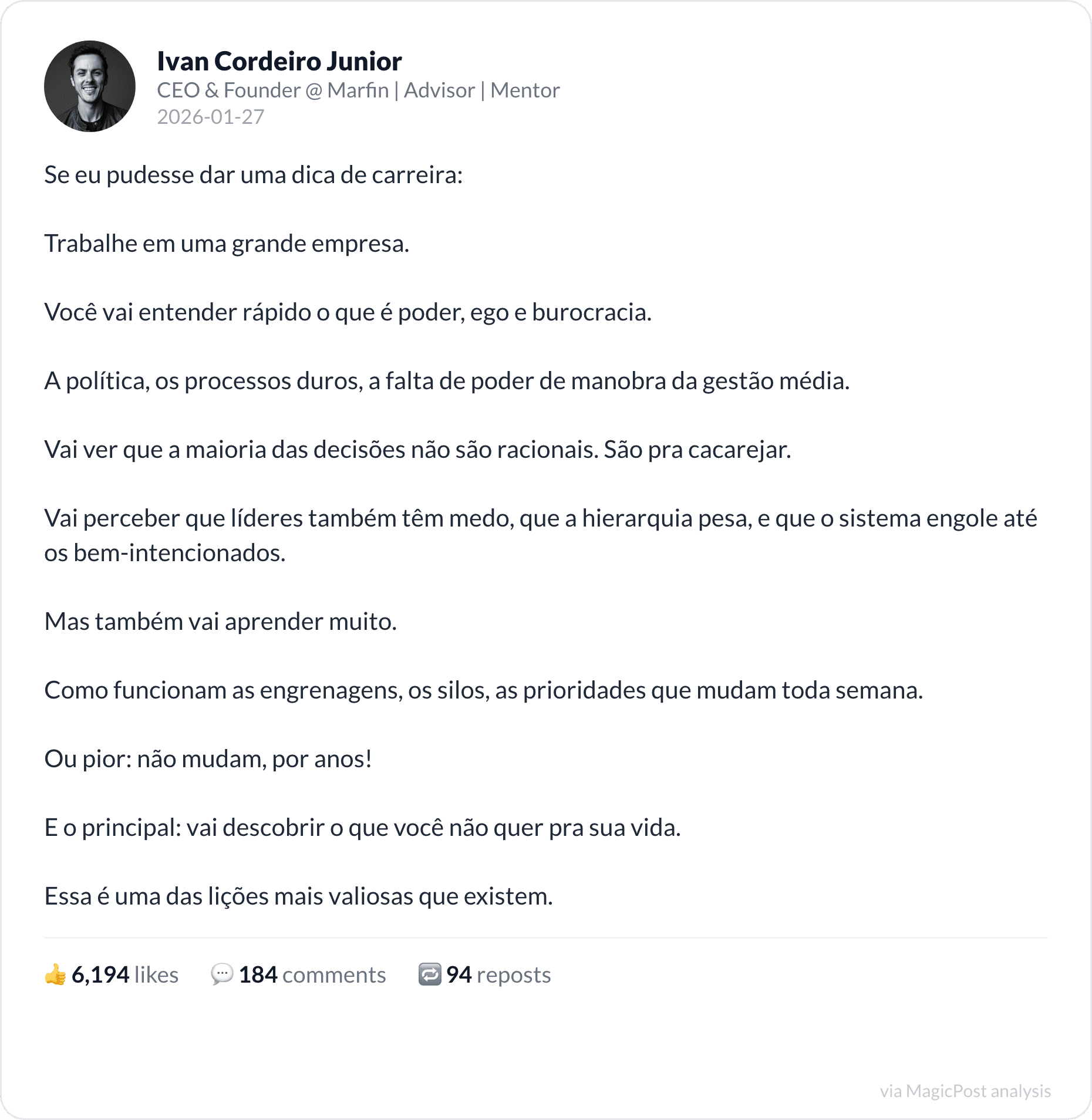
6,194 likes. A career tip that turns into a warning: "Trabalhe em uma grande empresa. Você vai entender rápido o que é poder, ego e burocracia." (Work at a big company. You will quickly understand power, ego and bureaucracy.) The payoff is the inversion: the real value is discovering what you do not want.
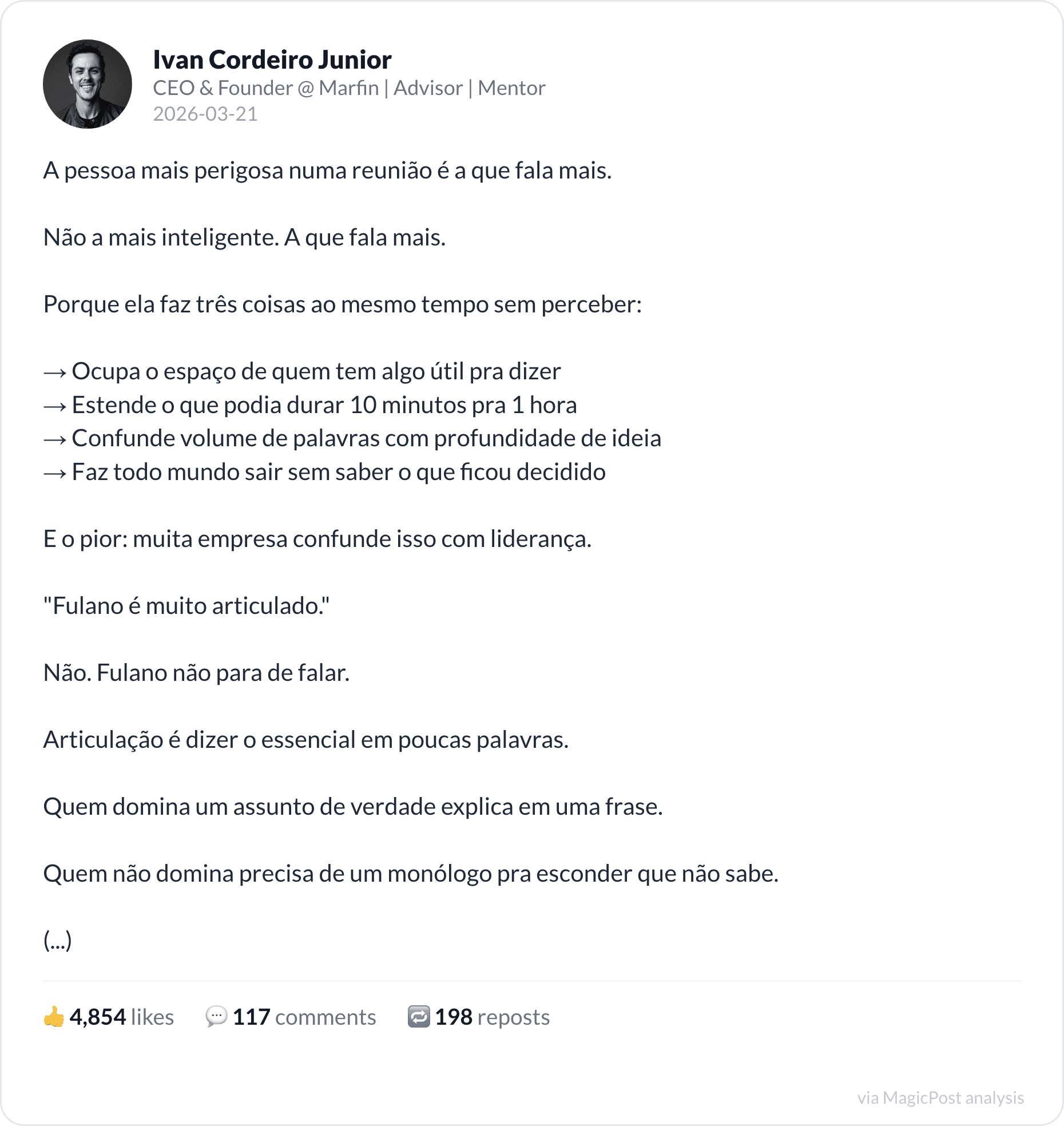
4,854 likes. "A pessoa mais perigosa numa reunião é a que fala mais. Não a mais inteligente. A que fala mais." (The most dangerous person in a meeting is the one who talks most. Not the smartest. The one who talks most.) A precise, naming-no-names indictment that lets every reader picture a specific colleague.
Is he still growing?
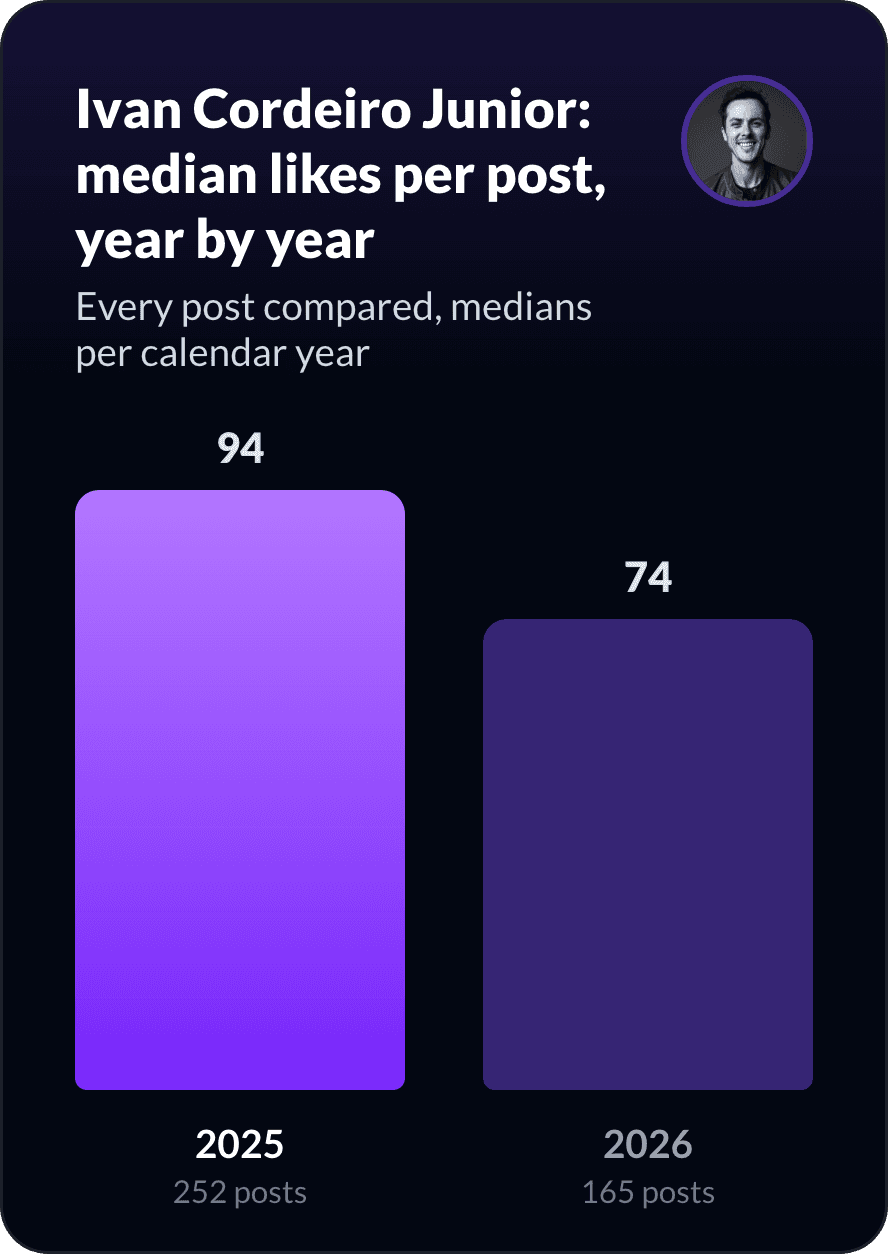
Here the honest answer is mixed. His median post drew about 94 likes in 2025 and about 74 in 2026, a step down even as the top posts got bigger. This is the most common shape on LinkedIn right now: biggest hits climbing while the median compresses, because reach gets harder and post volume rises. One caveat: we measure engagement per post, not followers over time, so this is how hard the average post lands, not his audience size, which sits near 108,000.
Where do these charts come from? Everything on this page runs on MagicPost's LinkedIn analytics, and it works on your profile too: your best posts, your audience, your benchmark, even a side-by-side with creators like Ivan Cordeiro Junior.
How he writes
Here is Ivan measured against the average creator:
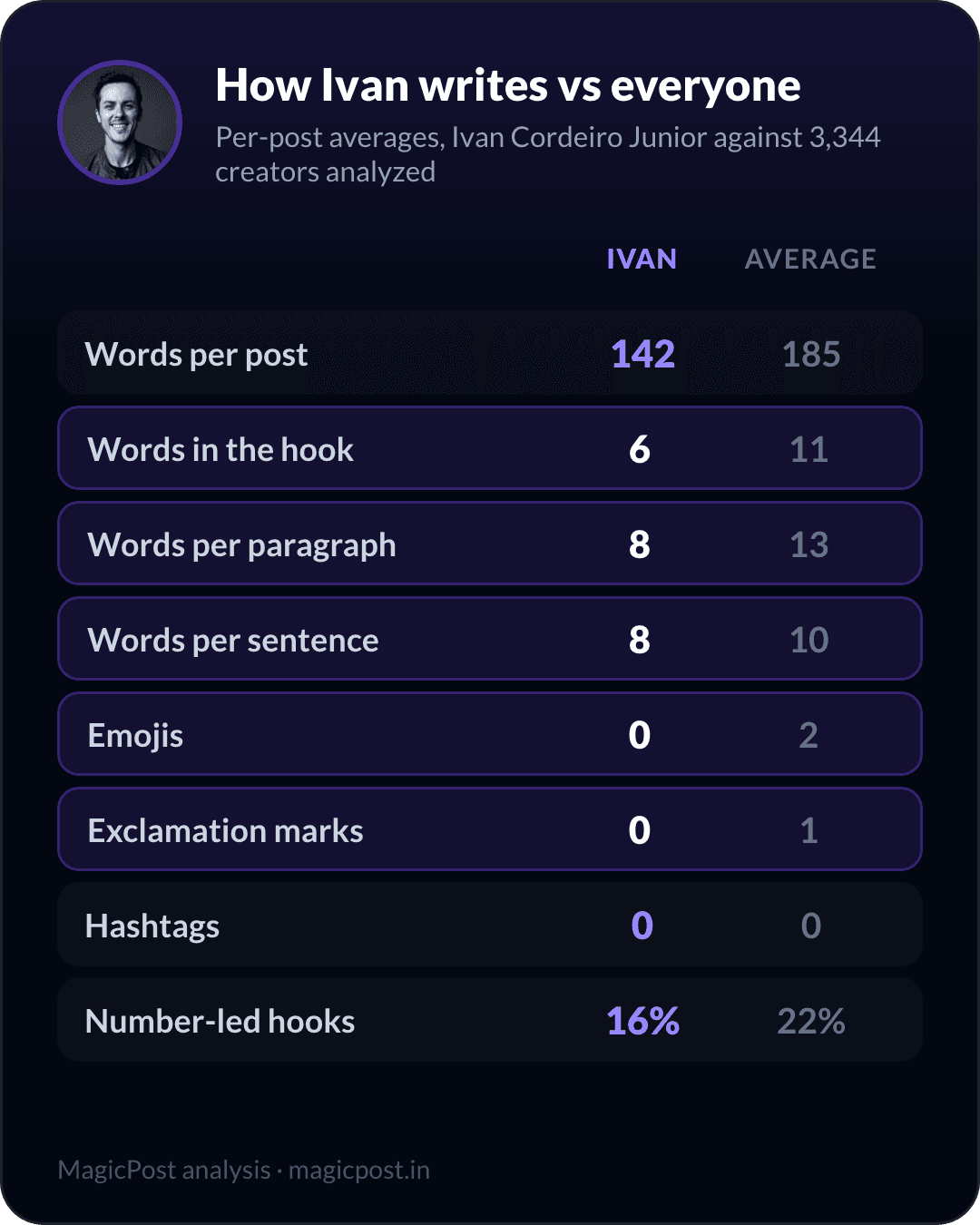
Metric (per post) | Ivan Cordeiro Junior | Average creator* |
Words | ~142 | 185 |
Words in the hook | 6 | 11 |
Words per paragraph | 8 | 13 |
Words per sentence | 8 | 10 |
Emojis | 0 | 2 |
Exclamation marks | 0 | 1 |
Hashtags | 0 | 0 |
Hooks built on numbers | 16% | 22% |
*Median across the 3,344 creators we analyzed with 20+ posts each.
The numbers do not just say "short," they say stripped. At 142 words he writes leaner than the 185-word average, but the real signature is the zeros: no emojis, no hashtags, no bold, no exclamation marks, across the whole sample. A six-word hook drops you straight into the claim with no warm-up, and his eight-word paragraphs mean most are a single sentence floating in white space. The effect is a flat, declarative voice that reads like someone stating facts he has already paid for. When our system describes his style in one word, it says: punchy.
The "AI tells" in his style (read this the right way)
Run Ivan's writing through the patterns people now call "AI tells," and one device stands out:
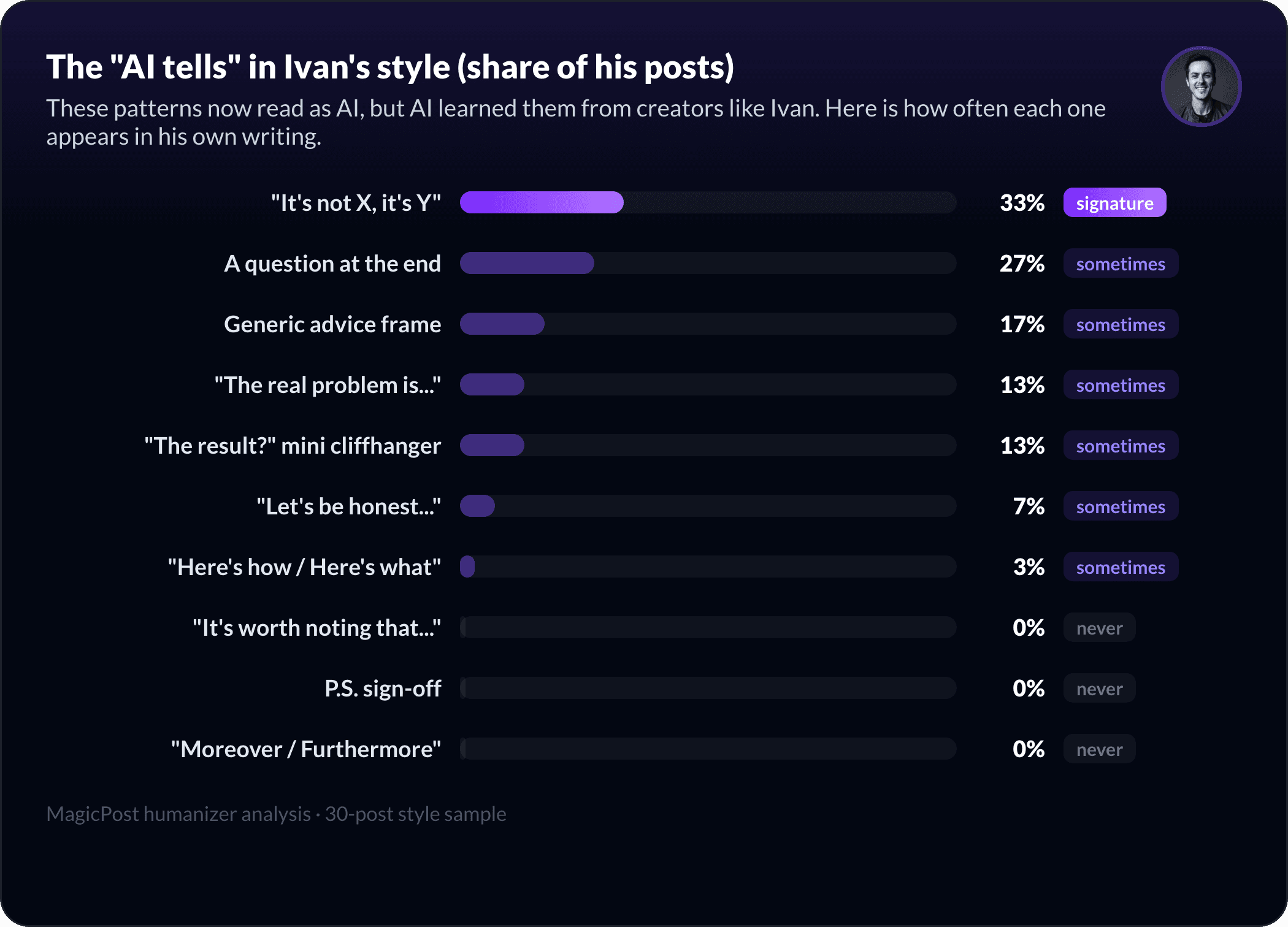
A third of his posts run the "It's not X, it's Y" contrast formula, his one characteristic move and the single most flagged "AI" pattern on LinkedIn. You can see why: his whole worldview is built on inversions ("Não a mais inteligente. A que fala mais."). A quarter of his posts close on a direct question to the reader ("Já sentiram isso?"), and a sixth lean on an advice frame.
Do not read it backwards. Ivan does not write like an AI; AI writes like Ivan. These contrast structures read as robotic today because the models trained on the best creators of this platform and then stacked every move at once, in every post. Ivan uses the contrast where it lands, because it is genuinely how he thinks. And the rest of his fingerprint is what AI cannot help adding and he refuses to: he never hedges, never opens with a throat-clearing "Moreover," never bolts on an automatic sign-off. The discipline is the signature. (Full story: how to spot AI writing on LinkedIn.)
When he posts
Ivan publishes about 8 times a week, favorite slot Thursday around midday, with only 13% of his posts on weekends: a steady weekday-business rhythm, and a volume that sits inside the range our posting-frequency study found among the creators who compound. Timing matters less than that consistency, but for finding your own best slot, see our general best-time data. And his posts get a median of 12 comments each, a lot of conversation to keep up with; showing up in those threads is exactly what an engagement feed is for: his posts, every day, without hunting the timeline.
What to steal from Ivan Cordeiro Junior
Write against your own tribe. The founder whose founder-posts under-perform found his audience by speaking for the employee. Pick the side of your topic your readers actually live on.
Make your failures the franchise. The "cockroach became a phoenix" arc gets re-run because the scars are specific and earned. Your worst year is your best content asset.
Strip the post bare. 142 words, no emojis, no bold, no exclamation marks. The flat voice is what makes the hard claims land.
One contrast, not six tricks. The "X, not Y" inversion in a third of his posts is a signature, not a tell, because it is the only AI-adjacent move he uses and it matches how he thinks.
End by handing the mic over. A quarter of his posts close with a real question, which is how a flat voice still generates 12 comments a post.
Study him, then study yourself. With MagicPost you can dig into Ivan Cordeiro Junior's numbers the way we just did, analyze your own LinkedIn performance with the same depth, and write in the spirit of his style: in your own voice. The data on this page is the product.
Where this data comes from
Everything in this article is MagicPost's own research. MagicPost analyzed 417 of Ivan Cordeiro Junior's public LinkedIn posts: timing, engagement, topics, writing metrics, and the AI-pattern profile from a 30-post style sample. Every biographical claim is quoted from one of his own public LinkedIn posts and linked to it. Ivan is not affiliated with MagicPost; his style is one of those we track closely, which is why we built this page.
FAQ
Who is Ivan Cordeiro Junior?
A Brazilian founder and CEO of Marfin, a venture builder he runs from Oslo, Norway. He has about 108,000 LinkedIn followers and writes in Portuguese, mostly about leadership, management and the realities of corporate life, drawing on a career he describes as a series of failures and recoveries since 2015.
How does Ivan Cordeiro Junior make money?
By his own public account, through Marfin, which he describes evolving from a single platform into a "máquina de criação" (creation machine) running many products at once, including software like WordzAI and Formz, plus a founders' community he calls Foundrs Mafia. He has said publicly that he rebuilt the company to be profitable and remote after a near-collapse in 2022.
How often does Ivan Cordeiro Junior post on LinkedIn?
About 8 times a week in our data, most often around midday on Thursdays, with only 13% of posts on weekends.
Does Ivan Cordeiro Junior write with AI?
His fingerprint reads intensely human: no emojis, hashtags, bold or exclamation marks, and none of the filler AI adds. The twist is that AI tools learned from creators like him, which is why about a third of his posts contain the "It's not X, it's Y" contrast people now mislabel as an AI tell.
Is Ivan Cordeiro Junior still growing on LinkedIn?
His biggest posts have grown (his top 2026 post passed 8,000 likes), but his median engagement per post stepped down from about 94 likes in 2025 to about 74 in 2026, the reach-compression shape common across LinkedIn right now. We measure engagement per post, not follower count over time.
Can I write like Ivan Cordeiro Junior?
You can learn the mechanics: MagicPost learns a creator's writing style (length, rhythm, hooks, signature moves) and helps you write in that spirit, in your own voice.
The Top LinkedIn Creators to Study in 2026 (By the Data)
The top LinkedIn creators to study in 2026, by the data: 62 creators, six languages, 27 countries, 32,000 posts analyzed by MagicPost. Grouped by what they teach.
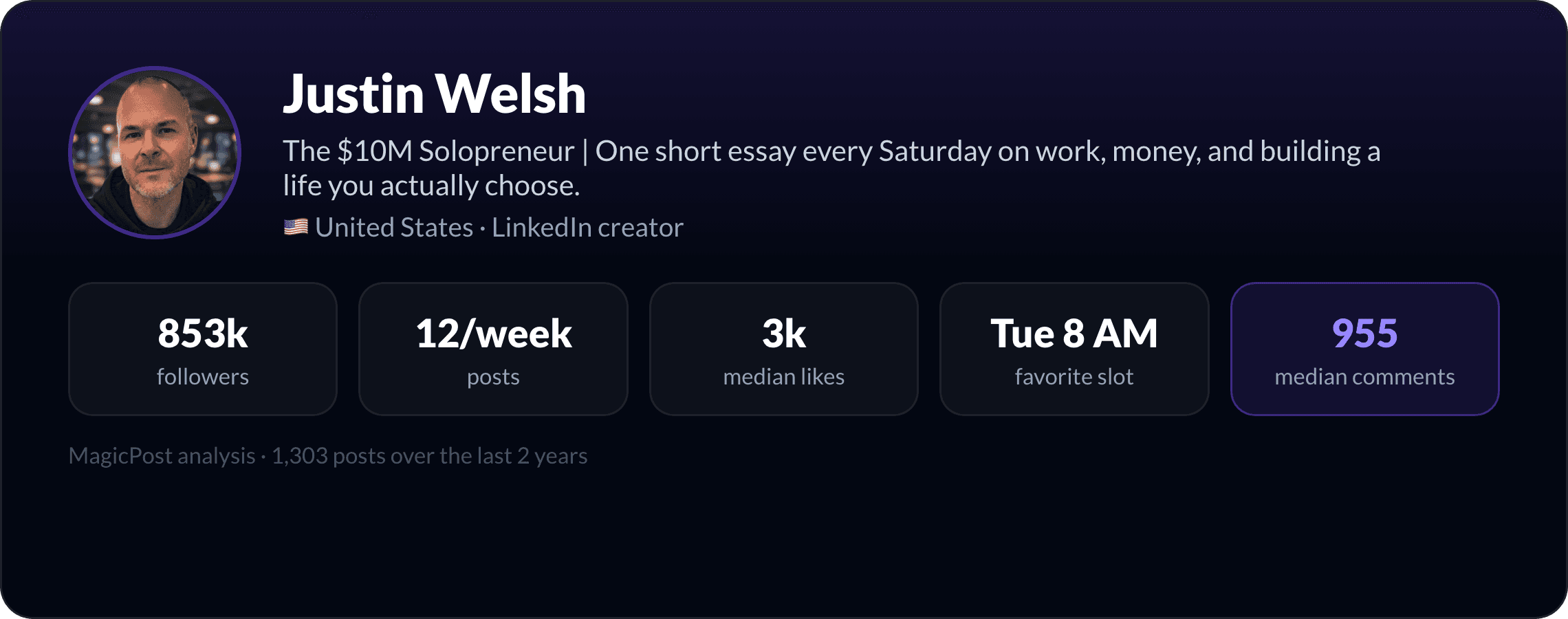
Who Is Justin Welsh? The $10M Solopreneur, Explained by Data (2026)
Who is Justin Welsh? MagicPost analyzed 1,303 of their LinkedIn posts: topics, timing, signature moves and the writing fingerprint behind their growth, with rea
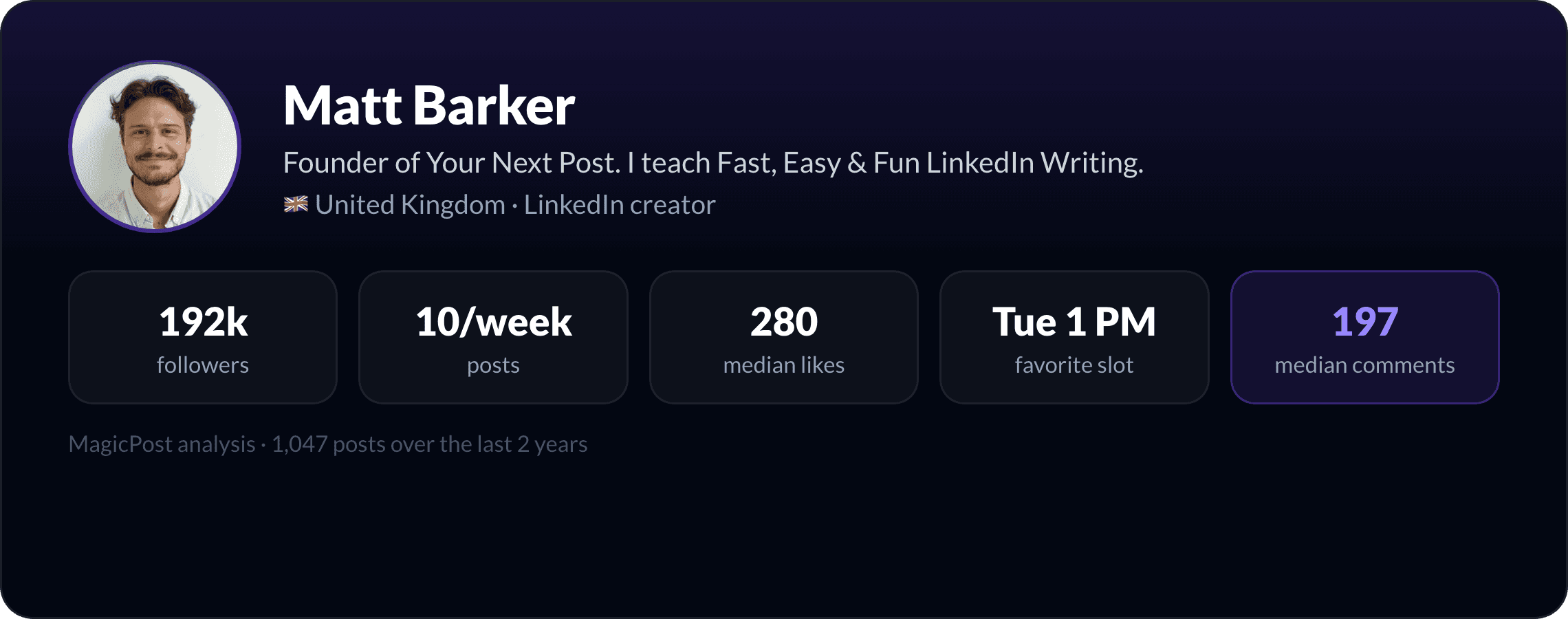
Who Is Matt Barker? The Hook Writer on LinkedIn, by Data (2026)
Who is Matt Barker? MagicPost analyzed 1,047 of their LinkedIn posts: topics, timing, signature moves and the writing fingerprint behind their growth, with real
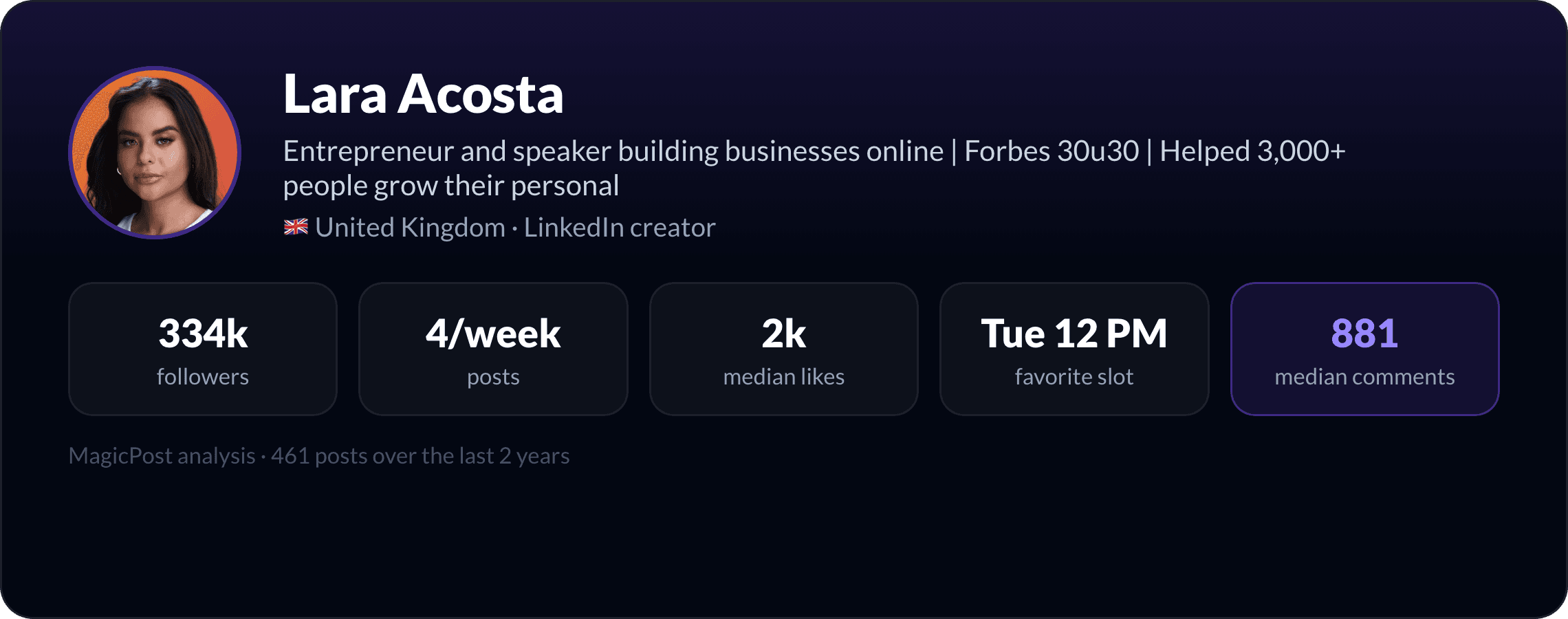
Who Is Lara Acosta? The Forbes 30 Under 30 Comment Machine, Explained by Data (2026)
Who is Lara Acosta? MagicPost analyzed 461 of their LinkedIn posts: topics, timing, signature moves and the writing fingerprint behind their growth, with real n
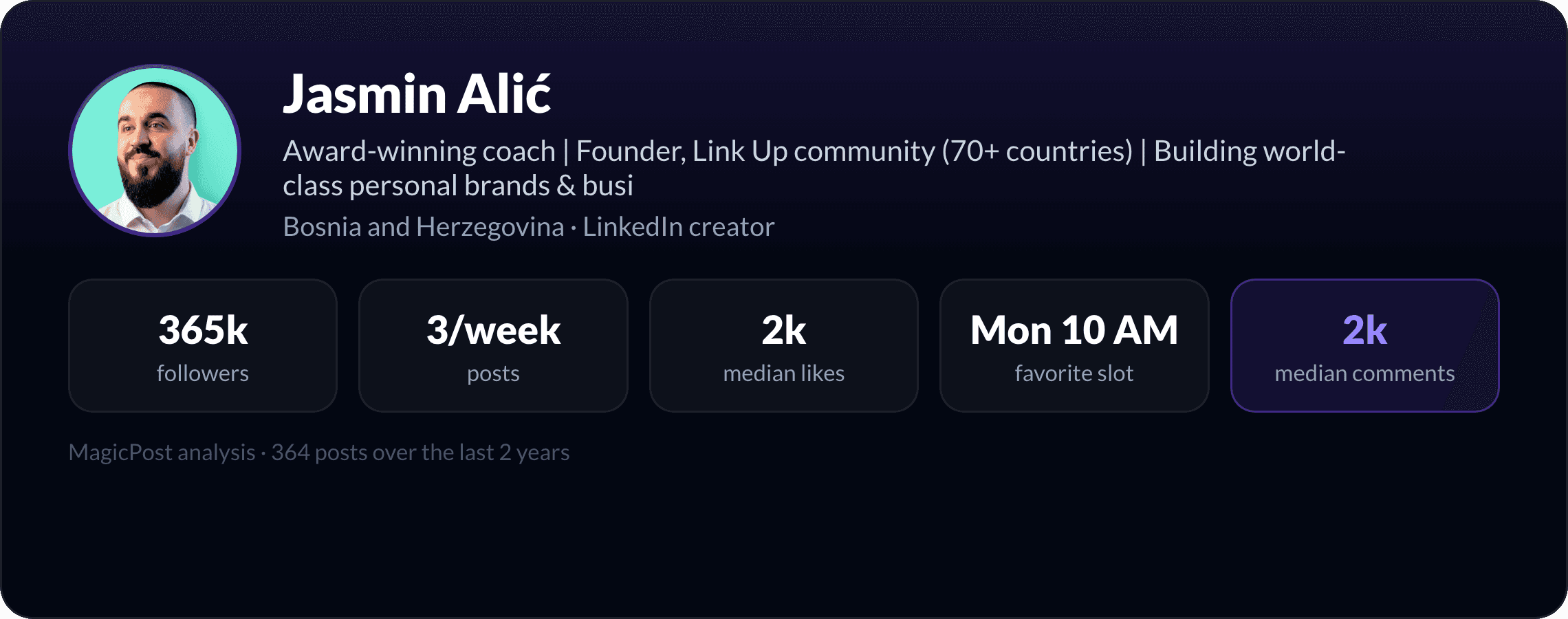
Who Is Jasmin Alić? The Bosnian Coach LinkedIn Mistook for a Bot (2026)
Who is Jasmin Alić? MagicPost analyzed 364 of their LinkedIn posts: topics, timing, signature moves and the writing fingerprint behind their growth, with real n
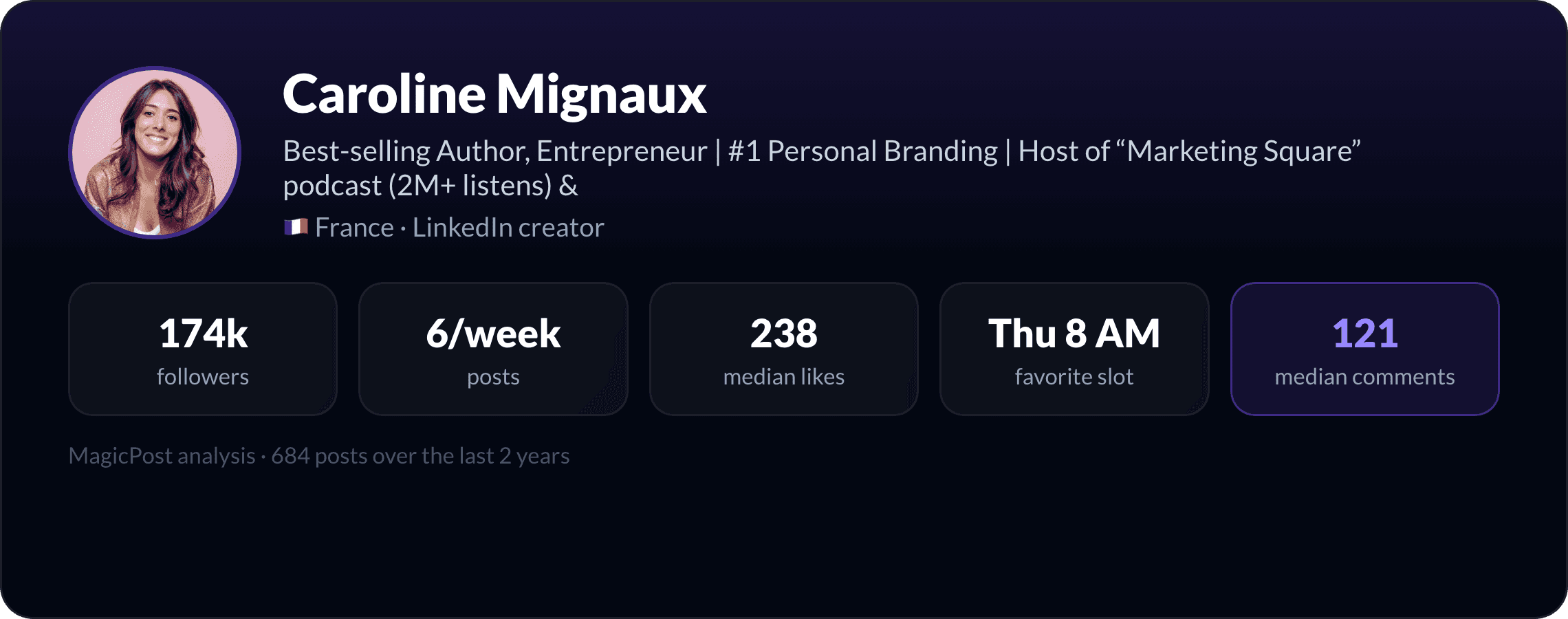
Who Is Caroline Mignaux? France's LinkedIn Top Voice Who Turned Shame Into a Following (2026)
Who is Caroline Mignaux? MagicPost analyzed 684 of their LinkedIn posts: topics, timing, signature moves and the writing fingerprint behind their growth, with r
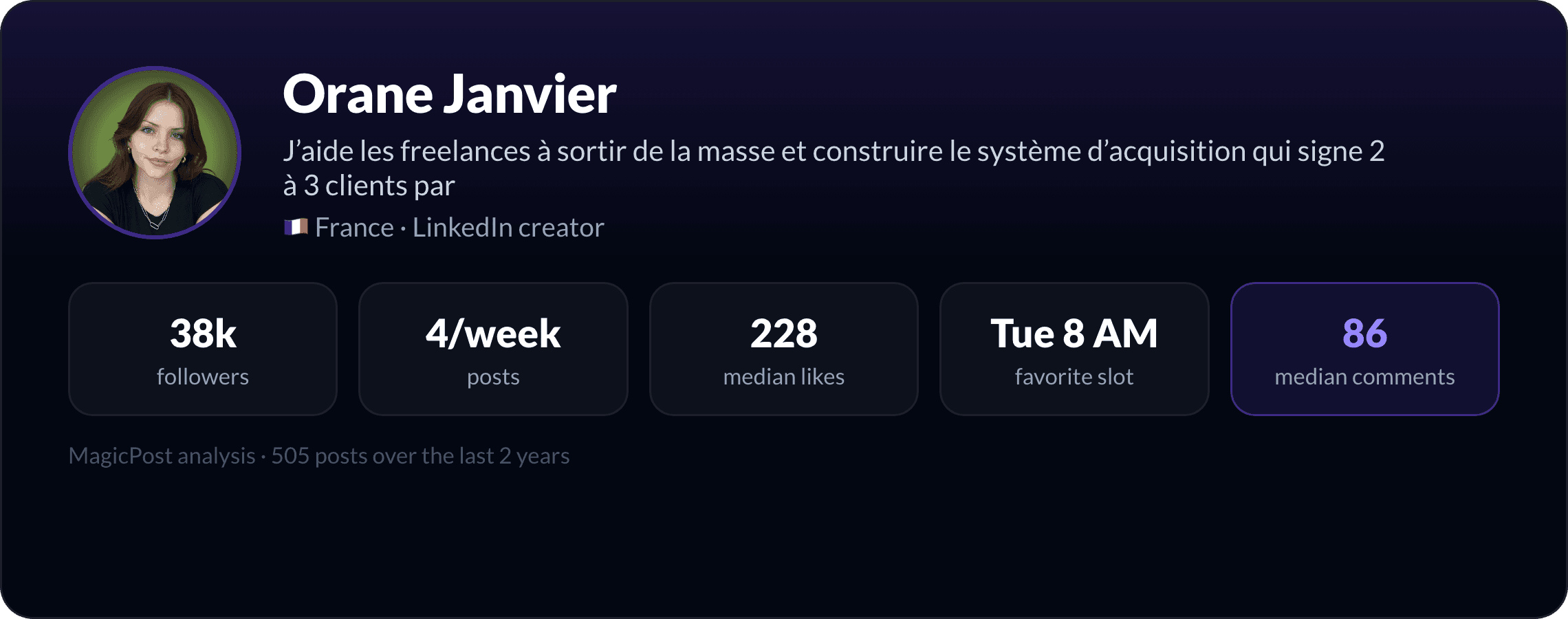
Who Is Orane Janvier? The Freelance Coach LinkedIn Quietly Copies (2026)
Who is Orane Janvier? MagicPost analyzed 505 of their LinkedIn posts: topics, timing, signature moves and the writing fingerprint behind their growth, with real
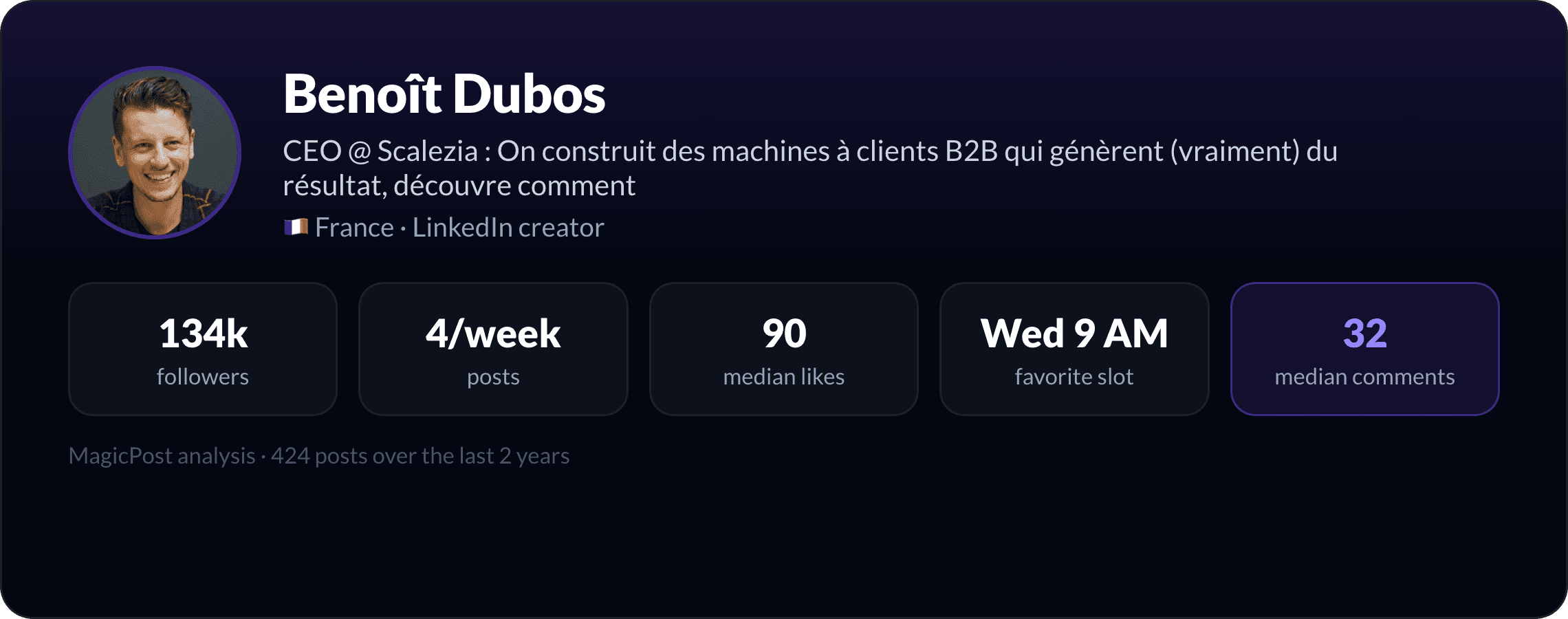
Who Is Benoît Dubos? The Growth Operator Who Turned a Falling Reach Into a Lead Machine (2026)
Who is Benoît Dubos? MagicPost analyzed 424 of their LinkedIn posts: topics, timing, signature moves and the writing fingerprint behind their growth, with real
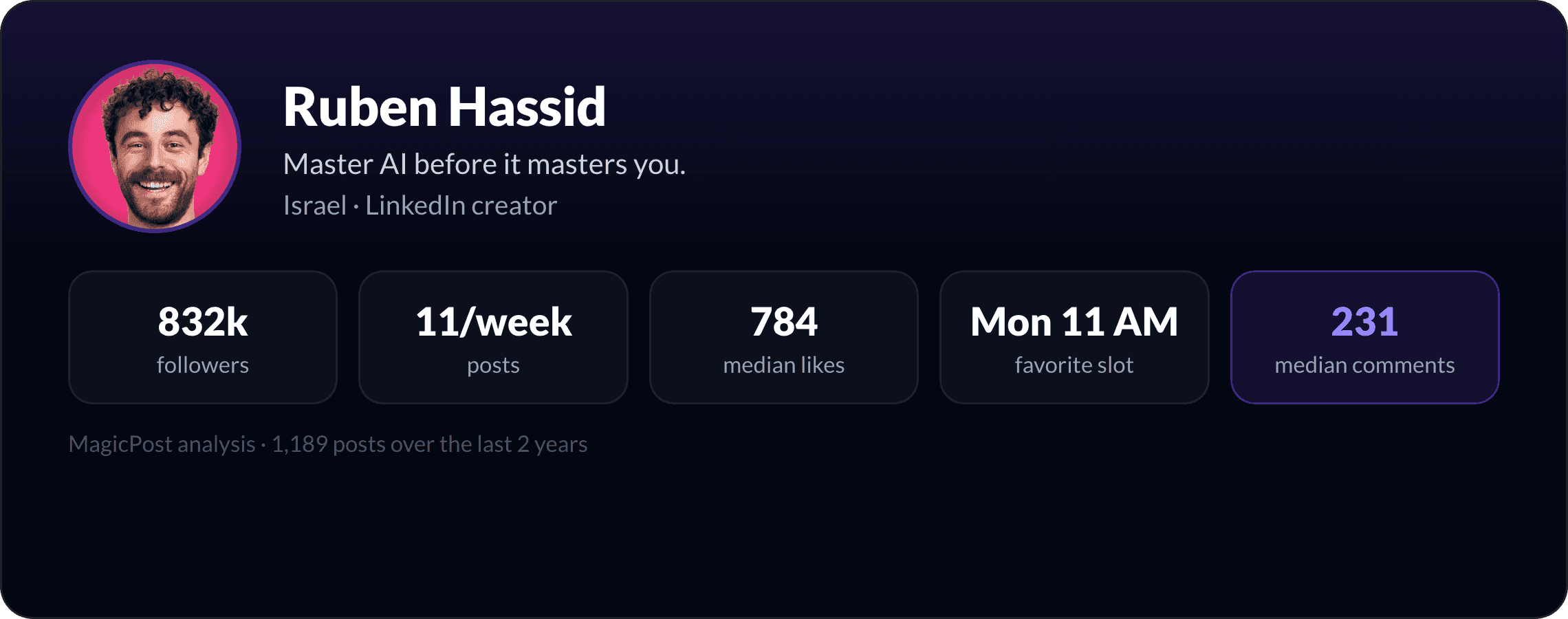
Who Is Ruben Hassid? The "Master AI Before It Masters You" Creator, Explained by Data (2026)
Who is Ruben Hassid? MagicPost analyzed 1,189 of their LinkedIn posts: topics, timing, signature moves and the writing fingerprint behind their growth, with rea
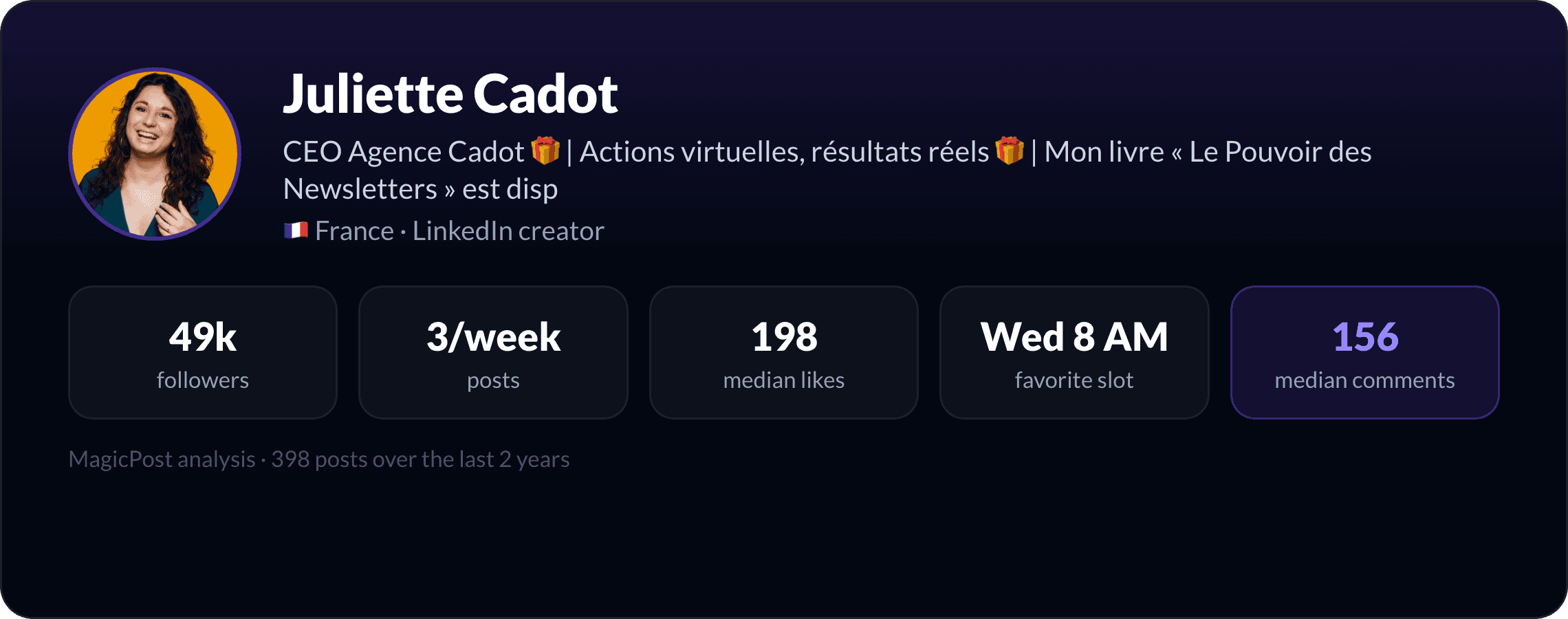
Who Is Juliette Cadot? The Agency Founder Whose Audience Talks Back (2026)
Who is Juliette Cadot? MagicPost analyzed 398 of their LinkedIn posts: topics, timing, signature moves and the writing fingerprint behind their growth, with rea