" height="26.80529977783203px" id="tymKb8bqC" width="128.00300311279295px"/><path d="M 0 2.417 L 0 0 L 12.909 0 L 12.909 2.417 Z" fill="rgb(126, 78, 253)" height="2.417099999999998px" id="aYr4em6zK" transform="translate(128.341 22.325)" width="12.908999999999992px"/></svg>)

"/><stop offset="1" stop-color="rgb(118, 37, 250)"/></linearGradient></defs><g d="M 19.242 21.22 L 19.362 6.204 L 19.272 6.204 L 13.757 21.22 L 10.161 21.22 L 4.796 6.204 L 4.706 6.204 L 4.825 21.22 L 0 21.22 L 0 0 L 7.283 0 L 12.109 13.607 L 12.229 13.607 L 16.844 0 L 24.247 0 L 24.247 21.22 Z M 26.421 26.113 L 26.421 23.445 L 41.407 23.445 L 41.407 26.113 Z" fill="transparent" height="26.112508199679183px" id="DvfaAIHYn" width="41.40731898311435px"><path d="M 19.242 21.22 L 19.362 6.204 L 19.272 6.204 L 13.757 21.22 L 10.161 21.22 L 4.796 6.204 L 4.706 6.204 L 4.825 21.22 L 0 21.22 L 0 0 L 7.283 0 L 12.109 13.607 L 12.229 13.607 L 16.844 0 L 24.247 0 L 24.247 21.22 Z" fill="rgb(46, 46, 46)" height="21.220180016149442px" id="pLsxRCobd" width="24.247352589074694px"/><path d="M 0 2.668 L 0 0 L 14.986 0 L 14.986 2.668 Z" fill="url(%23yD9d4I5GR-3279285344-linear-gradient)" height="2.6675085048549647px" id="yD9d4I5GR" transform="translate(26.421 23.445)" width="14.986002836263765px"/></g></svg>)

Naïlé Titah
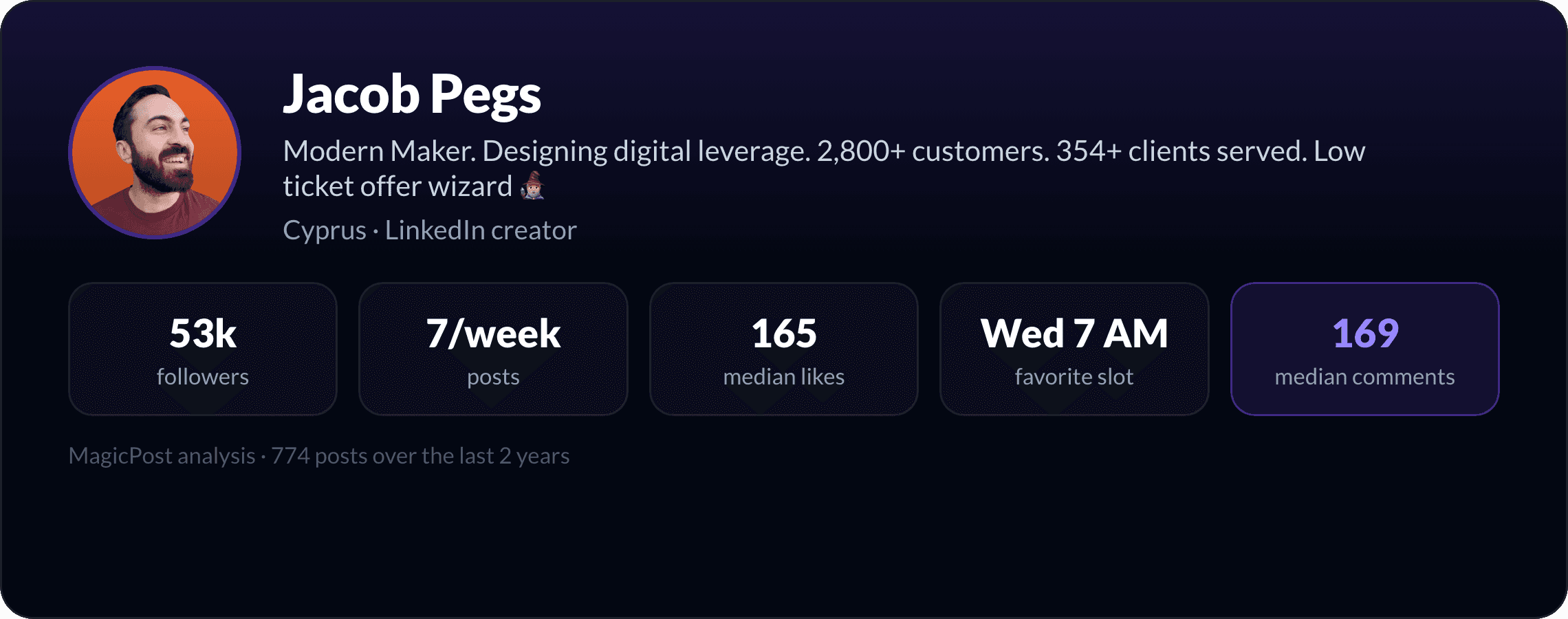
Jacob Pegs calls himself a "Modern Maker," a one-person business owner in Nicosia, Cyprus, who sells small digital products and coaching to solo builders. At MagicPost, we analyzed 774 of his recent LinkedIn posts, plus a close read of his 161 most personal ones.
Here is the finding nobody could write without the data: Jacob's median engagement has fallen three years running, from about 206 likes a post in 2024 to about 133 in 2026, and instead of hiding it, he keeps posting his own declining numbers as proof the model still works. This is who Jacob Pegs is, by the best source: his own posts, measured.
His story, in his own posts
You do not need a biographer for Jacob. He retells his origin story on LinkedIn often, and the data shows which chapters he treats as load-bearing.
The attic. The hinge of his whole brand is 2019. "In 2019, I left my €28,500/yr job in London. In exchange for a €14,000/yr job in Cyprus," he writes. "My parents had divorced (twice)... We lost my childhood home due to unpaid debt." He moved back to be near a father "diagnosed with lung cancer & bipolar," and "lived and worked from my girlfriend's parent's attic. With no office. 6 pets. 1 bed. A backpack. A laptop. A family."
Before the attic. A longer timeline fills in what came first: "At 18, I used to play music to earn a living," flying "to California to study Jazz Guitar," a Masters at UCL, and a now-famous detour: "I put my rent money on it. The rest is history. (2017 was a good year :) )," his nod to an early Bitcoin bet.
The climb out. From the attic he founded Mojo Design, "scaled Mojo to $500K/ARR," then "co-founded a Metaverse Consultancy and scaled it to $1.2M in 9 months," before launching the thing he is known for: "Founded Modern Maker, my solo consultancy helping creators install low ticket funnels, offers and email writing." His headline number: a seven-figure, one-person business, "over 350+ clients and over 2,800+ customers."
Why the money matters to him. His most-liked post of 2026 is not about funnels. "Last week I sent my mum $10k for her birthday," it opens, before the reason: "Take care of the people who carried you when you had nothing. Everything else is bullsh*t you'll forget in a week." Buying his mother a house, then a home for his own family, recurs as the emotional payoff of the business.
One detail our data surfaces that a normal bio never would: the timeline is a franchise, not a post. Jacob re-ships near-identical "here is my whole journey" recaps (the attic, the divorces, the lost home, the mum's beach house, the marathon) at least three times in the corpus, updating the client counts each time. The signature story is an asset he re-runs, not a one-off.



What he actually talks about
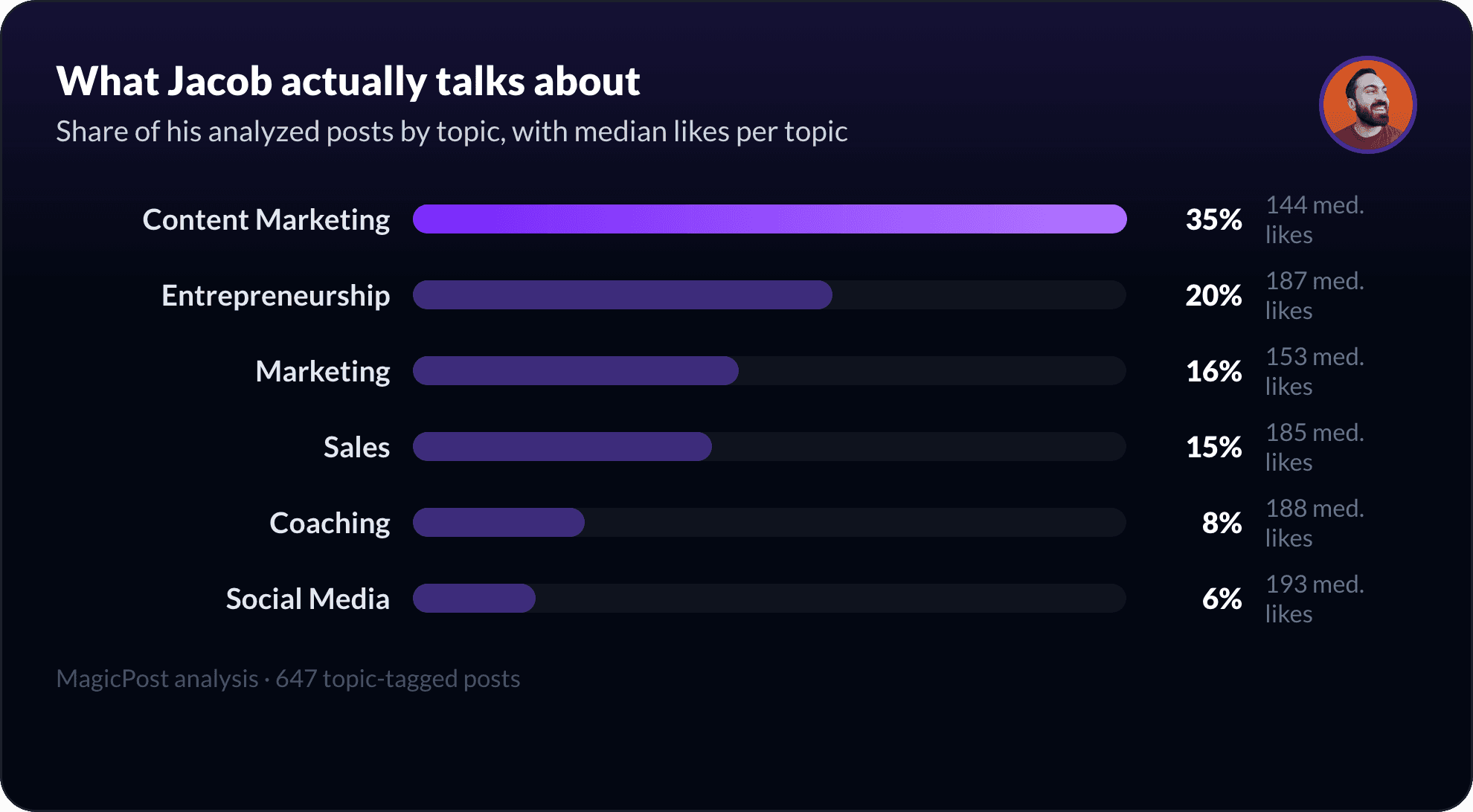
His feed is a marketing feed. Content Marketing is his single biggest theme (about 225 posts), with Entrepreneurship, Marketing, and Sales close behind. But the ranking hides the more useful signal: which themes land.
His most-frequent topic is his weakest performer. Content Marketing posts earn a median of about 144 likes, his lowest, while topics he posts less often hit harder: Social Media (about 193), Coaching (about 188), Entrepreneurship (about 187). When Jacob steps off tactics and into who he is and who he helps, his audience leans in.
By register rather than topic, about a quarter of his posts are punchy standalone advice, and nearly as many are "selling through value": a useful breakdown that ends in a soft offer. Add his "state of play" business updates and a layer of lead magnets, and you have the Modern Maker playbook in miniature: teach, prove, invite.
Who he writes for
His reader is explicit and repeated: the solo builder who wants out of the hustle, not into a bigger one. He writes to the person who, like him in 2018, is "Minimum wage. Underweight. Burned out. No holidays," and who suspects the grind is optional. His mantra for them: "Lead with impact, not impressions." The offers match exactly: low-ticket digital products, an email list, and coaching to "install" his model.
His best posts of 2026
His biggest posts of 2026 so far, from our data (click through to the originals):
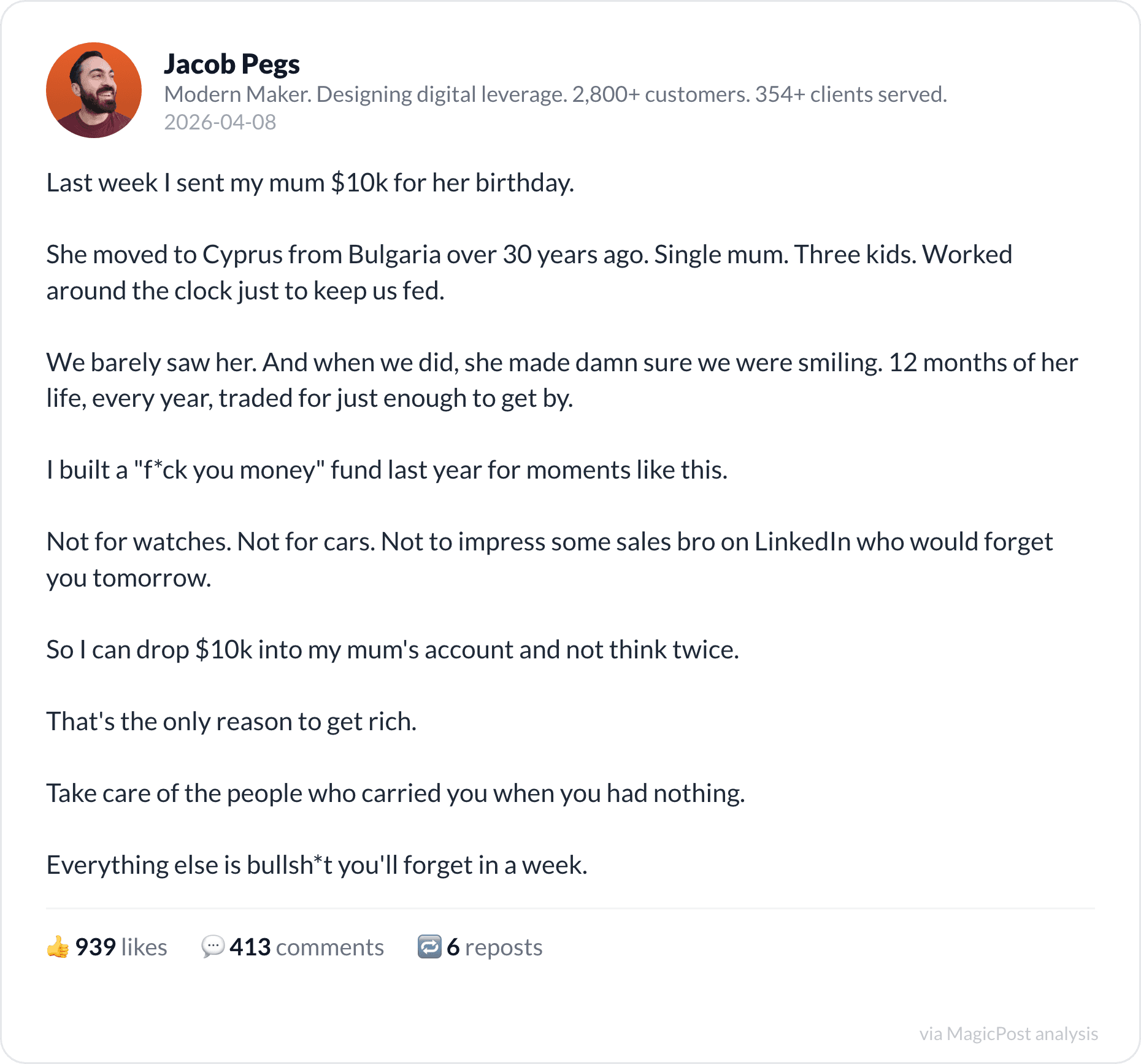
939 likes. A tear-jerk hook ("I sent my mum $10k for her birthday"), a single-mum backstory, then a clean values turn. Zero product, maximum proof of why he built the business.
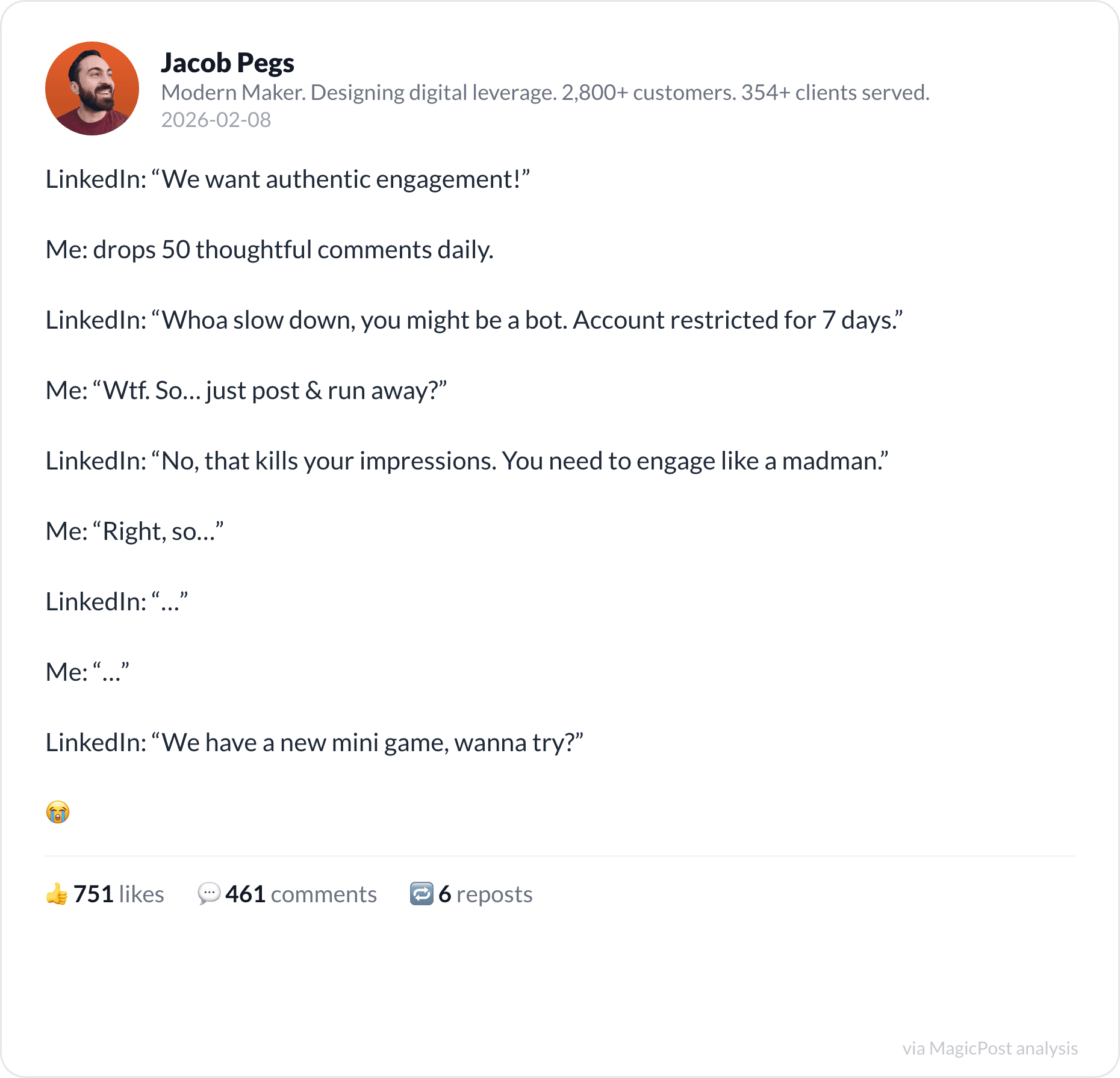
751 likes. A fake scripted dialogue with the platform itself ("Account restricted for 7 days... We have a new mini game, wanna try?"). It names a frustration every creator feels, which is why it pulled 461 comments.
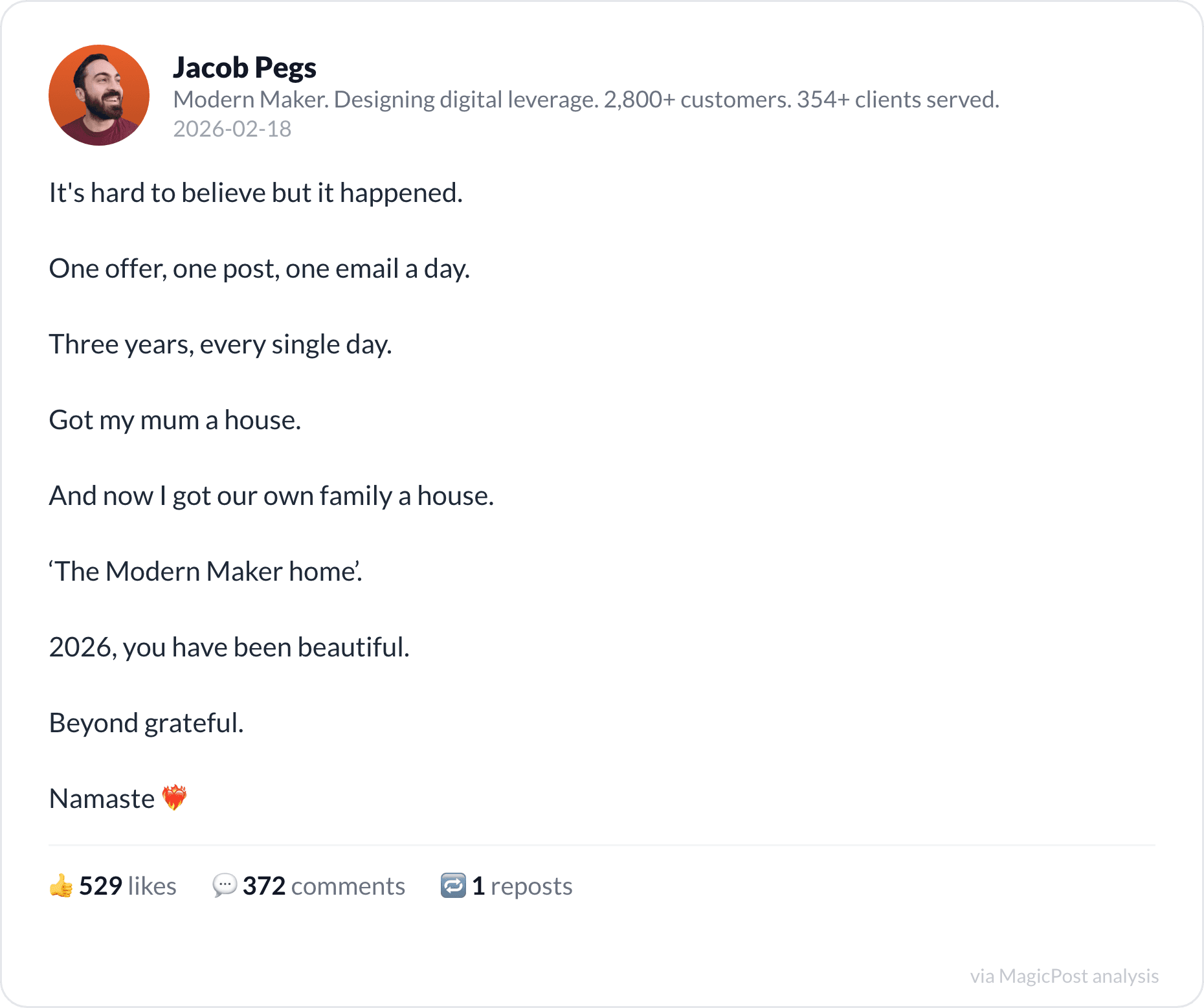
465 likes. Pure satire of the "AI agent did everything for me" genre: "it made me $500k this week... It also teleported me to the year 3000... while I ate watermelon & slept." Deadpan absurdity aimed at hype his audience is drowning in.
Is he still growing?
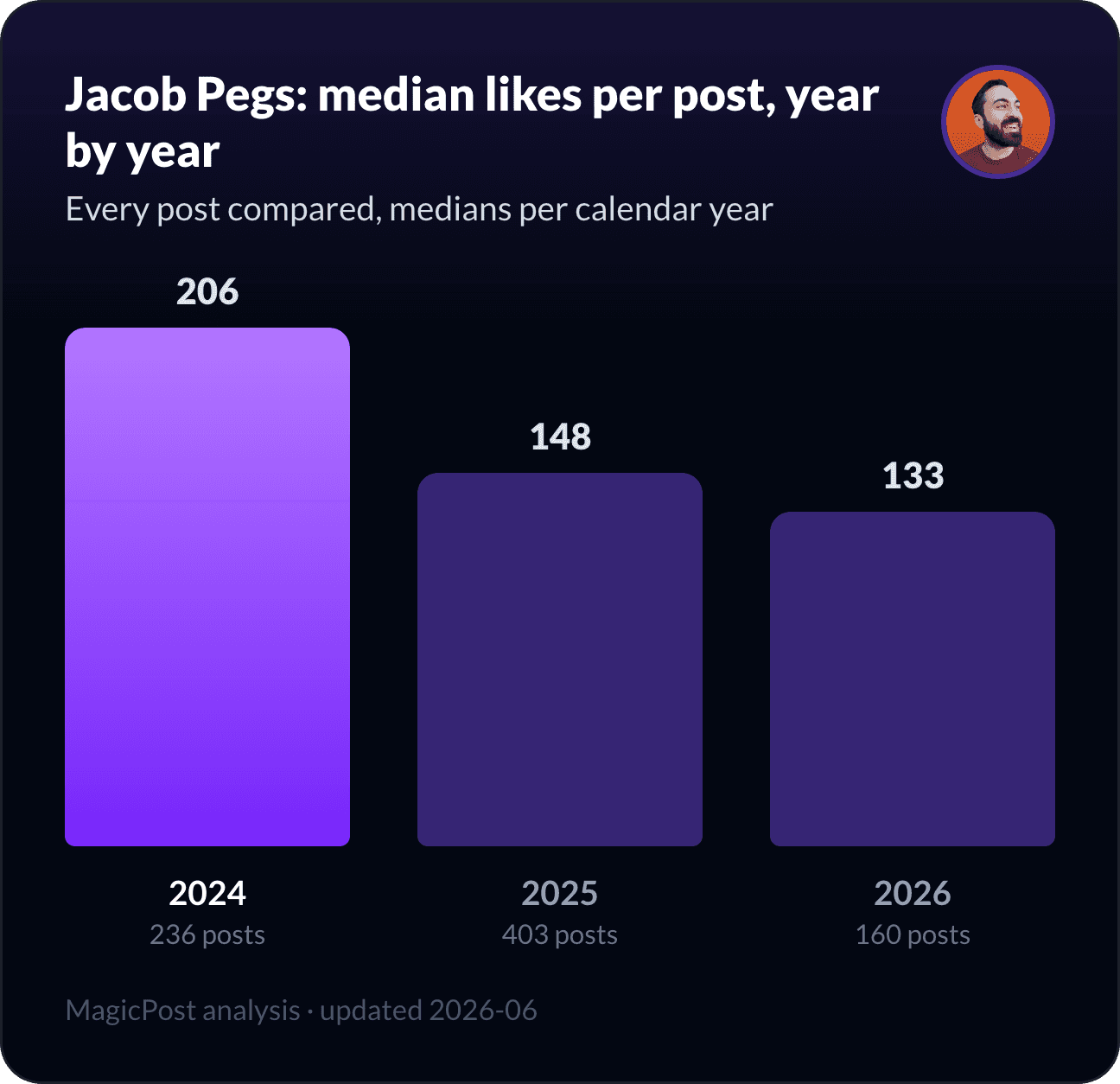
This is the honest part, and Jacob is honest about it too. His median engagement has stepped down each year: about 206 likes a post in 2024, 148 in 2025, 133 in 2026. That is not a collapse, it is the "reach compression" arc many established creators are living through as feeds get crowded.
What makes him unusual is that he narrates it. "My reach this month is down by -16.1%. But I'm pretty stoked if I'm honest," he writes, before listing a $20k product week. He has even built a whole post around the drop: "This year on LinkedIn: -40% in views, -64% in likes," only to land on "But those are not statistics that interest me," because he has "doubled down on my email list" instead. One honest note on our side: we measure engagement per post, not followers over time, so this is the trajectory of how hard each post lands, not of his audience size (around 53,000). For Jacob, that is the point: he treats likes as vanity and revenue as the scoreboard.
Where do these charts come from? Everything on this page runs on MagicPost's LinkedIn analytics, and it works on your profile too: your best posts, your audience, your benchmark, even a side-by-side with creators like Jacob Pegs.
How he writes
Here is Jacob measured against the average creator, and the headline is not "he writes short":
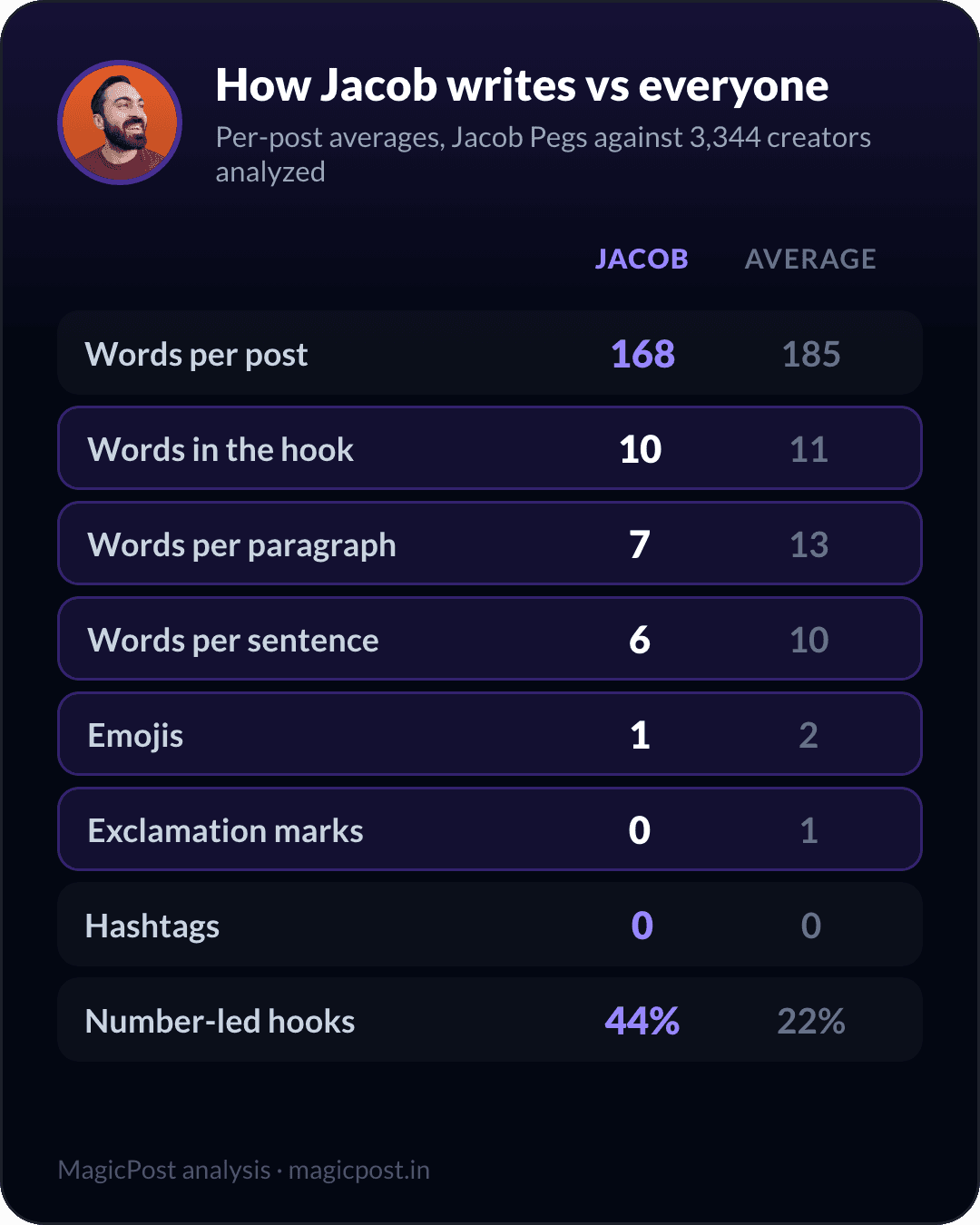
Metric (per post) | Jacob Pegs | Average creator* |
Words | ~168 | 185 |
Words in the hook | 10 | 11 |
Words per paragraph | 7 | 13 |
Words per sentence | 6 | 10 |
Emojis | 1 | 2 |
Exclamation marks | 0 | 1 |
Hashtags | 0 | 0 |
Hooks built on numbers | 44% | 22% |
*Median across the 3,344 creators we analyzed with 20+ posts each.
At about 168 words he writes a near-average-length post. The difference is the architecture inside it. His typical paragraph is seven words against the average thirteen, and his sentence six against ten: most paragraphs are a single short line with white space around it, the "one thought per line" cadence that makes his posts scannable on a phone. The most distinctive number is the hook: 44% of his posts open on a number ("My 1st month on LinkedIn: $73 in sales"), double the benchmark of 22%. He sells transformation, and a number makes one feel real fastest. In one word, our system calls his style punchy.
The "AI tells" in his style (read this the right way)
Run Jacob's writing through the patterns people now call "AI tells," and the picture is mostly clean, with one telling exception:
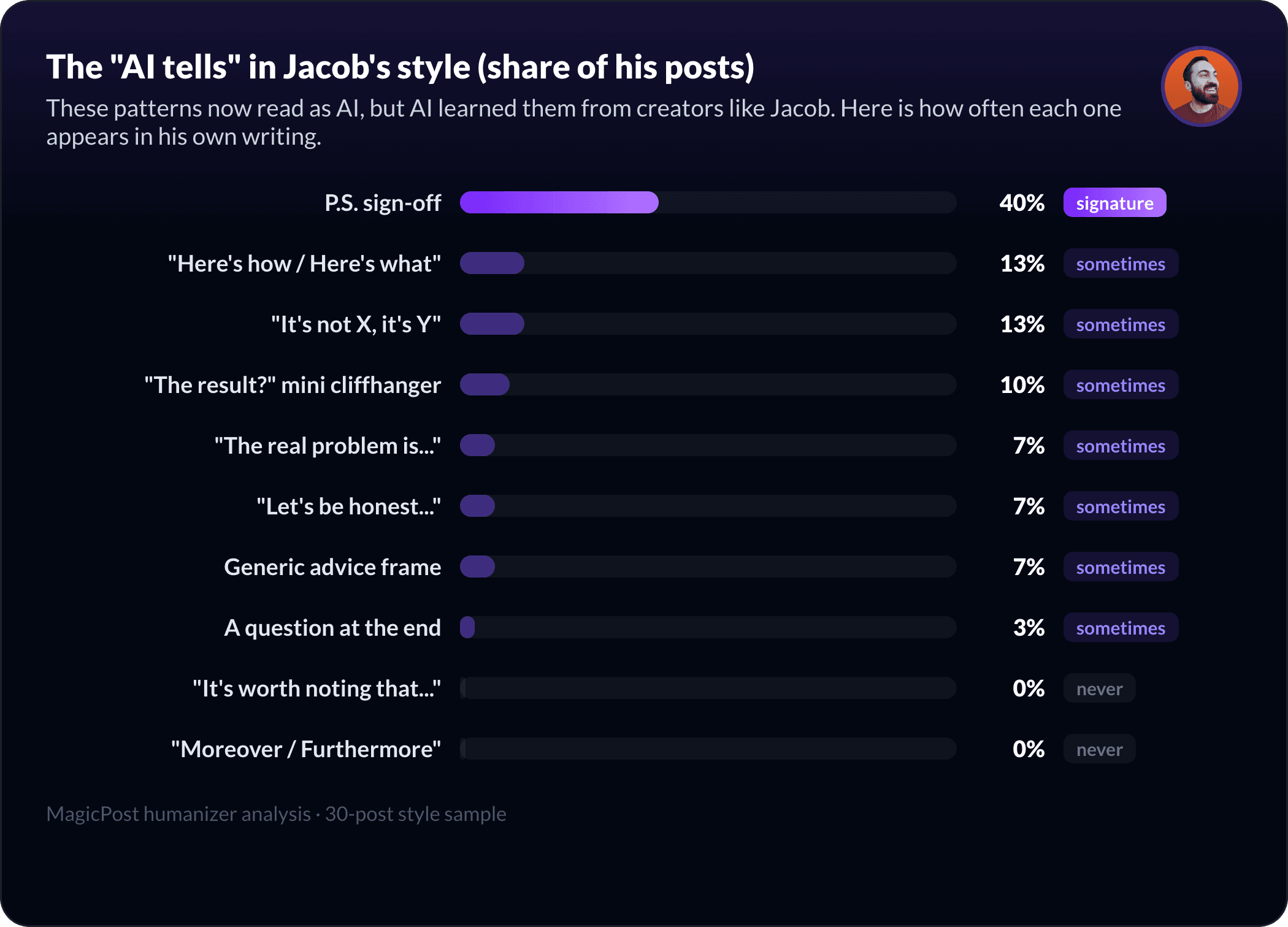
The one device genuinely characteristic of him is the P.S. sign-off: about 4 in 10 of his posts end with one. But his P.S. is not AI filler, it is a deliberate funnel: "PS. 3,400+ Modern Makers got their free sales post template," "PS. comment 'ENGINE' below and I'll DM it to you." It is the working end of his lead-magnet engine, not decoration. Everything else stays occasional at most: the "It's not X, it's Y" contrast formula appears in about 1 in 8 posts, the "Here's how" opener about as often, a reveal-the-real-problem bridge about 1 in 10.
Do not read it backwards. Jacob does not write like an AI; AI writes like Jacob. These moves read as robotic today because the models trained on creators like him and then stacked every device into every post. Jacob uses one where it earns its place, and never adds the filler AI cannot resist: he never hedges ("it's worth noting that..."), and never opens on a "Moreover" transition. The discipline is the signature.
When he posts
Jacob publishes about 7 to 8 times a week, favorite slot 7 AM, with 54% of his posts in the morning and a heavy 28% on weekends. That bias fits what our timing data finds about quieter, higher-attention windows, and his volume sits near the top of what our posting-frequency study measured. His real engine is the comments: a median of about 169 comments per post against 165 likes, an unusually high conversation rate driven by his "comment a word and I'll DM it" lead magnets. If your own playbook includes showing up in his comments the way he does in others', that is what an engagement feed is for: his posts every morning, without hunting the timeline.
What to steal from Jacob Pegs
Open on a number. 44% of his posts do, double the average. A concrete figure ("$73 in sales") makes the promise believable in line one.
Build a signature story and re-run it. His attic-to-seven-figures recap reappears with the counts updated. Your origin story is an asset, not a one-off.
One thought per line. Seven-word paragraphs, six-word sentences. Same total length as everyone else, far more readable on a phone.
Let the P.S. do the selling. Four in ten posts end with a soft lead-magnet invite, so the body stays pure value.
Be honest about the down months. His "reach is down 16%, but here's the revenue" posts build more trust than a victory lap.
Study him, then study yourself. With MagicPost you can dig into Jacob Pegs's numbers the way we just did, analyze your own LinkedIn with the same depth, and write in the spirit of his style, in your voice. The data on this page is the product.
Where this data comes from
Everything in this article is MagicPost's own research. MagicPost analyzed 774 recent Jacob Pegs posts (and a close read of his 161 most personal ones): timing, engagement, topics, writing metrics, and the AI-pattern profile from a 30-post style sample. Every biographical claim is quoted from one of his own public LinkedIn posts and linked to it. Jacob is not affiliated with MagicPost.
Veelgestelde vragen
Who is Jacob Pegs?
A Cyprus-based founder who calls himself a "Modern Maker": he runs a seven-figure, one-person business helping solo builders sell low-ticket digital products and coaching through writing and email. By his own account he has served "over 350+ clients and over 2,800+ customers," with about 53,000 LinkedIn followers.
How does Jacob Pegs make money?
By his own posts: small digital products and templates, a paid community and coaching ("Modern Maker"), and an email list he calls the core of his model ("social media makes you famous, but email sets you free"). He says he no longer takes sales calls and sells "through my writing."
How often does Jacob Pegs post on LinkedIn?
About 7 to 8 times a week, most often around 7 AM, with 54% of posts in the morning and 28% on weekends.
Does Jacob Pegs write with AI?
His fingerprint reads human: he never hedges and never uses "Moreover" style transition openers, and his most frequent device, the P.S. sign-off, is a real lead-magnet funnel, not filler. The twist is that AI tools learned from creators like him, which is why a slice of his posts contain the "It's not X, it's Y" pattern people now mislabel as an AI tell.
Is Jacob Pegs still growing on LinkedIn?
His median likes per post have stepped down each year (about 206 in 2024, 148 in 2025, 133 in 2026), part of the reach-compression many established creators face. He frames it as a non-issue because he measures revenue and email subscribers, not impressions.
Can I write like Jacob Pegs?
You can learn the mechanics: MagicPost learns a creator's writing style (length, rhythm, number hooks, signature moves like the P.S. funnel) and helps you write in that spirit, in your voice.
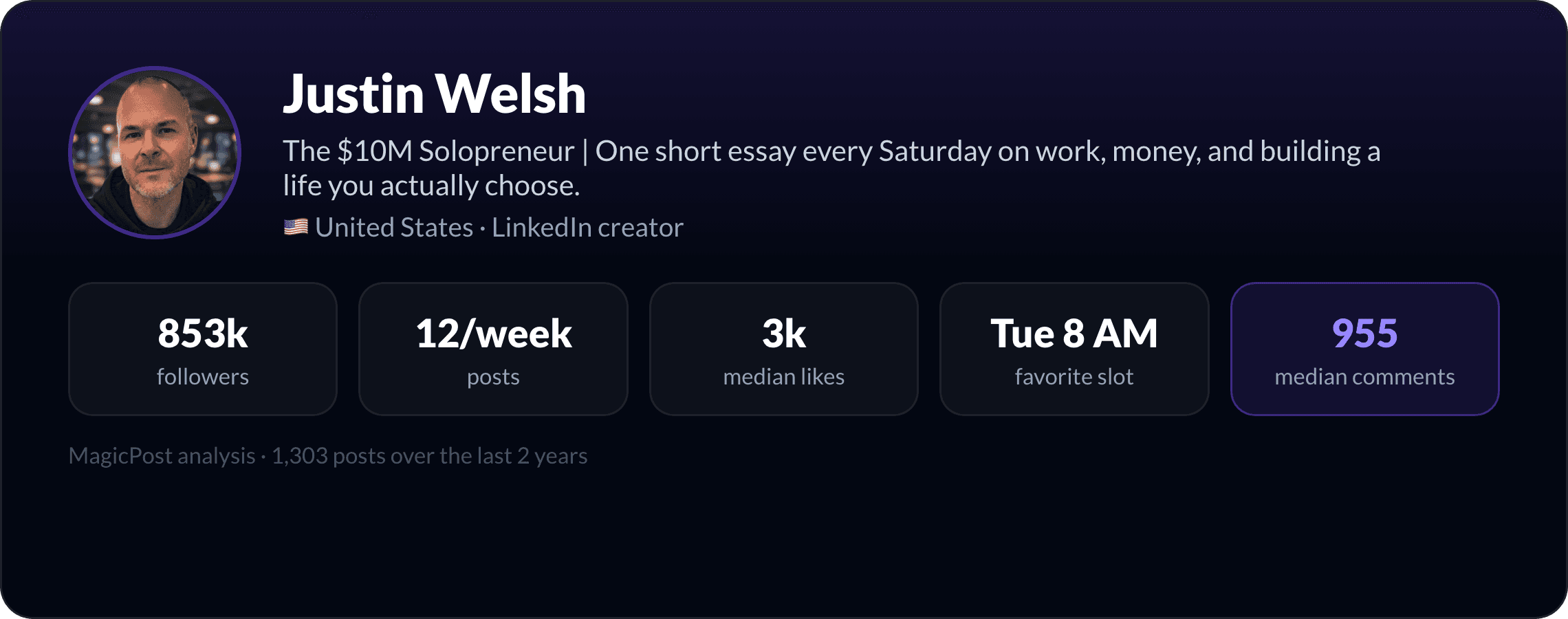
The Top LinkedIn Creators to Study in 2026 (By the Data)
The top LinkedIn creators to study in 2026, by the data: 62 creators, six languages, 27 countries, 32,000 posts analyzed by MagicPost. Grouped by what they teach.
Who Is Justin Welsh? The $10M Solopreneur, Explained by Data (2026)
Who is Justin Welsh? MagicPost analyzed 1,303 of their LinkedIn posts: topics, timing, signature moves and the writing fingerprint behind their growth, with rea
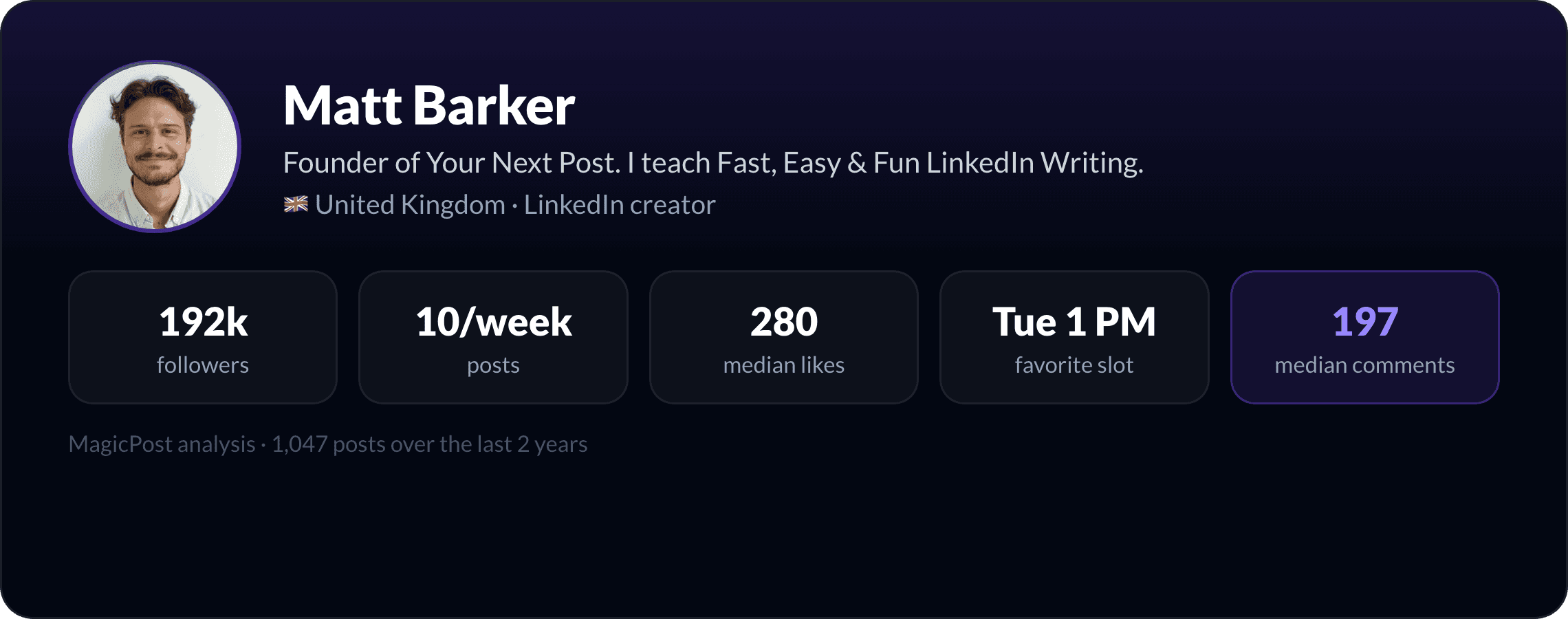
Who Is Matt Barker? The Hook Writer on LinkedIn, by Data (2026)
Who is Matt Barker? MagicPost analyzed 1,047 of their LinkedIn posts: topics, timing, signature moves and the writing fingerprint behind their growth, with real
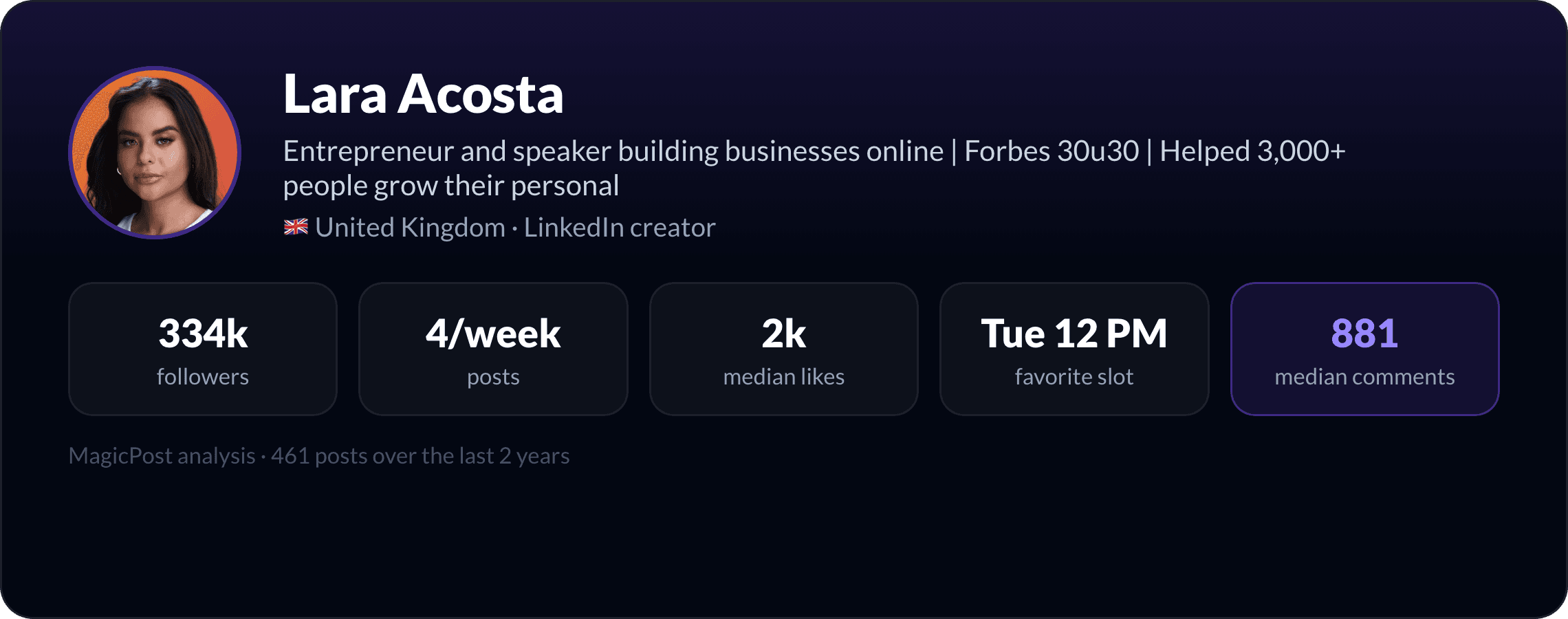
Who Is Lara Acosta? The Forbes 30 Under 30 Comment Machine, Explained by Data (2026)
Who is Lara Acosta? MagicPost analyzed 461 of their LinkedIn posts: topics, timing, signature moves and the writing fingerprint behind their growth, with real n
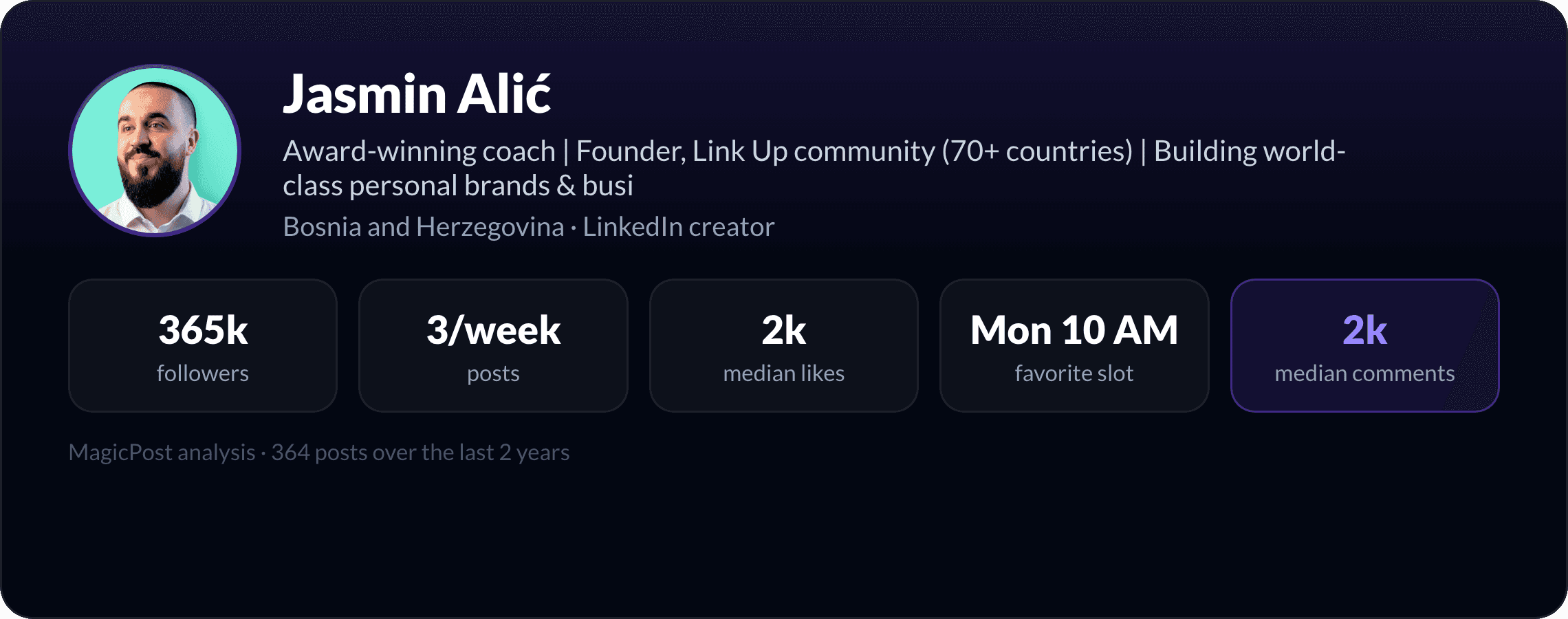
Who Is Jasmin Alić? The Bosnian Coach LinkedIn Mistook for a Bot (2026)
Who is Jasmin Alić? MagicPost analyzed 364 of their LinkedIn posts: topics, timing, signature moves and the writing fingerprint behind their growth, with real n
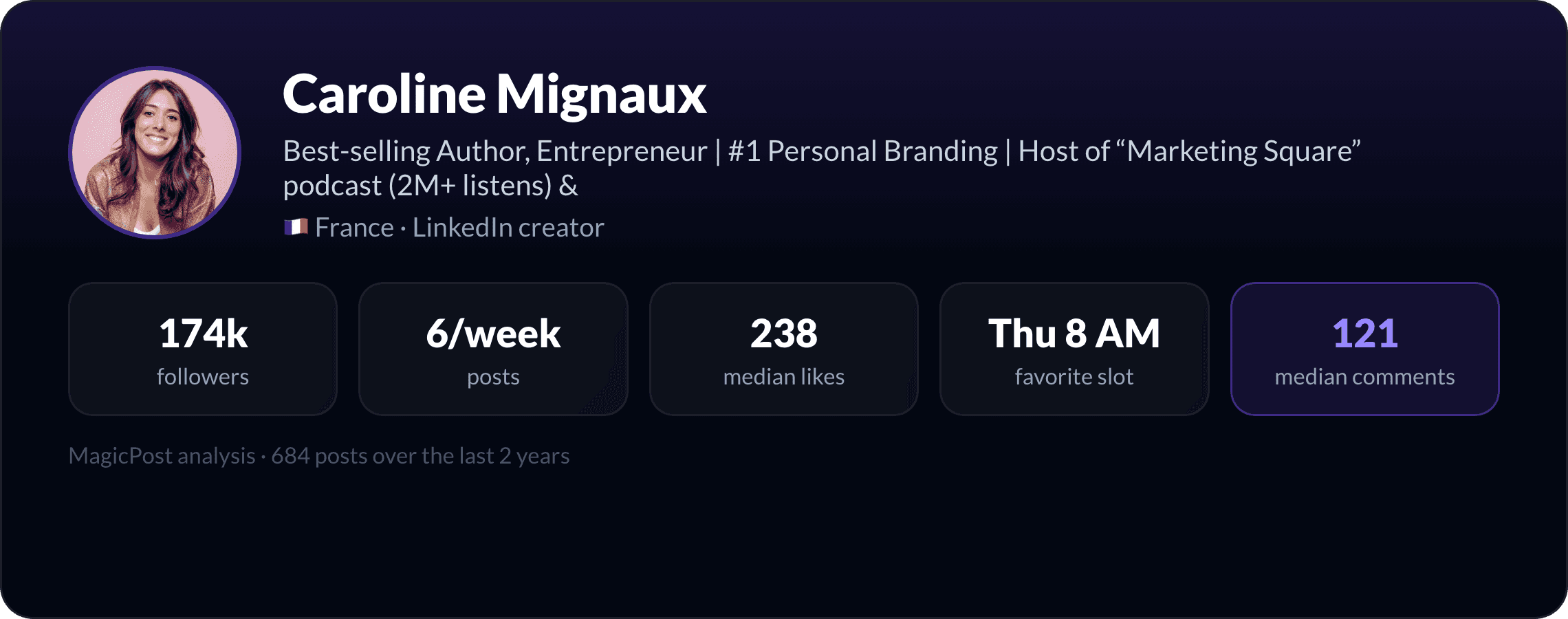
Who Is Caroline Mignaux? France's LinkedIn Top Voice Who Turned Shame Into a Following (2026)
Who is Caroline Mignaux? MagicPost analyzed 684 of their LinkedIn posts: topics, timing, signature moves and the writing fingerprint behind their growth, with r
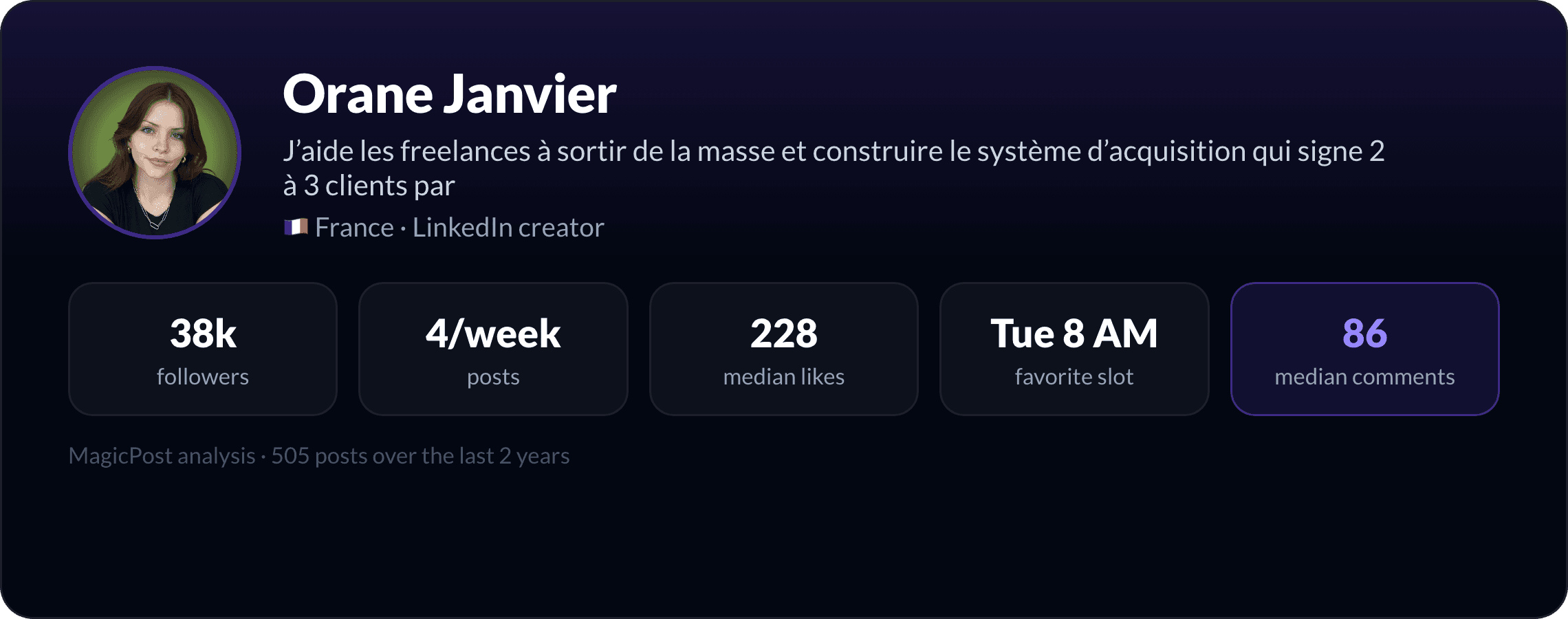
Who Is Orane Janvier? The Freelance Coach LinkedIn Quietly Copies (2026)
Who is Orane Janvier? MagicPost analyzed 505 of their LinkedIn posts: topics, timing, signature moves and the writing fingerprint behind their growth, with real
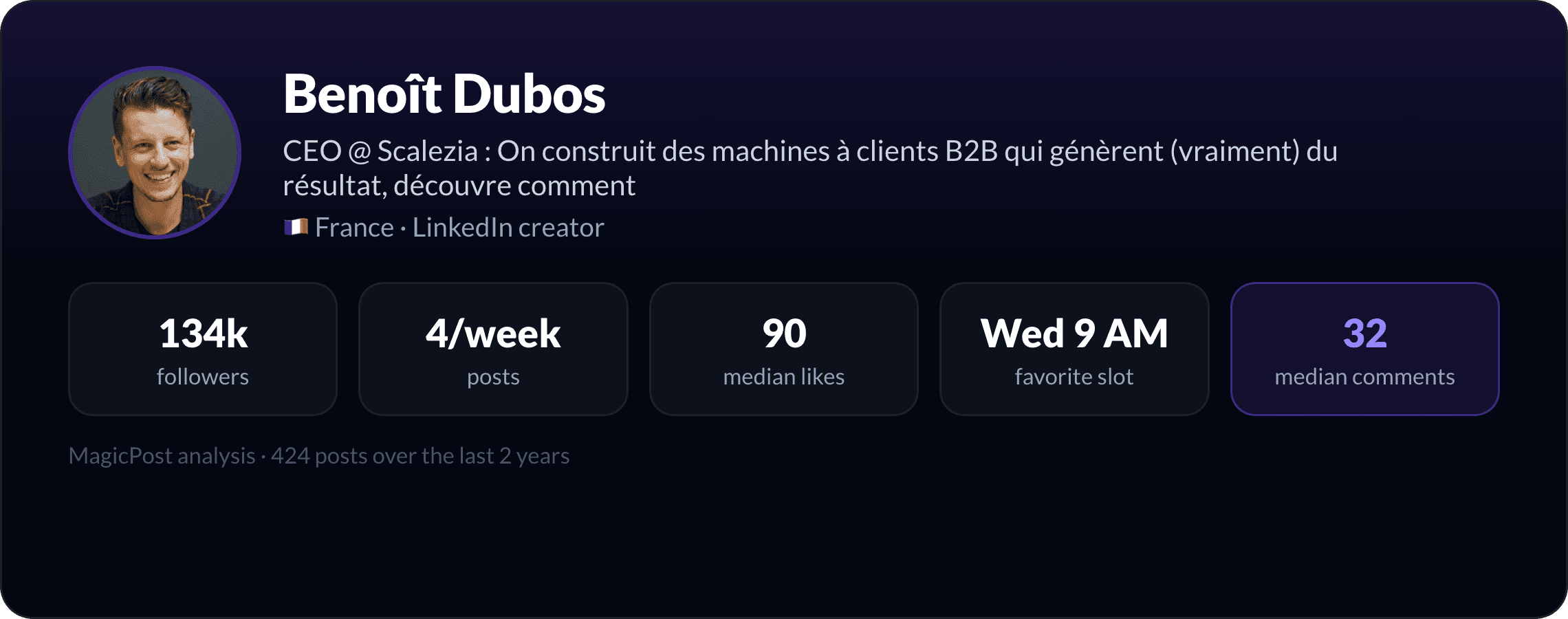
Who Is Benoît Dubos? The Growth Operator Who Turned a Falling Reach Into a Lead Machine (2026)
Who is Benoît Dubos? MagicPost analyzed 424 of their LinkedIn posts: topics, timing, signature moves and the writing fingerprint behind their growth, with real
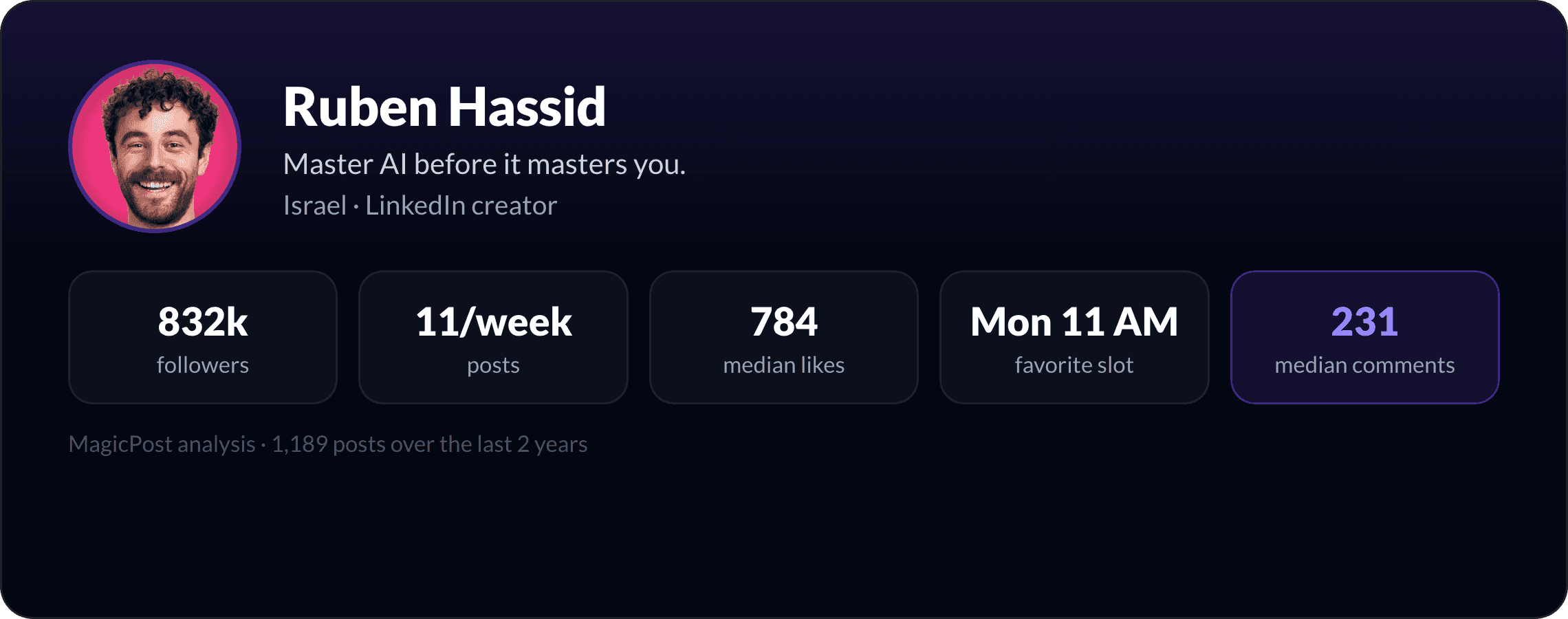
Who Is Ruben Hassid? The "Master AI Before It Masters You" Creator, Explained by Data (2026)
Who is Ruben Hassid? MagicPost analyzed 1,189 of their LinkedIn posts: topics, timing, signature moves and the writing fingerprint behind their growth, with rea
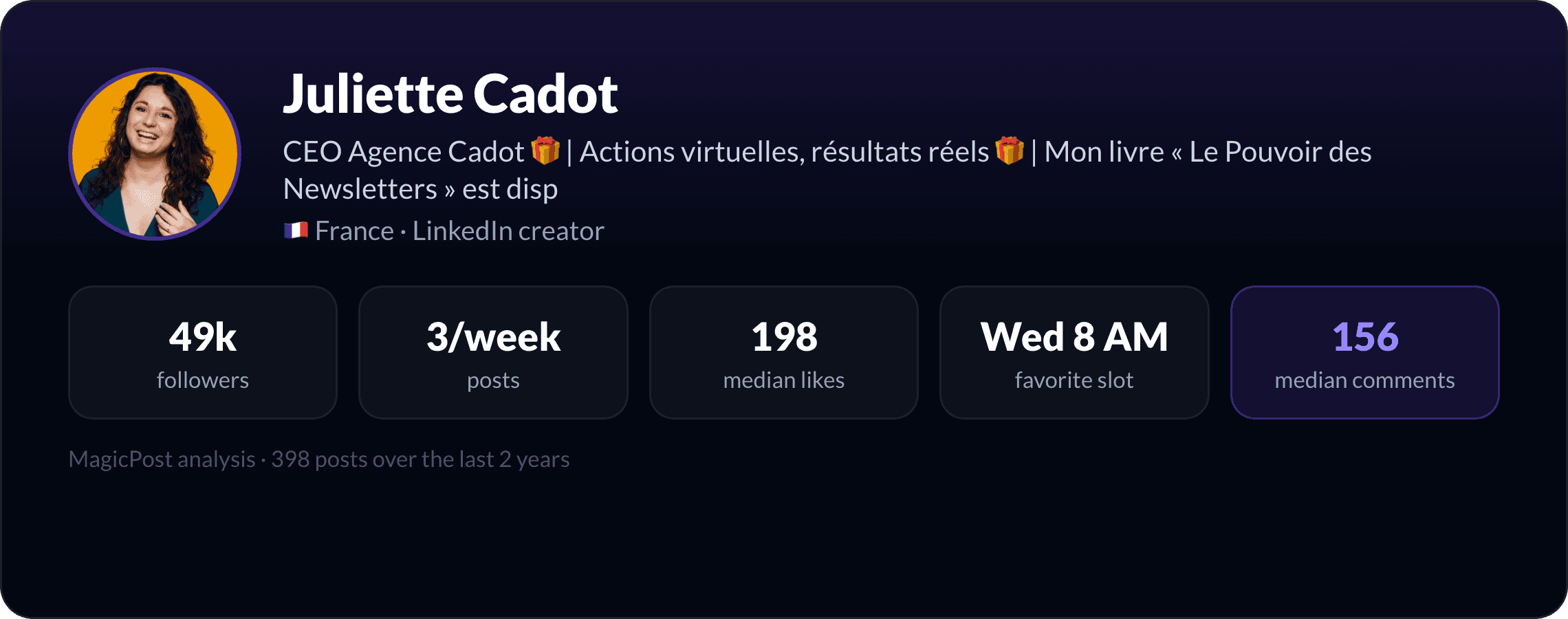
Who Is Juliette Cadot? The Agency Founder Whose Audience Talks Back (2026)
Who is Juliette Cadot? MagicPost analyzed 398 of their LinkedIn posts: topics, timing, signature moves and the writing fingerprint behind their growth, with rea