" height="26.80529977783203px" id="tymKb8bqC" width="128.00300311279295px"/><path d="M 0 2.417 L 0 0 L 12.909 0 L 12.909 2.417 Z" fill="rgb(126, 78, 253)" height="2.417099999999998px" id="aYr4em6zK" transform="translate(128.341 22.325)" width="12.908999999999992px"/></svg>)

"/><stop offset="1" stop-color="rgb(118, 37, 250)"/></linearGradient></defs><g d="M 19.242 21.22 L 19.362 6.204 L 19.272 6.204 L 13.757 21.22 L 10.161 21.22 L 4.796 6.204 L 4.706 6.204 L 4.825 21.22 L 0 21.22 L 0 0 L 7.283 0 L 12.109 13.607 L 12.229 13.607 L 16.844 0 L 24.247 0 L 24.247 21.22 Z M 26.421 26.113 L 26.421 23.445 L 41.407 23.445 L 41.407 26.113 Z" fill="transparent" height="26.112508199679183px" id="DvfaAIHYn" width="41.40731898311435px"><path d="M 19.242 21.22 L 19.362 6.204 L 19.272 6.204 L 13.757 21.22 L 10.161 21.22 L 4.796 6.204 L 4.706 6.204 L 4.825 21.22 L 0 21.22 L 0 0 L 7.283 0 L 12.109 13.607 L 12.229 13.607 L 16.844 0 L 24.247 0 L 24.247 21.22 Z" fill="rgb(46, 46, 46)" height="21.220180016149442px" id="pLsxRCobd" width="24.247352589074694px"/><path d="M 0 2.668 L 0 0 L 14.986 0 L 14.986 2.668 Z" fill="url(%23yD9d4I5GR-3279285344-linear-gradient)" height="2.6675085048549647px" id="yD9d4I5GR" transform="translate(26.421 23.445)" width="14.986002836263765px"/></g></svg>)

Naïlé Titah
You have a webinar to fill, so you write the obvious post: a title, a date, a "register here" line, a link. It feels like the responsible thing to do. It is also, by the numbers, one of the worst posts you can publish.
We measured it. Across 51,864 webinar signup posts in the last 12 months, the median post earns a 0.31% engagement rate. The platform-wide median across 1.14 million posts is 0.39%. That puts the standard signup push at second-worst of the 22 post types we track, beaten to the bottom only by podcast and video shares at 0.29%. For contrast, simply celebrating a win earns 1.21%, nearly four times more.
The reason is structural, and it is the same reason a bare sales post fails: a signup post asks before it gives. It hands the reader a chore (register, block your calendar, show up) and offers nothing in return inside the post itself. This page shows what the surviving webinar posts do instead, hands you three templates built on that move, and gives you the cadence that keeps the ask working.
TL;DR: Webinar signup posts earn 0.31% median ER, second-worst of 22 content types. The fix is structural: teach one real thing from the webinar in the post itself, then invite. 3 templates plus real examples.
The scoreboard nobody promoting a webinar wants to see
Here is where the webinar signup post sits next to the formats it competes with for a slot in your week:
Post type | Posts measured | Engagement rate | Median likes | Median comments |
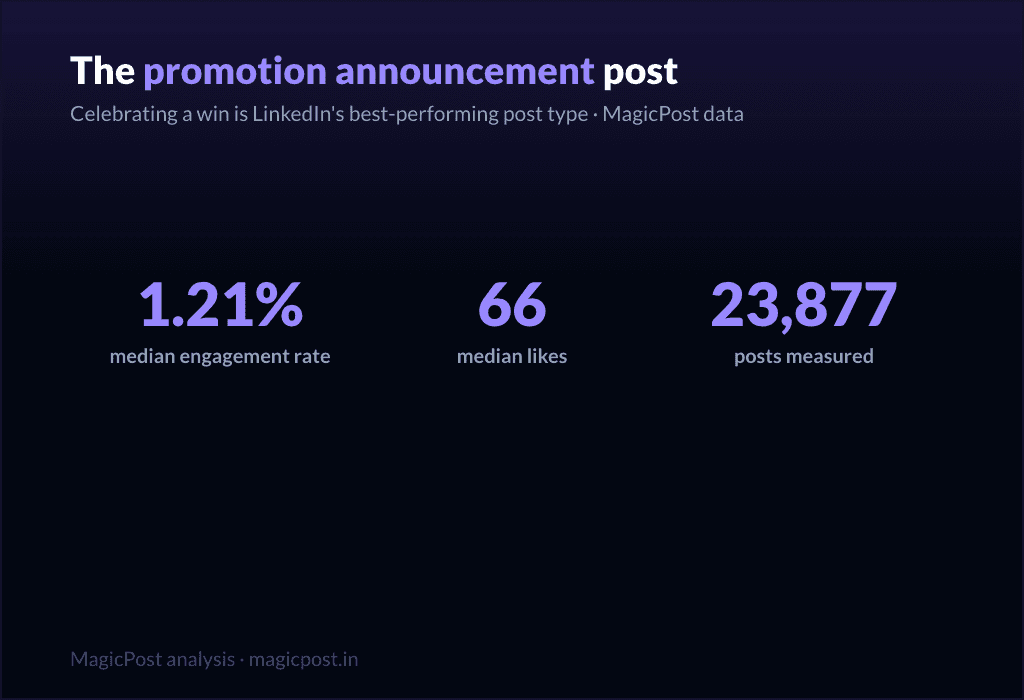
Celebrating a win | 23,877 | 1.21% | 66 | 11 |
Platform median (all posts) | 1,141,932 | 0.39% | - | - |
Webinar signup push | 51,864 | 0.31% | 32 | 6 |
Podcast / video share | 32,031 | 0.29% | 36 | 7 |
Read it bottom to top. The webinar signup push sits at 0.31%, second from the floor, below the 0.39% line every average post clears. The only thing that does worse is the podcast/video share at 0.29%, the other classic "go consume this thing" ask. At the top, a win celebration earns 1.21%, because it shows something instead of requesting something. (For the full ranking by post type, see which LinkedIn post types actually get engagement.)
The lesson is the same one that runs through this whole cluster: asking underperforms giving. A webinar post is almost pure ask, which is exactly why it lands where it does.



So why publish them at all?
Because engagement rate is not the only scoreboard for a webinar post. The win and the lesson earn attention; the webinar post is supposed to convert attention into registrations. The mistake is judging a signup push by likes when its real metric is seats filled.
But there is a trap inside that excuse. A post nobody engages with is a post the feed barely distributes, so fewer people ever see the ask at all. Low engagement and low reach are the same problem wearing two hats. The goal is not to abandon the ask. It is to make the post worth reading first, so the feed carries it far enough for the ask to land.
What the surviving webinar posts actually look like
We pulled the highest-engagement posts in the webinar signup category, and they barely look like event promotions. None opens with a date or a "register here." Each one teaches or provokes first, delivers a complete thought, and lets the event sit underneath as the natural next step. Three verbatim examples from our corpus:
"How do we create an environment in which our people can work at their natural best? Building a trusting team is the second of the five practices outlined in The Infinite Game." Simon Sinek (8.9M followers), 19,897 likes (post)
The post opens with a real question and names a concrete idea (the five practices, the trusting team) before it ever points to an event. The reader leaves with something whether or not they register. Same move, sharper edge, here:
"When you promote toxic people, you lose your best people. Let's be honest. Every company says they have a great culture. But most employees would tell a different story." Eric Partaker (1.2M followers), 10,965 likes (post)
That is a problem-question opener: a tension the audience feels, stated plainly, with no ask in sight. The webinar is the answer to a problem the post made you feel first. And a third, the same teach-first structure built around a single reframe:
"What if leadership is more about your actions than your title? It’s not reserved for those at the top of the org chart. It's available to anyone willing to step up." Eric Partaker (1.2M followers), 7,342 likes (post)
The pattern is identical across all three: the post is a complete, useful thought on its own, and the event is the place to go deeper, not the price of reading. The reader finishes thinking "I want more of this," and that want is what converts to a registration. The ask, when it comes, comes last and light. None of these lead with the event, which is exactly why they survived a category that medians 0.31%.
Want the teach-first version written for you? The hard part of a webinar post is delivering one real idea from the session before you ask anyone to sign up. MagicPost's AI LinkedIn post generator turns your webinar's topic into a post that teaches one concrete takeaway first, so the insight carries the post and the invite rides underneath instead of leading it.
Three templates that earn the signup
These are starting structures, not scripts. Fill in your own facts; the shape is the point. Each one delivers value before it asks, which is the whole trick.
1. The teach-first invite
Give away one genuine takeaway from the session. Then point to the event as the place for the rest.
[One specific, useful idea from your webinar, stated and explained in full.]
Here's why it matters: [the consequence that makes the idea land].
That's one of [N] things we'll go deep on.
[Event], [date]. Free / link in comments. But the idea above is yours either way.
Why it works: you have already paid the reader before you ask for anything, so the invite reads as "there's more where that came from," not "give me your calendar." This is the structure behind the Sinek post above.
2. The problem-question invite
Open with a tension your audience feels. Make them nod before you mention an event at all.
[A blunt, true statement of the problem your audience lives with.]
Let's be honest: [the uncomfortable version everyone recognizes].
Most people [the wrong fix they default to].
We're unpacking what actually works on [date]. [Soft pointer to register.]
Why it works: the post earns engagement on the problem alone, the way Partaker's "toxic people" post did. The webinar becomes the answer to a question the reader is now actively holding, instead of an interruption.
3. The social-proof invite
Borrow the engagement of a result. Lead with something that already happened, then invite people to the next one.
[A concrete outcome from a past session, a guest, or an attendee, stated plainly.]
[One detail that makes it real: a number, a name, a quote.]
We're doing it again on [date]. [Single low-pressure invitation to join.]
Why it works: a result shown is a result that sells the event without asking. It borrows the energy of a win post (the highest-engagement format on the board at 1.21%) and spends only the final line on the ask.
The cadence, not the blast
The biggest reason webinar posts sit at 0.31% is that people fire off five of them in a week, each a bare ask, and burn down the trust their other posts built. The fix is a ratio, the same one that rescues a LinkedIn sales post, its sibling in the "asking" family. Reading the scoreboard backwards, here is the budget the data supports:
Mostly give. The bulk of your posts should be the trust-building formats: wins, lessons, contrarian takes, stories. These generate the goodwill, and the reach, that a webinar post draws down. (What to post on LinkedIn maps the full menu.)
Promote with one direct invite, not five. A single clean signup post inside a give-mostly mix outperforms a barrage, because each extra bare ask deepens the fatigue the 0.31% median is already measuring.
Wrap every promotion in a takeaway. When you do post the invite, lead with one real idea from the session, the way all three surviving examples did. That way the post earns its slot even for the people who will never register.
Let the warm-ups do the selling. A teaching post the week before, with no ask attached, primes the audience so the one invite that follows lands on interest you already built rather than cold.
Stuck on what the "mostly give" posts should be? MagicPost's LinkedIn post ideas turns your topic and audience into a steady stream of trust-building angles, so the rare webinar invite lands on a full account instead of an empty one. For the complete template library this page belongs to, start at the LinkedIn post templates hub.
Where the data and examples come from
Every engagement figure here is MagicPost's own research, from the same corpus as the rest of this cluster: LinkedIn posts published over the last 12 months, reshares and excluded posts filtered out, deleted posts removed, then classified by post type. Engagement rate is the median of likes-plus-comments over follower count within each category, never an average, so a handful of viral posts cannot distort the picture. Webinar signup posts are measured on 51,864 posts, podcast/video shares on 32,031, celebrating a win on 23,877, and the platform median on 1,141,932 posts. The example posts are real, public posts pulled verbatim, each linked to its source. One honest confounder: people do not choose post types at random, and the author who promotes a webinar well tends to give well the rest of the time, so part of the gap between a signup push (0.31%) and a win (1.21%) reflects intent and effort, not format alone. The direction of the gap, though, is consistent across the corpus: the ask costs you. Figures dated June 2026, refreshed with the data.
FAQ
How do you promote a webinar on LinkedIn?
Lead with value, not the event. The webinar posts that earn the most engagement in our data open with one complete, useful idea (a question, a problem, a takeaway from the session), deliver it fully, and let the registration sit underneath as the natural next step. The bare version (title, date, "register here," link) is what makes the standard signup post the second-worst post type on LinkedIn at a 0.31% engagement rate, below the 0.39% platform median. So teach one real thing from the webinar first, keep the promotion to a single clean invite rather than a week-long blast, and run it inside a mix of trust-building posts so the ask lands on goodwill you already built.
Why do webinar posts get such low engagement on LinkedIn?
Because they ask before they give. Measured across 51,864 webinar signup posts over the last 12 months, the median earns a 0.31% engagement rate, second-worst of the 22 types we track and below the 0.39% platform median. A bare signup post hands the reader a chore (register, block time, show up) and offers nothing inside the post itself, so the feed barely distributes it and few people ever see the ask. Low engagement and low reach are the same problem here: a post nobody interacts with is a post nobody is shown.
What is the worst-performing LinkedIn post type?
The podcast/video share, at a 0.29% engagement rate across 32,031 posts, the only type that does worse than the webinar signup push (0.31%). Both are pure "go consume this elsewhere" asks with no value delivered in the post itself, which is why they sit at the bottom. The top of the board is the opposite: celebrating a genuine win earns 1.21%, nearly four times the webinar post, because it shows something instead of requesting something.
How often should I post about my webinar?
Sparingly, and wrapped in value. The data does not support blasting five signup posts in a week; each extra bare ask deepens the fatigue the 0.31% median already measures. A better pattern is a teaching post or two with no ask attached, then a single direct invite that leads with one real takeaway from the session, all inside a mix tilted toward the give-mostly formats (wins at 1.21%, lessons, stories).
Should I put the webinar link in the post or the comments?
Either works; placement is not what decides the post's fate. What decides it is whether the post delivers value before it points anywhere. A post that teaches one concrete idea first can carry its link in the body or the first comment and still perform, because the reader is already sold. A post that opens with the link and the date, wherever you put it, reads as a bare ask and lands at the 0.31% floor. Fix the opening before you worry about the link.
> Build the balance, then spend it. With MagicPost you can write, schedule and analyze all your LinkedIn content in one place, so the trust-building posts do their job and the rare webinar invite lands on a full account instead of an empty one.
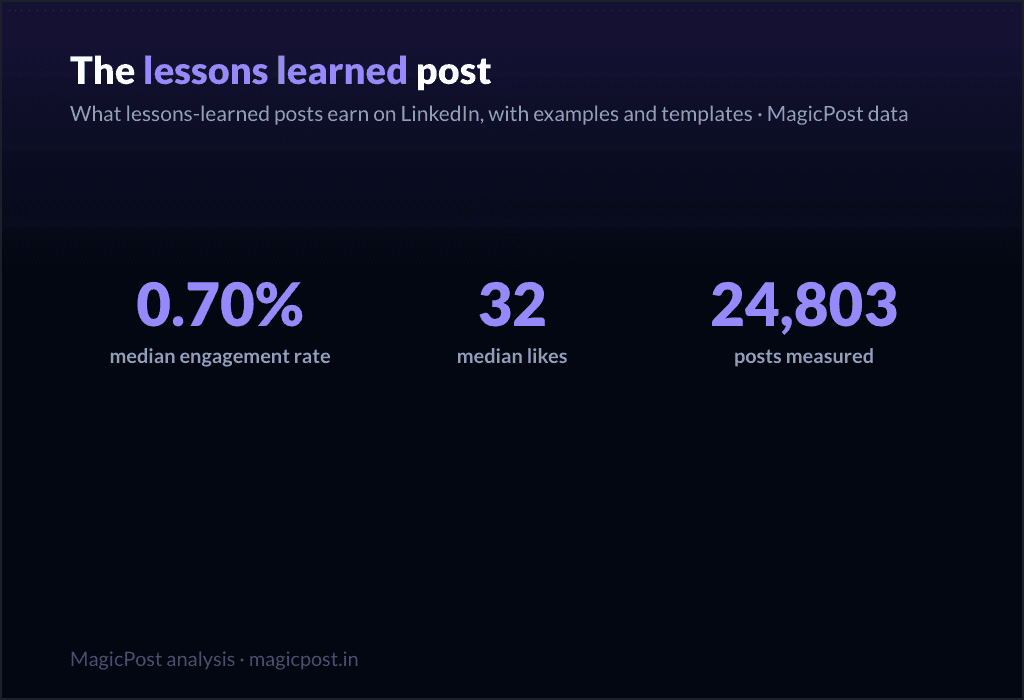
The Lessons Learned LinkedIn Post: Why Earned Advice Beats Expert Advice (0.70% vs 0.44%)
The lessons learned LinkedIn post: earned advice (0.70% ER) beats expert advice (0.44%). The difference is the receipt. Examples and templates.
The Last Day LinkedIn Post: How to Say Goodbye Well (Real Examples + Templates)
The last day LinkedIn post: how to say goodbye well. Real examples (one earned 13,121 likes), 3 templates, and the etiquette of leaving in public.
The Graduation LinkedIn Post: Real Examples, Templates, and How to Make Yours Count
The graduation LinkedIn post: real examples (up to 19,038 likes), 3 templates, and how to make your first professional post count.
The Work Anniversary LinkedIn Post: Beyond the Auto-Generated Badge (Examples + Templates)
The work anniversary LinkedIn post: beyond the auto-badge. Real examples, 3 templates, and the reframe that turns a date into a story.
The Holiday LinkedIn Post: How to Not Sound Like a Corporate Card (Examples + Templates)
The holiday LinkedIn post: how to not sound like a corporate card. Real examples, 3 templates, and why seasonal posts should be scheduled early.
5 Najlepszych Szablonów Postów na LinkedIn (2026)
5 szablonów postów na LinkedIn: narracja, lista, osobista refleksja, skarga i analiza. Przewodniki krok po kroku, jak stworzyć angażujące posty i zwiększyć widoczność.
13 przykładów postów na LinkedIn, które przynoszą rezultaty (2026)
Ukraść te 13 sprawdzonych przykładów postów na LinkedIn, aby przekształcić swoją treść w potencjalnych klientów i autorytet. Zawiera szablony i pełną dekonstruację tego, co działa.
Co publikować na LinkedIn? (2026)
Zwiększ swój wpływ na LinkedIn dzięki naszemu ekspertowi przewodnikowi. Odkryj potężne strategie publikacji i rodzaje treści, aby skutecznie angażować swoją sieć.
Jak ogłosić nową pracę na LinkedIn: (+ 5 gotowych szablonów)
Opanuj swoje nowe ogłoszenie o pracy na LinkedIn. Rozwijaj swoją sieć, przyciągaj możliwości i zdobądź 5 gotowych szablonów postów, aby uczynić to bezwysiłkowym.
Najlepsze przykłady postów promujących na LinkedIn (2026)
Musisz napisać post sprzedażowy, ale nie wiesz, od czego zacząć? Pokażę ci przykłady najskuteczniejszych postów promocyjnych, które możesz dostosować do swoich potrzeb.