" height="26.80529977783203px" id="tymKb8bqC" width="128.00300311279295px"/><path d="M 0 2.417 L 0 0 L 12.909 0 L 12.909 2.417 Z" fill="rgb(126, 78, 253)" height="2.417099999999998px" id="aYr4em6zK" transform="translate(128.341 22.325)" width="12.908999999999992px"/></svg>)

"/><stop offset="1" stop-color="rgb(118, 37, 250)"/></linearGradient></defs><g d="M 19.242 21.22 L 19.362 6.204 L 19.272 6.204 L 13.757 21.22 L 10.161 21.22 L 4.796 6.204 L 4.706 6.204 L 4.825 21.22 L 0 21.22 L 0 0 L 7.283 0 L 12.109 13.607 L 12.229 13.607 L 16.844 0 L 24.247 0 L 24.247 21.22 Z M 26.421 26.113 L 26.421 23.445 L 41.407 23.445 L 41.407 26.113 Z" fill="transparent" height="26.112508199679183px" id="DvfaAIHYn" width="41.40731898311435px"><path d="M 19.242 21.22 L 19.362 6.204 L 19.272 6.204 L 13.757 21.22 L 10.161 21.22 L 4.796 6.204 L 4.706 6.204 L 4.825 21.22 L 0 21.22 L 0 0 L 7.283 0 L 12.109 13.607 L 12.229 13.607 L 16.844 0 L 24.247 0 L 24.247 21.22 Z" fill="rgb(46, 46, 46)" height="21.220180016149442px" id="pLsxRCobd" width="24.247352589074694px"/><path d="M 0 2.668 L 0 0 L 14.986 0 L 14.986 2.668 Z" fill="url(%23yD9d4I5GR-3279285344-linear-gradient)" height="2.6675085048549647px" id="yD9d4I5GR" transform="translate(26.421 23.445)" width="14.986002836263765px"/></g></svg>)

Naïlé Titah
Fabio Banzato is, by the numbers, the smallest creator we profile in this series: around 12,200 followers from the Greater Milan area, an Italian LinkedIn consultant whose median post earns about 65 likes. That is a fraction of the audience the other names in this cluster command. And yet his style is one we track closely, because what Banzato lacks in reach he makes up for in something rarer: a craftsman's discipline applied to a single subject, with a conversation rate most large accounts would envy.
At MagicPost, we analyzed 203 of his LinkedIn posts: what he writes, when, for whom, and what makes his style worth studying. This is who Fabio Banzato is, according to the best possible source: his own posts, measured.

His story, in his own posts
Banzato does not sell a rags-to-riches arc. His self-portrait is quieter, and more honest, than most: the most striking thing he writes about is his own imperfection.
The man who "never learns." His most revealing post is titled "Non imparo mai" ("I never learn"), listing the mistakes that keep coming back: a lack of assertiveness, the fear of offending, "il non sentirmi all'altezza" ("not feeling good enough"). His punchline reframes the whole thing: "non imparo mai' non significa che sto sbagliando. Significa che sto crescendo mentre lavoro" ("'I never learn' does not mean I am getting it wrong. It means I am growing while I work").
The reluctant salesman. Banzato struggles with the very word "venditore" (salesperson). "Non ti sto vendendo niente," he writes ("I am not selling you anything"). His method: "non parto dal 'devo proporti qualcosa'. Parto dal 'fammi capire dove vuoi arrivare'" ("I do not start from 'I have to pitch you something'. I start from 'let me understand where you want to go'").
The perfectionist who publishes anyway. In "Il post perfetto non esiste" ("The perfect post does not exist"), he admits to abandoning ideas over the inner voice saying "Non è scritto bene" ("It's not written well"). His conclusion is the working creed of anyone who publishes daily: "pubblicare non è un esercizio di stile. È un gesto di presenza" ("publishing is not an exercise in style. It is a gesture of presence").
Where the bigger creators in this series recycle a heroic origin story, Banzato recycles a posture: the professional still carrying a "lavori in corso" sign ("work in progress"), even after years of expertise. Unusually disarming for a consultant.



What he actually talks about
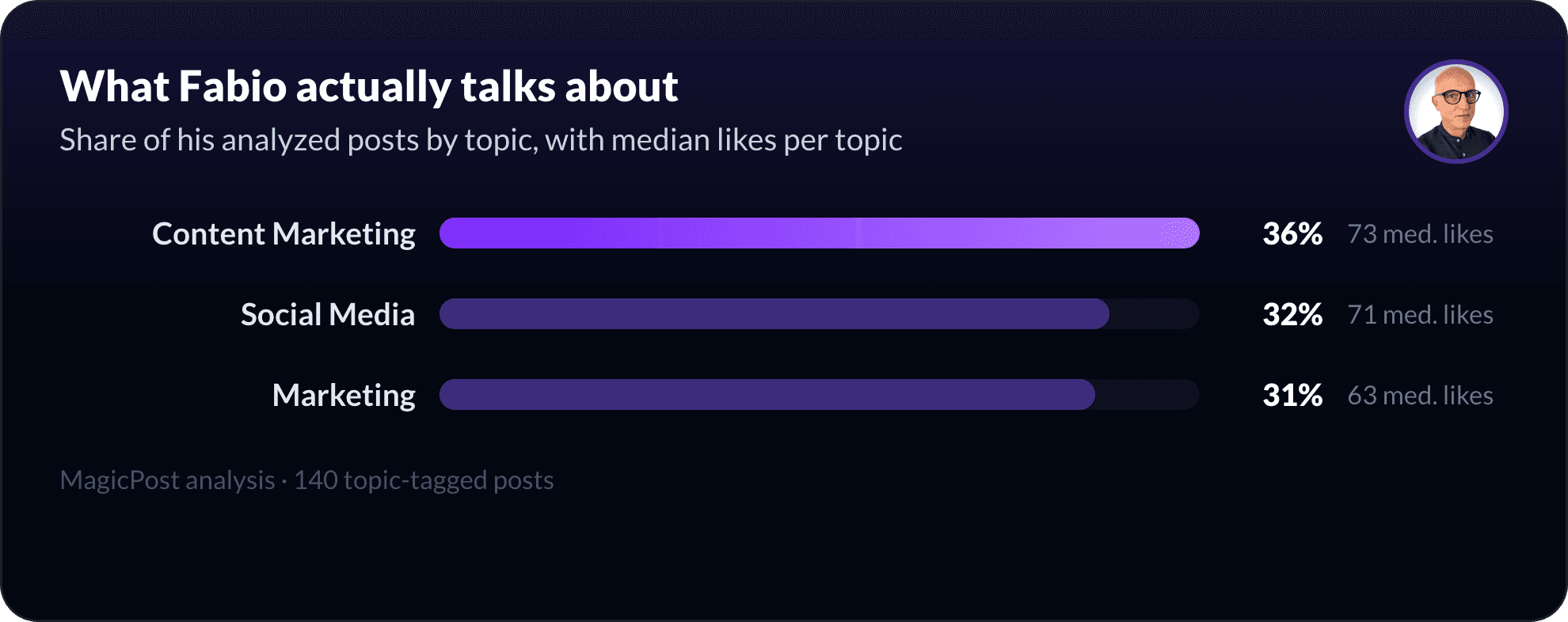
Here is the finding that defines him, and that no generic bio would surface: Fabio Banzato writes about LinkedIn, on LinkedIn, almost to the exclusion of everything else. His top themes are Content Marketing (51 posts, about 73 median likes), Social Media (45 posts, about 71 likes), and Marketing (44 posts, about 63 likes). Read the posts behind those labels and they are nearly all about one platform: the algorithm, the feed, profiles, etiquette, AI on the timeline. He is a meta-creator whose subject is LinkedIn.
That focus is the over-performer too: his most platform-specific buckets (Content Marketing, Social Media) outscore his broader Marketing posts. When Banzato turns the platform on itself, his audience responds hardest. By register, he is a teacher: four in ten of his posts are a how-to or an analysis, not a sales pitch.
Who he writes for
His reader is explicit in his headline: "LinkedIn® works if you know how to use it." He writes for the professional who has an account but treats it as a filing cabinet. His "LinkedIn compie 23 anni" post ("LinkedIn turns 23") draws the line sharply: "Se lo usi come bacheca, ricevi silenzio. Se lo usi come spazio di relazione, ricevi attenzione" ("If you use it as a noticeboard, you get silence. If you use it as a space for relationships, you get attention"). The offer matches the reader exactly: LinkedIn courses, consulting, profile reviews, and a free introductory call.
His best posts of 2026
His biggest posts of 2026, reproduced from our data (click through to the originals):
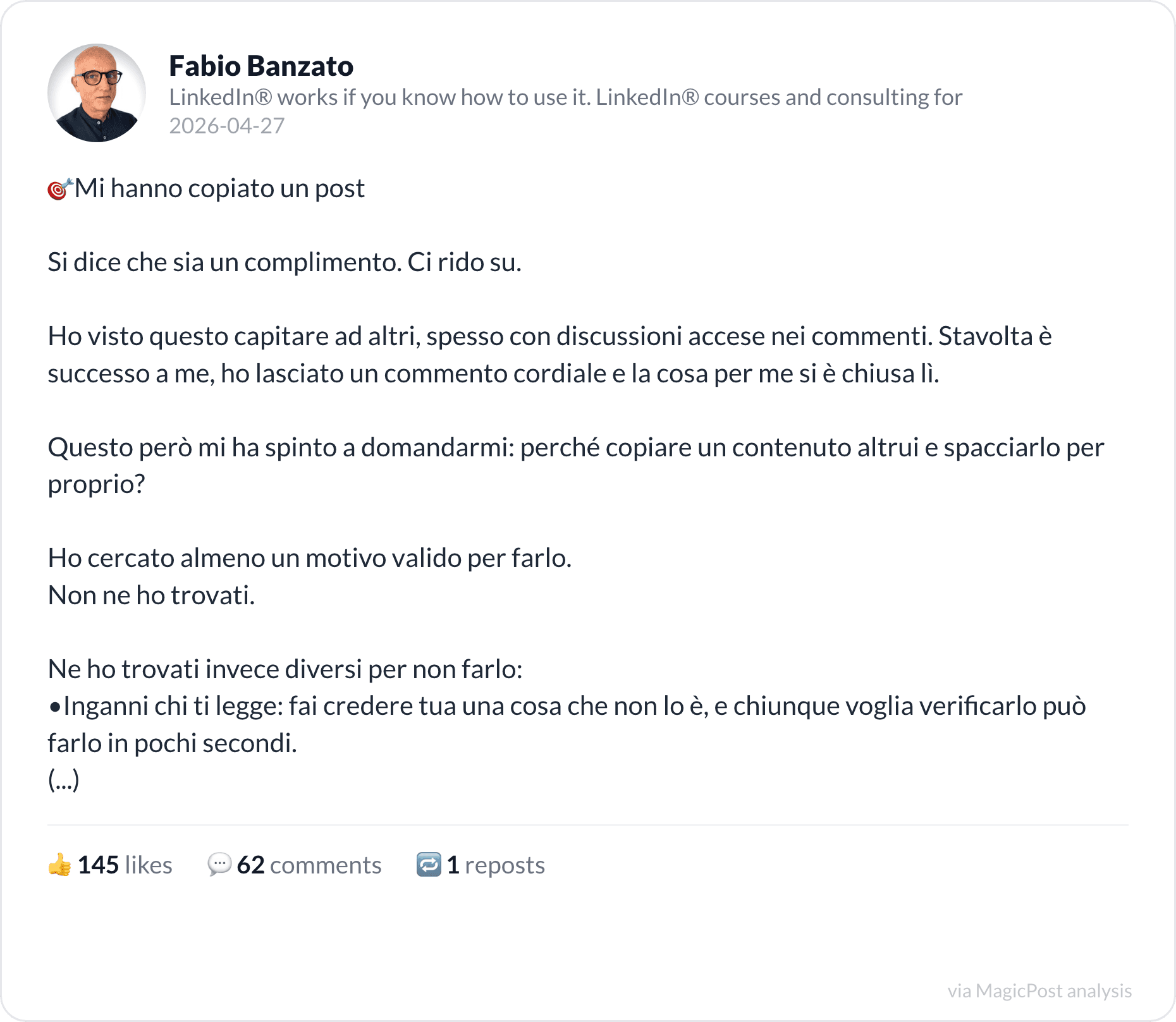
145 likes. "Mi hanno copiato un post" ("Someone copied a post of mine"). He turns a small annoyance into a clean lesson on attribution, closing like a proverb: "Copiare ha un costo preciso. Si paga al momento peggiore" ("Copying has a precise cost. You pay it at the worst possible moment").
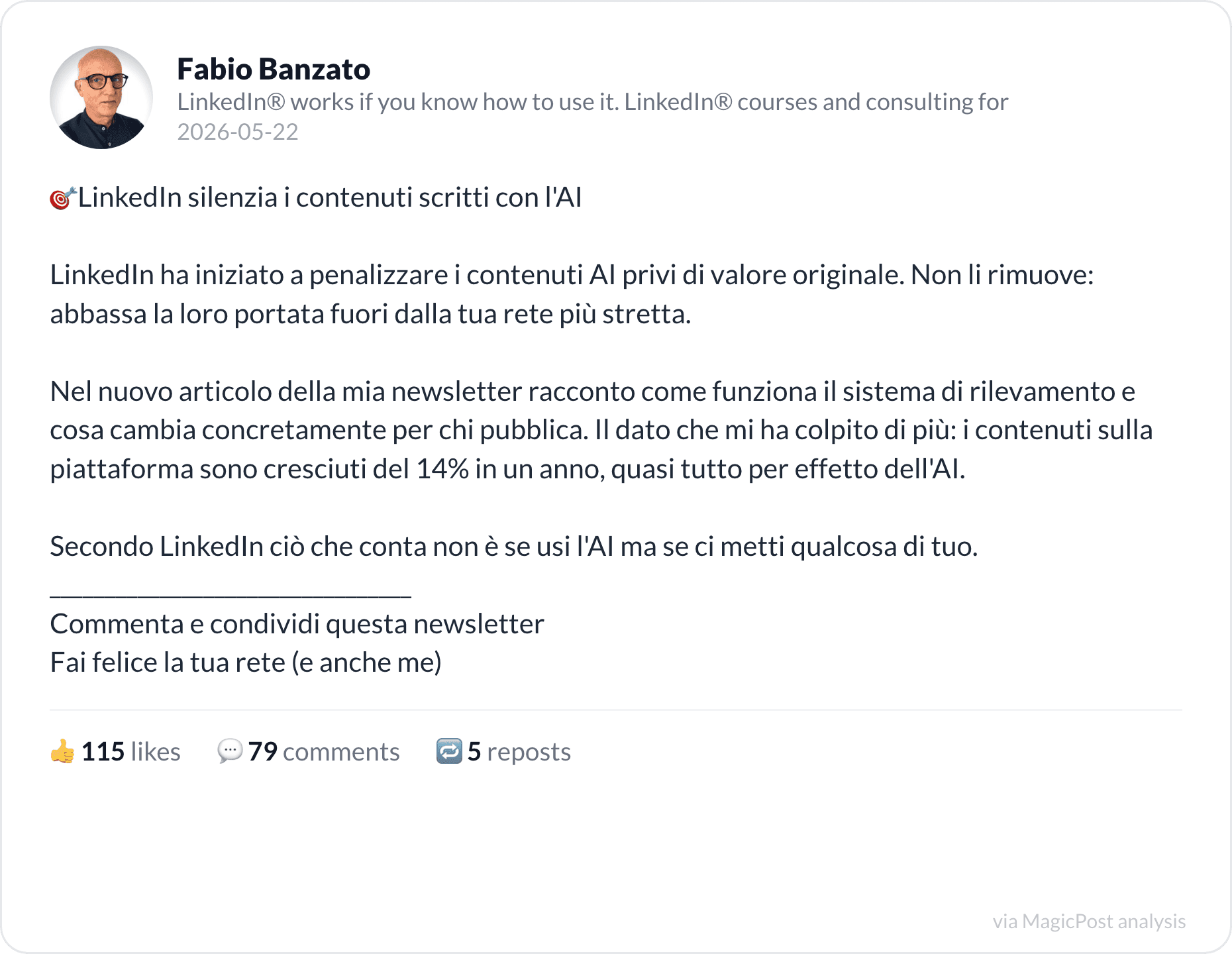
115 likes, 79 comments. A platform-news post on LinkedIn reducing the reach of low-value AI content. Note the comment count nearly matches the likes: the Banzato pattern in its purest form, engineered for discussion, not applause.
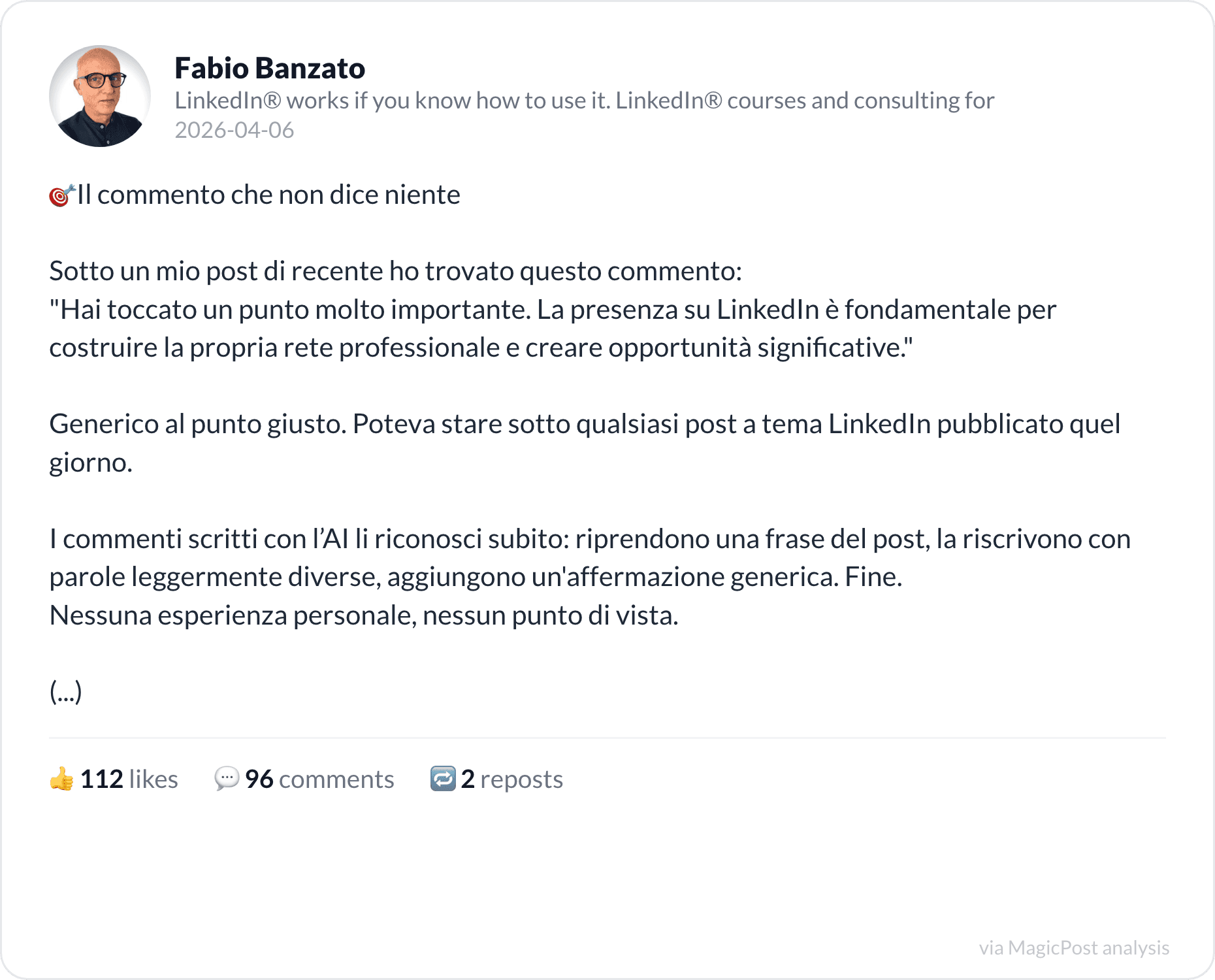
112 likes, 96 comments. "Il commento che non dice niente" ("The comment that says nothing"), a takedown of generic AI-written comments, where comments outnumber likes. His sign-off doubles as advice: "Se non hai niente da aggiungere, non aggiungere niente. Un like è sufficiente" ("If you have nothing to add, add nothing. A like is enough").
His all-time best names his whole method: "Non è LinkedIn, sei tu" ("It's not LinkedIn, it's you"), 176 likes and 113 comments. "LinkedIn siamo noi," he argues ("LinkedIn is us"), "e il nostro modo di usarlo contribuisce a renderlo migliore o peggiore" ("and how we use it helps make it better or worse").
Is he still growing?
We hold a clean read on one full year: in 2025, across 165 posts, his median was about 66 likes, almost identical to his current overall median of 65. Banzato is not on a steep growth curve; he is on a plateau, holding a stable, modest median while posting steadily. One honest note we make on every page in this series: we measure engagement per post, not follower count over time. At his audience size, a flat, dependable median is not stagnation; it is consistency.
Where do these charts come from? Everything on this page runs on MagicPost's LinkedIn analytics, and it works on your profile too: your best posts, your audience, your benchmark against thousands of creators, even a side-by-side with someone like Fabio Banzato.
How he writes
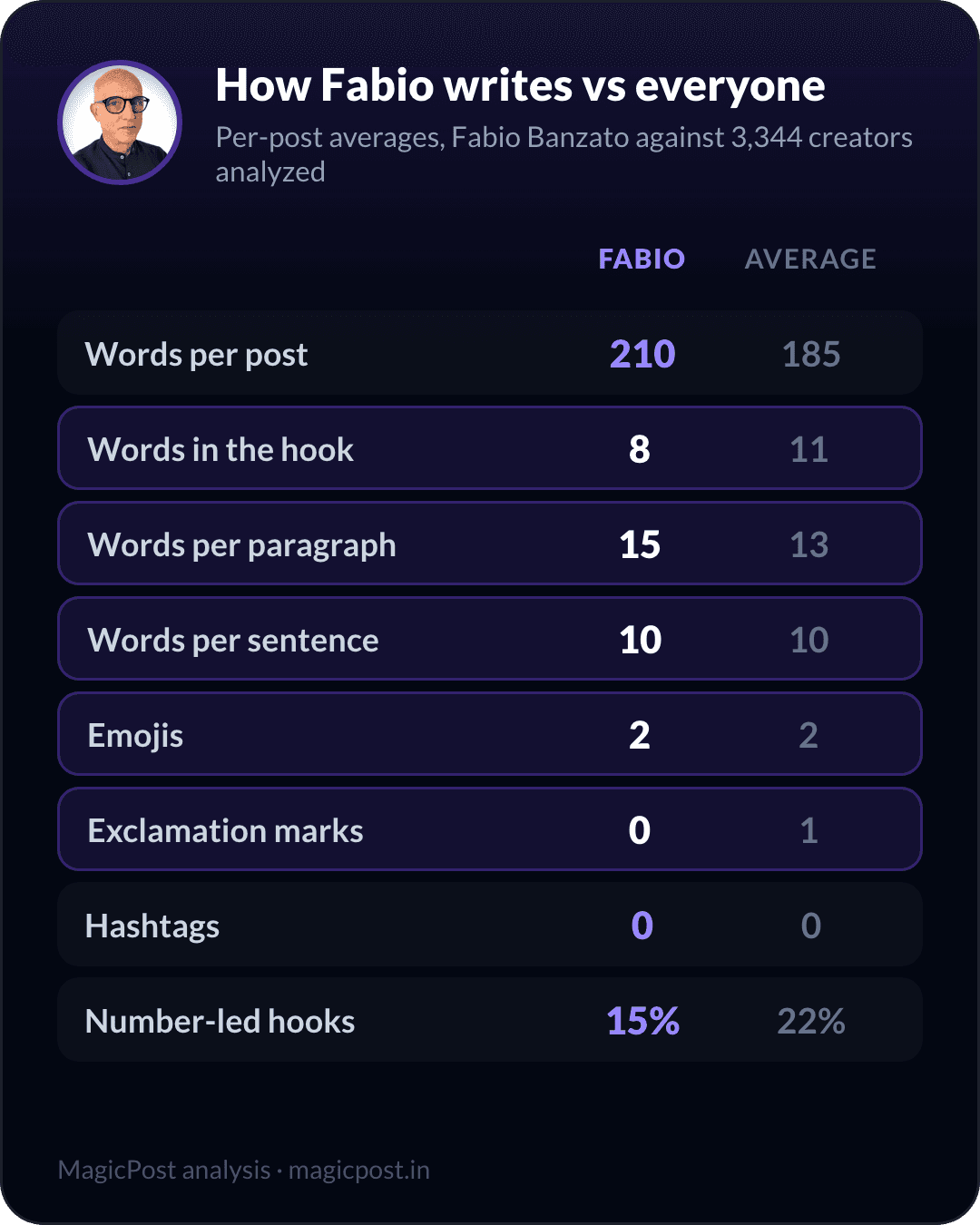
Here is Banzato measured against the average creator, and the surprise is how ordinary the surface looks:
Metric (per post) | Fabio Banzato | Average creator* |
Words | ~210 | 185 |
Words in the hook | 8 | 11 |
Words per paragraph | 15 | 13 |
Words per sentence | 10 | 10 |
Emojis | 2 | 2 |
Exclamation marks | 0 | 1 |
Hashtags | 0 | 0 |
Hooks built on numbers | 15% | 22% |
*Median across the 3,344 creators we analyzed with 20+ posts each.
On length and rhythm he sits almost exactly on the average: 210 words, 10-word sentences, two emojis. He does not chase the white-space style of a Justin Welsh. What the numbers reveal is elsewhere. His hook is tight: 8 words against the typical 11, almost always a single bold, declarative line ("Non è LinkedIn, sei tu"). He has zero exclamation marks across his sample, where the average creator reaches for one; his emphasis comes from the idea, never the punctuation. And his real signature is not in this table at all. It is in his comments: at about 33 median comments against 65 median likes, roughly one comment for every two likes, his readers do not just react, they reply. Most of his bangers tip even further, with comments rivaling or beating likes. That is the rarest number in his whole profile.
The "AI tells" in his style (read this the right way)
Run Banzato's writing through the patterns people now call "AI tells," and a clear shape emerges:
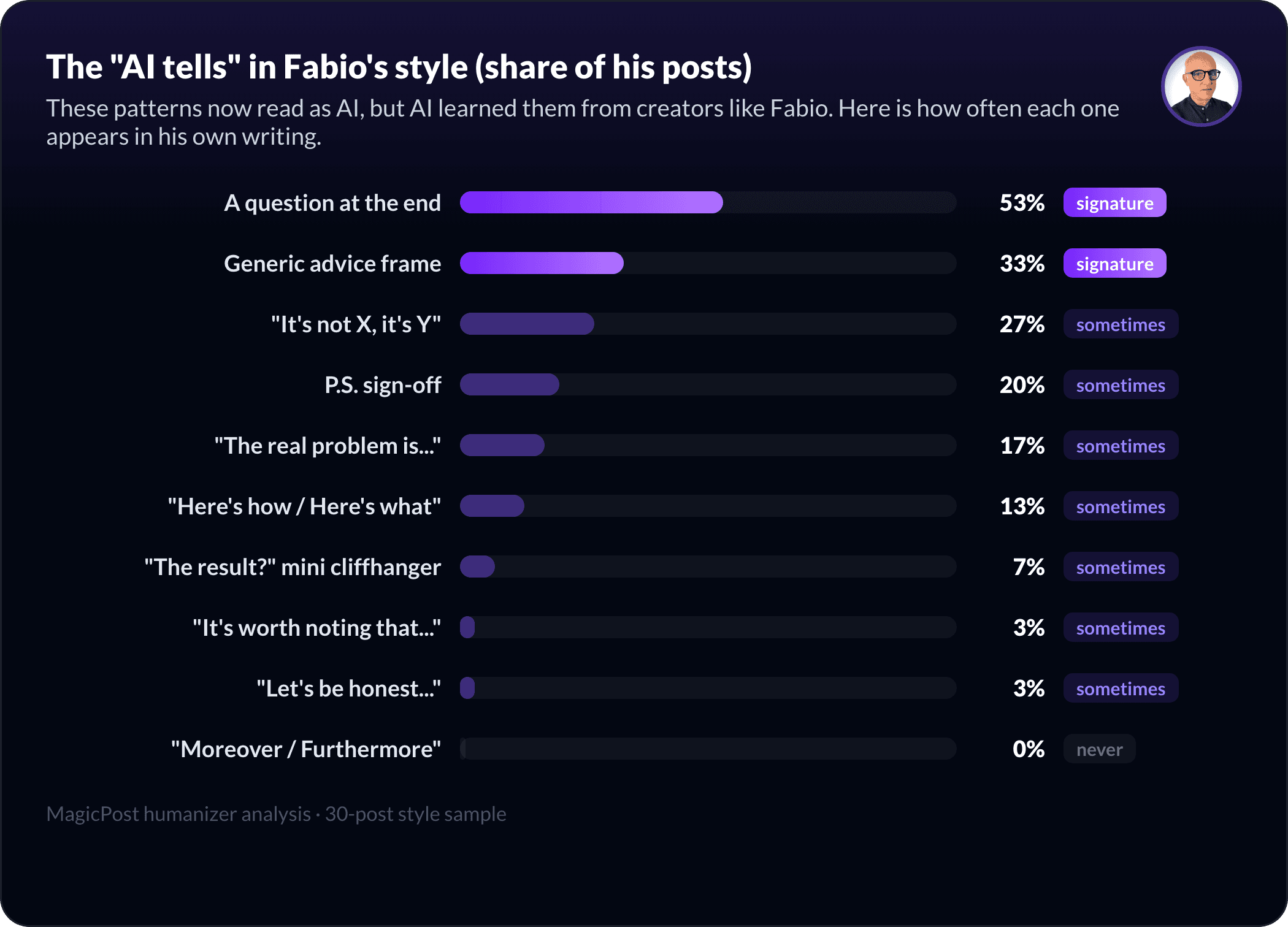
His most characteristic move is the closing question: 53% of his posts end by asking the reader something ("Which 'work in progress' have you carried the longest?"). A third lean on a generic advice frame, about a quarter use the "It's not X, it's Y" contrast formula, the most flagged "AI" pattern on LinkedIn (his best post ever, "Non è LinkedIn, sei tu," is literally that formula), and a handful open with "Here's how". Do not read it backwards. Banzato does not write like an AI; AI writes like Banzato. These patterns read as robotic today because the models trained on effective creators and then bolt every move on at once, in every post. Banzato uses the closing question as a genuine conversation starter, which is exactly why his comment counts are so high, and he never uses the transition-opener filler ("Moreover," "Furthermore"): zero occurrences. There is a deeper irony here: Banzato writes openly about AI on LinkedIn, admitting "Anche io mi faccio aiutare dall'AI per produrre contenuti" ("I too use AI to help produce content"), while drawing a hard line at delegating the human part, the point of view and the lived experience.
When he posts
Banzato publishes about 2.6 times a week, favorite slot Monday at 8 AM Rome time, with a remarkable 94% of his posts in the morning and only 6% on weekends. A disciplined weekday-morning rhythm, consistency over flooding. It lines up with the early window in our LinkedIn timing data, and his pace sits well below the heaviest publishers in our posting-frequency study, proof you do not need daily volume to build real conversation. And given how much of his strategy lives in the replies, showing up in the comments of the people he wants to reach is its own channel, which is exactly what an engagement feed is for: their posts, every day, without hunting the timeline.
What to steal from Fabio Banzato
Own one subject completely. Banzato writes about LinkedIn, on LinkedIn, almost nothing else. Narrow beats broad when you want to be the reference on a topic.
Engineer for replies, not applause. A closing question in over half his posts, plus debatable takes, give him roughly one comment per two likes. Comments are the conversation; likes are the receipt.
Lead with one bold line. His 8-word hooks are flat declarations ("Non è LinkedIn, sei tu"), no exclamation marks, no decoration. The idea carries the weight.
Sell by understanding first. "Non ti sto vendendo niente" is a posture, not a trick. Diagnose before you pitch, and the audience stays.
Publish imperfect. Publishing is "un gesto di presenza," a gesture of presence, not an exercise in style. Done beats perfect.
Study him, then study yourself. With MagicPost you can dig into Fabio Banzato's numbers the way we just did, analyze your own LinkedIn the same way, and write in the spirit of his style: one topic, one bold line, a real question at the end.
Where this data comes from
Everything in this article is MagicPost's own research. MagicPost analyzed 203 of Fabio Banzato's public LinkedIn posts: timing, engagement, topics, writing metrics, and the AI-pattern profile from a 30-post style sample. Every biographical claim is quoted from one of his own public posts and linked to it, with his Italian kept verbatim and glossed in English. Banzato is not affiliated with MagicPost; his style is one of those we track most closely.
Frequently Asked Questions
Who is Fabio Banzato?
An Italian LinkedIn consultant based in the Greater Milan area, with around 12,200 followers. He runs LinkedIn courses and consulting focused on lead generation, social selling, and sales navigation, and describes his work in one line: "LinkedIn® works if you know how to use it."
How does Fabio Banzato make money?
By his own public account: LinkedIn courses and consulting for professionals and companies, profile reviews, and one-to-one work that starts with a free call. He is candid about disliking the "salesperson" label, preferring to understand a client's need before proposing anything.
How often does Fabio Banzato post on LinkedIn?
About 2.6 times a week, most often on Monday at 8 AM Rome time, with 94% of his posts published in the morning and only 6% on weekends.
Does Fabio Banzato write with AI?
He openly says he uses AI to help produce content, but draws the line at the human parts. His own viral post mocks empty AI-written comments: "Se non hai niente da aggiungere, non aggiungere niente." The twist is that AI tools learned their moves from creators like him, which is why over half his posts end with the kind of closing question people now associate with AI, except his actually start real conversations.
Is Fabio Banzato still growing on LinkedIn?
His engagement is stable rather than climbing: about 66 median likes per post in 2025, holding near 65 today. We measure engagement per post, not follower count over time.
Can I write like Fabio Banzato?
You can learn the mechanics: MagicPost learns a creator's writing style (length, rhythm, hooks, signature moves) and helps you write in that spirit, in your voice.

The Top LinkedIn Creators to Study in 2026 (By the Data)
The top LinkedIn creators to study in 2026, by the data: 62 creators, six languages, 27 countries, 32,000 posts analyzed by MagicPost. Grouped by what they teach.
Who Is Justin Welsh? The $10M Solopreneur, Explained by Data (2026)
Who is Justin Welsh? MagicPost analyzed 1,303 of their LinkedIn posts: topics, timing, signature moves and the writing fingerprint behind their growth, with rea
Who Is Matt Barker? The Hook Writer on LinkedIn, by Data (2026)
Who is Matt Barker? MagicPost analyzed 1,047 of their LinkedIn posts: topics, timing, signature moves and the writing fingerprint behind their growth, with real
Who Is Lara Acosta? The Forbes 30 Under 30 Comment Machine, Explained by Data (2026)
Who is Lara Acosta? MagicPost analyzed 461 of their LinkedIn posts: topics, timing, signature moves and the writing fingerprint behind their growth, with real n
Who Is Jasmin Alić? The Bosnian Coach LinkedIn Mistook for a Bot (2026)
Who is Jasmin Alić? MagicPost analyzed 364 of their LinkedIn posts: topics, timing, signature moves and the writing fingerprint behind their growth, with real n
Who Is Caroline Mignaux? France's LinkedIn Top Voice Who Turned Shame Into a Following (2026)
Who is Caroline Mignaux? MagicPost analyzed 684 of their LinkedIn posts: topics, timing, signature moves and the writing fingerprint behind their growth, with r
Who Is Orane Janvier? The Freelance Coach LinkedIn Quietly Copies (2026)
Who is Orane Janvier? MagicPost analyzed 505 of their LinkedIn posts: topics, timing, signature moves and the writing fingerprint behind their growth, with real
Who Is Benoît Dubos? The Growth Operator Who Turned a Falling Reach Into a Lead Machine (2026)
Who is Benoît Dubos? MagicPost analyzed 424 of their LinkedIn posts: topics, timing, signature moves and the writing fingerprint behind their growth, with real
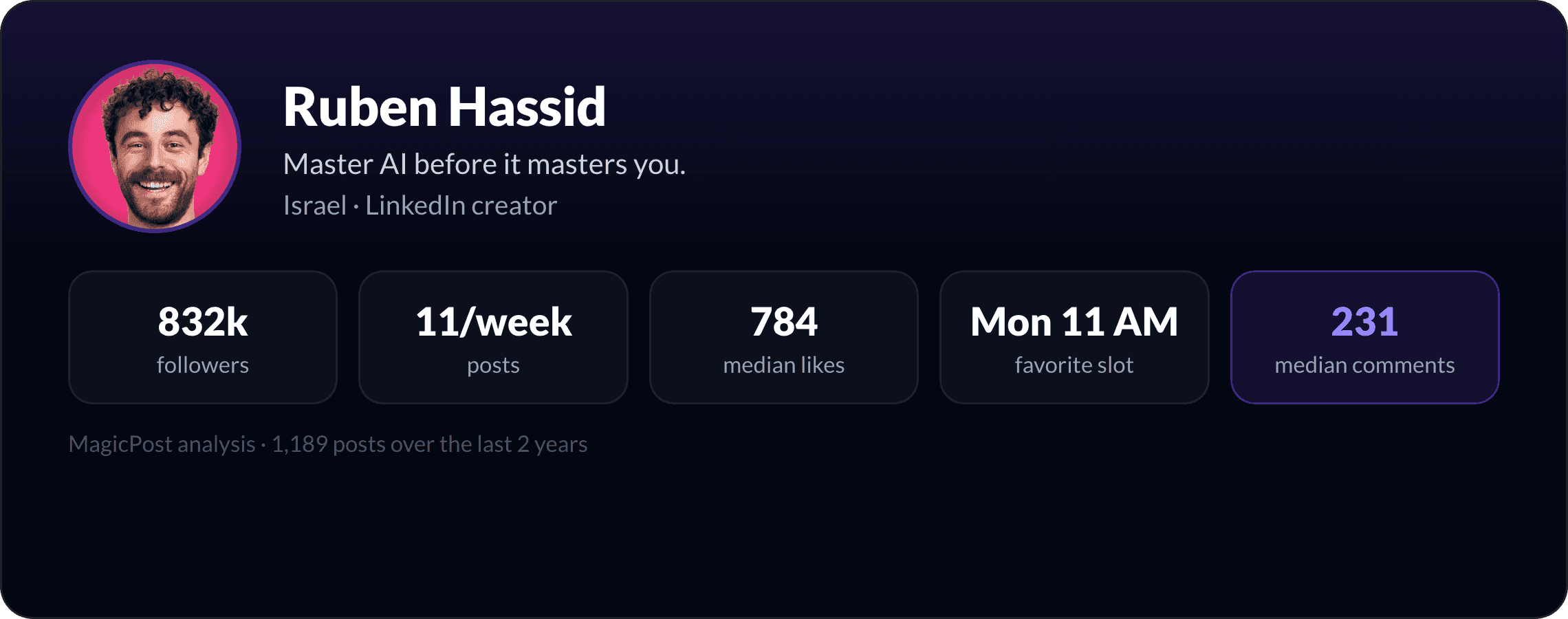
Who Is Ruben Hassid? The "Master AI Before It Masters You" Creator, Explained by Data (2026)
Who is Ruben Hassid? MagicPost analyzed 1,189 of their LinkedIn posts: topics, timing, signature moves and the writing fingerprint behind their growth, with rea
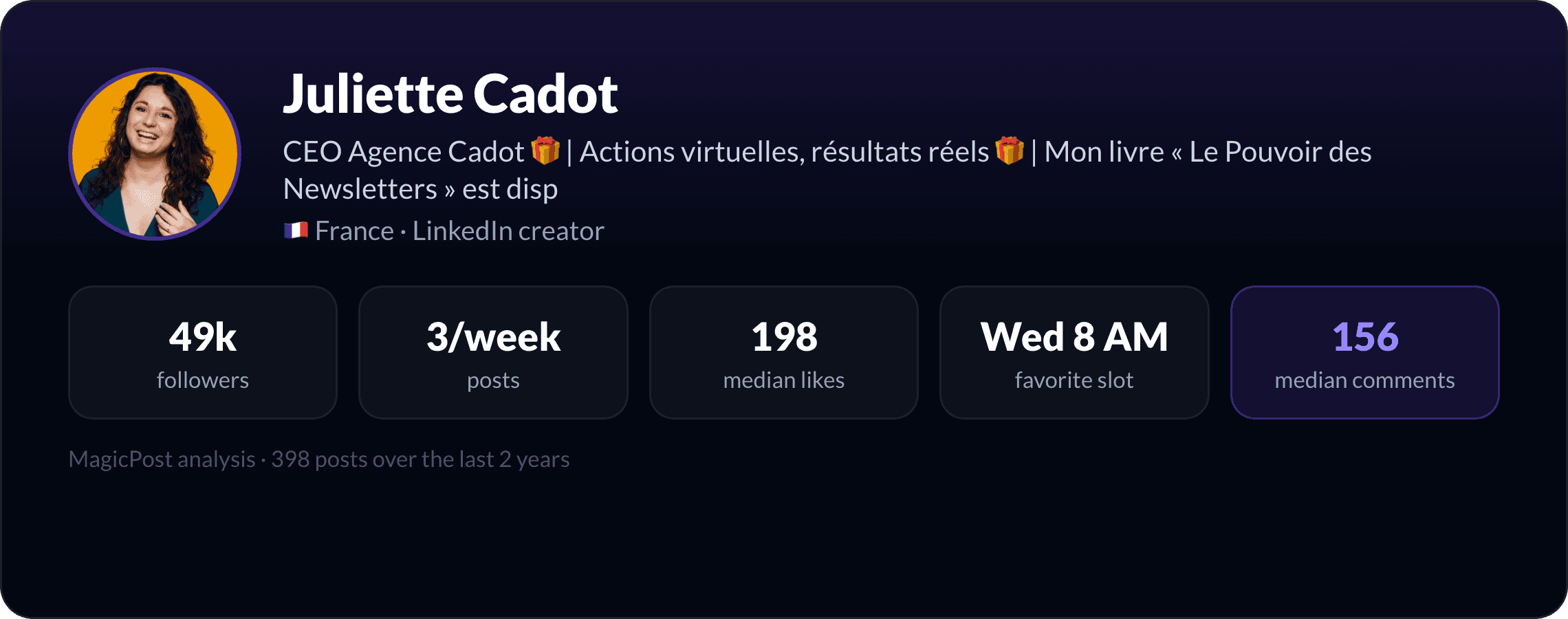
Who Is Juliette Cadot? The Agency Founder Whose Audience Talks Back (2026)
Who is Juliette Cadot? MagicPost analyzed 398 of their LinkedIn posts: topics, timing, signature moves and the writing fingerprint behind their growth, with rea