" height="26.80529977783203px" id="tymKb8bqC" width="128.00300311279295px"/><path d="M 0 2.417 L 0 0 L 12.909 0 L 12.909 2.417 Z" fill="rgb(126, 78, 253)" height="2.417099999999998px" id="aYr4em6zK" transform="translate(128.341 22.325)" width="12.908999999999992px"/></svg>)

"/><stop offset="1" stop-color="rgb(118, 37, 250)"/></linearGradient></defs><g d="M 19.242 21.22 L 19.362 6.204 L 19.272 6.204 L 13.757 21.22 L 10.161 21.22 L 4.796 6.204 L 4.706 6.204 L 4.825 21.22 L 0 21.22 L 0 0 L 7.283 0 L 12.109 13.607 L 12.229 13.607 L 16.844 0 L 24.247 0 L 24.247 21.22 Z M 26.421 26.113 L 26.421 23.445 L 41.407 23.445 L 41.407 26.113 Z" fill="transparent" height="26.112508199679183px" id="DvfaAIHYn" width="41.40731898311435px"><path d="M 19.242 21.22 L 19.362 6.204 L 19.272 6.204 L 13.757 21.22 L 10.161 21.22 L 4.796 6.204 L 4.706 6.204 L 4.825 21.22 L 0 21.22 L 0 0 L 7.283 0 L 12.109 13.607 L 12.229 13.607 L 16.844 0 L 24.247 0 L 24.247 21.22 Z" fill="rgb(46, 46, 46)" height="21.220180016149442px" id="pLsxRCobd" width="24.247352589074694px"/><path d="M 0 2.668 L 0 0 L 14.986 0 L 14.986 2.668 Z" fill="url(%23yD9d4I5GR-3279285344-linear-gradient)" height="2.6675085048549647px" id="yD9d4I5GR" transform="translate(26.421 23.445)" width="14.986002836263765px"/></g></svg>)

Naïlé Titah
Every creator eventually wants the audience they built to actually buy something, so they write a sales post: link the offer, describe the product, hit publish, and expect the feed to reward the ask the way it rewards everything else.
It does not. We measured it. Across 57,659 value-first selling posts in the last 12 months (the polished kind, where the pitch is wrapped in a genuine insight rather than dumped raw), the median post earns a 0.33% engagement rate. The platform-wide median across 1.14 million posts is 0.39%. So even the good sales post, the one that gives before it asks, lands below the average post on LinkedIn.
That is the honest headline, and it does not get softer. A selling post is a tax you pay on the trust your other posts build. This page shows what the few surviving sales posts share, hands you three templates that keep the tax low, and gives you the ratio that makes the whole thing work.
TL;DR: Even value-first sales posts earn 0.33% median ER, below the 0.39% platform median: asking underperforms giving. The implication is a ratio, not abstinence: mostly give, occasionally ask, and anchor every ask in a story or result.
The scoreboard nobody wants to read
Here is where selling sits next to the formats it competes with for a slot in your week:
Post type | Posts measured | Engagement rate | Median likes | Median comments |
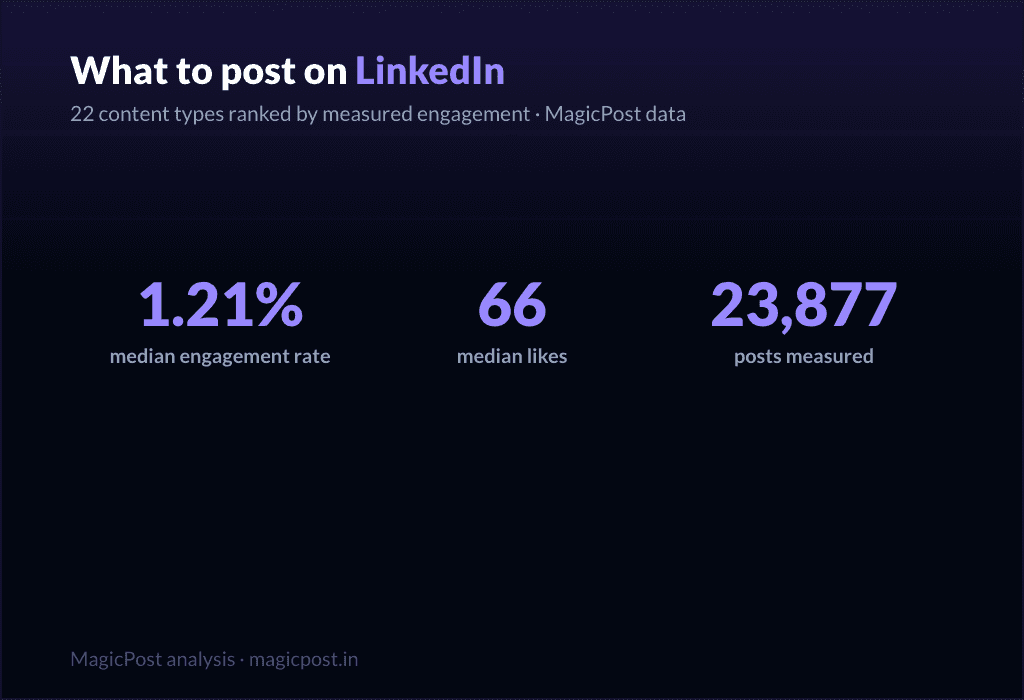
Celebrating a win | 23,877 | 1.21% | 66 | 11 |
Comment-gated lead magnet | 11,530 | 0.40% | 39 | 17 |
Platform median (all posts) | 1,141,932 | 0.39% | - | - |
Value-first selling | 57,659 | 0.33% | 34 | 11 |
Read it top to bottom. Simply celebrating a win earns 1.21%, almost four times the engagement of trying to sell. The comment-gated lead magnet sits at 0.40%, fractionally above the platform median. And the direct value-first sale sits dead last at 0.33%, below the line every other post clears.
The lesson is not subtle: asking underperforms giving, even when the ask is dressed up as value. A win celebration sells you better than a pitch, because it shows competence without demanding anything. (For the full ranking by post type, see which LinkedIn post types actually get engagement.)



So why publish them at all?
Because engagement rate is not the only scoreboard for a sales post. The other formats win attention; the sales post converts attention into revenue. The mistake is expecting one post to do both jobs.
Think of it as a budget. Your wins, lessons, and contrarian takes generate the trust; the sales post spends a little of it. Spend constantly and the balance runs dry (the 0.33% is partly the sound of that fatigue). Spend rarely, anchored in a real story or result, and the post still underperforms on likes but does the one thing it exists to do: it asks. The 0.33% is the cost of doing business. The skill is keeping that cost low and spending it on purpose.
What the surviving sales posts actually look like
The posts that earned the most engagement in the "value-first selling" category barely look like sales posts at all. They open with a free, complete idea, deliver it fully, and let the offer sit underneath as a quiet consequence. Three verbatim examples from our corpus:
"Only foolish people dismiss hard work as "luck." "They're lucky they can work from home." "They're lucky their business took off." "They're lucky they have that lifestyle." Luck? Behind every "overnight success" is years of work. Pitching dozens of clients before landing the first one." Justin Welsh, 9,388 likes (post)
Notice what is missing: a link, a price, a "DM me." The post earns its place by being useful on its own. Same structure here:
"Uncomfortable truth most don't want to hear: Having an idea isn't what makes you special. Executing the idea is. We've all been there: You're out on a walk, in the shower, or just somewhere zoning out... And suddenly you're being flooded with brilliant ideas." Chris Donnelly, 8,516 likes (post)
And a third, the same teach-first move applied to a basic business principle:
"A stupid simple way to stand out in business (and life): Be extremely easy to work with. Be an optimist. Be a pleasant person. Respond quickly to requests. Always do what you said you'd do. That's the basics. That's really the whole strategy. An alarming number of people are bad at all of these things." Justin Welsh, 7,261 likes (post)
The pattern is identical across all three: the value is the whole post, and the sale is implied, not stated. The reader finishes thinking "this person knows what they are talking about," and that is the conversion event. The actual offer happens later, on a profile or in a link they go looking for. None of these lead with the ask, which is exactly why they survived a category that medians 0.33%.
Want the value-first version written for you? The hard part of a selling post is making it genuinely useful before it asks for anything. MagicPost's AI LinkedIn post generator turns your offer into a teach-first post built on the structures above, so the insight carries the post and the sell rides underneath instead of leading it.
Three templates that keep the tax low
These are starting structures, not scripts. Fill in your own facts; the shape is the point.
1. The case-study sell
Lead with a client's result, told as a story. The offer is the last line, and it is optional.
[Client / situation] came to me with [specific painful problem].
Here's what we changed: [1-2 concrete moves, no jargon].
The result: [specific, verifiable number or outcome].
The part most people miss: [the insight that makes it repeatable].
If you're stuck on the same thing, that's the work I do. [soft pointer]
Why it works: the value is the case study itself. A reader gets a usable lesson whether or not they ever buy, which is what keeps the engagement rate from collapsing.
2. The teach-then-offer
Give away the entire method. Then, and only then, name what you sell to do it faster.
Here's exactly how I [achieve the outcome your product delivers]:
1. [step]
2. [step]
3. [step]
That's the whole process. It works. It's also slow and tedious.
[Product] does steps 2 and 3 for you. But the method above is yours either way.
Why it works: you have already delivered the value before you mention the product, so the ask feels like a shortcut, not a wall. This is the structure behind all three example posts above.
3. The soft ask after a win
The highest-engagement move on the board is a win (1.21%). Use that energy. Celebrate something real, then attach one quiet line.
[Genuine milestone, stated plainly, with the human detail that makes it real.]
None of this happens without [audience / clients / team].
If you want to be part of the next one: [single low-pressure invitation].
Why it works: it borrows the engagement of a celebration post and spends only a sentence of it on the ask. The win does the selling; the ask just catches the people already leaning in.
The ratio, not the abstinence
The takeaway is not "never sell." It is a posting mix. Reading the scoreboard backwards, here is the budget the data supports:
Mostly give. The bulk of your posts should be the trust-building formats: wins, lessons, contrarian takes, stories. These generate the balance the sales post draws down. (What to post on LinkedIn maps the full menu.)
Occasionally ask, wrapped in value. When you sell, use a case study or a taught method so the post earns its slot even for people who will never buy. That is the difference between the surviving examples and the 0.33% floor.
Anchor every ask in a story or result. A bare "here's my offer, link below" is the worst version of an already-underperforming format. A sale attached to a real outcome at least carries a lesson when it does not carry a click.
Let comment-gating do the soft conversions. The comment-gated lead magnet (0.40%) outperforms the direct sale and is the gentlest way to ask. It is the live, comment-driven cousin of the sales post: see the LinkedIn lead magnet playbook for how to run one without it reading as a hack.
Stuck on what the "mostly give" posts should be? MagicPost's LinkedIn post ideas turns your topic and audience into a steady stream of trust-building angles, so the rare sales post lands on a full balance instead of an empty one. For the complete template library this page belongs to, start at the LinkedIn post templates hub.
Where the data and examples come from
Every engagement figure here is MagicPost's own research, from the same corpus as the rest of this cluster: LinkedIn posts published over the last 12 months, reshares and excluded posts filtered out, deleted posts removed, then classified by post type. Engagement rate is the median of likes-plus-comments over follower count within each category, never an average, so a handful of viral posts cannot distort the picture. Value-first selling is measured on 57,659 posts, celebrating a win on 23,877, the comment-gated lead magnet on 11,530, and the platform median on 1,141,932 posts. The example posts are real, public posts pulled verbatim, each linked to its source. One honest confounder: people do not choose post types at random, and the author who sells well tends to give well, so part of the gap between selling (0.33%) and a win (1.21%) reflects intent and effort, not format alone. The direction of the gap, though, is consistent across the corpus: the ask costs you. Figures dated June 2026, refreshed with the data.
Preguntas frecuentes
Do sales posts work on LinkedIn?
They work, but not the way most people hope. Measured across 57,659 value-first selling posts over the last 12 months, the median sales post earns a 0.33% engagement rate, below the 0.39% platform median across 1.14 million posts. A win celebration earns 1.21%, almost four times more. So a sales post is not how you win attention; it is how you convert attention you already earned elsewhere. It works when it is rare, anchored in a real story or result, and built on a steady diet of trust-building posts. It fails when it is frequent, bare, and asks before it gives.
How do you sell on LinkedIn without being salesy?
Give the value away first and let the sale be the consequence. The top posts in our selling category open with a complete, free idea (a method, a lesson, a case study), deliver it fully, and let the offer sit underneath where the reader finds it only if they want it. None lead with a link or a price. The reader finishes thinking "this person knows their stuff," and that impression is the actual conversion. Salesy is when the ask comes first; value-first is when it comes last, if at all.
How often should I post sales content on LinkedIn?
Treat it as a budget, not a habit. The bulk of your posts should be trust-building formats (wins at 1.21%, lessons, stories, contrarian takes) that generate the goodwill a sales post spends. Keep selling to a small minority of your posts, and make each one earn its slot by carrying a real lesson or result so it still has value for people who never buy. The data does not support abstinence; it supports a ratio that mostly gives and occasionally asks.
What is the difference between a sales post and a lead magnet post?
A direct sales post points at an offer (a product, a service, a link) and asks the reader to buy or click. A comment-gated lead magnet asks for a low-cost action instead, usually a comment, in exchange for a free resource. The lead magnet performs better in our data (0.40% versus 0.33%) because the ask is softer and the exchange is generous, and it pulls strong comment counts (median 17). Many creators use it as the warm-up and reserve the direct sale for an established relationship.
Which LinkedIn post earns the most engagement, a sale or a win?
A win, by a wide margin. Celebrating a genuine milestone earns 1.21% against 0.33% for a value-first sale, almost four times higher. A win post sells you (your competence, your momentum) far more effectively than a pitch, and without asking the reader for anything. The practical move is to attach your softest sales asks to your win posts, borrowing their engagement and spending only a sentence on the offer.
> Build the balance, then spend it. With MagicPost you can write, schedule and analyze all your LinkedIn content in one place, so the trust-building posts do their job and the rare sales post lands on a full account instead of an empty one.
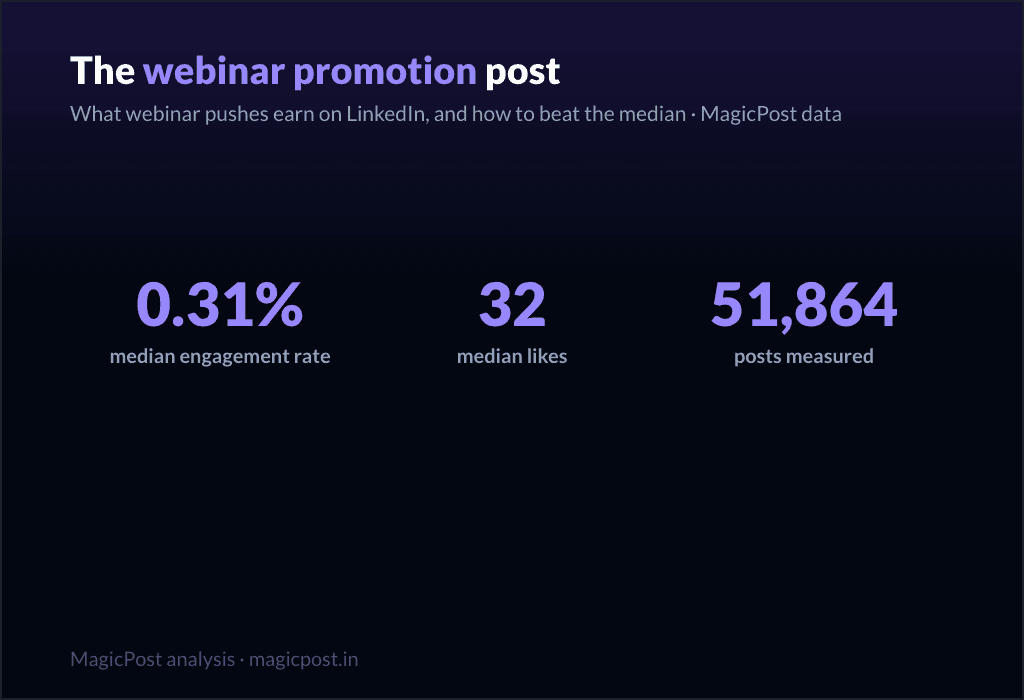
How to Promote a Webinar on LinkedIn (the Standard Signup Post Is the Second-Worst Post Type)
How to promote a webinar on LinkedIn: the standard signup post is the second-worst post type (0.31% ER). The teach-first structure that beats it.
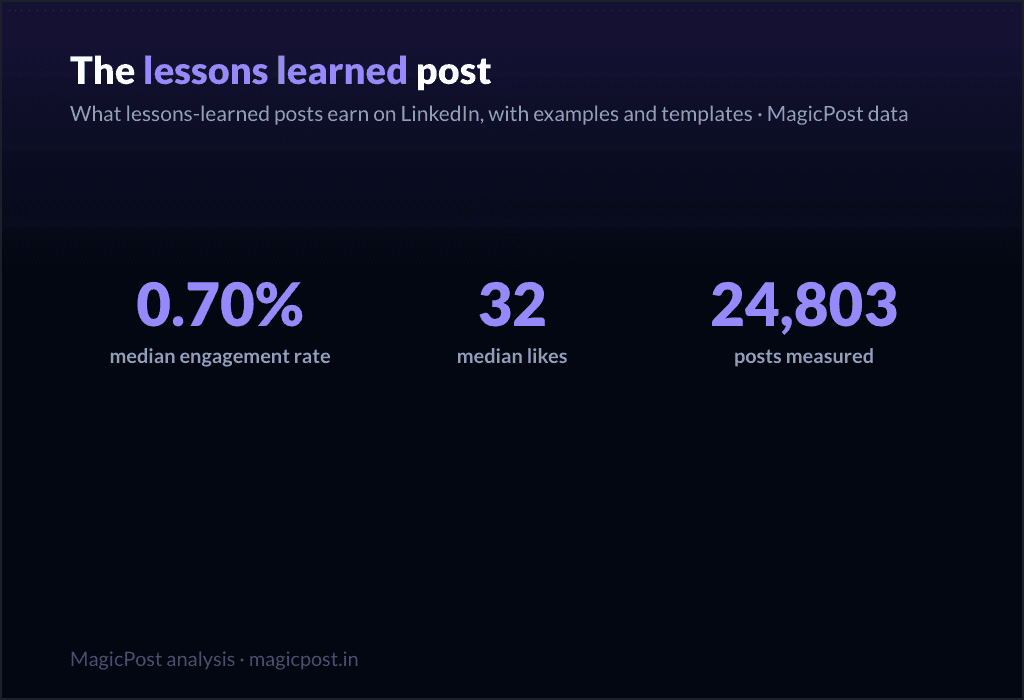
The Lessons Learned LinkedIn Post: Why Earned Advice Beats Expert Advice (0.70% vs 0.44%)
The lessons learned LinkedIn post: earned advice (0.70% ER) beats expert advice (0.44%). The difference is the receipt. Examples and templates.
The Last Day LinkedIn Post: How to Say Goodbye Well (Real Examples + Templates)
The last day LinkedIn post: how to say goodbye well. Real examples (one earned 13,121 likes), 3 templates, and the etiquette of leaving in public.

The Graduation LinkedIn Post: Real Examples, Templates, and How to Make Yours Count
The graduation LinkedIn post: real examples (up to 19,038 likes), 3 templates, and how to make your first professional post count.
The Work Anniversary LinkedIn Post: Beyond the Auto-Generated Badge (Examples + Templates)
The work anniversary LinkedIn post: beyond the auto-badge. Real examples, 3 templates, and the reframe that turns a date into a story.
The Holiday LinkedIn Post: How to Not Sound Like a Corporate Card (Examples + Templates)
The holiday LinkedIn post: how to not sound like a corporate card. Real examples, 3 templates, and why seasonal posts should be scheduled early.
5 Mejores Plantillas de Publicación en LinkedIn (2026)
5 plantillas para publicaciones en LinkedIn: narrativa, artículo en lista, reflexión personal, queja y análisis. Guías paso a paso para crear publicaciones atractivas y aumentar la visibilidad.
13 ejemplos de publicaciones en LinkedIn que generan resultados (2026)
Roba estos 13 ejemplos de publicaciones en LinkedIn comprobados para convertir tu contenido en clientes potenciales y autoridad. Incluye plantillas y una descomposición completa de lo que funciona.
¿Qué publicar en LinkedIn? (2026)
Aumenta tu impacto en LinkedIn con nuestra guía experta. Explora poderosas estrategias de publicación y tipos de contenido para involucrar eficazmente a tu red.
Cómo Anunciar un Nuevo Trabajo en LinkedIn: (+ 5 Plantillas Pre-Hechas)
Domina tu nuevo anuncio de trabajo en LinkedIn. Amplía tu red, atrae oportunidades y consigue 5 plantillas de publicaciones listas para usar para que sea sencillo.