" height="26.80529977783203px" id="tymKb8bqC" width="128.00300311279295px"/><path d="M 0 2.417 L 0 0 L 12.909 0 L 12.909 2.417 Z" fill="rgb(126, 78, 253)" height="2.417099999999998px" id="aYr4em6zK" transform="translate(128.341 22.325)" width="12.908999999999992px"/></svg>)

"/><stop offset="1" stop-color="rgb(118, 37, 250)"/></linearGradient></defs><g d="M 19.242 21.22 L 19.362 6.204 L 19.272 6.204 L 13.757 21.22 L 10.161 21.22 L 4.796 6.204 L 4.706 6.204 L 4.825 21.22 L 0 21.22 L 0 0 L 7.283 0 L 12.109 13.607 L 12.229 13.607 L 16.844 0 L 24.247 0 L 24.247 21.22 Z M 26.421 26.113 L 26.421 23.445 L 41.407 23.445 L 41.407 26.113 Z" fill="transparent" height="26.112508199679183px" id="DvfaAIHYn" width="41.40731898311435px"><path d="M 19.242 21.22 L 19.362 6.204 L 19.272 6.204 L 13.757 21.22 L 10.161 21.22 L 4.796 6.204 L 4.706 6.204 L 4.825 21.22 L 0 21.22 L 0 0 L 7.283 0 L 12.109 13.607 L 12.229 13.607 L 16.844 0 L 24.247 0 L 24.247 21.22 Z" fill="rgb(46, 46, 46)" height="21.220180016149442px" id="pLsxRCobd" width="24.247352589074694px"/><path d="M 0 2.668 L 0 0 L 14.986 0 L 14.986 2.668 Z" fill="url(%23yD9d4I5GR-3279285344-linear-gradient)" height="2.6675085048549647px" id="yD9d4I5GR" transform="translate(26.421 23.445)" width="14.986002836263765px"/></g></svg>)

Naïlé Titah
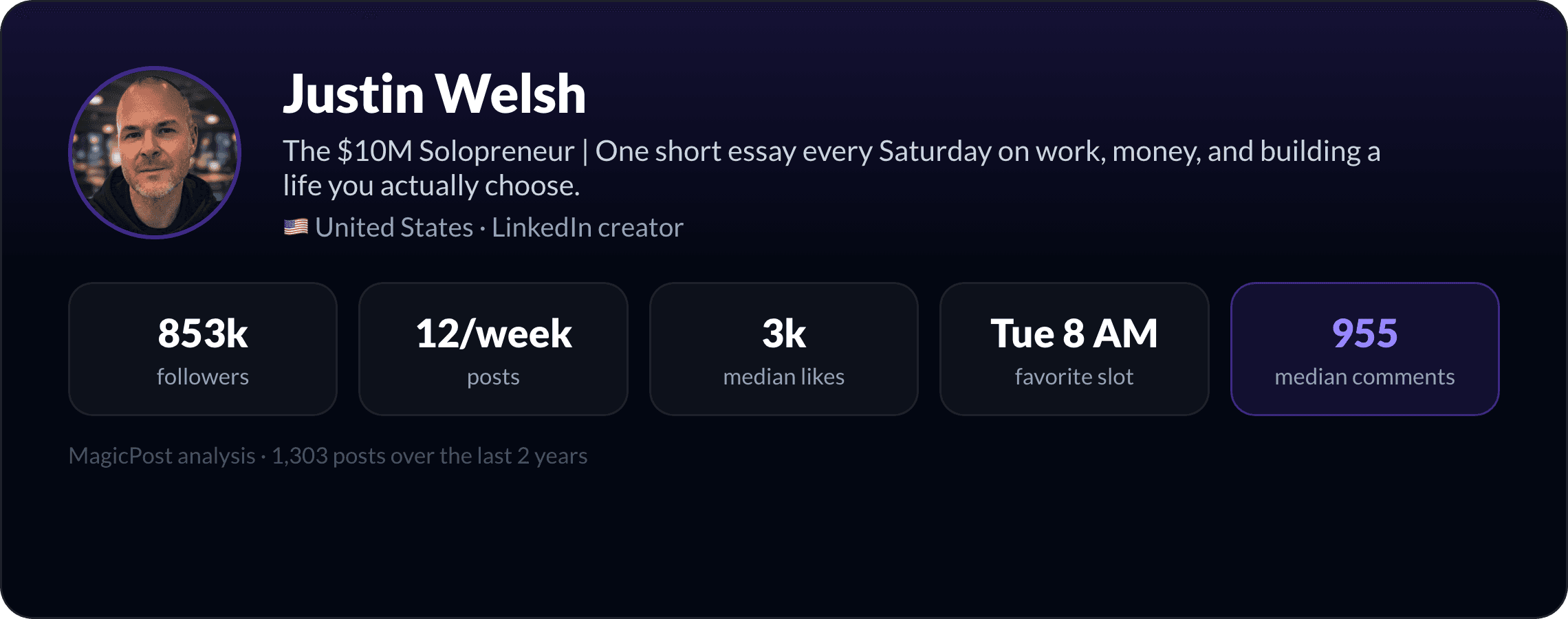
Justin Welsh calls himself "The $10M Solopreneur," and unlike most LinkedIn bios, the numbers behind that one check out in public. At MagicPost, we analyzed 1,303 of his LinkedIn posts from the last two years (and his full history back to 2023): what he writes, when, for whom, what it earns him, and what makes his style worth studying.
This is who Justin Welsh is, according to the best possible source: his own posts, measured.
His story, in his own posts
You do not need a biographer for Welsh. He retells his own story on LinkedIn regularly, and the data shows which chapters he considers essential.
The failure years. "I was a failure from 2003 to 2009," he wrote in a 2025 post: "Bad jobs... Poor performance... $25,000 in credit card debt... Living paycheck to paycheck." His own timeline lists being hired and fired three times in six years, in pharma and medical devices.
The corporate climb. From 2009, the same timeline flips: a New York tech startup, four promotions, VP of Sales in 2015, CRO in 2018. Then the line that defines his brand: "I spent 16 years succeeding at the wrong thing. Big title. Big salary. Completely empty." In another post: "Like I was climbing a ladder I didn't want to reach the top of."
The restart. He quit in 2019, at 38. "I wrote my first LinkedIn post October 30th, 2018. I heard complete crickets. Absolutely nothing," he recalls. And then, looking back: "I started at 38 with zero followers and absolutely no idea what I was doing. Two years later? I reached 100,000 followers and achieved $1 million in revenue."
The one-person business. By mid-2024 he reported crossing $7.5M in total revenue, "zero ads," at "a ~91% margin," selling education products and a newsletter. His stated philosophy, from a "who I am" post: "I am not a productivity machine... I want to take a nap on Monday at 2pm. I want Tuesday lunches out with my wife."
One detail our data surfaces that a regular bio never would: his career-timeline post is not a post, it is a franchise. He has republished near-identical versions of it at least six times in two years, and it reliably pulls 2,000 to 3,400 likes every single time. The lesson is itself very Welsh: when a story works, you do not retire it, you re-run it.



What he actually talks about
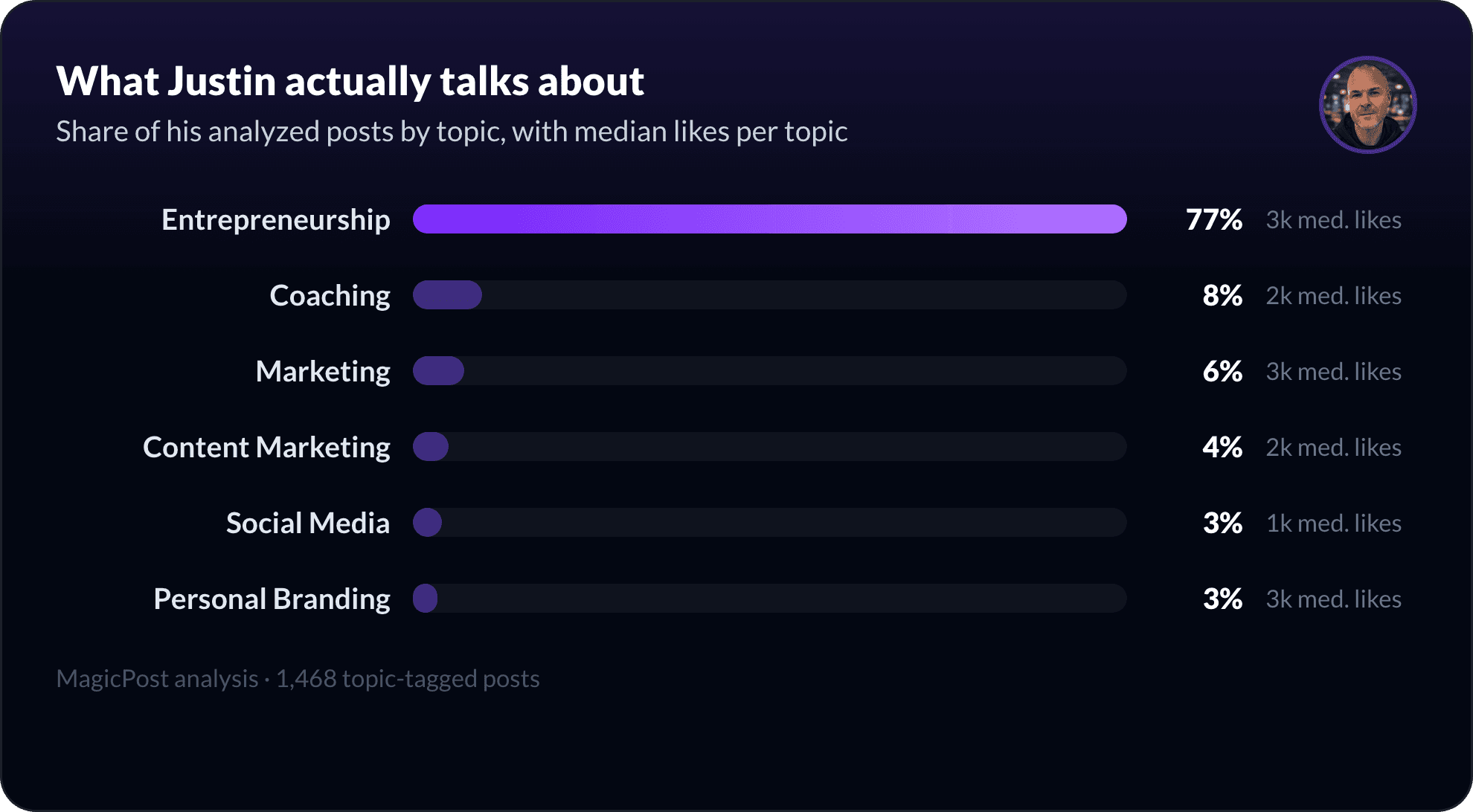
No surprise at the top: Entrepreneurship dominates his feed (about 7 posts in 10), with coaching, marketing and personal branding filling most of the rest. Two details are more interesting than the ranking:
Personal branding over-performs for him (about 3,100 median likes versus his overall 2,800): when Welsh talks about building an audience, his audience listens hardest. Social-media tactics, by contrast, under-perform (about 1,100).
Categorized by register rather than topic, about half his analyzed posts are selling something through value, and another third are punchy standalone advice. Welsh is one of the clearest public examples of an audience that does not punish constant selling, because the selling is wrapped in usable lessons.
Who he writes for
His target reader is explicit in his own words: the corporate employee who suspects there is another way, and the early solopreneur in the messy first years. He writes to "a regular person building in public" (his words) and regularly addresses the reader directly: "If you've ever felt the same way, know that you have the power to...". The offers match the audience: LinkedIn growth systems, content systems, the tools of a one-person business.
His best posts of 2026
His three biggest posts of 2026 so far, reproduced from our data (click through to the originals):
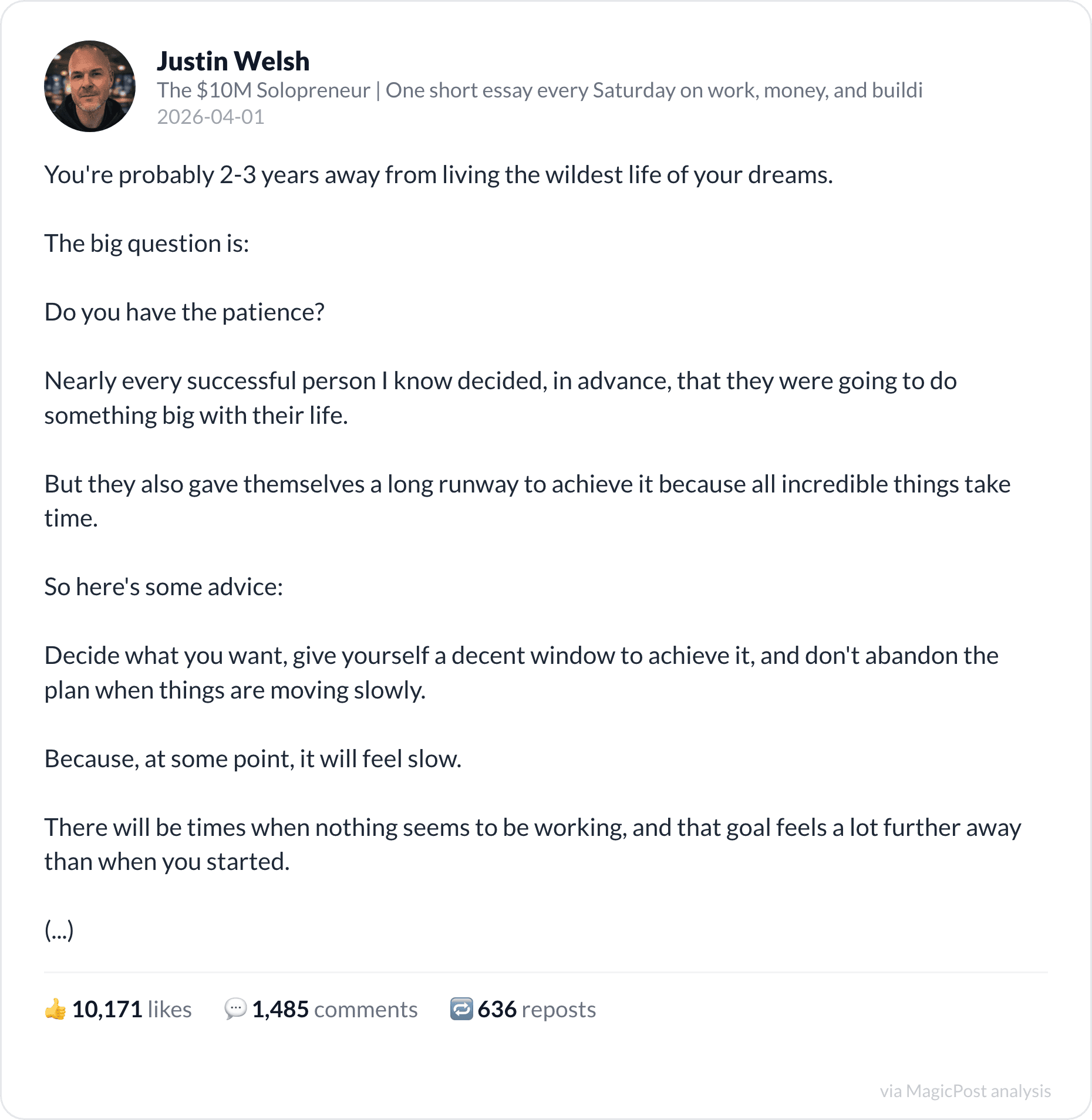
10,171 likes. Classic Welsh mechanics: a big promise in line one, a one-question pivot ("Do you have the patience?"), then short declarative lines. Pure motivation, zero product.
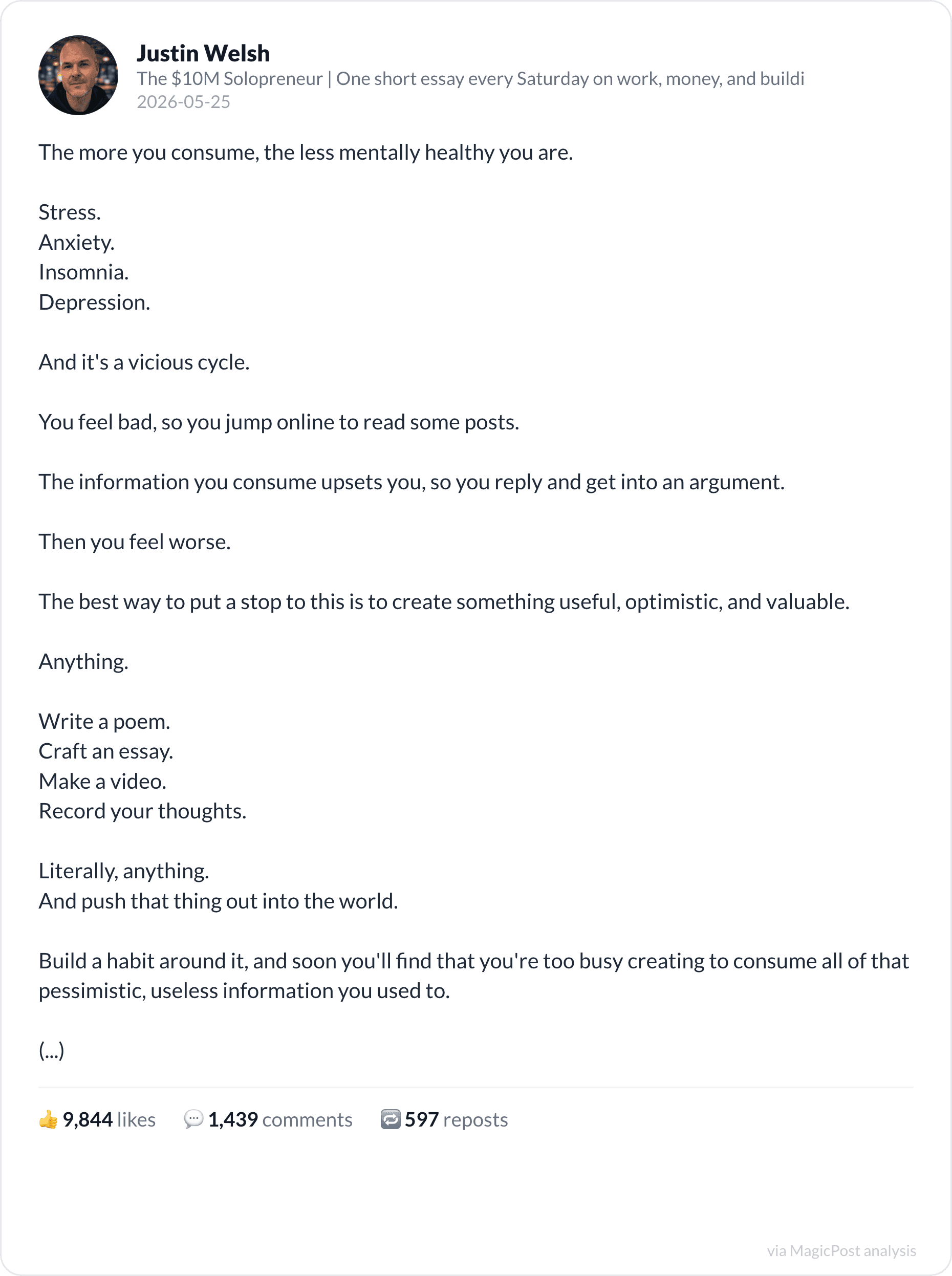
9,844 likes. A contrarian health take ("The more you consume, the less mentally healthy you are") built as a staircase of one-word lines. The furthest he gets from business, and his audience rewarded it.
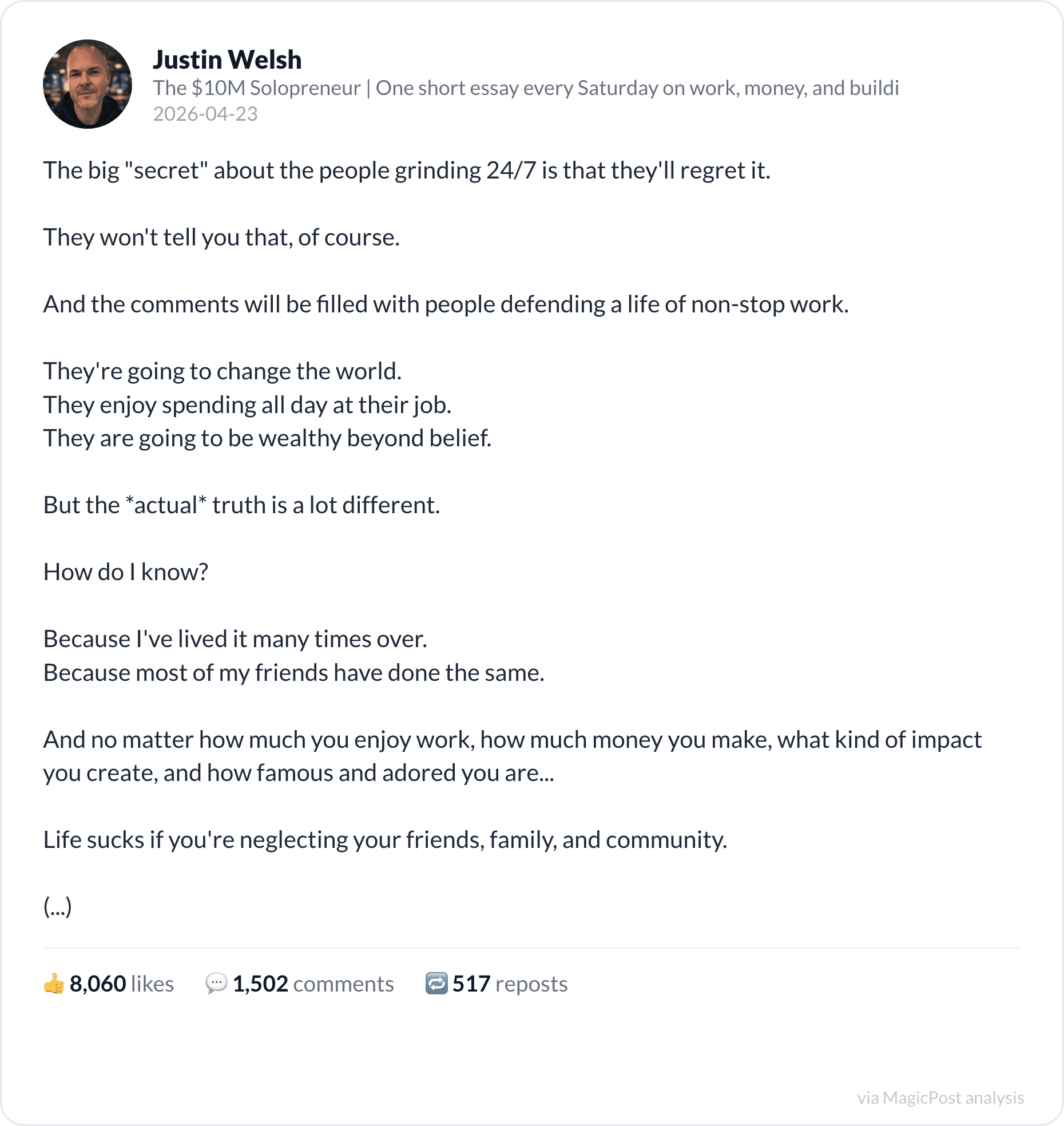
8,060 likes. The anti-hustle position ("the people grinding 24/7... will regret it"), which is the emotional core of his whole brand: success without self-destruction.
Is he still growing?
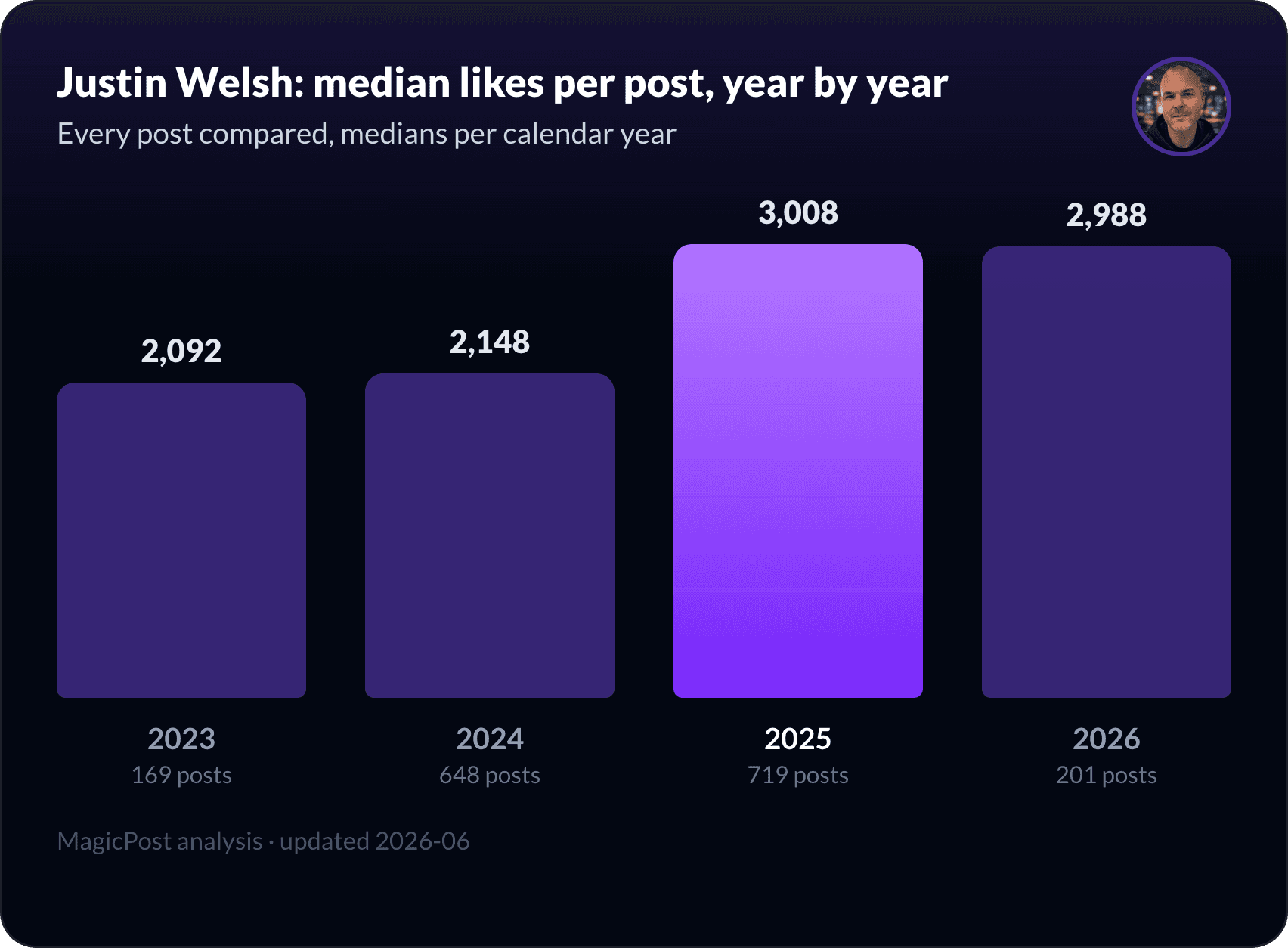
Yes, and measurably. His median post went from about 2,100 likes (2023 and 2024) to about 3,000 in 2025, a 40% jump, and 2026 is holding that level. For a creator posting at his volume (roughly 700 posts a year), holding a 3,000-like median is the quiet proof that the machine still compounds. One honest note: we measure engagement, not followers over time, so this is the trajectory of how hard his posts hit, not of his audience size.
Where do these charts come from? Everything on this page runs on MagicPost's LinkedIn analytics, and it works on your profile too: your best posts, your audience, your benchmark, even a side-by-side with creators like Justin Welsh.
How he writes (the Spartan fingerprint)
Here is Welsh measured against the average creator, and the headline is not what you expect:
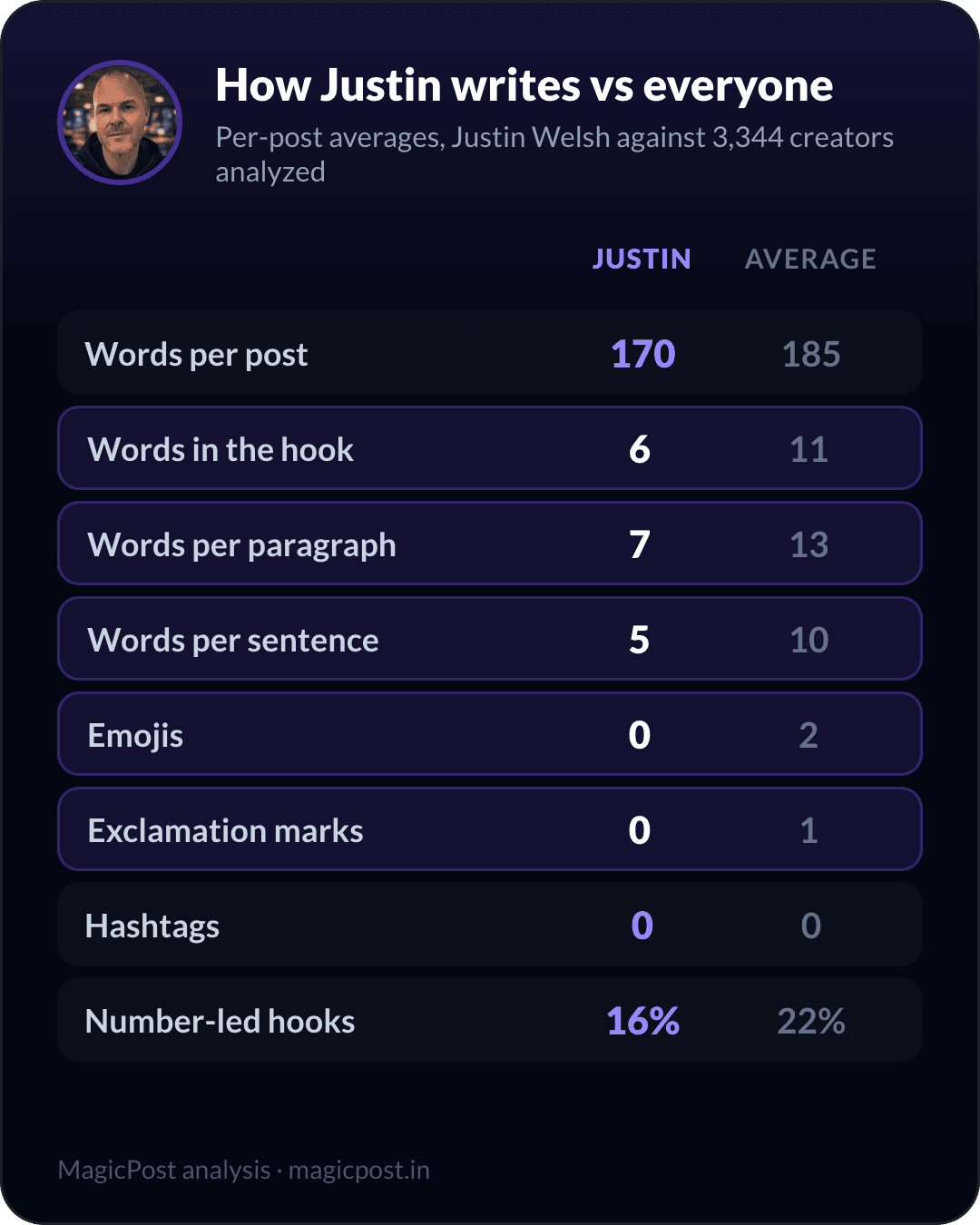
Metric (per post) | Justin Welsh | Average creator* |
Words | ~170 | 185 |
Words in the hook | 6 | 11 |
Words per paragraph | 7 | 13 |
Words per sentence | 5 | 10 |
Emojis | 0 | 2 |
Exclamation marks | 0 | 1 |
Hashtags | 0 | 0 |
Hooks built on numbers | 16% | 22% |
*Median across the 3,344 creators we analyzed with 20+ posts each.
He does not actually write short: at ~170 words per post he is within shouting distance of the 185-word average. What he writes is dense. His typical sentence is five words against the average ten. His typical paragraph is seven words, meaning most of his paragraphs are one short sentence with air around it. His hooks are six words against the typical eleven ("Two years is nothing."). Half the sentence length, half the paragraph length, same total: that is where the famous white-space style lives in the numbers. And the four zeros (no emojis, no hashtags, no bold, no exclamation marks, across a thousand-plus posts) strip away everything the average creator leans on. When our system describes his style in one word, it says: punchy.
The "AI tells" in his style (read this the right way)
Run Welsh's writing through the patterns that people now call "AI tells," and something funny shows up:
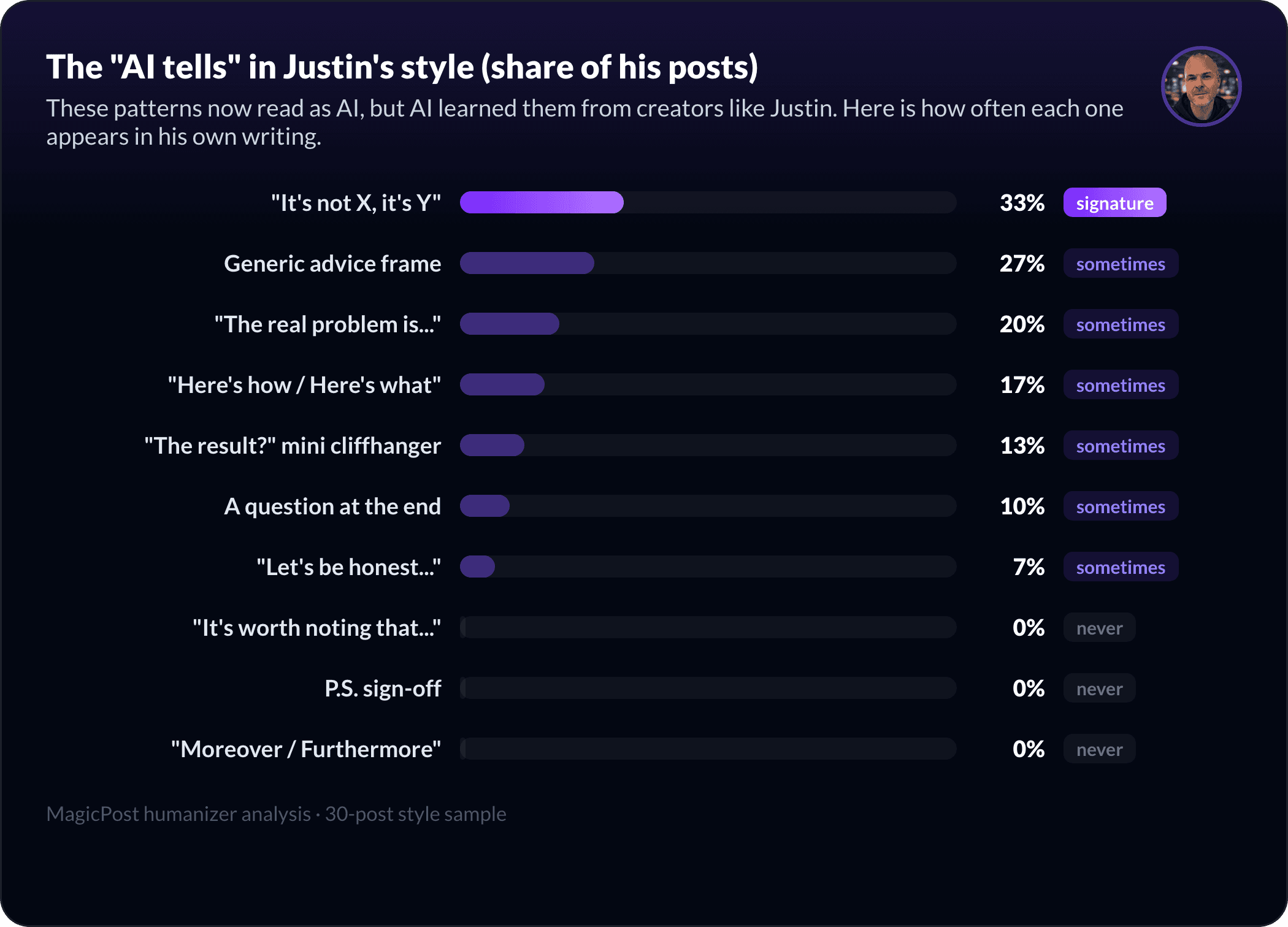
One in three of his posts uses the "It's not X, it's Y" contrast formula, the single most flagged "AI" pattern on LinkedIn. A quarter lean on an advice frame, a fifth on "the real problem is..." reveals, a sixth open with "Here's how".
Do not read it backwards. Welsh does not write like an AI; AI writes like Welsh. These patterns read as robotic today because the models trained on the best creators of this platform and then used all of their moves at once, in every post. Welsh uses one, where it lands. And the other half of his fingerprint is exactly what AI cannot help adding: he never hedges ("it's worth noting that..."), never opens a line with "Moreover," never bolts on an automatic P.S. The discipline is the signature. (Full story: how to spot AI writing on LinkedIn.)
When he posts
Welsh publishes about 12 times a week, favorite slot Tuesday 8 AM US Eastern, with 55% of his posts in the morning and a meaningful 27% on weekends. That is consistent with what our US timing data says about the early-morning window, and his volume sits at the very top of what our posting-frequency study measured. Do not start at 12 a week: he built up to it over 1,900+ consecutive days of publishing (his number). And if part of your own playbook is showing up in his comments, that is exactly what an engagement feed is for: his posts, every day, without hunting the timeline.
What to steal from Justin Welsh
One idea, stripped bare. 170 words, no decoration. If a sentence does not carry weight, it goes.
Build a signature story and re-run it. His career timeline earned 2,000+ likes six separate times. Your origin story is an asset, not a one-off.
Sell through the lesson. Half his posts sell, and the audience stays, because the post is useful before it is commercial.
One strong move per post. The contrast formula in a third of posts, never six patterns stacked. That is the difference between a signature and an AI tell.
Volume after consistency, not before. The 12-a-week pace came after years of daily publishing, at a rhythm he could keep.
Study him, then study yourself. With MagicPost you can dig into Justin Welsh's numbers the way we just did, analyze your own LinkedIn analytics with the same depth, and write in the spirit of his style (255 people already do). The data on this page is the product.
Where this data comes from
Everything in this article is MagicPost's own research. MagicPost analyzed 1,303 Justin Welsh posts from the last two years (1,737 in total back to 2023): timing, engagement, topics, writing metrics, and the AI-pattern profile from a 30-post style sample. Every biographical claim is quoted from one of his own public LinkedIn posts and linked to it. Welsh is not affiliated with MagicPost; his style is one of those MagicPost tracks most closely.
Preguntas frecuentes
Who is Justin Welsh?
A former tech executive (VP of Sales, then CRO) who quit corporate life in 2019 at 38 and built a one-person education business he reported at $7.5M+ in cumulative revenue, with about 853,000 LinkedIn followers. He brands himself "The $10M Solopreneur."
How did Justin Welsh make his money?
By his own public account: education products and courses about building a one-person business (14,000+ students reported), a large newsletter, and content systems, at margins he reports around 90%, with no ads.
How often does Justin Welsh post on LinkedIn?
About 12 posts a week in our data, most often at 8 AM US Eastern, with Tuesday his most frequent day, and 27% of posts on weekends.
Does Justin Welsh write with AI?
His style predates the AI era and reads intensely human: four hard zeros (no emojis, hashtags, bold or exclamation marks) and none of the filler AI adds. The twist is that AI tools learned from creators like him, which is why a third of his posts contain the "It's not X, it's Y" pattern people now mislabel as an AI tell.
Is Justin Welsh still growing on LinkedIn?
His median engagement per post jumped about 40% in 2025 (from ~2,100 to ~3,000 likes) and held that level into 2026.
Can I write like Justin Welsh?
You can learn the mechanics: MagicPost learns a creator's writing style (length, rhythm, hooks, signature moves) and helps you write in that spirit, in your own voice.
The Top LinkedIn Creators to Study in 2026 (By the Data)
The top LinkedIn creators to study in 2026, by the data: 62 creators, six languages, 27 countries, 32,000 posts analyzed by MagicPost. Grouped by what they teach.
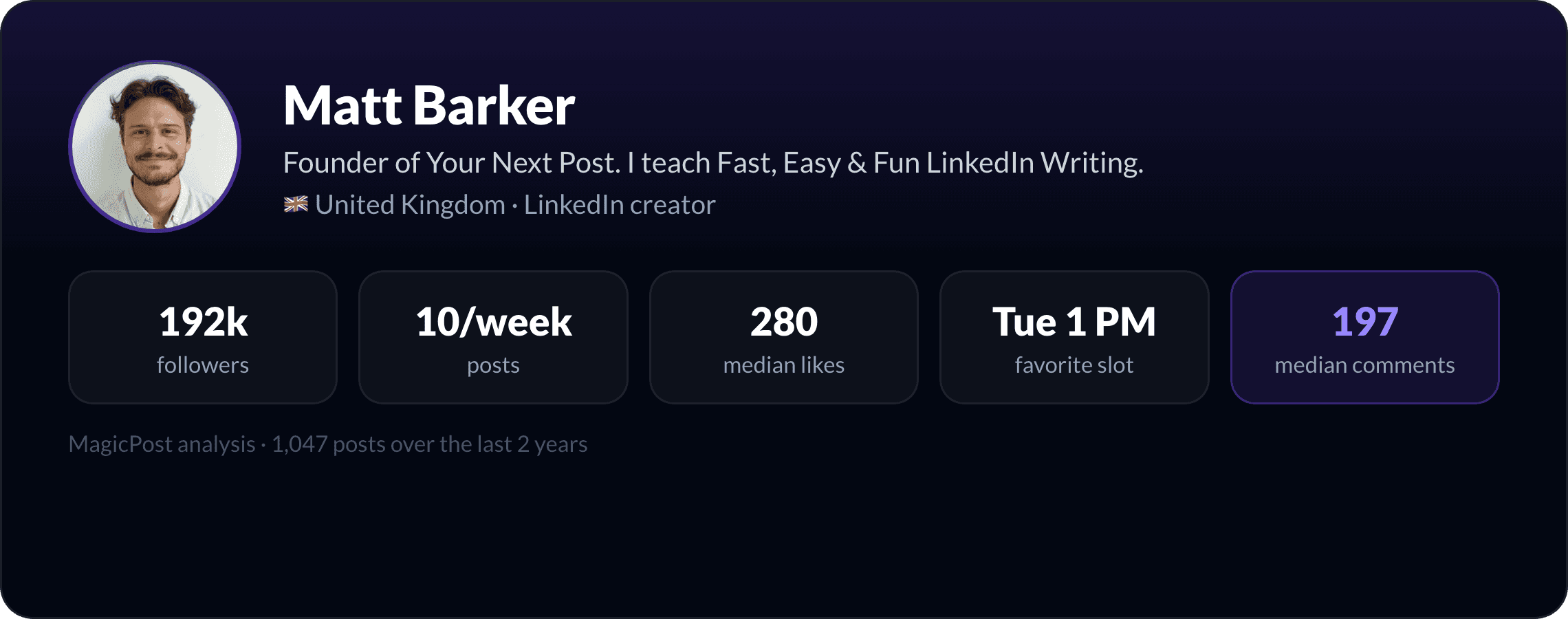
Who Is Matt Barker? The Hook Writer on LinkedIn, by Data (2026)
Who is Matt Barker? MagicPost analyzed 1,047 of their LinkedIn posts: topics, timing, signature moves and the writing fingerprint behind their growth, with real
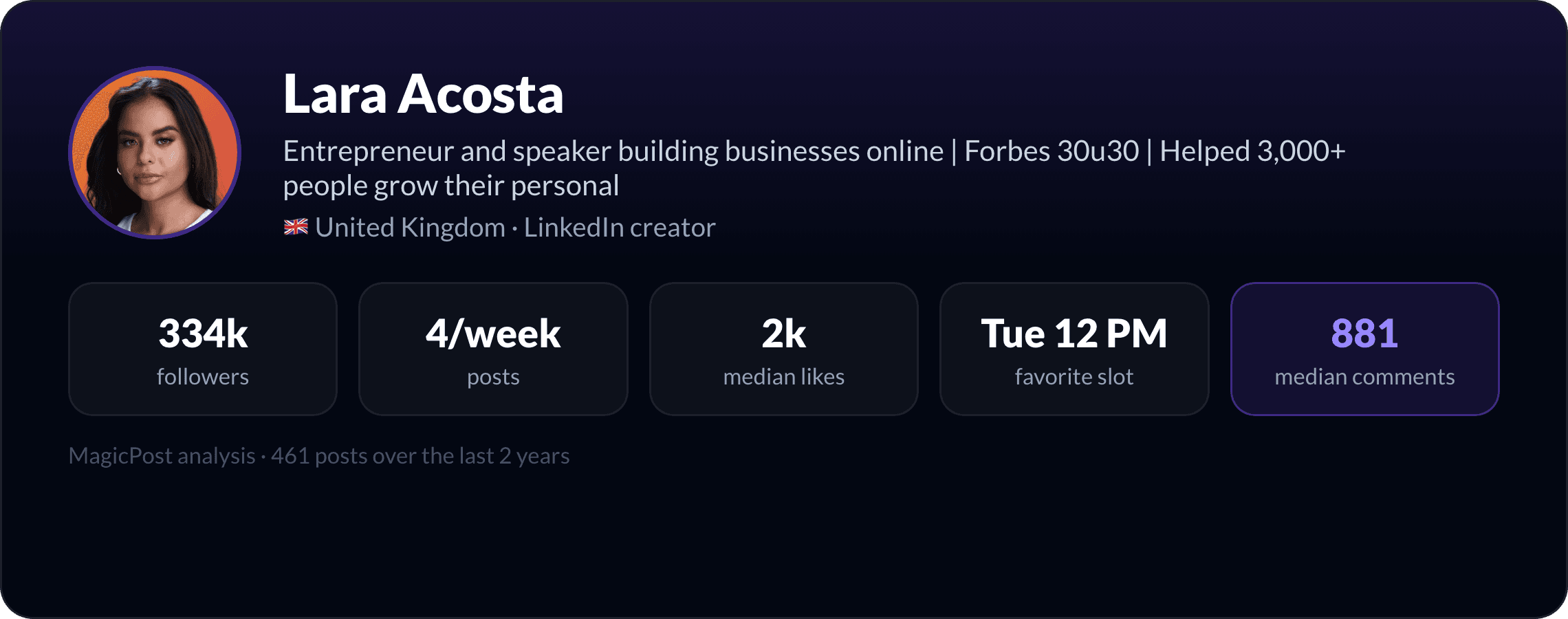
Who Is Lara Acosta? The Forbes 30 Under 30 Comment Machine, Explained by Data (2026)
Who is Lara Acosta? MagicPost analyzed 461 of their LinkedIn posts: topics, timing, signature moves and the writing fingerprint behind their growth, with real n
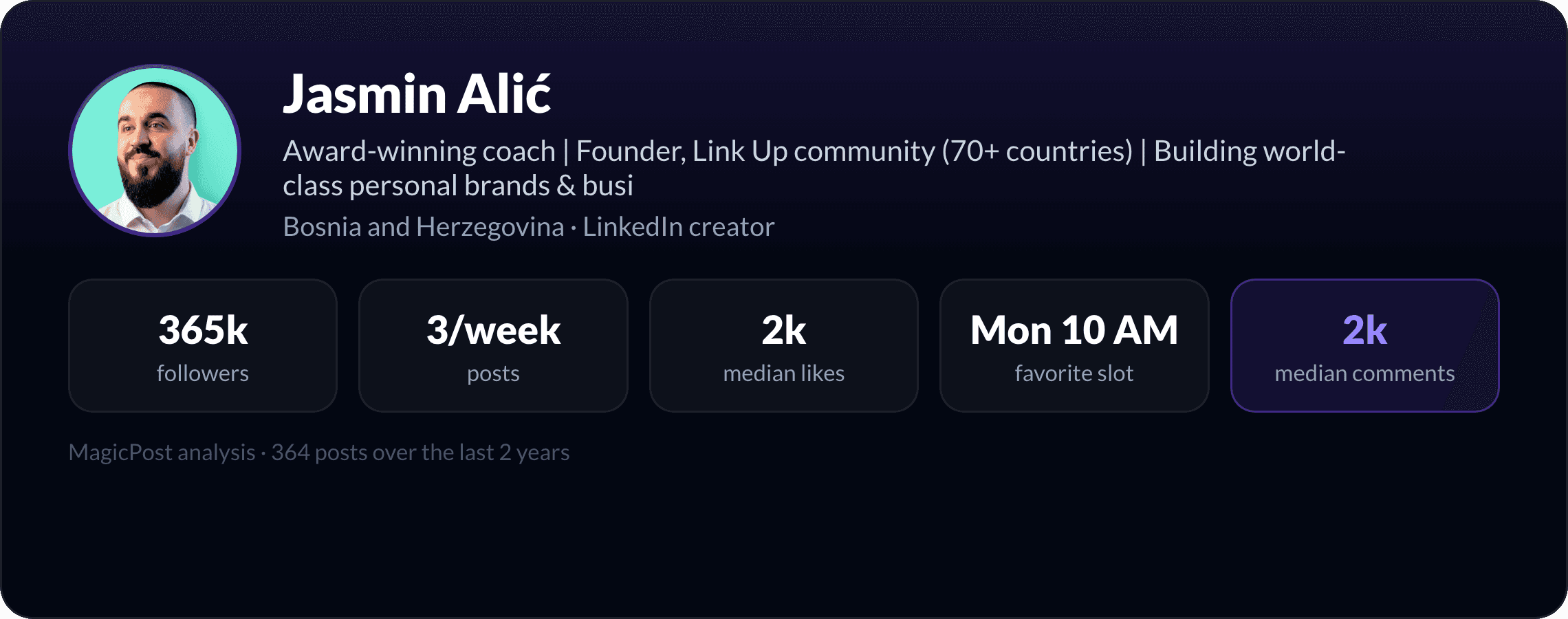
Who Is Jasmin Alić? The Bosnian Coach LinkedIn Mistook for a Bot (2026)
Who is Jasmin Alić? MagicPost analyzed 364 of their LinkedIn posts: topics, timing, signature moves and the writing fingerprint behind their growth, with real n
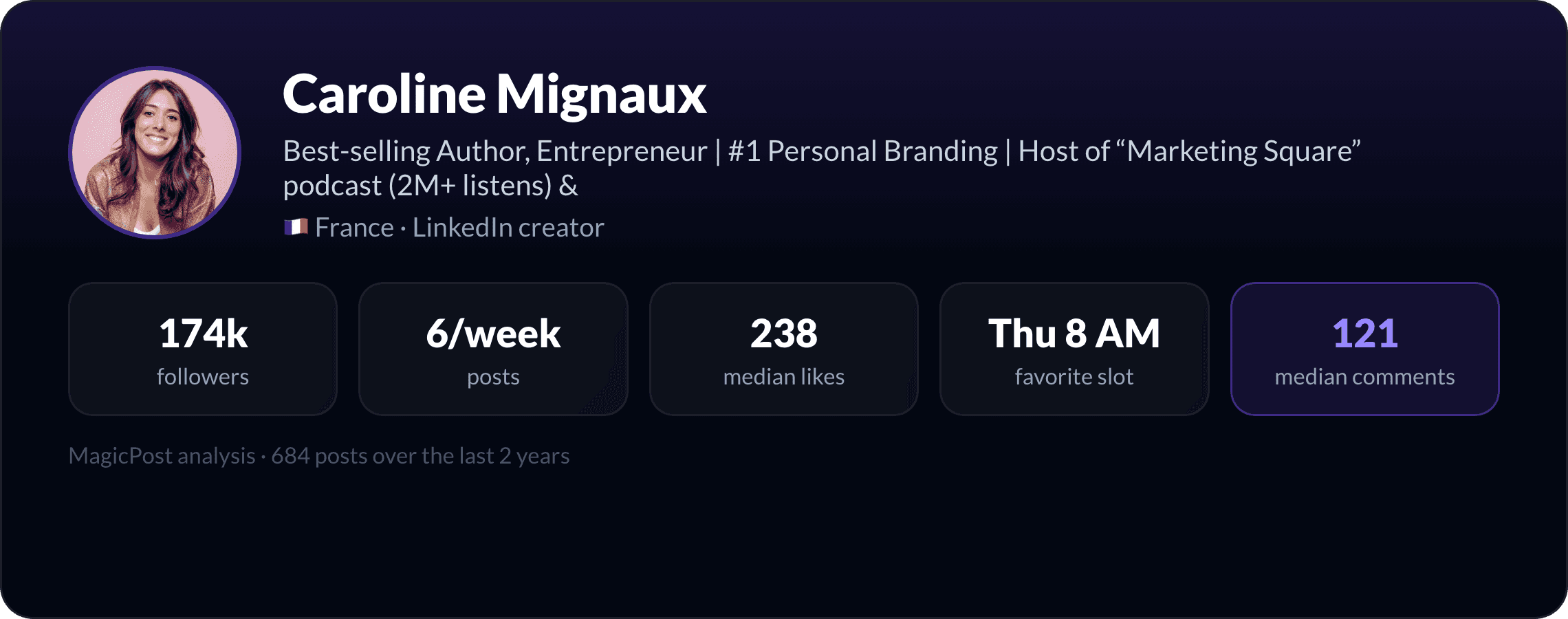
Who Is Caroline Mignaux? France's LinkedIn Top Voice Who Turned Shame Into a Following (2026)
Who is Caroline Mignaux? MagicPost analyzed 684 of their LinkedIn posts: topics, timing, signature moves and the writing fingerprint behind their growth, with r
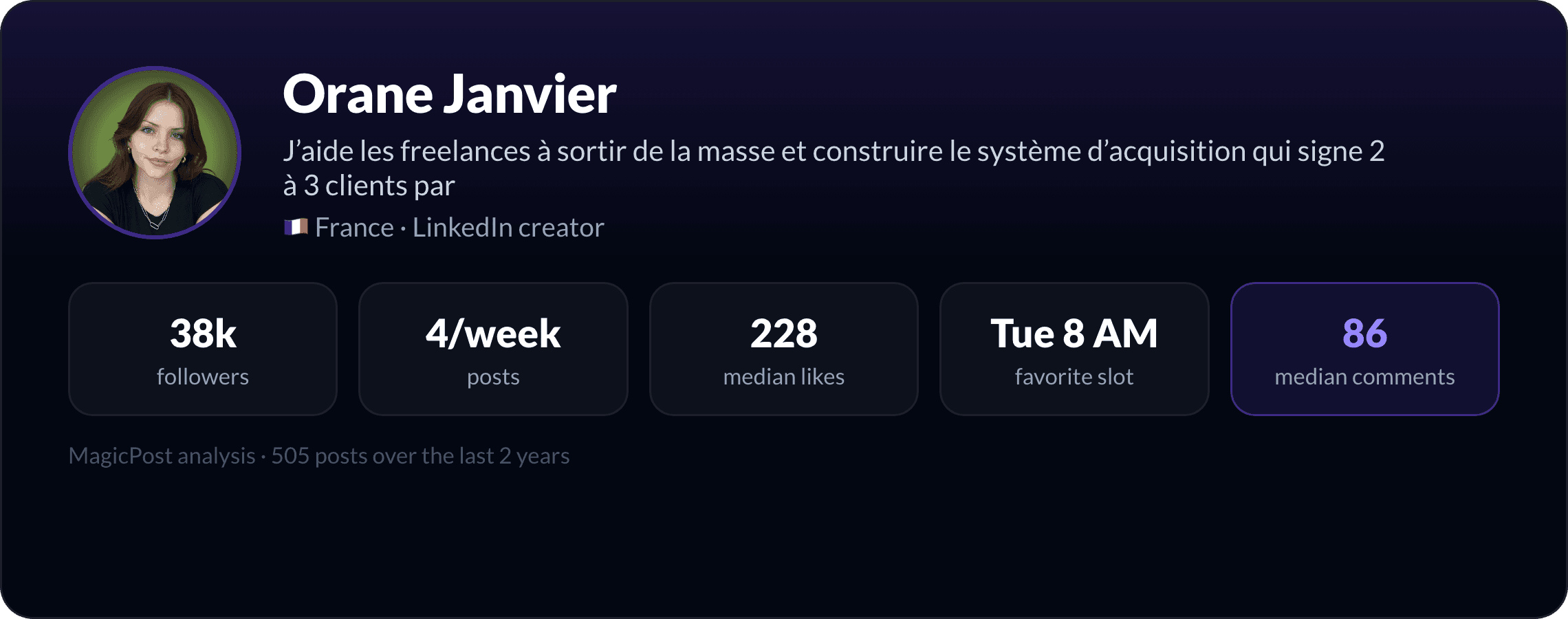
Who Is Orane Janvier? The Freelance Coach LinkedIn Quietly Copies (2026)
Who is Orane Janvier? MagicPost analyzed 505 of their LinkedIn posts: topics, timing, signature moves and the writing fingerprint behind their growth, with real
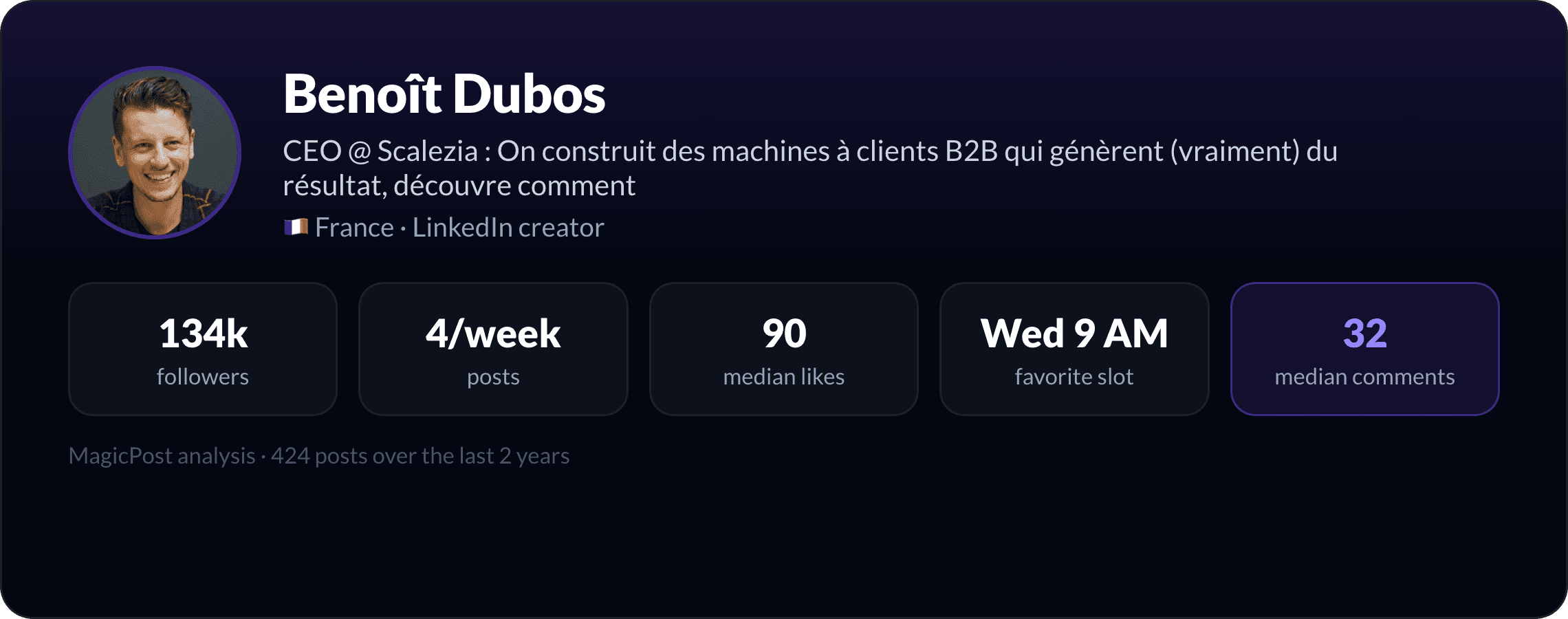
Who Is Benoît Dubos? The Growth Operator Who Turned a Falling Reach Into a Lead Machine (2026)
Who is Benoît Dubos? MagicPost analyzed 424 of their LinkedIn posts: topics, timing, signature moves and the writing fingerprint behind their growth, with real
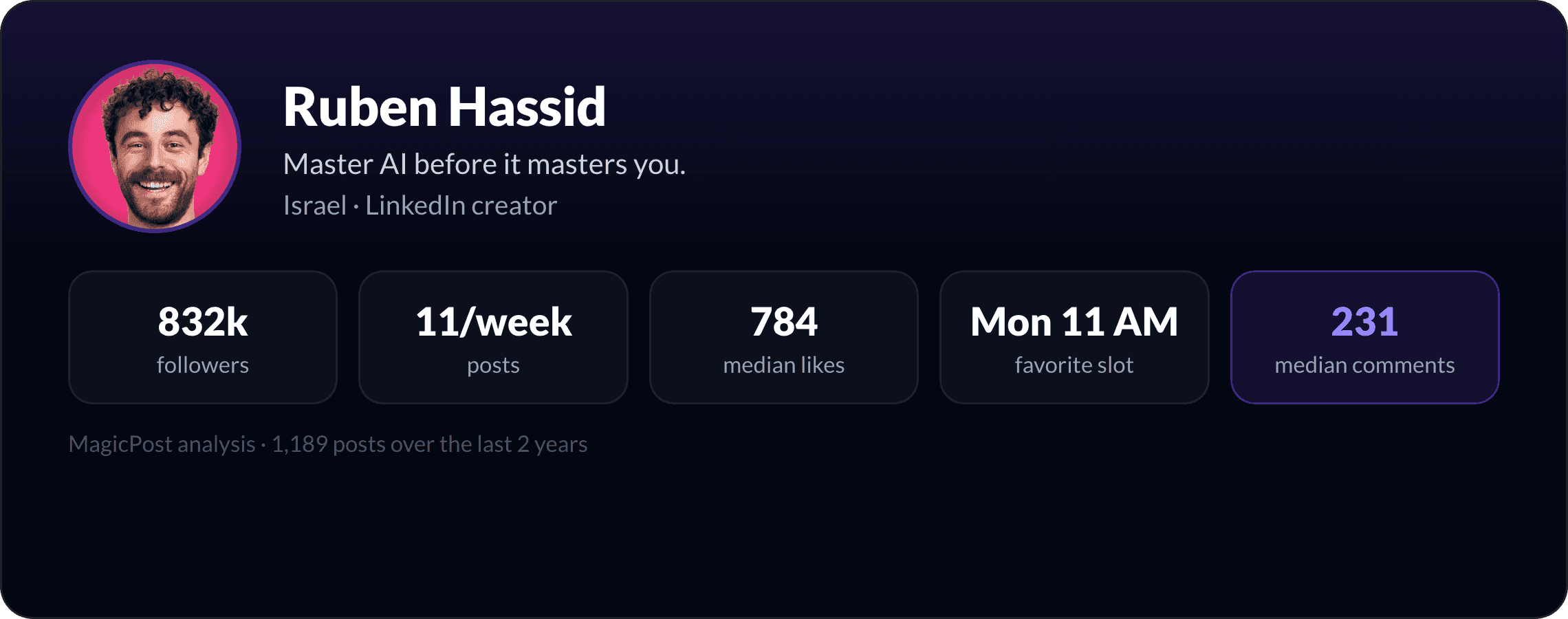
Who Is Ruben Hassid? The "Master AI Before It Masters You" Creator, Explained by Data (2026)
Who is Ruben Hassid? MagicPost analyzed 1,189 of their LinkedIn posts: topics, timing, signature moves and the writing fingerprint behind their growth, with rea
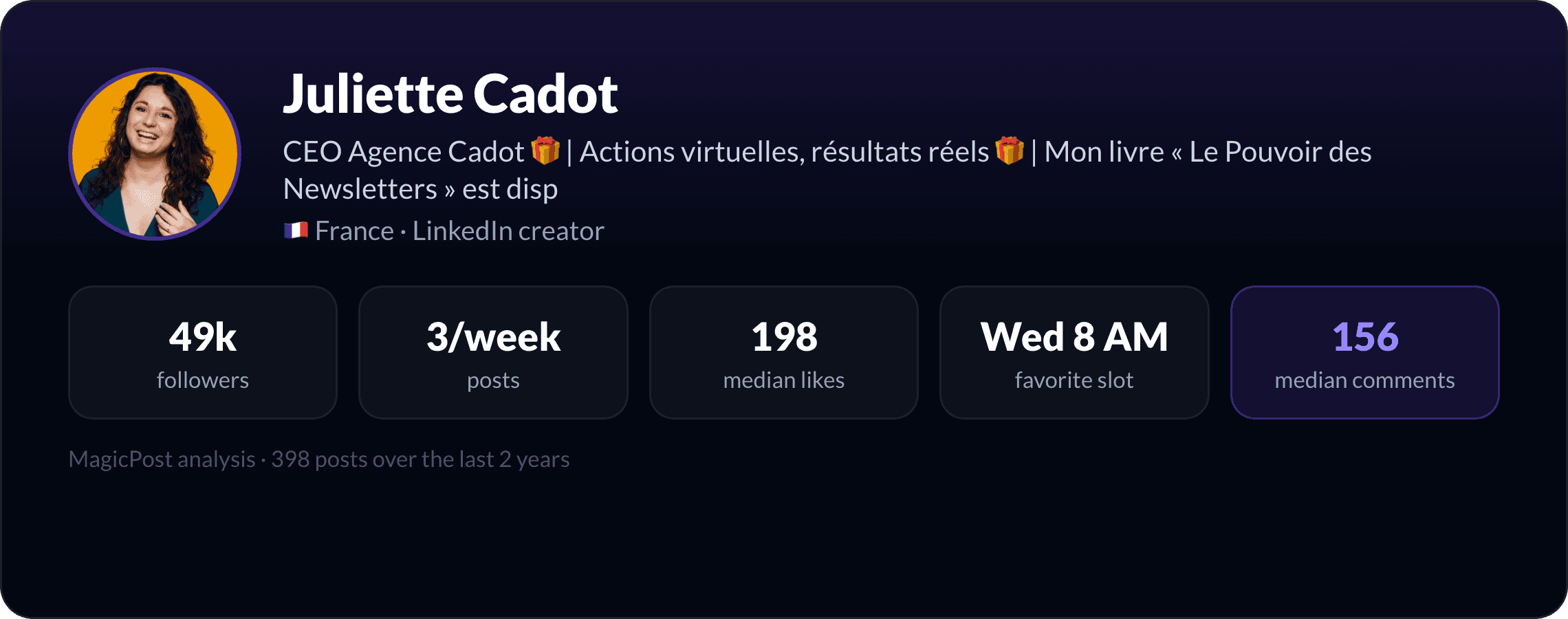
Who Is Juliette Cadot? The Agency Founder Whose Audience Talks Back (2026)
Who is Juliette Cadot? MagicPost analyzed 398 of their LinkedIn posts: topics, timing, signature moves and the writing fingerprint behind their growth, with rea
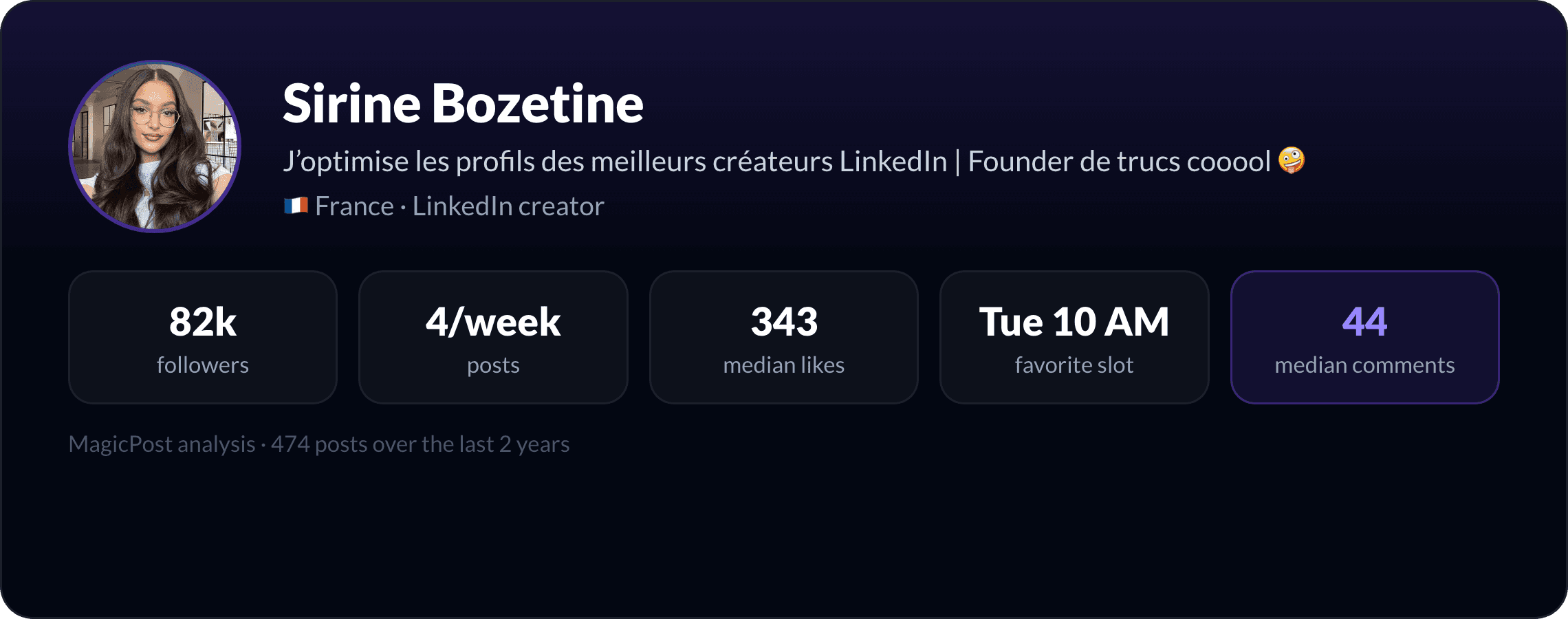
Who Is Sirine Bozetine? The Creator Who Turned Getting Rejected Into 82k Followers (2026)
Who is Sirine Bozetine? MagicPost analyzed 474 of their LinkedIn posts: topics, timing, signature moves and the writing fingerprint behind their growth, with re