" height="26.80529977783203px" id="tymKb8bqC" width="128.00300311279295px"/><path d="M 0 2.417 L 0 0 L 12.909 0 L 12.909 2.417 Z" fill="rgb(126, 78, 253)" height="2.417099999999998px" id="aYr4em6zK" transform="translate(128.341 22.325)" width="12.908999999999992px"/></svg>)

"/><stop offset="1" stop-color="rgb(118, 37, 250)"/></linearGradient></defs><g d="M 19.242 21.22 L 19.362 6.204 L 19.272 6.204 L 13.757 21.22 L 10.161 21.22 L 4.796 6.204 L 4.706 6.204 L 4.825 21.22 L 0 21.22 L 0 0 L 7.283 0 L 12.109 13.607 L 12.229 13.607 L 16.844 0 L 24.247 0 L 24.247 21.22 Z M 26.421 26.113 L 26.421 23.445 L 41.407 23.445 L 41.407 26.113 Z" fill="transparent" height="26.112508199679183px" id="DvfaAIHYn" width="41.40731898311435px"><path d="M 19.242 21.22 L 19.362 6.204 L 19.272 6.204 L 13.757 21.22 L 10.161 21.22 L 4.796 6.204 L 4.706 6.204 L 4.825 21.22 L 0 21.22 L 0 0 L 7.283 0 L 12.109 13.607 L 12.229 13.607 L 16.844 0 L 24.247 0 L 24.247 21.22 Z" fill="rgb(46, 46, 46)" height="21.220180016149442px" id="pLsxRCobd" width="24.247352589074694px"/><path d="M 0 2.668 L 0 0 L 14.986 0 L 14.986 2.668 Z" fill="url(%23yD9d4I5GR-3279285344-linear-gradient)" height="2.6675085048549647px" id="yD9d4I5GR" transform="translate(26.421 23.445)" width="14.986002836263765px"/></g></svg>)

Naïlé Titah
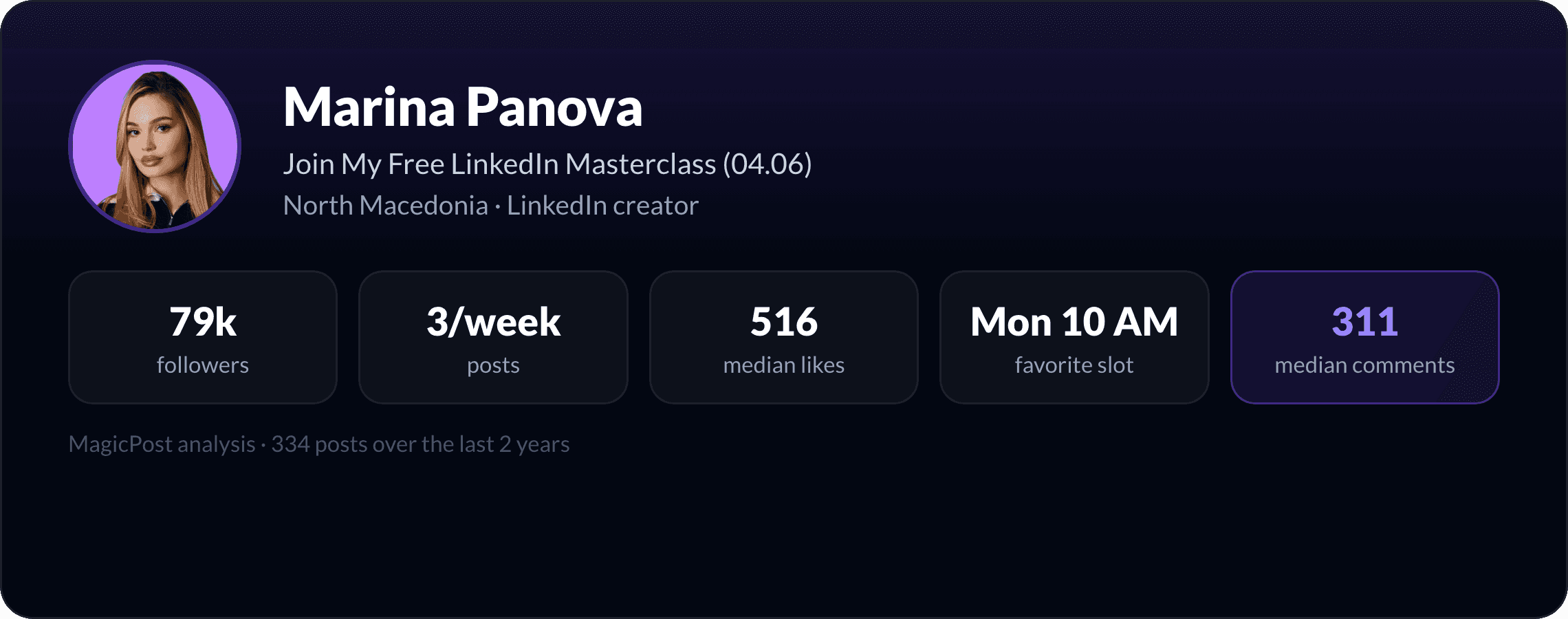
Marina Panova writes from Kočani, a town in North Macedonia, to nearly 79,000 LinkedIn followers, and her whole brand rests on one before-and-after: she used to push strollers in Paris, and now she runs a six-figure content business. At MagicPost, we analyzed 334 of her LinkedIn posts: what she writes, when, for whom, what it earns her, and what makes her style worth studying.
This is who Marina Panova is, according to the best possible source: her own posts, measured.
Her story, in her own posts
Marina does not need a biographer either. She retells her origin story constantly, and the data shows it is the single most reliable engine she owns.
The nanny years. The before-picture is always the same four facts. "I used to change diapers and push strollers in Paris. Today, my business has crossed 6 figures," she writes, then lists what no one saw: "the fear of being in a new country, with broken language, no network, no plan. My first job was as a nanny. I didn't speak French. I didn't know where to start. I didn't know a single person." In another telling she dates it: "Three years ago, I moved to Paris... I found a job as an English nanny."
The 6-month bet. The pivot is a single decision she has dramatized at least three times. "They said I should get a real job. So I gave myself 6 months to prove them wrong," one version opens. Another credits "that one advice": "Give it everything for 6 months and see what's possible." In 2022, she writes, she was "done working as a nanny, done struggling to survive in Paris, done watching other people live the life I wanted."
The build. From there the timeline compounds, and she keeps a running ledger of it. By her own clean summary: "In 2021, I was working as an English nanny in Paris. In 2022, I found my first freelance job (€500/month). In 2023, I posted about social media on LinkedIn. In 2024, I cracked the LinkedIn code... In 2025, I'm scaling my own marketing funnel." Along the way: an agency co-founded with her friend Keti, a move to Spain "for 5 months," a stage at her "first ever live event" in Skopje, and "officially married this Sunday" in a post that earned 2,796 likes.
One detail the data surfaces that a normal bio never would: the nanny-in-Paris story is not a memory, it is a franchise. She has republished the same before-and-after at least half a dozen times in two years (diapers and strollers, broken French, no network, building LinkedIn "while the baby slept"), and it reliably anchors her biggest posts. The lesson is very Marina: when an origin story converts, you do not retire it, you re-ship it for the next cohort that needs to hear it.



What she actually talks about
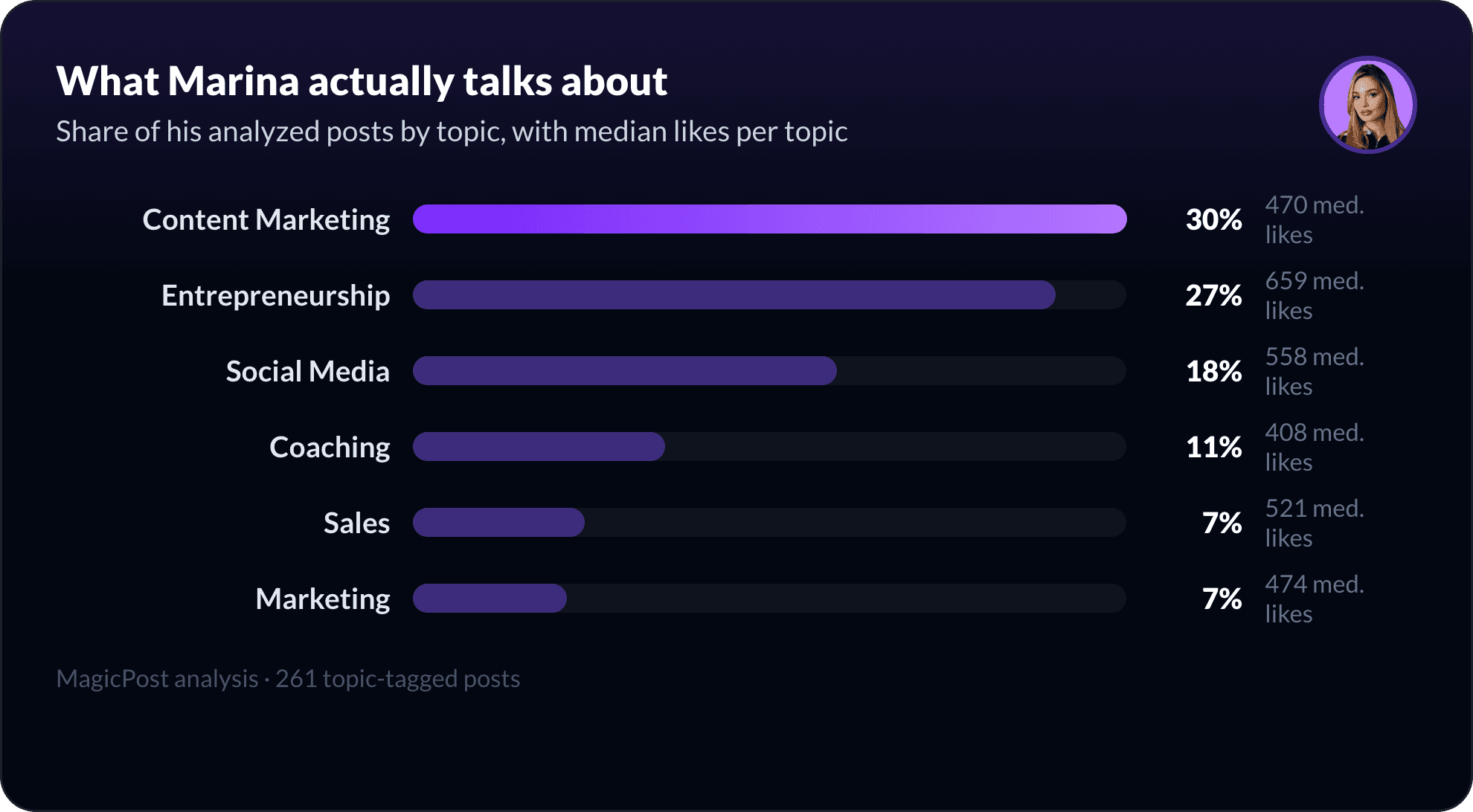
Her feed is content-marketing first (about 79 posts in our sample), then entrepreneurship, social media and coaching. Two details matter more than that ranking:
Entrepreneurship over-performs everything else (about 659 median likes versus her overall 516). When Marina drops the tactics and talks about the leap itself, the leaving, the building, the betting on yourself, her audience leans in hardest. Coaching, by contrast, under-performs (about 408).
Sorted by register rather than topic, her two largest buckets are punchy standalone advice (about 56 posts) and selling through value (about 50). The next layer up is pure narrative: "challenges overcome" and "status check-ins." So roughly half her output is teaching or quietly selling, and the other half is the story of how she got here, retold from new angles.
Who she writes for
Her reader is explicit and it is basically her younger self: the broke beginner staring at a leap they have not taken. She addresses them directly. "If you're still in the before phase, this is for you," she writes. "So if you're in the middle of your 6 months? Keep going," she tells another. Her stated specialty is freelancers and founders who want clients without a CV: "This year, I worked with over 40+ clients. Guess how many CVs I sent? Zero," a line she has run more than once. The offers match the audience: a freelance coaching program, an "AI Social Media Academy," and a free LinkedIn masterclass.
Her best posts of 2026
Her biggest posts of 2026 so far, reproduced from our data (click through to the originals):
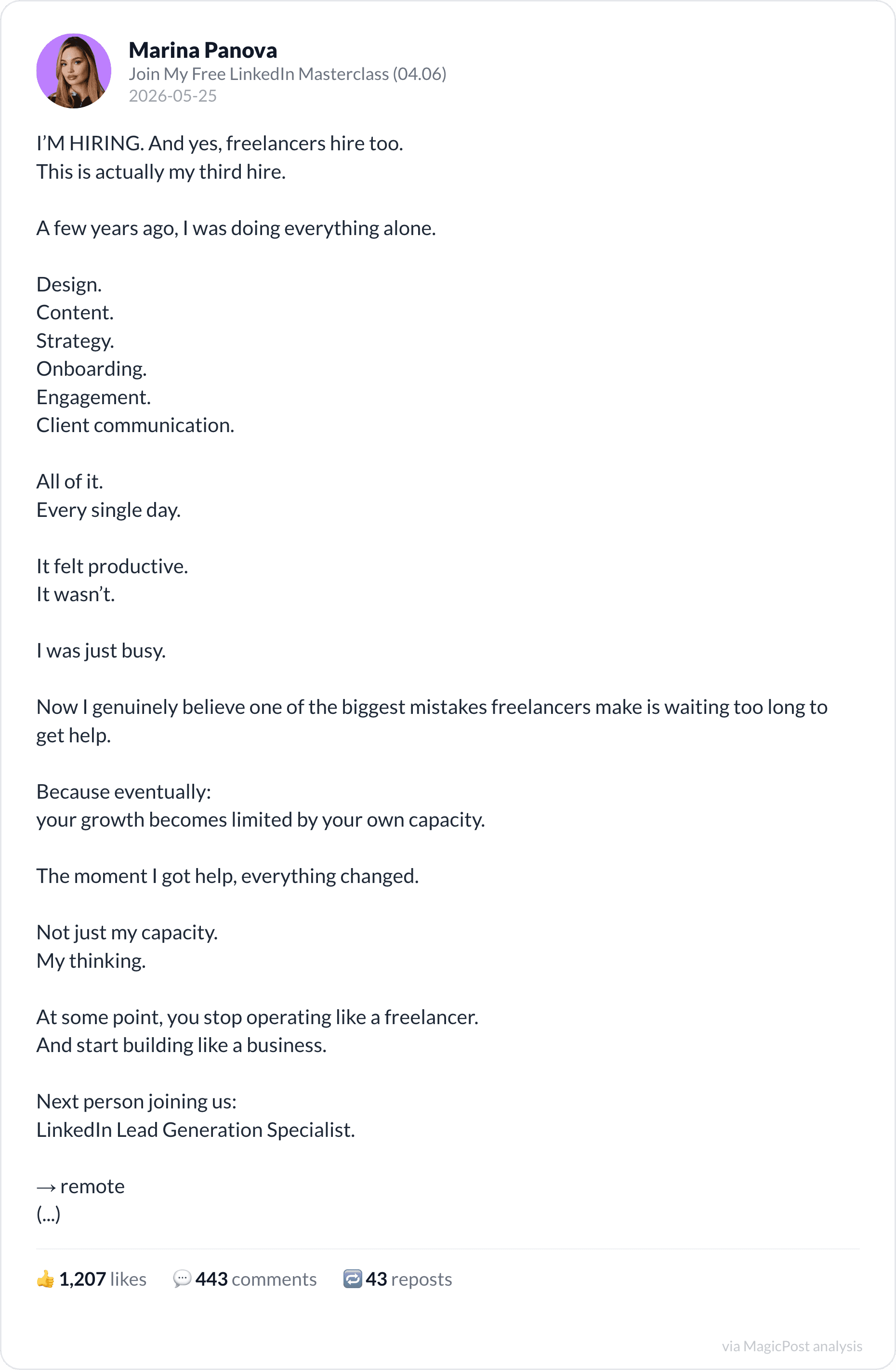
1,207 likes. A hiring post disguised as a lesson ("I'M HIRING. And yes, freelancers hire too"), turning a job ad into a story about outgrowing the freelancer mindset, then closing with "Comment Interested below." It pulled 443 comments, a near 1:3 comment-to-like ratio.
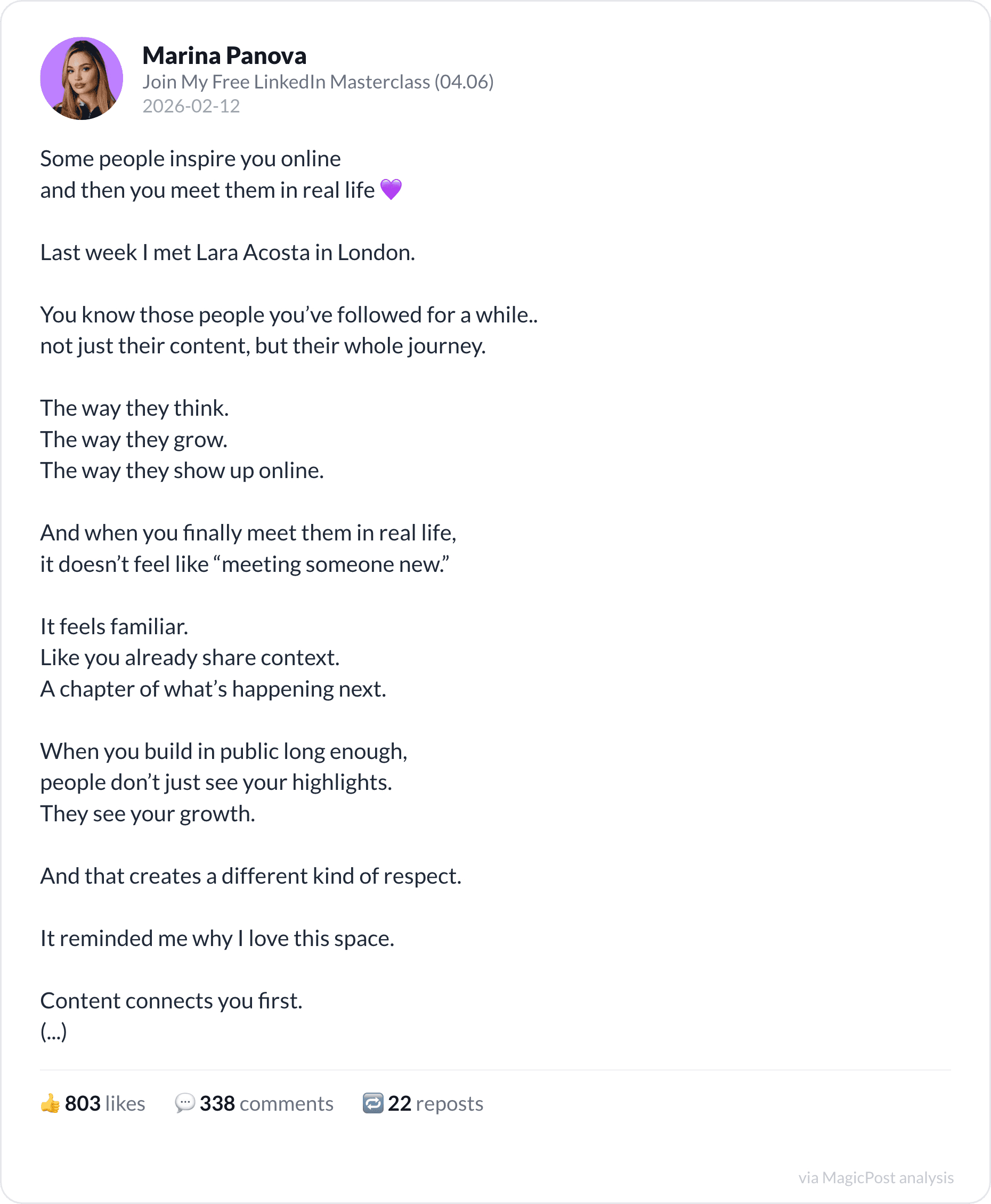
803 likes. Meeting a creator she had followed for years, in real life ("Some people inspire you online and then you meet them in real life"). Soft, warm, zero product, a reminder that the network IS the business.
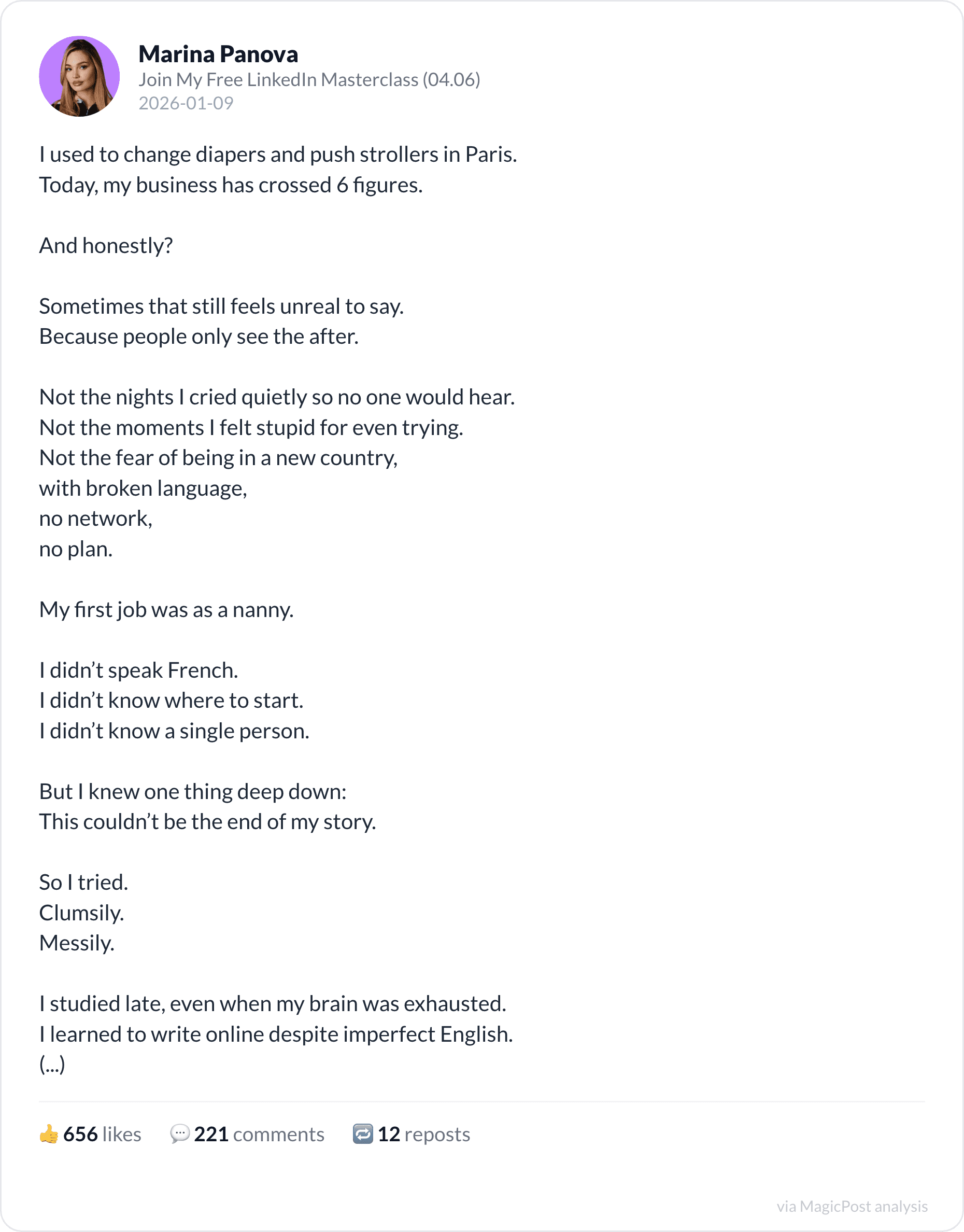
656 likes. The signature franchise itself, the Paris nanny opener with the masterclass invite stapled on the end ("P.S. The interest has been huge. 80% of the spots are already taken"). The clearest single example of her story doing the selling.
Is she still growing?
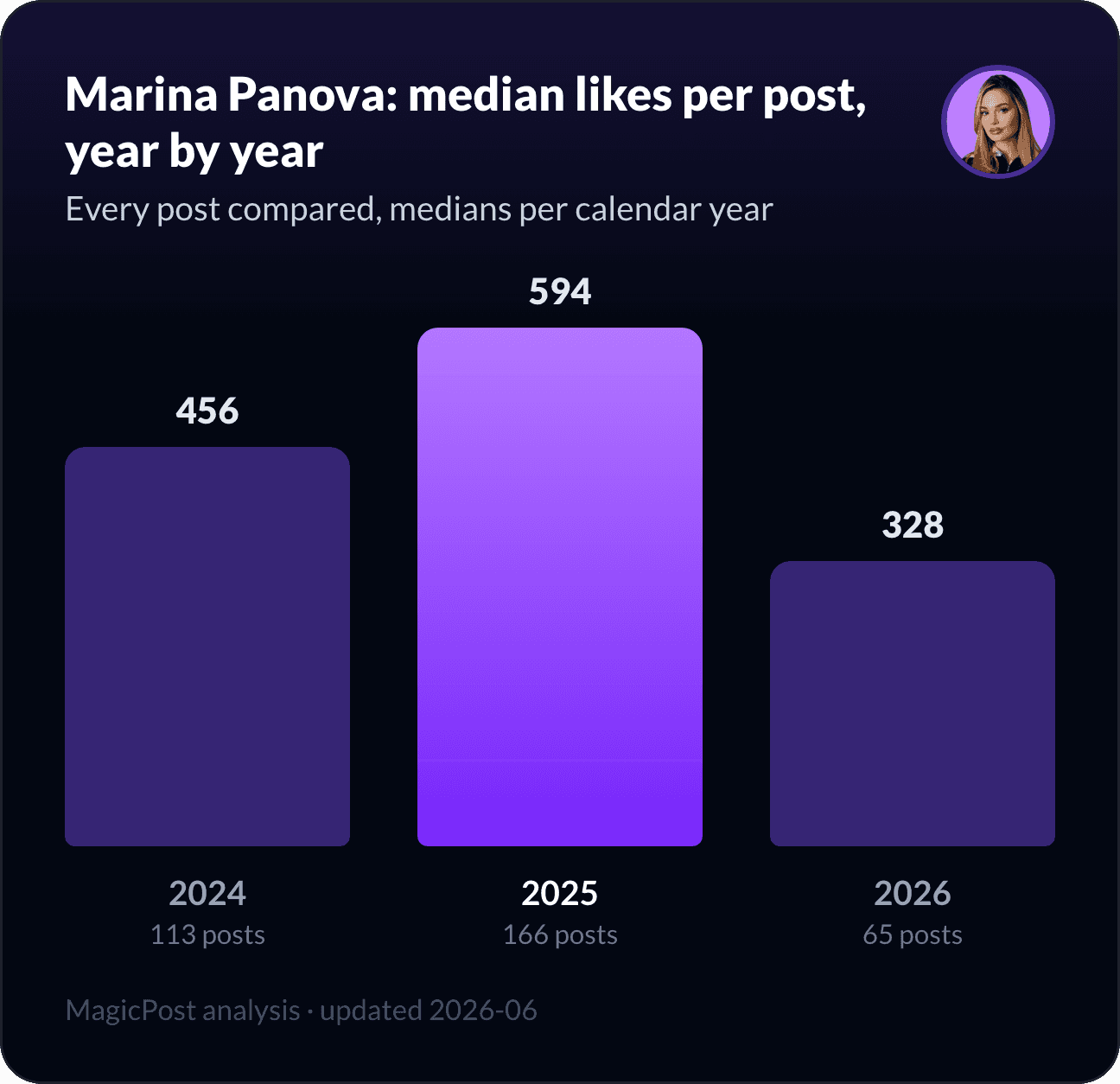
Here the honest read matters. Her median post climbed from about 456 likes in 2024 to 594 in 2025, then her early-2026 sample sits at about 328. That is a real dip in per-post engagement, even as her follower count kept climbing past 78,000. It is the same arc many top creators are living right now: the audience grows, the median post hits a little softer, because reach compresses platform-wide. One honest note: we measure engagement, not followers over time, so this is the trajectory of how hard each post lands, not of her audience size, which is still rising.
Where do these charts come from? Everything on this page runs on MagicPost's LinkedIn analytics, and it works on your profile too: your best posts, your audience, your benchmark, even a side-by-side with creators like Marina Panova.
How she writes (the number-hook habit)
Here is Marina measured against the average creator, and the headline is not "she writes short":
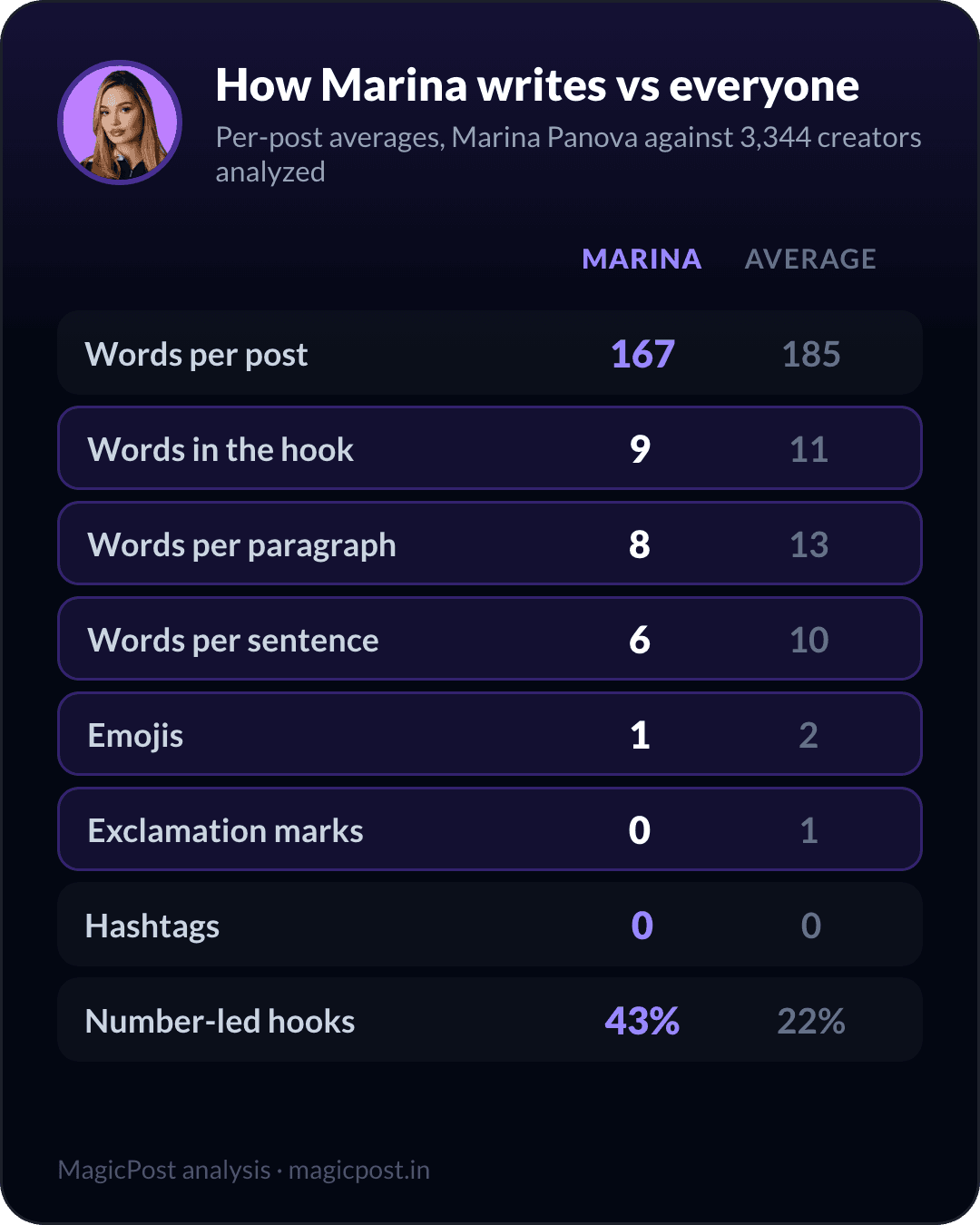
Metric (per post) | Marina Panova | Average creator* |
Words | ~167 | 185 |
Words in the hook | 9 | 11 |
Words per paragraph | 8 | 13 |
Words per sentence | 6 | 10 |
Emojis | 1 | 2 |
Exclamation marks | 0 | 1 |
Hashtags | 0 | 0 |
Hooks built on numbers | 43% | 22% |
*Median across the 3,344 creators we analyzed with 20+ posts each.
At ~167 words she is close to the 185-word average, so she is not unusually short, she is dense and front-loaded. Her sentences run six words against the typical ten, her paragraphs eight words against thirteen: most of her lines are one short thought with white space around it. But the number that actually defines her is the last row: 43% of her hooks open on a number or a milestone, nearly double the 22% benchmark. "I went from 20K to 60K in just 7 months." "I'm 26 running a 6-figure business." "This year, I worked with over 40+ clients." She does not ease you in, she opens the ledger. Her engine is also a conversation engine: she earns about 516 median likes and 311 median comments, a roughly 3-comments-per-5-likes ratio that is far above normal, because half her posts end on a direct question or a "comment X below."
The "AI tells" in her style (read this the right way)
Run Marina's writing through the patterns people now call "AI tells," and the result is worth reading carefully, not backwards:
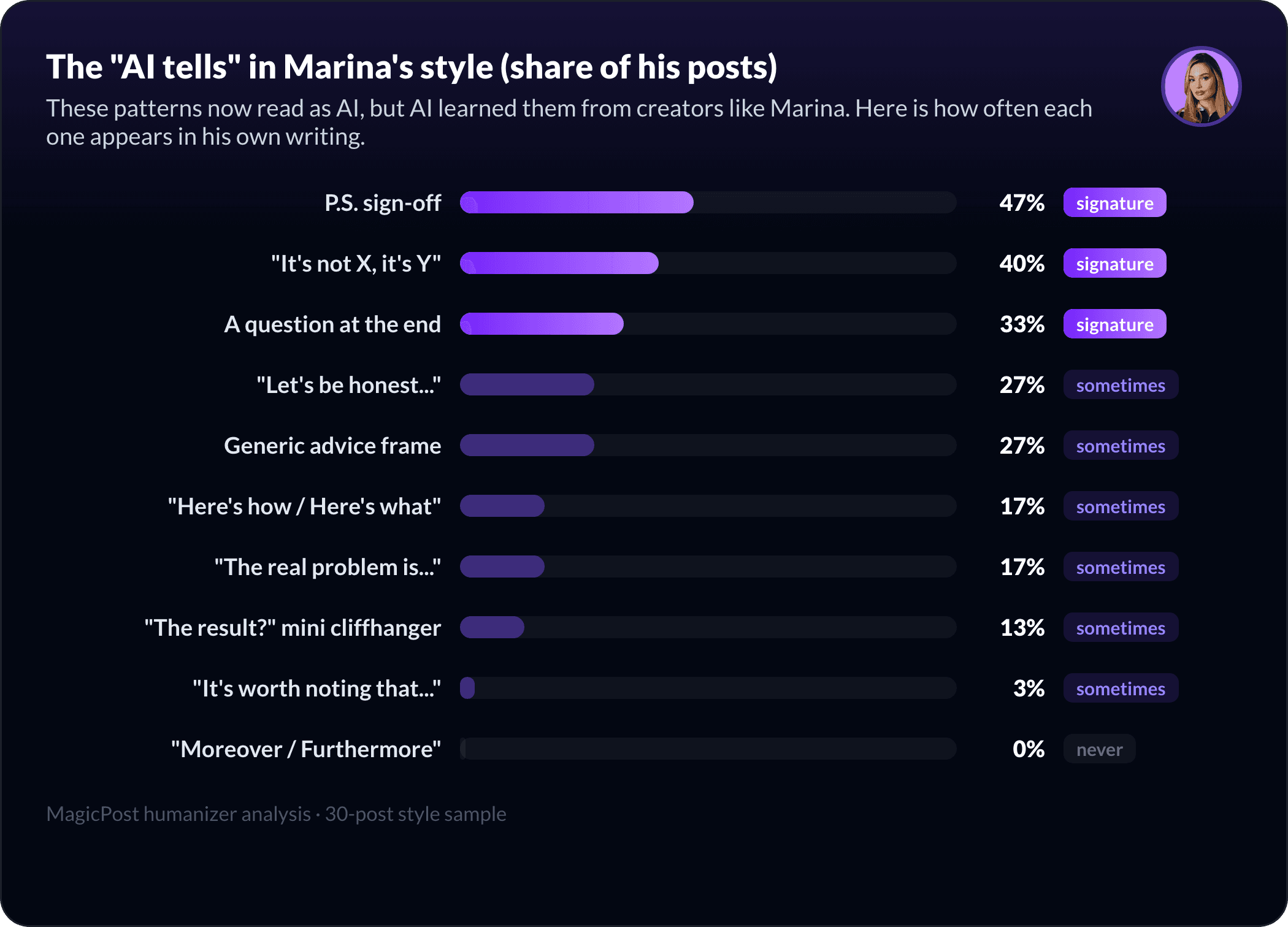
Four in ten of her posts use the "It's not X, it's Y" contrast formula, one of the most flagged "AI" patterns on LinkedIn ("Not because I felt confident. But because I didn't quit"). Nearly half close on a P.S. sign-off, a third end on a question, and a sixth open with a "here's how" frame.
Do not read it backwards. Marina does not write like an AI; AI writes like Marina. These moves read as robotic today because the models trained on the best creators of this platform and then deployed every device at once, in every post. Marina uses the contrast flip where the emotion is real, and the P.S. as an actual call to action, not decoration. And the tell that gives her away as human is what she never does: she does not hedge ("it's worth noting that..."), and she never opens a line with "Moreover" or "Furthermore." The discipline is the signature. (Full story: how to spot AI writing on LinkedIn.)
When she posts
Marina publishes about 3 times a week, favorite slot Monday morning around 10 AM, with 61% of her posts in the morning and almost nothing on weekends (about 3%). That is a lighter, weekday-disciplined rhythm than the daily-grind crowd, and it is the rhythm she brags about: she grew "with posting only 3x per week." Her cadence sits well inside what our posting-frequency study calls sustainable, and her morning-weekday bias lines up with the general best-time-to-post data. And if part of your own playbook is showing up in her comments, that is exactly what an engagement feed is for: her posts, every day, without hunting the timeline.
What to steal from Marina Panova
Build one origin story and re-ship it. Her Paris-nanny before-and-after anchors her biggest posts again and again. Your reinvention is an asset, not a one-time confession.
Open the ledger in line one. 43% of her hooks lead with a number or milestone. A concrete "from X to Y" beats a vague promise every time.
Write to your past self. She talks straight to "the before phase," the exact person she was, which is why the advice lands as empathy instead of lecture.
End with a door, not a mic drop. Half her posts close on a question or a "comment X," which is why comments rival likes. The conversation is the conversion.
Sustainable beats heroic. Three weekday morning posts, almost no weekends. She built nearly 79K followers on a pace she can actually keep.
Study her, then study yourself. With MagicPost you can dig into Marina Panova's numbers the way we just did, analyze your own LinkedIn the same way, and write in the spirit of her style, in your own voice. The data on this page is the product.
Where this data comes from
Everything in this article is MagicPost's own research. MagicPost analyzed 334 of Marina Panova's public LinkedIn posts: timing, engagement, topics, writing metrics, and the AI-pattern profile from a 30-post style sample. Every biographical claim is quoted from one of her own public LinkedIn posts and linked to it. Panova is not affiliated with MagicPost; her style is one of those we track most closely, which is why we studied it in this depth.
FAQ
Who is Marina Panova?
A LinkedIn creator and founder from Kočani, North Macedonia, with about 79,000 followers. By her own public account she went from working as an English nanny in Paris to running a six-figure content and coaching business, and co-founded a social media agency with her friend Keti.
How does Marina Panova make money?
By her own public posts: client work through her agency, freelance coaching programs (she reports coaching 100+ freelancers), a paid academy, and content services. She is explicit that clients find her through LinkedIn rather than applications, "Guess how many CVs I sent? Zero."
How often does Marina Panova post on LinkedIn?
About 3 times a week in our data, most often on Monday mornings around 10 AM, with 61% of her posts in the morning and almost none on weekends.
Does Marina Panova write with AI?
Her style is intensely personal and story-driven, with none of the filler AI adds (no hedging, no "Moreover" openers). The twist is that AI tools learned from creators like her, which is why four in ten of her posts contain the "It's not X, it's Y" pattern people now mislabel as an AI tell.
Is Marina Panova still growing?
Her follower count keeps climbing past 78,000, but her median likes per post dipped in early 2026 (about 594 in 2025 to 328), the same reach-compression arc many top creators are seeing as the platform shifts.
Can I write like Marina Panova?
You can learn the mechanics: MagicPost learns a creator's writing style (length, rhythm, hooks, signature moves) and helps you write in that spirit, in your own voice.
</content>
</invoke>
The Top LinkedIn Creators to Study in 2026 (By the Data)
The top LinkedIn creators to study in 2026, by the data: 62 creators, six languages, 27 countries, 32,000 posts analyzed by MagicPost. Grouped by what they teach.
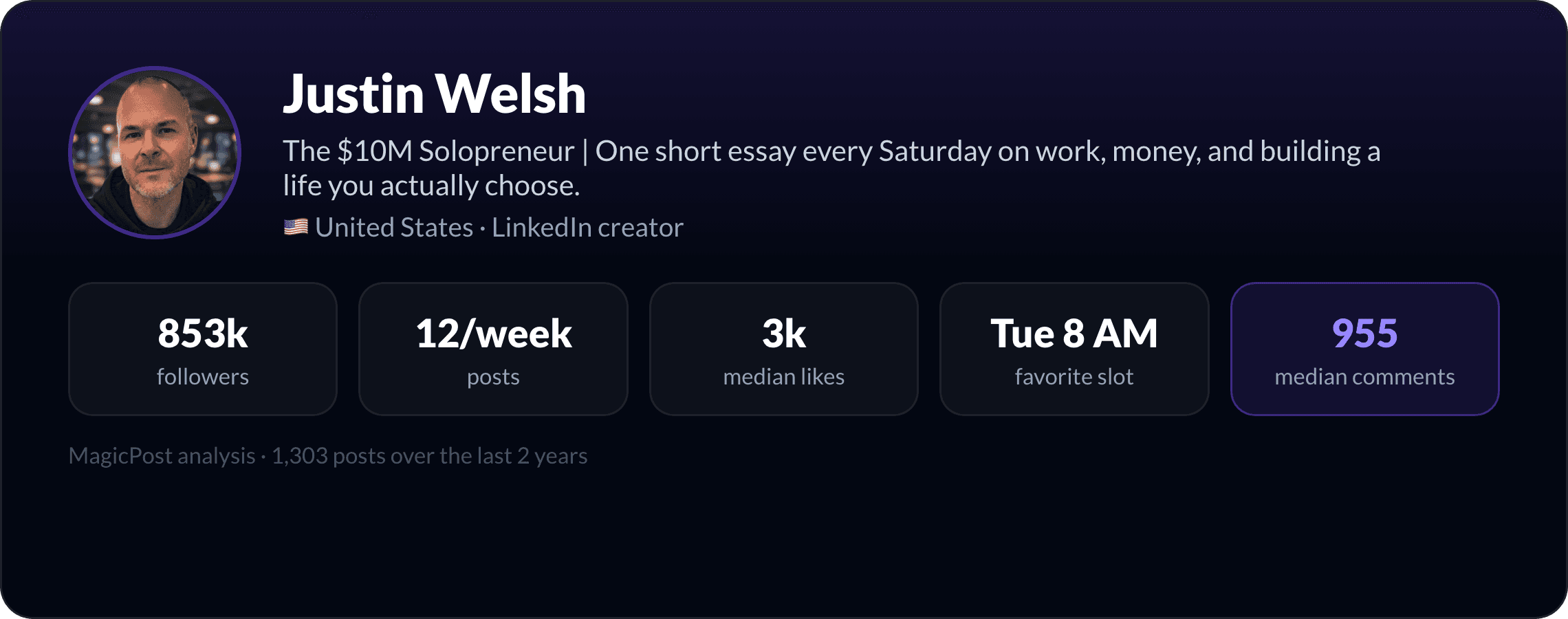
Who Is Justin Welsh? The $10M Solopreneur, Explained by Data (2026)
Who is Justin Welsh? MagicPost analyzed 1,303 of their LinkedIn posts: topics, timing, signature moves and the writing fingerprint behind their growth, with rea
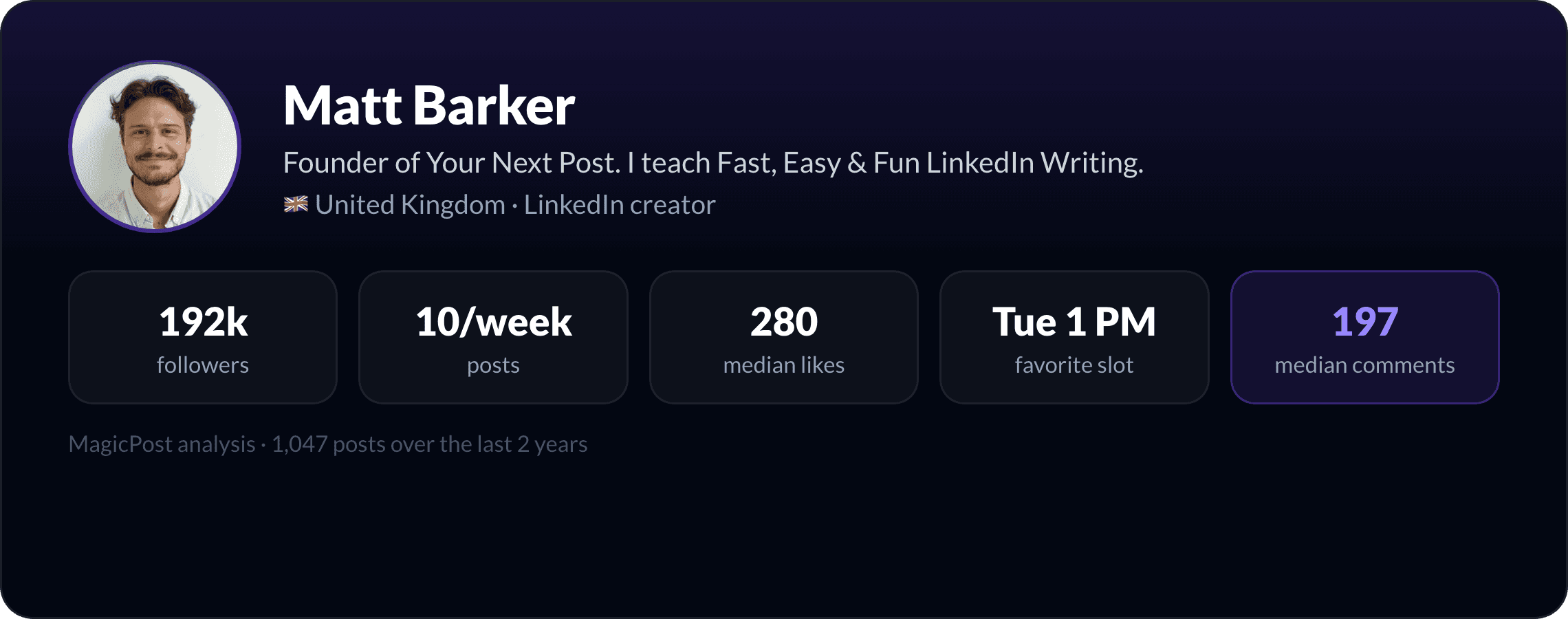
Who Is Matt Barker? The Hook Writer on LinkedIn, by Data (2026)
Who is Matt Barker? MagicPost analyzed 1,047 of their LinkedIn posts: topics, timing, signature moves and the writing fingerprint behind their growth, with real
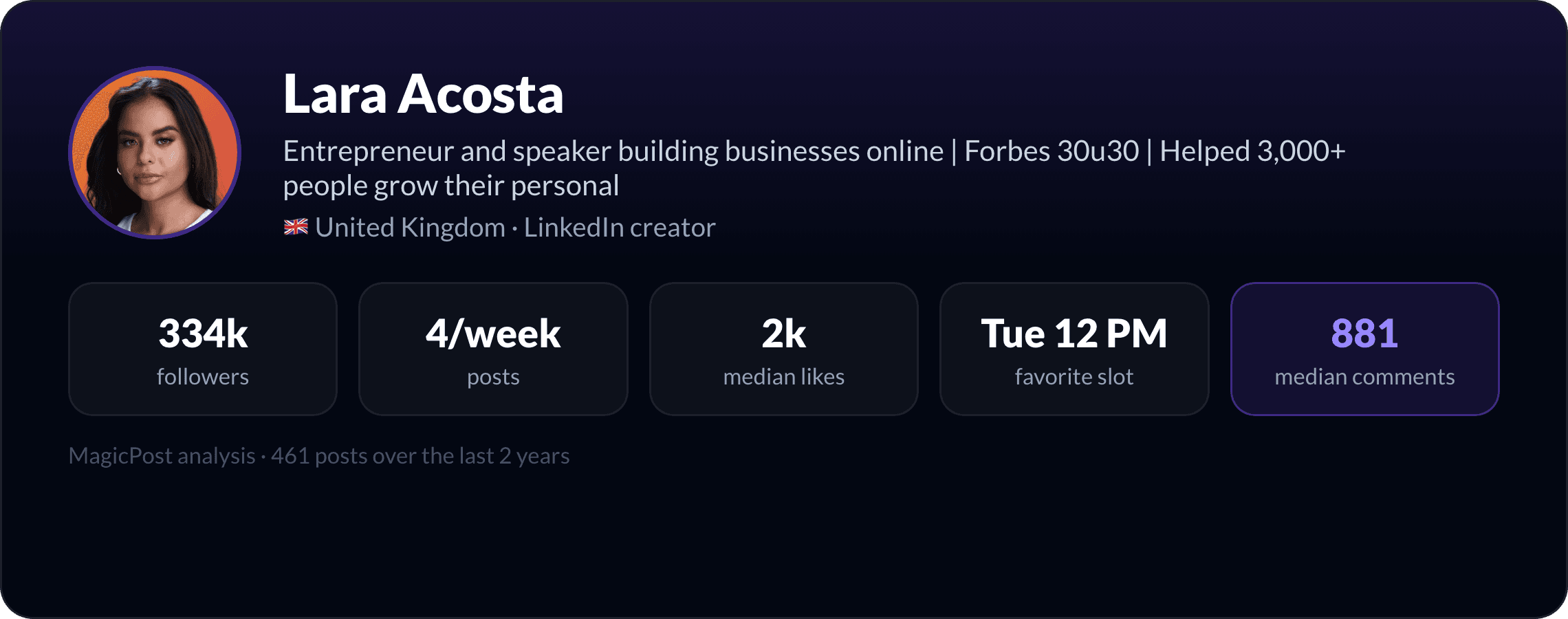
Who Is Lara Acosta? The Forbes 30 Under 30 Comment Machine, Explained by Data (2026)
Who is Lara Acosta? MagicPost analyzed 461 of their LinkedIn posts: topics, timing, signature moves and the writing fingerprint behind their growth, with real n
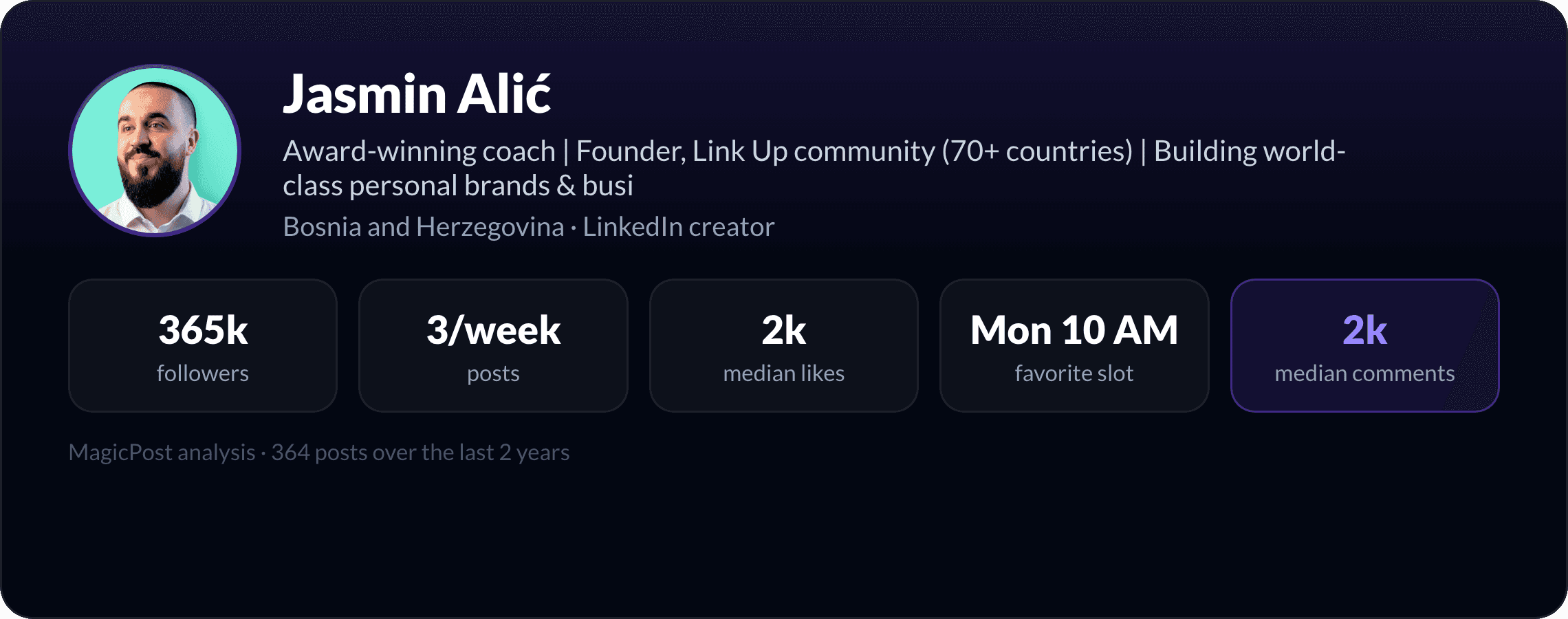
Who Is Jasmin Alić? The Bosnian Coach LinkedIn Mistook for a Bot (2026)
Who is Jasmin Alić? MagicPost analyzed 364 of their LinkedIn posts: topics, timing, signature moves and the writing fingerprint behind their growth, with real n
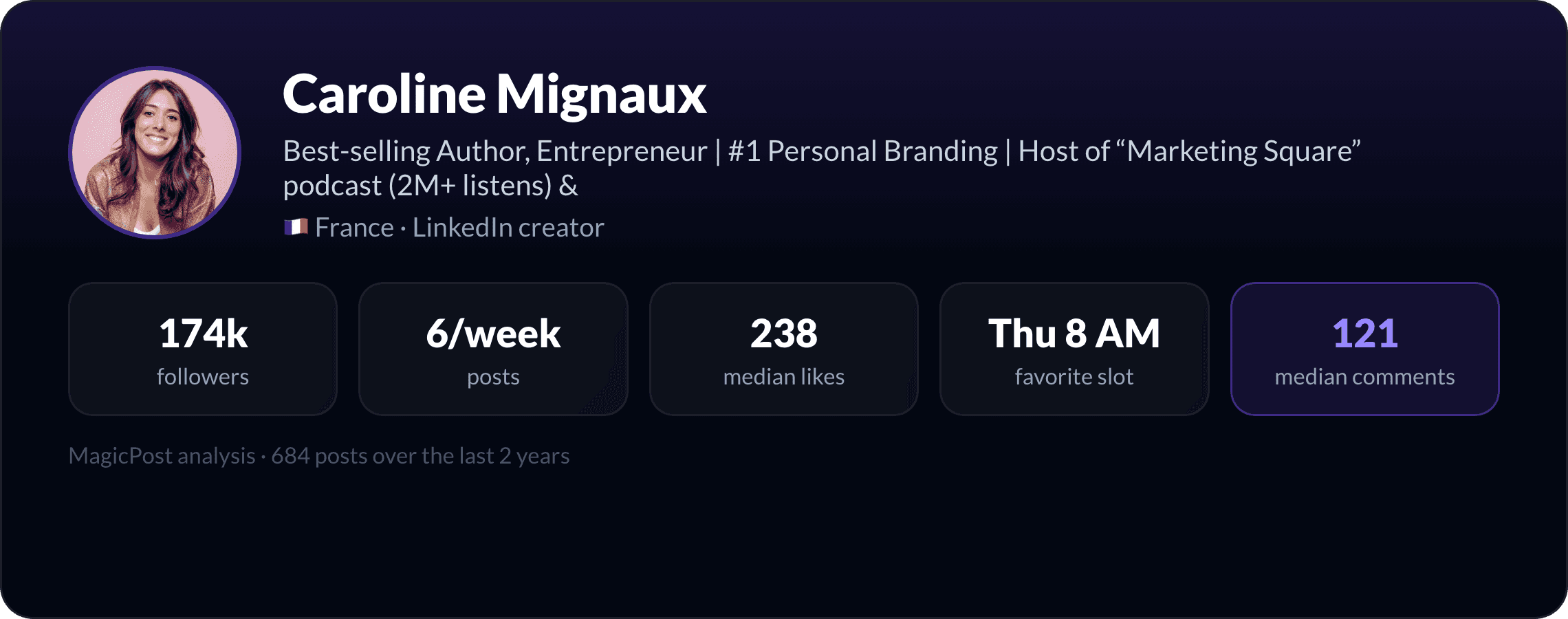
Who Is Caroline Mignaux? France's LinkedIn Top Voice Who Turned Shame Into a Following (2026)
Who is Caroline Mignaux? MagicPost analyzed 684 of their LinkedIn posts: topics, timing, signature moves and the writing fingerprint behind their growth, with r
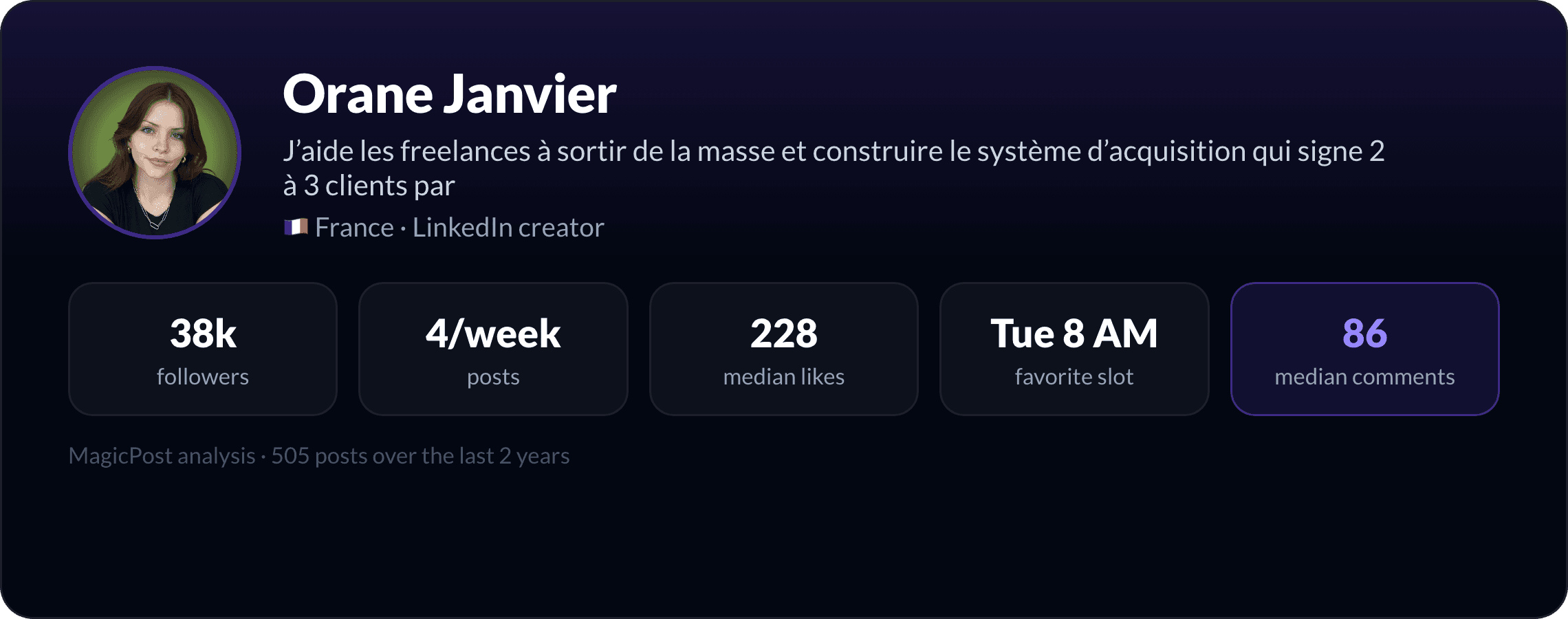
Who Is Orane Janvier? The Freelance Coach LinkedIn Quietly Copies (2026)
Who is Orane Janvier? MagicPost analyzed 505 of their LinkedIn posts: topics, timing, signature moves and the writing fingerprint behind their growth, with real
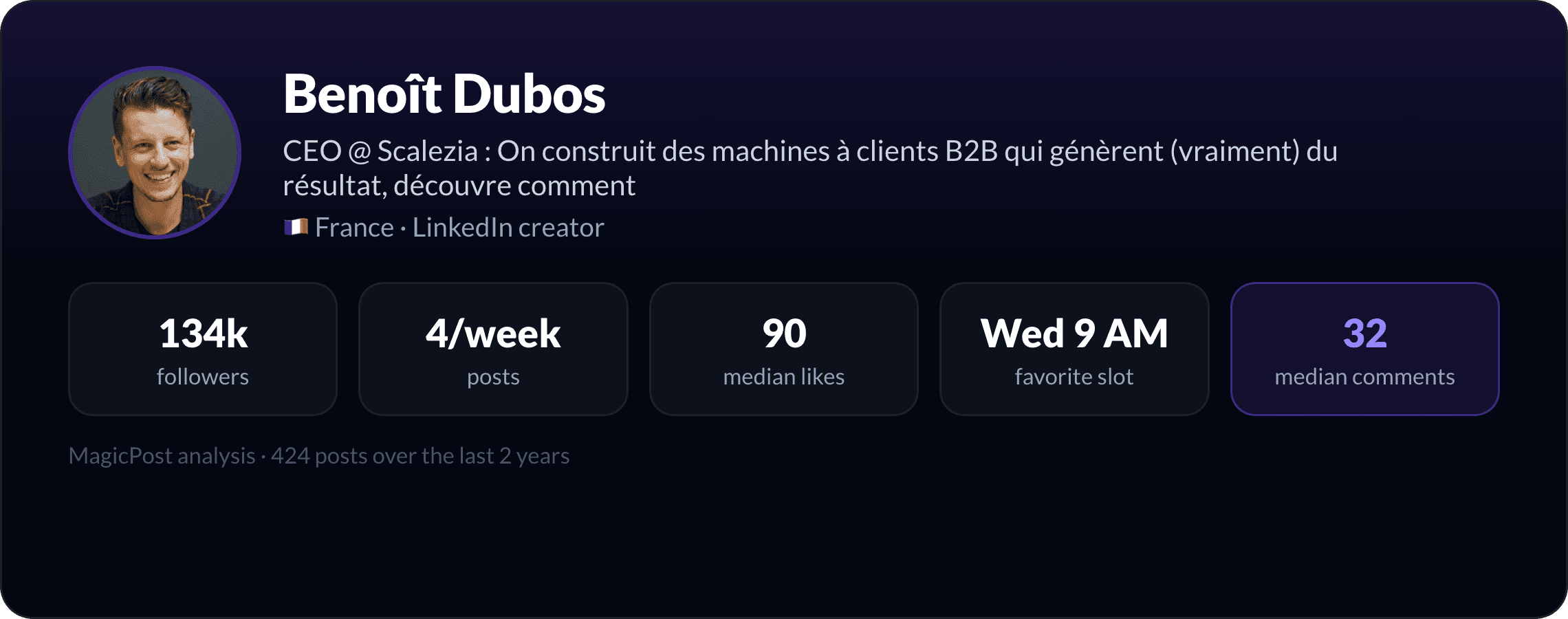
Who Is Benoît Dubos? The Growth Operator Who Turned a Falling Reach Into a Lead Machine (2026)
Who is Benoît Dubos? MagicPost analyzed 424 of their LinkedIn posts: topics, timing, signature moves and the writing fingerprint behind their growth, with real
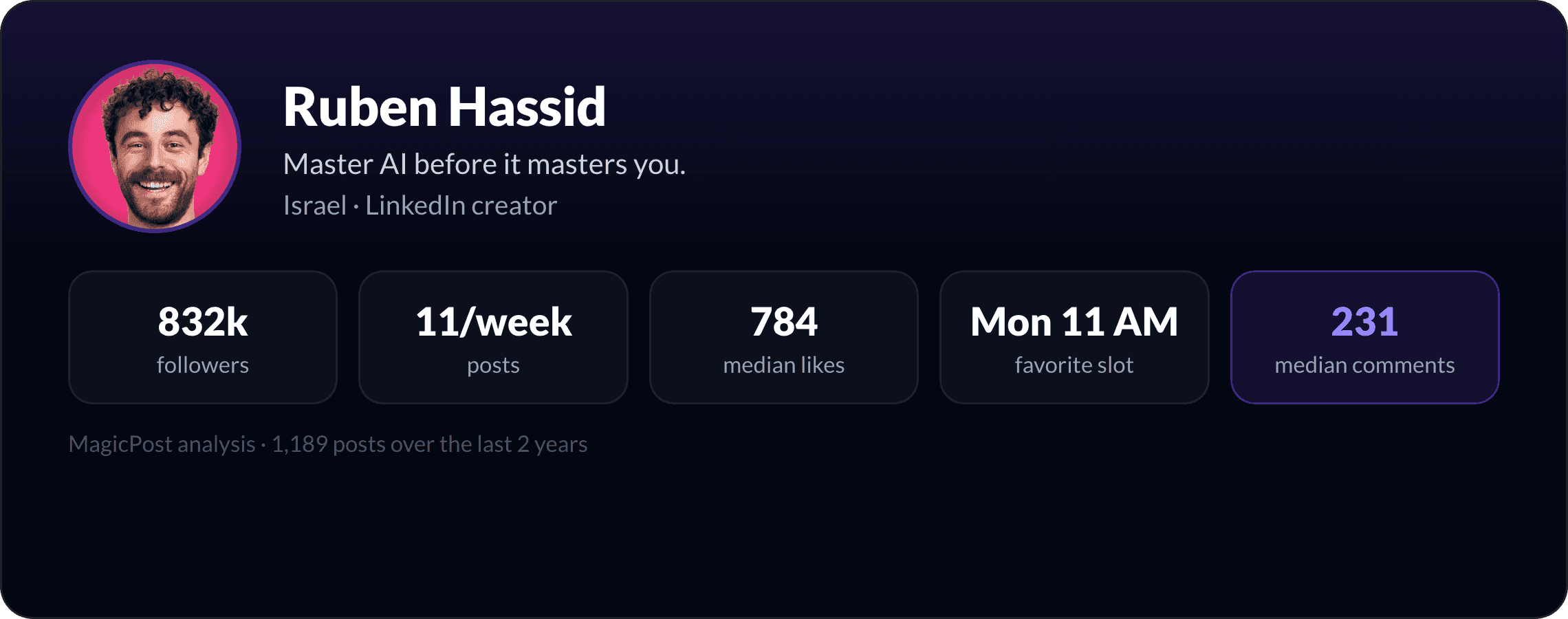
Who Is Ruben Hassid? The "Master AI Before It Masters You" Creator, Explained by Data (2026)
Who is Ruben Hassid? MagicPost analyzed 1,189 of their LinkedIn posts: topics, timing, signature moves and the writing fingerprint behind their growth, with rea
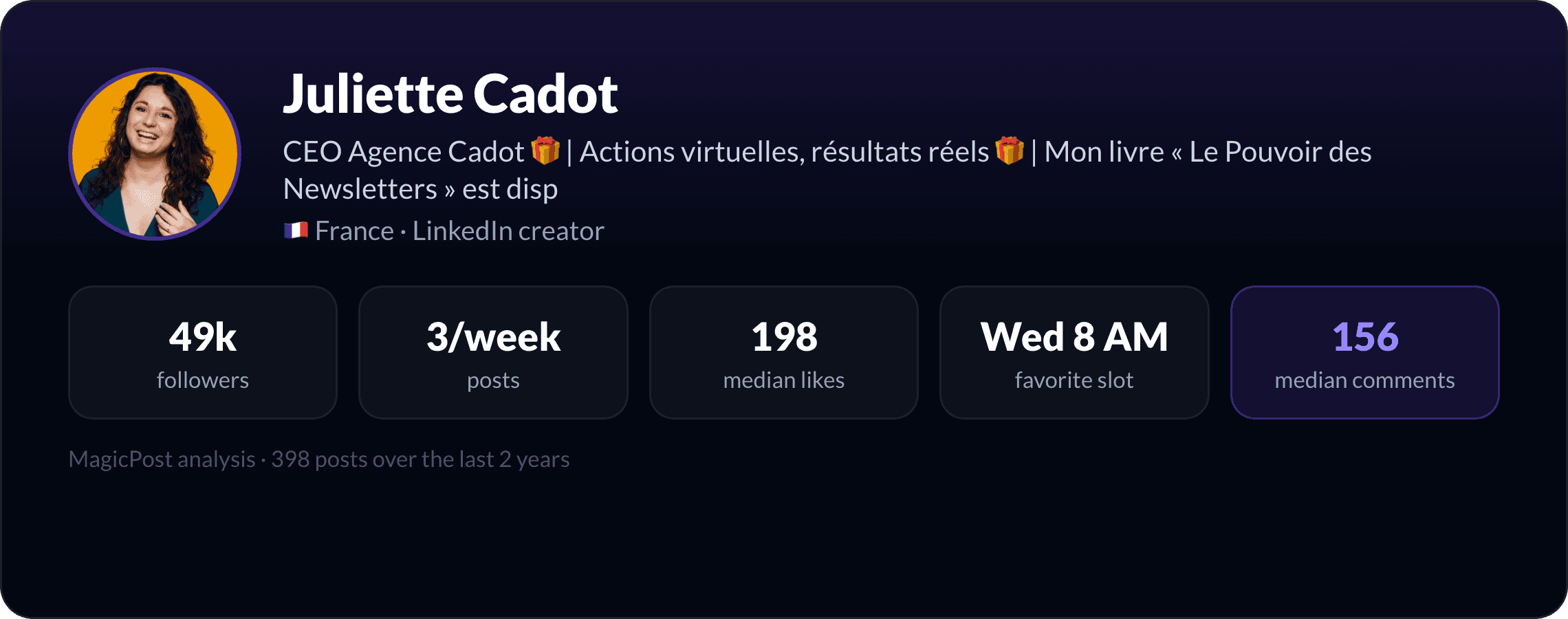
Who Is Juliette Cadot? The Agency Founder Whose Audience Talks Back (2026)
Who is Juliette Cadot? MagicPost analyzed 398 of their LinkedIn posts: topics, timing, signature moves and the writing fingerprint behind their growth, with rea