" height="26.80529977783203px" id="tymKb8bqC" width="128.00300311279295px"/><path d="M 0 2.417 L 0 0 L 12.909 0 L 12.909 2.417 Z" fill="rgb(126, 78, 253)" height="2.417099999999998px" id="aYr4em6zK" transform="translate(128.341 22.325)" width="12.908999999999992px"/></svg>)

"/><stop offset="1" stop-color="rgb(118, 37, 250)"/></linearGradient></defs><g d="M 19.242 21.22 L 19.362 6.204 L 19.272 6.204 L 13.757 21.22 L 10.161 21.22 L 4.796 6.204 L 4.706 6.204 L 4.825 21.22 L 0 21.22 L 0 0 L 7.283 0 L 12.109 13.607 L 12.229 13.607 L 16.844 0 L 24.247 0 L 24.247 21.22 Z M 26.421 26.113 L 26.421 23.445 L 41.407 23.445 L 41.407 26.113 Z" fill="transparent" height="26.112508199679183px" id="DvfaAIHYn" width="41.40731898311435px"><path d="M 19.242 21.22 L 19.362 6.204 L 19.272 6.204 L 13.757 21.22 L 10.161 21.22 L 4.796 6.204 L 4.706 6.204 L 4.825 21.22 L 0 21.22 L 0 0 L 7.283 0 L 12.109 13.607 L 12.229 13.607 L 16.844 0 L 24.247 0 L 24.247 21.22 Z" fill="rgb(46, 46, 46)" height="21.220180016149442px" id="pLsxRCobd" width="24.247352589074694px"/><path d="M 0 2.668 L 0 0 L 14.986 0 L 14.986 2.668 Z" fill="url(%23yD9d4I5GR-3279285344-linear-gradient)" height="2.6675085048549647px" id="yD9d4I5GR" transform="translate(26.421 23.445)" width="14.986002836263765px"/></g></svg>)

Naïlé Titah
Ruben Taieb is one of the most studied LinkedIn voices in France, and the strangest thing about a man who sells a LinkedIn method is the line he signs his posts with. At MagicPost we analyzed 516 of his posts, and one sentence recurs almost word for word in roughly a third of them: "N'oublie jamais qu'il n'y a aucune règle sur LinkedIn. Tout le monde peut réussir. Surtout toi." (Never forget there is no rule on LinkedIn. Everyone can succeed. Especially you.) The LinkedIn expert's most repeated teaching is that the rules he sells do not exist.
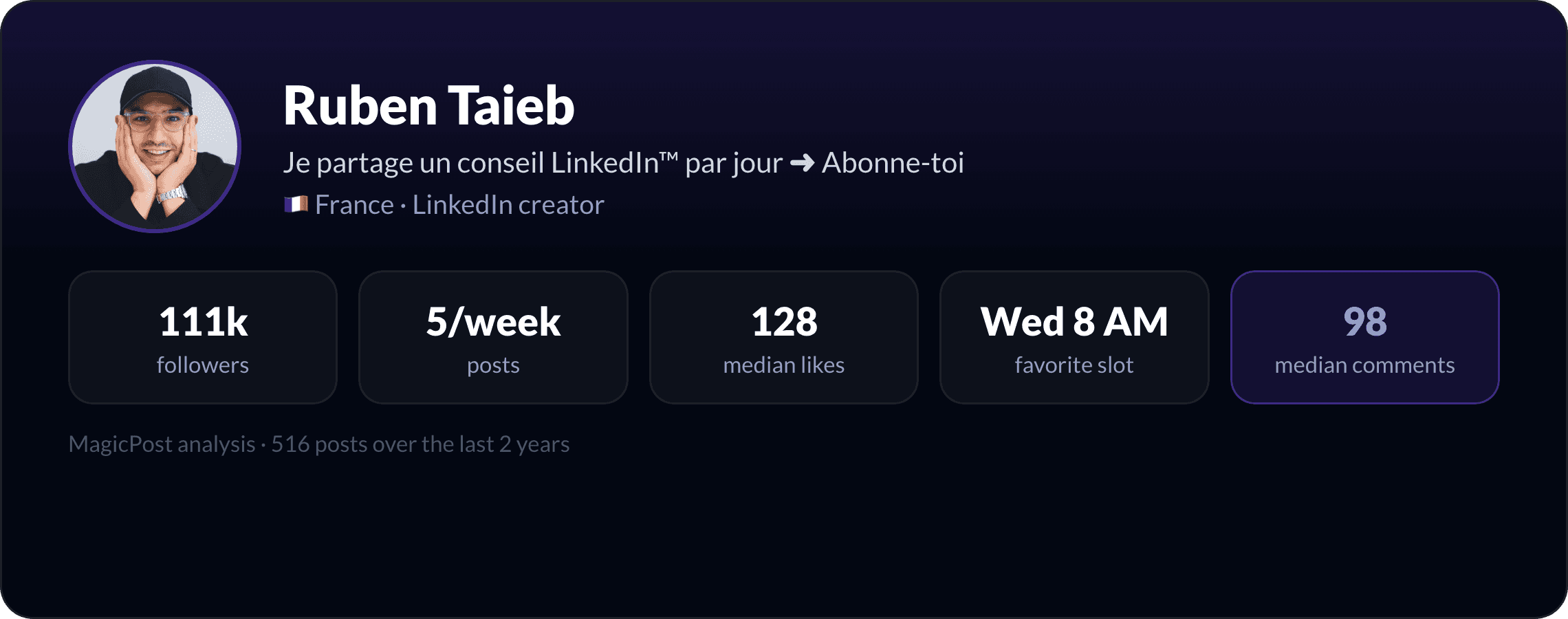
This is who Ruben Taieb is, according to the best source: his own posts, measured.
His story, in his own posts
Ruben Taieb does not hide where he started. His origin story is the single most-engaged post in our whole sample, and he has republished it more than once.
The burnout. It opens the same way every time: "J'ai fait un Burnout en 2018. Je suis resté 7 mois dans ma chambre sans sortir. Je n'ai pas fait d'études." (I burned out in 2018. I stayed seven months in my room without going out. I did no studies.) He lists the odd jobs before it: factory work, BlaBlaCar runs to Amsterdam, PS3 controllers on eBay. The bottom: "Je suis devenu champion du monde de World Of Warcraft. Top 1 monde. La vérité ? J'allais pas bien." (I became World of Warcraft world champion. Top 1 worldwide. The truth? I was not okay.) That post earned 4,305 likes, his all-time best.
The restart, through LinkedIn. The way out, in his telling, was the platform itself: "J'ai cherché un boulot sur LinkedIn. Mon boulot, je l'ai trouvé." (I looked for a job on LinkedIn. I found my job.) One year later: "Je suis marié. Je suis Papa. J'ai mon entreprise. Et tout roule." (I am married. I am a dad. I have my business. And everything runs.)
No diploma, taught at HEC. A recurring pride point, framed as proof his path works: "Je n'ai pas fait d'études. Pourtant, j'ai donné un cours à HEC," he wrote, closing with what is basically his thesis statement, "Si l'ascenseur est en panne, prenez l'escalier." (I did no studies. Yet I taught a class at HEC. If the elevator is broken, take the stairs.) Source.
The 43-post desert. He is honest about the slow years too: "J'ai posté 43 fois. 43 posts. Zéro vente," he recalls of 2022, before the diagnosis that drives his whole offer, "le problème c'était pas l'algo. C'était pas l'audience. C'était moi." (here): 43 posts, zero sales; the problem was not the algorithm, not the audience, it was me.
One pattern a normal bio would miss: his burnout story is a recurring asset, not a single post. We hold near-identical versions republished across 2023 and 2024, both pulling hundreds to thousands of likes. When a story lands for Ruben Taieb, he does not retire it.



What he actually talks about
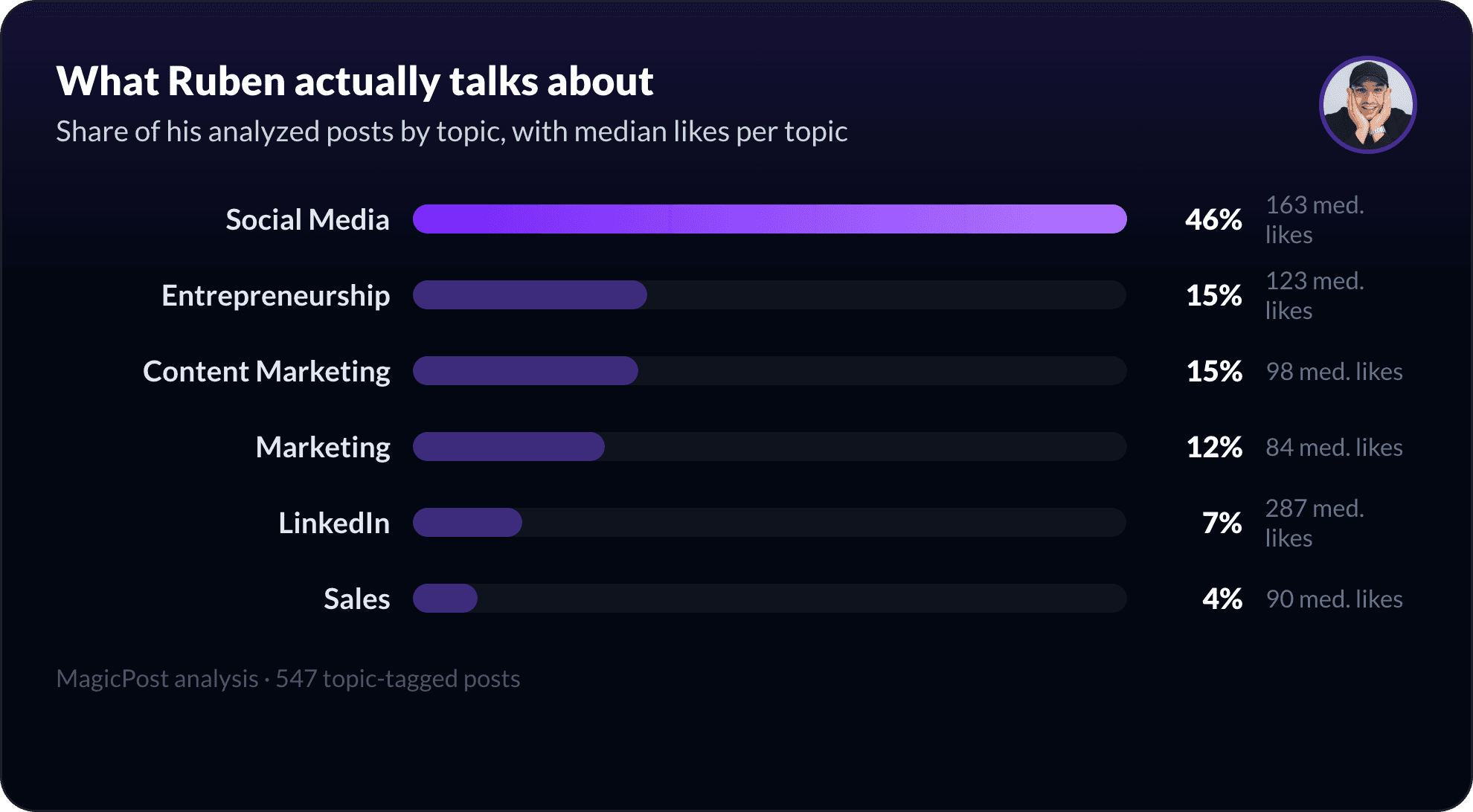
His feed is almost entirely about one thing: winning on LinkedIn. Social Media is his biggest topic by far (254 posts, median 163 likes), with Entrepreneurship, Content Marketing and Marketing filling the rest. Two details matter more than the ranking:
LinkedIn-about-LinkedIn over-performs hardest for him. Posts tagged specifically as the LinkedIn topic carry a median of 287 likes, nearly double his overall median of 128. When he teaches the platform on the platform, the platform rewards him.
Sorted by register rather than topic, his biggest category is "selling through value" (169 posts, by far the largest bucket). Almost every post, even the personal ones, ends by pointing at the same offer: his Programme d'Accélération LinkedIn. The teaching is real, and it is always a funnel.
Who he writes for
His reader is explicit and consistent: the independent professional, the consultant, the solopreneur who is invisible and wants clients. He says it in his positioning: "J'aide les indépendants à augmenter leur CA en 6 mois grâce à LinkedIn" (I help freelancers grow their revenue in six months thanks to LinkedIn), and he paints the before-state with affection, "Des indépendants invisibles devenir visibles. Des consultants largués redevenir leaders." (source): invisible freelancers becoming visible, washed-up consultants becoming leaders again.
His best posts of 2026
His three biggest posts of 2026 so far, reproduced from our data (click through to the originals):
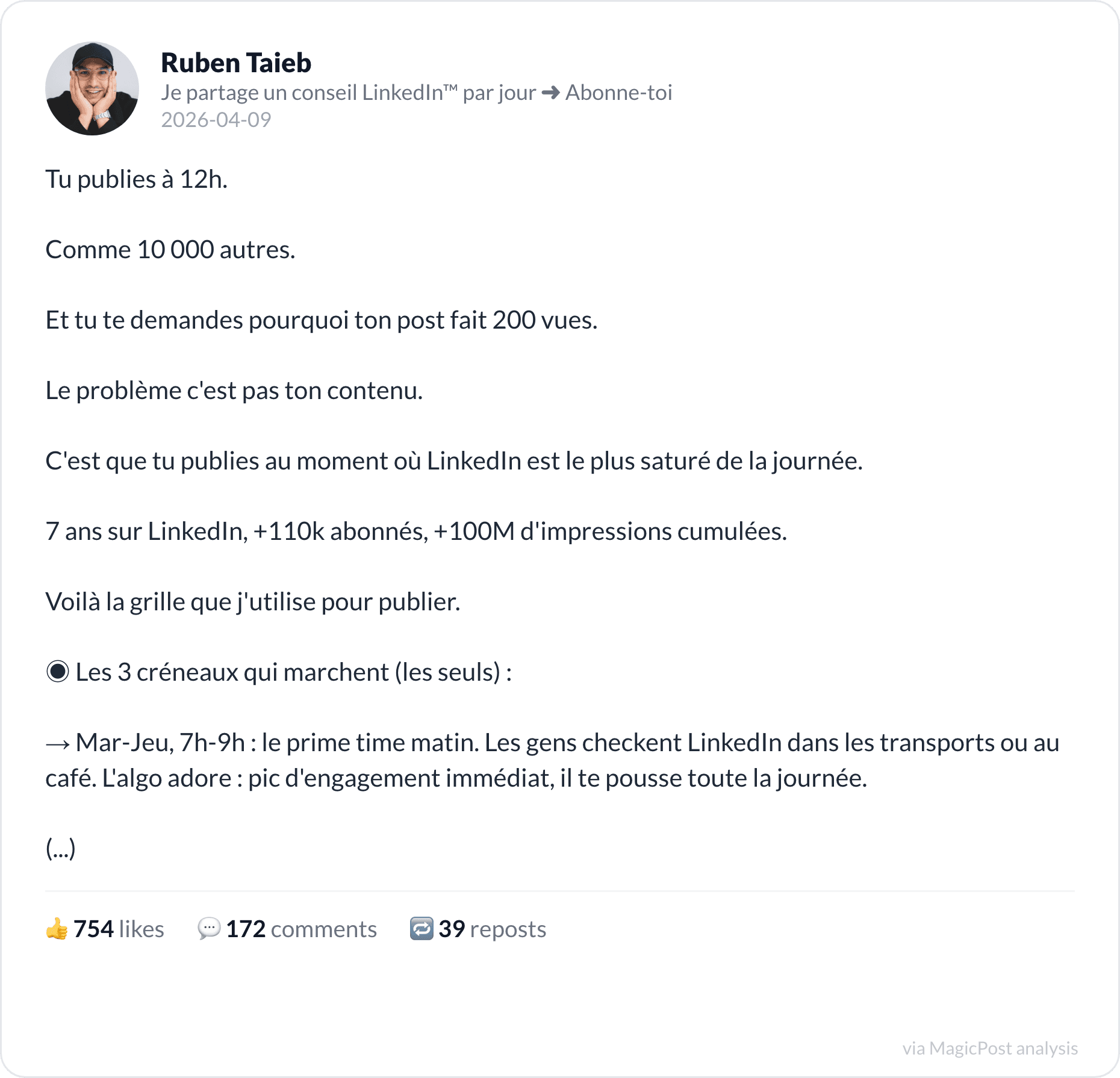
754 likes. A contrarian hook ("Tu publies à 12h. Comme 10 000 autres." / You post at noon, like ten thousand others) then a clean grid of the three slots that work and the three that kill a post. Pure value, with the offer bolted on at the end.
334 likes, 660 comments. A "comment IA and I will DM you everything" lead magnet about writing posts with a Claude system in his own voice. The comment count is the real number: the call to action did its job.
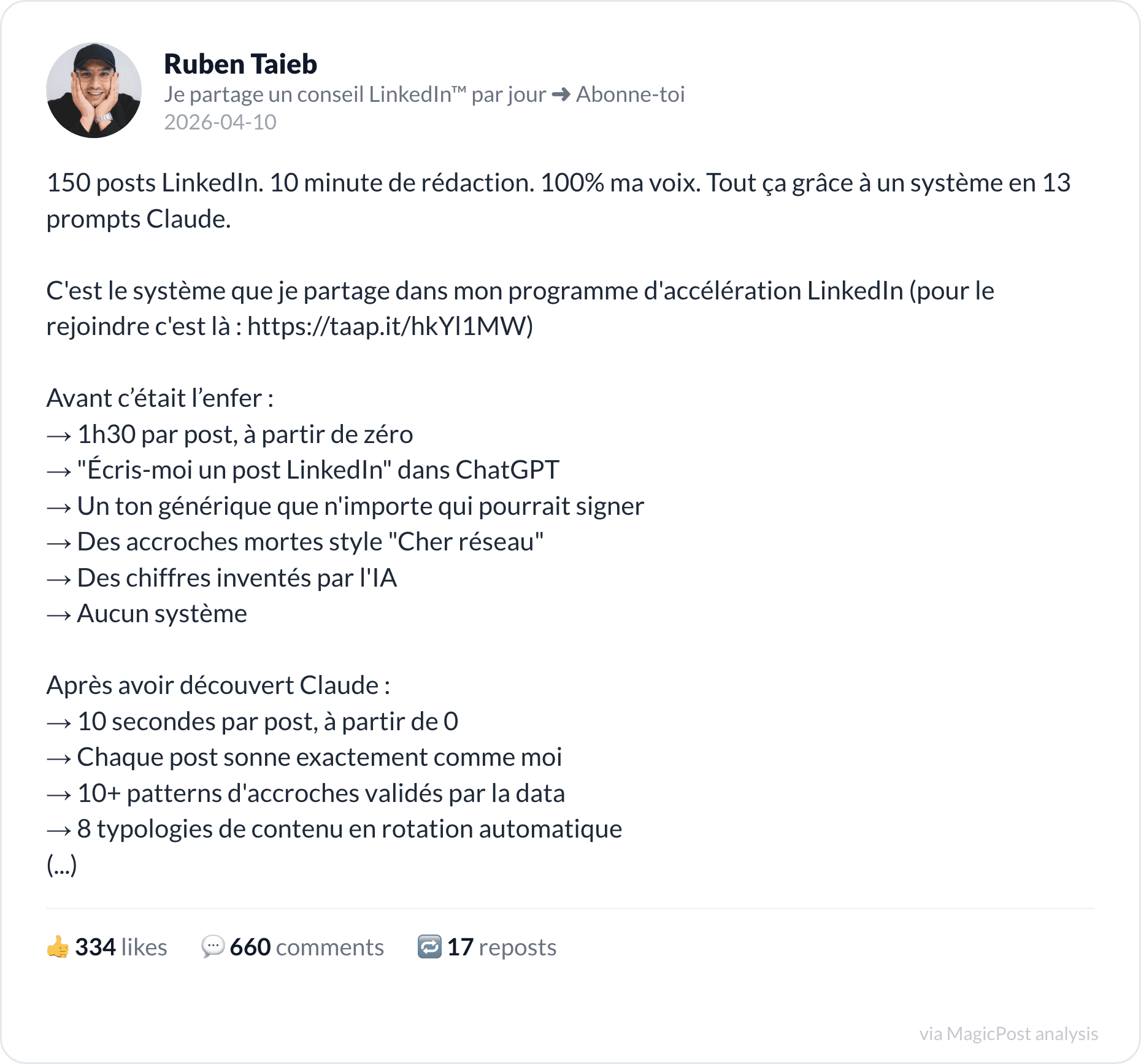
279 likes. A 21-link checklist to optimize your LinkedIn profile, the kind of save-and-do-later resource that earns reposts. It closes, like almost everything, on the program link.
Is he still growing?
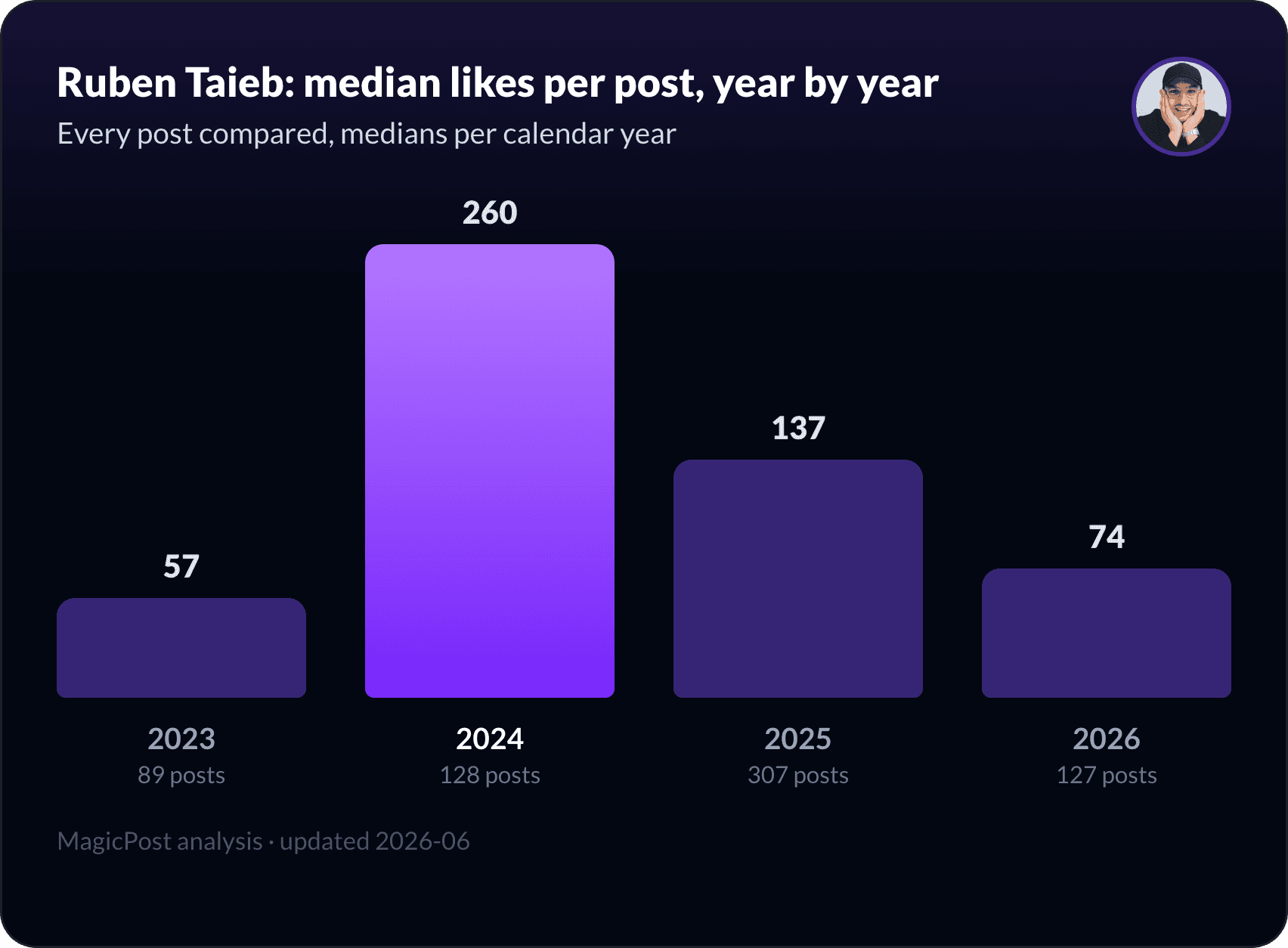
Here the data is more honest than a follower count. His median post went from 57 likes in 2023 to 260 in 2024, then settled back to 137 in 2025 and 74 so far in 2026. His audience kept growing past 111,000 followers, but his per-post engagement peaked in 2024 and has cooled since: the normal arc of a creator who scaled volume and leaned harder into selling. One honest note: we measure engagement, not followers over time, so this is the trajectory of how hard his posts hit, not of his audience size, which by his own reports kept climbing.
Where do these charts come from? Everything on this page runs on MagicPost's LinkedIn analytics, and it works on your profile too: your best posts, your audience, your benchmark, even a side-by-side with creators like Ruben Taieb.
How he writes
Here is Ruben Taieb measured against the average creator, and the numbers tell a specific story:
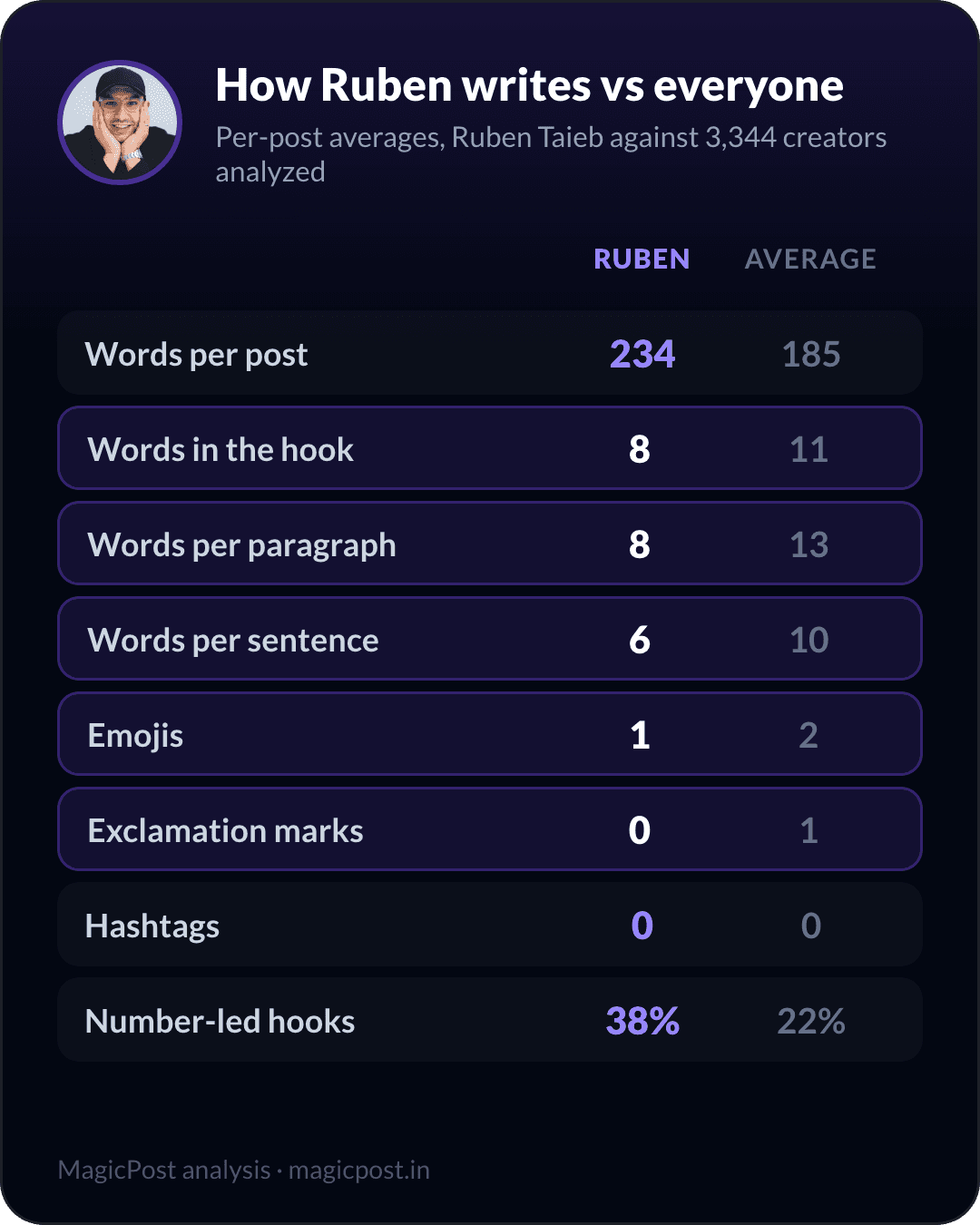
Metric (per post) | Ruben Taieb | Average creator* |
Words | 234 | 185 |
Words in the hook | 8 | 11 |
Words per paragraph | 8 | 13 |
Words per sentence | 6 | 10 |
Emojis | 1 | 2 |
Exclamation marks | 0 | 1 |
Hashtags | 0 | 0 |
Hooks built on numbers | 38% | 22% |
*Median across the 3,344 creators we analyzed with 20+ posts each.
He does not write short. At 234 words he writes longer than average. What he does is break it into rubble: six-word sentences against the average ten, eight-word paragraphs against thirteen. Most paragraphs are a single short line with white space around it, the staircase style you can see in every quote above. The other tell is the hook: 38% of his posts open on a number ("150 posts LinkedIn", "21 liens"), versus 22% for the average creator. He writes long, reads fast, and almost always starts by putting a figure in your face.
The "AI tells" in his style (read this the right way)
Run Ruben Taieb's writing through the patterns people now call "AI tells," and the result is worth reading carefully.
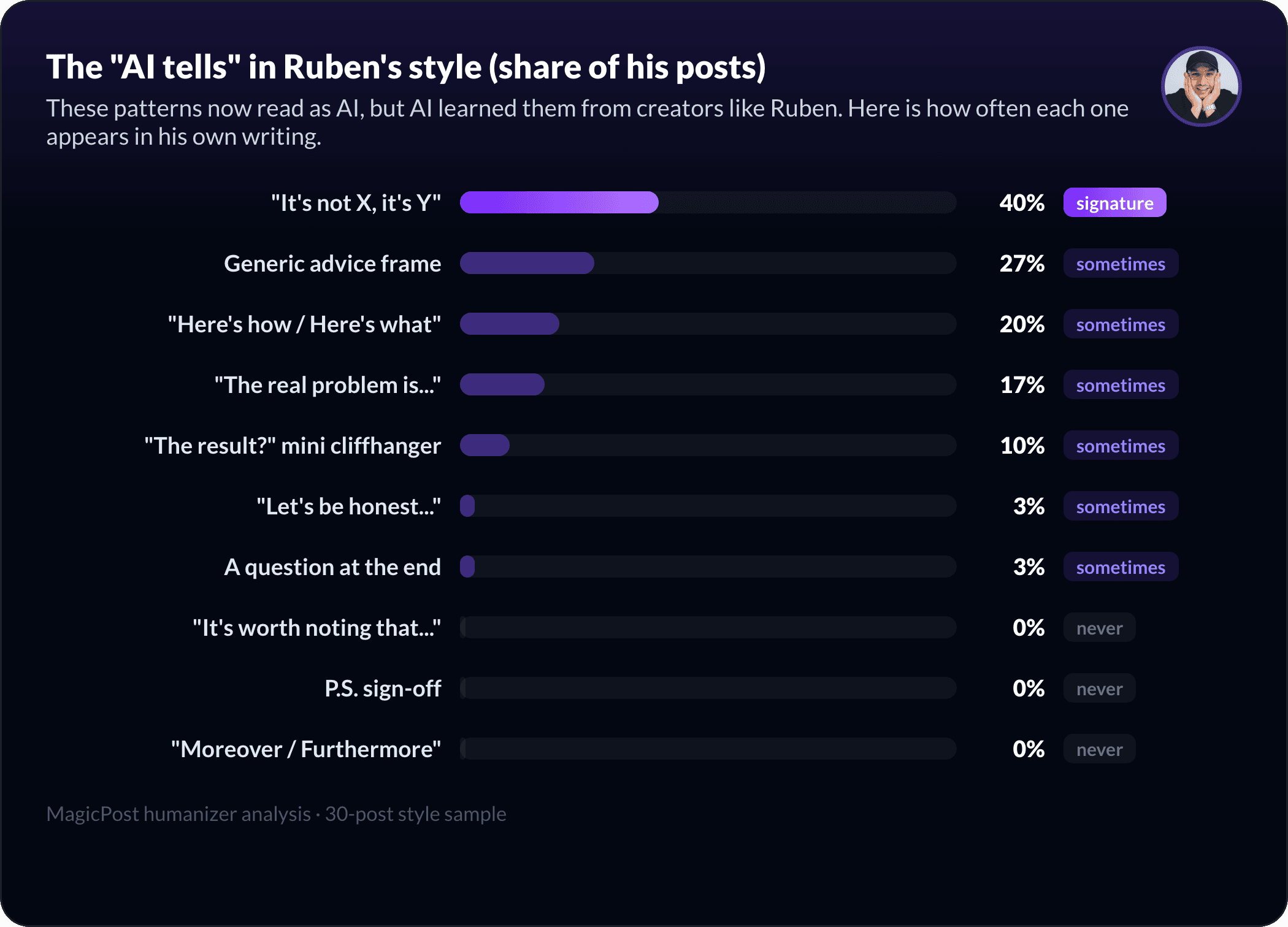
Two in five of his posts use the "It's not X, it's Y" contrast formula, the single most flagged "AI" pattern on LinkedIn, and the most characteristic move in his style ("Le problème c'est pas ton contenu" / the problem is not your content). About a quarter lean on a generic advice frame, and one in five open with a "here's how" setup.
Do not read it backwards. Ruben Taieb does not write like an AI; AI writes like Ruben Taieb. These moves read as robotic today because the models trained on the best creators of this platform, then used all of their tricks at once, in every post. Taieb uses the contrast formula where it lands, on a real before-and-after. And the other half of his fingerprint is what AI cannot resist adding and he refuses to: he never hedges, never bolts on a transition opener, never signs off with a fake "P.S." line. The discipline is the signature. (Full story: how to spot AI writing on LinkedIn.)
When he posts
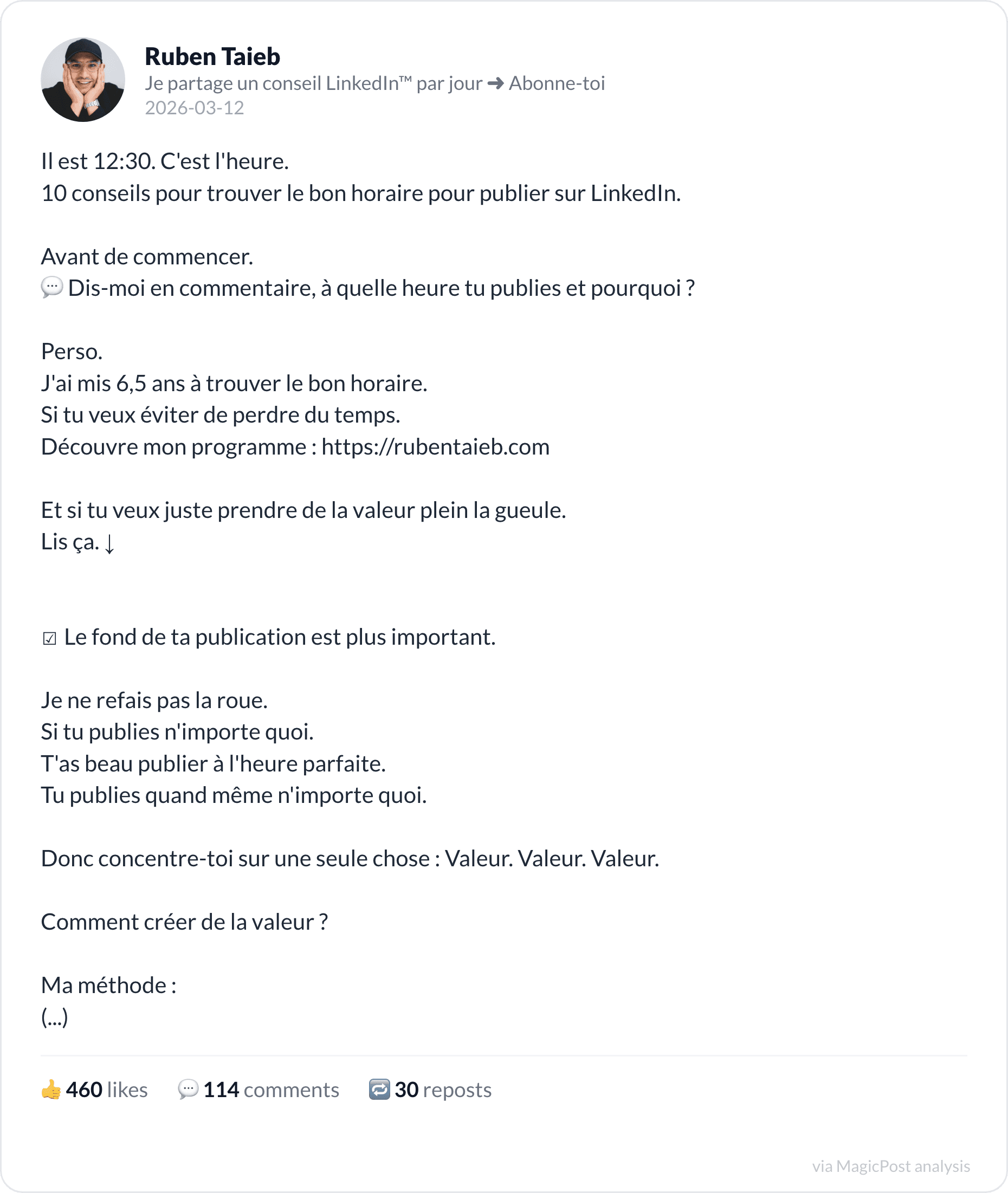
Ruben Taieb publishes about 5 times a week, favorite slot 8 AM Paris time, with 59% of his posts in the morning and only 17% on weekends. There is a piece of history there: his 2024 signature post opened "Il est 12:30. C'est l'heure" (It is 12:30, it is time) and told readers he posted at half past noon. By 2026 he had reversed himself, and his biggest post of the year now opens by mocking the noon slot. The data agrees with the newer Ruben: 8 AM, not 12:30. That early-morning window matches what our France timing data finds, and his 5-a-week cadence sits inside what our posting-frequency study calls the sustainable zone. And if showing up in his comments is part of your playbook, that is exactly what an engagement feed is for: his posts, every day, without hunting the timeline.
What to steal from Ruben Taieb
Lead with a number. 38% of his hooks open on a figure. A concrete number in line one ("43 posts. Zéro vente.") buys attention before the reader scrolls.
Build one origin story and re-run it. His burnout-to-recovery post is his all-time best, and he republishes it. Your hardest chapter is an asset.
Sell through the lesson. His biggest category is selling through value: the post teaches something real, then points at the offer. The teaching earns the right to sell.
Break long into short. He writes more words than average but in six-word sentences. Density, not brevity, is the white-space style.
One strong AI-era move, not six. The contrast formula in two posts of five, never the hedging filler. That restraint is the difference between a signature and an AI tell.
Study him, then study yourself. With MagicPost you can dig into Ruben Taieb's numbers the way we just did, analyze your own with the same depth, and write in the spirit of his style, in your own voice and on your own stories. The data on this page is the product.
Where this data comes from
Everything in this article is MagicPost's own research. We analyzed 516 of Ruben Taieb's public LinkedIn posts: timing, engagement, topics, writing metrics, and the AI-pattern profile from a 30-post style sample. Every biographical claim is quoted from one of his own public posts and linked to it; his quotes stay in French with an English gloss. Ruben Taieb is not affiliated with MagicPost; his style is one of those MagicPost tracks most closely.
Domande Frequenti
Who is Ruben Taieb?
A Paris-based LinkedIn expert and content creator with about 111,000 followers, who built his business on the platform after a 2018 burnout. He runs a one-on-one LinkedIn acceleration program for freelancers and consultants, and brands himself around a single mantra: there is no rule on LinkedIn, and everyone can succeed.
How does Ruben Taieb make money?
By his own public account: a one-on-one LinkedIn acceleration program (originally six months, later two intensive half-days), which he says has generated more than 3.4 million euros in net margin for its members. Before that he was a LinkedIn ghostwriter, moving, in his words, from 40 euros to 1,000 euros per post.
How often does Ruben Taieb post on LinkedIn?
About 5 posts a week in our data, most often at 8 AM Paris time, with 59% of his posts in the morning and only 17% on weekends.
Does Ruben Taieb write with AI?
His style predates the current AI era and reads intensely human: zero exclamation marks, almost no emojis, none of the filler AI adds. The twist is that AI tools learned from creators like him, which is why two in five of his posts contain the "It's not X, it's Y" pattern people now mislabel as an AI tell. He has openly shared building a Claude system to draft posts in his own voice.
Is Ruben Taieb still growing on LinkedIn?
His follower count kept climbing past 111,000, but his per-post engagement peaked in 2024 (median 260 likes) and cooled since (137 in 2025, 74 in early 2026), the normal arc of a creator who scaled volume and selling.
Can I write like Ruben Taieb?
You can learn the mechanics: MagicPost learns a creator's writing style (length, rhythm, hooks, signature moves) and helps you write in that spirit, in your own voice.
The Top LinkedIn Creators to Study in 2026 (By the Data)
The top LinkedIn creators to study in 2026, by the data: 62 creators, six languages, 27 countries, 32,000 posts analyzed by MagicPost. Grouped by what they teach.
Who Is Justin Welsh? The $10M Solopreneur, Explained by Data (2026)
Who is Justin Welsh? MagicPost analyzed 1,303 of their LinkedIn posts: topics, timing, signature moves and the writing fingerprint behind their growth, with rea
Who Is Matt Barker? The Hook Writer on LinkedIn, by Data (2026)
Who is Matt Barker? MagicPost analyzed 1,047 of their LinkedIn posts: topics, timing, signature moves and the writing fingerprint behind their growth, with real
Who Is Lara Acosta? The Forbes 30 Under 30 Comment Machine, Explained by Data (2026)
Who is Lara Acosta? MagicPost analyzed 461 of their LinkedIn posts: topics, timing, signature moves and the writing fingerprint behind their growth, with real n
Who Is Jasmin Alić? The Bosnian Coach LinkedIn Mistook for a Bot (2026)
Who is Jasmin Alić? MagicPost analyzed 364 of their LinkedIn posts: topics, timing, signature moves and the writing fingerprint behind their growth, with real n
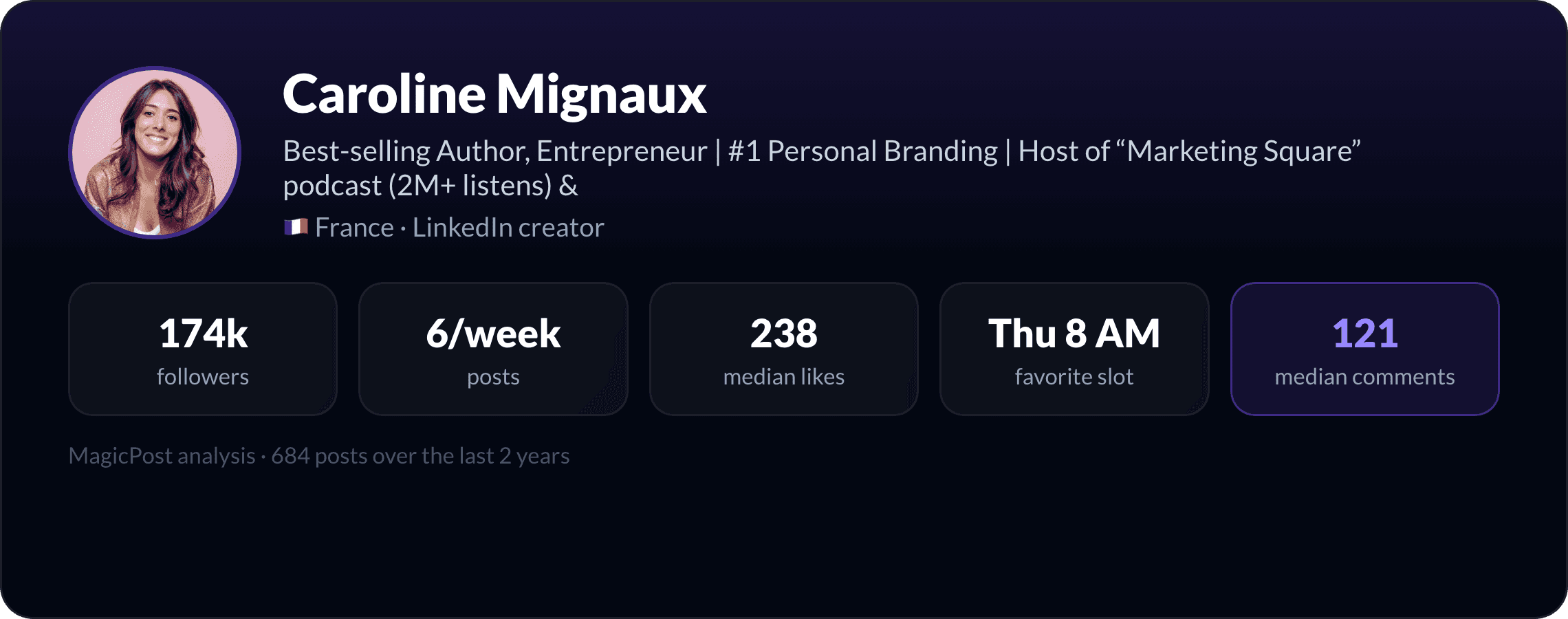
Who Is Caroline Mignaux? France's LinkedIn Top Voice Who Turned Shame Into a Following (2026)
Who is Caroline Mignaux? MagicPost analyzed 684 of their LinkedIn posts: topics, timing, signature moves and the writing fingerprint behind their growth, with r
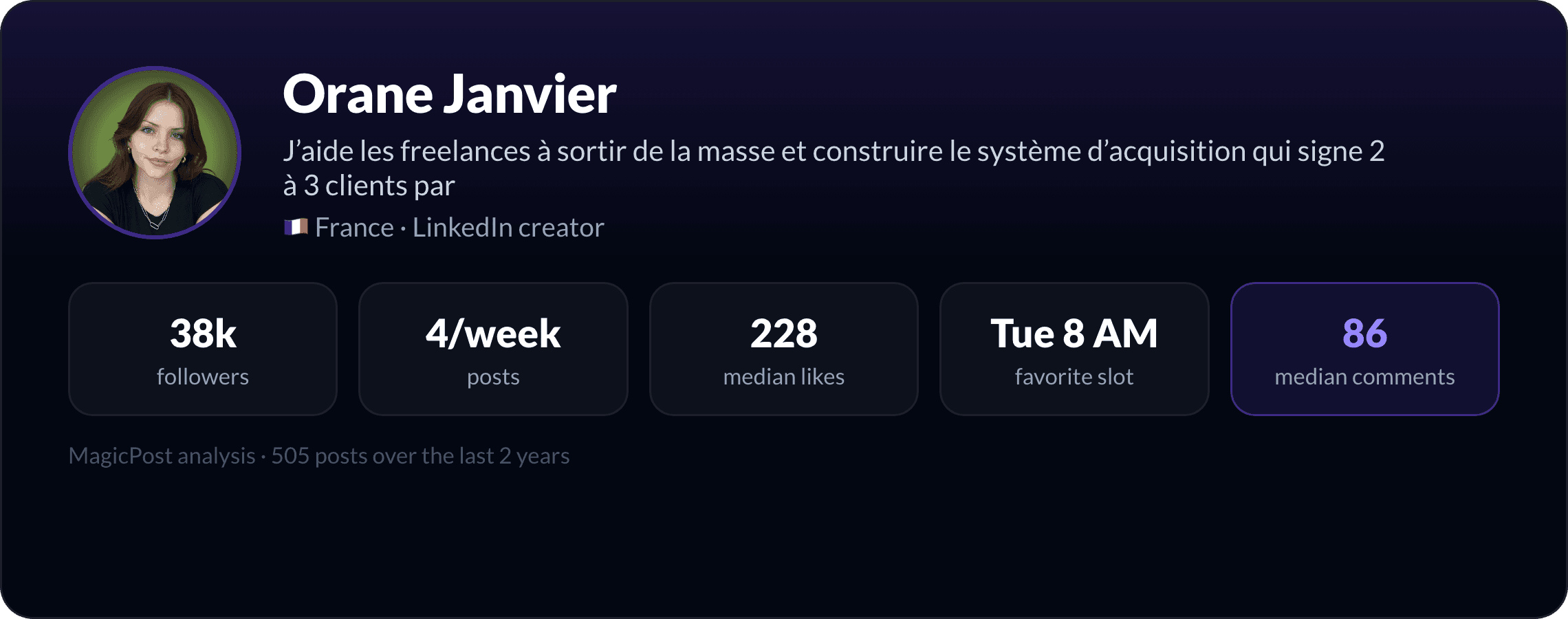
Who Is Orane Janvier? The Freelance Coach LinkedIn Quietly Copies (2026)
Who is Orane Janvier? MagicPost analyzed 505 of their LinkedIn posts: topics, timing, signature moves and the writing fingerprint behind their growth, with real
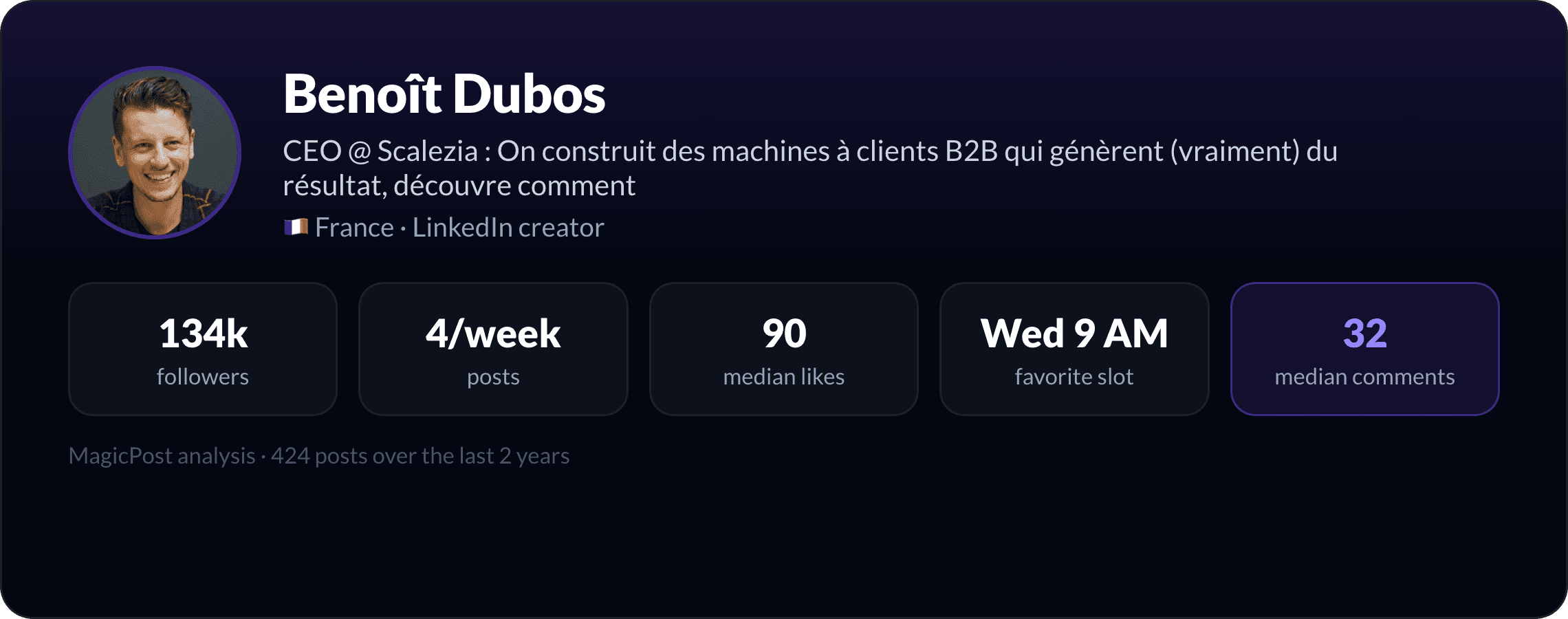
Who Is Benoît Dubos? The Growth Operator Who Turned a Falling Reach Into a Lead Machine (2026)
Who is Benoît Dubos? MagicPost analyzed 424 of their LinkedIn posts: topics, timing, signature moves and the writing fingerprint behind their growth, with real
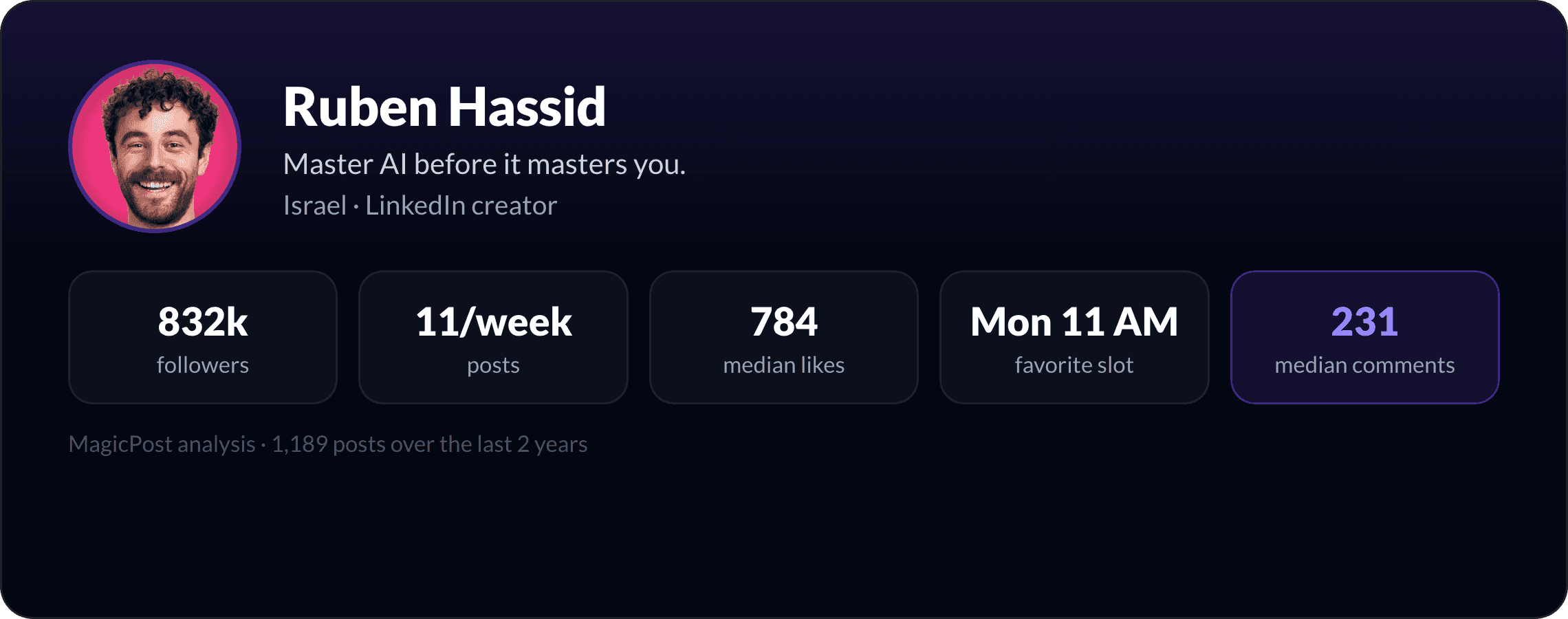
Who Is Ruben Hassid? The "Master AI Before It Masters You" Creator, Explained by Data (2026)
Who is Ruben Hassid? MagicPost analyzed 1,189 of their LinkedIn posts: topics, timing, signature moves and the writing fingerprint behind their growth, with rea
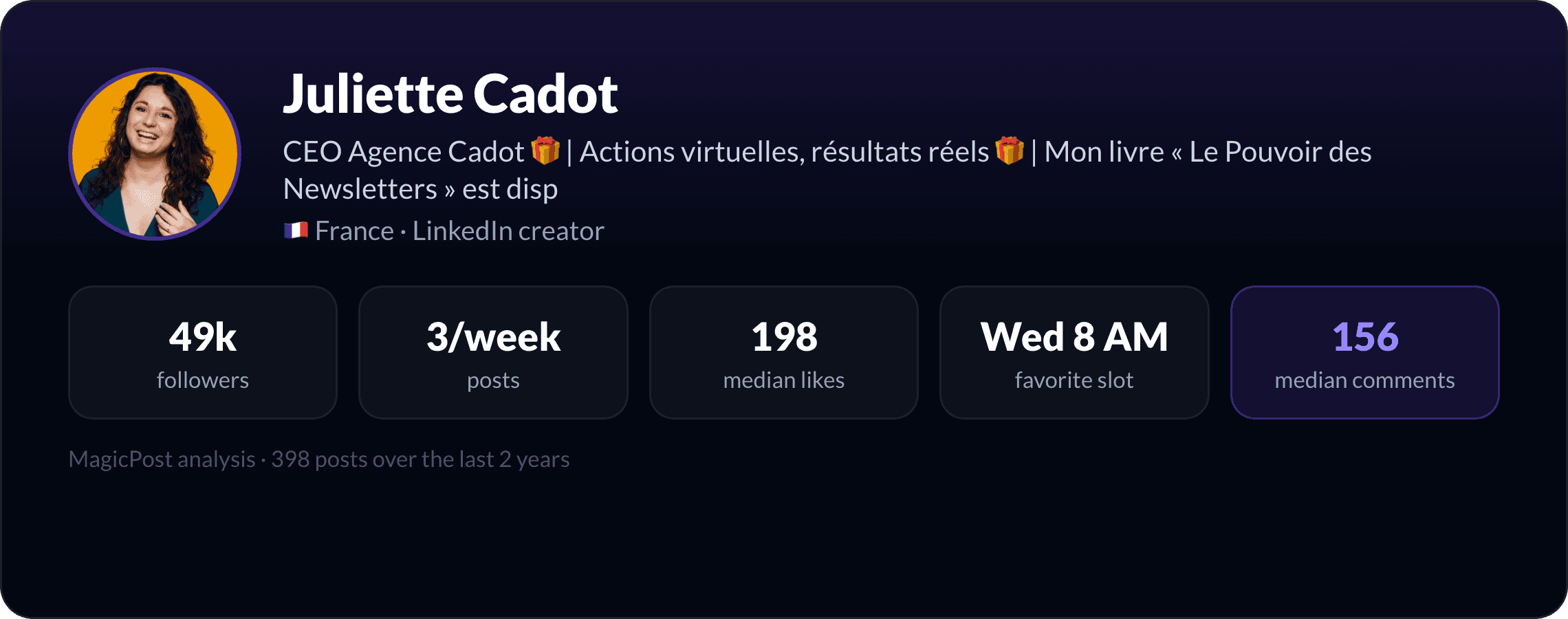
Who Is Juliette Cadot? The Agency Founder Whose Audience Talks Back (2026)
Who is Juliette Cadot? MagicPost analyzed 398 of their LinkedIn posts: topics, timing, signature moves and the writing fingerprint behind their growth, with rea