" height="26.80529977783203px" id="tymKb8bqC" width="128.00300311279295px"/><path d="M 0 2.417 L 0 0 L 12.909 0 L 12.909 2.417 Z" fill="rgb(126, 78, 253)" height="2.417099999999998px" id="aYr4em6zK" transform="translate(128.341 22.325)" width="12.908999999999992px"/></svg>)

"/><stop offset="1" stop-color="rgb(118, 37, 250)"/></linearGradient></defs><g d="M 19.242 21.22 L 19.362 6.204 L 19.272 6.204 L 13.757 21.22 L 10.161 21.22 L 4.796 6.204 L 4.706 6.204 L 4.825 21.22 L 0 21.22 L 0 0 L 7.283 0 L 12.109 13.607 L 12.229 13.607 L 16.844 0 L 24.247 0 L 24.247 21.22 Z M 26.421 26.113 L 26.421 23.445 L 41.407 23.445 L 41.407 26.113 Z" fill="transparent" height="26.112508199679183px" id="DvfaAIHYn" width="41.40731898311435px"><path d="M 19.242 21.22 L 19.362 6.204 L 19.272 6.204 L 13.757 21.22 L 10.161 21.22 L 4.796 6.204 L 4.706 6.204 L 4.825 21.22 L 0 21.22 L 0 0 L 7.283 0 L 12.109 13.607 L 12.229 13.607 L 16.844 0 L 24.247 0 L 24.247 21.22 Z" fill="rgb(46, 46, 46)" height="21.220180016149442px" id="pLsxRCobd" width="24.247352589074694px"/><path d="M 0 2.668 L 0 0 L 14.986 0 L 14.986 2.668 Z" fill="url(%23yD9d4I5GR-3279285344-linear-gradient)" height="2.6675085048549647px" id="yD9d4I5GR" transform="translate(26.421 23.445)" width="14.986002836263765px"/></g></svg>)

Naïlé Titah
You finished the degree, and now LinkedIn wants a post about it. You have a blinking cursor and a vague worry that "I'm pleased to announce I graduated" is going to land with a thud. It might. But a graduation post is one of the easiest wins on the platform to get right, because of what it fundamentally is: a win. And wins are the single best thing you can publish on LinkedIn.
TL;DR: Graduation posts are wins, LinkedIn's best content family (1.21% median ER vs 0.39%). The big ones make the struggle specific, name the people, and include the photo moment. This post starts your professional graph: make it findable.
Why a graduation post is built to perform
LinkedIn is, underneath everything, a place where people celebrate progress. We measured this across 1,141,932 posts: the type that consistently earns the most engagement is the one we label "celebrating a win," at a 1.21% median engagement rate versus a 0.39% median across every post in the corpus. Roughly three times the typical post.
A graduation announcement sits squarely in that family: a win with a date, a photo, and a built-in cast of people who want to clap for you.
One caveat that matters: we did not isolate "graduation posts" as their own measured category, so we cannot tell you a graduation post earns exactly X. What we can tell you is the family it belongs to, and that family is the best-performing content on LinkedIn by a wide margin. The tailwind is real. What you do with it is the rest of this page.


What the biggest graduation posts actually share
The temptation is to assume the huge posts went viral because the person was already famous. Followers help. But look at what the words are doing, and a pattern shows up that has nothing to do with follower count.
The struggle, made specific. Anupam Mittal's is one of the most-engaged graduation-themed posts we have on record (19,038 likes, 655 comments):
"I had to make >800 applications and sit through 65 interviews before landing my first job." Anupam Mittal (view post)
He does not say "the job hunt was hard." He says 800 applications and 65 interviews. A specific struggle is something a reader can feel, count, and recognize in their own life. A vague one slides right off.
The photo moment, named. Sara Blakely's post (13,474 likes, 680 comments) does something different and just as effective:
"I'm giving my first ever commencement speech tonight at Florida State University, my alma mater!" Sara Blakely (view post)
She anchors the moment to a real place (Florida State), a real artifact (a photo of her own graduation, 33 years earlier), and a real time. Not a generic gown-and-cap feeling. Hers, with the school named out loud.
Put the two together and you have the recipe: a specific struggle, the people and places named, and a real moment captured. None of that requires a million followers. All of it requires you to be concrete instead of polished.
This post is the start of your professional graph
Here is the part most graduates miss. Your graduation post is not the end of school. It is the first node in your professional network, and the choices you make in it stay searchable for years.
Tag your school's official page, the professors, the program, the people who got you there. Every tag is a connection LinkedIn now understands, and every name makes the post findable to people searching that school, program, or cohort. Recruiters filter by exactly these fields.
The post you write tonight is the first thing a future connection finds when they look you up. Make it the start of a graph, not a dead end.
Staring at a blank box? MagicPost's AI LinkedIn post generator turns a few rough notes (your degree, the hard part, who to thank) into a finished graduation post that still sounds like you, so you get the specificity these examples have without spending an hour fighting the cursor.
Three graduation post templates
These are fill-in-the-blanks, not copy-paste. The brackets are where your specifics go, and the specifics are the whole point. Strip out anything that is not actually true for you.
1. The journey + thanks
[X] years ago I [where you started: a doubt, a setback, a first day that felt impossible]. Today I graduated with [degree] from [school, tagged]. Between those two points: [one specific hard number or moment: late nights, a class you nearly failed, a job you worked alongside]. I didn't get here alone. Thank you [name the people, tagged: a professor, a mentor, family] for [the specific thing they did]. On to [what's next].
2. The non-traditional path
Most people don't graduate at [your age / after this detour], and for a long time I thought that meant I'd missed my window. Today I'm proud to say I earned [degree] from [school, tagged] while [the thing that made it non-traditional: working full time, raising kids, switching careers at 40]. If you're on a path that doesn't look like the brochure: [the one honest thing you learned about doing it your way]. The diploma is the same. The story behind it is yours.
3. The first-generation milestone
I'm the first person in my family to [graduate from university / earn this degree]. Today that stopped being a goal and became a fact: [degree], [school, tagged]. This one is for [the people who made it possible: a parent who didn't get the chance, a community, a scholarship program, tagged]. To anyone who'd be the first in their family too: it is heavier and it is worth it. [One specific encouragement.]
The one mistake that kills a graduation post
The trap is the polished announcement with nothing lived inside it: "I am pleased to announce that I have graduated with a degree in [field]. I am grateful for the opportunity and excited for the next chapter."
It is grammatically perfect and completely empty. No struggle a reader can feel, no name they can tag, no moment they can picture. The LinkedIn algorithm pushes wins, but readers reward specifics, and this version has none.
Compare it to "800 applications and 65 interviews." Same milestone. One disappears in the feed, the other gets 19,038 likes. The difference is not talent or follower count. It is whether you put one real, countable thing in the post.
What comes after graduation
A graduation post rarely travels alone. It usually sits next to one of these moments, and each has its own playbook:
Landing the first role. When the offer comes, the announcement is its own art form. See how to announce a new job on LinkedIn (+ 5 pre-made templates), the next milestone after this one.
Graduating into a search. If the job is not lined up yet, you are graduating straight into a job hunt, and the "Open to Work" badge is worth understanding before you flip it: LinkedIn Open to Work: what it means, how it works, and if you should use it.
Telling the longer story. A graduation post is a short story, and the format scales up. See how to build a LinkedIn personal story post when you want to go deeper than a single milestone.
More occasions. Every other "moment to post" template lives in the pillar: LinkedIn post templates.
Where the data and examples come from
The engagement figures come from MagicPost's own research across 1,141,932 LinkedIn posts, classified by content type and compared on median engagement rate (likes plus comments over followers), never averages, so a few viral posts cannot move a row. The "celebrating a win" type earns a 1.21% median engagement rate against a 0.39% median across all posts. Stated plainly: we did not isolate graduation posts as a separate measured type, so every claim about graduation specifically is about the broader "celebrating a win" family it belongs to, not a standalone graduation measurement. The example posts are real, public LinkedIn posts, quoted verbatim and attributed to their authors with links to the originals; counts are as recorded at collection.
Veelgestelde vragen
What should a graduation LinkedIn post say?
A strong graduation LinkedIn post says three things: the milestone (your degree and your school, tagged), one specific hard thing you went through to get there (a real number or moment, not "it was a journey"), and the people who helped, named and tagged. Skip the press-release tone. The graduation posts that perform best are concrete, not formal: one post we have on record earned 19,038 likes by opening with "800 applications and 65 interviews," while generic "I'm pleased to announce I graduated" posts disappear in the feed. End with what's next, and tag your school so the post is findable to recruiters and your cohort.
Are graduation posts actually good for LinkedIn engagement?
They have a strong tailwind. We did not measure graduation posts as a separate type, but they belong to the "celebrating a win" family, the best-performing content type we measured: a 1.21% median engagement rate versus a 0.39% median across all posts, roughly three times typical. The format starts ahead; what you write inside it decides the rest.
Should I tag my university in a graduation post?
Yes. Tagging your school's official page, your program, and the professors or mentors who helped does two things: it makes the post findable to anyone searching that school or cohort (recruiters filter by exactly these fields), and each tag is a real connection that strengthens your network. Your graduation post is the first node in your professional graph, so name the people and places out loud.
How do I write a graduation post if I didn't have a traditional path?
Lean into it, do not hide it. A non-traditional path (graduating later, while working, after a career switch, or as the first in your family) is a more specific and more memorable story than the standard one, and specificity is what makes graduation posts travel. Use the "non-traditional path" or "first-generation milestone" template above: name what made your path different, name the one honest thing you learned doing it your way, and let that be the post.
> Make your milestone count. MagicPost keeps the drafting, the calendar, and the post-by-post numbers under one roof, so your graduation post (and the career posts that follow it) get the specifics and the timing that turn a milestone into momentum.
Work Anniversary LinkedIn Post: Beyond the Badge
The work anniversary LinkedIn post: beyond the auto-badge. Real examples, 3 templates, and the reframe that turns a date into a story.
Happy Holidays LinkedIn Post: Not a Corporate Card
The holiday LinkedIn post: how to not sound like a corporate card. Real examples, 3 templates, and why seasonal posts should be scheduled early.
5 Beste LinkedIn Post-sjablonen (2026)
5 LinkedIn-postsjablonen: verhaal, lijstartikel, persoonlijke reflectie, rant en analyse. Stapsgewijze gidsen om boeiende berichten te maken en de zichtbaarheid te vergroten.
13 LinkedIn-postvoorbeelden die resultaten opleveren (2026)
Steal deze 13 bewezen LinkedIn-berichten voorbeelden om je content om te zetten in leads en autoriteit. Inclusief sjablonen en een volledige ontleding van wat werkt.
Wat te Posten op LinkedIn? (2026)
Verhoog je impact op LinkedIn met onze deskundige gids. Ontdek krachtige plaatsingsstrategieën en contenttypes om je netwerk effectief te betrekken.
Hoe je een nieuwe baan op LinkedIn aankondigt: (+ 5 kant-en-klare sjablonen)
Beheers je nieuwe vacature-aanzoek op LinkedIn. Breid je netwerk uit, trek kansen aan en ontvang 5 kant-en-klare posttemplates om het eenvoudig te maken.
Beste LinkedIn Promotie Post Voorbeelden (2026)
Moet je een verkoopbericht schrijven maar weet je niet waar je moet beginnen? Ik zal je voorbeelden laten zien van de meest effectieve promotieberichten, zodat je ze kunt aanpassen aan jouw behoeften.
LinkedIn Open to Work: Wat het is en hoe het werkt (2026)
Ontdek hoe de LinkedIn Open to Work-functie uw zoektocht naar een baan in 2025 kan transformeren. Tips, voordelen, nadelen en trucs om op te vallen voor recruiters.
LinkedIn Lead Magnets: Een Gids voor Leads die Echt Werken
Ontdek hoe je krachtige lead magnets kunt maken die kwaliteitsleads aantrekken, verlangen opwekken en je publiek begeleiden naar het worden van betalende klanten.
LinkedIn Product Launch Post: Voorbeelden + 3 Sjablonen
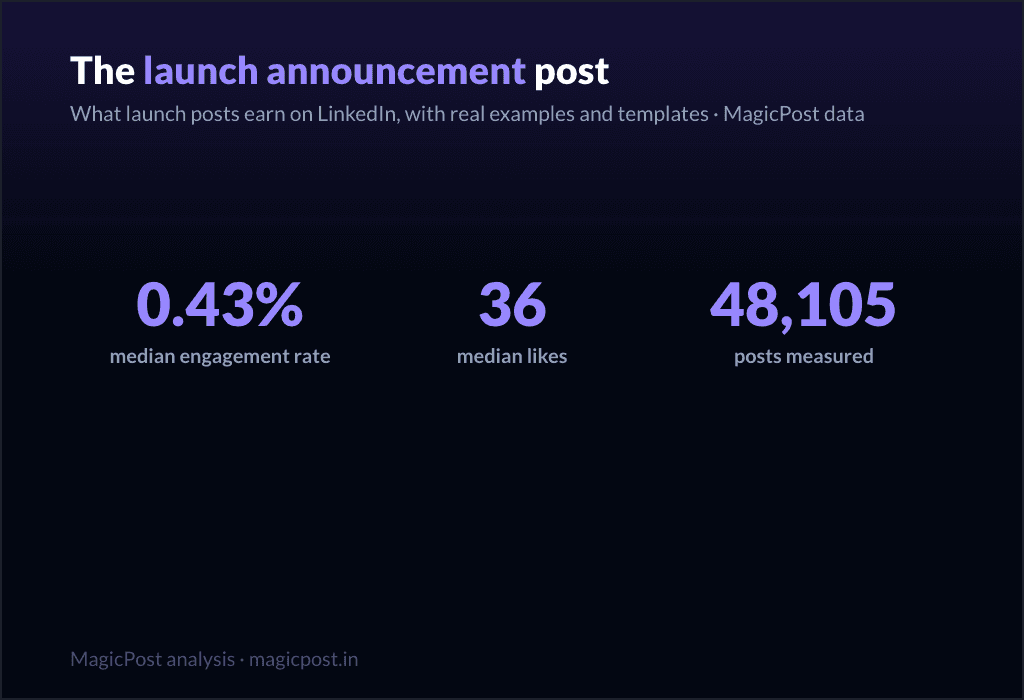
De LinkedIn productlancering post: echte voorbeelden, 3 templates en de data (lanceringen behalen een mediaan engagementpercentage van 0,43%). Begin met het probleem, niet met het product.